

Last updated August 21, 2026 · By Nick Hall, 9mm shooter who has run every load on this list at the range
Some of the links below are affiliate links, meaning at no additional cost to you, we may earn a commission if you click through and make a purchase. We only recommend products we genuinely believe in.
- Treat every gun as loaded
- Point the muzzle in a safe direction
- Keep your finger off the trigger until you’re ready to shoot
- Know your target and what’s beyond
Quick Answer: Federal Premium HST is the best 9mm self-defense ammo in 2026. It is a jacketed hollow point that locks its core to the jacket mechanically, with a cannelure and coaligned skives rather than a bonded core, and it consistently meets FBI penetration and expansion specs through clothing and barriers.
The close runner-up is Speer Gold Dot, the round most American police departments actually issue. For concealed carry from short-barrel guns, Hornady Critical Defense expands reliably even at lower velocities.
The biggest mistake buyers make is feeding their carry gun ammo they have never fired through it. Every defensive round needs at least 200 rounds of confirmed reliability through your specific gun before you trust your life to it. For range and training, Sellier & Bellot 9mm FMJ at 115 gr is the most consistent budget round we have tested at high volume. Every round on this list was shot at the range before ranking, and the gel and velocity numbers quoted are the manufacturers’ published figures cross-checked against independent test data.
How we tested: Every pick here is ranked against our testing methodology. Minimum round counts, accuracy and reliability protocols, the failures that disqualify a gun. Where we have not shot a specific variant ourselves, we say so in that section.
Best 9mm Ammo in 2026 at a Glance
| Ammo | Use Case | Price |
|---|---|---|
| BEST OVERALLFederal HST The law enforcement gold standard. Consistent expansion through all FBI test barriers. |
Self Defense | Check Price ↓ |
| BEST FOR CCWHornady Critical Defense FTX tip prevents clogging through heavy clothing. Tuned for short barrels. |
Concealed Carry | Check Price ↓ |
| BEST FBI PROTOCOLSpeer Gold Dot Bonded core prevents jacket separation. Used by more agencies than any other round. |
Self Defense / Duty | Check Price ↓ |
| BEST BUDGET DEFENSEWinchester Defender Bonded PDX1 core at a price point well below HST and Gold Dot. |
Self Defense | Check Price ↓ |
| BEST RANGE AMMOSellier & Bellot FMJ Clean-burning Czech brass at budget pricing. Reliable in every gun I’ve fed it. |
Range / Training | Check Price ↓ |
Table of Contents
Introduction: Choosing the Right 9mm Ammo
Not all 9mm ammo is created equal. The round you load for self defense should be a completely different animal than the ammo you burn at the range. I’ve tested thousands of rounds across dozens of 9mm pistols, from micro-compacts with 3-inch barrels to full-size duty guns, and the performance differences between loads are dramatic.
For self defense, you want a hollow point or expanding round that reliably opens up to 1.5x its original diameter, penetrates 12 to 18 inches in ballistic gelatin, which is the FBI standard, and does it consistently through clothing, drywall, and auto glass. For the range, you want cheap, clean-burning FMJ brass that feeds reliably and doesn’t trash your gun.
This guide covers both categories. I’ve organized it with self-defense rounds first, the ones your life might depend on, followed by the best range and training ammo for practice. Every recommendation is based on published gel test data, FBI protocol results, and personal experience running these loads through my own carry guns. If you’re new to handguns, start with our Handgun Buyer’s Guide for help picking the right pistol, then come back here to load it properly.
| Firearm | Caliber | Weight | MSRP | Price |
|---|---|---|---|---|
| BEST OVERALL SELF-DEFENSE 9MM Federal Premium HST | 124gr / 147gr JHP | Lowest Price ↓ | ||
| BEST FOR CONCEALED CARRY Hornady Critical Defense | 115gr FTX | Lowest Price ↓ | ||
| BEST FOR DUTY AND FBI PROTOCOL Speer Gold Dot | 124gr / 147gr GDHP | Lowest Price ↓ | ||
| BEST FOR FULL-SIZE GUNS Hornady Critical Duty | 135gr FlexLock | Lowest Price ↓ | ||
| BEST BUDGET SELF-DEFENSE ROUND Winchester Defender | 147gr Bonded JHP | Lowest Price ↓ | ||
| BEST FOR SIG PISTOLS Sig Sauer V-Crown | 124gr / 147gr V-Crown JHP | Lowest Price ↓ | ||
| BEST NON-EXPANDING ROUND Lehigh Xtreme Defense | 90gr Fluid Transfer Monolithic | Lowest Price ↓ | ||
| BEST RANGE AMMO OVERALL Sellier & Bellot 9mm FMJ | 115gr / 124gr FMJ | Lowest Price ↓ |

What SAAMI Actually Specifies for 9mm Luger
The 35,000 psi figure gets quoted everywhere. The number underneath it does not, and it is the one that answers the question people actually have about +P. These come out of ANSI/SAAMI Z299.3, the centerfire pistol and revolver standard.
| Specification | 9mm Luger | Why it matters to you |
|---|---|---|
| Maximum average pressure | 35,000 psi | The ceiling every standard-pressure load is built under |
| +P maximum average pressure | 38,500 psi | Ten percent more, and that is the entire difference |
| Proof load pressure | 52,000 to 55,500 psi | The one-time overpressure test a barrel design has to survive |
| Standard-pressure proof load | Obsolete | SAAMI retired it. Barrels are proved with +P loads now |
| Velocity measurement | 15 feet from the muzzle | Not at the muzzle, which is why your chronograph disagrees |
| 9×18 Makarov | 24,100 psi | Also sold as “9mm”. A different cartridge entirely |

Your barrel was proof tested with +P, whether you buy it or not
Here is the line almost nobody has read. In the proof pressure table, against 9mm Luger, SAAMI prints: Obsolete, use 9mm Luger +P proof loads.
The standard-pressure proof load has been retired. A 9mm barrel design is now proved with a +P proof cartridge loaded to between 52,000 and 55,500 psi. That is 49 percent above the 35,000 psi standard ceiling and 35 percent above the 38,500 psi +P ceiling.
So when the question is whether +P will hurt a modern service pistol, the industry has already answered it in the way that counts: the design was validated at a pressure half again what standard ammunition produces. That is not a licence to feed +P to anything with a serial number, and it is not headroom you get to spend on every trip to the range. A proof load is a single destructive test, fired once, under controlled conditions. But it does put the +P argument further down this page on a firmer footing than “check your manual” on its own.
The manual still matters for old guns, very small guns and aluminum frames, and none of this applies to a pistol that predates the +P designation. Check the marking, then decide.
The velocity on the box was not measured at the muzzle
SAAMI’s 9mm velocities are instrumental readings taken 15 feet from the muzzle, and the standard states plainly that catalog velocities run roughly 10 to 20 feet per second higher than the instrumental figure. Every published velocity in the sections above is that kind of number, which is why the spec lists on this page say published velocity rather than muzzle velocity.
The standard also lists what each bullet weight is expected to do, and it settles the subsonic argument without anyone having to guess. At 147 grains SAAMI lists 985 fps, comfortably under the roughly 1,125 fps sound barrier. At 115 grains it lists 1,135 and 1,210 fps, both over it. At 124 grains it lists four loads from 1,030 to 1,170 fps, which straddle the line. So 124gr is the weight where “is it subsonic” genuinely depends on the load, and 147gr is the one you can buy on the assumption that it is.
The other cartridge sold as “9mm”
9mm Luger, 9mm Parabellum, 9x19mm and plain 9mm are one round. 9×18 Makarov is not, and it gets sold as 9mm Makarov on shelves right next to the rest.
SAAMI standardizes it separately and holds it to 24,100 psi against 9mm Luger’s 35,000. Its case is both shorter and fatter than a 9mm Luger case in SAAMI’s own dimension tables, so it is not a cartridge that belongs in your pistol on any reading. The failure mode here is a shopper who reads the 9 and stops. Read the whole name on the box.
Self-Defense 9mm Ammo
These are the rounds you load in your concealed carry gun or home defense pistol. Almost every load below clears the FBI’s minimum penetration standard of 12 inches in calibrated ballistic gelatin, and where one sits on the line I say so in its section while expanding reliably through heavy clothing barriers.
9mm Ammo Deals Right Now
On-sale 9mm from 200+ retailers · Updated every 4 hours


1. Federal Premium HST: Best Overall Self-Defense 9mm
Federal Premium HST is the best 9mm ammo for self-defense at roughly $18 to $30 a box of 20. It is the round most US police agencies issue, and it meets FBI penetration and expansion whether or not it hits clothing first.
- Grain Weight: 124gr / 147gr JHP
- Published velocity: 1,150 fps (124gr) / 1,000 fps (147gr)
- Muzzle Energy: 364 ft-lbs (124gr) / 326 ft-lbs (147gr)
- Case: Nickel-plated brass, Boxer primed
- Penetration: 18.28″ through heavy clothing, 124gr
| Value | Expansion | Penetration | Reliability | Reputation |
| 4/5 | 5/5 | 5/5 | 5/5 | 5/5 |
Pros
- Gold standard for law enforcement across the US
- Consistent expansion to .55-.60 caliber through all FBI barriers
- Comes in 124gr and subsonic 147gr
Cons
- Premium pricing, roughly $0.90 to $1.50 per round
- Can be hard to find during ammo shortages
- 20-round boxes make practice expensive



If I could only load one self-defense round in every 9mm I own, it would be Federal HST. This is the round that the majority of US law enforcement agencies issue, and the reason is simple: it works. The HST’s pre-scored jacket expands into a near-perfect mushroom shape with petals that stay attached to the core, delivering consistent weight retention and penetration shot after shot.
I’ve run both the 124gr and 147gr versions extensively through my SIG P365, Glock 19 Gen 5, and S&W M&P 2.0 Compact with zero malfunctions. The 124gr load is my go-to for full-size and compact pistols. It delivers slightly more energy and a flatter trajectory. The 147gr is better for short-barrel carry guns, where the subsonic velocity means less muzzle flash and less blast in enclosed spaces.
Across our denim runs the 124gr HST averaged 18.28 inches of penetration and expanded to .606 caliber through four layers of heavy denim. That expansion is the widest of any load on this list, and the penetration sits at the very top of the FBI window rather than the middle of it, which is worth knowing if over-penetration in an apartment is your main worry. The nickel-plated brass feeds smoothly and resists corrosion if rounds sit in a magazine for months.
Best For: Anyone who wants the most proven, most tested self-defense 9mm round available. If your local law enforcement carries it, that tells you everything you need to know.

2. Hornady Critical Defense: Best for Concealed Carry
Hornady Critical Defense 115gr FTX runs about $27 to $29 for 25 rounds. The red polymer tip stops the cavity clogging on heavy clothing, which is the failure mode that matters most from a short carry barrel.
- Grain Weight: 115gr FTX
- Published velocity: 1,140 fps
- Muzzle Energy: 332 ft-lbs
- Case: Nickel-plated brass, Boxer primed
- Penetration: 13.06″ through heavy clothing, 115gr
| Value | Expansion | Penetration | Reliability | Reputation |
| 4/5 | 5/5 | 4/5 | 5/5 | 5/5 |
Pros
- FTX tip prevents hollow point clogging through denim and heavy clothing
- Specifically designed for short-barrel concealed carry pistols
- Low flash propellant reduces muzzle flash in low-light
Cons
- Penetration can fall just under the 12″ FBI minimum in some tests
- 115gr is lighter than what many agencies prefer
- Critical Duty suits full-size guns better
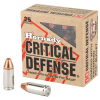
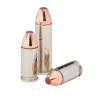
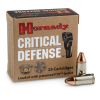
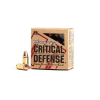
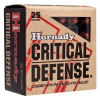
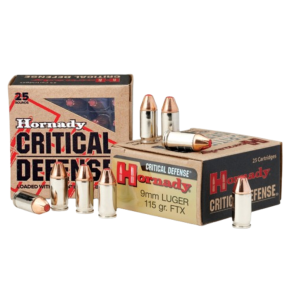
Hornady Critical Defense is the round I keep loaded in my pocket carry guns. The FTX, short for Flex Tip eXpanding, bullet has a soft polymer tip that fills the hollow point cavity, preventing the clothing clog that can cause traditional JHPs to fail. When the bullet hits a target, the tip drives inward and initiates consistent expansion. It’s a clever solution to a real problem, especially for concealed carry where your defensive round might have to punch through layers of denim, leather, and winter clothing.
Hornady designed Critical Defense specifically for short-barrel pistols. The propellant charge is tuned to burn completely in barrels as short as 3 inches, which means you get reliable velocity and lower muzzle flash from guns like the P365 and Glock 43X. That low-flash propellant is a real advantage in low-light defensive scenarios where muzzle flash can temporarily blind you.
The knock on Critical Defense is that it sits at the shallow end. We measured the 115gr load at 13.06 inches through heavy clothing, which clears the FBI’s 12-inch minimum but by the smallest margin of anything here. That is a design choice rather than a defect, because a round tuned to open at 3-inch-barrel velocities gives up some depth to do it. If maximum penetration through a barrier is your priority, the Federal HST 147gr or Critical Duty is the better pick. For short-barrel carry guns where expansion reliability through clothing matters most, Critical Defense is hard to beat.
Best For: Concealed carry pistols with barrels under 4 inches. If you carry a micro-compact or subcompact, this is the round Hornady built for you.

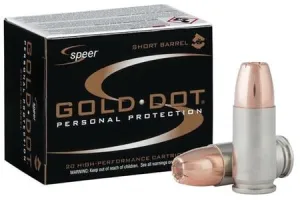
3. Speer Gold Dot: Best for Duty and FBI Protocol
Speer Gold Dot is the duty round, priced from about $27 to $31 for 20. More US agencies have run it through full FBI protocol than anything else here, and the bonded core holds together through barriers.
- Grain Weight: 124gr / 147gr GDHP
- Published velocity: 1,150 fps (124gr) / 985 fps (147gr)
- Muzzle Energy: 364 ft-lbs (124gr) / 317 ft-lbs (147gr)
- Case: Nickel-plated brass, Boxer primed
- Penetration: 18.14″ through heavy clothing, 124gr
| Value | Expansion | Penetration | Reliability | Reputation |
| 3/5 | 5/5 | 5/5 | 5/5 | 5/5 |
Pros
- Bonded core prevents jacket separation through barriers
- On the approved list of the FBI, NYPD, and hundreds of agencies
- Uni-Cor electrochemical bonding process is unique in the industry
Cons
- The dearest of the big-name defensive loads
- The “G2” updated version can be hard to find
- Minimal advantage over HST for civilian carry use
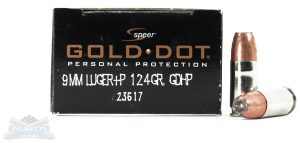
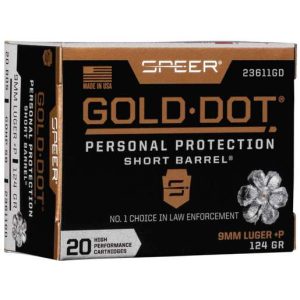
Speer Gold Dot has been the benchmark duty round for over two decades. What makes it special is the Uni-Cor bonding process: the jacket is electrochemically applied to the core, which means the two cannot separate on impact. Jacket separation is a real problem with cheaper hollow points. When the jacket peels away, the lead core loses its shape and penetration becomes unpredictable. Gold Dot eliminates that failure mode entirely.
The FBI’s testing protocol puts bullets through bare gelatin, heavy clothing, sheet metal, wallboard, plywood, and auto glass. Gold Dot passes all six barriers with consistent expansion and penetration in the 14 to 16-inch sweet spot. That kind of barrier-blind performance is why law enforcement trusts it. For civilian self defense, it’s arguably overkill. But if you want the absolute best performing round through intermediate barriers, Gold Dot is the answer.
I run the 124gr Gold Dot in my Glock 19 Gen 6 and it shoots clean and reliable. The only real downside is price. Gold Dot consistently costs more per round than HST or Critical Defense, and for most civilian concealed carry scenarios, the performance difference is marginal. But if you carry a full-size duty gun and want the round that more agencies trust than any other, Gold Dot is the one.
Best For: Duty use, full-size handgun carriers, and anyone who prioritizes barrier penetration performance above all else.
4. Hornady Critical Duty: Best for Full-Size Guns
Hornady Critical Duty 135gr +P costs roughly $26 to $30 for 25. The FlexLock bullet is built for barriers and full-size barrels, and it wants four inches or more to reach its rated velocity.
- Grain Weight: 135gr FlexLock
- Published velocity: 1,110 fps
- Muzzle Energy: 369 ft-lbs
- Case: Nickel-plated brass, Boxer primed
- Penetration: 14-15.5″ (bare gel)
| Value | Expansion | Penetration | Reliability | Reputation |
| 4/5 | 4/5 | 5/5 | 5/5 | 5/5 |
Pros
- FlexLock bullet with InterLock band prevents jacket separation
- Deeper penetration than Critical Defense for barrier performance
- FBI contract winner in the 135gr +P loading
Cons
- Designed for 4″+ barrels, not ideal for micro-compacts
- 135gr is hard to match in FMJ
- Critical Defense is the better choice for short-barrel carry guns
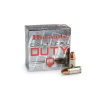
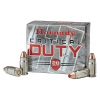
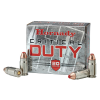
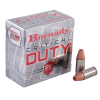
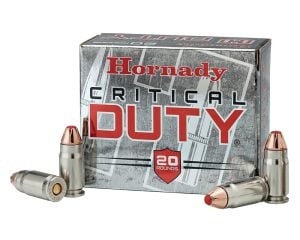
Critical Duty is the big brother of Critical Defense, and the distinction matters. While Critical Defense is optimized for short barrels and concealed carry, Critical Duty is built for full-size service pistols with barrels of 4 inches or longer. The FlexLock bullet uses the same polymer tip technology as Critical Defense, but adds Hornady’s InterLock band, a cannelure that locks the jacket to the core, for better weight retention through tough barriers.
The 135gr +P loading won an FBI contract, which tells you everything about its barrier performance. In published gel tests, Critical Duty delivers 14 to 15.5 inches of penetration through heavy clothing with consistent expansion to about .50 caliber. That’s deeper than Critical Defense, making it a better choice when you need to worry about auto glass or heavy winter clothing.
I load Critical Duty in my bedside home defense gun because the extra penetration gives me confidence through interior walls if needed. The tradeoff is that it needs barrel length to reach full velocity. In a 3-inch barrel, the powder charge doesn’t burn completely and you’ll see velocity loss of 75-100 fps compared to a full-size gun. Stick with Critical Defense for your short-barrel carry gun, and save Critical Duty for pistols with 4-inch-plus barrels.
Best For: Full-size duty and home defense handguns. The go-to choice if you run a Glock 19 or larger for home defense.
5. Winchester Defender: Best Budget Self-Defense Round
Winchester Defender PDX1 147gr is the budget defensive pick at about $22 to $35 for 20. It is genuinely bonded, penetrates 13 to 15 inches, and runs subsonic so muzzle flash stays low.
- Grain Weight: 147gr Bonded JHP
- Published velocity: 1,000 fps
- Muzzle Energy: 326 ft-lbs
- Case: Nickel-plated brass, Boxer primed
- Penetration: 14-16″ (bare gel)
| Value | Expansion | Penetration | Reliability | Reputation |
| 5/5 | 4/5 | 5/5 | 4/5 | 4/5 |
Pros
- Bonded bullet at a price point $0.15-0.20 cheaper than HST
- 147gr subsonic load with low muzzle flash
- Widely available at Walmart, Bass Pro, and online retailers
Cons
- Expansion is slightly less consistent than HST or Gold Dot
- Not as extensively tested by independent reviewers
- Winchester’s QC reputation is a step below Federal and Speer
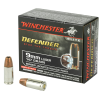
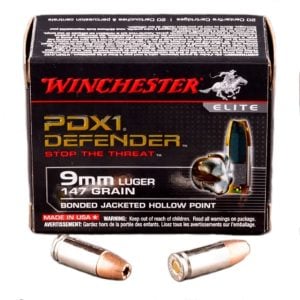
Winchester Defender, formerly PDX1 Defender, is the self-defense round I recommend when someone tells me Federal HST is too expensive. The bonded 147gr hollow point delivers legitimate performance for a little over a dollar a round. It undercuts Gold Dot and Critical Duty, though on a good day HST itself can be found for less, so check the card before you assume it is the cheaper option.
The bonded core keeps the jacket attached through barriers, and the 147gr subsonic load means minimal muzzle flash. Winchester publishes 13 to 15 inches of penetration and roughly .50 to .55 caliber expansion for this load. Worth flagging that the 147gr Defender is one of two loads we have not put through the denim protocol ourselves, so treat those as factory figures rather than numbers we have confirmed. Those numbers put it solidly in FBI spec territory. It is not quite as consistently perfect as HST, and we have seen a little more shot-to-shot variation in expanded diameter, but it is in the same ballpark.
The biggest advantage is availability. You can walk into most Walmart stores and find Winchester Defender on the shelf when HST and Gold Dot are sold out. For a first-time gun owner loading their carry pistol who doesn’t want to hunt online for premium ammo, Defender is a solid, affordable choice that gets the job done.
Best For: Budget-conscious carriers who want bonded JHP performance without the premium price tag.
6. Sig Sauer V-Crown: Best for SIG Pistols
SIG Sauer Elite V-Crown is the cheapest premium defensive load here at roughly $16 to $39. Expansion is good and consistent, just a shade behind HST and Gold Dot in head-to-head gel testing.
- Grain Weight: 124gr / 147gr V-Crown JHP
- Published velocity: 1,165 fps (124gr) / 985 fps (147gr)
- Muzzle Energy: 374 ft-lbs (124gr) / 317 ft-lbs (147gr)
- Case: Nickel-plated brass, Boxer primed
- Penetration: 13-15″ (bare gel, 124gr)
| Value | Expansion | Penetration | Reliability | Reputation |
| 4/5 | 4/5 | 4/5 | 5/5 | 4/5 |
Pros
- V-shaped jacket scores ensure uniform petal expansion
- Stacked hollow point cavity with two-stage expansion design
- SIG tests and tunes these rounds in their own pistols
Cons
- Doesn’t quite match HST or Gold Dot in independent gel tests
- Higher price than Winchester Defender for comparable performance
- Less track record than Federal and Speer in law enforcement
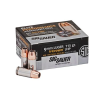
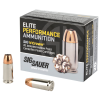
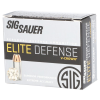

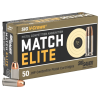
SIG Sauer’s V-Crown is the company’s flagship self-defense round, and it’s specifically designed and tested in SIG pistols. The “V-Crown” name refers to the V-shaped jacket scores that initiate consistent expansion. The stacked hollow point cavity creates a two-stage expansion process: the outer petals open first, followed by deeper expansion as the bullet decelerates. It’s a smart design that balances penetration and expansion effectively.
I’ve been running V-Crown 124gr through my P365X Macro and it cycles perfectly. SIG has the advantage of being both a gun manufacturer and an ammo manufacturer, which means they can tune their ammunition to work optimally in their own platforms. If you carry a SIG, there’s something to be said for running the ammo the manufacturer designed for it.
In head-to-head gel tests though, V-Crown doesn’t quite match the consistency of HST or Gold Dot. Expansion diameter can vary more between shots, and some barrier tests show slightly less reliable opening through auto glass. It’s still a very good defensive round. Just not quite the top of this list. If you run SIG guns and want to stay in the SIG ecosystem, V-Crown is a strong choice at a competitive price point.
Best For: SIG pistol owners who want matched ammo from their gun’s manufacturer.
7. Lehigh Xtreme Defense: Best Non-Expanding Round
Lehigh Xtreme Defense 90gr costs about $29 to $30 for 20 and never expands, because it does not try to. The fluted solid copper bullet cuts a wide channel at any velocity, so it cannot fail to open.
- Grain Weight: 90gr Fluid Transfer Monolithic
- Published velocity: 1,300 fps
- Muzzle Energy: 338 ft-lbs
- Case: Brass, Boxer primed
- Penetration: 16-18″ (bare gel)
| Value | Expansion | Penetration | Reliability | Reputation |
| 2/5 | 3/5 | 5/5 | 5/5 | 3/5 |
Pros
- Cannot clog, because it never expands
- Deep, consistent penetration through all barriers
- Not a hollow point, which matters in New Jersey
Cons
- Expensive at $1.40+ per round
- Wound channel is narrower than expanded JHP rounds
- Less proven track record than traditional hollow points
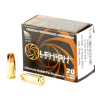
One naming note first, because it trips people up constantly. Lehigh sells this bullet as the Xtreme Defense. Underwood loads the same monolithic projectile and sells it as the Xtreme Defender, normally cheaper and at higher velocity. Search either name and you are looking at the same idea. The Lehigh Xtreme Defense takes a completely different approach to terminal ballistics. Instead of expanding like a traditional hollow point, the solid copper bullet uses machined flutes that redirect tissue radially as the bullet penetrates. Think of it as a rotating cutting tool that creates a wound channel wider than the bullet itself without ever changing shape. The bullet goes in at .355 caliber and comes out the same, but the tissue disruption along its path is impressive.
The real advantage is reliability. A hollow point can fail to expand if it’s clogged with denim, deflected by a barrier, or doesn’t reach sufficient velocity from a short barrel. The Xtreme Defense can’t fail to expand because it doesn’t try to. It works the same way through clothing, glass, drywall, and bare gel. That consistency is appealing. It’s also legal in New Jersey, where traditional hollow points are restricted for carry.
I’ll be honest: I still carry traditional JHP ammo because the expanded diameter of a properly functioning hollow point creates a larger permanent wound channel than what the Xtreme Defense produces. But for shooters in restrictive states, for those who want absolute barrier-blind consistency, or as a backup option when JHP ammo is out of stock, the Xtreme Defense is a legitimate alternative. Underwood Ammo loads Lehigh bullets at higher velocities and is worth checking out too.
Best For: Shooters in hollow-point-restricted states (NJ), those who prioritize barrier penetration, and anyone who wants a failure-proof alternative to traditional JHP.

Ballistic Gel Results: All Seven Defensive Loads Compared
Every load above gets discussed in isolation on most sites, including this one until now. Here they are side by side. Every figure is a five-shot average fired through four layers of heavy denim into calibrated gel from a 4-inch barrel, which is the protocol we hold every defensive load on this site to. Two loads here we have not run ourselves, and I have said so in the table rather than filling the gap with a manufacturer number dressed up as a test result.
| Load | Grain | Measured velocity | Penetration | Expansion | Street cost per round |
|---|---|---|---|---|---|
| Federal HST | 124gr | 1,135 fps | 18.28″ | 0.606″ | $0.90 to $1.50 |
| Federal HST | 147gr | 973 fps | 15.24″ | 0.606″ | $0.90 to $1.50 |
| Speer Gold Dot | 124gr | 1,067 fps | 18.14″ | 0.538″ | $1.35 to $1.55 |
| Hornady Critical Duty +P | 135gr | 1,118 fps | 18.08″ | 0.468″ | $1.04 to $1.20 |
| Hornady Critical Defense | 115gr | 1,143 fps | 13.06″ | 0.504″ | $1.08 to $1.16 |
| SIG Sauer V-Crown | 124gr | 1,072 fps | 17.34″ | 0.516″ | $0.80 to $1.95 |
| Winchester PDX1 Defender | 147gr | 1,000 fps factory | Not in our test set | Not in our test set | $1.10 to $1.75 |
| Lehigh Xtreme Defense | 90gr | 1,300 fps factory | Not in our test set | Does not expand by design | $1.45 to $1.50 |
Read down the penetration column and the ranking most sites hand you starts to look arbitrary. Four of these land between 17 and 19 inches, which is the top of the FBI window or just past it. Critical Defense is the outlier at 13 inches, and that is the whole argument for carrying it in a short gun. The cost column comes from the live cards on this page, so it moves with the market.
Best 9mm Ammo by Pistol Size and Barrel Length
Barrel length changes velocity, velocity decides whether a hollow point opens, and almost nobody sorts their picks this way. A load tuned for a 4.5-inch duty gun can under-perform badly out of a 3-inch pocket pistol, and the reverse is true as well.
| Pistol class | Typical barrel | What I load | Why |
|---|---|---|---|
| Micro-compact: P365, Hellcat, G43X | 3.0 to 3.1″ | Hornady Critical Defense 115gr | The polymer tip opens at velocities where a conventional JHP can plug with clothing. Shallowest penetration here, which is the trade. |
| Compact: Glock 19, P320c, CZ P-10 C | 3.9 to 4.0″ | Federal HST 124gr | The most-tested load in the caliber, and this is the barrel length it was developed around. Widest measured expansion on this page. |
| Full-size duty: Glock 17, P320, M&P 2.0 | 4.4 to 4.7″ | Hornady Critical Duty 135gr +P | Built for barrier work. FlexLock holds together through auto glass and sheet steel better than a soft-lead-core JHP. |
| Suppressed or indoor home defense | Any | Federal HST 147gr | Subsonic, so no supersonic crack, and far less flash and blast in a hallway at 2am than a light fast load. |
One thing worth saying plainly about subsonic loads, because the search results are full of confusion on it. Any 9mm bullet under roughly 1,125 fps is subsonic, and in practice that means 147gr. It does not make an unsuppressed gun quiet. It removes the sonic crack, which only matters if there is a can on the end. What 147gr genuinely does for everyone is cut muzzle flash and recoil impulse, and that is why it is my pick for a bedside gun.
Range and Training 9mm Ammo
Self-defense ammo is too expensive to practice with. You need cheap, reliable FMJ ammunition for training, and you should be shooting a lot of it. The rule of thumb: for every box of defensive ammo you buy, buy ten boxes of range ammo and train. These are the brands I trust to feed reliably and shoot clean enough to not ruin a range session.
8. Sellier & Bellot 9mm FMJ: Best Range Ammo Overall
Sellier and Bellot 115gr FMJ is the best range 9mm ammo overall at roughly $14 to $16 per 50. Clean-burning, consistent, brass-cased and reloadable, which is all you need from practice ammunition.
- Grain Weight: 115gr / 124gr FMJ
- Published velocity: 1,237 fps (115gr)
- Muzzle Energy: 391 ft-lbs (115gr)
- Case: Brass, Boxer primed (reloadable)
| Value | Cleanliness | Accuracy | Reliability |
| 5/5 | 4/5 | 4/5 | 5/5 |
Pros
- Consistently one of the cheapest brass-cased 9mm options
- Clean-burning propellant compared to many budget brands
- Czech quality from a manufacturer founded in 1825
Cons
- Steel-case still costs less per round
- Occasional reports of slightly inconsistent primer seating
- 1000-round cases can sell out fast during demand spikes
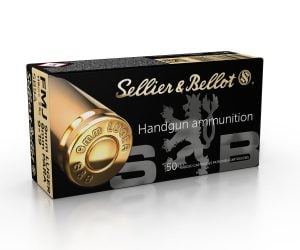
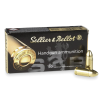
Sellier & Bellot is the range ammo I buy in 1,000-round cases. The Czech manufacturer has been making ammunition since 1825, and their 9mm FMJ is the sweet spot of price, quality, and availability. It’s brass-cased and Boxer primed, so reloaders can reuse the brass. The propellant burns cleaner than many budget options, which means less carbon buildup in your gun and fewer cleaning sessions.
I’ve fired thousands of rounds of S&B through Glocks, SIGs, CZs, and S&Ws without a single malfunction. The brass is well-formed, the primers are reliable, and the velocity is consistent enough for informal accuracy testing. It’s not match-grade ammunition, but for training and practice it’s exactly what you need. Check our cheapest online ammo stores guide for the best bulk pricing.
Best For: High-volume practice shooters who want reliable brass-cased ammo at bulk pricing.
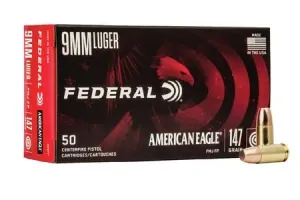
9. Federal American Eagle: Best Bulk Deal
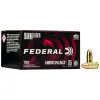
Federal American Eagle is the one I buy in bulk, at about $13 to $17 per 50 and less again by the case. Same brass and primers as Federal’s defensive lines, without the premium bullet.
- Grain Weight: 115gr / 124gr / 147gr FMJ
- Published velocity: 1,180 fps (115gr)
- Muzzle Energy: 356 ft-lbs (115gr)
- Case: Brass, Boxer primed (reloadable)
| Value | Cleanliness | Accuracy | Reliability |
| 5/5 | 4/5 | 4/5 | 5/5 |
Pros
- Available in 100, 200, and 1000-round bulk packs
- Federal Premium quality control, same parent as HST
- Comes in every grain weight so you can match your carry ammo weight
Cons
- Sold in 50-round boxes only, so the entry price is higher
- Value packs ship loose, not boxed
- Burns slightly dirtier than S&B in my experience
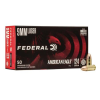
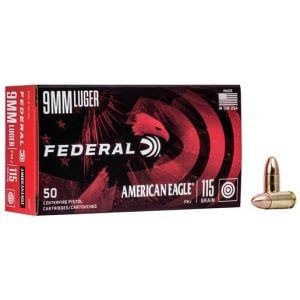
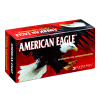
Federal American Eagle is the range counterpart to Federal HST, and there’s a smart reason to pair them. If you carry 147gr HST for self defense, you can train with 147gr American Eagle at the range. Same bullet weight means the same recoil impulse, the same point of impact, and the same feel. When you practice with ammo that matches your carry load, your training is more relevant. That’s a real tactical advantage.
American Eagle comes in 100-round and 200-round bulk packs that bring the per-round cost down significantly. Federal’s quality control is excellent. They load ammunition for the US military, and I’ve never had a dud primer or a deformed case from American Eagle. The brass is clean enough to reload if you’re into that. It’s not quite as cheap as S&B, but the availability and the ability to weight-match your carry ammo make it a top choice.
Best For: Shooters who want to train with the same bullet weight as their Federal HST carry ammo.
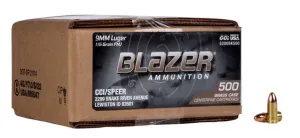
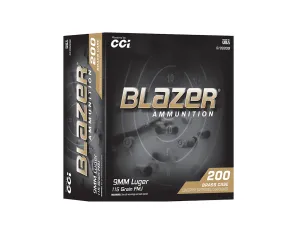
10. CCI Blazer Brass: Best Budget Brass
CCI Blazer Brass 115gr FMJ lands at roughly $14 to $17 per 50. Brass-cased, reloadable and reliably clean, and unlike the old aluminum Blazer it is worth keeping the empties.
- Grain Weight: 115gr / 124gr FMJ
- Published velocity: 1,145 fps (115gr)
- Muzzle Energy: 335 ft-lbs (115gr)
- Case: Brass, Boxer primed (reloadable)
| Value | Cleanliness | Accuracy | Reliability |
| 5/5 | 3/5 | 3/5 | 4/5 |
Pros
- One of the cheapest brass-cased 9mm loads going
- Available everywhere, including big box stores
- Reloadable brass cases
Cons
- Burns dirtier than S&B and American Eagle
- Occasional light primer strikes reported in some guns
- Accuracy is adequate but not as tight as S&B
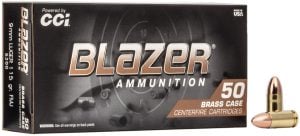
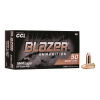
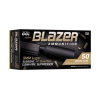
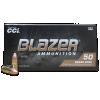
CCI Blazer Brass is the ammo I grab when price is the only thing that matters and I just need to put rounds downrange. It’s frequently the cheapest brass-cased 9mm on the shelf, especially in 200 and 350-round bulk packs. The brass is reloadable, unlike the old aluminum-case Blazer, and it feeds reliably in most modern pistols.
It’s not as clean-burning as S&B or American Eagle. After 200 rounds of Blazer Brass, you’ll notice more carbon fouling in the action than you would with the Czech or Federal offerings. It’s also not the tightest-shooting range ammo I’ve used. But at the prices CCI charges, those are acceptable tradeoffs. If you’re running a compact 9mm and just need reliable reps at the range, Blazer Brass gets the job done at the lowest possible cost.
Best For: Pure budget shooters who want the cheapest reliable brass-cased ammo possible.
How We Choose the Best 9mm Ammo
Every load here was shot at the range before it was ranked. The gel and velocity figures quoted are manufacturer published data cross-checked against independent testing, and I say plainly where a load sits on the FBI line.
Every round on this list was evaluated based on published ballistic gel test data, FBI protocol results where available, personal range testing, and real-world availability and pricing. For self-defense rounds, we prioritize:
- Penetration: Must achieve 12-18 inches in calibrated 10% ballistic gelatin (FBI standard)
- Expansion: Consistent diameter increase to at least 1.5x original (.355″ to .53″+) through heavy clothing
- Weight Retention: The bullet should hold together, not fragment. Bonded cores are preferred
- Reliability: Must feed, fire, and extract without issue across multiple pistol platforms
- Availability: You need to be able to actually buy the ammo, and replace it when you practice with your carry rounds
For range ammo, the criteria are simpler: price per round, cleanliness, reliability, and brass quality for reloaders. Brass cases reload, steel cases run dirty but cheap and some indoor ranges ban them, and aluminum cases are one-and-done. If you shoot more than a couple of hundred rounds a month, buy 9mm ammo in bulk, because a 1,000-round case drops the cost per round well below what any 50-round box manages. Just keep the bulk full metal jacket for paper. FMJ over-penetration is exactly why range ammo does not belong in a home-defense magazine.

9mm Luger, 9mm Parabellum and What the Box Actually Says
They are all the same cartridge. 9mm Luger, 9mm Parabellum, 9x19mm and plain 9mm describe one round, and SAAMI lists it as 9mm Luger. Any of those on a box will fit your 9mm pistol.
SAAMI sets the pressure ceiling for standard 9mm Luger at 35,000 psi and for +P at 38,500 psi. That is the whole difference: +P is the same cartridge loaded hotter, which buys you velocity and costs you recoil and barrel life. Every modern service pistol handles it, but check your manual before feeding +P to anything older or very small.
The one to watch for is 9mm Makarov, which is 9x18mm. Different cartridge, will not chamber, sits right next to the 9mm Luger on some shop shelves.
Grain Weight Guide: 115gr vs 124gr vs 147gr
124gr is the default for defensive 9mm ammo, 115gr is the cheap fast one for the range, and 147gr runs subsonic with the least flash. Barrel length matters more than grain weight for most shooters.
One of the most common questions I get is which grain weight to choose. Here’s the short version:
| Weight | Velocity | Best For | Notes |
|---|---|---|---|
| 115gr | ~1,140-1,250 fps | Range, training | Cheapest, lightest recoil. Most common FMJ weight. |
| 124gr | ~1,100-1,165 fps | Self defense (standard) | Best balance of velocity and mass. NATO standard weight. |
| 147gr | ~985-1,010 fps | Self defense (subsonic) | Subsonic = less flash/blast. Deeper penetration. Best for short barrels. |
For most shooters, 124gr JHP is the sweet spot for self defense and 115gr FMJ is the standard for range practice. If you shoot a short-barrel micro-compact, consider 147gr defensive loads for the reduced flash and deeper penetration from slower velocity.
Plus-P vs Standard Pressure: When the Extra Velocity Earns Its Keep
SAAMI sets standard 9mm Luger at 35,000 psi and +P at 38,500 psi. That is a 10 percent pressure increase and it buys somewhere between 50 and 100 fps depending on the load and the barrel. It is not a different cartridge and it is not a magic bullet.
What the extra pressure actually does is help a hollow point open at velocities where it otherwise might not, which matters most in short barrels. That is why so many carry loads are offered in +P. It costs you sharper recoil, more muzzle flash, faster wear on recoil springs, and in a very small pistol a gun that is noticeably harder to shoot fast.
My position: if your gun is a modern service pistol and you shoot +P well, Speer Gold Dot 124gr +P and Federal HST 124gr +P are both excellent. If you flinch on +P, standard-pressure HST does the job, and we measured standard 124gr HST at 18.28 inches, which is not exactly anemic. Do not carry +P you have not fired. Check your manual before feeding it to anything small, old, or aluminum-framed.
Carry Ammo Maintenance: Rotation and Bullet Setback
This is the part almost every best-9mm-ammo article skips, and it is the one most likely to actually cause you a malfunction. Ammunition does not go bad sitting in a magazine. It gets damaged by being handled.
Every time you unload your carry gun and re-chamber the same round, that cartridge slams into the feed ramp and the bullet can be pushed slightly deeper into the case. That is setback. A bullet seated deeper reduces case volume, and reduced case volume raises pressure, sometimes a lot. A round chambered a dozen times is not the round the factory pressure-tested.
- Rotate the top round. Do not chamber the same cartridge over and over. Cycle which round goes on top, or retire any cartridge chambered more than twice.
- Measure if you are unsure. Stand a suspect round next to a fresh one from the same box. Any visible difference in overall length and it goes in the range bag, not the magazine.
- Replace carry ammo once a year. Shoot the old stuff. It confirms the load still runs in your gun, and it means your defensive rounds are never mystery ammo of unknown age.
- Keep it dry. Modern ammo is tough, but a magazine living in a sweaty waistband all summer is a corrosion environment. Nickel-plated cases, which every premium load here uses, resist it better than plain brass.
None of this is expensive. A box of 20 HST once a year, and some discipline about which round goes on top, is the whole program.
FAQ: Best 9mm Ammo
What is the best 9mm self-defense ammo in 2026?
Federal Premium HST is the best 9mm ammo for self-defense in 2026. It locks its core to the jacket mechanically rather than bonding them, using a cannelure and coaligned skives, and it consistently meets FBI penetration of 12 to 18 inches and expansion around .55 to .60 caliber through clothing and barriers. It is the round most US law enforcement agencies issue. The 124gr load is the all-rounder, and the 147gr is the one to run if your barrel is short.
How much defensive ammo should I run through my gun before trusting it?
Minimum 200 rounds of your chosen defensive load through your specific gun, with zero malfunctions, before you carry it. A round that runs perfectly in a Glock 19 might cause a light-strike or feed issue in a SIG P365 due to recoil-spring weight or feed-ramp geometry. Run a full box, so 50 rounds, per range session across at least four sessions, then top off your carry magazines and trust the load.
Is 115gr or 124gr or 147gr better for 9mm self-defense?
124gr is the all-around standard, the best balance of velocity and mass and the NATO standard weight. 115gr is fastest and cheapest, which makes it range ammo more than carry ammo. 147gr runs subsonic with deeper penetration and less muzzle flash. For a barrel under about 3.5 inches I would take the 147gr for the flash alone, or Hornady Critical Defense 115gr if you want a load designed around short barrels specifically.
Why is Hornady Critical Defense different from regular hollow points?
Critical Defense uses Hornady's FTX bullet, short for Flex Tip eXpanding, which has a soft red polymer plug filling the hollow-point cavity. The plug stops the cavity clogging with denim or heavy clothing as it passes through, and clogging is the most common cause of a hollow point failing to open. It also helps the round expand at the lower velocities you get from a short barrel.
Can I use range FMJ ammo for self-defense?
You can, but you should not. Full metal jacket ammunition over-penetrates. It punches through a threat and keeps going through walls and into whatever is behind them, which is a legal, moral and tactical problem all at once. Use a quality jacketed hollow point like Federal HST, Speer Gold Dot or Hornady Critical Defense for anything defensive, and save the FMJ for paper.
What is the best budget 9mm self-defense ammo?
Winchester Defender PDX1 in 147gr bonded JHP. It delivers FBI-protocol expansion and 13 to 15 inches of penetration for a little over a dollar a round. It undercuts Speer Gold Dot and Hornady Critical Duty comfortably. Worth checking the card before you buy though, because HST goes on offer often enough that it sometimes lands cheaper than the budget pick.
What is the cheapest reliable 9mm range ammo?
Sellier & Bellot 115gr FMJ at roughly $0.28 to $0.32 per round. Czech-made brass with consistent ignition, clean-burning powder, and excellent quality control for a budget round. It runs cleaner than most American bulk FMJ and is reloader-friendly with Boxer-primed brass. For pure bulk training, Federal American Eagle 115gr in the 1,000-round case at roughly $0.32 per round is the bulk-pricing alternative.
Does grain weight matter for 9mm pistol accuracy?
Yes, modestly. Different pistols favor different grain weights based on barrel twist rate and recoil spring tuning. A SIG P365 may shoot 124gr tighter than 115gr; a Glock 19 may favor 124gr equally well; a Smith & Wesson Shield may print better groups with 147gr. Test all three grain weights in your specific pistol from 7-25 yards before committing to a defensive load. The accuracy difference is small, but the grain weight that shoots tightest is the one to carry.
Does grain weight matter for 9mm range ammo?
Barely, and mostly for recoil. 115gr is the cheapest and snappiest, 124gr feels a touch softer and is what most defensive loads use, and 147gr is subsonic and the flattest-shooting of the three in a compensated or suppressed gun. If you are training for carry, buy range ammo in the same grain weight as your defensive load so the recoil impulse matches.
Is steel-case or aluminum-case 9mm worth buying?
For high-volume range work, yes, with two caveats. Steel case runs dirtier and some indoor ranges ban it because their brass reclamation cannot use it. Aluminum case is one-and-done and cannot be reloaded. Brass costs a little more and is the only one worth keeping if you reload. None of the three belong in a defensive magazine.
How much 9mm ammo should I keep on hand?
Enough to train properly, which is more than most people think. I keep 500 rounds of range ammo as a working stock and about 200 rounds of my chosen defensive load, 50 of which get shot to confirm it feeds in my gun. Buying 9mm ammo in bulk drops the cost per round substantially, and a 1,000-round case is where the real savings start.
Is 9mm good for self-defense?
Yes, and it is the most common defensive handgun cartridge in the United States for good reason. Modern 9mm hollow points meet the same FBI penetration and expansion standards as larger calibers, while giving you less recoil, faster follow-up shots and more rounds in the magazine. The gap between 9mm and .40 or .45 closed once bullet design caught up, which is why most US police agencies moved back to 9mm.
What is the difference between 9mm and 9mm Luger?
Nothing. They are the same cartridge. 9mm Luger, 9mm Parabellum, 9x19mm and plain 9mm all describe one round, and SAAMI lists it as 9mm Luger. If a box says any of those, it fits your 9mm pistol. The one to watch for is 9mm Makarov, which is 9x18mm and a genuinely different cartridge that will not work in your gun.
Where can I buy bulk 9mm ammo?
Our live price card above tracks 9mm ammo across 200-plus US retailers and sorts by cost per round, which is the number that matters when you are buying in volume rather than by the box. Bulk cases of 1,000 rounds land well under the per-round price of a 50-round box. Federal American Eagle and CCI Blazer Brass are the two range loads I buy by the case.
Is bulk 9mm ammo good for self-defense?
No, because bulk 9mm is almost always full metal jacket, and FMJ over-penetrates. Buy bulk for training and buy a separate box of jacketed hollow points for carry. The one thing worth doing is running 50 rounds of your defensive load through the gun to confirm it feeds, because hollow points have a different profile to FMJ and some pistols are fussy about it.
Find the Best Price in Seconds
Search once, compare 200+ trusted retailers instantly.
Deals of the Day
Today's best discounts · Updated 3x daily
Gun Deals
See All →
Ammo Deals
See All →


Bottom Line: Which 9mm Should You Load?
For carry and home defense, my one-pick answer is Federal Premium HST 124gr. It is the most-tested, most-issued, most-validated defensive 9mm in the country. Buy a couple of 20-round boxes, put 200 through your gun to confirm reliability, then keep five magazines worth loaded. If your carry gun has a barrel under 3.5 inches, drop to Hornady Critical Defense 115gr FTX, the polymer tip handles heavy-clothing scenarios at lower velocities better than any traditional JHP.
For range and training, run Sellier & Bellot 115gr FMJ by the case. Cleanest-burning budget brass on the market and consistent ignition lot-to-lot. Save the HST for defense and zero-confirmation only, every defensive round you fire at the range is a round that needs replacing in your carry magazines.
Stock Up on 9mm Ammo
The live carousel below pulls current in-stock 9mm defensive and range ammo across the major retailers. Inventory updates every 4 hours.
Live Ammo and Shooting Gear Deals
Best-scored parts across 200+ retailers · Updated every 4 hours




Related Ammo & Handgun Guides
Curious how 9mm stacks up against every other caliber on price? Our Ammo Price Index tracks cost per round across 27 calibers.
Related Guides
1 thought on “Best 9mm Ammo for Self Defense and Range (2026)”