

Affiliate disclosure: This Underwood Ammo review contains affiliate links. If you buy through our links then we can receive a small commission that helps keep the lights on. You don’t pay anything more.
- Treat every gun as loaded
- Point the muzzle in a safe direction
- Keep your finger off the trigger until you’re ready to shoot
- Know your target and what’s beyond
This Underwood Ammo review checks the brand’s two big promises: that its solid copper Xtreme Defender wounds like nothing else, and that its loads really run as fast as the box says. I put the Xtreme Defender, Xtreme Penetrator and hard cast lines into gel, and ran 18 chronograph strings from guns with barrels of 1 7/8 to 20 inches.
In short: from full-size guns the box speeds hold up, and 12 of 13 full-size handgun strings landed within 61 fps; from snubs they do not. Two XTP loads missed the FBI window: the .380 +P XTP stopped short of 12 inches from a Ruger LCP and the 9mm +P 147 gr XTP went 20.75 to 21 inches through clothing. Our Underwood brand page covers the company; this page is the test.
Last updated October 16, 2026
On-sale 9mm from 200+ retailers · Updated every 4 hours


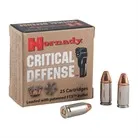
Table of Contents
Underwood Ammo Review at a Glance
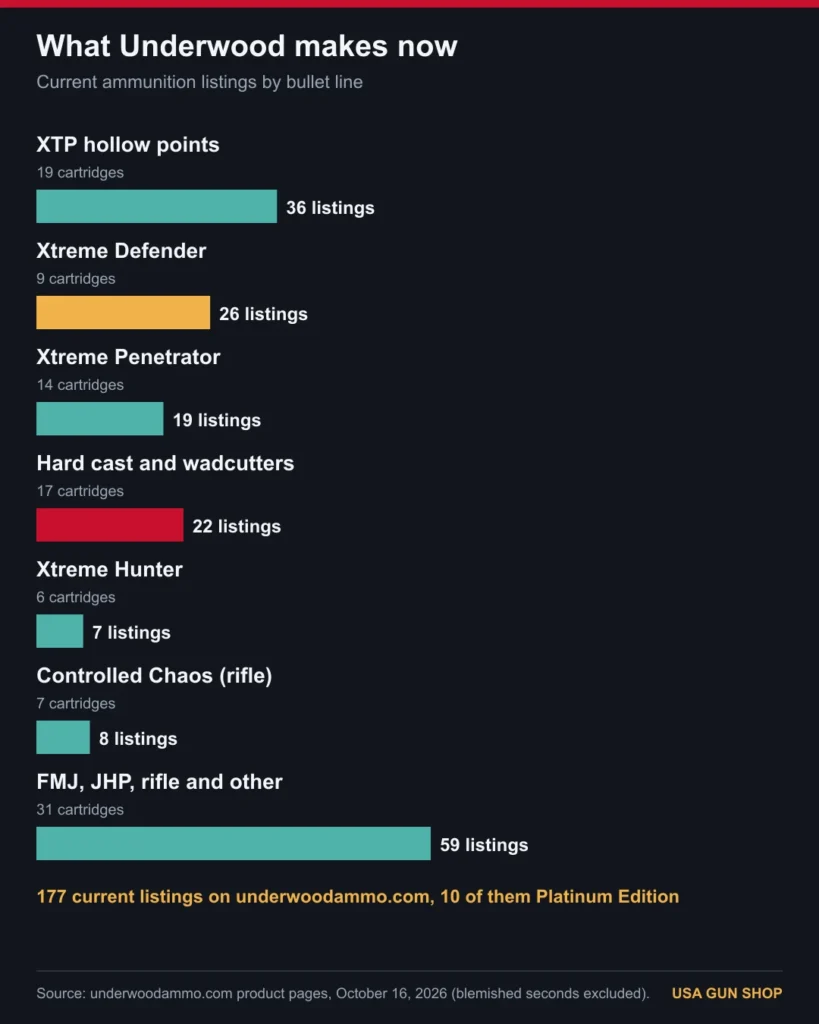
Underwood is a full-power specialist from Sparta, Illinois with 177 current listings. Its fluted solid copper Xtreme Defender is the defensive flagship, its hard cast is a woods load, and its box speeds come from barrels it does not name.
| Line | Bullet | Current range | Best use |
|---|---|---|---|
| Xtreme Defender | Fluted solid copper, does not expand | 18 loads in 9 cartridges | Carry and home defense |
| Xtreme Penetrator | Fluted solid copper, built to pass 18 in | 19 listings | Woods, hogs, barriers |
| Xtreme Hunter | Defender nose on a deeper bullet | 7 listings | Handgun and carbine hunting |
| Hard cast | 21 Brinell lead, Black Cherry coated | 22 listings | Bear and big game |
| XTP hollow points | Jacketed hollow point | 36 listings | Defense and hunting |
Counts come from underwoodammo.com on October 16, 2026, with Platinum Edition coated versions counted as separate listings and blemished seconds left out. Every Underwood box shown on this page holds 20 rounds unless a card says otherwise.
Pros
- Xtreme Defender held depth through clothing
- Box speeds hold from full-size guns
- Hard cast drives past 23 in
Cons
- Snubs run slow; no handgun test barrel
- .380 XTP shallow, 9mm 147 XTP deep
- Flat nose hard cast stubbed twice
Our Rating: 8.0/10
Who Makes Underwood Ammo and Whose Bullets It Loads
Underwood loads its own ammunition in Sparta, Illinois, and Kevin Underwood founded the company in 2013. Underwood credits Lehigh Defense for its Xtreme Penetrator and Xtreme Defender bullets, and its XTP loads use XTP bullets.
Underwood’s About page says “Kevin Underwood started Underwood Ammo in 2013 after seeing a need in the market for better ammunition at a reasonable price.” Most cases are nickel-plated brass, and its product pages say “we utilize flash suppressed powder.”
The Lehigh Defense link is Underwood’s own wording. Its Xtreme Penetrator pages say Underwood “combines our trademark power and precision with Lehigh Defense” and its “masterfully designed Xtreme Penetrator bullets.” The Xtreme Defender page description reads “Underwood Ammo offers the most comprehensive and innovative Lehigh Defense” handgun ammo, and lists the bullet model as Xtreme Defense.
Here we stick to Underwood’s boxes, Underwood’s velocity figures and what those loads did in our guns and gel.
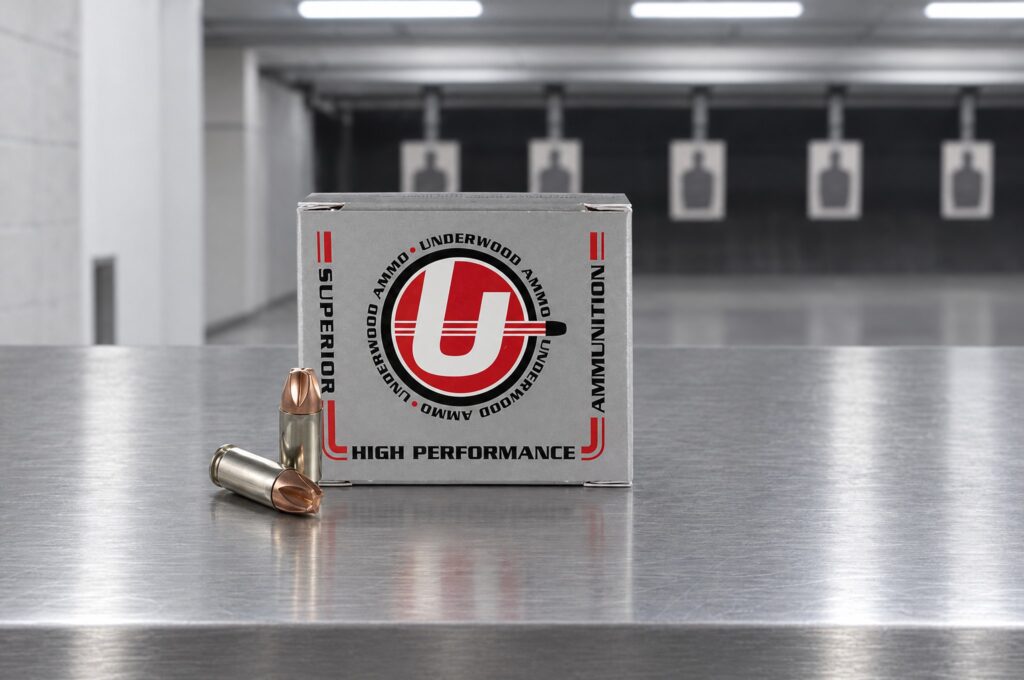
Underwood Xtreme Defender Review: 9mm
In 9mm the Xtreme Defender did what Underwood says. Our 90 gr +P averaged 18.00 inches in bare gel and the 68 gr +P 17.25 inches, both inside the FBI window, and neither changed shape.
| Load | Box fps | Our gun | Our fps | vs box | Depth | Medium |
|---|---|---|---|---|---|---|
| 9mm +P 90 gr | 1,475 | Glock 17, 4.5 in | 1,501 | +26 | 18.00 in | bare gel, 3 shots |
| 9mm +P 68 gr | 1,800 | Glock 17, 4.5 in | 1,815 | +15 | 17.25 in | bare gel, 3 shots |
| 9mm 90 gr | pressure not stated | Canik METE SFT, 4.46 in | 1,447 | not stated | no gel | range session, 10 shots |
| 9mm 90 gr | pressure not stated | not recorded | not recorded | not stated | 16.5 in | leather and denim, 1 shot |
I shot three rounds of each +P load from a Glock 17 into calibrated bare gel at 10 feet. The 90 gr averaged 1,501 fps against Underwood’s 1,475, and the 68 gr 1,815 against 1,800. Both strings were tight: standard deviations of about 4 fps for the 90 gr and 10 fps for the 68 gr.
Depth was 18.00 inches for the 90 gr and 17.25 for the 68 gr. Two 68 gr shots left the side of the block near 16 inches because my alignment was off, which pulled its average down. Both still sit inside the FBI window of 12 to 18 inches of ballistic gel.
The permanent channels measured more than three inches at their widest and stayed over two inches wide far longer than the HST and Gold Dot channels in the same blocks.
A second session with the 90 gr went through leather and denim first: 16.5 inches deep, and the bullet came out at about 88 grains, so it lost almost nothing. The gun and velocity for that shot were not recorded.
In a separate range session with no gel, a Canik METE SFT with a 4.46 inch barrel ran a 10-shot string of the 90 gr at 1,447 fps. More than 100 rounds fed without a stoppage, and the best five-shot group at 15 yards measured 1.03 inches.
68 gr or 90 gr?
Underwood answers this itself: “The 68gr will do just about the same exact job through bare gel or 4 layers of denim as the 90gr.” Its FAQ adds the catch: “It’s only through thicker barriers like sheet metal, plywood, glass, etc. that we see a reduction in wounding effect and penetration with the 68gr.”
Our gel agrees on the soft-target side, with less than an inch between the two. For a home where a shot might cross a car door or a wall stud, the 90 gr is the safer pick; the 68 gr is for shooters who want the least recoil.
Standard, +P or +P+?
Underwood sells the 9mm 90 gr Xtreme Defender in three pressures: standard at 1,400 fps, +P at 1,475 and +P+ at 1,550. The 68 gr comes in standard at 1,700 and +P at 1,800. Every 9mm +P and +P+ product page warns against aftermarket Sig P365 conversion barrels and adds: “All of our testing and validation is performed with factory Sig P365 barrels.”
Our pick for most 9mm pistols is the +P 90 gr: it met its box speed in our Glock 17, and SAAMI publishes a +P pressure level for it. That is the core of this Underwood Xtreme Defender review; the +P+ is covered in the pressure section below.



How the Xtreme Defender Wounds Without Expanding
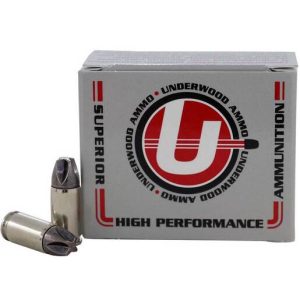
An Xtreme Defender is a machined solid copper bullet with deep flutes in its nose. It never opens up; the spinning flutes push tissue sideways, so the wound channel is wider than the bullet and nothing depends on expansion.
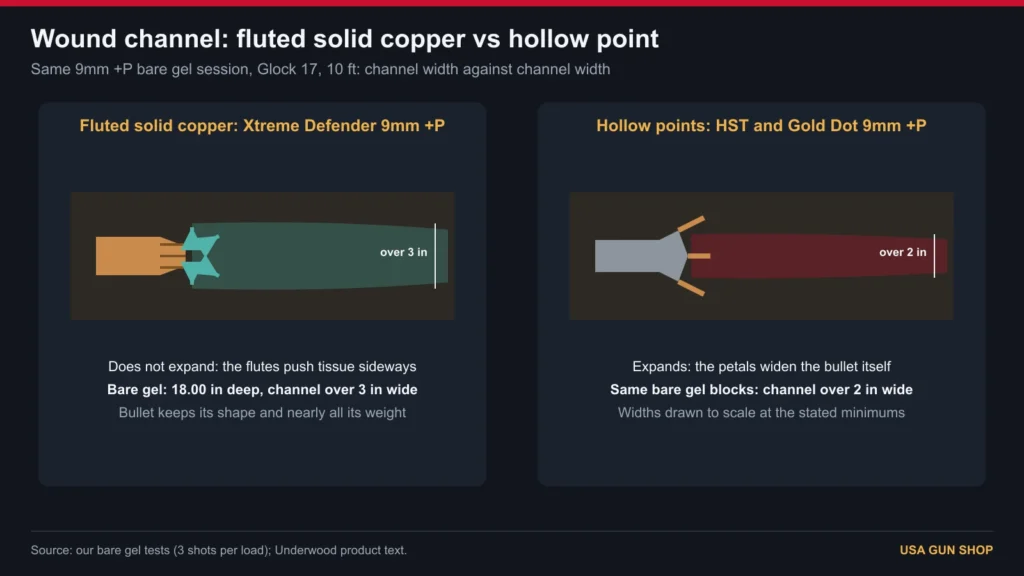
Underwood’s own description promises “penetration depth up to 18 inches” and “A permanent wound cavity (PWC)that is 2 times greater than any expanding bullet.” Our gel backed the depth claim. In that same bare gel session, the HST and Gold Dot +P channels topped out a little past two inches wide, while the Xtreme Defender channels measured over three.
That makes the claim plausible, not proven: gel shows a channel, not tissue, and an opened hollow point is still a heavier, wider bullet.
The fluted design is built for consistency because it does not need to expand, and through leather and denim our 90 gr still went 16.5 inches. We fired no barrier shots, and Underwood itself says the 68 gr loses some effect through sheet metal, plywood and glass.
Because the bullet is lead free and does not deform, it also keeps nearly all its weight. That matters in states with lead rules and for shooters who want the same result every time, but it means you are betting on flutes and velocity rather than expansion.
Xtreme Defender in 380, 38 Special, 10mm and Other Calibers
Underwood makes the Xtreme Defender in 9 cartridges, from .32 ACP to 10mm and .45 Colt, 18 loads in all before the Platinum Edition versions. Outside 9mm we list Underwood’s figures; we have not gel tested those loads.
| Cartridge | Bullet | Box fps | Energy | Platinum too |
|---|---|---|---|---|
| .32 ACP | 55 gr | 950 | 110 ft-lb | No |
| .32 ACP +P | 55 gr | 1,050 | 135 ft-lb | No |
| .357 Sig | 65 gr | 2,100 | 637 ft-lb | No |
| .38 Special | 100 gr | 1,200 | 320 ft-lb | No |
| .38 Special +P | 100 gr | 1,300 | 375 ft-lb | No |
| .380 ACP | 68 gr | 1,300 | 255 ft-lb | Yes |
| .380 ACP +P | 68 gr | 1,400 | 296 ft-lb | Yes |
| .40 S&W | 100 gr | 1,500 | 500 ft-lb | No |
| .40 S&W | 115 gr | 1,400 | 501 ft-lb | No |
| .45 ACP | 135 gr | 1,240 | 461 ft-lb | No |
| .45 ACP +P | 135 gr | 1,335 | 534 ft-lb | No |
| .45 Colt | 135 gr | 1,410 | 596 ft-lb | No |
| 10mm Auto | 115 gr | 1,700 | 738 ft-lb | Yes |
| 9mm Luger | 68 gr | 1,700 | 436 ft-lb | Yes |
| 9mm Luger | 90 gr | 1,400 | 392 ft-lb | Yes |
| 9mm Luger +P | 68 gr | 1,800 | 489 ft-lb | Yes |
| 9mm Luger +P | 90 gr | 1,475 | 435 ft-lb | Yes |
| 9mm Luger +P+ | 90 gr | 1,550 | 480 ft-lb | Yes |
Two warnings come straight from Underwood. On .380: “You may use our +P .380s in a Ruger LCP in limited quantities with the installation of a 13lb recoil spring.” On the S&W Bodyguard 2.0, it says “Xtreme Defender functions reliably in the vast majority of Bodyguard 2.0 pistols we have tested,” and points any feeding trouble at the gun.
Treat every pocket gun as unproven until a few boxes have fed in it. For a .380 carry load with gel data from a short barrel, our .380 ammo test ranks the field; for .38 Special see our .38 Special ammo guide.
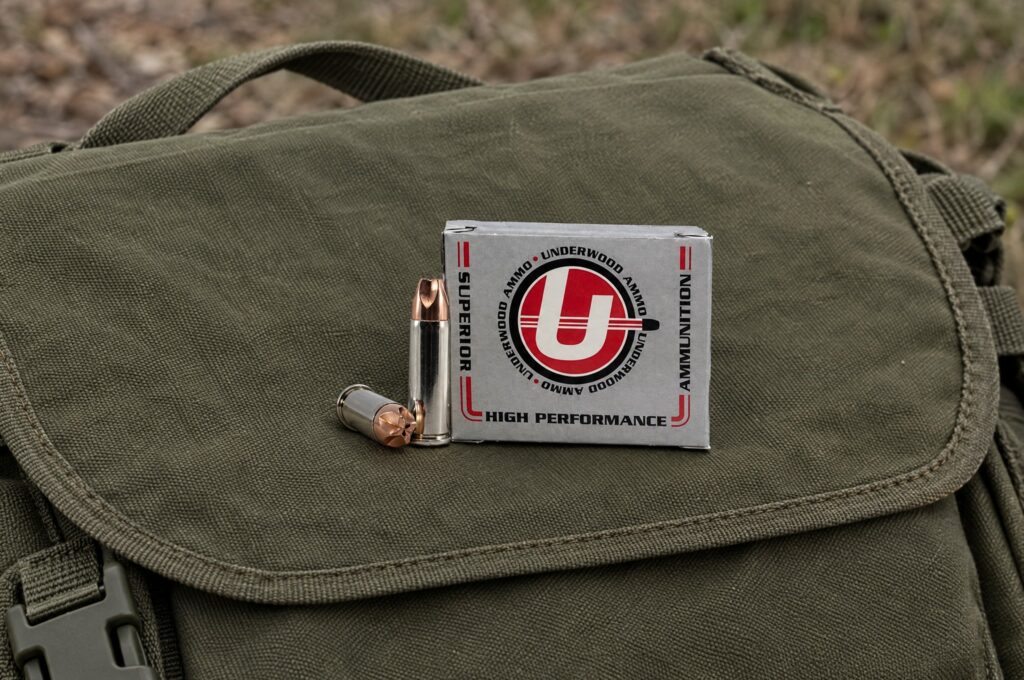
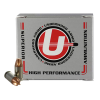
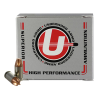


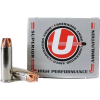
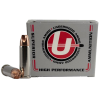

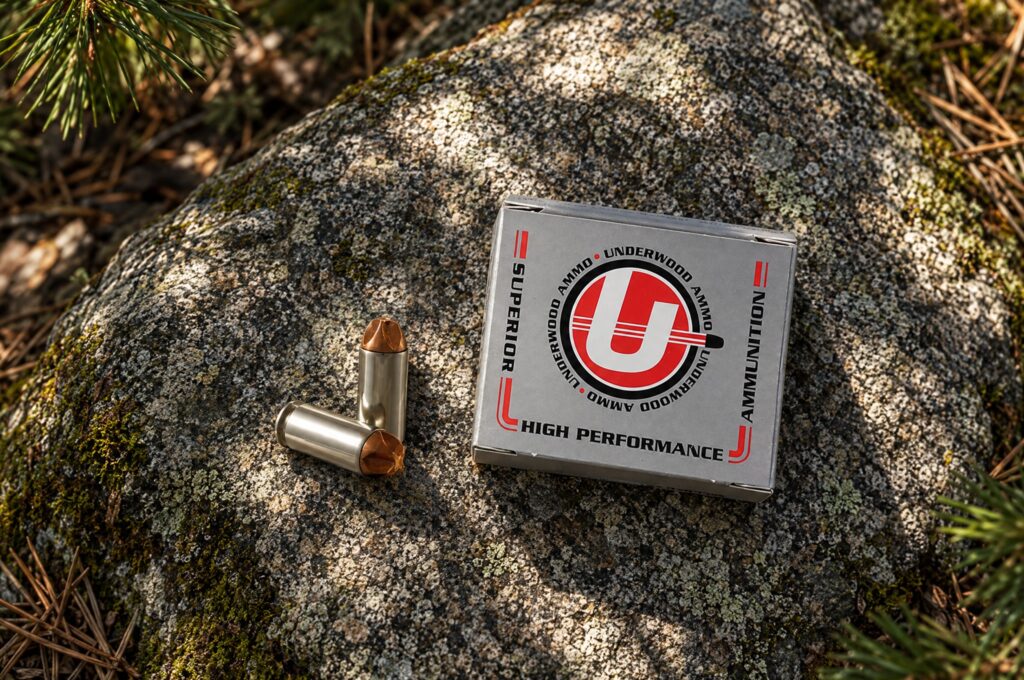
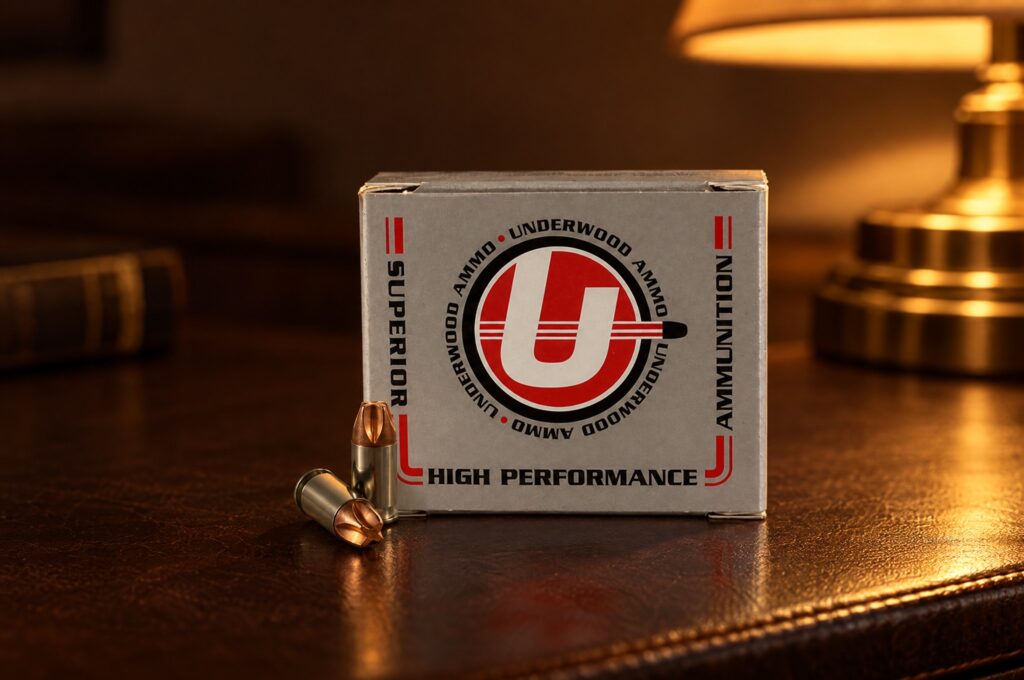
The Underwood 10mm Xtreme Defender is a 115 gr bullet that Underwood rates at 1,700 fps. Our 10mm ammo guide compares it with heavier 10mm defense loads.

Underwood’s Velocity Claims vs Our Chronograph
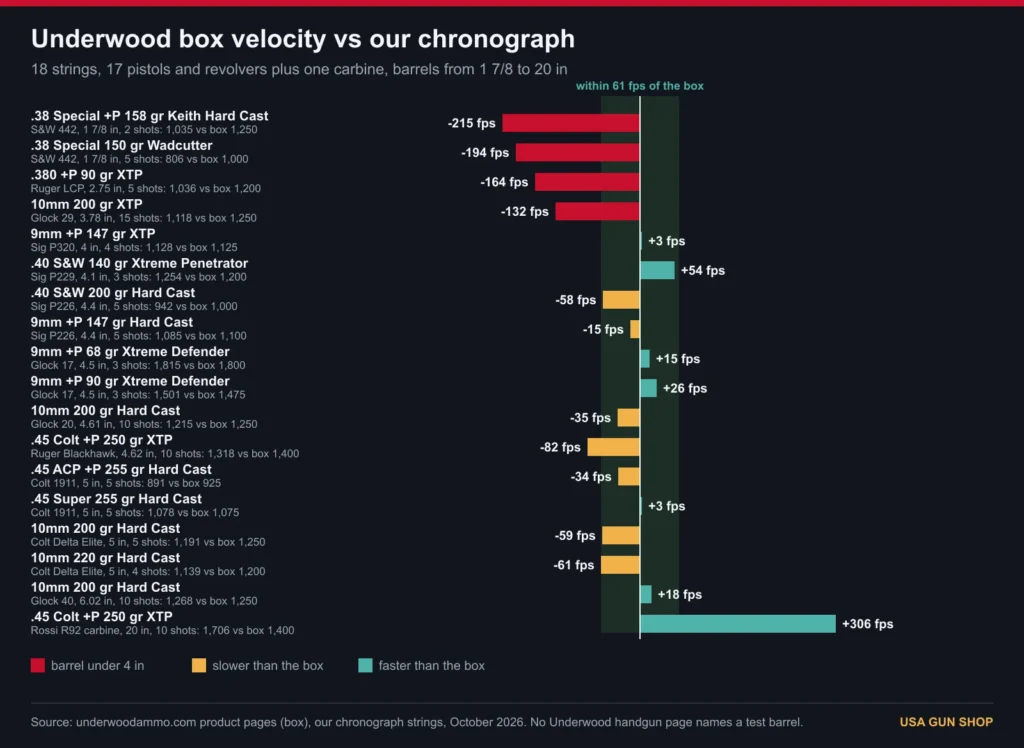
Underwood prints a muzzle velocity on every product page, but none of its 132 handgun pages names a test barrel. From barrels of 4 inches and longer, 12 of our 13 handgun strings landed within 61 fps of the box.
| Load | Gun and barrel | Shots | Box fps | Our fps | vs box |
|---|---|---|---|---|---|
| .38 Special +P 158 gr Keith Hard Cast | S&W 442, 1 7/8 in | 2 | 1,250 | 1,035 | -215 |
| .38 Special 150 gr Wadcutter | S&W 442, 1 7/8 in | 5 | 1,000 | 806 | -194 |
| .380 +P 90 gr XTP | Ruger LCP, 2.75 in | 5 | 1,200 | 1,036 | -164 |
| 10mm 200 gr XTP | Glock 29, 3.78 in | 15 | 1,250 | 1,118 | -132 |
| 9mm +P 147 gr XTP | Sig P320, 4 in | 4 | 1,125 | 1,128 | +3 |
| .40 S&W 140 gr Xtreme Penetrator | Sig P229, 4.1 in | 3 | 1,200 | 1,254 | +54 |
| .40 S&W 200 gr Hard Cast | Sig P226, 4.4 in | 5 | 1,000 | 942 | -58 |
| 9mm +P 147 gr Hard Cast | Sig P226, 4.4 in | 5 | 1,100 | 1,085 | -15 |
| 9mm +P 68 gr Xtreme Defender | Glock 17, 4.5 in | 3 | 1,800 | 1,815 | +15 |
| 9mm +P 90 gr Xtreme Defender | Glock 17, 4.5 in | 3 | 1,475 | 1,501 | +26 |
| 10mm 200 gr Hard Cast | Glock 20, 4.61 in | 10 | 1,250 | 1,215 | -35 |
| .45 Colt +P 250 gr XTP | Ruger Blackhawk, 4.62 in | 10 | 1,400 | 1,318 | -82 |
| .45 ACP +P 255 gr Hard Cast | Colt 1911, 5 in | 5 | 925 | 891 | -34 |
| .45 Super 255 gr Hard Cast | Colt 1911, 5 in | 5 | 1,075 | 1,078 | +3 |
| 10mm 200 gr Hard Cast | Colt Delta Elite, 5 in | 5 | 1,250 | 1,191 | -59 |
| 10mm 220 gr Hard Cast | Colt Delta Elite, 5 in | 4 | 1,200 | 1,139 | -61 |
| 10mm 200 gr Hard Cast | Glock 40, 6.02 in | 10 | 1,250 | 1,268 | +18 |
| .45 Colt +P 250 gr XTP | Rossi R92 carbine, 20 in | 10 | 1,400 | 1,706 | +306 |
Barrel length explains almost everything. The four short-barrel strings ran 132 to 215 fps slow: the .38 Special +P Keith and wadcutter from a 1 7/8 inch S&W 442, the .380 +P XTP from a 2.75 inch Ruger LCP and the 10mm 200 gr XTP from a 3.78 inch Glock 29.
From full-size guns Underwood’s box speeds hold up. The 9mm +P Xtreme Defender and XTP loads, the .40 140 gr Xtreme Penetrator and the .45 Super beat the box, and the Underwood 10mm 200 gr hard cast ran 1,215 fps from a Glock 20 and 1,268 fps from a 6.02 inch Glock 40, as our Glock 40 review and Glock 20 Gen 5 review show.
The one long-barrel miss was the .45 Colt +P XTP, 82 fps slow from a 4.62 inch Ruger Blackhawk. Every other pistol and revolver string from a barrel of 4 inches or more landed within 61 fps.
So read an Underwood box speed as a full-size number. If you carry a snub or a pocket pistol, plan on 132 to 215 fps less, and pick a load that still works at that speed. A 20 inch carbine goes the other way: the same .45 Colt +P ran 1,706 fps from a Rossi R92.
Underwood +P and +P+: What the Labels Mean
+P is a SAAMI pressure level for some cartridges; +P+ is not a SAAMI level at all. 14 Underwood handgun listings carry a +P or +P+ label that the SAAMI pistol and revolver standard does not define.
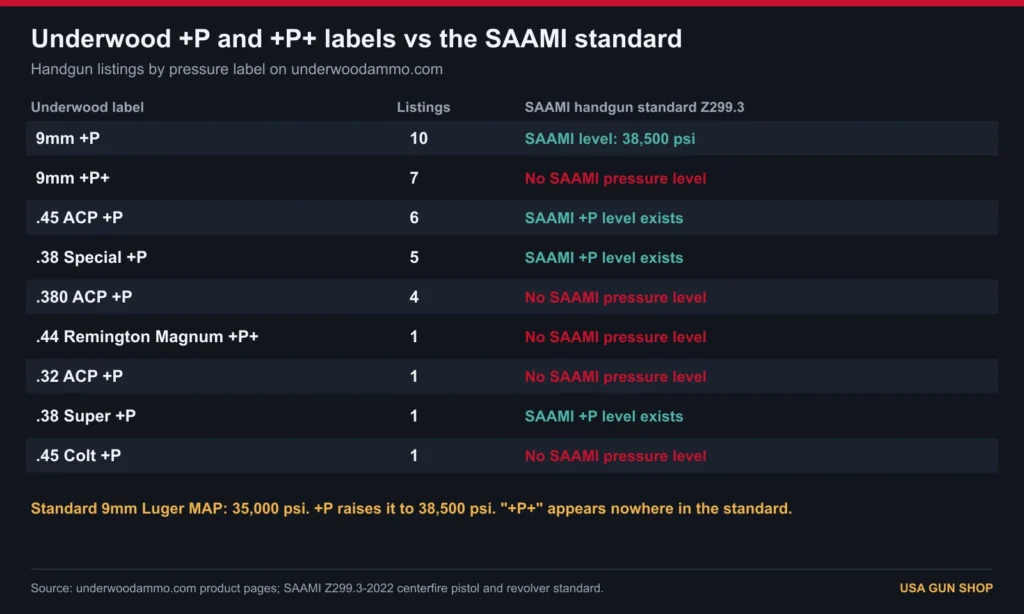
SAAMI’s Z299.3 standard sets the maximum average pressure for 9mm Luger at 35,000 psi and for 9mm Luger +P at 38,500 psi. The phrase +P+ does not appear in it, and neither does a +P level for .380 ACP, .32 ACP or .45 Colt, all of which Underwood sells as +P.
That does not make those loads unsafe in a strong modern gun, but it does mean nobody outside Underwood defines the pressure, and Underwood publishes no pressure figures. Underwood itself says “Inherently using +P or +P+ ammunition does increase wear and tear on your firearm” and adds “Which is why we recommend limited use of these ammunitions and having a steady diet of standard pressure.”
Its 10mm is a different case. Underwood’s FAQ says “No, our 10mm loads are within pressure boundaries for SAAMI specs,” and “We just load our ammunition to the original and true 10mm loading.” Our Glock 20 and Glock 40 strings fit that, landing within 35 fps of the box. We count seven 9mm +P+ listings, Platinum versions included.
Underwood Xtreme Penetrator Review
The Underwood Xtreme Penetrator is the deep-driving sibling: same solid copper and flutes, a blunter nose, and Underwood’s own rule that it will always pass 18 inches. In our bare gel it went 22.50 to 47.50 inches.
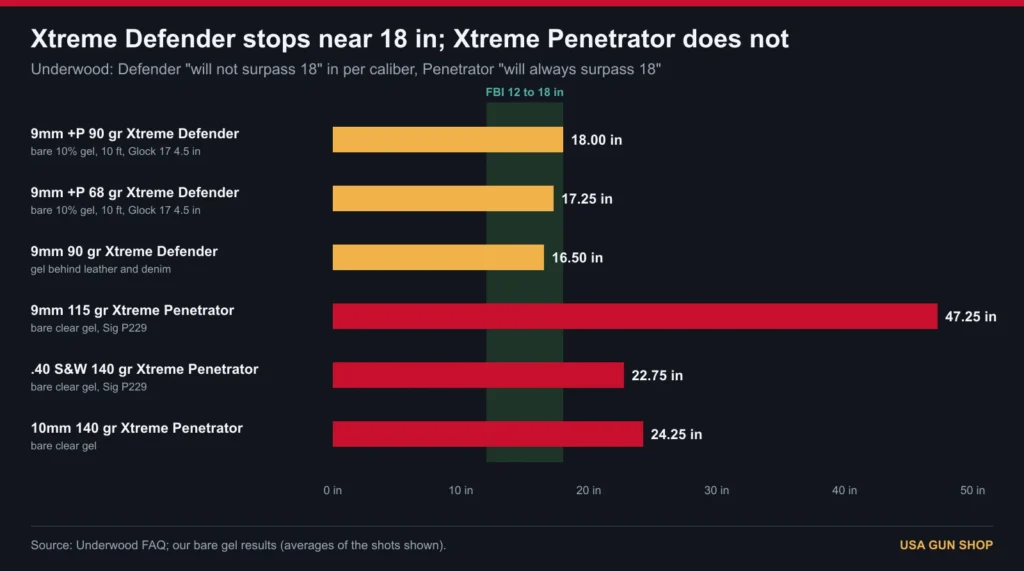
Underwood’s FAQ draws the line in plain words: per caliber, the Xtreme Defender will not pass 18 inches and the Xtreme Penetrator always will. It adds that “The Xtreme Hunter is a hybrid of the Defender and Penetrator,” using the Defender nose on a deeper-driving bullet.
| Xtreme Penetrator | Gun | Bare gel | Through 20 ga steel at 30 degrees |
|---|---|---|---|
| 9mm 115 gr | Sig P229 | 47, 47.5 in | 16.5, 18 in |
| .40 S&W 140 gr | Sig P229 | 22.5, 23 in | 17, 18.5 in |
| 10mm 140 gr | 10mm pistol | 24.25 in | 21.25 in |
The 9mm went 47 and 47.5 inches in bare gel and showed signs of tumbling near 35 inches, then held 16.5 to 18 inches through angled 20 gauge steel. The .40 stopped near 23 inches and the 10mm at 24.25, with velocities of 1,250 to 1,260 fps from the .40 and 1,482 to 1,512 fps from the 10mm.
In soft gel the 9mm wound track looked much like ball ammunition; the 10mm track looked wider. That is the tradeoff: deep and straight, and it held 16.5 to 18 inches through angled steel, but it is not a defensive load for a house with neighbors. For people, buy the Defender.
Platinum Edition
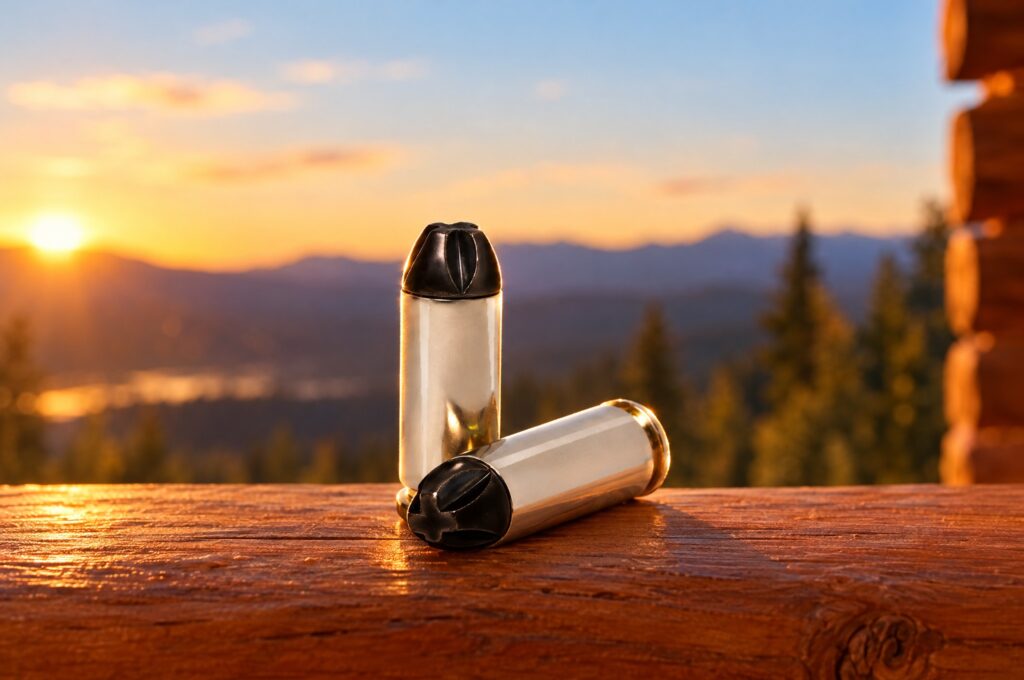
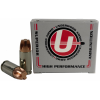
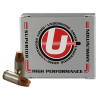
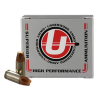
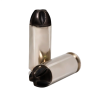
Underwood’s FAQ says “Our Platinum line features a black coating applied to the projectile.” The coating is meant to stop copper tarnish in storage, add dry lubrication for feeding and cut barrel wear. Bullet weight and box speed match the uncoated load; 10 of the 177 current listings are Platinum.
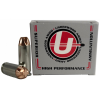


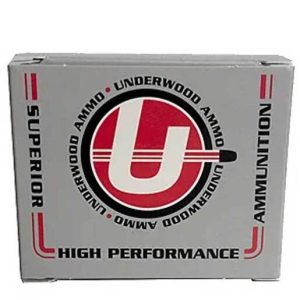
Underwood Hard Cast Review: Bear and Woods Loads
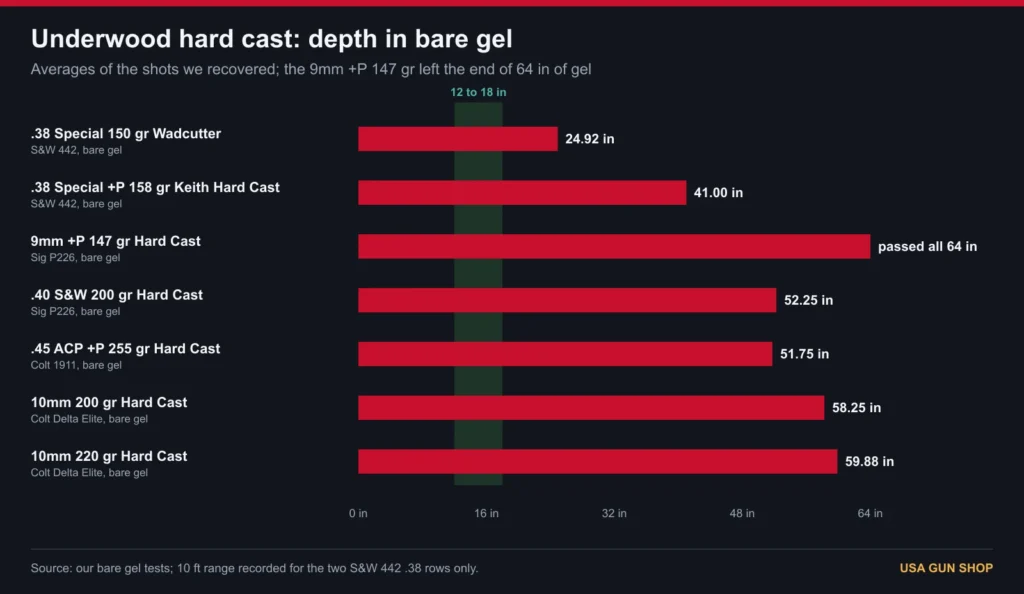
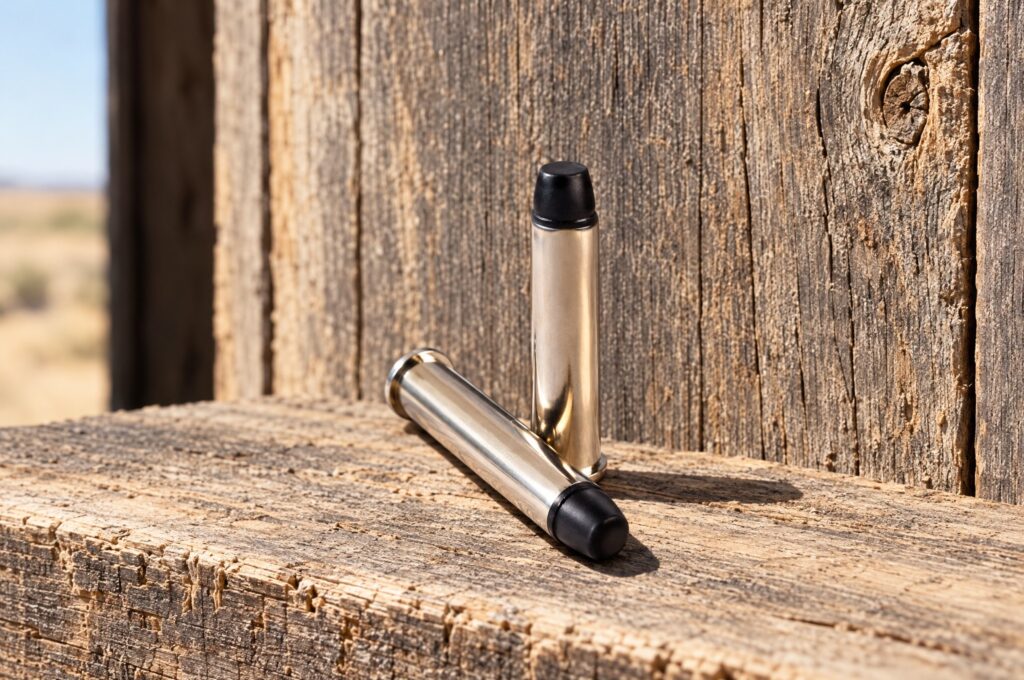
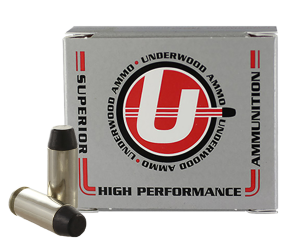
Underwood’s 9mm, .40, .45 and 10mm hard cast drove deeper than anything else here. Every hard cast string passed 23 inches of bare gel, and the 9mm +P 147 gr left the end of 64 inches.
Underwood’s FAQ calls hard cast “our number one choice by us and our customers for wilderness defense” and says “Our hard cast projectiles have a 21 brinell hardness.” It skips gas checks: “our black cherry coating and our tight manufacturing processes eliminates the need for a gas checks.” The Black Cherry coating “prevents lead to bore contact,” so polygonal Glock barrels are approved.
| Hard cast load | Gun | Bare gel | Through 20 ga steel at 30 degrees |
|---|---|---|---|
| .38 Special 150 gr Wadcutter | S&W 442 | 25.75, 25.5, 23.5 in | not shot |
| .38 Special +P 158 gr Keith Hard Cast | S&W 442 | 34.5, 47.5 in | not shot |
| 9mm +P 147 gr Hard Cast | Sig P226 | both passed 64 in | 18.75, 18.5 in |
| .40 S&W 200 gr Hard Cast | Sig P226 | 52, 52.5 in | 17, 16.25 in |
| .45 ACP +P 255 gr Hard Cast | Colt 1911 | 53.5, 50 in | 21.25, 18.75 in |
| 10mm 200 gr Hard Cast | Colt Delta Elite | 58.5, 58 in | not shot |
| 10mm 220 gr Hard Cast | Colt Delta Elite | 60, 59.75 in | 25 in |
Through angled steel the depths dropped to 16 to 25 inches, and several 10mm bullets curved and left the side of the block, which is what flat nose solids often do after a hard hit. Recovered bullets kept at least 91 percent of their weight. No hollow point comes close to this depth, and none is meant to.
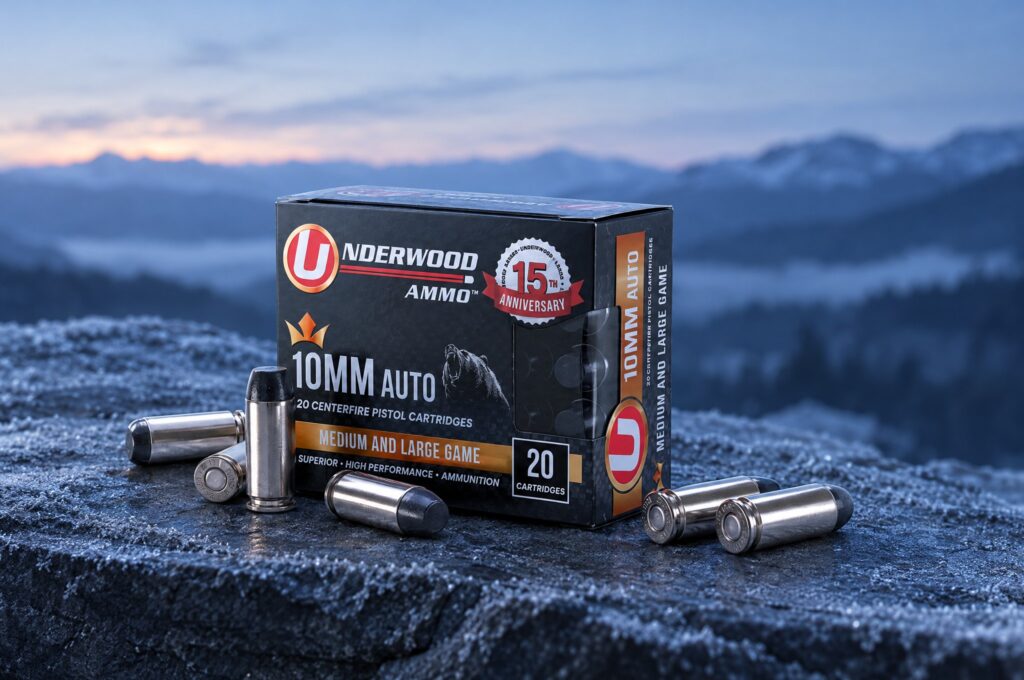
Best Underwood ammo for bears
For Underwood 10mm in bear country, carry the 200 gr or 220 gr hard cast. Underwood rates the 220 gr as the better performer but recommends the 200 gr for guns that dislike long, heavy bullets. In our guns the 200 gr ran 1,215 fps from a Glock 20, and 150 rounds fed without a stoppage in a Glock 20 Gen 5. See our 10mm bear defense guide and bear defense handgun picks for the full picture.
Hard cast vs Xtreme Penetrator
In 10mm our hard cast went 58 to 60 inches of bare gel, and the Xtreme Penetrator stopped at 24.25. Underwood frames the choice the same way: “If your priority is maximum penetration with a clean wound channel that helps preserve the most meat, we recommend the Hard Cast.” For a wider channel it says “If you’re willing to trade some penetration depth for additional wound cavity performance, the Xtreme Penetrator is the better choice.”
For revolvers and lever guns, Underwood loads heavier: a .44 Magnum +P+ 340 gr at 1,425 fps, and .45-70 430 gr hard cast at 1,550 fps standard and 1,925 fps +P. We have not chronographed those three. Our .44 Magnum ammo guide and 45-70 rifle guide cover the guns that can take them.


Underwood XTP Hollow Points
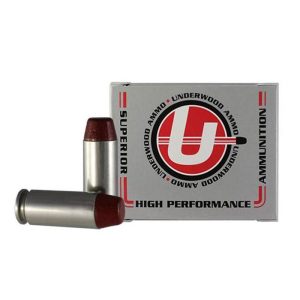
Underwood’s XTP hollow points are its most conventional loads and its biggest line, 36 listings. They expand modestly and drive deep, and like the other loads here they lose speed from short barrels.
The 9mm +P 147 gr XTP ran 1,128 fps from a 4 inch Sig P320, 3 fps over the box. It went 16 inches in bare gel at about 0.6 inches wide, and 20.75 and 21 inches through heavy clothing, past the FBI window. It is a woods 9mm more than a carry load.
The .380 +P 90 gr XTP from a Ruger LCP averaged 1,036 fps against a 1,200 fps box, 164 fps slow. It went 11.75 and 10.75 inches in bare gel and 13 and 13.23 through heavy clothing, opening to about 0.5 inches: short of 12 inches bare, just over it clothed.
In 10mm the 200 gr XTP ran 1,118 fps from a 3.78 inch Glock 29 and grouped 2.9 inches at 15 yards; see our Glock 29 review. The .45 Colt +P 250 gr XTP is in our .45 Colt ammo guide, with chronograph numbers from a Blackhawk and a carbine.
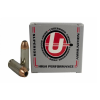


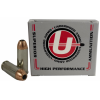
What Happened to Underwood TAC-XP and Gold Dot
TAC-XP is gone from Underwood’s site, and Underwood’s own rule says a product it no longer makes is removed. Gold Dot loads are gone too, and Underwood says why.
Underwood’s FAQ states: “When we are no longer producing a product, it is removed from our website.” In 2023 its product page listed a “9mm Luger +P 115gr. TAC-XP Hollow Point Hunting & Self Defense Ammo” at 1,250 fps; that page and the 10mm and .357 TAC-XP pages now return 404. TAC-XP is a Barnes copper bullet family.
Older reviews still recommend the 10mm TAC-XP, so check the box you are buying against Underwood’s current list. On Gold Dot, Underwood says “We have discontinued use of them throughout our entire line up due to Speer cutting us off” during shortages, and it now points buyers to the Xtreme Defender instead.
Underwood vs Federal HST, Speer Gold Dot and Critical Defense
Against the best 9mm hollow points, the Xtreme Defender trades expansion for consistency. In the same bare gel blocks it went deeper than HST and Gold Dot +P and left a wider channel, but it never grows.
| Load | Gun | fps | Depth | Expanded | Medium |
|---|---|---|---|---|---|
| Underwood Xtreme Defender 9mm +P 90 gr | Glock 17, 4.5 in | 1,501 | 18.00 in | does not expand | bare gel |
| Underwood Xtreme Defender 9mm 90 gr | not recorded | not recorded | 16.5 in | does not expand | leather and denim |
| Federal HST 124 gr | S&W M&P9c, 3.5 in | 1,135 | 18.28 in | 0.61 in | heavy clothing |
| Speer Gold Dot 124 gr | S&W M&P9c, 3.5 in | 1,067 | 18.14 in | 0.54 in | heavy clothing |
| Hornady Critical Defense 115 gr | S&W M&P9c, 3.5 in | 1,143 | 13.06 in | 0.50 in | heavy clothing |
| Hornady Critical Duty 135 gr | S&W M&P9c, 3.5 in | 1,053 | 19.04 in | 0.43 in | heavy clothing |
The hollow point rows are five-shot averages from our HST review, Gold Dot review, Critical Defense review and Critical Duty review, through four layers of heavy clothing from a compact. The Xtreme Defender rows are bare gel and leather with denim, so compare depth with care; against these compact heavy clothing numbers it is about as deep, and the fluted bullet does not need to expand.
Is Underwood ammo good against these? On consistency, yes. Choose HST or Gold Dot if you trust expansion and want the most-tested police loads. Choose the Xtreme Defender if you want lead free, consistent behavior and a gun that runs it.
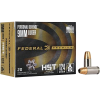
Rival card for comparison, not Underwood: Federal HST 9mm 124 gr.
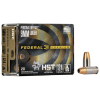
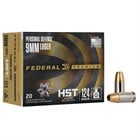
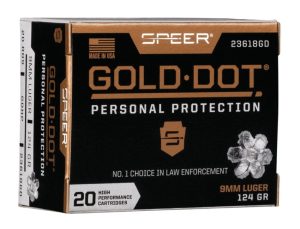
Rival card for comparison, not Underwood: Speer Gold Dot 9mm 124 gr.
Reliability and Known Problems
Underwood ran clean in most of our guns: three feed stoppages and two failures to eject, all with flat nose hard cast. The bigger problems are paperwork, starting with no test barrel on any handgun page.
| Load | Gun | Rounds | Stoppages | What happened |
|---|---|---|---|---|
| 9mm 90 gr Xtreme Defender | Canik METE SFT 4.46 in | 100 | 0 | |
| 10mm 200 gr Hard Cast | Glock 20 Gen 5 | 150 | 0 | |
| 10mm 200 gr Hard Cast | Glock 40 | 100 | 1 | failure to feed, flat nose |
| 10mm 200 gr Hard Cast | Colt Delta Elite | 50 | 1 | failure to feed, flat nose |
| 10mm 200 gr XTP | Glock 29 | 50 | 0 | |
| 9mm +P 147 gr and .40 200 gr Hard Cast | Sig P226 | one box | 0 | |
| 10mm 200 and 220 gr Hard Cast | Colt Delta Elite | one box | 2 | two failures to eject, slide lock-back |
| .45 ACP +P and .45 Super 255 gr Hard Cast | Colt 1911 not set up for .45 Super | one box | 1 | one failure to feed; .45 Super flattened primers |
- Flat nose feeding. In 300 rounds of 10mm 200 gr hard cast across a Glock 20, a Glock 40 and a Colt Delta Elite, we had two failures to feed, each a flat nose stubbing on the ramp. In a second Delta Elite session I also had two failures to eject and the slide locked back on a loaded magazine with the 200 gr; I am not convinced the ammo caused those. Test a few boxes in your gun.
- .45 Super in a standard 1911. Across the .45 ACP +P and .45 Super strings we had one failure to feed, and the .45 Super flattened primers in a gun not set up for it. Use it only in a gun built for it; our .45 ACP ammo guide covers standard .45 loads.
- P365 aftermarket barrels. Underwood warns that “Many aftermarket P365 barrels are produced using a 416R Stainless Steel” and should not see its +P or +P+.
- Blemished seconds. Underwood sells blemished lots and says they “may have either minor cosmetic imperfections caused by the manufacturing processes or an average velocity slightly less than the published velocity.” Fine for practice, not for carry.
- Copy slips. Two product pages list energy that does not match their own velocity: the 10mm 180 gr FMJ and the .400 Cor Bon 140 gr Xtreme Penetrator. Trust the velocity, not the energy, on those two.
Which Underwood Load for Which Gun
Match the load to your barrel length first. Underwood box speeds assume a full-size gun; from a snub or pocket pistol, expect 132 to 215 fps less and pick accordingly.
- Glock 17, 19, 45 or other full-size 9mm: Xtreme Defender 9mm +P 90 gr. It met its box speed in our Glock 17 and stayed in the FBI window.
- Sig P365 or other micro 9mm: standard or +P Xtreme Defender in a factory barrel only, never +P+ in an aftermarket barrel.
- Ruger LCP or other pocket .380: Xtreme Defender 68 gr standard pressure; +P only with the 13 lb spring Underwood names.
- Snub .38 Special: the 150 gr wadcutter for control, or the 100 gr Xtreme Defender; the 158 gr +P Keith is brutal from a 442.
- Glock 20, Glock 40 or Delta Elite in bear country: 10mm 200 gr or 220 gr hard cast, tested for feeding in your gun.
- .44 Magnum revolver or 45-70 lever gun: the heavy hard cast loads, if the gun is rated for them.
Our 9mm ammo test and concealed carry ammo picks rank defensive loads from many makers if Underwood does not fit your gun.
Underwood Ammo Variants
These are the Underwood loads we would shortlist, with Underwood’s box speed. Every one is current on underwoodammo.com; Platinum Edition coated versions exist for several of them.
Who Should NOT Buy Underwood Ammo
Underwood suits shooters who want full-size performance and know their gun. It is the wrong buy for four kinds of shooter, and each has a better load on our site.
- Snub and pocket pistol carriers who want box speed. Our short barrels ran 132 to 215 fps slow; see our concealed carry ammo picks for loads tested from short barrels.
- Buyers who want an expanding bullet. The Xtreme Defender never expands; buy Federal HST or Speer Gold Dot.
- Anyone with an aftermarket P365 barrel or an older gun. Skip +P and +P+; Hornady Critical Defense is a softer, proven 9mm.
- High-volume range shooters. Underwood is priced as premium ammunition; practice with ball from our 9mm ammo guide.
Price and Where to Buy
Underwood prices its defensive loads with premium hollow points such as Federal HST and Speer Gold Dot, not with range ammunition. The cards on this page compare them per round on the day.
Underwood names Sportsman’s Warehouse, Turners Outdoor, Optics Planet, Target Sports and Midway USA as retail partners.
Underwood also sells direct and ships by ground only. Many Xtreme Defender and hard cast loads go in and out of stock, so the card for your caliber is the best check on the day. Prices on the cards update from our dealers; we print none in this review.
Underwood Ammo Review: The Verdict
Underwood Ammo is a strong buy for full-size guns and woods carry: the Xtreme Defender is a consistent 9mm defense load and the hard cast is outstanding. Skip the .380 +P XTP and 9mm 147 gr XTP for carry.
The .380 +P XTP went 10.75 and 11.75 inches in bare gel from a Ruger LCP, and the 9mm +P 147 gr XTP went 20.75 and 21 inches through heavy clothing. Ignore the box speeds from short barrels.
Is Underwood ammo good? Yes, with two conditions: a gun that feeds it and a barrel long enough to reach the box speed. Buy the 9mm +P 90 gr Xtreme Defender for a full-size 9mm and 10mm hard cast for the woods. That is our Underwood Xtreme Defender review in one line.
If you came here asking is Underwood ammo good for your gun, start with the barrel length table above. Our Underwood brand page covers the company, and the HST review and PDX1 Defender review cover the best hollow point alternatives.
Underwood Ammo FAQ
Short answers, from our data and Underwood’s own pages.
Is Underwood ammo good?
Yes, from the right gun. 12 of 13 full-size handgun strings ran within 61 fps of the box, and the 9mm Xtreme Defender and hard cast did their jobs in gel. Snubs ran 132 to 215 fps slow, the .380 +P XTP stopped short of 12 inches and the 9mm 147 gr XTP went 20.75 to 21 inches through clothing.
Does Underwood list a test barrel length?
No. Each product page gives a muzzle velocity, but none of its 132 handgun pages names the barrel it came from. Our numbers suggest a full-size barrel.
Is Underwood ammo SAAMI spec?
Underwood says its 10mm is within SAAMI pressure. But +P+ is not a SAAMI level, and SAAMI defines no +P for .380, .32 ACP or .45 Colt; 14 Underwood handgun listings use those labels, and Underwood publishes no pressure figures.
Does the Xtreme Defender expand?
No. It is a solid copper bullet with a fluted nose that never changes shape. The flutes push tissue sideways, so in our gel the channel measured over 3 inches wide while the bullet kept nearly all its weight.
What is the difference between Xtreme Defender and Xtreme Penetrator?
Underwood says the Defender will not pass 18 inches per caliber and the Penetrator always will. In our bare gel the 9mm Defender stopped near 18 inches and the 9mm Penetrator went past 47.
Should I carry the 68 gr or 90 gr 9mm Xtreme Defender?
The 90 gr for most people. Both stayed inside 12 to 18 inches of ballistic gel in our tests, but Underwood says the 68 gr loses more through sheet metal, plywood and glass. The 68 gr kicks less.
Who makes the Xtreme Defender bullet?
Underwood credits Lehigh Defense: its Xtreme Defender page names Lehigh Defense and lists the bullet as Xtreme Defense, and its Xtreme Penetrator pages call those bullets Lehigh Defense designs. Underwood loads the ammunition in Sparta, Illinois.
Is Underwood good for bear defense?
Its hard cast is. Underwood calls hard cast its first choice for wilderness defense, and our 10mm 200 gr and 220 gr reached 58 inches or more of bare gel. Test feeding in your gun first.
Did Underwood discontinue TAC-XP?
Yes. The TAC-XP pages live in 2023 now return 404, and Underwood says it removes products it no longer makes. It also dropped Gold Dot bullets after Speer stopped supplying it.
Where is Underwood ammo made?
In Sparta, Illinois. Kevin Underwood started the company in 2013, and it sells direct and through dealers.
3,984+ Gun & Ammo Deals
Updated daily from 200+ top retailers. Filter by category, caliber, action type, and price.
Related Guides