

Last updated May 3rd 2026
Some of the links below are affiliate links, meaning at no additional cost to you, we may earn a commission if you click through and make a purchase.
- Treat every gun as loaded
- Point the muzzle in a safe direction
- Keep your finger off the trigger until you’re ready to shoot
- Know your target and what’s beyond
The Guns of Rambo in 2026 at a Glance
| Weapon | Details | Key Specs | Check Price |
|---|---|---|---|
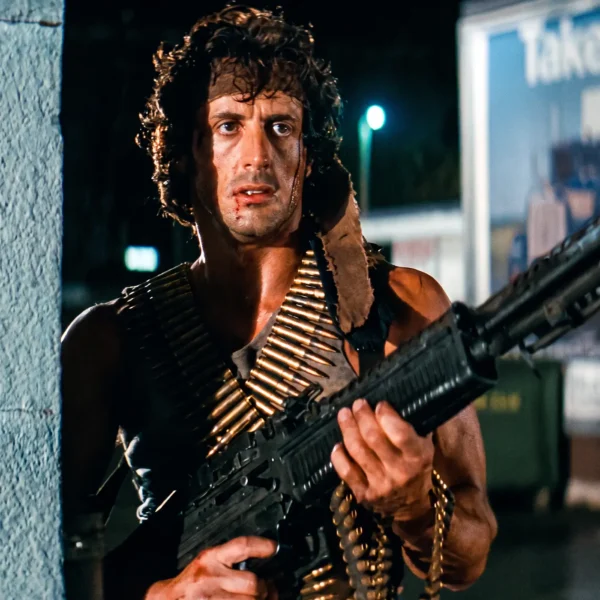 |
Best Overall IconicM60 Machine Gun The original Vietnam-era M60 Rambo strips off a National Guard truck and turns on the town of Hope, Washington. |
Caliber: 7.62 NATO Weight: 22.7 lb Origin: Saco Defense, ME |
Check Price ↓ |
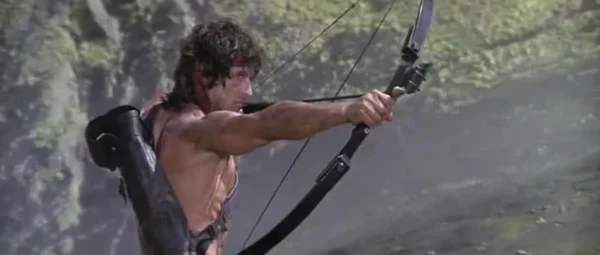 |
Best Signature WeaponHoyt Archery Torque Bow The 55-pound compound that fires the gold-tipped Razorback “explosive” arrows. The single most-imitated archery rig in cinema. |
Draw: 55-60 lb Limbs: Glass Origin: Hoyt Archery, UT |
Check Price ↓ |
| Best Cinematic BladeJimmy Lile First Blood Knife The 9-inch sawback survival knife with hollow handle and compass cap. Heritage Auctions sold a Lile original for $48,000 in 2018. |
Blade: 9″ 440C Spine: Sawback Origin: Russellville, AR |
Check Price ↓ | |
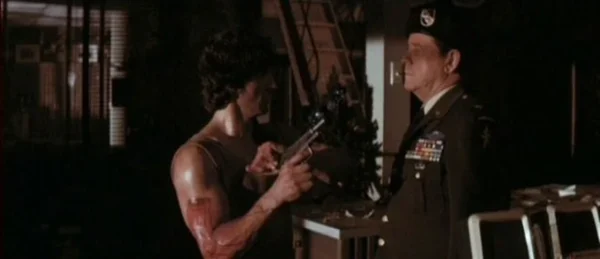 |
Best SidearmColt M1911A1 Government Model Hidden on the longboat in Rambo (2008). Pulled to execute the river-pirate boss after the “who are you” exchange. |
Caliber: .45 ACP Capacity: 7+1 Origin: Hartford, CT |
Check Price ↓ |
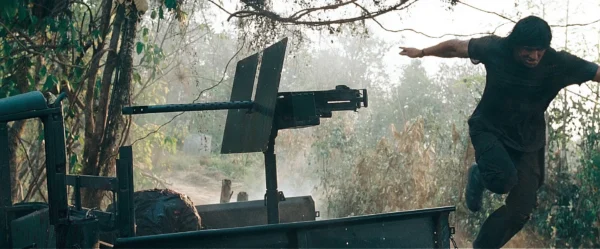 |
Best Mounted Weapon.50 AN/M2 Browning The truck-mount Rambo turns on the Tatmadaw column in the most graphic .50-cal sequence in film history. |
Caliber: .50 BMG Rate: 450-600 rpm Origin: Saco Defense, ME |
Check Price ↓ |
The guns of Rambo across all five films are eight signature weapons: John Rambo’s original Vietnam-era M60 from First Blood, the M60E3 belt-fed he wraps around his forearm in Part II, the Hoyt Archery Torque Bow compound bow that fires the Razorback “explosive” arrows, the captured AKM/AKMS Kalashnikov he picks up off Soviet and Tatmadaw soldiers, the PKM general-purpose Soviet belt-fed in Rambo III, the Colt M1911A1 Government Model hidden on the Burma longboat, the .50 AN/M2 truck mount that ends the Tatmadaw rescue, and the Lile and Hibben survival blades that became the most-recognized cinema knives ever forged.
Table of Contents
Forty Years of Rambo, One Drifter and a Belt-Fed
First Blood landed in October 1982 as a sober, tightly-wound character study about a damaged Green Beret veteran walking the wrong county road. Three sequels and one 2019 coda later, Rambo has become a five-film franchise spanning thirty-seven years, four directors, and one of the most-imitated weapon silhouettes in action cinema. If you want the same treatment on another franchise, we did the guns of John Wick too. The arsenal evolved with every entry, but the through-line is the same: a Special Forces soldier with a knife on his hip and a belt-fed in his hands.
I’ve watched the gas-station rampage at the end of First Blood probably fifty times since I first saw it on rented VHS in 1991, and the M60 work in that scene still lands harder than most modern action film gun choreography. Stallone wasn’t a trained gunner. The film’s armorer drilled him for weeks on belt-feed manipulation, malfunction clearance, and shoulder-mount ergonomics until the manipulations read clean on screen. The result is one of the few late-Vietnam-era M60 depictions in cinema that feels procedurally honest.
Across the franchise, Rambo’s arsenal pulls from four weapon eras: late-Vietnam American (the original M60, M16A1 service rifles), Cold War Soviet (AKM, PKM, RPG-7), 2008-era heavy mounted (.50 AN/M2, DShK), and modern Western practical (Benelli M3, Colt 1911, M1 Garand, Winchester 1892). The franchise spans the Reagan administration through the post-Iraq cartel-violence era, and the guns track the geopolitics.
What follows: every weapon Rambo carries across the five films, the scene that made it iconic, the production-side detail most viewers missed, what civilian alternatives exist in 2026, and live retail pricing if you want to clone a screen-correct piece in your own safe. Plus a sidebar on the Lile and Hibben survival knives, which became their own collector market the year First Blood released.
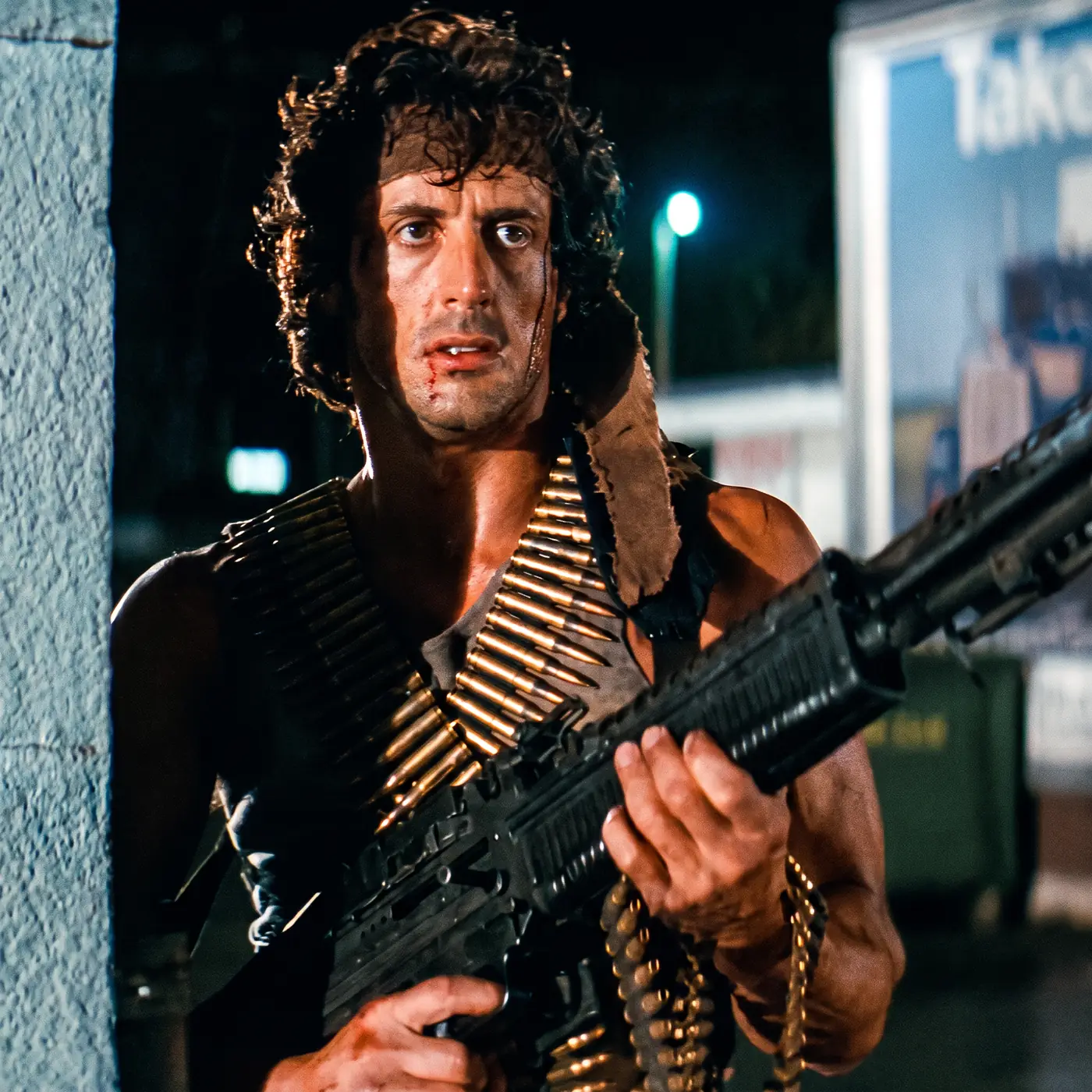
1. M60 Machine Gun: The Hope, Washington Rampage
John Rambo strips an M60 machine gun off a National Guard truck at the climax of First Blood (1982) and walks it through the gas station, the gun shop, and the police station of Hope, Washington, in the most-imitated belt-fed sequence in action cinema.
- Caliber: 7.62x51mm NATO
- Weight: 22.7 pounds (gun only, no ammo)
- Barrel: 22 inches
- Action: Gas-operated, open-bolt, disintegrating-link belt feed
- Rate of fire: ~550 rounds per minute
- Origin: Saco Defense, Saco, Maine
| Rating | |
|---|---|
| Iconic Factor | 5/5 |
| Civilian Legality | 2/5 |
| Affordability | 1/5 |
| Period Authenticity | 5/5 |
| Scene Impact | 5/5 |
Pros
- The single most-recognized belt-fed silhouette in action film history
- Ohio Ordnance Inc. builds civilian-legal semi-auto M60 clones in current production
- Vietnam-era originals are tracked NFA collector pieces with documented provenance
Cons
- Pre-1986 transferable M60s clear $40,000-$80,000 with the NFA stamp
- Ohio Ordnance semi-auto M60E3/E4/E6 clones run $9,995-$13,000 MSRP
- 7.62 NATO belt-feed ammunition pricing makes range time expensive even at the clone level
We do not currently carry this one. It is a real product, just not in our retailer feeds, so there is no live price to show rather than a card that returns the wrong gun.
The M60 in First Blood is the original Vietnam-era M60, not the M60E3 the franchise switches to in Part II. Rambo pulls it off a National Guard support truck after the convoy rolls into Hope, walks the belt up his shoulder, and uses it to vent the gas station, the sporting goods store, and the police station window line.
Stallone trained for weeks with the film’s armorer on belt-feed manipulation. The M60 is famously unforgiving on inexperienced gunners. Belt twist, link separation, and runaway-gun stoppages were all hazards Stallone had to drill until the manipulations read clean on camera. He breaks one belt mid-rampage on screen, slings the gun across his chest, and reseats it without breaking stride.
The M60 is the United States military’s general-purpose machine gun adopted in 1957 to replace the Browning M1919A6 and the BAR. Saco Defense (now part of General Dynamics) built the production runs through Vietnam and into the 1990s. The 7.62 NATO chambering, 100-round disintegrating-link belt feed, and 22.7-pound weight made it the standard squad belt-fed for two generations of US infantry.
For civilian ownership in 2026, the closest screen-correct path is the Ohio Ordnance Inc. M60 series. Ohio Ordnance (Chardon, Ohio) builds semi-auto M60E3, M60E4, and M60E6 belt-fed rifles on their own forged receivers, with the original Saco-pattern barrel groups and stamped trigger groups. The semi-auto conversion is BATFE-approved and ships without NFA paperwork.
Pre-1986 transferable original M60s clear $40,000-$80,000 at GunBroker auctions with the NFA stamp and the Form 4 paper trail. The Ohio Ordnance semi-auto clones run $9,995-$13,000 depending on barrel-group configuration.
For broader belt-fed and crew-served options, see our Machine Guns and How They Changed Combat guide.
Best For: Belt-fed collectors who want the screen-correct Vietnam-era M60 silhouette in a current-production semi-auto clone, with original Saco-pattern barrel and trigger groups.
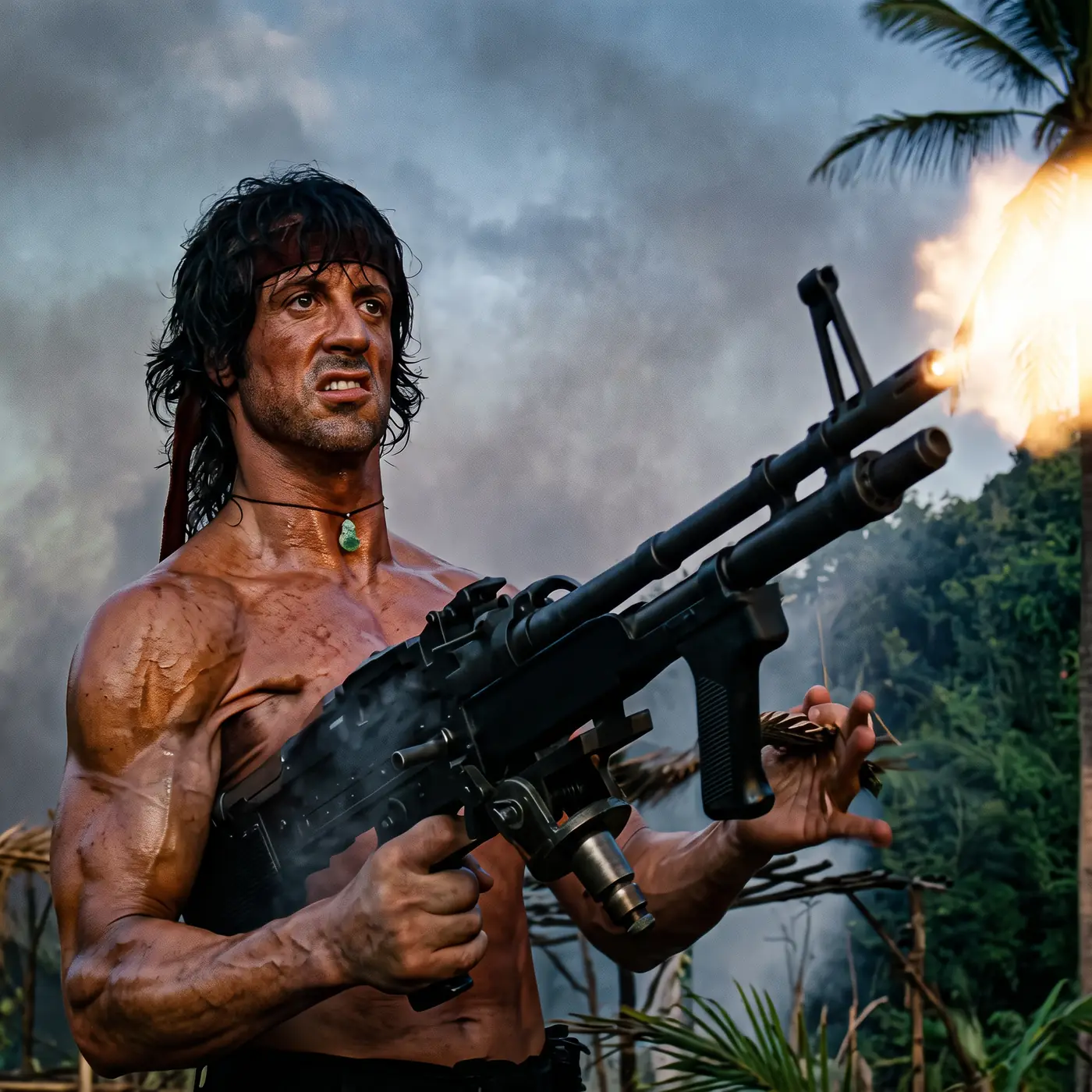
2. M60E3: The Murdock Rain-and-Mud Finale
Rambo carries the lighter M60E3 short-barrel variant through the climactic rescue and rain-and-mud “Murdock” finale of First Blood Part II (1985), with the ammo belt wrapped around his left forearm in the most-imitated belt-fed pose in action cinema.
- Caliber: 7.62x51mm NATO
- Weight: 18.7 pounds (lightened from M60 base)
- Barrel: 18.5 inches (short-barrel “Heavy Barrel” variant)
- Furniture: Forward vertical grip, ambidextrous safety
- Origin: Saco Defense (US Navy SEAL request, refined for SOF use)
| Rating | |
|---|---|
| Iconic Factor | 5/5 |
| Civilian Legality | 3/5 |
| Affordability | 2/5 |
| Period Authenticity | 4/5 |
| Scene Impact | 5/5 |
Pros
- Lightest M60 variant ever issued, designed for SEAL and Marine Corps SOF use
- Ohio Ordnance Inc. builds the M60E3 semi-auto in current production
- The forearm-wrapped belt pose is one of the most-imitated weapon silhouettes in cinema
Cons
- Ohio Ordnance M60E3 semi-auto runs ~$9,995 MSRP
- Original transferable M60E3s clear $50,000+ with NFA paperwork
- Forward grip and short barrel sacrifice cooling capacity vs. the original M60
We do not currently carry this one. It is a real product, just not in our retailer feeds, so there is no live price to show rather than a card that returns the wrong gun.
The M60E3 should not be in this film at all. It was not introduced until the mid-1980s, which makes a Soviet door gunner holding one in a Vietnam-set story genuinely strange, and Part II is very likely the first film ever to put an M60E3 on screen. It beat Commando into theatres by four months and twelve days, and it predates the US military adopting the E3 by roughly a year. There is a continuity goof stacked on top: the gun has a full-length barrel when the door gunner fires it, and a short barrel from the moment Rambo takes it off the chopper.
The Part II M60E3 is the variant the production team chose for visual silhouette. By 1985 the M60E3 was a recently-developed Saco refinement requested by the US Navy SEAL community: shorter barrel, forward vertical grip, ambidextrous safety, and four pounds shaved off the base M60 weight. The Marine Corps adopted it shortly after.
The film actually pre-dates the official US military adoption of the E3, which is the kind of production-armorer detail that gets the gun-knowledge crowd excited. The screen unit was supplied through the production armorer with original Saco markings.
The forearm-wrapped belt is the iconography. Stallone wraps the disintegrating-link 7.62 NATO belt around his left forearm during the rain-and-mud Murdock confrontation, fires from the hip, and walks the gun through the camp. The wrap is technically poor field practice. Live belt-feed manipulation calls for a feed tray and an assistant gunner, not a forearm wrap. But it reads on screen as raw, primal, soldier-against-the-system, and it became the single most-imitated machine-gun pose in action film history.
Ohio Ordnance Inc. builds the civilian-legal semi-auto M60E3 with original Saco-pattern stamped trigger groups and the period-correct 18.5-inch heavy barrel. Retail runs $9,995. The forward vertical grip and the ambidextrous safety are both period-correct to the screen unit.
Original pre-1986 transferable M60E3s rarely surface for sale. The few that do clear $50,000-$70,000 with the NFA stamp and the Form 4 paper trail. Ohio Ordnance semi-auto clones are the practical buy for anyone wanting the screen-correct Part II silhouette in their safe.
Best For: SOF-history collectors and Rambo fans who want the M60E3 short-barrel “Murdock” variant with the forward vertical grip and the screen-correct belt-fed silhouette, in a current-production semi-auto clone.
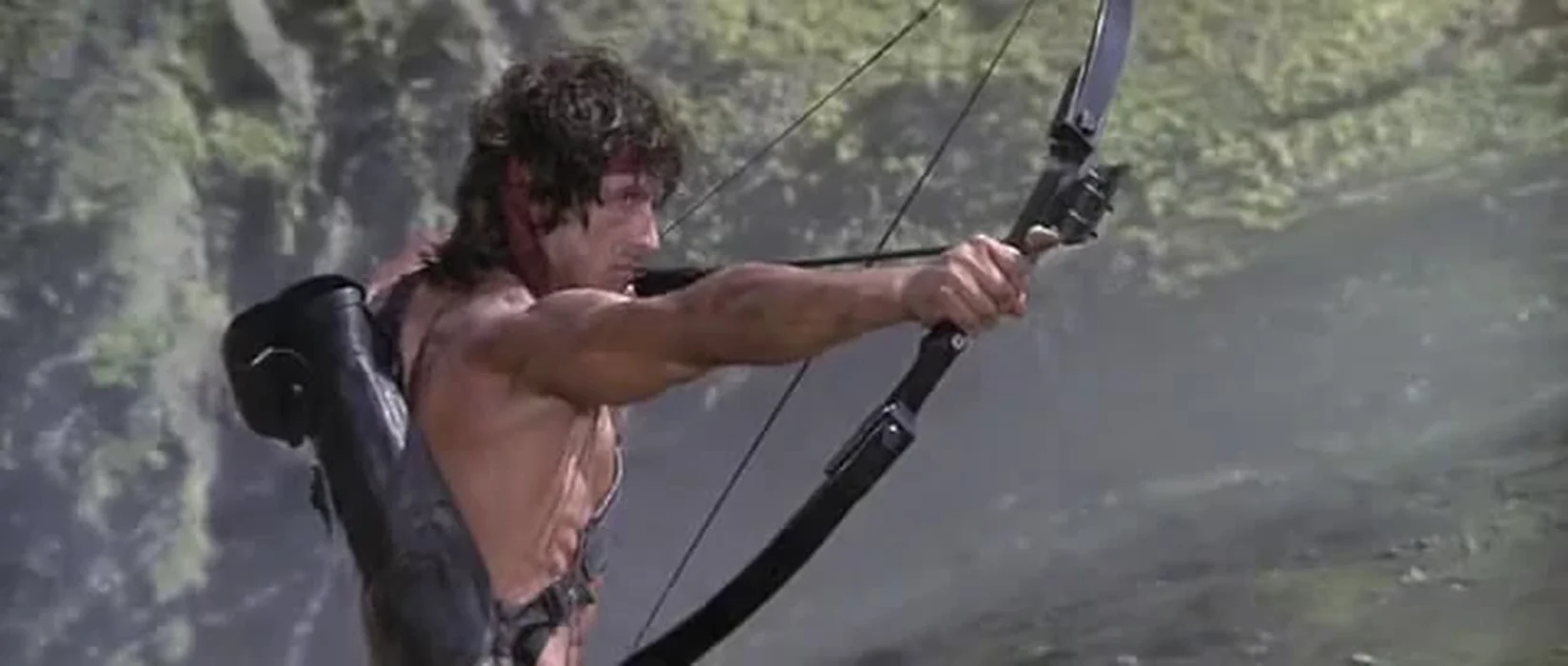
3. Hoyt Archery Torque Bow: The Razorback Arrow Tips
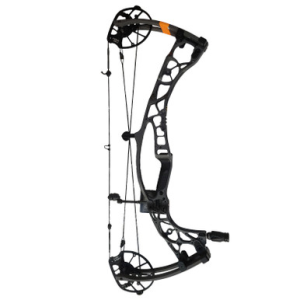
Rambo carries a Hoyt Archery Torque Bow compound bow with glass limbs and Omega wheels through First Blood Part II (1985), firing the gold-tipped Razorback 5 broadhead arrows that the film props out as “explosive” tips for the helicopter-killing scene.
- Draw weight: 55-60 pounds (period-spec)
- Limbs: Glass laminate (period-correct)
- Wheels: Omega round (period Hoyt cam system)
- Axle-to-axle: ~30 inches
- Origin: Hoyt Archery, Salt Lake City, Utah
| Rating | |
|---|---|
| Iconic Factor | 5/5 |
| Civilian Legality | 5/5 |
| Affordability | 3/5 |
| Period Authenticity | 5/5 |
| Scene Impact | 5/5 |
Pros
- The most-recognized compound bow in action cinema history
- Hoyt is still in business and shipping current-flagship compounds in Salt Lake City
- Original 1980s Hoyt compounds surface in the vintage archery collector market
Cons
- Original Hoyt Archery Torque Bows are discontinued; clean examples run $1,000-$3,000
- Modern Hoyt flagship compounds (RX-9, PowerMax) start ~$1,099
- The “explosive arrow” tips were prop pyrotechnics, not a real product
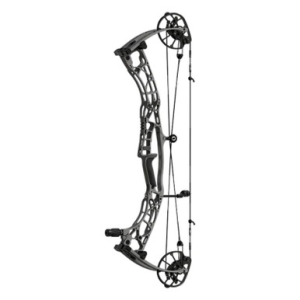
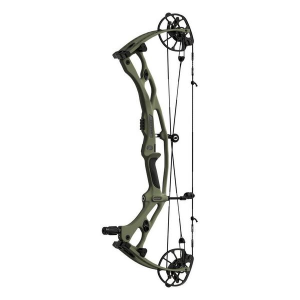
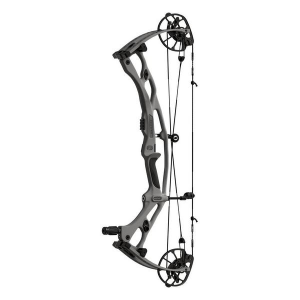
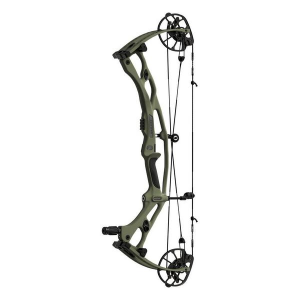
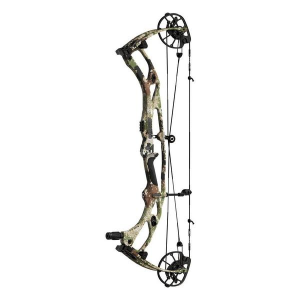
The Hoyt Archery Torque Bow is the bow Stallone shoulders into the Vietnamese POW camp in Part II. He fires it from the hip, from a kneeling position, and from a treetop perch, killing two Soviet advisors and one helicopter gunner across the second act. The helicopter-killing arrow is the cinematic moment everyone remembers.
The arrow tips are props. The “explosive arrows” were Razorback 5 broadheads with the cutting blades painted gold and capped, with the actual pyrotechnics handled by film FX. There was no real explosive payload riding the broadhead. The visual effect of the helicopter exploding was a rigged squib charge on the chopper rotor, timed to the arrow impact.
Hoyt Archery has built compound bows in Salt Lake City since 1931. Their mid-1980s target and hunting compounds ran glass limbs and round wheels, and a typical 50-60 pound draw weight depending on the limb spec. The film unit was a 55-pound configuration, fitted with Razorback broadheads and the gold cap-and-paint treatment.
That generation of bow is long discontinued. Vintage examples surface in the collector market at $1,000-$3,000 depending on condition and provenance. Cartertown Archery in Pennsylvania specialises in the period bows and ships Rambo-spec replicas built on vintage limbs.
For a current-production Hoyt that scratches the same itch, the practical buy is the Hoyt PowerMax 8 (entry-flagship, ~$649), the RX-9 (top flagship, ~$1,299), or the Highline (mid-range, ~$899). All three ship from Salt Lake City and use the same limb-pocket and cam architecture as the 1980s flagships.
Best For: Compound-bow collectors who want either an original 1980s Hoyt Archery Torque Bow in vintage trim from a specialty dealer, or a current-production Hoyt flagship that descends from the same Salt Lake City limb-pocket lineage.
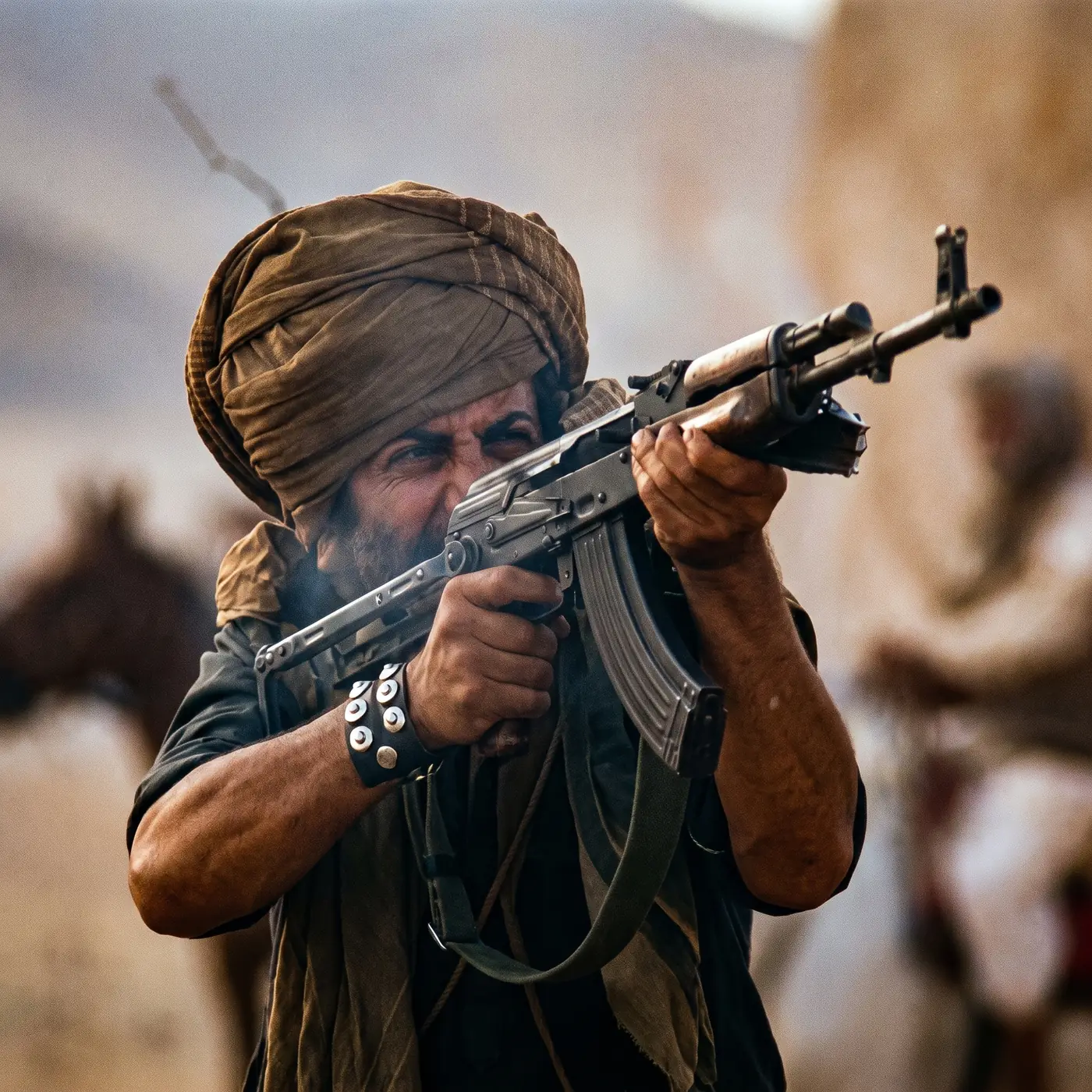
4. AKMS Underfolder: The Captured-Soviet Rifle
Rambo picks up an AKMS underfolder Kalashnikov off Soviet and Tatmadaw soldiers across First Blood Part II, Rambo III, and Rambo (2008), firing the captured 7.62×39 rifle through trench-clearing sequences in the POW camp escape and the Mujahideen cave fights.
- Caliber: 7.62x39mm
- Capacity: 30-round steel magazine
- Action: Long-stroke gas piston, rotating bolt
- Barrel: 16.3 inches
- Stock: Underfolder steel wire (AKMS variant)
- Origin: Mikhail Kalashnikov design, Soviet Izhmash production
| Rating | |
|---|---|
| Iconic Factor | 4/5 |
| Civilian Legality | 4/5 |
| Affordability | 4/5 |
| Period Authenticity | 5/5 |
| Scene Impact | 4/5 |
Pros
- The most-issued service rifle in the world, period-correct for every Rambo sequel
- Century WASR-10 ships under $900 from Romanian-built receivers
- Zastava ZPAP M70 underfolder is the closest current-production AKMS clone
Cons
- Original Soviet-marked AKMS imports are pre-1989 collector pieces
- Underfolder stock variants are less commonly imported than fixed-stock AKMs
- 7.62×39 ammo pricing has tightened post-2022 import restrictions
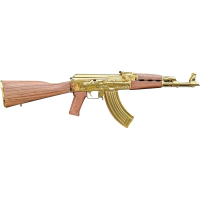
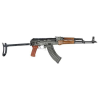
The AKMS is the standard “captured Soviet rifle” of the Rambo sequels. He pulls one off a Vietnamese guard in Part II during the trench-clearing sequence, picks up another off a Soviet officer in the Rambo III cave fight, and uses an AKM-pattern Type 56 against the Tatmadaw in the 2008 entry. The screen units are typically full-auto registered transferables supplied through the production armorer.
The Rambo III rifle is technically dressed as an AKS-74 with the under-folding stock, but the screen unit is chambered in 7.62×39, not 5.45×39. The 5.45 chambering is the period-correct Soviet round for an AKS-74, but in 1987-88 American production armorers had effectively no commercial 5.45 ammo to work with. The pragmatic call was an AKMS dressed up to look 74-pattern. The cosmetic illusion holds.
The Kalashnikov is the most-issued service rifle in modern military history, with more than 100 million units produced across Soviet, Romanian, Bulgarian, Hungarian, East German, Yugoslav, Chinese, and North Korean factories from 1947 forward. The AKM (modernised AK) entered Soviet service in 1959 with stamped receiver construction; the AKMS adds the wire underfolder stock for paratroop and vehicle-crew use.
For civilian ownership in 2026, the closest screen-correct path is a Zastava ZPAP M70 underfolder (Serbian-built, Century-imported, ~$1,099) or a Pioneer Arms AKMS clone (~$899). Both ship in 7.62×39 with the steel underfolder stock and original AKM-pattern receiver and gas system.
Century WASR-10 fixed-stock AKMs are the budget option at ~$899 if the underfolder isn’t a priority. Original Soviet-marked imports from the 1989-1994 import window surface at GunBroker for $2,500-$4,500 in clean condition.
For broader AK-pattern coverage, see our Best AK-47 Rifles roundup.
Best For: AK-pattern collectors who want the period-correct AKMS underfolder Rambo carries through the sequel arc, in a modern Zastava or Pioneer-built clone with original 7.62×39 chambering.
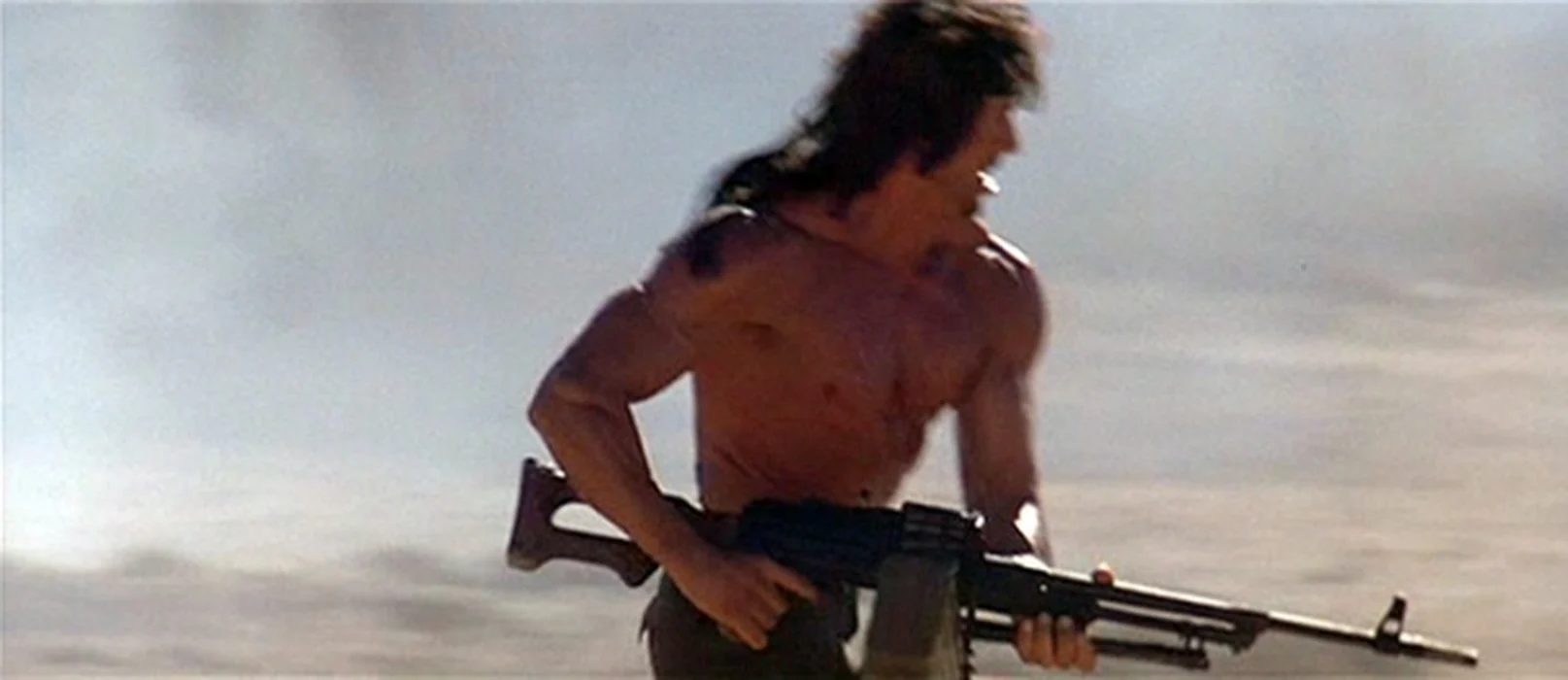
5. PKM: The Soviet Belt-Fed of the Final Battle
Rambo strips a PKM off a Soviet emplacement in Rambo III (1988) and uses the captured 7.62x54R Soviet belt-fed against the Mi-24 Hind crews in the Afghan tank-vs-helicopter finale.
- Caliber: 7.62x54mmR (Russian rimmed)
- Weight: 16.5 pounds (gun only)
- Capacity: 100, 200, or 250-round non-disintegrating belt
- Rate of fire: ~650-750 rounds per minute
- Origin: Mikhail Kalashnikov design, Soviet Vyatskie Polyany production
| Rating | |
|---|---|
| Iconic Factor | 4/5 |
| Civilian Legality | 2/5 |
| Affordability | 1/5 |
| Period Authenticity | 5/5 |
| Scene Impact | 5/5 |
Pros
- The Soviet equivalent of the M60, same role, lighter, more reliable in dust
- Pioneer Arms and DDI ship semi-auto PKM clones in current production
- 7.62x54R is one of the most affordable belt-fed cartridges on the surplus market
Cons
- Semi-auto PKM clones run $10,000-$15,000
- Pre-1986 transferable PKMs are extremely rare on the US registry
- 7.62x54R surplus availability has tightened post-2022 import restrictions
We do not currently carry this one. It is a real product, just not in our retailer feeds, so there is no live price to show rather than a card that returns the wrong gun.
The PKM is the Soviet general-purpose machine gun. Mikhail Kalashnikov’s team designed it in the early 1960s as the rifle-caliber belt-fed counterpart to the AKM, chambered in the older 7.62x54R Russian rimmed cartridge to maintain commonality with the Mosin-Nagant and SVD ammo logistics chain.
It entered Soviet service in 1969, replacing the heavier RP-46 and SGM. The PKM is significantly lighter than the M60 it competes against (16.5 vs 22.7 pounds) while delivering a slightly higher rate of fire and superior reliability in dust, mud, and Arctic conditions. It became the standard Warsaw Pact and proxy-state belt-fed and remains in service across more than sixty current militaries.
Stallone’s Rambo III character pulls a PKM off a Soviet emplacement during the cave-system breakout and uses it against the Mi-24 Hind helicopters during the Afghan finale. The film deploys the PKM as the visual counterpoint to the M60E3 of Part II, same role, opposite alliance, and the framing reads cleanly even to viewers who don’t know the gun by name.
For civilian ownership in 2026, the closest screen-correct path is the Pioneer Arms PKM-S semi-auto clone (~$10,995) or the DDI (Desert Tech / Detonics Defense International) PKM build (~$13,000-$15,000). Both ship in 7.62x54R with the Soviet-pattern PKM receiver, gas system, and feed cover. The semi-auto conversion is BATFE-approved and ships without NFA paperwork.
Pre-1986 transferable original PKMs are extraordinarily rare on the US registry. The few that have surfaced cleared $80,000-$120,000 with the NFA stamp at auction. The semi-auto clones are the only practical path for the screen-correct PKM in 2026.
Best For: Belt-fed collectors who want the Soviet counterpoint to the M60 in their safe, in a current-production semi-auto PKM clone with original 7.62x54R chambering and Soviet-pattern receiver.
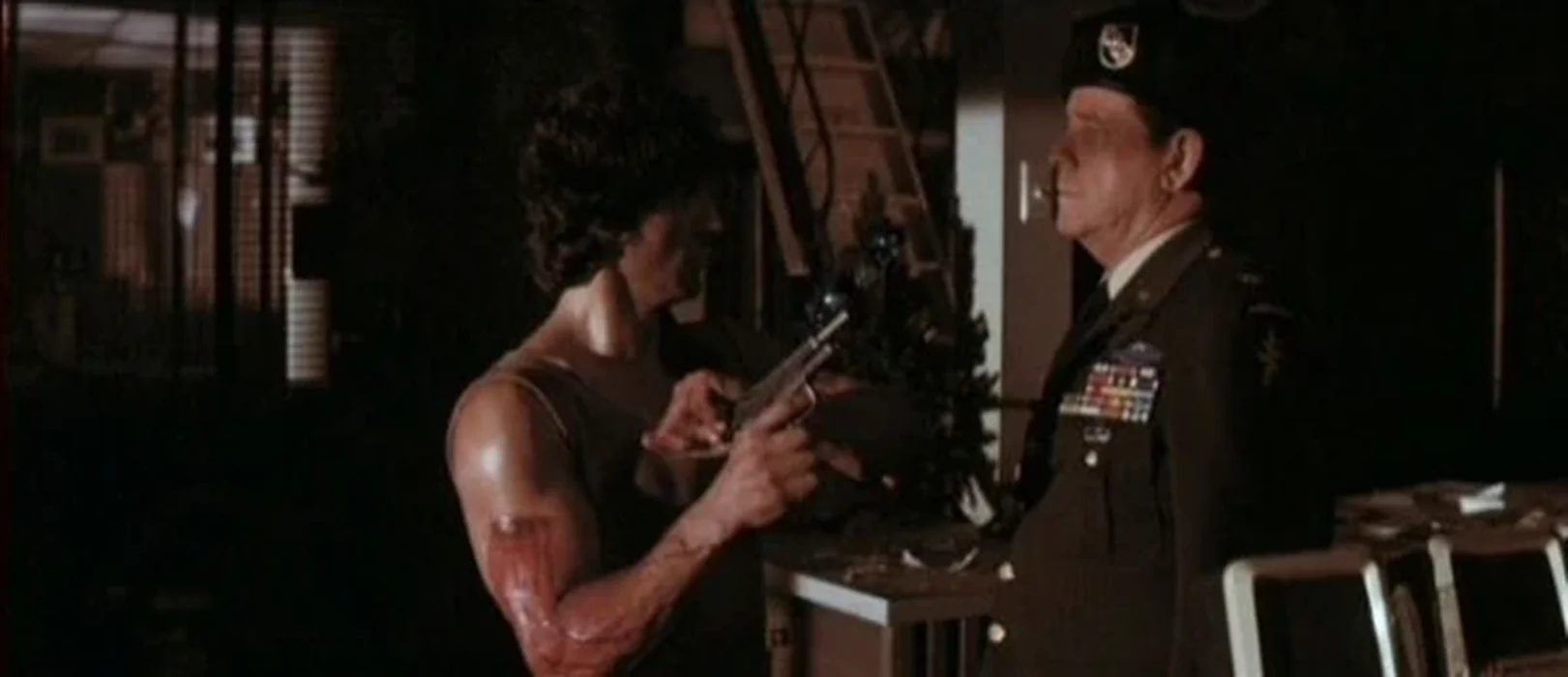
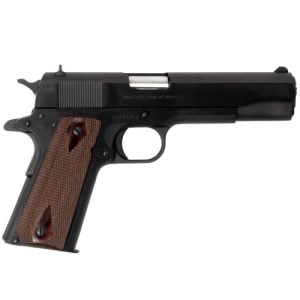
6. Colt M1911A1 Government Model: The Burma Longboat Sidearm
Rambo carries a Colt M1911A1 Government Model hidden on the longboat in Rambo (2008), pulling it for the point-blank execution of the river-pirate boss after the “who are you” exchange and the most-quoted scene of the franchise’s late arc.
- Caliber: .45 ACP
- Capacity: 7+1 (single-stack magazine)
- Barrel: 5 inches
- Action: Single-action, recoil-operated
- Weight: 2.4 pounds
- Origin: Colt’s Manufacturing, Hartford, Connecticut
| Rating | |
|---|---|
| Iconic Factor | 4/5 |
| Civilian Legality | 5/5 |
| Affordability | 4/5 |
| Period Authenticity | 5/5 |
| Scene Impact | 5/5 |
Pros
- John Browning’s 1911 design has been in continuous production for 114 years
- Colt Series 70 Government MSRP runs ~$1,099, accessible mid-tier .45 ACP
- Springfield Mil-Spec 1911 ships at ~$799 for budget-tier screen-correct 1911s
Cons
- Single-stack 7+1 capacity is limited by modern carry pistol standards
- Steel-frame 1911 weight (2.4 lb) is heavy for daily concealment
- Series 70-spec internals require period-correct disassembly knowledge for service
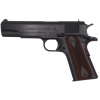
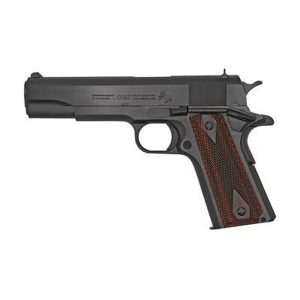
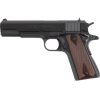
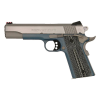
The 2008 Rambo opens with John Rambo running a longboat ferry on the Salween River, hauling missionaries upstream into the Burmese jungle. The 1911 is hidden under the deck planking. He pulls it after the river-pirate boss tries to leverage one of the missionaries off the boat.
The “who are you” exchange ends with Rambo putting a single round through the pirate boss’s head at point-blank range, then walking the muzzle across the rest of the crew. The sequence is the moment the 2008 entry establishes itself as the most violent of the franchise. The 1911 returns briefly in Last Blood (2019) as a backup pistol during the ranch-tunnel siege.
The Colt M1911A1 Government Model is John Browning’s 1908 design, refined through 1911 service-pistol trials and adopted by the US Army the same year. It served as the standard US military sidearm from 1911 through 1985, when it was officially replaced by the Beretta M9. The A1 designation marks the 1924 refinements (arched mainspring housing, shorter trigger, longer grip safety spur). Colt has built the design in continuous production for 114 years.
For civilian ownership in 2026, the closest screen-correct path is the Colt Series 70 Government (~$1,099 MSRP), the same Hartford-built 1911 platform with Series 70 internals matching the 2008-era production spec. Springfield Armory’s Mil-Spec 1911 (~$799) is the budget-tier alternative with the same operating system and a 5-inch barrel.
Premium-tier 1911 options for the Rambo-aesthetic build include the Wilson Combat Government (~$3,800), the Nighthawk Custom Heinie Tactical Carry (~$4,200), and the Les Baer Premier II (~$2,400). All three are hand-fit single-stack .45 ACP 1911s with the same Government-model frame and slide profile.
For broader 1911 buying coverage, see our Best Cheap 1911 Pistols Under $500 guide and our Best .45 ACP Ammo roundup.
Best For: 1911 buyers who want the screen-correct Government Model that Rambo carries on the longboat, in a Colt Series 70 production-spec build with single-stack .45 ACP and the original Browning operating system.
7. .50 AN/M2: The Burma Truck-Mount Massacre
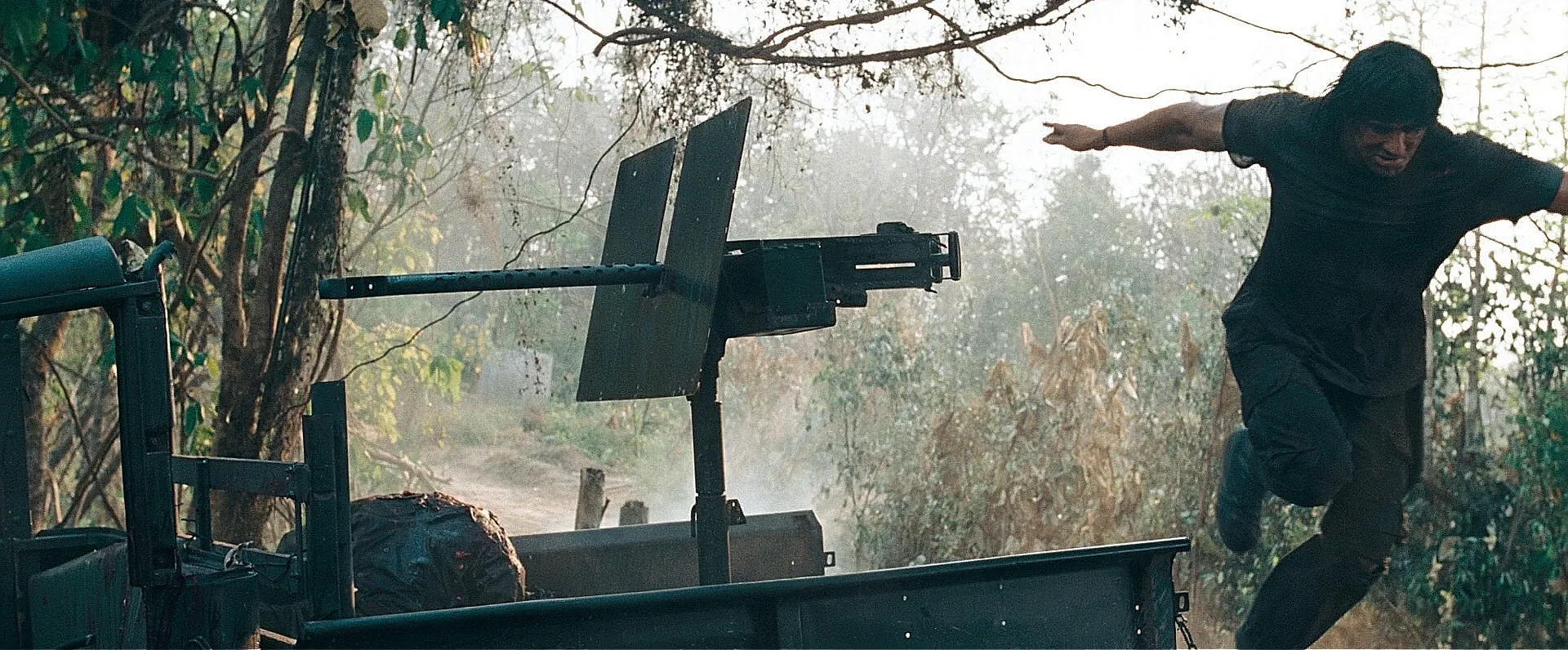
Rambo turns a truck-mounted .50 AN/M2 on the Tatmadaw column in the climactic rescue of Rambo (2008), in the most graphically violent .50-caliber sequence in feature film history.
- Caliber: .50 BMG (12.7x99mm)
- Weight: 84 pounds (gun only, no tripod)
- Barrel: 45 inches
- Rate of fire: 450-600 rounds per minute
- Action: Short-recoil, belt-fed, air-cooled
- Origin: John Browning design, FN Herstal / Saco Defense production
| Rating | |
|---|---|
| Iconic Factor | 5/5 |
| Civilian Legality | 2/5 |
| Affordability | 1/5 |
| Period Authenticity | 5/5 |
| Scene Impact | 5/5 |
Pros
- The longest-serving heavy machine gun in US military history (1933 to present)
- Serbu BFG-50A semi-auto .50 BMG ships in current production at ~$8,995
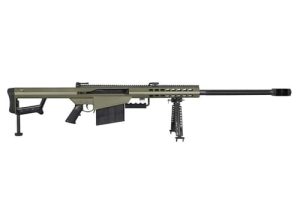
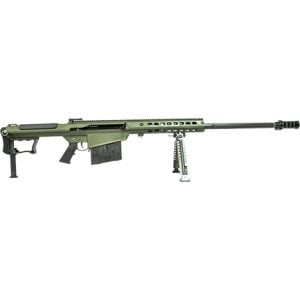
- Single-shot Barrett M82 / Armalite AR-50 .50 BMG rifles cover the same caliber
Cons
- Full-auto M2s are dealer-sample / registered transferable only, six-figure pricing
- .50 BMG ammunition costs $5-$8 per round at the cheap end
- No civilian-legal belt-fed M2 conversion exists in the US registry
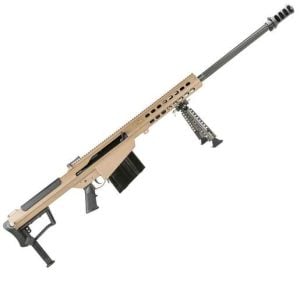
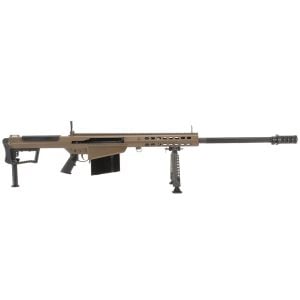
It is not the M2HB most people assume. The gun on the truck is a .50 AN/M2, the aircraft-flexible model, and you can identify it on screen from the long perforated barrel shroud and the big ring sight. The AN/M2 wore that shroud because wartime aircraft gunners fired far longer bursts than ground crews, the barrels ran red hot, and the jacket both shielded the crew and shed heat. The film’s gun also carries a muzzle brake to throw the flash sideways, which matters when you are firing from behind an armored shield and the only thing you can see over is the barrel.
And the production story is better than the gun. Stallone was originally going to fire it by hand. The M2 was weighed at over 120 pounds, he could physically carry and shoot it, but it was so slow and cumbersome that it killed the pace of the scene. So they mounted it on the back of a jeep instead, and the recoil promptly ripped the floor out of the jeep. They ended up bolting the mount straight to the frame, and that is the rig you see in the film.
The Browning M2 sequence is the violent peak of the franchise. Rambo crosses the river on foot, cuts the Tatmadaw gunner’s throat with the Hibben machete, mounts the M2 on the truck pintle, and walks the .50 BMG fire across the column for roughly four minutes of screen time. The film’s DVD commentary lists the sequence as the highest body count Stallone has ever delivered in a single scene.
The screen unit is a real M2HB on a real M3 tripod, supplied through the production armorer in Mexico (where the film shot the rescue exteriors). The belt feed, the recoil, the muzzle flash, and the brass ejection are all live-fire.
The Browning M2 is the longest-serving heavy machine gun in US military history. John Browning designed the .50 BMG round and the M1921 receiver during World War I; the M2 entered service in 1933 and remains in current service across the entire Western world ninety-two years later. The 84-pound gun, 45-inch barrel, and ~550 rpm rate of fire have not meaningfully changed since.
For civilian ownership in 2026, the M2 itself is functionally unobtainable. Full-auto M2HBs exist on the US registry as dealer-sample or registered transferable, with the latter clearing $200,000-$400,000 at auction with the NFA stamp. The practical .50 BMG path is a single-shot or semi-auto rifle in the same chambering.
The Serbu BFG-50A is a magazine-fed semi-auto .50 BMG rifle (~$8,995). The Barrett M82A1 is the iconic semi-auto .50 BMG sniper rifle (~$11,000-$13,000). The Armalite AR-50A1 is a single-shot bolt-action .50 BMG rifle (~$3,500). All three deliver the .50 BMG cartridge experience without the NFA registry barrier.
Best For: .50 BMG buyers who want the closest civilian-legal path to the cartridge Rambo uses on the Tatmadaw column, in a Serbu semi-auto, a Barrett M82, or an Armalite AR-50 single-shot bolt-action.
8. Last Blood: The Colt, the Garand and the Winchester
Last Blood (2019) is the one everybody forgets when they list the arsenal, and it is the only film in the series where Rambo actually carries a sidearm. That is not a small detail for a character defined for thirty-seven years by a knife and a belt-fed.
The sidearm is a Colt M1911A1, and it is deliberately not the same pistol from Rambo (2008). That one had been customized with an ambidextrous safety and an extended slide stop. This is a plain gun. The man has gone home, and his kit has gone plain with him.
The tunnel finale is where the film shows its hand. Rambo works the last act with an M1 Garand and a Winchester 1892 Saddle Ring Carbine, which is to say the franchise that opened on a Vietnam-issue belt-fed closes on a WWII service rifle and a lever gun from 1892. He also runs an M16A2 fitted with A1 triangular handguards in the tunnels, and there is an M16A1 in the arsenal in his cave, alongside the archive Vietnam footage that opens the film.
The cartel side carries the modern hardware: Colt Model 933 carbines, M4A1s, AKS-74U shorties, SIG P226 and H&K USP pistols, and an ornate nickel-plated 1911 for Hugo Martinez. The contrast is the whole point. They bring 2019, he brings 1892, and the tunnels do the rest.
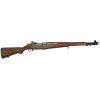
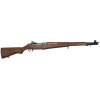
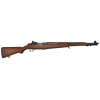
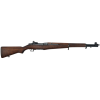
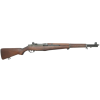
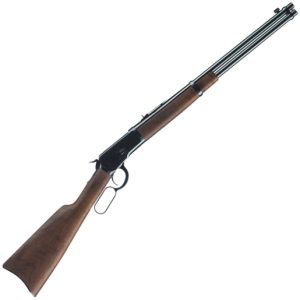
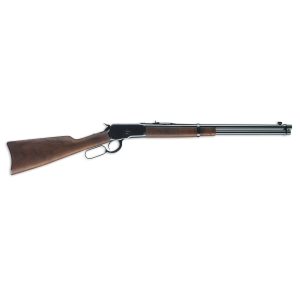
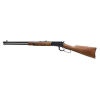
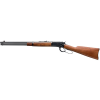
Both are current-production buys. Winchester still still lists the 1892 carbine in .45 Colt and .44-40, and the Garand market runs from CMP service-grade rifles up to collector Springfields. If you want the Last Blood look rather than the Vietnam one, that is a far more achievable safe than a belt-fed. For more on the lever side see our best lever action rifles guide.
Best For: Shooters who want the closing-chapter Rambo kit, a plain .45, a Garand and a lever carbine, all of which are buyable today without an NFA stamp or a five-figure check.
9. Jimmy Lile and Gil Hibben Survival Knives: The Rambo Signature
The Lile, Hibben, and Pohl survival knives Rambo carries across all five films are the most-recognized cinema blades ever forged, with the original Jimmy Lile First Blood knife clearing $48,000 at Heritage Auctions in 2018.
- First Blood (1982): Jimmy Lile “First Blood” knife, 9″ 440C blade, hollow handle with compass
- First Blood Part II (1985): Jimmy Lile “Mission” knife, 9″ 440C, brass-pinned leather handle
- Rambo III (1988): Gil Hibben Bowie, 10″ clip-point, stag handle, brass guard
- Rambo (2008): Hibben “golok” machete, D2 truck-spring slab, deliberately rough-forged
- Last Blood (2019): Dietmar Pohl MK-9 “Heartstopper”, 9″ Niolox, olive Micarta handle
| Rating | |
|---|---|
| Iconic Factor | 5/5 |
| Civilian Legality | 5/5 |
| Affordability | 3/5 |
| Period Authenticity | 5/5 |
| Scene Impact | 5/5 |
Pros
- Hibben Knives still produces the official Rambo III and Rambo IV licensed reproductions
- United Cutlery ships budget-tier UC1158 First Blood reproductions at ~$60-$120
- Original Jimmy Lile pieces are top-shelf collector blades with documented auction history
Cons
- Original Lile First Blood knives clear $20,000-$50,000 at auction
- Hibben Rambo III stag-handle Bowie reproductions run $400-$700
- United Cutlery reproductions are stainless wallhangers, not field-grade survival knives
We do not currently carry this one. It is a real product, just not in our retailer feeds, so there is no live price to show rather than a card that returns the wrong gun.
The First Blood knife is the start of an entire collector market. Jimmy Lile (Russellville, Arkansas) was a custom Bowie knife maker working out of a small shop when Stallone’s production team approached him in 1981. Lile delivered fourteen custom blades for the production, with hollow-handle construction housing a sewing kit, fishing line, hooks, and a compass cap.
The 9-inch 440C blade with the sawback spine and the cord-wrapped handle defined the survival-knife genre. Lile #14 of the original production run sold at Heritage Auctions for $48,000 in 2018. Lile-marked First Blood reproductions from his original shop run $20,000-$50,000 in clean condition.
For Part II, Lile delivered the refined “Mission” knife with a longer 9-inch blade and a brass-pinned leather handle, dropping the hollow-handle compass cap. For Rambo III, Lile declined the more elaborate jungle-bowie spec, and the production team approached Gil Hibben (LaGrange, Kentucky). Hibben took over the franchise and has produced licensed reproductions since.
The 2008 entry introduced a deliberately crude D2-steel machete that Stallone reportedly ordered Hibben to roughen, the first prototype came back “too perfect” for the character’s revised aesthetic. Last Blood swapped to Dietmar Pohl’s MK-9 “Heartstopper” with a 9-inch Niolox blade and an olive Micarta handle, with Hibben’s earlier RIV machete hung on the ranch wall as a callback to the previous film.
For collector purchase in 2026, the practical paths are: United Cutlery UC1158 First Blood reproduction ($60-$120, stainless wallhanger spec), Hibben Knives Rambo III stag-handle Bowie reproduction ($400-$700, official licensed), and Pohl Force MK-9 Heartstopper ($600-$900, official Last Blood production knife). For the original Lile market, GunBroker, Heritage Auctions, and Cartertown all surface period pieces.
Best For: Knife collectors who want either the licensed Hibben Rambo III Bowie reproduction, the Pohl Last Blood MK-9 production knife, or a budget-tier United Cutlery First Blood wallhanger reproduction at the entry price point.
How I Researched the Rambo Arsenal
The film identifications above were cross-referenced across IMFDB’s franchise pages (used for verification only, not cited as authority, IMFDB is a wiki, not a primary source), period production interviews with armorer Jim Cuthbert and FX coordinator Steve Lampkin, BLADE Magazine’s archival coverage of Lile and Hibben, and Rock Island Auction Company’s catalog history of pre-1986 transferable M60 and M60E3 sales. Specs and current pricing come from manufacturer catalogs (Ohio Ordnance, Hibben Knives, Hoyt Archery, Colt’s Manufacturing, Springfield Armory, Serbu Firearms), GunBroker auction records for 2024-2026 transferable sales, and current retail listings as of May 2026.
Where film props or production decisions diverge from real-world weapon specifications, I’ve flagged it inline. The Part II “explosive arrows” were prop pyrotechnics with painted Razorback broadhead caps, not a real product. The Rambo III AKS-74 dressing on a 7.62×39 AKMS receiver was a 1987-era armorer’s pragmatic call given the absence of commercial 5.45 ammo at the time of filming. The First Blood M60 is the original Vietnam-era M60, not the M60E3 the franchise adopts in Part II, a common misattribution worth correcting.
Related Reading
- The guns of John Wick (2014)
- Best lever action rifles
- Best AR-15 rifles
- Best .308 rifles
- Best semi-auto tactical shotguns
- Best online gun stores
- Today’s gun deals
- The Guns of Predator (1987): Every Weapon Identified
- The Guns of Scarface (1983): Every Weapon Identified
- The Guns of The Matrix (1999): Every Weapon Identified
- The Guns of John Wick 3: Every Weapon Identified
- Machine Guns and How They Changed Combat
- Best AK-47 Rifles
FAQ: The Guns of Rambo
What machine gun does Rambo use in First Blood?
John Rambo strips a Vietnam-era M60 machine gun off a National Guard truck at the climax of First Blood (1982). It is the original Saco-built M60 chambered in 7.62x51mm NATO with a 22-inch barrel and a 100-round disintegrating-link belt feed, not the M60E3 short-barrel variant the franchise switches to in First Blood Part II.
What bow does Rambo use in First Blood Part II?
Rambo carries a Hoyt Archery compound bow, widely known as the "Torque Bow" because of the exploding arrow tips. IMFDB does not name the exact model and Hoyt has never publicly confirmed it. The tips themselves are Razorback 5 broadheads with their protective covers left on and hand-painted gold so they read as miniature warheads on camera. The explosions were prop pyrotechnics.
Are the Rambo knives still made today?
Yes. Hibben Knives still produces licensed Rambo III and Rambo IV reproductions in Kentucky. United Cutlery ships budget-tier UC1158 First Blood reproductions at $60 to $120. Original Jimmy Lile First Blood knives clear $20,000 to $50,000 at auction, with a documented 2018 Heritage Auctions sale at $48,000 for Lile #14 of the original run.
Can civilians legally own an M60 like the one in First Blood?
Yes, with two paths. Pre-1986 transferable original M60s exist on the US registry but require an NFA tax stamp, the Form 4 paper trail, and $40,000 to $80,000 in cash. The practical civilian path is an Ohio Ordnance Inc. semi-auto M60E3, M60E4, or M60E6 clone built in Chardon, Ohio, retailing $9,995 to $13,000 with no NFA paperwork required.
What pistol does Rambo carry in the 2008 film?
Rambo carries a Colt M1911A1 Government Model in .45 ACP, hidden under the deck planking of his Salween River longboat. He pulls it for the point-blank execution of the river-pirate boss after the who-are-you exchange, and again briefly in Last Blood as a backup pistol during the ranch-tunnel siege. The civilian-legal current-production equivalent is the Colt Series 70 Government, retailing around $1,099.
Does Rambo ever use a Minigun in any of the films?
Yes, in First Blood Part II. A GE M134 Minigun is mounted on the right side of the UH-1, and Rambo fires it electrically from the controls when he strafes the POW camp. One of the freed POWs then mans it and kills a Soviet Hind door gunner with it. Worth knowing: that Hind is actually an Aerospatiale Puma dressed in Soviet markings. The other sustained-fire high point is the truck-mounted .50 AN/M2 in Rambo (2008).
4,618+ Gun & Ammo Deals
Updated daily from 200+ top retailers. Filter by category, caliber, action type, and price.