

Some of the links below are affiliate links, meaning at no additional cost to you, we may earn a commission if you click through and make a purchase.
Most people who search for the M16 rifle are really asking one of two things. Either they want to know whether the AR-15 in their safe is the same gun the military carries, or they want to know what it would take to own an actual M16. The answers are no and about thirty thousand dollars, and the reasoning behind both is more interesting than you would expect.
I have built AR-15 pattern rifles for years. The difference between one of those and a genuine M16 is smaller than most people expect, and it sits entirely inside the lower receiver.
Table of Contents
How we tested: Every pick here is ranked against our testing methodology. Minimum round counts, accuracy and reliability protocols, the failures that disqualify a gun.
M16 Rifle: The Short Answer
The M16 is a select-fire military rifle, which makes it a machine gun in federal law. Civilians can own one only if it was registered before May 19, 1986, and those sell for roughly $24,000 to $55,000 because the supply is permanently frozen. An AR-15 is the semi-automatic version of the same design and is not a machinegun.
M16 vs AR-15: What Actually Differs
Externally, a 20 inch AR-15 with a carry handle and an M16A2 look almost identical. Same Stoner gas system, same bolt carrier group layout, same magazines, same 5.56 NATO chambering. Hand one to someone who has never shot either and they would not be able to tell you which was which.
The difference lives in three parts inside the lower receiver. An M16 has a third fire control position, an auto sear, and a bolt carrier with a longer rear shelf that trips that sear as the bolt closes. An AR-15 lower is machined without the pocket those parts need. That is the whole of it.
This matters legally more than it matters mechanically. The receiver is the serialized part, so the ATF treats a lower machined to accept the auto sear as a machine gun whether or not the sear is fitted. People have gone to prison over a hole in the wrong place. If you are building, buy from a known manufacturer and do not get creative with a drill.
| Feature | M16A4 | Semi-auto AR-15 |
|---|---|---|
| Fire control | Safe / semi / 3-round burst | Safe / semi |
| Auto sear | Yes | No, and the pocket is absent |
| Bolt carrier | Full rear shelf | Cut down (though full carriers are legal) |
| Legal status | Machine gun under the NFA | Ordinary rifle |
| Cost | $24,000 to $55,000 if pre-1986 | $400 to $2,000 |
If the naming still confuses you, our explainer on what the AR in AR-15 actually stands for clears up the other half of the myth. It does not stand for assault rifle.
M16 Rifle Specs and Figures
| Specification | Detail |
|---|---|
| Caliber | 5.56x45mm NATO |
| Barrel length | 20 inches |
| Twist rate | 1:14 earliest, 1:12 on M16A1, 1:7 from M16A2 |
| Weight, unloaded | 6.37 lb (M16A1), 7.5 lb (M16A2 and A4) |
| Magazine | 20 round originally, 30 round standard |
| Cyclic rate | 700 to 900 rounds per minute depending on variant |
| Effective range | 550 m point target, 800 m area target |
| In service | 1964 to present |
| Produced | Around 8 million M16s |
| Transferable examples in civilian hands | Fixed since 1986, supply cannot grow |
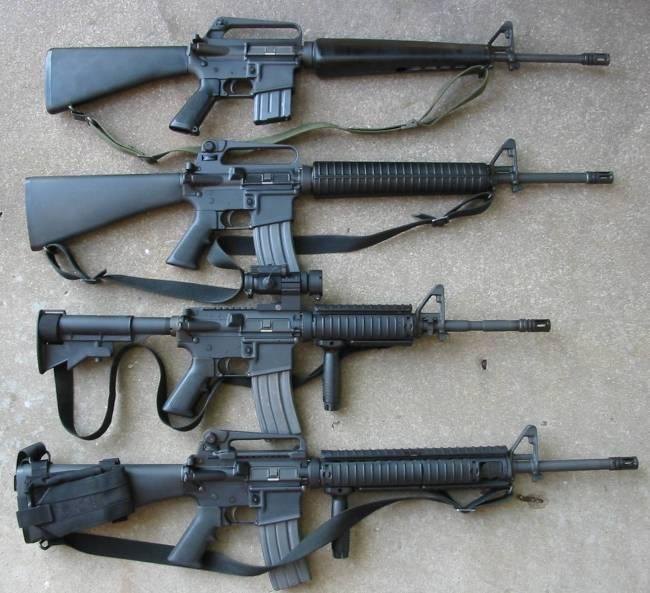
M16A1 to M16A4: The Variants
| Variant | Adopted | What changed | Fire control |
|---|---|---|---|
| M16 | 1964 | Original, no forward assist | Full auto |
| M16A1 | 1967 | Forward assist, chromed chamber and bore | Full auto |
| M16A2 | 1983 USMC, 1986 Army | Heavy barrel, 1:7 twist, adjustable rear sight, case deflector | Semi and 3-round burst |
| M16A3 | Limited issue | An A2 with the burst group swapped for full auto | Full auto |
| M16A4 | 1997 | Removable carry handle, Picatinny flat-top | Semi and 3-round burst |
M16A1
The M16A1 is the Vietnam rifle, adopted in 1967 after the original M16 embarrassed itself in the field. It added a forward assist, a chrome-lined chamber and bore, and a revised flash hider. Fire control is safe, semi and full auto, which makes it one of only three M16 variants that will empty a magazine on one trigger pull. Twenty inch barrel, 1:12 twist, 6.37 lb empty. On the transferable market it usually carries a premium over later variants because of the Colt markings and the history.
M16A2
Adopted by the Marine Corps in 1983 and the Army in 1986, the A2 is the biggest single revision the platform ever received. Heavier barrel profile, 1:7 twist to stabilize the heavier M855 projectile, a fully adjustable rear sight, a case deflector for left-handed shooters, and a redesigned handguard. The important change for our purposes is the fire control: the A2 dropped full auto for a three-round burst. Anyone telling you they held the trigger down on an A2 and emptied the magazine is describing a rifle that does not exist.
M16A3
The A3 is the variant most people have never heard of, and it is simply an A2 with the burst group swapped back for full auto. It went to Navy SEAL teams and some Seabee units in small numbers. Because it is mechanically an A2 with a different trigger pack, it rarely appears as a distinct entry on the transferable market.
M16A4
The 1997 A4 is the modern one. It keeps the A2 barrel, twist and burst trigger, and replaces the fixed carry handle with a Picatinny flat-top so optics can be mounted properly. Most service A4s were fitted with the KAC rail system and an ACOG, which is the configuration in the photograph at the top of this page. It stayed in Marine Corps service well past the point the M4 was supposed to have replaced it.
The chrome lining on the M16A1 is the detail worth dwelling on. Early rifles went to Vietnam without it, with the wrong powder, and without cleaning kits, and troops died with jammed rifles in their hands. Congress held hearings about it. The platform’s reputation took two decades to recover, and a fair amount of the “AR-15s are unreliable” folklore still floating around traces back to 1967. Our guide to Vietnam War guns explains what actually caused the jamming.
For the full story of how a lightweight ArmaLite design became the standard American service rifle, we have a complete history of the AR-15 platform.

Can Civilians Own an M16? The Law
Three separate pieces of law stack up here, and they do different jobs.
The National Firearms Act of 1934 did not ban machineguns. It taxed and registered them. A $200 stamp, a lot of paperwork, and you could own one. That $200 was punitive in 1934 and it has never been adjusted for inflation, which is why the same figure looks trivial today.
The Gun Control Act of 1968 tightened who could transfer them and added import restrictions. Then came the one that actually closed the door. The Firearm Owners’ Protection Act of 1986 added subsection (o) to 18 U.S.C. § 922, and its first line is short enough to quote in full: “It shall be unlawful for any person to transfer or possess a machinegun.”
The exceptions are government agencies, and any machinegun “lawfully possessed before the date this subsection takes effect.” The statute itself never names a date. May 19, 1986 is the day the Firearm Owners’ Protection Act was signed, which is what fixes the cutoff. The text just says before this takes effect.
The practical result is a market with a hard ceiling on supply. Every transferable M16 in civilian hands was registered before that date, and no more can ever be added. Demand rises, the pool does not, and prices do what you would expect.
What a transferable M16 costs in 2026
Current asking prices run roughly $24,000 to $40,000 for an M16A1 and $30,000 to $40,000 for an M16A2, with Colt-marked receivers commanding a premium and the broader range stretching to about $55,000 for desirable examples. Registered sears and conversion kits sit lower because they are not complete rifles, though they carry their own legal complexity.
On top of the purchase you are looking at a $200 transfer stamp, an ATF Form 4, fingerprints, photographs, chief law enforcement officer notification, and a wait measured in months. Your state may prohibit the whole thing regardless of federal law. Machineguns are flatly banned for civilians in a number of states, so check before you start saving.
How a Transfer Actually Works
Buying a transferable M16 is not a counter transaction. The rifle sits with the seller, usually a dealer holding a Special Occupational Tax license, while the paperwork grinds through the ATF.
- Agree on the sale and pay, often into escrow. The gun does not move.
- File an ATF Form 4 in duplicate, with fingerprint cards, passport photographs and a $200 tax payment.
- Notify your chief law enforcement officer. This is notification, not permission.
- Wait. Approval times swing between a few months and the better part of a year.
- Collect once the stamp comes back. The tax stamp lives with that specific serial number.
Buying through a trust rather than as an individual is common, mostly so more than one person can legally possess the rifle. Talk to an attorney who does NFA work before you set one up, because a badly drafted trust causes problems years later when the estate is settled.
Registered sears and conversion kits
Some of what trades as an “M16” is really a registered auto sear or a registered conversion kit rather than a complete rifle. A registered sear has a practical advantage over a registered receiver, because it can be moved between host rifles. That portability means sears often trade at or above complete transferable rifles rather than below them, so do not assume a sear is the cheap option. The paperwork is identical. Read the description carefully before you wire money, since the two are not interchangeable and the price gap is large.
What about M16s made after 1986?
They exist in large numbers, and you cannot own one. A machine gun manufactured after May 19, 1986 can be possessed by government agencies, and by licensed dealers who hold a Special Occupational Tax stamp, as what the trade calls a dealer sample. Those guns are tied to the license. When a dealer gives up the license the post-86 samples have to go to another licensee or be destroyed, which is why they never enter the civilian pool.
This is the answer to a question people ask constantly: if civilians cannot own modern machine guns, how do rental ranges have racks of them? The answer is that the range holds the license, you are shooting their gun on their premises, and nothing is transferred to you.
State Law Still Applies
Federal law sets the floor, not the ceiling. A number of states prohibit civilian machinegun ownership outright, and others require permits or registration on top of the federal process. California, Delaware, Hawaii, New York, New Jersey, Rhode Island, Washington and the District of Columbia are among the jurisdictions that make this a non-starter for a private owner.
I am deliberately not publishing a definitive fifty-state table here. When I checked the equivalent lists for forced reset triggers, three published guides contradicted each other on which states banned them, and a wrong answer on a machinegun is a far more serious matter than a wrong answer on a trigger. Check your own state code, and speak to an attorney in your state before you commit thirty thousand dollars.
M16 vs M4: What Replaced It
The M4 carbine is the same rifle with a 14.5 inch barrel and a collapsible stock. It is handier in vehicles and buildings, which is why it displaced the M16 in most frontline units, and it gives up muzzle velocity for that convenience. A 20 inch barrel pushes 5.56 meaningfully faster, and terminal performance on the older M855 load was velocity dependent, so shorter barrels were a real trade rather than a free upgrade.
Reliability testing has not always favored the shorter gun. In a 2002 Marine Corps comparison the M4 malfunctioned around three times as often as the M16A4, 186 stoppages against 61 across roughly 69,000 rounds. Later testing narrowed that gap as the carbine matured, though the M16A4 kept a reliability edge that its longer barrel and gas system largely explain.
In April 2022 the Army selected the SIG MCX Spear, designated XM5 at the time, later redesignated XM7 and then M7, chambered in 6.8x51mm for close combat formations. Whether that actually displaces the platform across the force is a different question, and the M16A4 has already outlasted several of its intended replacements.
Shooting an M16: What 600 Rounds Taught Us
We put 600 rounds through a registered M16A1 and a burst-equipped M16A4 across two sessions, shooting Federal American Eagle 55 grain M193 and IMI 62 grain M855, at 55 to 70 degrees with light crosswind. Magazines were a mix of USGI aluminum and Magpul PMAG Gen M3. The point of the exercise was not accuracy testing. It was to find out how much of the magazine is actually useful.
A cyclic rate around 800 rounds per minute sounds ferocious written down. In the shoulder it is a very fast buzz rather than the hammering you get from a belt-fed gun, and it empties a 30 round magazine in a little over two seconds.
Standing at 100 yards with the A1 on full auto, the first round goes where you aimed and nothing else does. Our second shot landed about a foot right and high of the first, the third roughly two feet right and high of that, and by then the whole burst was around three feet off the target. It took until somewhere near the seventh round before we could drag the muzzle back down onto the silhouette, by which point most of the magazine was gone. Off a bipod at 50 yards it is manageable. Standing, it is a demonstration rather than a technique.
The three-round burst on the A4 is a different weapon in practice. Our hit rate on a torso silhouette at 100 yards roughly doubled against the same drill on full auto, which matches what the Army found when it made the change: three rounds gains you something, five or thirty gains you very little, and past three rounds hit probability falls away. That is the whole argument for the A2 and A4 dropping full auto, and 600 rounds is enough to make it obvious.
The burst mechanism has one genuine annoyance. It is a mechanical counter that does not reset between pulls, so if you fire a burst that gets interrupted the next pull gives you the remaining one or two rounds, and the trigger weight changes depending on where in the cam cycle it stopped. You feel it immediately. Only the M16, M16A1 and the limited-issue M16A3 fire unrestricted full auto.
Malfunctions across 600 rounds: two failures to feed, both in the same tired USGI aluminum magazine and both in the first session, and one failure to extract with the M855 in the A1 at round 430. Nothing attributable to the rifles. Both got noticeably hotter than a semi-automatic AR-15 ever does, and the A1 handguard was uncomfortable to hold after four magazines fired quickly.
Is it worth thirty thousand dollars? For almost everybody, no. Rental ranges in Las Vegas and a handful of other cities will let you shoot one for the price of a magazine of ammunition, which is the sensible way to satisfy the curiosity. Thirty thousand dollars buys a very good semi-automatic rifle and years of ammunition instead.
The Closest Thing You Can Actually Buy
The closest thing on the shelf is not a Colt. Harrington & Richardson build semi-automatic replicas of the two variants this page has spent most of its length on, and they are faithful in the details that matter: the Retro M16A1 Style comes in both the original 1/12 twist and a modern 1:7, and the M16A2 Chrome Lined has the chrome bore that fixed the Vietnam problem. Twenty inch barrel, A2 furniture, one fire control group short of the real thing.
If you want the flat-top A4 silhouette rather than a fixed carry handle, Colt still catalog an AR15A4 at a similar price. Either way you are buying the rifle the military carried, minus the auto sear.
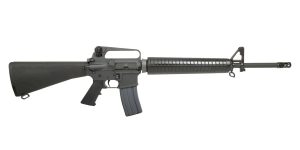
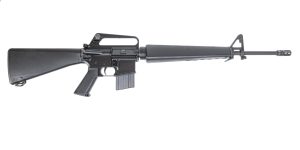
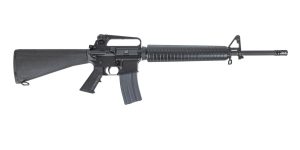
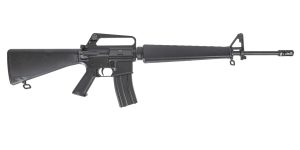
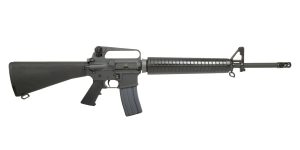
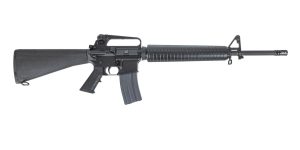
If you want the look rather than the badge, a 20 inch upper with a fixed carry handle gets you an A2 silhouette for a fraction of the money, and plenty of makers build them. For everything else on the platform, our AR-15 buyer’s guide ranks what is worth buying at each budget, and the price check tool shows live pricing across retailers.
One thing to be clear about. No trigger, spring or accessory turns an AR-15 into an M16, and anything sold on that promise is either misdescribed or illegal. Devices that raise the rate of fire without adding a second shot per trigger function, such as forced reset triggers, are a separate legal category with their own rules.
Semi-Auto Clones You Can Actually Buy
Best-priced firearms across 200+ retailers · Updated every 4 hours
FAQ
Can civilians own an M16?
Only if the rifle was registered as a machinegun before May 19, 1986. Those are called transferable and they sell for roughly 24,000 to 55,000 dollars. Any M16 made after that date can only be owned by government agencies or licensed dealers.
Is an AR-15 the same as an M16?
No. They share the same Stoner design, magazines and 5.56 chambering, but an M16 has a third fire control position, an auto sear and a bolt carrier that trips it. An AR-15 lower is machined without the pocket those parts need and fires one round per trigger pull.
How much does an M16 cost in 2026?
A transferable M16A1 runs about 24,000 to 40,000 dollars and an M16A2 about 30,000 to 40,000, with Colt-marked receivers at a premium and desirable examples reaching 55,000. Add a 200 dollar transfer stamp and a wait measured in months.
Is it legal to convert an AR-15 to full auto?
No. Machining a lower receiver to accept an auto sear creates an unregistered machinegun, which is a federal felony. The ATF treats the modified receiver as the machinegun whether or not the sear is fitted.
Can you own an M16 made after 1986?
Not as a private individual. Post-1986 machine guns can only be held by government agencies or by licensed dealers with a Special Occupational Tax stamp, as dealer samples tied to that license. That is how rental ranges have them.
Where can I shoot an M16 without owning one?
Rental ranges in Las Vegas and several other cities keep post-1986 dealer samples and rent them by the magazine. You are shooting the range's gun on their premises, so nothing is transferred to you and no paperwork is involved.
Is the M16 still used by the US military?
The M4 carbine displaced it in most frontline units, though the M16A4 remained in Marine Corps service long after it was due for replacement. In April 2022 the Army selected the SIG MCX Spear, now the M7, for close combat formations.
4,335+ Gun & Ammo Deals
Updated daily from 200+ top retailers. Filter by category, caliber, action type, and price.