

Last updated May 17th 2026
Some of the links below are affiliate links, meaning at no additional cost to you, we may earn a commission if you click through and make a purchase.
- Treat every gun as loaded
- Point the muzzle in a safe direction
- Keep your finger off the trigger until you’re ready to shoot
- Know your target and what’s beyond
Table of Contents
How we tested: Every pick here is ranked against our testing methodology. Minimum round counts, accuracy and reliability protocols, the failures that disqualify a gun.
Sig MCX Spear LT Review: The AR-15 Killer That Almost Is
This Sig MCX Spear LT review is built on 500 rounds through the standard 16″ 5.56 NATO model, Federal XM193, PMC Bronze, Hornady Frontier bulk, plus Federal Gold Medal Match 77gr SMK and Hornady BLACK 75gr BTHP for the accuracy work. Zero malfunctions. 1.5 MOA average with match ammo.
The short-stroke piston is the cleanest-running 5.56 platform I have shot, and the folding stock genuinely changes how you store and transport this rifle. Below: the full scorecard, range data, variant lineup, competitor cards, who should not buy this rifle, and the proprietary-BCG question every long-term buyer has to think about.
Our Rating: 8.5/10
- MSRP: $2,619.99
- Street Price: $1,800-$2,200
- Caliber (tested): 5.56 NATO (also offered in .300 BLK and 7.62×39)
- Action: Semi-Auto, Short-Stroke Gas Piston
- Barrel Length: 16 in (Cold Hammer Forged Steel), 1/2×28 TPI threaded
- Twist Rate: 1:7
- Overall Length: 34.3 in (extended) / 26.5 in (folded)
- Width: 2.8 in
- Height: 7.8 in
- Weight (Unloaded): 7.4 lbs
- Magazine: 30rd Polymer (AR-15 compatible)
- Stock: Folding Minimalist Plus
- Handguard: Lightweight Ergonomic M-LOK/Picatinny
- Trigger: SIG 2-Stage Matchlite Duo (Flat)
- Muzzle Device: SIG QD Suppressor-Ready Flash Hider
- Finish: Black Anodized
- Made in: Newington, NH (Sig Sauer USA)
Pros
- Short-stroke piston runs insanely clean even after 500 rounds of mixed bulk and match ammo, my BCG looked like it had 50 rounds through it
- Folding minimalist stock collapses the rifle to 26.5 inches without buffer-tube limitations, fits in a standard backpack
- 1.5 MOA average accuracy with Federal Gold Medal 77gr, better than most DI ARs at this price
Cons
- 7.4 lbs unloaded is a full pound heavier than a comparable BCM RECCE-16 or Aero AC-15
- $2,600 MSRP is a gut punch for a 5.56 rifle when a BCM gets you 90% there for $1,000 less
- Proprietary bolt carrier group, not AR-15 compatible, spare BCGs only from Sig
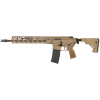
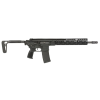
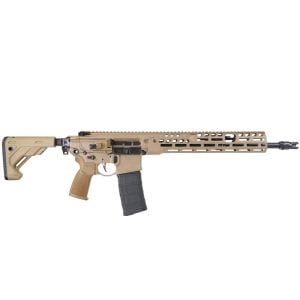
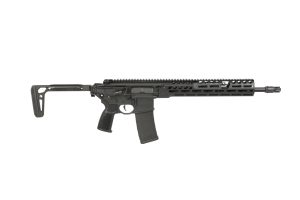
Quick Take
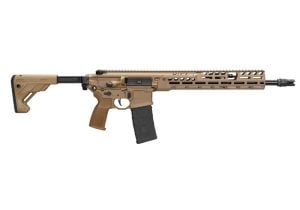
I have wanted to run an MCX hard for years. Sig has been iterating on this platform since 2015, and the Spear LT is the third generation. It takes everything they learned from the military MCX Spear program in 6.5 Creedmoor and 7.62 NATO and distills it down into a lighter, 5.56-friendly package. The result? A rifle that genuinely feels like the next step beyond the AR-15. Not a replacement. An evolution.
After 500 rounds, here’s the short version. It runs like a sewing machine, shoots tighter groups than it has any right to, and the folding stock is legitimately useful if you transport rifles in a bag or store them in a small safe. The piston system keeps the action so clean it’s almost weird pulling back the charging handle after a full range day and seeing barely any carbon.
But you’re paying for all of it. The street price hovers between $1,800 and $2,200 depending on when you catch a deal, and that’s a lot of money for a 5.56 rifle when a BCM RECCE-16 does 90% of the same job for $700 less. The weight is real too. At 7.4 pounds empty, this thing is a full pound heavier than a quality DI AR before you add an optic, light, and sling.
Best For: Shooters who want a piston-driven, folding-stock rifle that goes beyond the traditional AR-15 platform. Excellent choice for home defense builds where compactness matters, or for anyone who plans to run a suppressor regularly.
Why Sig Built the MCX Spear LT This Way
The MCX platform didn’t start as a civilian rifle. It started as a military contract weapon built for SOCOM. The original MCX came out around 2015, designed from the ground up as a suppressed-friendly, piston-driven platform that ditched the AR-15’s buffer tube. That last part is the key. No buffer tube means the stock can fold. And a folding stock on a rifle-length gun changes everything about how you store, transport, and deploy it.
Sig won the NGSW contract with the MCX Spear in 2022, giving the U.S. Army its next-generation squad weapon in 6.8x51mm. The Spear LT is the trickle-down from that program. “LT” stands for lightweight, and compared to the full-fat military Spear, it earned the name. Sig trimmed the handguard, slimmed the barrel profile, and focused on making a rifle that civilian shooters could actually carry all day without their arms falling off.
The short-stroke gas piston is the heart of the design. Instead of routing hot gas directly through the bolt carrier like a traditional DI AR-15, the MCX uses a piston above the barrel that gives the bolt a short, sharp push. Less carbon in the action. Less heat in the receiver. Better suppressor performance. The tradeoff is weight and a slightly different recoil impulse. But after running one, I think the tradeoff is worth it for most shooters.
Sig also made the smart move of keeping the MCX compatible with AR-15 triggers and magazines. You can drop in your favorite Geissele or LaRue trigger. Your PMAGs work fine. It’s proprietary where it needs to be and compatible where it matters, much like how the best PCCs for home defense stay compatible with handgun magazines while running a rifle-length action. Full spec on the Sig Sauer MCX Spear LT product page.
Variants and Configurations
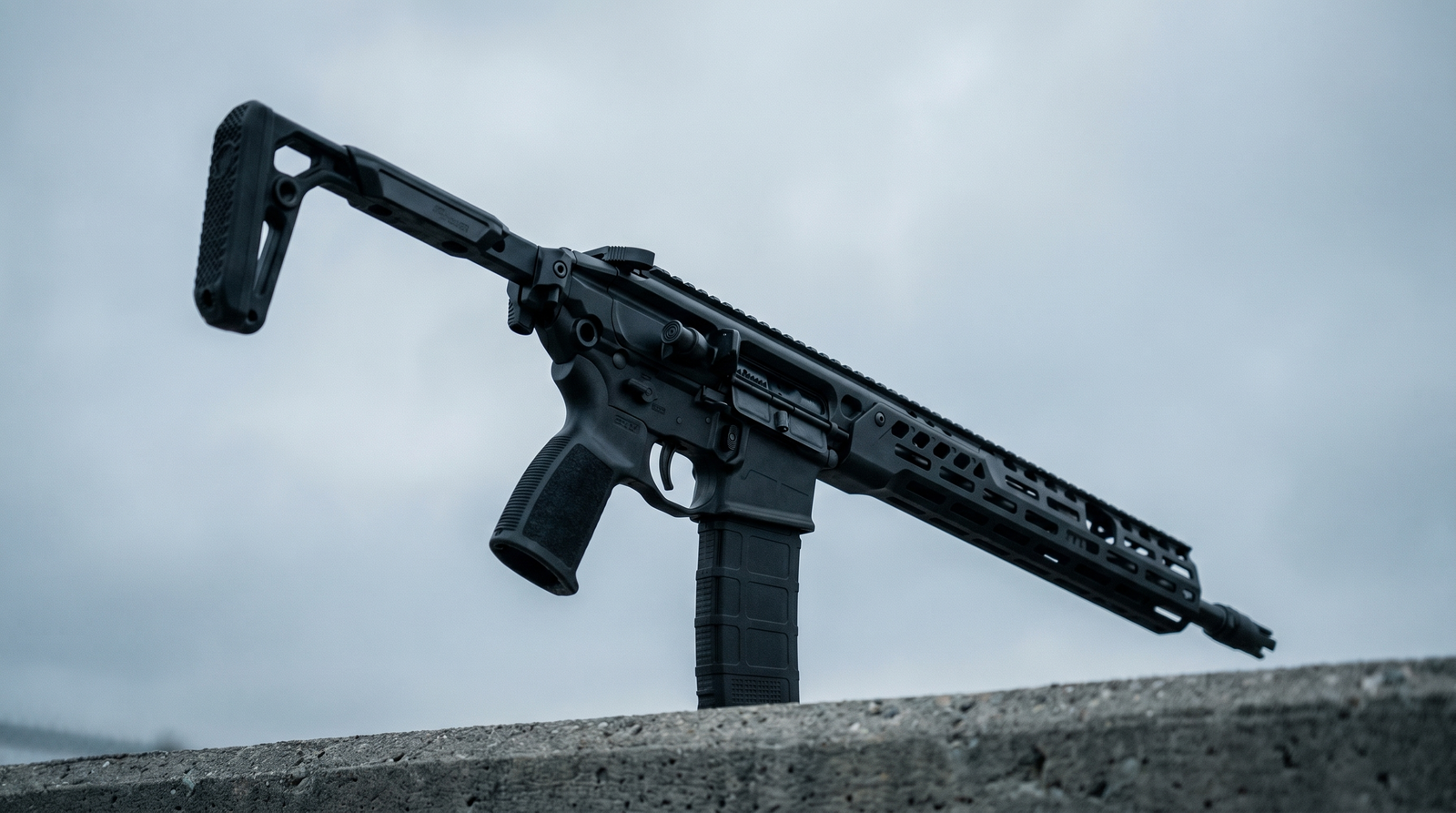
The MCX Spear LT ships in four meaningful factory configurations across three calibers. Same proprietary 2-lug short-stroke piston action sits under all of them. Pick the one that matches your use case, barrel length, cartridge, and suppressed-vs-unsuppressed-priority decisions are the variables.
MCX Spear LT 5.56 NATO — 16 $1,800-$2,200 street
MCX Spear LT 5.56 NATO 11.5 $2,100-$2,400 street (SBR requires NFA Form 4)
MCX Spear LT .300 Blackout — 9 $1,900-$2,300 street
MCX Spear LT 7.62x39 — AK ballistics in an MCX chassis $2,000-$2,300 street
If suppressed is your priority and you can navigate the NFA paperwork, the 11.5″ or .300 BLK is the natural pick, see our best .300 Blackout for home defense guide for matched-velocity load recommendations. For most shooters the 16″ 5.56 reviewed here is the all-rounder, quietest legal NFA-free buy that still benefits from the piston system when you eventually add a can. The 7.62×39 is for shooters who want AK ballistics and ammo cost without dropping the MCX ergonomics.
Competitor Comparison
Sub-$2,500 5.56 rifle segment is crowded. Here is how the MCX Spear LT stacks up against the five rifles buyers actually cross-shop it against.
Daniel Defense DDM4 V7 — premium DI gold standard $1,700-$1,900
The DD V7 is the gold standard for premium DI AR-15s. It’s lighter, has a proven track record stretching back well over a decade, and the aftermarket support is basically infinite. If you don’t care about a folding stock or piston system, the V7 gives you a rifle that’s arguably just as reliable and accurate for $600-$800 less. That’s real money. Where the Spear LT pulls ahead is suppressor performance and that folding stock, if either matters to you, the MCX wins.
BCM RECCE-16 — quiet professional, $1,000 less $1,300-$1,500
Bravo Company is the quiet professional of the AR world. No hype, no Instagram flexing, just genuinely excellent rifles that professionals trust. The RECCE-16 gives you a cold hammer forged barrel, solid mil-spec furniture, and BCM’s legendary quality control for about $1,000 less than the Spear LT.
You give up the piston, the folding stock, and some of the cool factor. But you get a rifle that does everything well, has infinite parts availability, and leaves you enough change for a quality optic.
IWI Zion-15 — best-value AR under a grand $850-$950
I keep recommending the Zion-15 to people who want a genuinely good AR-15 without the premium price tag. Israeli engineering, B5 furniture, a good barrel, and it runs. For under a grand, it’s one of the best values in the rifle market right now.
You could buy a Zion-15, a Vortex Strike Eagle, a Streamlight, and a case of ammo for the price of one MCX Spear LT. Think about that.
LWRC IC DI — ambi-control premium DI alternative $1,600-$1,800
LWRC is another piston-system company that also makes a very good DI rifle. The IC DI features a cold hammer forged spiral-fluted barrel, fully ambidextrous lower, and excellent fit and finish. It sits right between the BCM and the MCX in terms of price and features.
If you want ambi controls and premium build quality but don’t need the folding stock, the LWRC is a strong pick. But it’s still a traditional buffer-tube AR at its core. The MCX is a fundamentally different platform.
Springfield Saint Victor — step-above-budget AR $900-$1,100
Springfield’s Saint Victor is the entry point for “a step above budget” ARs. It’s well-made, has a Bravo Company trigger guard and grip, M-LOK handguard, and shoots well. For a thousand bucks, it’s hard to complain.
It’s not really competing with the MCX on features, it’s competing on the question of “do I really need to spend $2,000+ on a 5.56 rifle?” And honestly, for a lot of shooters, the answer is no. The Saint Victor does the job.
Features and Technical Deep Dive
Short-Stroke Gas Piston System
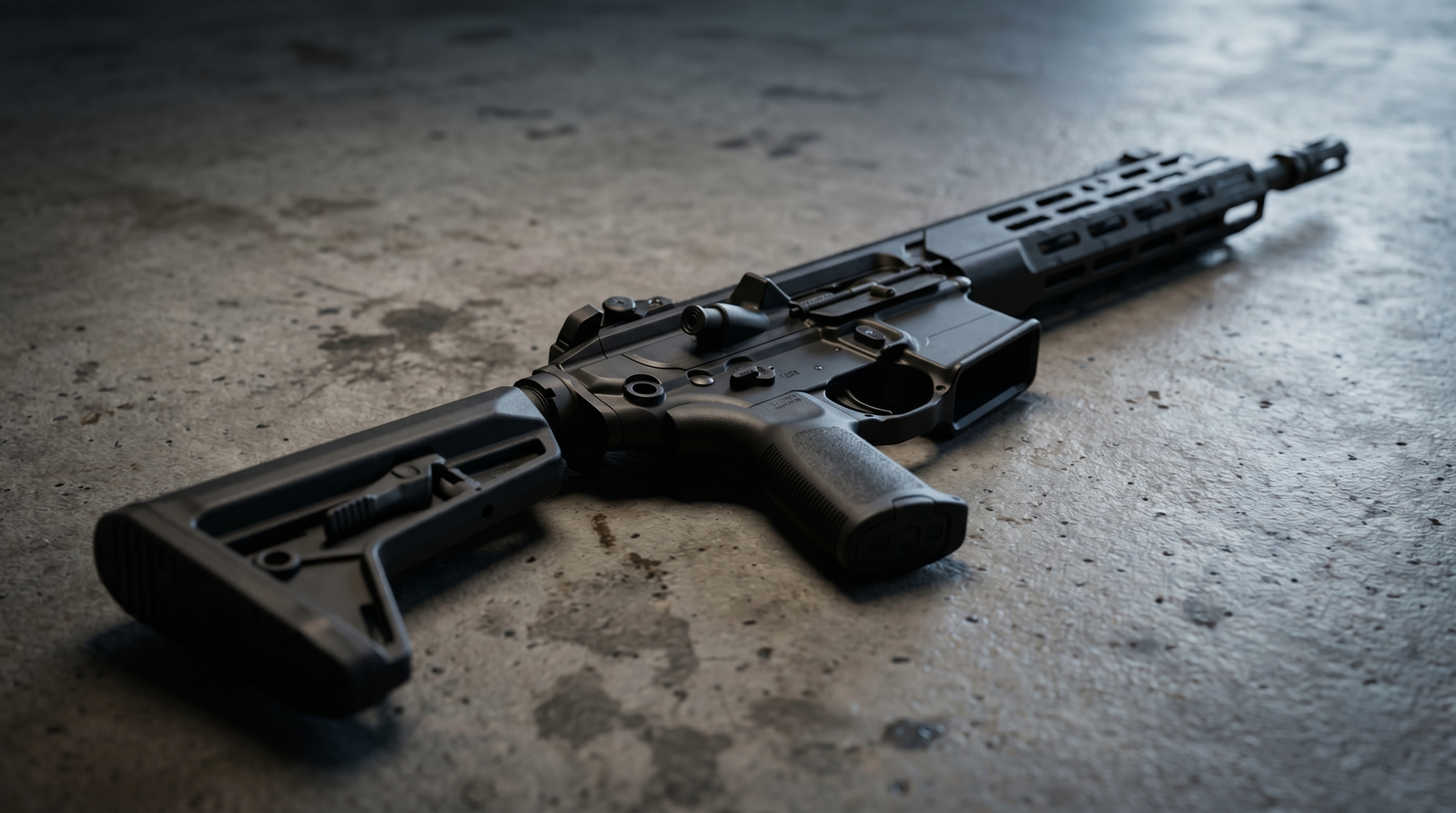
This is the whole reason the MCX exists. The short-stroke piston sits above the barrel and taps gas from a port near the gas block, driving a piston rod rearward that smacks the bolt carrier and cycles the action. The gas never enters the receiver. That means dramatically less carbon buildup, less heat transfer to the shooter’s hands, and way better manners when you screw on a suppressor.
After 500 rounds without cleaning, I pulled the bolt carrier and it looked like it had maybe 50 rounds through it. Not exaggerating. The carrier was damp with oil and had a light film of carbon. On a DI AR after 500 rounds, you’re scraping carbon like you’re cleaning a barbecue grill. Night and day.
The gas system is also adjustable, with a suppressed and unsuppressed setting. Flip the regulator when you mount a can and the rifle tunes itself for the extra backpressure. Simple. Effective.
Folding Stock
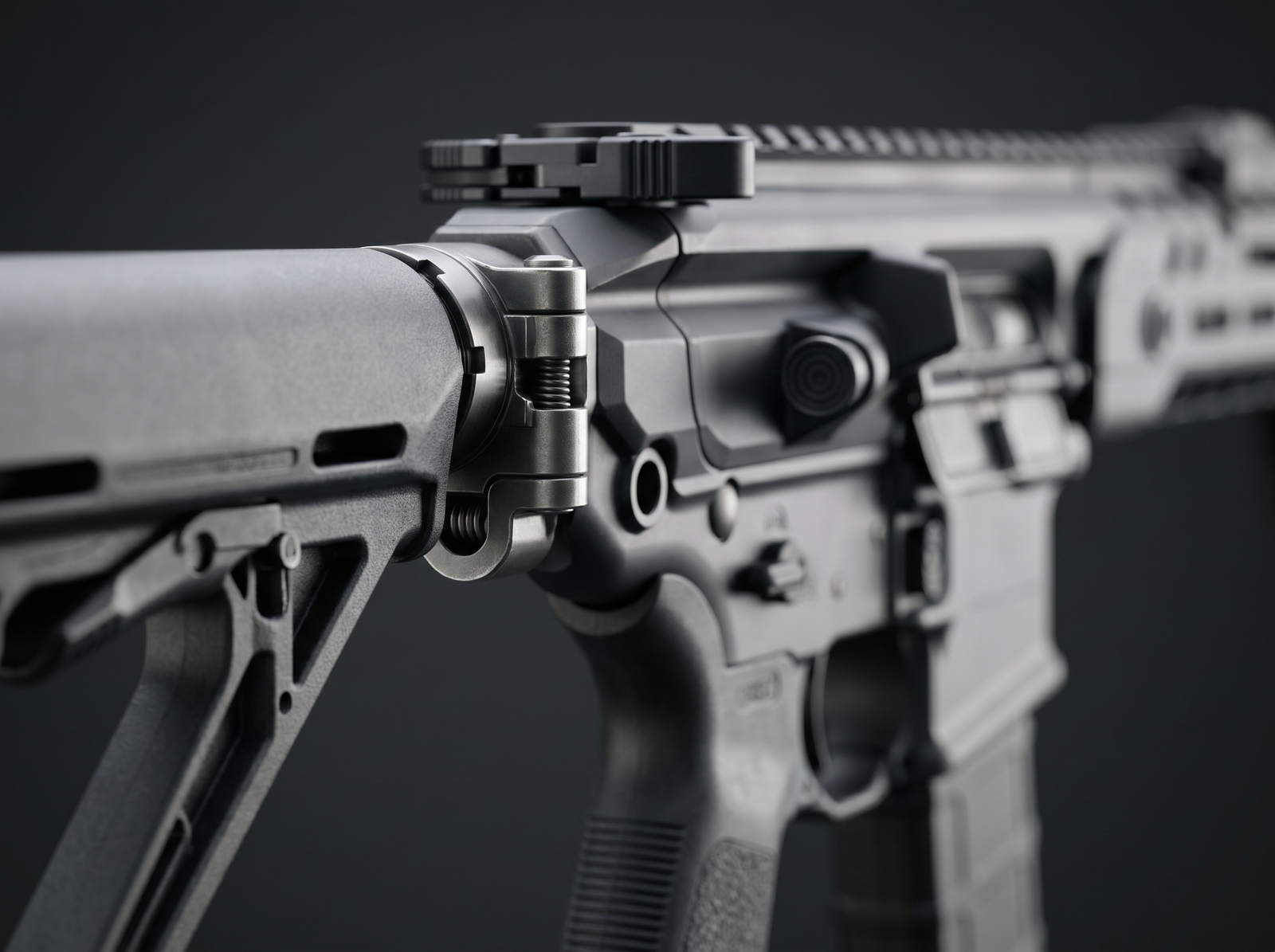
Because there’s no buffer tube, the stock folds to the left side of the receiver. Collapsed length is 26.5 inches. That’s shorter than some pistol-brace setups. You can fit this rifle in a standard backpack or a compact case that doesn’t scream “I’m carrying a rifle.”
And yes, the rifle fires with the stock folded. I would not recommend making a habit of it because your cheek weld is nonexistent, but in an emergency, the gun goes bang. That’s more than you can say for any buffer-tube AR.
One gripe. The factory Minimalist Plus stock feels short for anyone over 5’10”. Several owners have swapped it out immediately. At this price point, the stock should accommodate a wider range of body types out of the box.
Trigger: SIG Matchlite Duo
Sig ships the Spear LT with their 2-stage Matchlite Duo flat trigger. It’s… fine. The first stage has a distinct take-up, the wall is clean, and the break is predictable. It’s better than a mil-spec trigger by a wide margin. But for a $2,600 rifle, “fine” feels like it should be “exceptional.”
Good news: it takes standard AR-15 triggers. Drop in a Geissele SSA-E or a LaRue MBT-2S and this rifle transforms. The LaRue is $90 and makes the Spear LT feel like a completely different gun. That’s my first recommended upgrade.
Handguard and Controls
The lightweight ergonomic handguard is a significant improvement over the older Virtus. Sig trimmed weight aggressively here, and it shows. The M-LOK slots run at 3, 6, and 9 o’clock with a full Picatinny rail on top. Plenty of real estate for lights, lasers, grips, whatever you want to bolt on.
Controls are fully ambidextrous. Bolt catch and release, mag release, safety selector. All ambi, all from the factory. Left-handed shooters, this is your rifle. The charging handle is also non-reciprocating and ambi, which is a nice touch that some competitors skip.
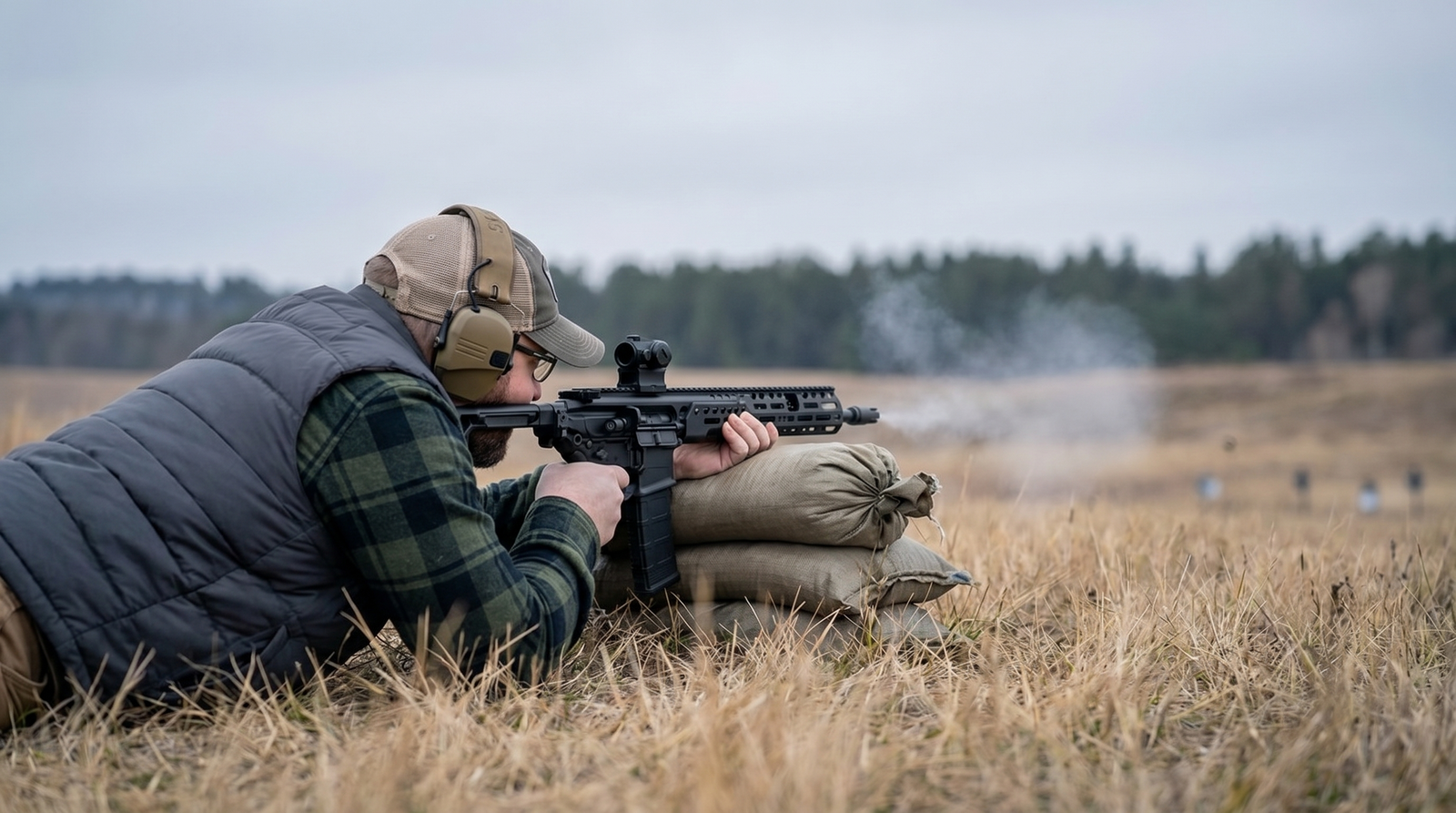
At the Range: 500-Round Test
Ammo Log
- Federal XM193 55gr FMJ: 200 rounds
- PMC Bronze 55gr FMJ: 100 rounds
- Hornady Frontier 55gr FMJ: 100 rounds
- Federal Gold Medal 77gr SMK: 60 rounds (accuracy testing)
- Hornady BLACK 75gr BTHP: 40 rounds (accuracy testing)
Break-In and Reliability
Zero malfunctions. Not one. Across 500 rounds of mixed ammo from three different manufacturers, the Spear LT ate everything without a hiccup. Federal bulk, PMC Bronze, Hornady Frontier. Didn’t matter. The piston cycled every single round.
I deliberately didn’t clean or oil the rifle during the test. Wanted to see how it handled being neglected. Answer: perfectly. The piston system genuinely earns its keep here. After the full 500 rounds, the action was still smooth with no gritty feeling during the charging handle pull.
Recoil is interesting. It’s not quite the same as a DI AR. The piston gives a slightly sharper, shorter impulse. Not harsh, just different. If you’ve only ever shot DI guns, it takes about a magazine to adjust. After that, it’s a non-issue. The rifle tracks flat and fast for follow-up shots.
Accuracy Testing
This is where the Spear LT surprised me. I was expecting good. I got great.
With Federal Gold Medal 77gr Sierra MatchKing at 100 yards from a bench, the best 5-shot group measured 1.3 MOA. Average across five groups was 1.5 MOA. That’s with a factory barrel and factory trigger. For a piston gun, that’s outstanding. A lot of DI ARs costing $1,500+ can’t match that.
Hornady BLACK 75gr ran about 1.7 MOA average. Still very respectable. The 1:7 twist rate clearly likes heavier bullets, which makes sense for the barrel length. Bulk 55gr ammo opened up to around 2.5 MOA, which is normal for cheap ammo in any rifle.
The cold hammer forged barrel is doing work here. Sig’s CHF barrels have a reputation for accuracy and longevity, and this one backs it up.
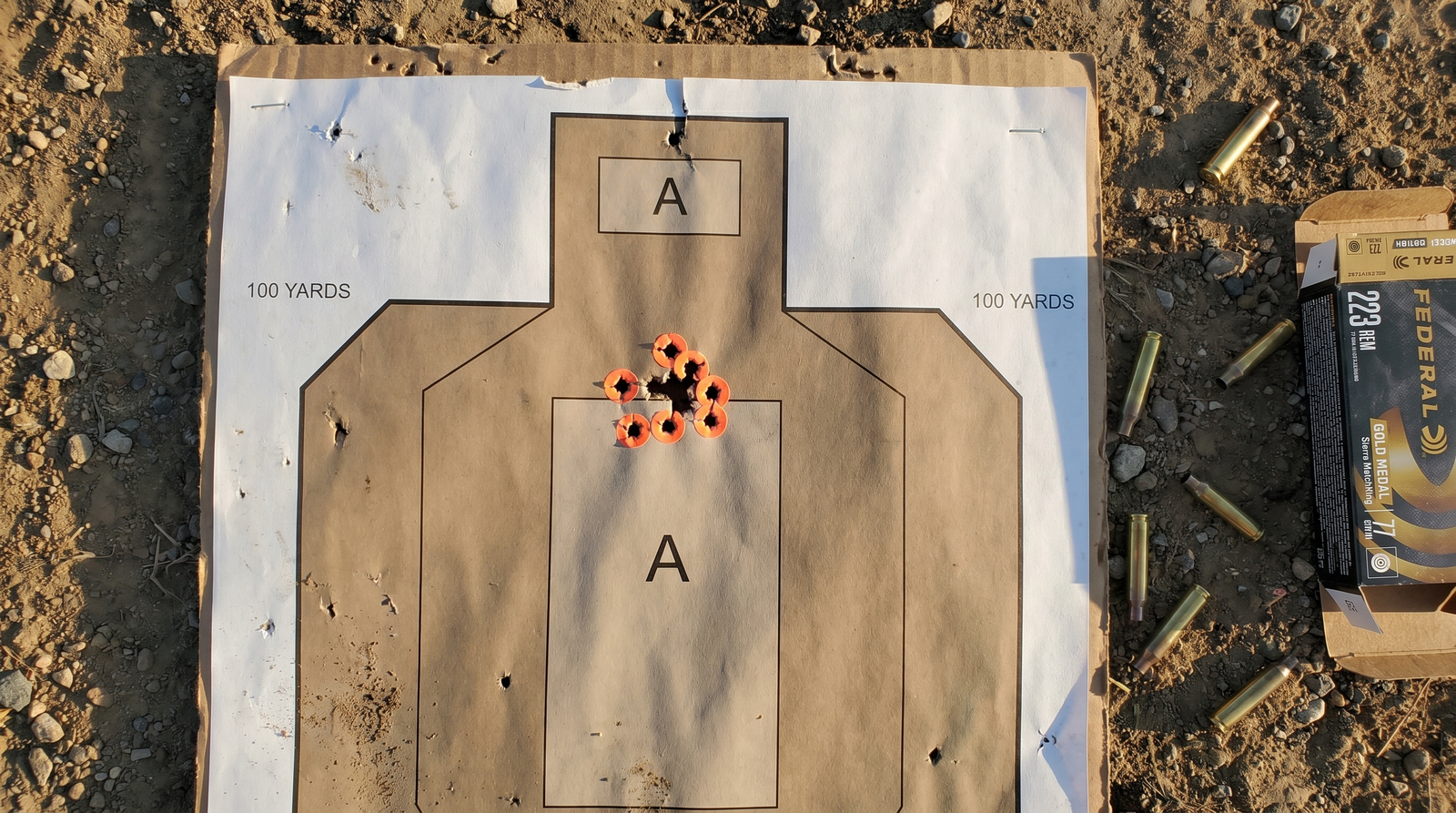
Performance Testing Results
Reliability: 9/10
500 rounds, zero malfunctions, no cleaning. The piston system is the real deal. Every round fed, fired, extracted, and ejected without drama. I have zero concerns about trusting this rifle for home defense or a training class. It runs.
Accuracy: 9/10
1.5 MOA average with match ammo from a piston rifle is legitimately impressive. You could push this thing out to 500 yards on steel with good ammo and a decent optic. The CHF barrel and 1:7 twist handle 75-77gr bullets beautifully. For anything short of precision competition, this is more accuracy than most shooters will ever use.
Ergonomics and Recoil: 8/10
Weight is the only thing holding this score back. At 7.4 pounds empty, add an optic, light, and loaded mag and you’re pushing 9.5 pounds. That’s carbine class territory. You feel it after an hour of drills. But the balance point is good, the controls are all where they should be, and the ambi setup is genuinely useful. The piston recoil impulse is a tiny bit sharper than DI, but it’s minor.
Fit, Finish, and QC: 9/10
Sig brought their A-game on build quality. The anodized finish is uniform and durable. Upper and lower receiver fit is tight with zero wobble. The handguard lockup is solid. Every control clicks with precision. This feels like a $2,600 rifle should feel. My only nitpick is the plastic forward assist and shell deflector housing, which feels like a cost-cutting move on an otherwise premium gun.
Known Issues and Common Problems
Weight
At 7.4 pounds unloaded, this is a heavy 5.56 rifle. Period. A comparable DI AR-15 from Aero or BCM weighs 6.2-6.5 pounds. That full pound difference adds up during training sessions and courses. It’s not a dealbreaker, but if low weight is your top priority, look elsewhere.
Proprietary BCG
The MCX bolt carrier group is not interchangeable with AR-15 BCGs. If it breaks, you’re ordering from Sig directly or finding MCX-specific parts. There’s no “grab a spare BCG off the shelf at any gun shop” option. Sig’s parts availability has improved in recent years, but it’s still a valid concern for long-term ownership. Keep a spare on hand if this is a duty gun.
Factory Stock Length
The Minimalist Plus stock is too short for a lot of shooters. This is probably the most common complaint on the forums. Sig prioritized compact folded length over length-of-pull, and bigger shooters pay the price. Budget for an aftermarket stock if you’re over 5’10” with normal length arms.
Price vs. the AR-15 Market
At $2,600 MSRP, you’re competing with rifles that have decades of aftermarket support, proven track records in military and LE service, and way more available spare parts. The MCX is a better mousetrap in some ways, but the premium you pay is steep. If you can find one on the street for $1,800-$1,900, the value proposition gets a lot more attractive.
Who Should NOT Buy This Gun
The MCX Spear LT is the right rifle for some buyers and the wrong rifle for others. Save your money if you fall into any of these categories.
- Pure budget buyers and first-time AR owners, at $1,800-$2,200 street the MCX is competing with rifles that cost a third of the money. If you don’t already own an AR-15 and your budget is under $1,500, get an IWI Zion-15 at $850-$950, a Vortex Strike Eagle, and a case of ammo for less than the MCX alone. You’ll learn more from shooting more.
- Shooters who prioritize weight above all else, at 7.4 lbs unloaded, the MCX is a full pound heavier than a comparable DI AR. Add an optic, light, sling, and loaded mag and you’re at 9.5+ lbs. If you carry the rifle in classes or hunt with it, the BCM RECCE-16 at 6.4 lbs is the meaningfully lighter alternative for $1,000 less.
- Anyone planning deep aftermarket upgrades or a chassis build, the MCX uses a proprietary bolt carrier group and upper receiver. Magazines and triggers swap with AR-15, but most other upgrade paths require Sig-specific parts. If you want to swap rails, BCGs, barrels yourself, the Daniel Defense DDM4 V7 on a standard mil-spec footprint gives you the deepest aftermarket in firearms history.
- Shooters who hate the slightly sharper piston recoil impulse, the MCX’s gas piston pushes the bolt with a noticeably different impulse than a DI AR. Most shooters adjust in one magazine, but some never love it. If you have shot only DI ARs for years and prefer that softer impulse, the LWRC IC DI gives you ambi controls and premium build quality on a traditional buffer-tube platform.
- Buyers who refuse to spend on the trigger upgrade, the factory Sig Matchlite Duo is decent but not great for the price tier. The rifle genuinely needs a $90-$240 trigger swap (LaRue MBT-2S or Geissele SSA-E) to feel like a $2,600 rifle. If you’re not willing to budget that upgrade in, the Springfield Saint Victor at $900-$1,100 gives you a perfectly capable AR with a good trigger out of the box for half the all-in cost.
What Real Owners Are Saying
I went through forums, Reddit, and owner groups to find out what people are saying after living with the MCX Spear LT. Here’s a mix of the good and the not-so-good.
“Completely reliable. I’ve put over 1,000 rounds through mine without cleaning and had zero malfunctions. The piston system just works.”, Owner on Sniper’s Hide
“The Spear LT shoots perfectly. Feeds great, 2-3 inch groups at 100 yards, and the ambi bolt release is excellent. Smooth shooter all around.”, SIG Talk forum member
“I love the modularity and feel of the rifle but I hate the folding stock. At the $2,500+ price point, I shouldn’t hate anything about it.”, SIG Talk owner review
“They lightened the weight up from the Virtus, especially in the handguard. It feels very similar to the original MCX now but with the extra durable parts.”, Long-time MCX owner on forum
“Easy to change out barrels and stocks. I love not having a buffer tube recoil system. The versatility of the MCX is the real selling point.”, SIG Talk member
“My only gripe is the plastic forward assist housing and the trigger kinda sucks. For $2,600, these should be better. Dropped in a Geissele and the trigger problem solved itself.”, Forum reviewer on 1911Forum
Parts, Accessories, and Upgrades
The MCX Spear LT runs great out of the box, but a few targeted upgrades take it from very good to genuinely exceptional. Here is the priority order based on dollar-per-improvement.
| Upgrade Category | Recommended Component | Why It Matters | Cost Estimate |
|---|---|---|---|
| Trigger | LaRue MBT-2S or Geissele SSA-E | Factory Matchlite is decent but a quality 2-stage transforms the rifle | $90-$240 |
| Optic | EOTech EXPS3 or Vortex Razor HD Gen III 1-10x | Red dot for CQB, LPVO for reaching out | $350-$2,000 |
| Weapon Light | Modlite PLHv2 or Surefire M600DF | If it is a home defense gun, you need a light | $250-$350 |
| Suppressor | SureFire SOCOM 556 RC2 or Dead Air Sandman-S | The MCX was born to be suppressed, the QD flash hider makes it painless | $800-$1,200 |
| Stock | See compatible AR-15 BCG options or Magpul SL-K stock | Replace the too-short Minimalist Plus if you need more LOP | $60-$200 |
| Sling | Blue Force Gear Vickers or Edgar Sherman Design ESD | The MCX is heavy, a good padded sling makes all-day carry tolerable | $45-$65 |
For aftermarket parts and triggers, browse the full UGS AR-15 parts catalog or the AR-15 parts database, the MCX takes standard AR-15 triggers, so the universe of options is wide.
The Verdict
The Sig MCX Spear LT is genuinely one of the most impressive 5.56 rifles I’ve tested. The piston system works exactly as advertised. It runs cleaner, cooler, and suppresses better than any DI AR. The folding stock is a significant upgrade for storage and transport. The accuracy is outstanding. The build quality is top-shelf. After 500 rounds, I have zero reliability concerns.
But let’s be real about the price. At $2,600 MSRP, you’re paying a significant premium for a 5.56 rifle. The weight is higher than comparable DI guns. The bolt carrier is proprietary. The aftermarket, while growing, can’t touch the AR-15 ecosystem. And the factory stock needs replacing for a lot of shooters. These aren’t fatal flaws, but they’re real trade-offs you need to accept.
If you want the cleanest-running, most compact, most forward-thinking 5.56 platform on the market, and you’re willing to pay for it, the MCX Spear LT delivers. Catch one on sale in the $1,800-$1,900 range and the value equation gets a lot better. It’s not for everyone. But for the right shooter, it’s the best home defense rifle platform that isn’t an AR-15. And that’s saying something.
Final Score: 8.5/10
Best For: Shooters who want a next-gen piston rifle with a folding stock for home defense, suppressed shooting, or compact transport. Ideal for anyone who wants to move beyond the traditional AR-15 platform without abandoning trigger and magazine compatibility.
Old-school .308 firepower lives on in our Springfield M1A review.
FAQ: Sig MCX Spear LT
Is the MCX Spear LT compatible with AR-15 parts?
Partially. The MCX Spear LT uses standard AR-15 magazines and accepts AR-15 fire control groups (triggers). The lower receiver is compatible with AR-15 grips and safeties. But the bolt carrier group, upper receiver, handguard, and stock system are all MCX-proprietary. You cannot swap in an AR-15 BCG or standard AR upper.
Can you fire the MCX Spear LT with the stock folded?
Yes. Because the MCX does not use a buffer tube, the rifle functions normally with the stock folded. Accuracy will suffer since you lose your cheek weld, but the rifle will fire and cycle without issue. This is one of the biggest advantages over any traditional AR-15.
How does the MCX Spear LT compare to the original MCX Virtus?
The Spear LT is the third generation of the MCX platform. Compared to the Virtus it has a lighter handguard, improved barrel profile, updated stock design, and benefits from engineering trickle-down from the military NGSW Spear program. It is lighter overall and has improved ergonomics, though the core piston operating system remains similar.
What is the difference between the MCX Spear and the MCX Spear LT?
The MCX Spear is the full-size military-derived rifle chambered in 7.62 NATO and 6.5 Creedmoor, designed around the NGSW program. It is heavier and built for the military new 6.8x51mm cartridge. The Spear LT ("Lightweight") is the trimmed-down civilian version chambered in 5.56 NATO, .300 Blackout, and 7.62x39. It is lighter, more affordable, and designed for the commercial market.
Is the MCX Spear LT good for home defense?
Yes. The folding stock makes it easy to store in a compact safe or bag. The piston system is extremely reliable and runs clean. The 5.56 NATO chambering with appropriate defensive ammo is effective for home defense. The only downside is the weight at 7.4 lbs, which makes it heavier than a comparable AR-15. Add a weapon light and it is pushing 8.5+ pounds loaded.
What optic should I put on the MCX Spear LT?
Depends on your use case. For home defense and CQB distances, an EOTech EXPS3 or Aimpoint Duty RDS work great on the full-length Picatinny rail. For a do-everything setup, a 1-6x or 1-8x LPVO like the Vortex Razor Gen III or Primary Arms GLx gives you flexibility from close range out to 500+ yards. The MCX accuracy potential deserves a quality optic.
Does the MCX Spear LT need to be broken in?
Not really. Mine ran perfectly from round one with zero malfunctions across 500 rounds of mixed ammo. Sig piston system is designed to work reliably out of the box. Just oil the bolt carrier, load up, and send it. No special break-in procedure needed.
Is the MCX Spear LT worth the price over a standard AR-15?
That depends on what you value. If you want a folding stock, piston-driven cleanliness, suppressor optimization, and next-gen engineering, yes. The MCX does things no standard AR-15 can do. But if you just need a reliable accurate 5.56 rifle and do not care about those features, a Daniel Defense, BCM, or even an IWI Zion-15 gets you 90% of the performance for significantly less money. The Spear LT is a premium tool for shooters who specifically want what it offers.
4,715+ Gun & Ammo Deals
Updated daily from 200+ top retailers. Filter by category, caliber, action type, and price.