

Affiliate disclosure: This Uberti 1873 Cattleman review contains affiliate links. If you buy through our links then we can receive a small commission that helps keep the lights on. You don’t pay anything more.
- Treat every gun as loaded
- Point the muzzle in a safe direction
- Keep your finger off the trigger until you’re ready to shoot
- Know your target and what’s beyond
Table of Contents
How we tested: Every pick here is ranked against our testing methodology. Minimum round counts, accuracy and reliability protocols, the failures that disqualify a gun. Where we have not shot a specific variant ourselves, we say so in that section.
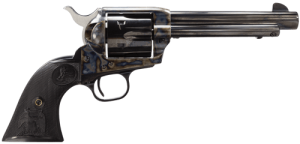
Review: Uberti 1873 Cattleman – The Peacemaker Pattern, 29 Ways
Our Rating: 8.1/10
- RRP: $599 (Hombre, Brass 5.5 in.) to $1,479 (Engraved)
- Street Price: $542.99 (Use our live pricing for the best up to date deal)
- Caliber: .45 Colt, .357 Magnum, .44-40, 9mm and .22 LR, depending on model
- Action: Single action, loads at half cock through a gate
- Barrel Length: 4.75 in., 5.5 in. or 7.5 in. (6 in. Callahan)
- Overall Length: 10.25 in. (Hombre) to 11 in. as Uberti lists it
- Weight (unloaded): 2.2 lbs (Hombre), 2.3 lbs listed for most models
- Capacity (cylinder): 6 (12 on the .22 LR model)
- Frame Size: Full-size single action, 1873 pattern
- Frame Material: Steel, case-hardened on most models
- Grip: One-piece walnut on most; brass or steel backstrap and trigger guard
- Sights: Fixed blade front, notch rear
- Twist: 1:16 (.45 Colt), 1:18.75 (.357, 9mm), 1:20 (.44-40)
Pros
- Real 1873 feel for a fraction of Colt
- Brass trim is the cheapest version
- Five chamberings, three barrel lengths
Cons
- Fixed sights, so hold off or file
- 29 models, prices that make no sense
- Traditional loading is slow at the range

Quick Take
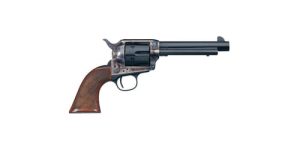
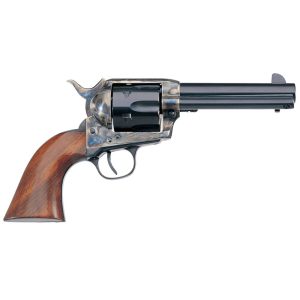
The Uberti 1873 Cattleman is the gun most people picture when they say “cowboy revolver”: a case-hardened frame, a one-piece walnut grip and the Colt Single Action Army’s lines, for a fraction of what a Colt costs. Ours, a 4.75 inch .45 Colt Steel model, ran 400 rounds without a mechanical fault and put five shots into 2.4 inches at 15 yards.
The hard part is choosing one. Uberti’s own Cattleman page lists 29 models from $599 to $1,479, and the price ladder has some odd rungs. The brass trimmed gun is the cheapest, the 5.5 inch brass gun costs $50 less than the 4.75 or 7.5 inch version, and the 7.5 inch steel .357 lists below the 5.5 inch.
Buy for the look you want and the cartridge you shoot. The gun underneath is the same 1873 pattern in every trim.
Best For: Cowboy action shooters, Western fans and anyone who wants a Peacemaker-style revolver to shoot without paying Colt prices. Not for anyone who wants adjustable sights, a transfer bar they can confirm on the maker’s page, or a fast-reloading range gun.

29 Models and a Price Ladder That Makes No Sense
Uberti’s 1873 Cattleman page lists every model with item number, MSRP, caliber, barrel, finish and trim. Read it closely and the pricing stops following any obvious rule.
| Model | Trim | Caliber | Barrel | MSRP |
|---|---|---|---|---|
| Hombre (343991 / 343901) | Matte steel, brass backstrap and guard | .45 Colt, .357 | 4.75 in. | $599 |
| Brass (356410) | Case-hardened, brass backstrap and guard | .45 Colt | 5.5 in. | $599 |
| Brass (356400 / 356450) | Case-hardened, brass | .45 Colt | 4.75 / 7.5 in. | $649 |
| Brass 9mm (356211) | Case-hardened, brass | 9mm | 5.5 in. | $599 |
| Brass 9mm with .357 cylinder (356212) | Case-hardened, brass | 9mm and .357 | 5.5 in. | $679 |
| Steel (356700 / 356710) | Case-hardened, steel backstrap and guard | .45 Colt | 4.75 / 5.5 in. | $689 |
| Steel (356550) | Case-hardened, steel | .357 | 7.5 in. | $649 |
| Steel (356610) | Case-hardened, steel | .44-40 | 5.5 in. | $649 |
| Charcoal Blue (345133) | Old Model, charcoal blue | .45 Colt | 5.5 in. | $829 |
| .22 LR 12-Shot (356187) | Case-hardened, steel | .22 LR | 5.5 in. | $699 |
| Engraved (356177) | Stainless, simulated pearl | .45 Colt | 5.5 in. | $1,479 |
Three things jump out. The brass trim costs $90 less than steel in the same .45 Colt 5.5 inch configuration ($599 against $689). The 5.5 inch brass gun is $50 cheaper than the 4.75 or 7.5 inch brass gun. And in steel, the 7.5 inch .357 lists $40 below the 5.5 inch .357. None of that tracks the amount of steel in the gun. It tracks what Uberti wants to move.
One more thing to read with care. Uberti lists an overall length of 11 inches and a weight of 2.3 pounds for its 4.75, 5.5 and 7.5 inch guns alike, and a 7.5 inch barrel cannot make an 11 inch gun the same length as a 4.75. Only the Hombre (10.25 inches, 2.2 pounds), the 6 inch Callahan and the 7.5 inch Hunter get their own figures. Treat the length and weight columns as approximate for everything else.
Hombre, matte, 4.75 in., .45 Colt or .357 $469-$549
Brass, case-hardened, brass trim $540-$649
Steel, case-hardened, steel trim $600-$689
Charcoal Blue, Old Model $676-$829
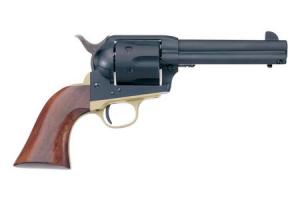
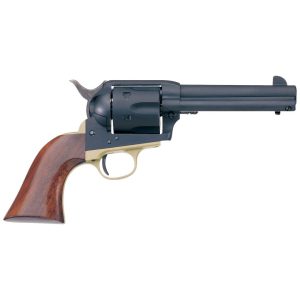
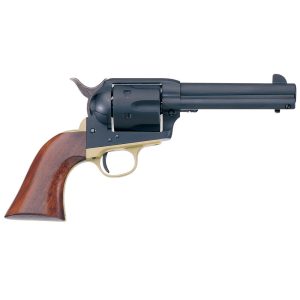
Brass or Steel, and Old Model or New

The Brass models wear a brass backstrap and trigger guard. The Steel models blue those two parts to match the barrel. The frame, cylinder, barrel and lockwork are the same, and the brass gun is the cheaper of the two at every length Uberti prices.
Uberti also builds some models in an Old Model pattern, and it explains the difference on the same page. New Model guns have a slightly higher fixed front sight and an oblong ejector rod head. Old Model guns have a shorter front sight and a round ejector-plunger head. The 4.75 and 5.5 inch Charcoal Blue guns and the Old West are Old Models, and they sit near the top of the price list.
Retailers add one more name to the confusion. Many listings call the current guns the “Cattleman II” and describe a retractable firing pin. Uberti’s own Cattleman page does not use that name or describe the firing pin, so read the listing and the manual that ships with your gun rather than assuming.
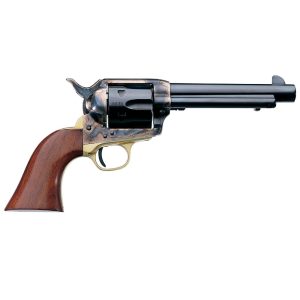
How We Tested It
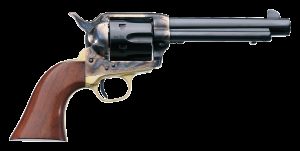
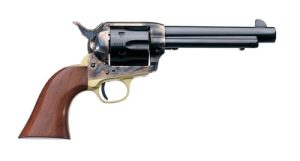
Our test gun was a Steel model 356700: .45 Colt, 4.75 inch barrel, case-hardened frame with a blued steel backstrap and trigger guard. We shot it over three sessions at an outdoor range between 52 and 74 degrees, 400 rounds in total, mostly cowboy action loads.
Phase 1: Handling and Loading
It loads the way Uberti’s page shows: bring the hammer back to half cock, swing the loading gate down, and feed one chamber at a time while you rotate the cylinder. Unloading is the same in reverse, one empty at a time with the ejector rod. It takes practice to do smoothly, and nobody will ever call it fast.
For carry, we loaded five and lowered the hammer on the empty chamber, which is the old rule for a traditional single action. Read the manual that comes with yours before you decide how many to load.
Phase 2: Reliability
No mechanical faults in 400 rounds. The hand indexed the cylinder into the bolt notch every time, the bolt locked up cleanly and the hammer never slipped. Two things are worth noting from the log:
- Lead buildup: After about 150 rounds of soft lead cowboy loads the forcing cone and cylinder face were grimy enough that rotation felt draggy. A brass brush and solvent put it right.
- Stiff ejection: Hotter Hornady Critical Defense cases needed a firmer push on the ejector rod than the mild cowboy loads.
Phase 3: Accuracy
Five shot groups from a rest. At 15 yards the best group was 2.4 inches with Black Hills Cowboy 250 grain RNFP, and the average across loads was 3.0. At 25 yards the average opened to 4.1 inches. Every load printed about 2 inches left of the sights at 15 yards. With fixed sights your options are to hold off, file the front blade, or have a gunsmith turn the barrel.
Ammunition Log
- Winchester Cowboy Action 250 gr LFN: 150 rounds
- Black Hills Cowboy 250 gr RNFP: 100 rounds
- Magtech 250 gr LFN: 100 rounds
- Hornady Critical Defense 185 gr FTX: 50 rounds
What This Means for You
- Sights: Shoot it before you blame yourself. Ours needed a 2 inch hold off at 15 yards.
- Cleaning: Brush the forcing cone and cylinder face every 150 rounds of lead.
- Ammo preference: 250 grain cowboy loads shot best and kicked least.
- Accuracy expectation: About 3 inches at 15 yards with fixed sights.
Performance Results
Reliability (9/10)
A single action has few parts to fail, and none did. Timing stayed correct through 400 rounds. It loses a point only because lead loads foul it quickly enough that you notice within a session.
Accuracy (7/10)
2.4 inches at 15 yards is fine for cowboy action targets and plinking. The groups were honest. The problem was where they landed, 2 inches left with every load, and on a fixed sight revolver that is a gunsmith job rather than a screwdriver job.
Ergonomics and Recoil (8/10)
The plow handle grip lets the gun roll up in your hand under recoil, which is why 250 grain .45 Colt loads feel like a push rather than a slap. The hammer spur is easy to reach, and at about 2.3 pounds the gun balances well with the 4.75 inch barrel.
Fit, Finish, and Quality Control (9/10)
The case colors on our frame were rich and mottled, the bluing even, and the walnut met the metal with no gaps or overhang. This is the category where the Uberti earns its reputation, and at this price it is hard to fault.
Technical Deep Dive
The Cattleman copies the 1873 Single Action Army pattern: a solid frame, a fixed cylinder that loads through a gate on the right side, a hammer you cock for every shot, and an ejector rod in a housing under the barrel. Uberti publishes different twist rates by caliber, which is worth knowing if you handload.
| Component | Specification | Why it matters |
| Frame | Steel, case-hardened on most models | The classic look, and the gun’s main cost |
| Backstrap and guard | Brass or steel by model | Brass is cheaper at every length |
| Barrel twist | 1:16 (.45 Colt), 1:18.75 (.357, 9mm), 1:20 (.44-40) | Match bullet weight to twist if you handload |
| Cylinder | 6 shot, fluted on most; 12 shot on the .22 LR | A 9mm model ships with a second .357 cylinder |
| Sights | Fixed blade and notch | New Model front sight is slightly taller than Old Model |
| Loading | Half cock, gate swings down | Traditional and slow |
How It Compares
Our guide to cowboy action shooting covers what the game asks of a revolver. These are the alternatives a Cattleman buyer weighs.
Colt Single Action Army ($2,400-$3,101)
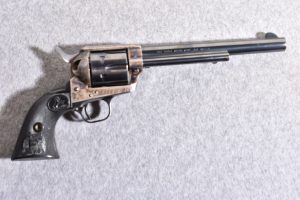
The original, and roughly four times the price. New Colt Single Action Armies start at $2,399.99 in our tracking. If the name on the barrel matters, nothing else will do. If you want to shoot the pattern, the Uberti gives you the look and the feel for about a quarter of the money.
Pietta 1873 ($515-$690)
The other Italian 1873, and priced right alongside the Uberti. A Pietta Great Western II starts at $579.99 from a trusted seller. Both builders are well regarded in cowboy action circles, and the choice often comes down to which trim and chambering you can actually find.
Ruger New Vaquero ($1,099 list)
The modern answer. Ruger’s spec sheet for the 5.5 inch .45 Colt model 5101 lists a transfer bar mechanism and loading gate interlock, a reverse indexing pawl for easier loading, 40 ounces and a $1,099 list price. It is heavier and pricier than the Uberti, and it is the one to buy if you want those safety features confirmed on the maker’s own page.
Verdict: The Colt is the name, the Pietta is the equal and the Ruger is the modern mechanism. The Uberti is the one with the most models and the cheapest way in through the brass trim.
Upgrades Worth Making
| Upgrade Category | Recommended Component | Why It Matters | Cost Estimate |
| Holster | A leather Western belt and holster rig | How this gun is meant to be carried | $120 – $300 |
| Action job | A cowboy action gunsmith tune | Lighter hammer and smoother cycling for competition | $150 – $300 |
| Sight regulation | Barrel turned or front blade filed | Moves the point of impact on a fixed sight gun | $50 – $120 |
| Cleaning | Brass brush and a lead removal cloth | Keeps the forcing cone and cylinder face clean | $15 – $25 |
If you are shooting it in competition, the action job is the upgrade that matters. For a casual shooter, a good holster rig and a sight fix are all it needs. Our guns of Tombstone page shows these revolvers in their natural habitat.
Common Problems and Fixes
- Shoots off the sights: Common on fixed sight single actions. Hold off, file the front blade to raise impact, or have the barrel turned for windage.
- Draggy cylinder after lead loads: Clean the forcing cone and cylinder face every 150 rounds or so.
- Buying the wrong model: Check brass or steel trim, Old or New Model, barrel length and chambering in the listing. Twenty nine models share one name.
- Unsure how many to load: Read the manual that ships with your gun. The traditional rule for a single action is five, hammer down on the empty chamber.
Who Should NOT Buy This Gun
- Buyers who want adjustable sights: The Cattleman’s are fixed. The Ruger Super Wrangler has an adjustable rear in .22 LR and .22 WMR.
- Anyone who wants a transfer bar confirmed by the maker: Ruger’s New Vaquero lists one on its spec sheet.
- Collectors who want the name: Only a Colt Single Action Army is a Colt.
- Shooters who want fast reloads: Gate loading one chamber at a time is slow. A double action revolver from our best revolvers list reloads in seconds.
Final Verdict
The Uberti 1873 Cattleman delivers the Peacemaker pattern with beautiful case colors, honest reliability and a lot of choice, for about a quarter of what a Colt costs. Ours ran 400 rounds without a fault and shot small enough groups for cowboy action, once we learned where it printed.
Shop the price list as carefully as the gun. The brass trim is the cheapest way in, the 5.5 inch brass gun undercuts the other lengths by $50, and a matte Hombre starts lower still. Pick the trim and chambering you want, and read the listing twice.
Final Score: 8.1/10. A handsome, reliable 1873 with a price list you have to decode.
FAQ: Uberti 1873 Cattleman
Is the Uberti 1873 Cattleman a copy of the Colt Single Action Army?
It follows the 1873 Single Action Army pattern: solid frame, gate loading, a hammer you cock for every shot and an ejector rod under the barrel. New Colt Single Action Armies start around $2,400, while Uberti lists the Cattleman from $599.
What is the difference between the Uberti Cattleman Brass and Steel models?
The Brass models have a brass backstrap and trigger guard, the Steel models blue those parts to match the barrel. Uberti lists the .45 Colt 5.5 inch Brass at $599 and the same gun in Steel at $689. The frame, barrel and lockwork are the same.
What calibers does the Uberti 1873 Cattleman come in?
Uberti's current Cattleman list includes .45 Colt, .357 Magnum, .44-40, 9mm and .22 LR, plus a .44 Callahan model. One 9mm Brass model ships with a second .357 Magnum cylinder, and the .22 LR model holds 12 rounds.
What is the difference between Uberti Old Model and New Model?
Per Uberti, New Model guns have a slightly higher fixed front sight and an oblong ejector rod head, while Old Model guns have a shorter front sight and a round ejector-plunger head. The Charcoal Blue 4.75 and 5.5 inch and the Old West are Old Models.
How accurate is the Uberti Cattleman?
Our 4.75 inch .45 Colt put five shots into 2.4 inches at 15 yards with Black Hills Cowboy 250 grain, averaging 3.0 inches across loads. It printed about 2 inches left of the fixed sights, so plan to hold off or have the sights regulated.
How much does a Uberti 1873 Cattleman cost?
Uberti lists the Cattleman from $599 for the Hombre and the 5.5 inch Brass to $1,479 for the Engraved model. On the street a Hombre starts around $469 and trusted sellers carry one from $526.99.
7,078+ Gun & Ammo Deals
Updated daily from 200+ top retailers. Filter by category, caliber, action type, and price.
Related Guides