

Last updated November 21st 2026
Some of the links below are affiliate links, meaning at no additional cost to you, we may earn a commission if you click through and make a purchase.
- Treat every gun as loaded
- Point the muzzle in a safe direction
- Keep your finger off the trigger until you’re ready to shoot
- Know your target and what’s beyond
By Nick Hall, who wrote our 300 Blackout vs 5.56 comparison.
Table of Contents
The Short Answer
Quick Answer: In the 300 Blackout vs 308 matchup, the .308 Winchester wins on power and range, and it isn’t close. Hornady’s 150 gr SST .308 load still carries more energy at 500 yards than its 110 gr CX 300 Blackout load has at 100. The 300 Blackout wins on size, suppressors and convenience. It runs in an AR-15 with a barrel swap, works with subsonic ammo, and shines from short barrels inside about 200 yards. Hunting deer past about 100 yards, or shooting long range? Buy a .308. Want a quiet, compact AR for home defense and close-range hogs? Buy a 300 Blackout.
Below, I compare them on SAAMI specs, maker ballistics to 500 yards, the barrel-length catch most comparisons miss, deer energy, recoil, twist rate, platform and cost per round, with live prices for both.
300 AAC Blackout vs 308: Same Bullet, Different Cartridge
Both rounds fire a .308 in. bullet, but the 300 Blackout is a short, low-pressure cartridge built for the AR-15, and the .308 is a full-power rifle round with a case about half again as long. The SAAMI specifications spell it out. The 300 AAC Blackout case is 1.368 in. long with a maximum overall length of 2.260 in. The .308 Winchester case is 2.015 in. with a maximum of 2.810 in.
Pressure follows the size. SAAMI sets the maximum average pressure at 55,000 psi for 300 Blackout and 62,000 psi for .308. More case and more pressure mean more powder behind the same diameter bullet, and that’s where every ballistic difference below comes from.
The case head matters too. The 300 Blackout rim is .378 in., the same family as the 5.56, which is why it runs on a standard AR-15 bolt. The .308 rim is .473 in. and needs a bigger bolt and a bigger rifle.
The Barrel Length Catch Most Comparisons Miss
SAAMI tests 300 Blackout in a 16 in. barrel and .308 in a 24 in. barrel, so the box numbers you see compare a carbine to a long hunting rifle. SAAMI’s rule is plain: “All standard test barrels shall be 24 inches long,” with 300 AAC Blackout listed as an exception at 16 in.
That matters when you’re choosing between a 16 in. 300 Blackout AR and a 16 in. .308 AR-10. The .308 maker figures come from 8 more inches of barrel than a 16 in. rifle has, so a short .308 won’t hit them. The .308 still wins by a wide margin, but the real gap is smaller than the box suggests.
300 Blackout was designed for short barrels. AAC’s own launch data lists its 110 gr load at 2,400 fps from 16 in., 2,190 fps from 9 in. and 1,940 fps from 6 in., and says “Barrels 4.5 inches or longer are reliable on the M4 platform.” That’s why 300 Blackout is such a common choice for short-barreled rifles and AR pistols. A rifle with a barrel under 16 in. is regulated under the National Firearms Act, so check the federal and state rules before you build one.
300 Blackout vs 308 Comparison Table
| 300 AAC Blackout | 308 Winchester | |
|---|---|---|
| Case length | 1.368 in. | 2.015 in. |
| Max overall length | 2.260 in. | 2.810 in. |
| Bullet diameter | .308 in. | .308 in. |
| Max average pressure | 55,000 psi | 62,000 psi |
| SAAMI test barrel | 16 in. | 24 in. |
| Standard twist | 1:8 | 1:12 |
| Common bullet weights | 110 to 220 gr | 125 to 180 gr |
| Subsonic loads | Yes, 190 to 220 gr | Not its strength |
| Hornady load compared | 110 gr CX | 150 gr SST |
| Muzzle velocity | 2,285 fps | 2,820 fps |
| Muzzle energy | 1,275 ft-lb | 2,649 ft-lb |
| Energy at 300 yd | 606 ft-lb | 1,603 ft-lb |
| Below sight line at 300 yd, 200 yd zero | 14.4 in. | 7.9 in. |
| Below sight line at 500 yd, 200 yd zero | 89.7 in. | 46.9 in. |
| Platform | AR-15, barrel swap | AR-10 and bolt rifles |
| Introduced | SAAMI, January 2011 | Winchester, 1952 |
Specs are from SAAMI Z299.4. Ballistics are from Hornady’s 300 Blackout 110 gr CX and 308 Win 150 gr SST pages, from their 16 in. and 24 in. test barrels.
300 BLK vs 308 Ballistics: Energy, Drop and Wind to 500 Yards
Past 100 yards, the .308 carries more than twice the energy of a supersonic 300 Blackout, and past 200 yards it drops about half as much. These charts use Hornady’s published tables for four loads, two of each.
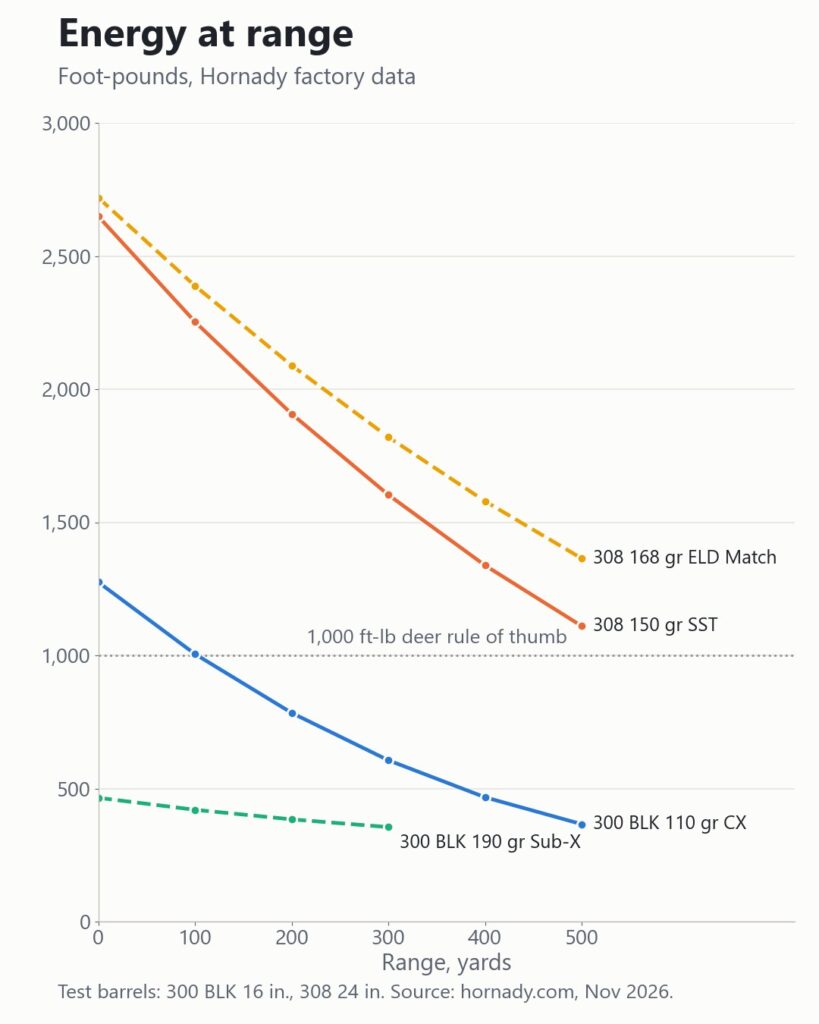
Hornady’s 110 gr CX in 300 Blackout starts at 1,275 ft-lb and is down to 606 ft-lb at 300 yards and 366 ft-lb at 500. The 150 gr SST in .308 starts at 2,649 ft-lb and still has 1,110 ft-lb at 500 yards, which is more than the 300 Blackout load carries at 100. The 168 gr ELD Match in .308 holds on even better, at 1,364 ft-lb at 500.
Drop tells the same story. With both zeroed at 200 yards, measured below the line of sight, the 300 Blackout load is 14.4 in. low at 300 yards and 89.7 in. low at 500. The .308 is 7.9 in. low at 300 and 46.9 in. at 500. Inside 200 yards, you’d barely notice the difference. Past 300, the 300 Blackout gets hard to hit with.
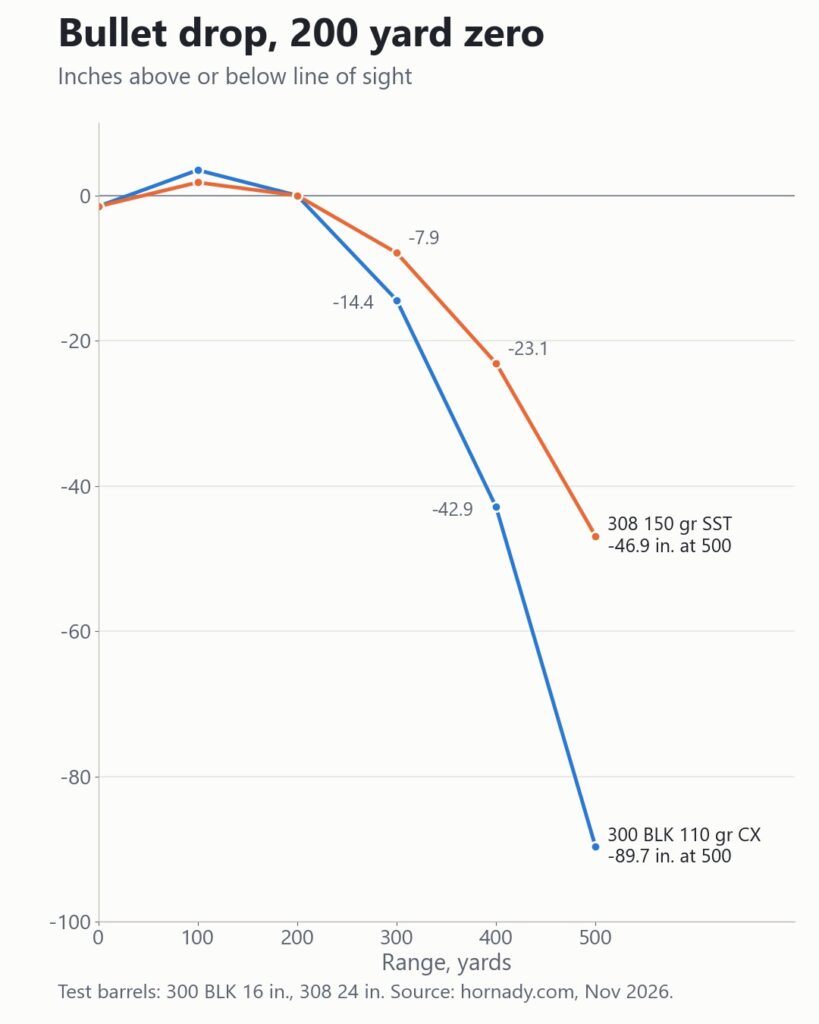
Copied comparisons often quote “8 in. vs 19.3 in. at 300 yards.” That comes from Federal’s two American Eagle loads with a 200 yard zero, the same basis as the chart. Few pages give the zero, and with Federal’s 100 yard zero row that 300 Blackout load is 34.7 in. low at 300.
Wind matters as much as drop. Federal’s 150 gr American Eagle 300 Blackout load drifts 13.7 in. at 300 yards and 40.6 in. at 500 in a 10 mph crosswind. Federal’s 168 gr Gold Medal .308 drifts 7.4 in. and 22.0 in. That’s roughly half, and it’s another reason the .308 is far easier to hit with at distance.
300 Blackout vs 308 for Deer, Hogs and Elk
Most supersonic 300 Blackout loads drop below 1,000 ft-lb between about 95 and 130 yards. Hornady’s 150 gr .308 loads stay above it to about 470 yards or past 500. The 1,000 ft-lb figure is a rule of thumb for deer, not a law, but it’s a useful way to see where each round runs out of steam.
Working from Hornady’s own tables, here’s where each load crosses 1,000 ft-lb:
- 300 BLK 110 gr NTX: about 20 yards
- 300 BLK 135 gr FTX: about 95 yards
- 300 BLK 110 gr CX: about 100 yards
- 300 BLK 125 gr HP: about 115 yards
- 300 BLK 110 gr V-MAX: about 130 yards
- 300 BLK 190 gr Sub-X subsonic: never above it, 465 ft-lb at the muzzle
- 308 150 gr InterLock SP: about 470 yards
- 308 150 gr SST and 168 gr ELD Match: past 500 yards
Plenty of hunters kill deer with 300 Blackout, and a well-placed shot with a bullet built to expand at lower speed does the job inside 100 yards or so. But if you hunt fields, cut lines or anywhere a 200 yard shot is possible, the .308 is the better deer cartridge by a long way. Check your state’s rules too, since some set minimum caliber or cartridge requirements for big game.
Elk: a common rule of thumb for elk is 1,500 ft-lb, and no 300 Blackout load in Hornady’s tables reaches it even at the muzzle. Hornady’s 150 gr SST .308 stays above it to about 340 yards and its 168 gr ELD Match to about 435. Hogs and coyotes: this is where 300 Blackout earns its keep, at close range, often at night and often suppressed. Inside 100 yards it does the job, and the .308 is more gun than a coyote needs.
For loads, see our best 300 Blackout ammo and best .308 ammo guides.
300 Blackout vs 308 for Home Defense
For home defense, 300 Blackout is the better pick. It runs from short barrels, so the rifle is easier to move around a house, and its recoil is far closer to a 5.56 than to a .308, so follow-up shots are quick. With a suppressor, subsonic loads take the edge off the blast indoors, which matters when you have no hearing protection on.
The .308 is more rifle than most homes need. A 16 in. AR-10 is long and heavy for hallways, the muzzle blast indoors is brutal without a suppressor, and every round carries far more energy than you need at room distances. If you already own a .308 and nothing else, it will work, but nobody should buy one for this job.
Whatever you choose, use expanding defensive ammo rather than FMJ, and know what is behind every wall you might shoot toward.
Can You Shoot 300 Blackout in a 308?
No. Never fire 300 Blackout in a .308 rifle, or .308 in a 300 Blackout. They share a bullet diameter, nothing else. A .308 round won’t even chamber in a 300 Blackout, because its 2.015 in. case is far longer than the 300 Blackout chamber. A 300 Blackout round in a .308 rifle sits on the wrong bolt face, with a .378 in. rim where the bolt expects .473 in.
SAAMI’s interchangeability guidance puts it simply. A round that fits a gun’s chamber, barrel or action “does not necessarily mean that it is safe to use that ammunition in that firearm.” The only alternate round it lists for 300 AAC Blackout is 300 Whisper.
The real danger with 300 Blackout isn’t the .308. It’s the 5.56. A 300 Blackout round fits AR-15 magazines and can chamber in a 5.56 barrel, and firing a .308 in. bullet into a 5.56 barrel built for .224 in. bullets can destroy the rifle. If you own both, mark your 300 Blackout mags, keep the ammo separate and check the headstamp before you load.
Subsonic and Suppressed: Where 300 Blackout Wins
300 Blackout was built to run quiet. AAC’s design goals included “Create the optimal platform for sound and flash suppressed fire” and “Work with subsonic and full power ammunition without requiring adjustable gas.” Heavy 190 to 220 gr bullets stay under the speed of sound, so a suppressor doesn’t have to fight a supersonic crack.
AAC’s own figures put a 9 in. 300 Blackout AR with 220 gr ammo and its 762-SDN-6 suppressor at 128 dB. Hornady’s 190 gr Sub-X leaves the muzzle at 1,050 fps from a 16 in. barrel, which is the kind of load that makes 300 Blackout the default suppressor host for an AR.
The trade-off is power. Subsonic 300 Blackout carries 465 ft-lb from Hornady’s 190 gr Sub-X and drops 33.4 in. at 200 yards from a 100 yard zero. It’s a close-range round. The .308 can be suppressed too, but it’s louder with standard ammo, and subsonic .308 isn’t what the cartridge is built for.
The Twist Rate Nobody Checks
SAAMI lists a 1:8 twist for 300 Blackout and 1:12 for .308. That isn’t trivia. The heavy, long subsonic bullets that make 300 Blackout useful need the faster twist to stabilize at low speed. A 1:12 .308 barrel is built for the 150 to 180 gr bullets the .308 runs best.
So even though both bores are .308 in., you can’t treat their bullets as interchangeable when you load your own. A 220 gr subsonic bullet that flies straight from a 1:8 300 Blackout barrel can keyhole from a slow .308 twist. If you reload, our how to reload 300 Blackout guide covers the 300 Blackout side.
300 Blackout or 308: AR-15, AR-10 or Bolt Action
The biggest practical reason to pick 300 Blackout is that it turns an AR-15 you already own into a .30 caliber rifle. AAC built it around “a standard AR Bolt Face” and existing AR magazines “while retaining their full capacity.” Swap the barrel, or the whole upper, and keep your lower, bolt and mags.
A .308 semi-auto needs an AR-10 pattern rifle, which is bigger and heavier, with its own magazines and parts. Standard AR-15 mags hold 30 rounds of 300 Blackout, the common AR-10 mag holds 20 rounds of .308, and most bolt rifles hold 4 or 5. Plenty of .308 shooters skip semi-autos entirely and buy a bolt-action rifle, which is where the cartridge has lived since 1952.
For an AR-15 owner on a budget, that’s the whole argument. See our best 300 Blackout uppers, best 300 Blackout rifles and best AR-10 rifles for the hardware.
308 vs 300 Blackout Recoil: How Much More Does 308 Kick?
From the same weight rifle, .308 recoil is roughly two and a half times that of 300 Blackout. Recoil energy grows with the square of the momentum you push out the barrel. A 150 gr bullet at 2,820 fps carries about 1.6 times the momentum of a 125 gr 300 Blackout bullet at 2,175 fps, and squaring that gives about 2.4 times the energy.
In an 8 lb. rifle, the bullet alone works out to about 2.9 ft-lb of free recoil for that 300 Blackout load and 7.1 ft-lb for the .308. Real numbers are higher once you count the powder gas, and the gap grows, because the .308 burns a lot more powder. At realistic weights, a 6.5 lb. 300 Blackout AR-15 comes out near 3.6 ft-lb and a 9 lb. .308 AR-10 near 6.3 ft-lb, bullet only. A supersonic 300 Blackout has more than twice the bullet-only recoil of a 55 gr 5.56, but at about 3 ft-lb it’s still mild. A .308 is a real push.
Where They Came From
The .308 is a 1952 Winchester cartridge. The 300 Blackout is an AAC design accepted by SAAMI in January 2011. Winchester’s own timeline says that in 1952 it “introduces the 308 Winchester cartridge that becomes the standard of the North Atlantic Treaty Organization.”
Advanced Armament Corp. built the 300 Blackout to put a .30 caliber round in the AR-15 without the feeding and bolt problems of 7.62×39. Its 2012 NDIA presentation says 7.62×39 “Requires a larger Bolt Face which reduces Bolt Locking Lug strength” and “Reduces Magazine capacity,” and that the 300 Blackout was “Accepted by SAAMI in January 2011.”
One related warning on the .308 side: SAAMI notes that surplus military rifles can have headspace that is fine for 7.62×51 NATO “but would be excessive for a SAAMI commercial cartridge,” naming 7.62×51 NATO and 308 Winchester as the example. Fire the ammo your rifle is marked for.
300 Blackout vs 308 Cost Per Round
300 Blackout is cheaper to shoot. The cheapest .308 box we track costs about a third more per round. In our live price check on November 21, 2026, the cheapest 300 Blackout box we track was $11.99 for 20 rounds of steel-cased FMJ, about 60 cents a round. The cheapest .308 was $15.99 for 20 rounds of brass FMJ, about 80 cents a round.
Hunting and match loads close the gap further, and subsonic 300 Blackout costs more than its supersonic FMJ. The price boxes below update daily, so check them for today’s numbers.
My Recommendation
Buy the .308 if you want one rifle for deer, elk and anything past 200 yards. It has more than twice the energy at every range past 100 yards, half the drop at 500, and more than 70 years of hunting loads behind it. A bolt-action .308 is still one of the best all-round hunting rifles you can own.
Buy the 300 Blackout if you already own an AR-15 and want a short, quiet .30 caliber gun. It’s the better home defense and suppressor round, it works from 8 or 9 in. barrels, and it handles hogs and deer at close range. Just don’t pretend it’s a 300 yard deer cartridge.
If I could only have one, I’d take the .308 in a bolt gun. If I already had an AR and a can, I’d add a 300 Blackout upper tomorrow. For more on the AR-15 side, read our 300 Blackout vs 5.56 and 300 Blackout for home defense pages.
300 Blackout Ammo Live Pricing


308 Win Ammo Live Pricing

Frequently Asked Questions
Is 300 Blackout better than 308?
Not for power or range. The .308 carries more than twice the energy past 100 yards and drops about half as much at 500. The 300 Blackout is better for short barrels, suppressors and turning an AR-15 into a .30 caliber gun.
Can you shoot 300 Blackout in a 308?
No. They share a .308 in. bullet diameter but nothing else. Never fire 300 Blackout in a .308 rifle or .308 in a 300 Blackout. SAAMI lists 300 Whisper as the only alternate for 300 Blackout.
Is 300 Blackout good for deer?
At close range, yes. Most of Hornady's supersonic 300 Blackout loads drop below 1,000 ft-lb between about 95 and 130 yards. For shots past that, a .308 is the better choice.
How far can 300 Blackout shoot effectively?
For deer, about 100 yards with supersonic expanding ammo. On paper or steel it reaches further, but Hornady's 110 gr CX is 14.4 in. below the sight line at 300 yards and 89.7 in. at 500 with a 200 yard zero.
Is 300 Blackout the same as 308?
No. Both use a .308 in. bullet, but the 300 Blackout case is 1.368 in. long vs 2.015 in. for .308, and SAAMI rates them at 55,000 psi and 62,000 psi.
Does 300 Blackout use AR-15 magazines?
Yes. AAC designed it to use standard AR-15 magazines and a standard AR bolt. Mark your 300 Blackout mags so the rounds never end up in a 5.56 rifle.
Which has more recoil, 300 Blackout or 308?
The .308, by a lot. From the same weight rifle, it's roughly two and a half times the recoil energy of a supersonic 300 Blackout, and more once powder gas is counted.
Is 300 Blackout cheaper than 308?
Yes. In our price check on November 21, 2026, the cheapest .308 box we tracked cost about a third more per round than the cheapest 300 Blackout. Check the live price boxes for today's prices.
Why is 300 Blackout good with a suppressor?
Its heavy 190 to 220 gr loads stay below the speed of sound, so there's no supersonic crack. AAC built it to run subsonic and full-power ammo in the same rifle without an adjustable gas block.
Is 300 Blackout or 308 better for home defense?
300 Blackout. It runs from short barrels, recoils far less than a .308 and works with subsonic ammo and a suppressor. The .308 is longer, louder and carries far more energy than you need indoors.
What twist rate is 300 Blackout vs 308?
SAAMI lists 1:8 for 300 Blackout and 1:12 for .308. The faster twist stabilizes heavy subsonic bullets.
Is 300 Blackout or 308 better for hogs?
Inside 100 yards, 300 Blackout is the handier hog gun, especially suppressed or at night. For longer shots across fields, the .308 carries far more energy.
Is 300 Blackout enough for elk?
No. A common rule of thumb for elk is 1,500 ft-lb, and no 300 Blackout load in Hornady's tables reaches it, even at the muzzle. Hornady's 150 gr SST .308 stays above it to about 340 yards.
3,029+ Gun & Ammo Deals
Updated daily from 200+ top retailers. Filter by category, caliber, action type, and price.
Related Guides