Last updated November 2026 · By Nick Hall
Some of the links below are affiliate links, meaning at no additional cost to you, we may earn a commission if you click through and make a purchase.
- Treat every gun as loaded
- Point the muzzle in a safe direction
- Keep your finger off the trigger until you’re ready to shoot
- Know your target and what’s beyond
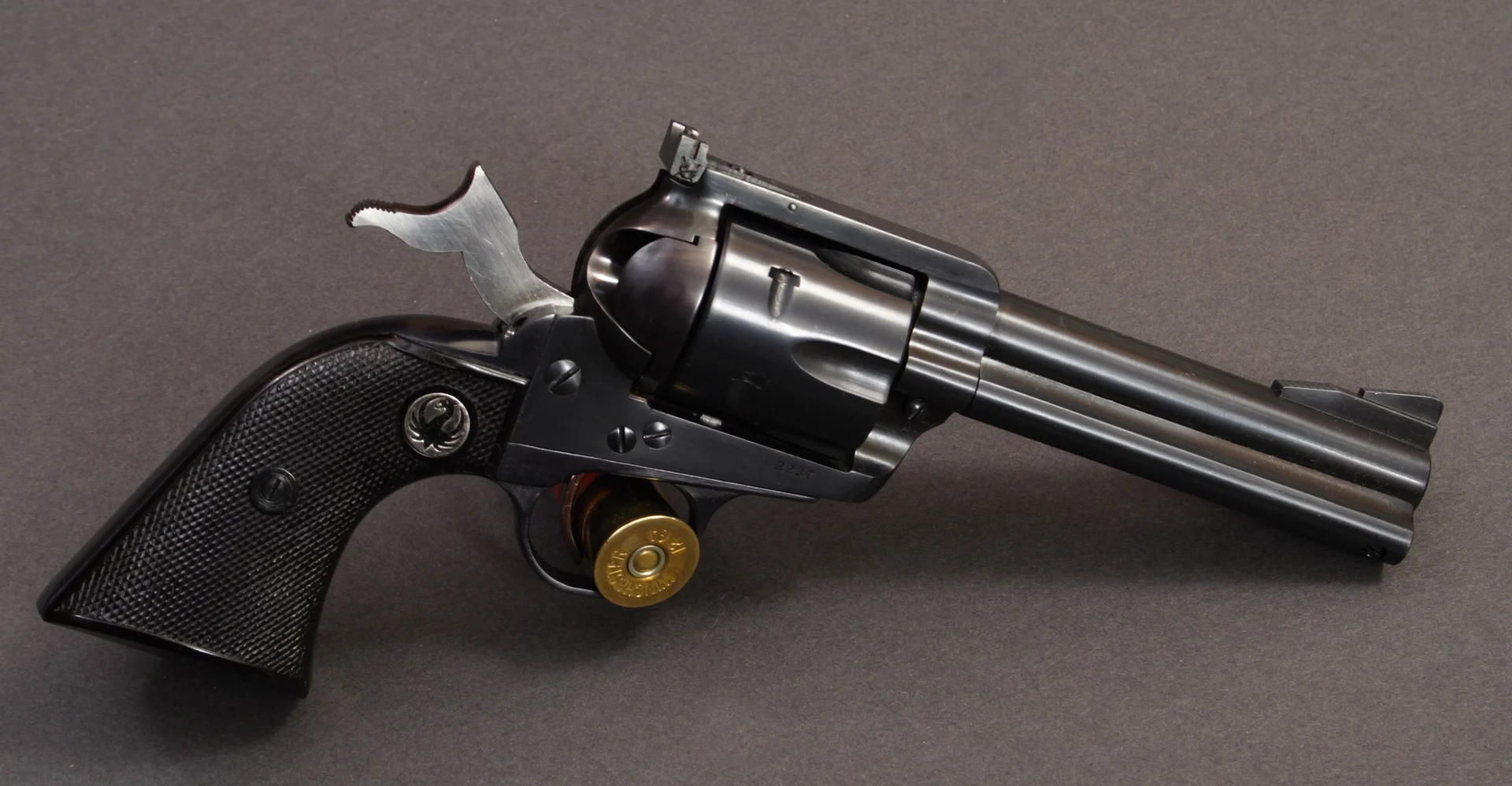
The Ruger Blackhawk is the single-action revolver that put Sturm, Ruger on the map. Bill Ruger launched it in 1955 in .357 Magnum, and for the next 70 years it was the strong, affordable answer to the Colt Single Action Army: a cowboy-shaped gun with adjustable sights and a frame tough enough for full-power magnums. Millions of hunters, ranchers and plinkers learned to shoot a handgun on one.
Now the story has a deadline. In October 2026 Ruger told distributors that the Blackhawk and Super Blackhawk would get final production runs over the rest of 2026, and every standard catalog Blackhawk on ruger.com now reads “Currently Unavailable.” That makes this the moment to understand the gun properly. This guide covers what a Blackhawk is worth by era and caliber, using 340 completed sales, how to tell a Flattop from a three-screw from a New Model in ten seconds, Ruger’s free safety conversion for old guns, and how the New Model actually shoots.
Quick take
A used New Model Blackhawk is one of the best-value magnum revolvers you can buy, and good .357s still sell for about $520. Buy a New Model if you want to shoot it and carry six rounds; buy an Old Model three-screw or a Flattop to collect, and never carry one with a round under the hammer. With new production ending in 2026, convertibles and .45 Colts are the models to buy before shelves empty.
- Typical used price (Dec 2025 to Nov 2026 sales): about $520 for a New Model .357, $827 for a New Model .45 Colt, $852 to $922 for a convertible, $544 for a three-screw .357 and $1,200 for a .357 Flattop
- Calibers: .357 Magnum, .41 Magnum, .44 Magnum, .45 Colt, .30 Carbine and .44 Special, plus .357/9mm and .45 Colt/.45 ACP convertibles
- Made: 1955 to 2026; Old Model to 1973, New Model with a transfer bar from 1973
- Legal: every Old Model, and New Models made more than 50 years ago, count as curios or relics by age
How we tested: Every pick here is ranked against our testing methodology. Minimum round counts, accuracy and reliability protocols, the failures that disqualify a gun.
Ruger Blackhawk Pros and Cons
Pros
- Built to handle full-power magnums
- Adjustable sights on every model
- Used .357s sell for about $520
- Convertibles shoot two calibers
- Free safety conversion for Old Models
- New Model carries six rounds safely
Cons
- Old Models must carry five, not six
- Slow to load and unload
- Final new production run in 2026
- Big grip frame for small hands
- .45 ACP cylinder shoots to a different point
- Factory cylinder gaps vary gun to gun
Ruger Blackhawk at a Glance
| Spec | Old Model (1955 to 1973) | New Model (1973 to 2026) |
|---|---|---|
| Calibers | .357 Magnum (1955), .44 Magnum (1956 to 1962), .41 Magnum (1965), .30 Carbine (1968), .45 Colt (1971) | .357, .41, .44 Magnum, .45 Colt, .30 Carbine, .44 Special; .357/9mm and .45 Colt/.45 ACP convertibles |
| Capacity | 6 chambers; carry 5 with the hammer on an empty chamber | 6, all of them can be loaded |
| Action | Single action, no transfer bar | Single action with transfer bar and loading-gate interlock |
| How to spot it | Three screws on the side of the frame | Two pins on the side of the frame; “NEW MODEL” in the roll mark |
| Barrels | .357 Flattop: 4 5/8, 6 1/2 and 10 in.; .44 Flattop: 6 1/2, 7 1/2 and 10 in. | 3 3/4 (exclusives), 4 5/8, 5 1/2, 6 1/2 and 7 1/2 in. |
| Weight | Varies by caliber and barrel | 36 oz. (Lipsey’s .357 convertible) to 46 oz. (stainless .357) |
| Last list price | $87.50 in 1955 | $889 blued, $999 convertible, $1,069 stainless .357 (2026) |
| Legal status | Curio or relic by age | Curio or relic only if made more than 50 years ago |
Table of Contents
What It’s Actually Like to Shoot a Blackhawk: Myth vs. Truth
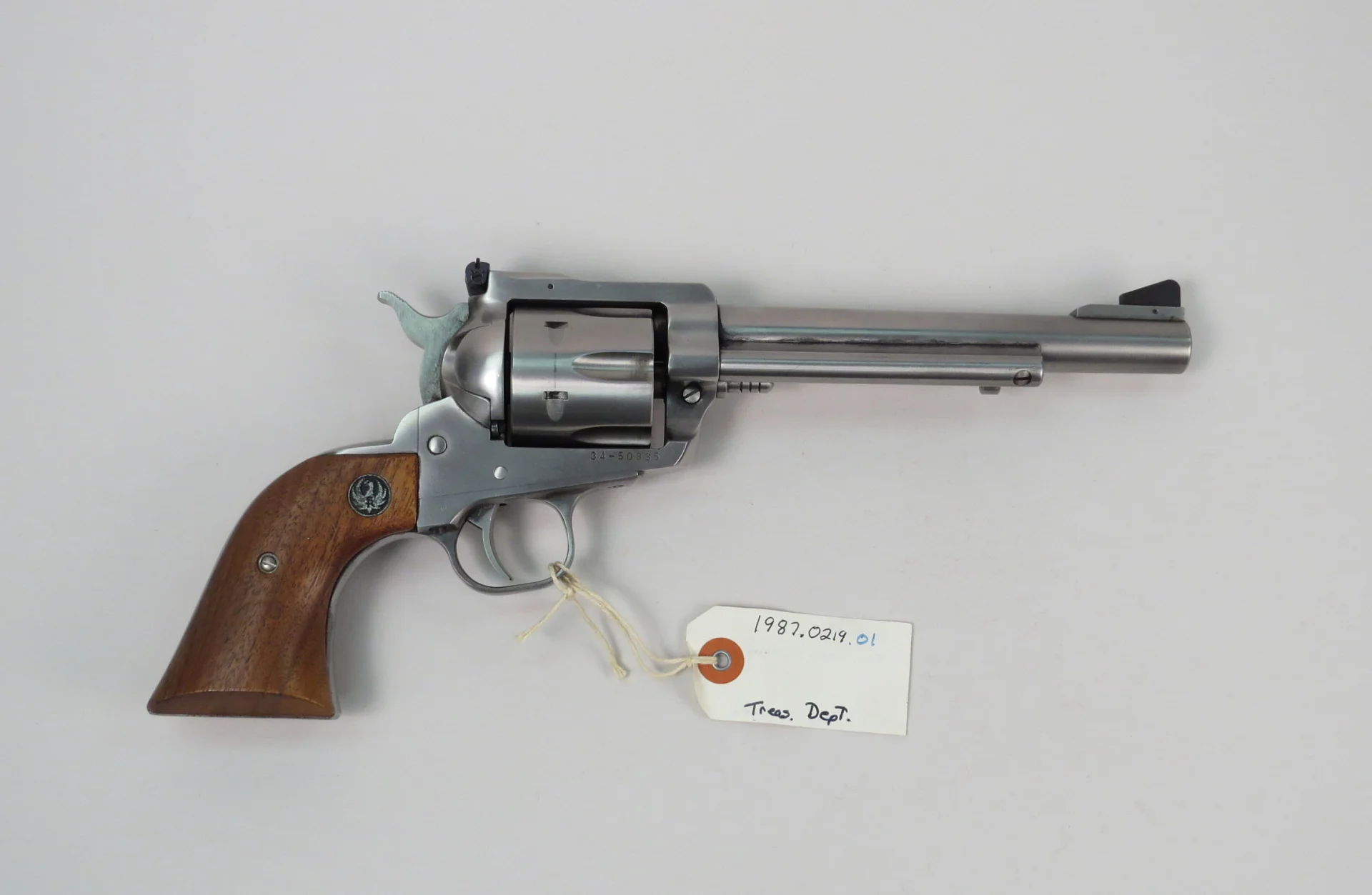
We shot three New Models: a stainless .357 with the 4 5/8-inch barrel, a blued .45 Colt convertible with its spare .45 ACP cylinder, and a blued Super Blackhawk in .44 Magnum with the 7 1/2-inch barrel. Before shooting each one we checked the cylinder gap with a feeler gauge and the end shake by pushing the cylinder back and forth with the hammer down on an empty chamber.
From a rest at 25 yards, the .357 averaged 1.75 inches for five-shot groups with a 140-grain hollow point, and .38 Special wadcutters grouped just as well. Its single-action trigger broke at about 4 lb 3 oz with a little creep. The .45 Colt was harder to shoot small. The big white-dot front sight covers a lot of target at 25 yards, and our groups with standard lead loads averaged about 3 inches. Its trigger broke at about 4 lb 6 oz. The Super Blackhawk put 200 rounds of .44 Magnum and .44 Special downrange, averaged 2.34 inches at 25 yards and had a 4 lb 1 oz trigger. Not one of the three guns had a malfunction.
The big surprise was the convertible. With the sights set for .45 Colt, the .45 ACP cylinder printed several inches higher at 15 yards. That’s normal for these guns, because the two cartridges leave the barrel at different speeds and with different bullet weights, but it means you’ll pick a cylinder to zero for and use the other one for plinking. The .357 had a cylinder gap of .008 inch, a little more than the .004 to .006 inch range most revolver smiths like, and it was still accurate.
| The myth | What we found | Evidence |
|---|---|---|
| “A three-screw Blackhawk is unsafe.” | It is safe if you carry five rounds with the hammer down on the empty chamber. Loading six with the hammer on a live round is what is dangerous, because a blow to the hammer can fire it. | Ruger’s safety notice; American Rifleman |
| “Ruger’s conversion ruins an Old Model’s value.” | Ruger says the value “will not be impaired” and returns the original parts. Collectors still pay more for an unconverted gun, so keep every part if you convert. | Ruger safety offer; collector guides |
| “The 1976 Liberty guns are rare Old Models.” | The “Made in the 200th Year of American Liberty” roll mark is on New Models made in 1976, and it adds little value. | American Rifleman; Rock Island Auction |
| “The .45 ACP cylinder shoots to the same spot.” | It printed several inches higher than .45 Colt in our session. Expect to re-sight or accept the shift. | Our range session |
| “Ruger has discontinued the Blackhawk for good.” | Ruger calls it a final production run, and says it doesn’t necessarily mean the family is permanently discontinued. | American Rifleman; Ruger Q3 2026 release |
Who the Blackhawk Is For (and Who Won’t Enjoy It)
- The hunter and outdoorsman: a 6 1/2- or 7 1/2-inch .44 Magnum Super Blackhawk or .45 Colt is a proven deer and field gun with sights you can adjust for one load.
- The new single-action shooter: a New Model .357 shoots cheap .38 Specials, carries six safely and sells used for about $520.
- The tinkerer who wants one gun for two calibers: a convertible shoots .357 and 9mm, or .45 Colt and .45 ACP, from the same frame.
- The collector: Flattops, early Super Blackhawks and three-screw .45 Colts and .30 Carbines are climbing, well-documented collector guns.
- The concealed carrier: it’s big, heavy and slow to reload. A double-action like the Ruger GP100 makes more sense.
- The cowboy action shooter on a budget: the fixed-sight Vaquero or an Uberti 1873 Cattleman has the traditional look and costs less.
- Anyone who wants an Old Model to carry fully loaded: it can’t safely be done without Ruger’s conversion.
- Shooters with small hands: the standard grip frame is long, and the Super Blackhawk’s square-back trigger guard can bite knuckles under magnum recoil.
What a Ruger Blackhawk Costs in 2026
These are completed-sale prices, not asking prices. We tracked 340 used Blackhawks, Super Blackhawks and Bisleys: GunBroker sales from December 2025 to November 2026, Connecticut auction results from 2020 to 2025 and Rock Island Auction hammer prices from 2009 to 2025. Distributor exclusives, 50th Anniversary guns, engraved and scoped guns are left out. We only give a median where we found at least three sales.
Old Models (1955 to 1973)
| Model | Median sale | Range seen | Sales tracked |
|---|---|---|---|
| .357 Flattop (1955 to 1962) | $1,200 | $575 to $2,000 | 9 |
| .357 Flattop, first-year three-digit serial | no median | $3,500 to $3,750 | 2 |
| .44 Magnum Flattop (1956 to 1962) | $1,000 | $600 to $1,900 | 15 |
| Three-screw .357 (1962 to 1973) | $544 | $424 to $1,089 | 7 |
| Three-screw .45 Colt (1971 to 1973) | $968 | $950 to $1,000 | 3 |
| Three-screw .30 Carbine (1968 to 1973) | $943 | $700 to $1,200 | 4 |
| Old Model Super Blackhawk (1959 to 1973) | $847 | $544 to $1,936 | 7 |
New Models (1973 to 2026)
| Model | Median sale | Range seen | Sales tracked |
|---|---|---|---|
| New Model .357 Magnum | $514 | $393 to $955 | 15 |
| New Model .30 Carbine | $605 | $550 to $715 | 5 |
| New Model .41 Magnum | $677 | $454 to $883 | 4 |
| New Model .45 Colt | $827 | $393 to $1,525 | 16 |
| Convertible .357/9mm | $852 | $605 to $1,390 | 11 |
| Convertible .45 Colt/.45 ACP | $922 | $605 to $1,525 | 10 |
| New Model .44 Special | $1,138 | $1,105 to $1,300 | 3 |
| Super Blackhawk .44 Magnum | $655 | $424 to $1,500 | 83 |
| Super Blackhawk Bisley .44 | $959 | $500 to $1,436 | 22 |
| Blackhawk Bisley | $1,190 | $575 to $1,775 | 15 |
A few things stand out. A three-screw .357 sells for about the same money as a used New Model .357, so it is the cheapest way into an Old Model. A Flattop costs about twice that. Convertibles carry a premium of roughly $300 over a plain .357, because the second cylinder is worth having, and both cylinders need to be there. The Super Blackhawk is the most traded Blackhawk by far, and stainless ones sell for more than blued: about $699 against $590 where the finish was stated.
New guns are now whatever dealers already have. When we checked on November 26, 2026, the cheapest new standard models in our price feed started at $699.99 for a blued .45 Colt, $799.99 for a .357 and $789.99 for a .357/9mm convertible, while Ruger’s list prices are $889 blued and $999 for a convertible. Expect those prices to rise as the last guns sell. You can also browse used Ruger Blackhawks on Guns.com.
Which Blackhawk to Buy: The Variants
The Flattop (1955 to 1962)
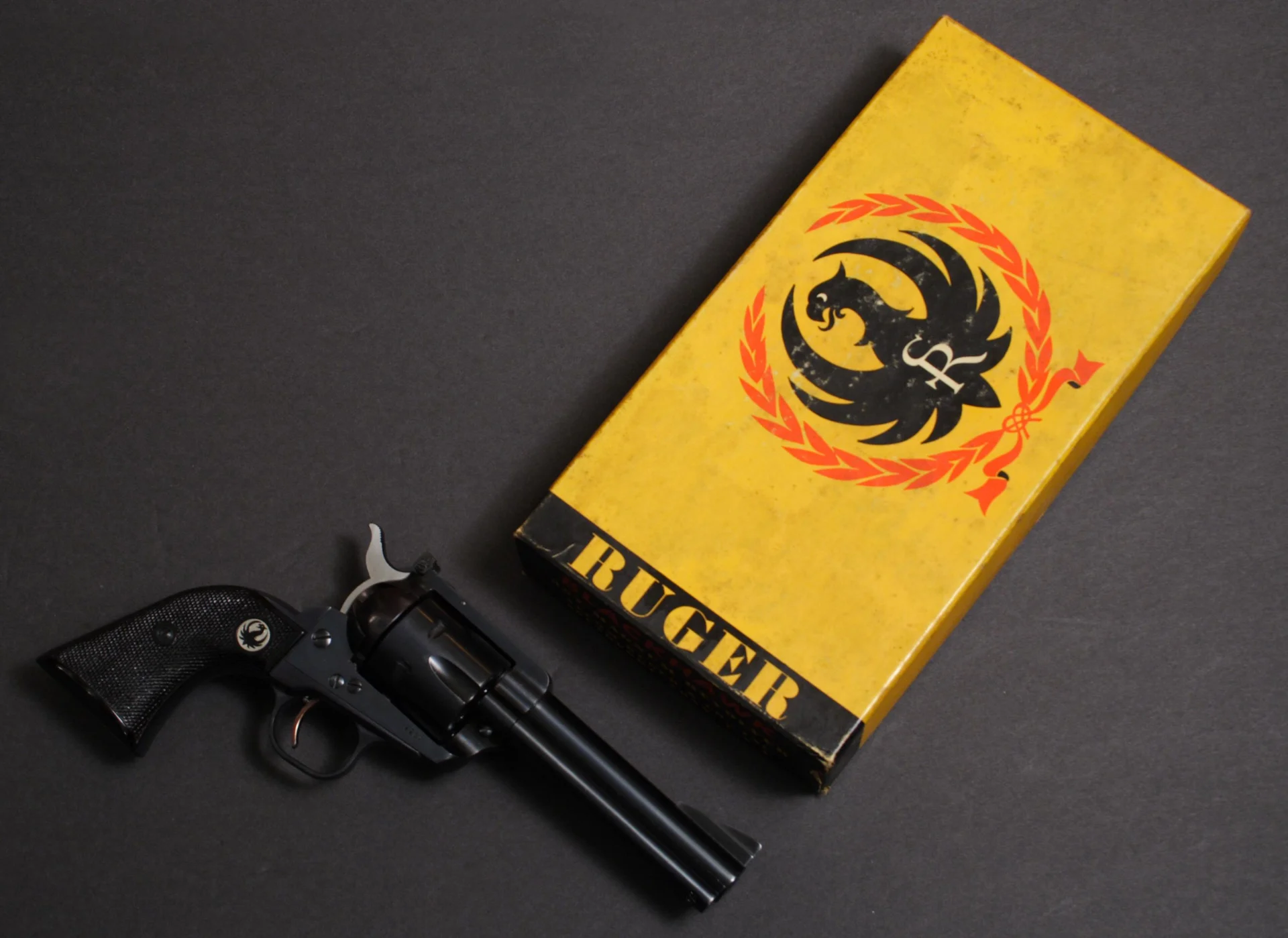
The first Blackhawk was a .357 with a flat top strap and the rear sight sitting right on it, with no protective ears. Collectors call it the Flattop, a nickname rather than a factory name. It had a 4 5/8-, 6 1/2- or 10-inch barrel, a chrome-moly investment-cast frame and a light aluminum grip frame. Ruger built about 1,750 in the first year and ended the Flattop in 1962 at about serial number 42,600 to 42,700. A .44 Magnum Flattop followed in November 1956 and ran to 1962.
Flattops are the collector Blackhawks. A .357 sells for about $1,200 and a .44 for about $1,000, while first-year guns with three-digit serial numbers go for $3,500 and up. The 10-inch .357s are the rarest standard Flattops.
The Three-Screw Old Model (1962 to 1973)
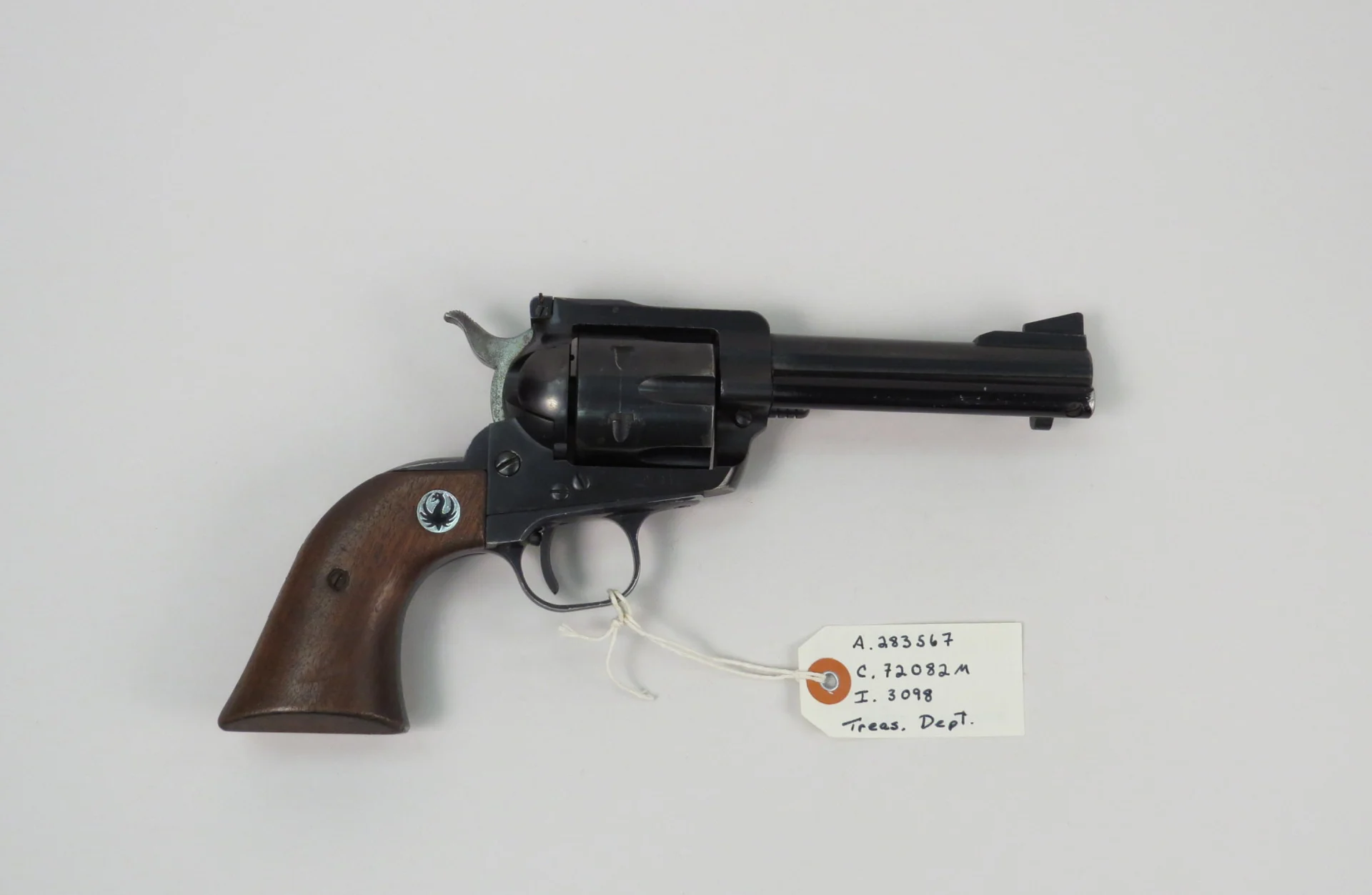
In 1962 Ruger added protective ears around the rear sight and a fuller grip frame. Calibers grew: .41 Magnum in 1965, .30 Carbine in 1968 and .45 Colt in 1971, with .357/9mm and .45 Colt/.45 ACP convertibles alongside. These guns still have the old lockwork, so they’re three-screw guns just like the Flattops. The way to tell them apart is the rear sight: Flattops have no ears.
A three-screw .357 is the bargain Old Model at about $544. The rarer calibers sell for more, about $968 for a .45 Colt and $943 for a .30 Carbine.
The Super Blackhawk (1959 on)
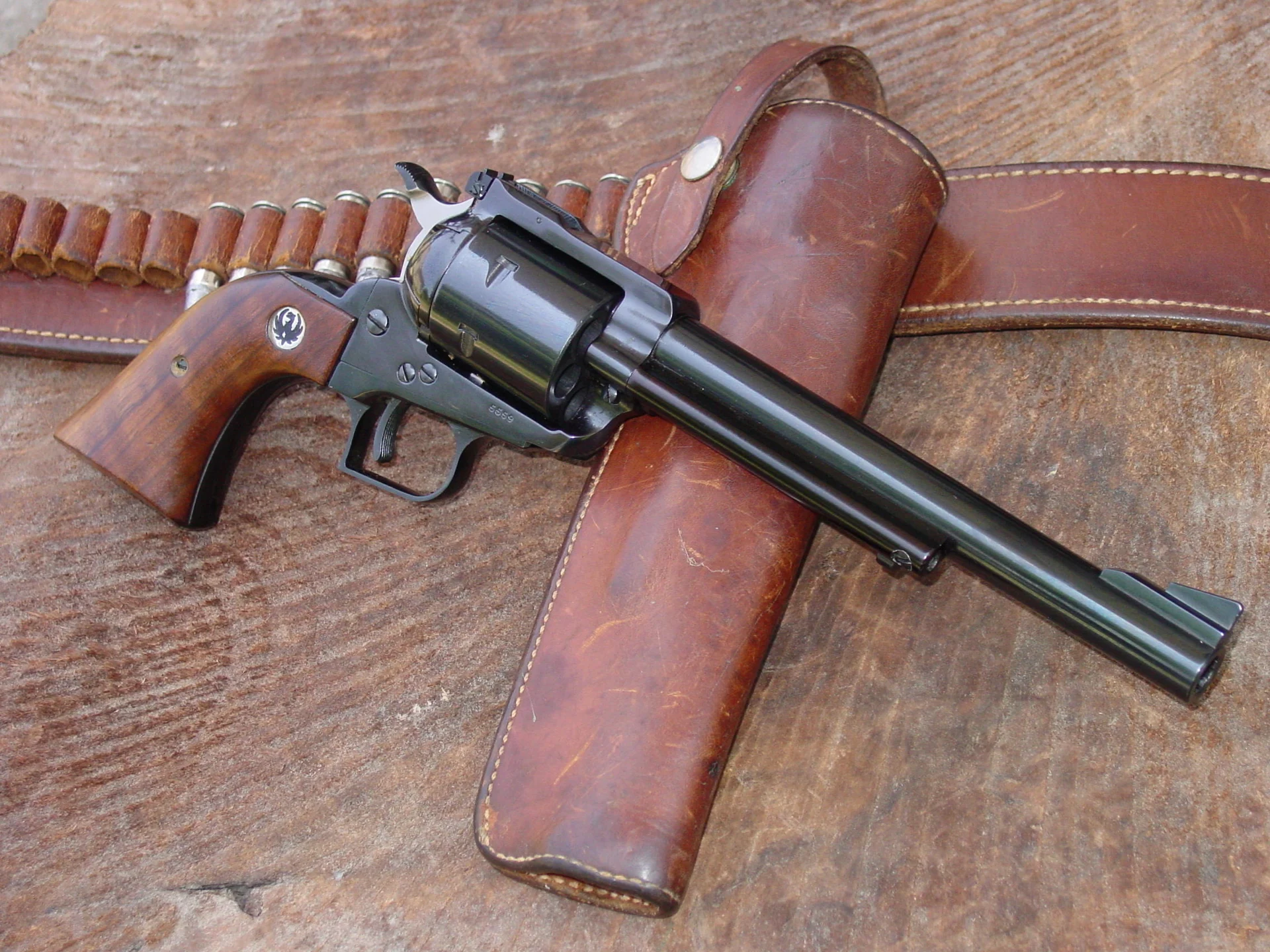
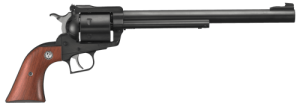
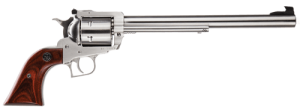
Ruger announced the Super Blackhawk in September 1959 to tame the .44 Magnum. It has a heavier frame, an unfluted cylinder, a 7 1/2-inch barrel and a longer steel grip frame with a square-back trigger guard modeled on the old Colt Dragoon. Elmer Keith called it the “Dragoon Ruger.” Early guns came in a mahogany case. The New Model Super Blackhawk arrived in 1973 and is the most common Blackhawk on the used market, at a median of about $655.
The New Model (1973 to 2026)
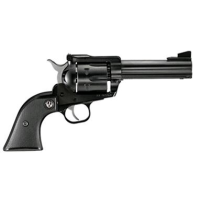
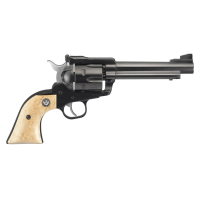
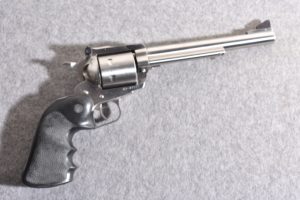
The New Model added Ruger’s transfer bar, which lets you carry six rounds, and a loading-gate interlock. Look for two pins on the side of the frame instead of three screws, and “NEW MODEL” in the roll mark. A used New Model .357 sells for about $514, a .45 Colt for about $827 and a .41 Magnum for about $677.
Convertibles
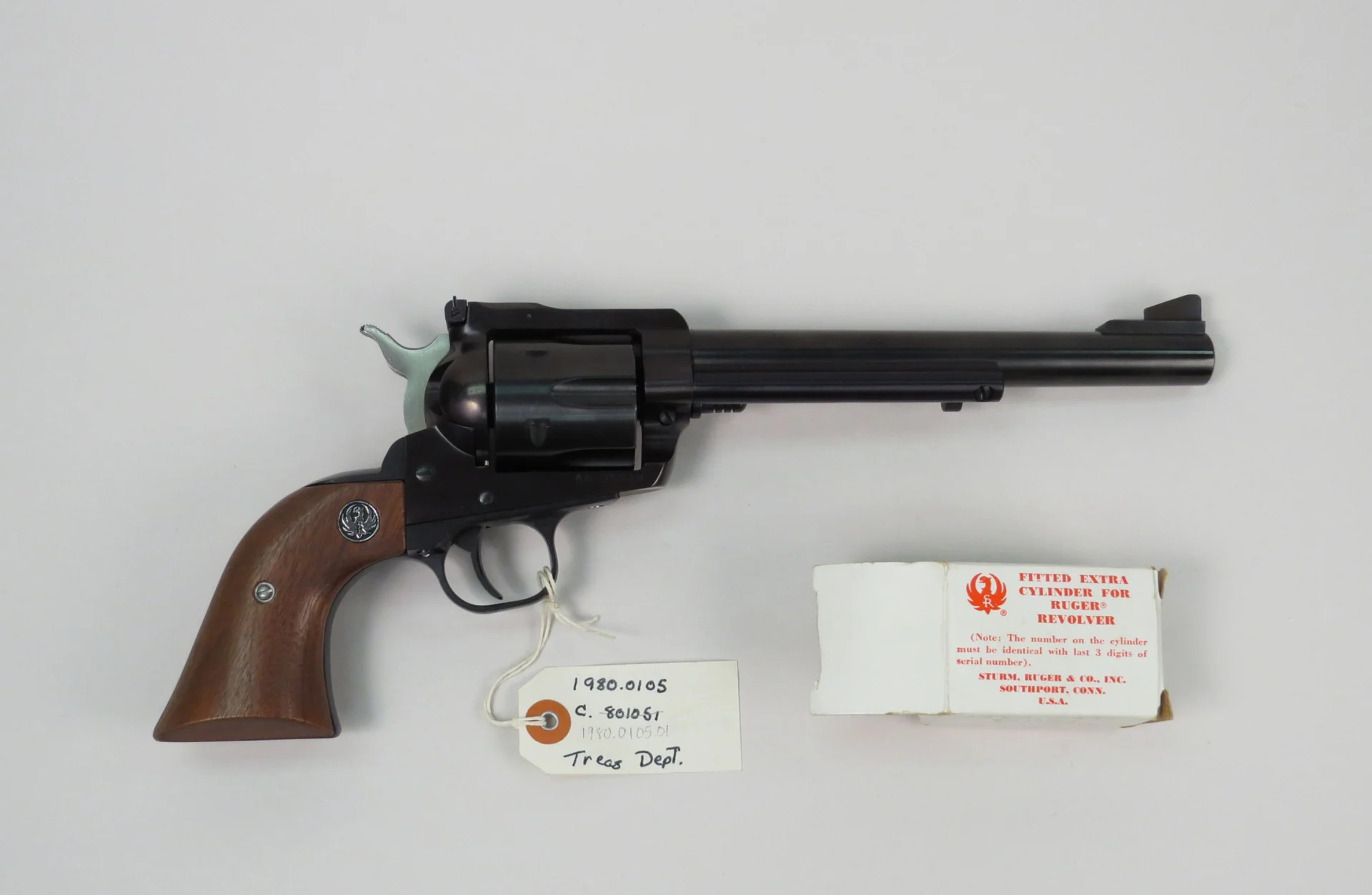
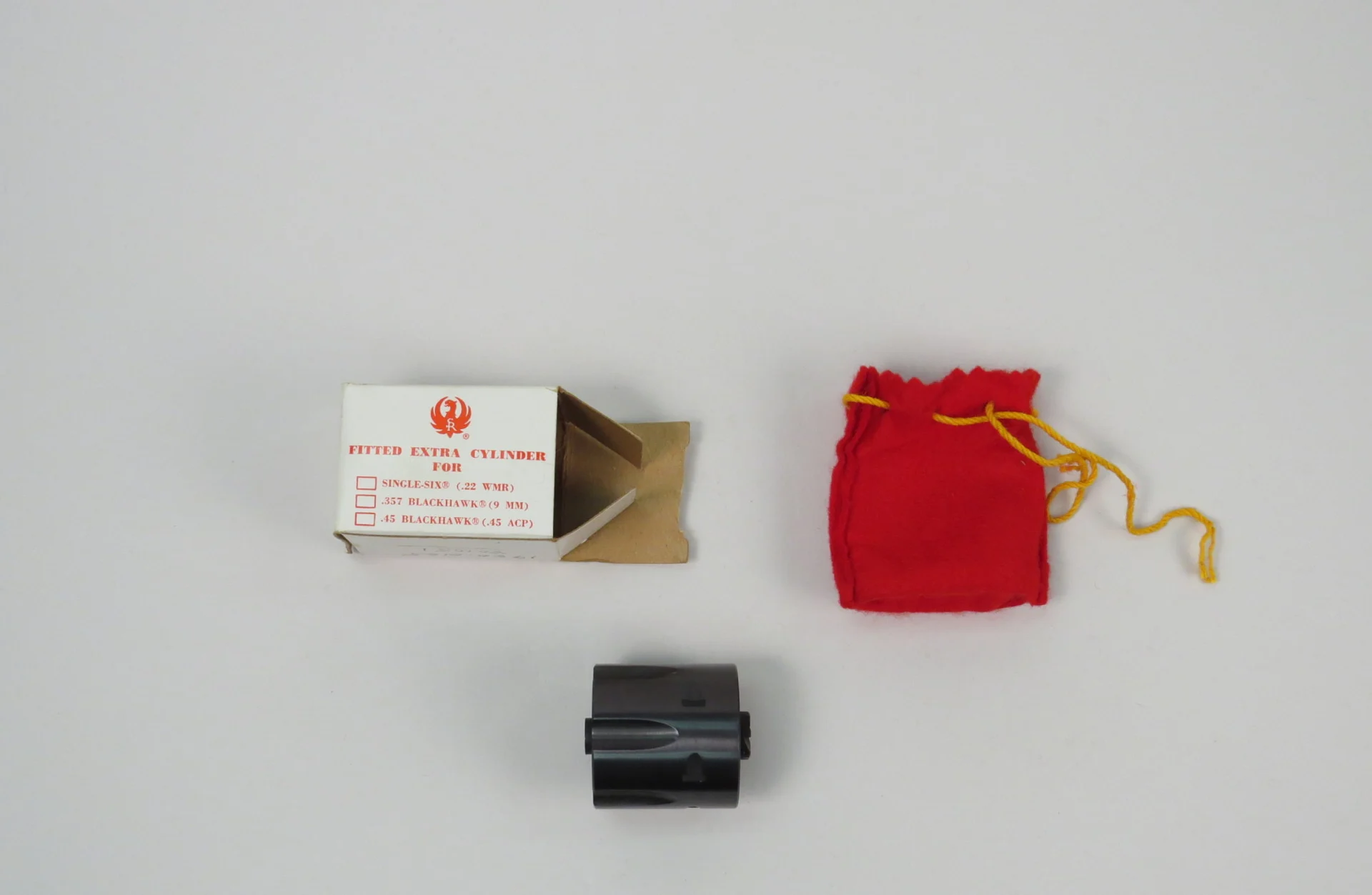
Convertibles come with two cylinders that swap without tools: .357 Magnum and 9mm, or .45 Colt and .45 ACP. They are the most practical Blackhawks, because you can shoot whichever ammo is cheaper. A convertible without its second cylinder is worth no more than a standard gun, so make sure both are in the box.
Bisleys, Anniversary Guns and Exclusives
Ruger’s Bisley models, with their sloped grip and low hammer, arrived in the mid-1980s and sell high: about $1,190 for a Blackhawk Bisley and $959 for a Super Blackhawk Bisley in .44. The 2005 50th Anniversary .357 has a gold “50TH YEAR BLACKHAWK 1955 TO 2005” roll mark and serials starting 520-, and a 2006 .44 Magnum Flattop anniversary model followed. Distributor exclusives from Lipsey’s, TALO and others, including .44 Special and short-barrel guns, are where most of the remaining new stock is.
Ruger Blackhawk Condition Guide
Most used Blackhawks are sold with a description, not a grade, so learn to read the gun yourself. The NRA’s condition standards are the common language, and our gun values guide explains them in full. Here’s how they apply to a Blackhawk.
| Condition | What you see on a Blackhawk | Effect on price |
|---|---|---|
| New in box | Unfired, box and paperwork, no turn line on the cylinder | Top of the range; boxed Old Models carry a big premium |
| Excellent | Over 95% blue, faint turn line, crisp roll marks, tight lockup | Upper end of the range |
| Very good | 85 to 95% blue, light holster wear at the muzzle and cylinder, sharp edges | Near the median |
| Good | Visible wear, some freckling or light pitting, a heavier turn line | 20 to 30% below the median |
| Fair | Worn finish, pitting, replaced grips or screws, loose lockup | Shooter or project price |
The wear points on a Blackhawk are the front of the cylinder, where flame cutting shows on the top strap above the gap, the muzzle, the edges of the loading gate and the grip frame. On Old Models with an aluminum grip frame, the frame wears to bare gray metal quickly. On blued guns, check that the frame and grip frame match in color; a brighter frame often means a refinish.
Markings, Serial Numbers and How to Date a Blackhawk
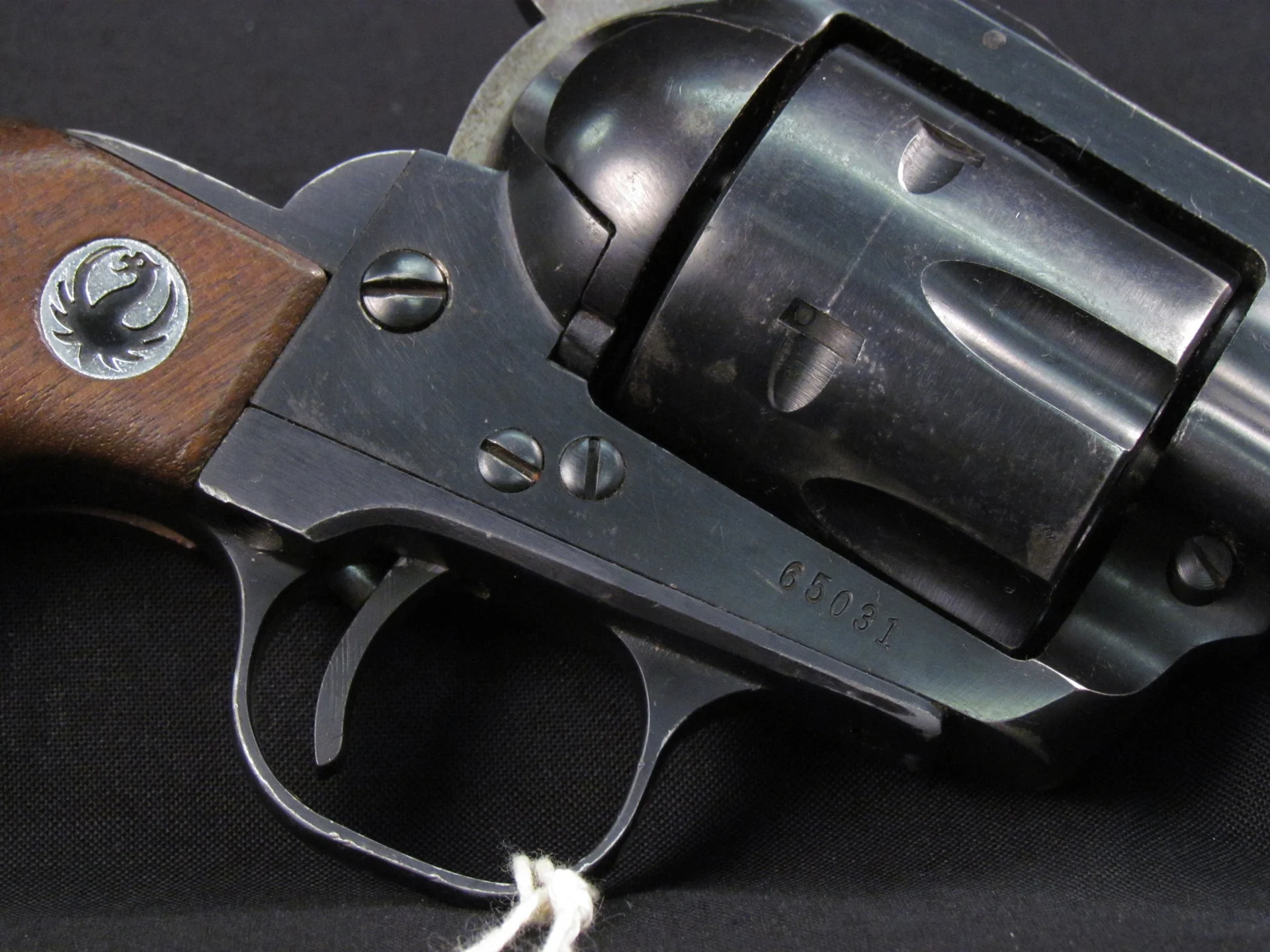
Ruger’s free serial number lookup returns the model, caliber and ship date for most guns, though Ruger notes the results are “reference only.” Ruger’s Letter of Authenticity service is paused for now. For older guns, the serial prefix tells you a lot on its own, and our Ruger serial number guide covers the rest.
| Prefix or range | Model and era |
|---|---|
| Plain numbers, up to about 42,700 | .357 Flattop, 1955 to 1962 |
| Plain numbers | .44 Magnum Flattop, 1956 to 1962; three-screw .357, .41 and .30 Carbine to 1968 |
| 30- and 31- | Old Model .357, 1969 to 1973 |
| 40- | Old Model .41 Magnum, from 1969 |
| 45- | Old Model .45 Colt, 1971 to 1973 |
| 50- | Old Model .30 Carbine, from 1969 |
| 80- | Old Model Super Blackhawk, from 1969 |
| 32- to 38- | New Model .357 (all calibers share 38- from 2013) |
| 46- to 48- | New Model .45 Colt and convertibles |
| 81- to 88- | New Model Super Blackhawk |
| 520- | 50th Anniversary .357, 2005 |
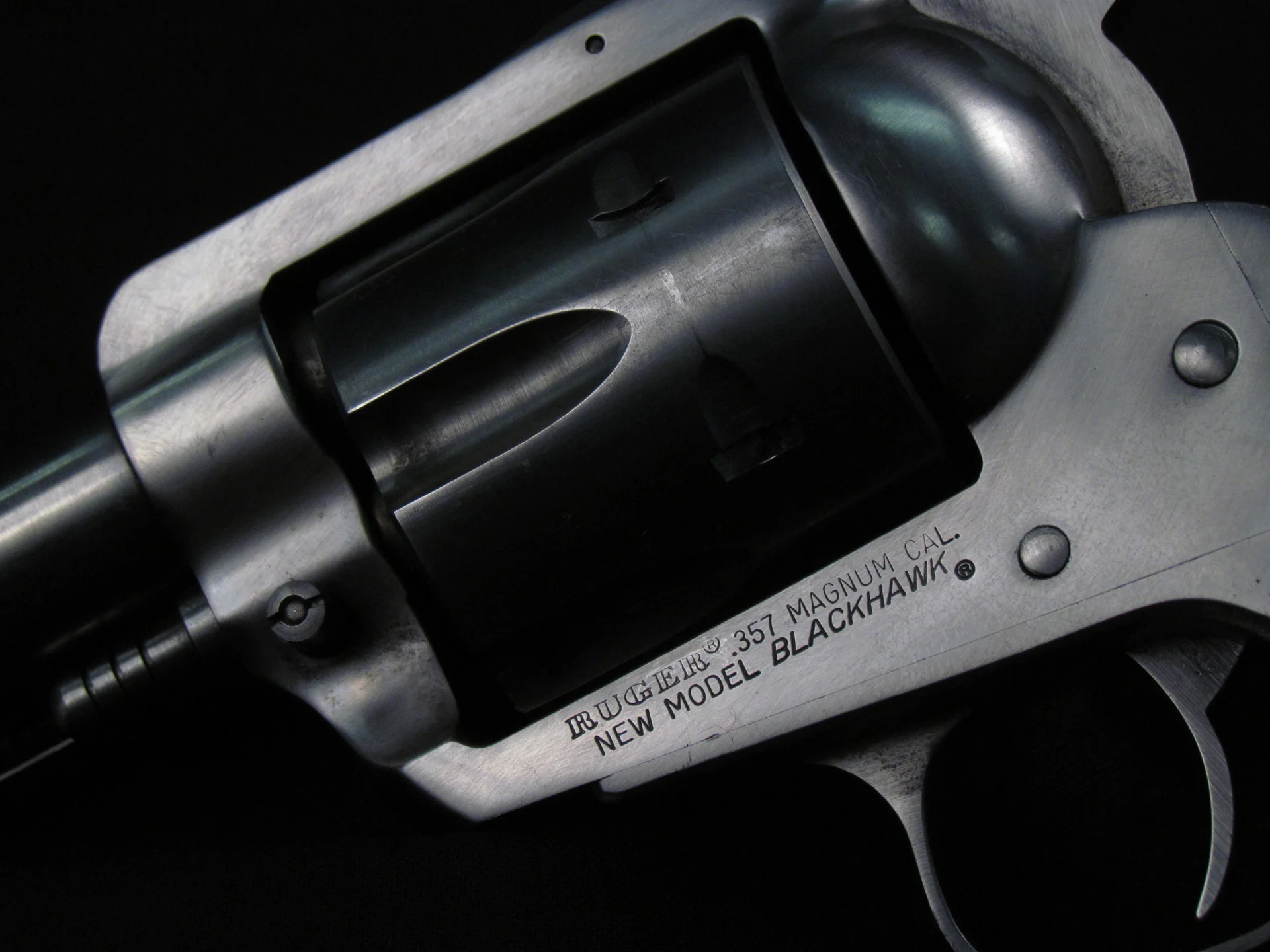
Old Model barrels carry the Southport, Connecticut address on early guns. The “Made in the 200th Year of American Liberty” roll mark appears on 1976 production, which is New Model, and it doesn’t make a gun an Old Model or add much value. Later New Models also carry a barrel warning telling you to read the instruction manual, another quick New Model tell.
Ruger’s Free Safety Conversion for Old Models
This is the most important thing to know about an Old Model. Without a transfer bar, the firing pin rests on the primer of the round under the hammer, so a hard blow to the hammer can fire it. The safe way to carry an Old Model is what American Rifleman describes as the old drill: “load one, skip one, load four” with the gun at half cock, then cock it and lower the hammer on the empty chamber. Don’t rely on the hammer’s safety notch.
Ruger still offers a free fix. Its current Blackhawk manual tells owners of all pre-1973 single-actions to write to Ruger’s Conversion Dept., 411 Sunapee Street, Newport, NH 03773, for a box and shipping instructions, with the model, caliber and serial number. Ruger’s safety offer says you pay only the initial shipping, Ruger pays for the return, and it sends back your original parts. Don’t ship the gun until you get Ruger’s box, and note that Ruger will only service an Old Model after the conversion kit is fitted.
Collectors argue about it. Ruger says the conversion doesn’t impair the gun’s value, but unconverted Old Models still draw more interest. If you convert a gun you might sell one day, keep the original parts with it so the next owner can reverse it. If you plan to shoot and carry an Old Model, convert it.
Refinishes, Parts Guns and Things to Watch For
- Fake Flattops: Ruger made modern New Model Flattops, including 50th Anniversary guns. Check for two pins and a New Model roll mark before paying Flattop money.
- Missing convertible cylinders: a convertible sold without its second cylinder, or with one that wasn’t fitted at the factory, is worth standard-gun money.
- Refinished guns: look for softened edges, washed-out roll marks and a frame and grip frame that don’t match in color.
- Replaced grip frames: brass grip frames were factory options on some Old Models and add value, so be wary of aftermarket brass on a gun sold as original.
- Converted guns sold as original: a Ruger-converted Old Model has a transfer bar. Ask whether the original parts are included.
- Cylinder swaps: check that the cylinder serial, where marked, matches the frame.
Pre-Purchase Inspection Checklist
- Count the frame screws or pins to confirm Old Model or New Model.
- With the gun unloaded, open the loading gate and confirm the cylinder rotates freely and clicks into each chamber.
- Cock the hammer slowly on each chamber and check that the cylinder locks up tight with little rotational play.
- Push the cylinder forward and back to check end shake; more than a few thousandths means wear.
- Measure the cylinder gap with a feeler gauge; about .004 to .006 inch is ideal.
- Look at the top strap above the gap for flame cutting, common on guns fed lots of hot magnums.
- Check the forcing cone for cracks or erosion with a flashlight.
- Look down the bore for pitting, bulges or a ring.
- On a New Model, confirm the transfer bar moves up only when the trigger is held back.
- Check the ejector rod moves smoothly and the base pin doesn’t walk forward.
- For a convertible, fit both cylinders and confirm both lock up and turn freely.
- Run the serial through Ruger’s lookup to check the model, caliber and ship year.
Shooting and Caring for a Blackhawk
Blackhawks are strong guns, and New Models handle full-power factory magnum loads all day. The .357 shoots .38 Special too, which is the cheap way to practice. In a .45 Colt, stick to standard factory loads unless you know the gun’s history; some heavy “.45 Colt +P” loads are only meant for guns on the ammunition maker’s list, and our .45 Colt ammo guide covers which ones. There’s no point running hot loads through a collector Old Model.
| Use | Avoid | Why |
|---|---|---|
| .38 Special in a .357 | Dirty, unwashed lead loads in a gun you want to keep clean | Cheap, mild and easy on the gun |
| Standard .45 Colt and cowboy loads | +P .45 Colt unless the maker lists your gun | Keeps pressures where a collector gun belongs |
| .44 Special in a Super Blackhawk | Steady hot loads in a three-screw .44 | Ruger says .44 Magnum models also accept .44 Special |
Clean the forcing cone and the front of the cylinder after shooting magnums, because lead and carbon build up there first. Keep the base pin lightly oiled. On an Old Model, never carry six. To unload, open the loading gate (an Old Model also needs the hammer at half cock to turn the cylinder) and push each case out with the ejector rod.
Ruger Blackhawk History
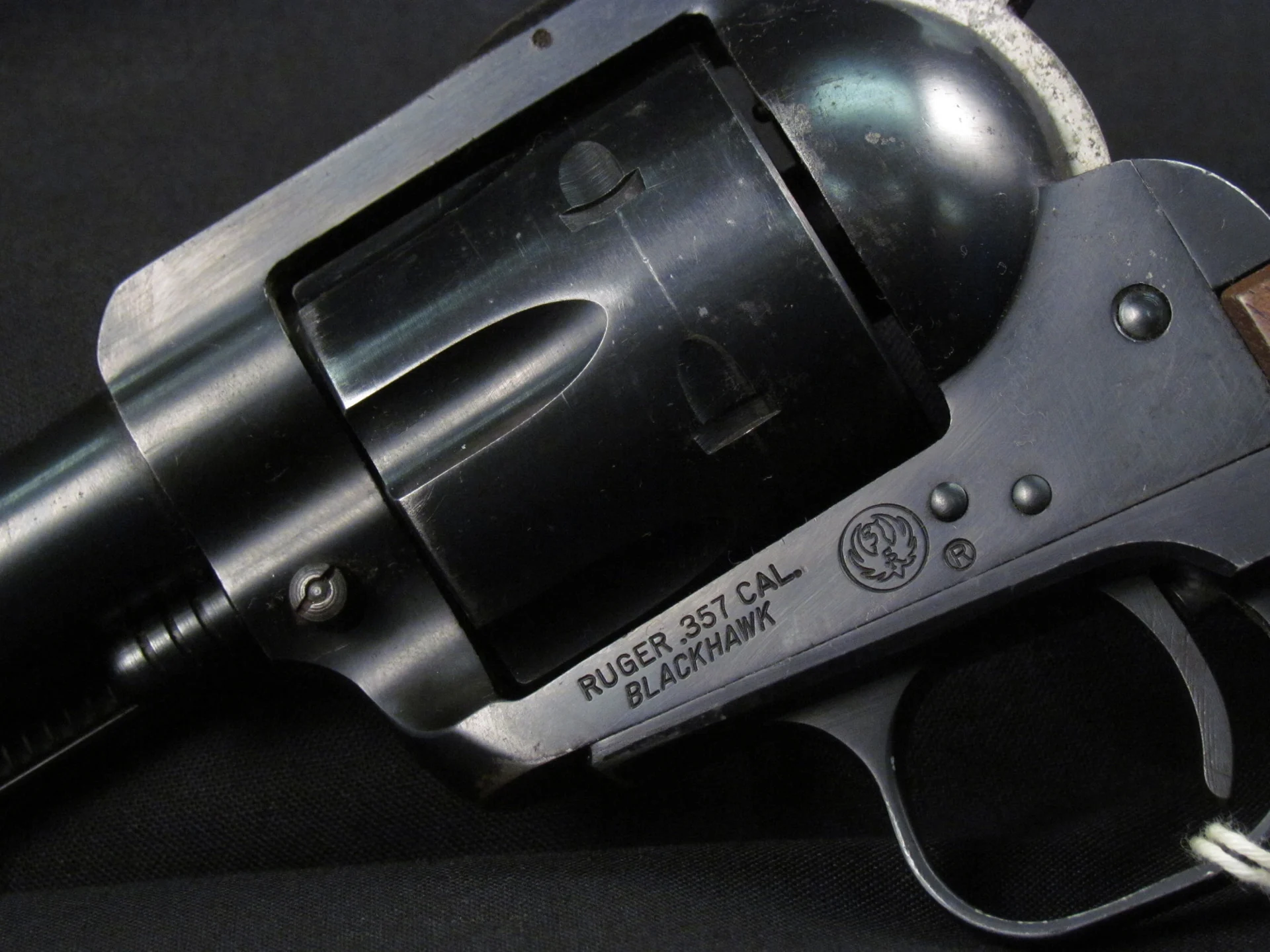
Sturm, Ruger launched the Blackhawk as its first centerfire revolver with a full-page advertisement in American Rifleman in August 1955. Catalog number BKH-3 was a six-shot .357 Magnum with a $87.50 list price, and according to American Rifleman, Bill Ruger named it after one of his favorite cars, the Stutz Blackhawk. It was a modern take on the Colt Single Action Army, built with an investment-cast steel frame and adjustable sights.
The .44 Magnum version followed in 1956, shipping that November, a few months after Smith & Wesson’s double-action .44. In September 1959 Ruger announced the Super Blackhawk to better handle that cartridge, and the .44 Flattop ended in 1962. That same year the .357 got its protective rear-sight ears and fuller grip frame. Ruger added the .41 Magnum in 1965, the .30 Carbine in 1968 and the .45 Colt in 1971.
The big change came in 1973. The New Model added the transfer bar, so all six chambers could be loaded, and replaced the three frame screws with pins. Ruger later began offering a free retrofit for the old guns, and its 2024 manual still offers it. The Bisley models arrived in the mid-1980s, and a 50th Anniversary .357 marked the gun’s half-century in 2005.
On October 13, 2026, Ruger told distributors that it would end GP100, SP101, LCR and Bearcat production immediately, and that the Blackhawk, Super Blackhawk, Vaquero and other families would get final production runs over the rest of 2026. Ruger’s spokesperson said that “does not necessarily mean these product families are permanently discontinued,” and the company hasn’t given model-by-model end dates. Our news story on Ruger’s production cuts has the full list.
Why the Blackhawk Is Still So Popular
The Blackhawk gave ordinary shooters a strong, accurate single-action for far less than a Colt. It handles cartridges the old Colt design couldn’t, it’s easy to work on, and its adjustable sights make it a real hunting and target gun rather than a costume piece. It also bridged two worlds: the look of the Old West with modern steel and springs. That’s why it stayed in the catalog for seven decades, and why the end of new production has sent buyers back to the used market.
Legal: Curio and Relic Status and Shipping
Under federal law, a firearm made more than 50 years ago counts as a curio or relic by age. Every Old Model Blackhawk qualifies, and so do the earliest New Models as they pass 50 years. A collector with a federal curio and relic license can have one shipped directly. Antique status is a different rule that covers guns made before 1899, so no Blackhawk is an antique. State laws still apply, including roster rules for new sales in some states. Buying one online works like any other handgun: it ships to a local dealer, and our used guns guide walks through the process.
Where to Buy a Ruger Blackhawk
New guns are on dealer shelves until the last of the 2026 run sells, and the cards above show who has them. For used guns, Guns.com, GunBroker and local dealers have the most listings. Auction houses like Rock Island add a buyer’s premium of 15 to 22.5% on top of the hammer price, so factor that in when you compare prices.
- Ask for close-up photos of the frame side, so you can see whether it has screws or pins.
- Ask whether a convertible includes both cylinders and whether they’re factory fitted.
- For an Old Model, ask if it has been converted and whether the original parts are included.
- Ask about the cylinder gap, end shake and lockup, or buy with an inspection period.
Ruger Blackhawk vs. Its Rivals
| Gun | Action | Sights | Used price | Best for |
|---|---|---|---|---|
| Ruger New Model Blackhawk .357 | Single action, transfer bar | Adjustable | About $520 | Hunting, plinking, first single-action |
| Colt Single Action Army | Single action, no transfer bar | Fixed | Far higher | Collectors, history |
| Uberti 1873 Cattleman | Single action | Fixed | Lower | Cowboy action, Old West look |
| Ruger GP100 | Double action | Adjustable | Similar | Defense and range use |
| Smith & Wesson Model 29 | Double action | Adjustable | Higher | .44 Magnum collectors |
For more classic wheelguns, see our classic revolvers guide and our best revolvers list.
Final Verdict
The Blackhawk is the most sensible single-action revolver ever built, and with new production ending, now is the time to buy one. For shooting, a used New Model .357 at about $520 is hard to beat, and a convertible is worth the extra $300 or so. For collecting, a three-screw .357 is the cheap way into an Old Model, and Flattops and early Super Blackhawks are the ones whose prices keep climbing. Whatever you buy, check the frame for screws or pins, and if it’s an Old Model, carry five or send it to Ruger for the free conversion.
Ruger Blackhawk FAQ
Is Ruger discontinuing the Blackhawk?
In October 2026 Ruger said the Blackhawk and Super Blackhawk would get final production runs over the rest of 2026. Ruger says that doesn't necessarily mean the family is permanently discontinued, and it hasn't given end dates, but every standard Blackhawk on ruger.com now reads Currently Unavailable.
How much is a Ruger Blackhawk worth?
In completed sales from December 2025 to November 2026, a used New Model .357 sold for about $514, a New Model .45 Colt for about $827 and a convertible for $852 to $922. A three-screw .357 sold for about $544 and a .357 Flattop for about $1,200.
How do I tell an Old Model Blackhawk from a New Model?
Look at the side of the frame. Old Models made before 1973 have three screws. New Models have two pins and say NEW MODEL in the roll mark. Old Model Flattops have no protective ears around the rear sight.
Is it safe to carry six rounds in an Old Model Blackhawk?
No. Without a transfer bar, a blow to the hammer can fire the round under it. Load one, skip one, load four, then lower the hammer on the empty chamber, or send the gun to Ruger for its free transfer-bar conversion.
Does Ruger still convert Old Model Blackhawks for free?
Yes. Ruger's 2024 manual still tells owners of pre-1973 single-actions to write to its Conversion Dept. in Newport, New Hampshire, for a box and shipping instructions. You pay only the first shipping leg, and Ruger returns the original parts.
What is a Ruger Blackhawk Flattop?
It's the collector name for the first Blackhawks, made from 1955 to 1962, which have a flat top strap and no protective ears around the rear sight. A .357 Flattop sells for about $1,200 and a .44 Magnum Flattop for about $1,000.
What is a Blackhawk convertible?
A Blackhawk sold with two cylinders that swap without tools, either .357 Magnum and 9mm or .45 Colt and .45 ACP. Both cylinders need to be with the gun for full value, and the two calibers may hit at different points of aim.
Is a Ruger Blackhawk a curio or relic?
Every Old Model Blackhawk is more than 50 years old, so it counts as a curio or relic by age under federal law, and so do New Models as they pass 50 years. No Blackhawk is an antique, because that rule covers guns made before 1899.
3,502+ Gun & Ammo Deals
Updated daily from 200+ top retailers. Filter by category, caliber, action type, and price.
Related Guides