

Last updated October 28th 2026
Some of the links below are affiliate links, meaning at no additional cost to you, we may earn a commission if you click through and make a purchase.
By Nick Hall, who wrote our best AR-15s for coyote hunting guide.
The best coyote call for most hunters is the FOXPRO X24. It ships with 100 sounds, holds up to 1,000, and its remote shows your sound list on a color screen, so you can switch from a rabbit distress to a pup whine without guessing. If you want a motion decoy and a rotating speaker in the same box, get the Lucky Duck Revolt 2.0. If you’re on a budget, the Western Rivers Mantis 75R gets you an electronic caller with a remote for under $50, and every hunter should carry a mouth call or two as a backup.
Below are four electronic callers and four mouth calls, with specs from the makers and retailers, live prices from our 200+ retailers checked on October 28, 2026, and two things most “best coyote call” lists leave out: how to set the caller up so a coyote walks into your shooting lane, and the state law that makes carrying a call mandatory.
Table of Contents
How we tested: Every pick here is ranked against our testing methodology. Minimum round counts, accuracy and reliability protocols, the failures that disqualify a gun.
Best Coyote Calls at a Glance
| Call | Type | Sounds | Remote | Price |
|---|---|---|---|---|
| FOXPRO X24 | Electronic | 100 loaded, holds 1,000 | Color screen TX-1000 | Live price |
| Lucky Duck Revolt 2.0 | Electronic, rotating, decoy | 200 loaded, holds 2,000 | 300+ yards | Live price |
| Primos Dogg Catcher 2 | Electronic | 12 Randy Anderson sounds | 100 yards | Live price |
| Western Rivers Mantis 75R | Electronic | 75, many species | 300 feet | Live price |
| Rocky Mountain Atomic-13 Mean Raspy | Mouth call, reed | Raspy prey distress | None | Live price |
| Primos Lil’ Dog | Mouth call, open reed | Distress, pup whines, howls | None | Live price |
| Haydel’s CH-92 Coyote Howler | Howler | Coyote howls | None | Live price |
| Primos Mouse Squeeze | Squeeze call | Mouse squeaks | None | Live price |
Electronic Call or Mouth Call?
- Electronic caller: A speaker you set out away from you and run with a remote. It plays recorded prey distress and coyote vocals, it’s loud, and it pulls a coyote’s attention to the speaker instead of to you. It costs more and needs batteries.
- Mouth call: A reed call you blow. It’s cheap, light and never runs out of power, but the sound comes from your position, and it takes practice to sound like a dying rabbit instead of a kazoo.
- Howler and squeaker: Specialist calls. A howler locates coyotes and talks to them in their own language. A squeaker makes quiet mouse sounds to finish a coyote that has stopped short of your shooting lane.
Most serious callers carry both: an electronic caller for the stand and a mouth call or squeaker in a pocket for the last 50 yards.
1. FOXPRO X24: Best Coyote Call Overall
- Type: Electronic caller with remote
- Sounds: 100 preloaded, holds up to 1,000
- Speaker: XHD horn speaker with a tweeter, plus an external speaker jack
- Remote: TX-1000 with a full color screen
- Power: Lithium battery and charger in the box
- Warranty: 5 year limited
Pros
- Color remote shows your whole sound list
- Rechargeable lithium battery included
- Aux jack runs a FOXPRO decoy
Cons
- Costs about $600
- No built-in motion decoy
- Overkill for a few hunts a year

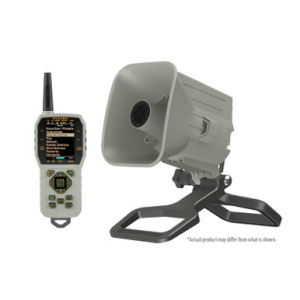
The X24 is the caller most coyote hunters graduate to, and the remote is the reason. The TX-1000 shows your sounds or sound categories on a full color screen, so you can find the exact distress or vocal you want at 5 a.m. with cold fingers. FOXPRO’s horn speaker adds a tweeter for the high squeals of a rabbit distress, and the handle folds out into a stand to lift the speaker over grass.
Two features earn their keep on a stand. FOXMOTION fades the sound from the left speaker to the right, so it sounds like an animal moving instead of a box. FOXCAST plays a preset sequence you build ahead of time, including volume changes and pauses, which makes it easy to run the short-burst, long-silence pattern pressured coyotes respond to. The auxiliary jack runs an approved FOXPRO decoy.
Best For: Hunters who call coyotes every weekend of the season and want one caller to last for years.
2. Lucky Duck Revolt 2.0: Best Call With a Built-In Decoy
- Type: Electronic caller with a rotating base and motorized decoy
- Sounds: 200 preloaded, capacity of 2,000
- Remote: LD2XR, backlit buttons, 300+ yard range
- Power: 10 AA cartridge in the caller, 3 AA in the remote
- List price: $599.99 at Lucky Duck, 5 year warranty
Pros
- Base rotates sound a full 360 degrees
- Three-speed motorized decoy included
- Tripod and XL carry bag included
Cons
- Thirteen AA batteries to feed
- Bulky to carry between stands
- Rechargeable pack sold separately
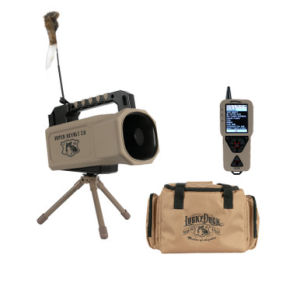
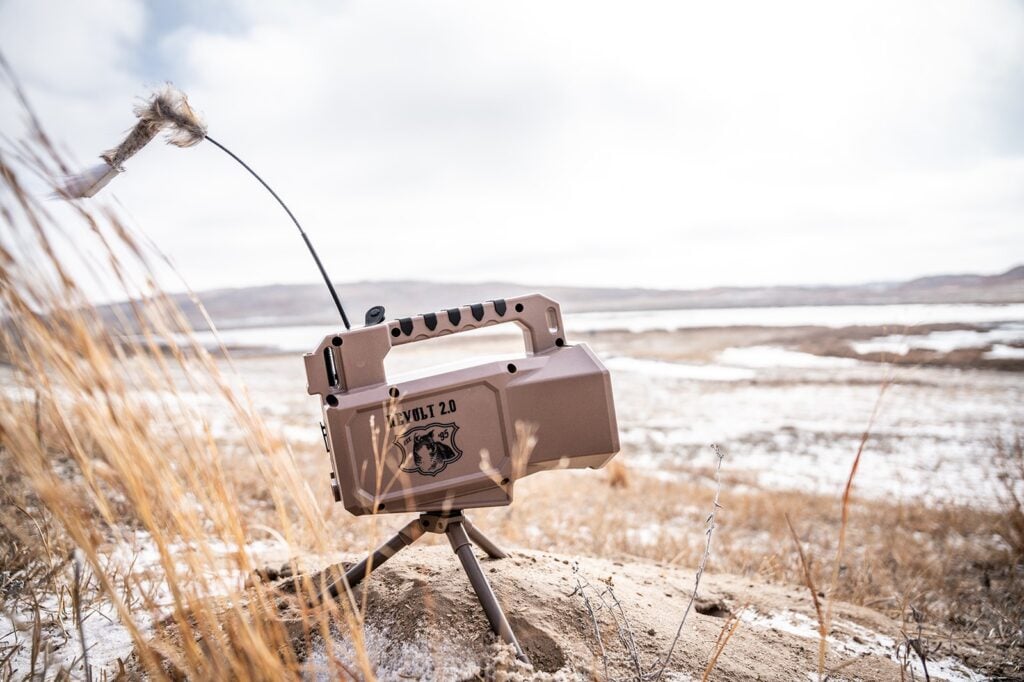
Lucky Duck built the Revolt 2.0 around a problem its own stand guide names: a coyote that hears a speaker but sees nothing moving often hangs up out of range. The Revolt answers with an erratic three-speed motorized decoy that stores on the caller, and a base you can rotate by remote to throw sound 360 degrees. The 200 preloaded sounds were recorded by Rick Paillet, “The Verminator,” and the caller holds up to 2,000.
It’s heavier and hungrier than the X24: a 10 AA cartridge in the caller and 3 AA in the remote, with a lithium-ion pack sold separately. Lucky Duck says the Revolt 2.0 uses the same tripod as its bigger Super Revolt 2.0, which was $699.99 at the time of writing.
Best For: Open country where coyotes need to see something before they commit.
3. Primos Dogg Catcher 2: Best Electronic Call Under $100
- Type: Electronic caller with remote (model 3851)
- Sounds: 12 Randy Anderson sounds, two can play at once
- Remote: 100 yards
- Power: AA batteries, not included
Pros
- Sounds picked by Randy Anderson
- Plays two sounds at the same time
- Legs aim the speaker upward
Cons
- Only 12 sounds, no downloads
- Shortest remote range of the electronics
- Batteries not included
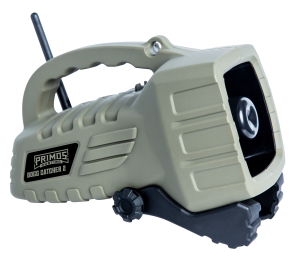
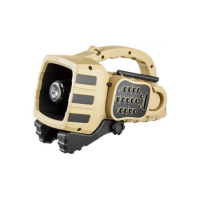
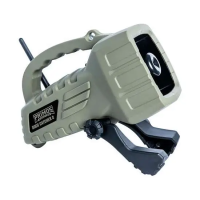
The Dogg Catcher 2 keeps it simple. Its 12 sounds come from Randy Anderson of the “Calling All Coyotes” videos: coyote and cottontail sets, a coyote serenade, adult and pup vocals, cottontail and jackrabbit distress, a baby fawn, a rodent and a woodpecker. Playing two at once lets you layer a distress over a pup whine, which is a sequence plenty of experienced callers run on purpose. The adjustable legs point the speaker up for more reach.
You can’t add sounds, and a 100 yard remote is short next to the X24 and Revolt. For most stands in timber or broken country, that’s plenty, and Palmetto State Armory had it at $92.99 when we checked.
Best For: A first electronic caller from a name you know.
4. Western Rivers Mantis 75R: Best Budget Electronic Call
- Type: Electronic caller with remote (GC75)
- Sounds: 75 preloaded, coyote, wolf, elk, deer, turkey and more
- Remote: 300 feet, CR2032 battery included
- Power: 4 AAA in the caller, not included
Pros
- Remote caller for under $50
- 75 sounds across many species
- External speaker port
Cons
- Short 300 foot remote range
- Basic screen and controls
- Runs on AAA batteries
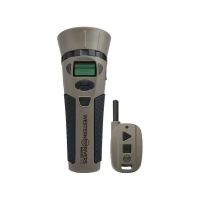
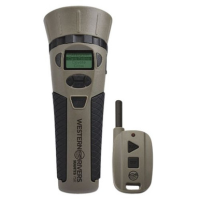
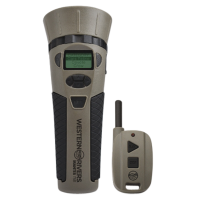
The Mantis 75R is the cheapest way to get the most important thing an electronic caller does: put the sound somewhere other than where you’re sitting. It has 75 preloaded sounds, a backlit screen, random repeat timing, legs that stand it up on its own, and a port for an external speaker if you want more volume later.
The listed remote range is 300 feet, about 100 yards, so set it closer than you would an X24. It’s also a multi-species caller, which makes it a good buy if you’ll use it for turkey or deer as well.
Best For: Trying electronic calling before you spend real money.
5. Rocky Mountain Atomic-13 Mean Raspy: Best Mouth Call for Distress
- Type: Reed mouth call
- Reed: Stainless steel over composite combo reed
- Body: Machined aluminum with a knurled grip ring, tan anodized
- Sound: Mid-range raspy prey distress
Pros
- Raspy distress that carries well
- Aluminum body survives a pocket
- Sold as a three-call set
Cons
- Takes practice to sound right
- Sound comes from your position
- Costs more than plastic calls
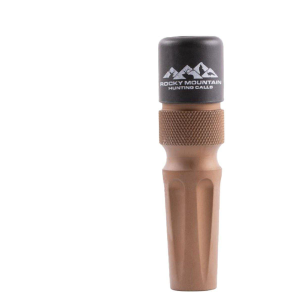
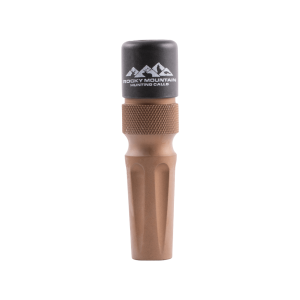
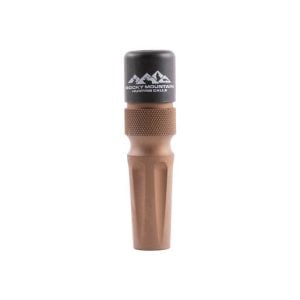
Raspy distress is the sound of a rabbit in real trouble, and the Mean Raspy does it with a stainless-over-composite reed in a machined aluminum body. It’s the middle call of Rocky Mountain’s Atomic-13 set. The Lil’ Raspy is quieter for coaxing a coyote that’s already close, and the Big Raspy is louder for open country. Sportsman’s Warehouse had the Mean Raspy at $29.97.
Best For: A durable backup to an electronic caller, or a first serious mouth call.
6. Primos Lil’ Dog: Best Mouth Call for Coyote Vocals
- Type: Open reed mouth call (PS350)
- Mouthpieces: Two, white for long range and green for close in
- Horn: Detachable
- Sounds: Mouse, bird, rabbit and fawn distress, pup whines, pup howls
Pros
- One call covers distress and vocals
- Two mouthpieces for near and far
- Randy Anderson series design
Cons
- Open reed needs real practice
- Plastic body
- Not as loud as a howler
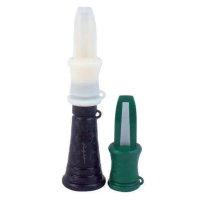
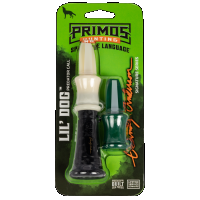
An open reed call makes any sound you can learn, and the Lil’ Dog is built to do a lot: mouse peeps, bird, jackrabbit, cottontail and fawn distress, pup whines and pup howls. It comes with two mouthpieces, a white one for calling at range and a green one for working a coyote close, and a horn that comes off. It’s part of Primos’s Randy Anderson series.
Best For: Hunters who want one mouth call and are willing to practice with it.
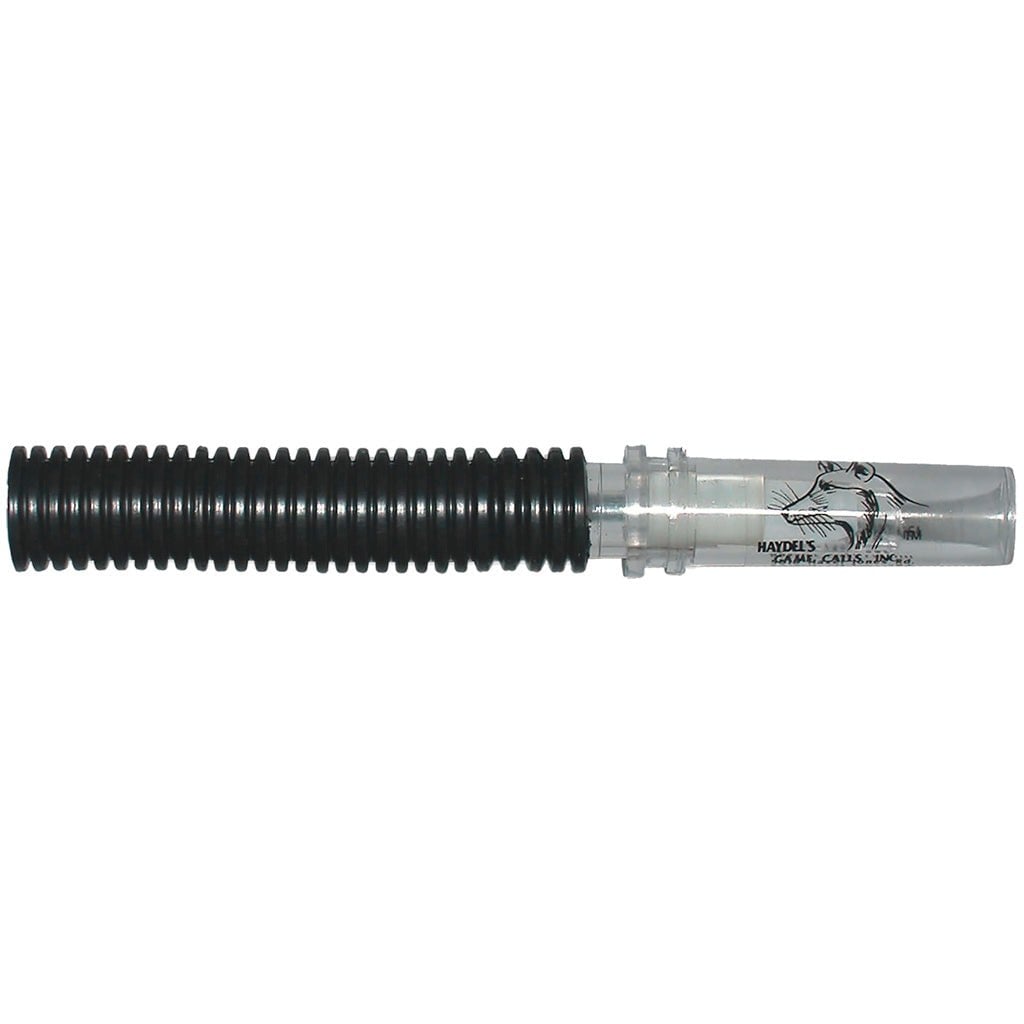
7. Haydel’s CH-92 Coyote Howler: Best Howler
- Type: Howler, no batteries
- Build: Clear body with a black collapsible hose
- Use: Locating and calling dominant coyotes, and locating turkeys
Pros
- Cheap way to locate coyotes
- Collapsible hose packs small
- Doubles as a turkey locator
Cons
- Howls only, no prey distress
- Wrong howl can spook coyotes
- Plastic build

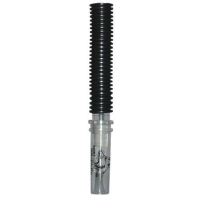
A howler talks to coyotes instead of pretending to be their dinner. Retailers describe the CH-92 as built to locate and call dominant coyotes, and a lone howl at first light will often get a pack to answer and tell you where to set up. It works on territorial coyotes during breeding season, when a prey distress may get ignored. Palmetto State Armory had it at $15.99.
Best For: Locating coyotes before you choose a stand, and calling in January and February.
8. Primos Mouse Squeeze: Best Close-Range Finisher
- Type: Squeeze call, rubber body (model 304)
- Sound: Mouse squeaks
- Use: Coaxing a coyote the last few yards
Pros
- No blowing, so it won’t freeze
- Works with gloves on
- Barely any hand movement
Cons
- Close range only
- One sound
- Easy to lose in a pocket
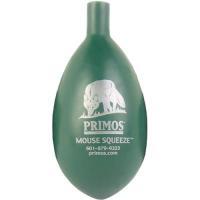
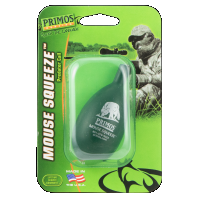
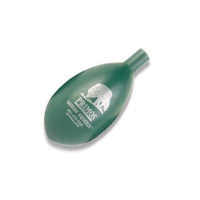
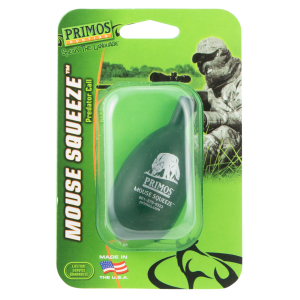
When a coyote stops 80 yards out and stares, you need a quiet sound that tells it the meal is right there. You squeeze the Mouse Squeeze instead of blowing it, so there’s no moisture to freeze, and it takes almost no hand movement. At around $10 it’s the cheapest call on this list and the one most likely to finish a hung-up coyote.
Best For: Every coyote hunter’s pocket.
How to Set Up a Stand With an Electronic Call
The best caller in the world won’t fix a bad setup. Lucky Duck’s own stand guide puts it plainly: “Coyotes almost always approach from downwind.” So set the caller out away from you, upwind or crosswind, and sit where a coyote circling downwind of the sound has to cross your shooting lane.
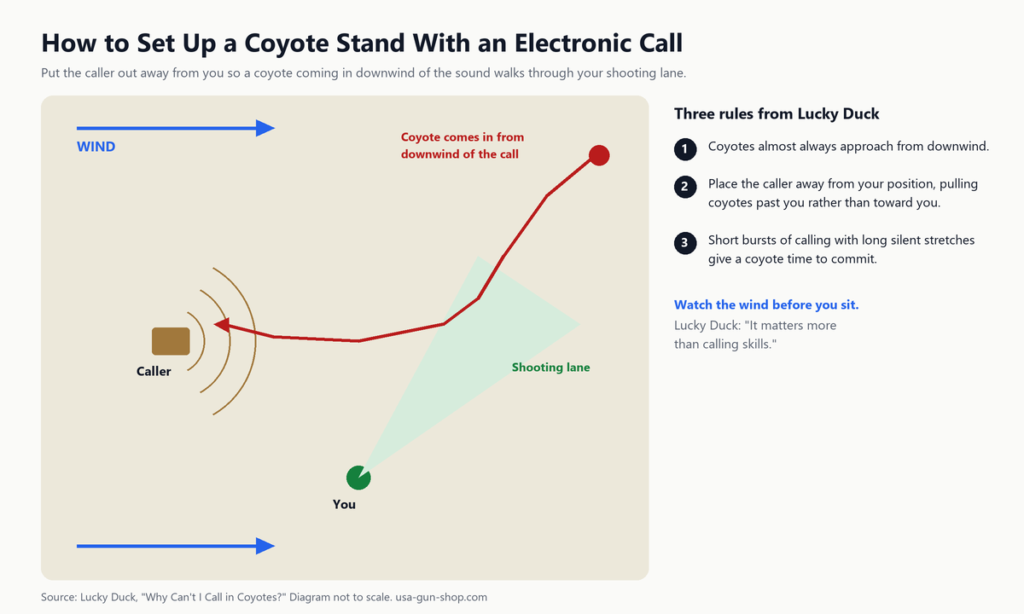
- Check the wind first. Lucky Duck says it “matters more than calling skills.” Morning thermals rise as the air warms and evening thermals fall, so your scent moves even on a still day.
- Call less. Short bursts with long silent stretches give a coyote time to commit. Long, loud sequences push pressured coyotes away.
- Add motion. A coyote that hears a sound but sees nothing often hangs up out of range. A decoy like the one on the Revolt 2.0, or a FOXPRO decoy on the X24’s aux jack, fixes that.
- Sit still and stay longer. Movement reads as predator behavior, and coyotes often show up after you think the stand is dead.
For the rifle and optic side of the setup, see our best AR-15s for coyote hunting, best predator hunting shotguns for close cover, best thermal scopes for night stands and our best bipods.
Are Electronic Coyote Calls Legal?
For coyotes, electronic calls are legal in most states, and in at least one state a call is mandatory. Maine law says “A person may not hunt coyotes at night without possessing an electronic, hand-held or mouth-operated predator calling device,” and breaking that rule is a Class E crime under 12 M.R.S. §12001. Maine’s night coyote season runs from December 16 to August 31 in every county.
Rules on electronic calls for other species, night hunting, lights and public land vary a lot by state and even by county. Read your state wildlife agency’s current hunting digest before you take an electronic caller into the field, especially if you plan to hunt at night.
How I Picked These Calls
I started from what coyote hunters actually buy, then checked each call against our live price feed across 200+ retailers so every pick has a real, current price. Specs come from the makers where they publish them and from retailer listings where they don’t. I picked four electronic callers at four price points and four mouth calls that each do a different job: distress, coyote vocals, howling and close-range finishing. I left off calls that only one small seller stocks.
Frequently Asked Questions
What is the best coyote call?
The FOXPRO X24 is our pick. It ships with 100 sounds, holds up to 1,000, and its TX-1000 remote shows your sound list on a color screen. The Lucky Duck Revolt 2.0 is the pick if you want a built-in motion decoy.
What is the best electronic coyote call for the money?
The Primos Dogg Catcher 2 was $92.99 at Palmetto State Armory, with 12 Randy Anderson sounds and a 100 yard remote. The Western Rivers Mantis 75R is the cheapest remote caller on our list at under $50.
Are electronic calls better than mouth calls for coyotes?
An electronic call puts the sound away from you, so a coyote looks at the speaker instead of at you. A mouth call is cheap, light and never runs out of power. Most hunters carry both.
Where should I put my electronic coyote call?
Set it out away from you, upwind or crosswind, and sit where a coyote approaching from downwind of the sound has to cross your shooting lane.
How long should I call for coyotes?
Call in short bursts with long silent stretches, and stay on the stand longer than feels comfortable. Long, loud sequences push pressured coyotes away.
Is it legal to use an electronic call for coyotes?
In most states, yes. Maine law goes further: you may not hunt coyotes at night without a predator calling device. Rules for other species and night hunting vary, so check your state's hunting digest.
What does a coyote howler do?
A howler makes coyote howls to locate coyotes and call in territorial ones. It's useful at first light and during breeding season, when a prey distress may get ignored.
What is a mouse squeaker for?
A mouse squeaker makes quiet mouse sounds to coax a coyote that has stopped short. The Primos Mouse Squeeze works by squeezing, so it won't freeze up in cold weather.
3,959+ Gun & Ammo Deals
Updated daily from 200+ top retailers. Filter by category, caliber, action type, and price.
Related Guides