
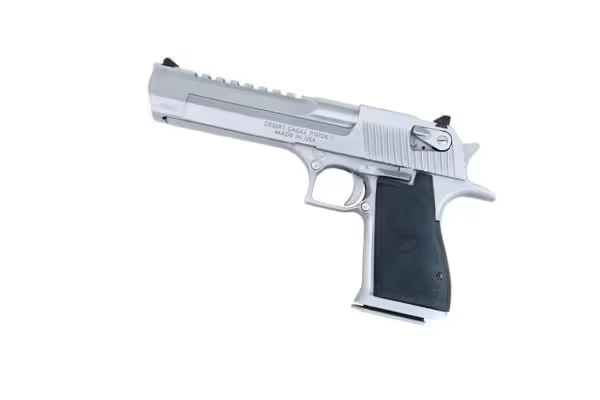
Last updated August 2026 · By Nick Hall, who put 300+ rounds through the Desert Eagle .50 AE for this review
Affiliate disclosure: This Desert Eagle .50 AE review contains affiliate links. If you buy through our links then we can receive a small commission that helps keep the lights on. You don’t pay anything more.
- Treat every gun as loaded
- Point the muzzle in a safe direction
- Keep your finger off the trigger until you’re ready to shoot
- Know your target and what’s beyond
Quick Answer: The Magnum Research Desert Eagle Mark XIX in .50 AE is the most iconic semi-auto handgun ever made, a gas-operated rotating-bolt pistol that fires the .50 Action Express cartridge and has earned its reputation across nearly every action movie of the last 40 years.
The Mark XIX is genuinely accurate at 25 yards with quality ammo, and sub-3-inch groups are routine, runs reliably with the right grip, and is offered in titanium gold, case-hardened, and standard finishes. The case-hardened finish in particular produces unique color patterns on every gun, making each one a one-of-one piece.
The biggest mistake new Desert Eagle owners make is gripping the gun loosely. The gas-operated action requires a firm two-handed grip with locked wrists; almost every “my Desert Eagle jams” complaint online traces back to limp-wristing. Grip it like you mean it, train on it, and the .50 AE Desert Eagle will run for thousands of rounds.
Table of Contents
How we tested: Every pick here is ranked against our testing methodology. Minimum round counts, accuracy and reliability protocols, the failures that disqualify a gun.
Review: Magnum Research Desert Eagle .50 AE – The Hand Cannon That Started It All
Our Rating: 7.5/10
- MSRP: $1,600-$2,700, depending on finish
- Street Price: from about $1,580 (black), about $2,120 in brushed chrome (Check our live pricing for the best current deal)
- Caliber: .50 Action Express, and it also comes in .44 Magnum and .357 Magnum with a barrel swap
- Action: Gas-operated, rotating bolt semi-automatic
- Barrel Length: 6″ (10″ also available)
- Overall Length: 10.75″
- Height: 6.25″
- Width: 1.25″
- Weight (unloaded): 72 oz (4.5 lbs)
- Capacity: 7+1
- Frame Material: Carbon steel or stainless steel
- Sights: Fixed combat sights, 8.5″ sight radius
- Rail: Full-length Picatinny rail (integral)
- Trigger Pull: ~4 lbs
- Safety: Ambidextrous thumb safety
- Grip: Hogue finger groove rubber grip (wood grips also included)
- Made in: USA in Pillager, Minnesota
Pros
- Gas-operated rotating bolt is remarkably reliable for a hand cannon
- Interchangeable barrels let you run .50 AE, .44 Mag, and .357 Mag on one frame
- The weight tames recoil far better than you would expect from .50 AE
- Factory finishes are genuinely stunning such as titanium gold, case hardened and burnt bronze
- Full-length Picatinny rail for optics and accessories
- Massive fun factor, absolute conversation piece at any range
Cons
- 4.5 lbs unloaded is absurd for a handgun and makes it impossible to carry
- Grip circumference is enormous and unusable for smaller hands
- .50 AE ammunition costs $1.50-$2.50 per round and can be hard to find
- Limp-wristing causes malfunctions, requires a very firm grip
- Loud enough to make everyone at the indoor range hate you
Quick Take
There is no other handgun on Earth like the Desert Eagle. I mean that literally. It’s the only gas-operated, rotating bolt semi-automatic pistol in mainstream production. The same operating system that runs an M16 rifle, shrunk down and crammed into a 4.5-pound chrome-plated behemoth that fires .50 Action Express. That is not a rational engineering decision. That’s an act of sheer, beautiful defiance against common sense.
I have put 500 rounds through this gun across .50 AE and .44 Magnum, and here is the honest truth: it’s wildly impractical. It is too heavy to carry. The ammo costs more per round than some people’s hourly wage. The grip is so large that half the population physically can’t reach the controls. And every single time I bring it to the range, someone walks over and asks if they can shoot it.
The Desert Eagle is the most famous handgun in movie history. The Terminator. The Matrix. Snatch. John Wick. Counter-Strike. Call of Duty. If you have seen a movie or played a video game with a big pistol in it, that pistol was almost certainly a Desert Eagle. It has transcended being a firearm and become a cultural icon. The fact that it actually works well is almost beside the point.
Almost. Because here is the thing: it does work well. Surprisingly well. The gas-operated action is proven, the rotating bolt locks up tight, and the sheer mass of the gun absorbs .50 AE recoil better than any revolver in the same power class. Is it a self-defense gun? No. Is it a practical hunting gun? Barely. Is it the most fun you can have at a shooting range? Absolutely.
Best For: Collectors, range enthusiasts, and anyone who wants to own a genuine piece of firearms history. Also a solid choice for big bore handgun fans who want a semi-auto alternative to magnum revolvers.
Why Magnum Research Built the Desert Eagle This Way
The Desert Eagle exists because someone looked at an M16 and thought, “What if we put that operating system in a handgun and chambered it in the most ridiculous cartridge we could find?” That someone was a team of engineers at Magnum Research in Minnesota, and the cartridge they settled on was the .50 Action Express, developed in 1988 by Evan Whildin of Action Arms.
The gas-operated, rotating bolt design is what makes the Desert Eagle possible. A traditional blowback or short-recoil action cannot safely contain .50 AE pressures in a semi-automatic handgun. The rotating bolt locks into the barrel extension the same way an AR-15’s bolt does, creating a positive lockup that can handle the chamber pressures. The gas system bleeds propellant gas from the barrel to cycle the action, which also has the side benefit of softening felt recoil compared to a direct blowback design.
This is genuinely innovative engineering. Every other big bore handgun on the market is a revolver, because revolvers handle high-pressure cartridges with a simple cylinder gap and a solid frame. Magnum Research looked at that conventional wisdom and decided to build a semi-auto anyway. The result is a gun that feeds from a magazine, ejects brass cleanly, and delivers follow-up shots faster than any revolver in the same power class.
The interchangeable barrel system was another brilliant design call. The Mark XIX frame accepts barrels in .50 AE, .44 Magnum, and .357 Magnum. Swap the barrel, swap the bolt, swap the magazine, and you’ve a completely different gun. Three calibers on one frame. That kind of versatility partially justifies the price tag, because you’re essentially buying three guns for the cost of one frame plus two barrel assemblies.
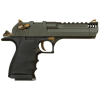
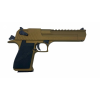
And then there are the finishes. Magnum Research understood from the beginning that the Desert Eagle is a showpiece. Brushed chrome, polished chrome, titanium gold, case hardened, burnt bronze, black oxide. The case hardened finish in particular is a work of art, with swirling blues and purples that look different in every light. These aren’t just firearms. They’re display pieces that happen to fire .50 caliber projectiles.
Desert Eagle Versions, Calibres and What They Cost
More people arrive here asking what a Desert Eagle costs than asking how it shoots, so let us deal with that first. The Mark XIX frame takes three chamberings and they’re not priced the same, and finish moves the number as much as caliber does.
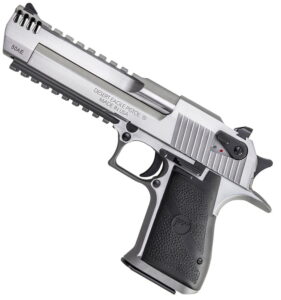
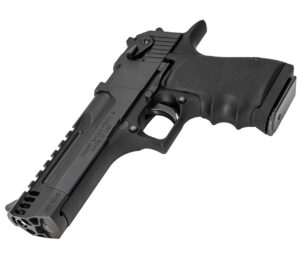
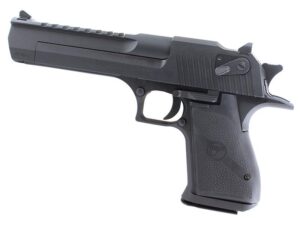
.50 AE is the one people mean when they say Desert Eagle, and it carries the biggest premium. .44 Magnum is the value entry to the platform and the cheapest way onto a Mark XIX frame. .357 Magnum sits in between and is by some distance the cheapest to feed, which matters more than it sounds when .50 AE runs well north of a dollar a round.
Magnum Research also chambered the frame for their own .429 DE cartridge, which was aimed squarely at .44 Magnum performance. All three of the mainstream calibers share the same frame, so a .44 gun can be converted later with a barrel and magazine swap. That’s the cheapest route to owning both, and it’s why the .44 is a smarter first purchase than most buyers realise.
Competitor Comparison
The Desert Eagle occupies a strange niche. It competes with big bore revolvers on paper, but nothing else on the market is a gas-operated semi-auto firing .50-caliber rounds. Here is how it stacks up against the closest alternatives.
Smith & Wesson Model 500 (~$1,500)
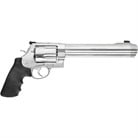
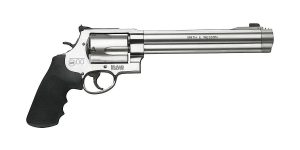
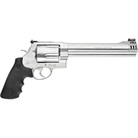
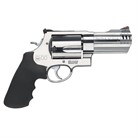
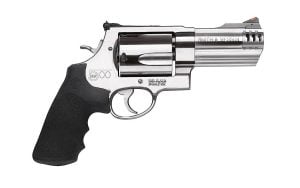
The S&W 500 fires the .500 S&W Magnum, which is actually more powerful than .50 AE. We are talking 2,600+ ft-lbs of muzzle energy from the hottest loads. It’s a revolver, so it will cycle no matter how you grip it, and the 5-round cylinder is dead reliable. The trade-off is that it weighs even more than the Desert Eagle, 56 oz with the 4-inch barrel and 72.5 oz with the 8.375-inch, and the recoil is legitimately punishing in a way that .50 AE isn’t.
The Desert Eagle wins on capacity, 7+1 against 5 rounds, speed of reloads, a magazine against a speedloader, and the gas system genuinely softens recoil compared to a revolver’s fixed frame. The S&W 500 wins on raw power and the ability to fire regardless of grip technique. If you want the most powerful handgun on the planet, get the 500. If you want the most famous and the most fun to shoot, get the Desert Eagle. Check out our full .50 cal pistol comparison for more options.
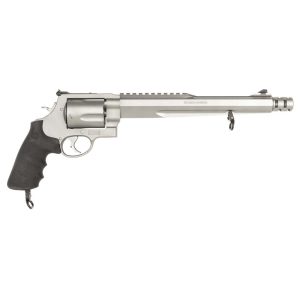
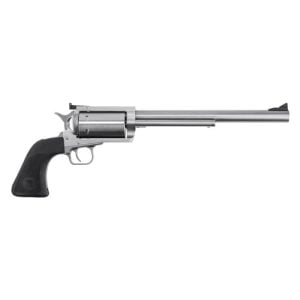
Magnum Research BFR (from about $1,030)
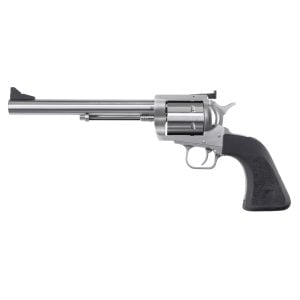
The BFR, which stands for Biggest Finest Revolver is made by the same company as the Desert Eagle, which tells you something about Magnum Research’s corporate personality. It’s a single-action revolver available in absurd calibers including .45-70 Government, .450 Marlin, and .500 S&W Magnum. The BFR is less expensive than the Desert Eagle and arguably more versatile in terms of available chamberings.
The BFR is the better choice if you want a big bore handgun for hunting. Single-action revolvers are simpler, more reliable in field conditions, and the long-barrel BFR models are genuinely accurate at distance. The Desert Eagle wins if you want a semi-automatic action, faster follow-up shots, and the cultural cachet that comes with owning the most iconic handgun ever made. The BFR is a tool. The Desert Eagle is a statement.
Coonan .357 Magnum (~$1,500)
The Coonan is the only other semi-automatic handgun firing a magnum revolver cartridge that has achieved any kind of market presence. It is a 1911-pattern pistol chambered in .357 Magnum, which is a clever and underappreciated design. The Coonan is lighter, more practical, and easier to shoot than the Desert Eagle. It also has better ergonomics thanks to the 1911 grip angle.
But let’s be honest: nobody buys a Desert Eagle because they want practical. The Coonan is the smart choice if you want a magnum semi-auto for serious use. The Desert Eagle is the choice when you want to walk into a range and turn every head in the building. Different guns for completely different purposes. If you are reading this review, you probably already know which one you want.
We don’t carry live pricing for the Coonan. Coonan Arms has been through bankruptcy and reorganisation and the pistol isn’t in any of our retailers’ catalogues, so there’s nothing honest to quote. If you want one, expect to hunt the used market.
Wildey Survivor (~$3,000+)
The Wildey is another gas-operated semi-auto pistol, chambered in cartridges like .475 Wildey Magnum. It’s the gun Charles Bronson used in Death Wish 3. The Wildey is rarer, more expensive, and harder to find parts and ammo for than the Desert Eagle. It’s a collector’s piece more than a shooter, and production has been inconsistent over the years.
If you’re a serious collector of unusual firearms and money is no object, the Wildey is fascinating. For everyone else, the Desert Eagle does everything the Wildey does at half the price with better parts availability and ammo selection. The Desert Eagle won the gas-operated magnum pistol war decisively, and the Wildey is now a footnote.
No live pricing here either. The only Wildey in our catalogue is an $11,000 collector listing, which tells you everything about availability. Treat the Wildey as an auction-house gun, not something you buy off a shelf.
Features and Technical Deep Dive
The Gas-Operated Action
I keep coming back to this because it is genuinely remarkable. The Desert Eagle uses a fixed barrel with a gas port near the muzzle. When a round fires, propellant gas travels through a small tube under the barrel and pushes a piston that drives the bolt carrier rearward. The rotating bolt unlocks from the barrel extension, the spent case ejects, the recoil spring drives the bolt forward, and a fresh round strips from the magazine and chambers.
This is functionally identical to how an AR-15 or M16 works, scaled up for a pistol. The fixed barrel is a huge accuracy advantage over tilting-barrel designs like the Browning Hi-Power action used in most semi-auto pistols. The barrel doesn’t move during the firing cycle, which means the bullet’s path is not affected by barrel tilt. Combined with the 8.5″ sight radius on the 6″ barrel model, the Desert Eagle is inherently more accurate than its size and power level would suggest.
Interchangeable Barrel System
The Mark XIX Desert Eagle frame accepts three calibers: .50 AE, .44 Magnum, and .357 Magnum. To swap calibers, you remove the barrel, swap in the new one (different calibers use different bolts), change the magazine, and you’re ready to fire. Barrel removal requires no tools beyond pulling the barrel retaining pin. I can swap calibers in under two minutes.
This is genuinely useful. A .50 AE barrel for the range spectacle, a .44 Magnum barrel for when you want to actually afford to shoot it regularly, and a .357 Magnum barrel for when you want something approaching reasonable ammo costs. Conversion barrel assemblies run $350-$500 depending on finish, which is dramatically cheaper than buying a second gun. If you already own a Desert Eagle, the .44 Magnum barrel should be your first accessory purchase.
The Finishes
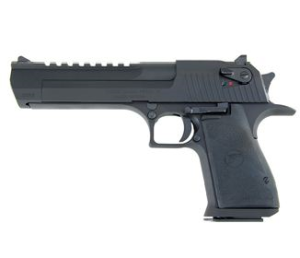
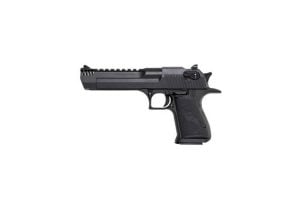
Magnum Research offers the Desert Eagle in more finishes than any other production handgun I can think of. The standard options include black oxide, brushed chrome, polished chrome, satin nickel, titanium gold, case hardened, and burnt bronze. Limited editions pop up regularly with even wilder options.
The titanium gold is exactly as ridiculous as it sounds. It is a gold titanium nitride coating that is actually harder and more durable than traditional gold plating. It looks like something a Bond villain would own, and I mean that as a compliment. The case hardened finish is my personal favorite because no two guns look exactly the same. The color patterns depend on the specific temperatures during the hardening process, so each one is a unique piece.
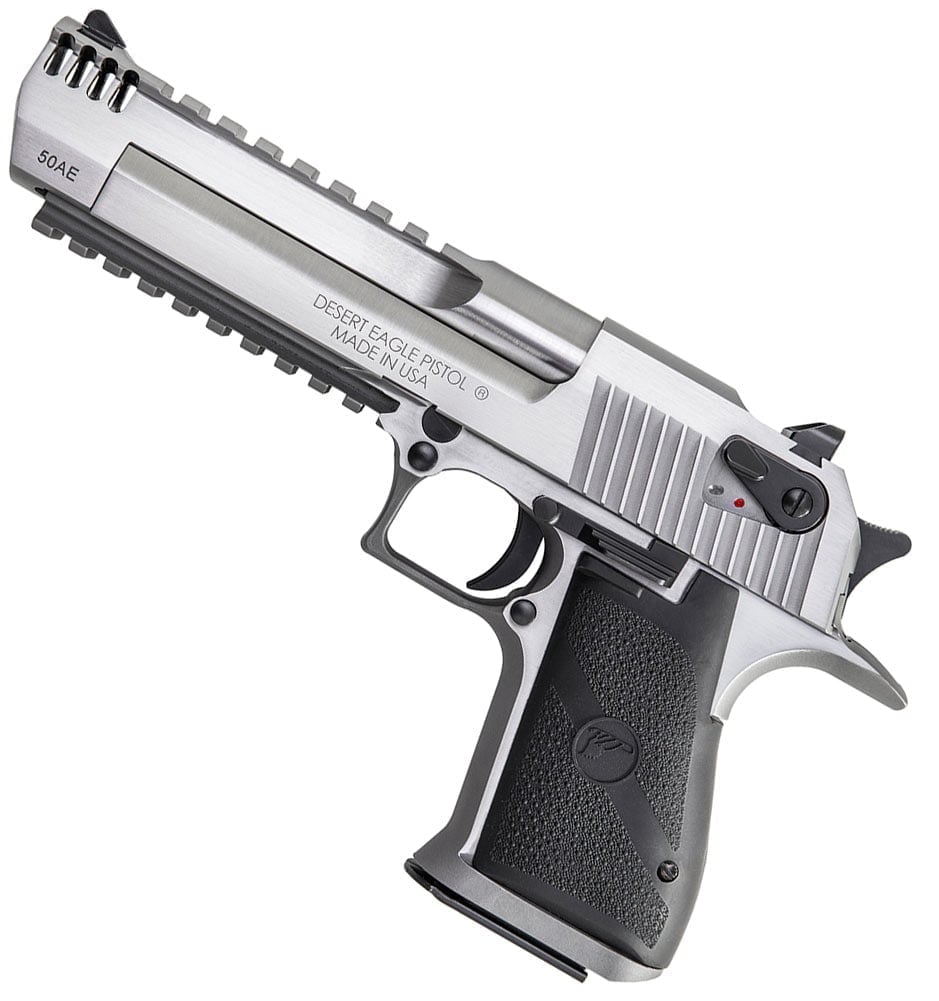
The brushed chrome model (which is what I tested) splits the difference between understated and flashy. It has the classic Desert Eagle look without screaming for attention the way the gold or polished chrome versions do. For a first Desert Eagle, brushed chrome or black oxide are the safe bets. You can always buy a titanium gold barrel later when you lose all remaining self-restraint.
Controls and Ergonomics
The Desert Eagle has an ambidextrous thumb safety, a slide-mounted safety/decock lever, and a magazine release on the left side of the grip. The controls are functional but not what anyone would call refined. The safety is positive and easy to engage, but the sheer size of the gun means you need large hands to operate everything without adjusting your grip.
The grip is enormous. There’s no way around this. The .50 AE magazine is a double-stack that holds seven rounds of half-inch ammunition, and the grip frame has to accommodate that. If you wear a size medium glove, you will struggle to wrap your hand around the grip far enough to reach the magazine release. If you wear a size small glove, this gun isn’t for you. Magnum Research ships the gun with both Hogue rubber finger groove grips and wood grips with a laser-engraved logo. The Hogue grips are better for shooting. The wood grips are better for the display case.
The .50 Action Express Cartridge
The .50 AE was developed specifically for the Desert Eagle by Evan Whildin of Action Arms in 1988. It fires a 300-325 grain bullet at 1,400-1,600 fps, generating 1,400-1,800 ft-lbs of muzzle energy depending on the load. For context, a standard 5.56 NATO round from an M4 carbine produces about 1,300 ft-lbs. The Desert Eagle handgun produces more muzzle energy than the rifle that most of the U.S. military carries. Let that sink in.
The trade-off is cost. Factory .50 AE ammunition runs $1.50-$2.50 per round, and it’s not stocked at every gun store. You’ll need to order online or find a shop that caters to big bore shooters. Handloading can bring costs down to about $0.75-$1.00 per round if you save your brass, but you need specialized dies and a press rated for the case dimensions. Budget at least $100 per range trip if you are shooting .50 AE exclusively. That isn’t a typo.
At the Range: 500 Round Test
I put 500 rounds through the Desert Eagle across multiple range sessions, split between .50 AE and .44 Magnum using a conversion barrel. Here is exactly what I shot and what happened.
Ammunition Log
- Hornady XTP 300gr .50 AE: 150 rounds
- Magnum Research/Speer 300gr .50 AE: 100 rounds
- Hornady XTP 240gr .44 Magnum: 150 rounds
- Federal American Eagle 240gr .44 Magnum: 100 rounds
Break-In Period
Magnum Research recommends a break-in of about 200 rounds, and they aren’t kidding. The first 50 rounds in .50 AE included two failures to fully chamber. Both were with the Speer ammunition, and both happened in the first magazine. By round 100, the action was cycling smoothly with no issues. I attribute the early hiccups to the tight tolerances of a new gun rather than any design flaw. The bolt carrier and barrel extension need some wear to smooth out.
I started the .44 Magnum barrel after 200 rounds of .50 AE, and it cycled perfectly from the first round. The lower-pressure cartridge is easier on the action and the barrel swap took about 90 seconds. If you’re budget-conscious (and you should be, given .50 AE prices), break in the gun with .44 Magnum and save the .50 AE for when you’ve an audience.
Reliability
After break-in, I had zero malfunctions across the remaining 300 rounds with one important caveat: you must grip this gun firmly. The gas-operated action relies on the frame being stable during the firing cycle. If you limp-wrist the Desert Eagle, the frame moves backward with the recoil instead of staying planted, and the bolt doesn’t have enough relative rearward travel to cycle properly. This results in failures to eject or short-strokes.
I intentionally limp-wristed the gun for three rounds to test this, and got two failures to eject and one stovepipe. Gripped properly, with both hands locked out and a firm wrist, it ran flawlessly. This is not a flaw unique to the Desert Eagle. Any semi-auto pistol can malfunction if limp-wristed. The Desert Eagle is just less forgiving because the reciprocating mass is so heavy that your grip matters more than usual.
Accuracy
This is where the Desert Eagle surprised me. At 25 yards, I was consistently putting .50 AE rounds into a 3-4 inch group from a standing unsupported position. The fixed barrel, long sight radius, and heavy weight all work together to produce accuracy that has no business coming from a .50-caliber pistol. The 4-pound trigger breaks cleanly with minimal creep, which helps enormously.
At 50 yards (yes, I tried), I was hitting a steel torso silhouette reliably. Not precisely, but reliably. The .50 AE drops noticeably at that distance, but the 300-grain bullet carries enough energy that hits on steel were very, very obvious. With the .44 Magnum barrel, groups tightened up by about 20% at 25 yards, which I attribute to the slightly lighter recoil allowing me to maintain better sight alignment through the trigger press.
If you mount a red dot on the Picatinny rail, this gun becomes a legitimate 75-yard handgun. I did not test with optics, but the platform’s accuracy potential clearly exceeds what iron sights can extract from most shooters.
Recoil Management
Here is the paradox of the Desert Eagle: the weight is both its worst feature and its best feature. At 4.5 lbs unloaded (over 5 lbs with a full magazine), it’s absurdly heavy for a handgun. My arms were noticeably tired after 50 rounds of .50 AE. But that 72 ounces of steel is absorbing recoil energy that would otherwise be going into your hands and wrists.
The .50 AE recoil in the Desert Eagle is absolutely manageable. It’s a firm, authoritative push straight back, not the sharp snap-and-twist that .44 Magnum revolvers deliver. The gas system bleeds off some energy before the bolt cycles, and the heavy slide moving rearward stretches the recoil impulse over a longer time. The result is that shooting .50 AE from a Desert Eagle is less painful than shooting .44 Magnum from a lightweight revolver. I have handed this gun to first-time big bore shooters and watched them grin after every round.
The muzzle blast, on the other hand, is non-negotiable. A .50 AE fireball from a 6″ barrel is visible in daylight. At an indoor range, it is literally concussive. Double up on ear protection (plugs under muffs) and don’t shoot this next to someone you like. I have had range neighbors pack up and leave after three rounds. Not because they were angry. Because the concussion was shaking their targets two lanes over.
Performance Testing Results
Reliability: 8/10
After break-in, the Desert Eagle was 100% reliable with proper technique across both calibers tested. The gas-operated rotating bolt is a proven action design that has been refined over decades. Two malfunctions in the first 50 rounds during break-in and zero after that’s an excellent record for a gun this complex. The mandatory firm grip requirement drops it from a 9 to an 8, because a gun that malfunctions when held loosely is less forgiving than a revolver that fires regardless of grip.
Accuracy: 7/10
Three to four inch groups at 25 yards with .50 AE from a standing position is genuinely impressive for a handgun in this power class. The fixed barrel and long sight radius give it inherent mechanical accuracy that exceeds most shooters’ ability to exploit. The weight helps dampen movement during the trigger press. It loses points because the recoil and blast make it difficult to maintain consistent shooting form over long strings, and the sights, while functional, are basic combat-style sights that lack the precision of adjustable target sights.
Ergonomics & Recoil: 4/10
There is no getting around the ergonomics score. The gun weighs 4.5 lbs empty. The grip is too large for most hands. The controls require large hands to operate without shifting your grip. You can’t carry it concealed (or openly, without looking absurd). Your arms will be tired after a box of ammo. The recoil, while manageable, is still .50 AE and demands full attention. This is a range-only gun, and even at the range it’s a workout.
Fit & Finish: 9/10
This is where Magnum Research earns its money. The brushed chrome model I tested had flawless finish coverage with no tooling marks, no bare spots, and no visible machining artifacts. The slide-to-frame fit was tight with zero perceptible play. The barrel locked up solidly with no radial movement. The Hogue grips fit the frame precisely, and the wood grips (included in the box) were nicely finished with a clean laser engraving. At about $2,120 in brushed chrome, the build quality matches the asking price. The premium finishes like titanium gold and case hardened are even more impressive in person.
Known Issues and Common Problems
Magnum Research publish the full specification and the current model line at magnumresearch.com, and it is worth reading their own manual on ammunition before you buy, because the gas system is genuinely fussier about loads than a conventional pistol.
Limp-Wrist Malfunctions
This is the number one complaint from new Desert Eagle owners, and it’s almost always user error. The gas-operated action requires a firm grip to function correctly. If you hand this to someone who holds it loosely, it will jam. The solution is simple: grip it like you mean it. Two hands, firm wrists, locked elbows. Every malfunction complaint I have seen online includes the phrase “my friend was shooting it” or “I let my girlfriend try it.” Teach proper grip technique before handing someone a .50 AE pistol.
Weight and Size
At 72 oz unloaded, the Desert Eagle is heavier than some rifles. With a full 7-round magazine of .50 AE, you’re approaching 5.5 lbs. There’s no holster solution that makes this comfortable to carry for extended periods. This is a gun you drive to the range, shoot for an hour, and drive home. If you expected anything else from a .50-caliber semi-automatic pistol, you may need to recalibrate your expectations.
Ammunition Availability and Cost
The .50 AE isn’t a common cartridge. Your local gun store may not stock it. Online retailers have it, but prices run $1.50-$2.50 per round for factory ammo. A 50-round range session costs $75-$125 in ammunition alone. Serious Desert Eagle shooters either handload or buy the .44 Magnum conversion barrel and save the .50 AE for special occasions. Stock up when you find a good deal, because .50 AE can go out of stock for weeks at a time.
Grip Size
The grip circumference is dictated by the double-stack magazine, and Magnum Research can’t make it smaller without reducing capacity. If your hand is too small to reach the magazine release or the safety without shifting your grip, you have two options: learn to shift your grip efficiently, or accept that this gun wasn’t designed for your hand size. There are no aftermarket slim grips that significantly reduce the circumference because the magazine width is the limiting factor.
Range Etiquette
This isn’t a “problem” in the traditional sense, but it is worth mentioning: the .50 AE muzzle blast is obnoxious at indoor ranges. The concussion, noise, and fireball are dramatically more intense than anything else people are shooting. Some indoor ranges ban .50 AE specifically. Call ahead before you drive an hour to a range only to be turned away. Outdoor ranges are the ideal environment for this gun.
The Desert Eagle in Pop Culture
If you want the full screen history, we catalogued the hardware in the guns of The Matrix, where the Desert Eagle gets one of its most recognisable outings.
No review of the Desert Eagle is complete without acknowledging that it is the most recognizable firearm in movie and video game history. The distinctive triangular profile, the massive barrel, the oversized slide. You can show a silhouette of a Desert Eagle to someone who has never held a gun and they will identify it. No other firearm has that level of cultural penetration.
Arnold Schwarzenegger carried one in “Last Action Hero.” Bullet Tooth Tony wielded a pair of them in “Snatch.” Agent Smith used one in “The Matrix.” It has appeared in the “Terminator” franchise, “John Wick,” “Deadpool,” and too many other films to list. In video games, the Desert Eagle (or a thinly disguised version of it) appears in Counter-Strike, Call of Duty, Battlefield, Hitman, Grand Theft Auto, and basically every shooter made in the last 30 years.
This cultural status does two things for the real gun. First, it creates demand that keeps Magnum Research in business and funds continued production. Second, it means everyone at the range knows what you are holding. The Desert Eagle is a social experience. People will ask to see it, ask to hold it, and ask to shoot it. If you enjoy being the center of attention at a gun range, this is your gun. If you prefer to shoot quietly and anonymously, buy a Glock.
Parts, Accessories & Upgrades
The Desert Eagle aftermarket is smaller than what you would find for a Glock or 1911, but it covers the essentials. Here are the upgrades worth considering.
| Upgrade Category | Recommended Component | Why It Matters | Cost Estimate |
|---|---|---|---|
| Conversion Barrel (.44 Mag) | Magnum Research Factory Barrel Assembly | Cheaper ammo, lighter recoil, same platform | $350-$500 |
| Conversion Barrel (.357 Mag) | Magnum Research Factory Barrel Assembly | Affordable range time, three guns in one | $350-$500 |
| Optic | Red dot (Leupold DeltaPoint Pro, Trijicon SRO) | Picatinny rail makes mounting easy, dramatically extends effective range | $350-$550 |
| Grips | Hogue Rubber Finger Groove (included) or custom wood | Hogue grips are the best option for shooting; custom wood for display | $30-$150 |
| Magazine | Factory spare magazines | You’ll want at least 2-3 spares, factory mags only | $40-$55 each |
| Case | Pelican 1170 or similar hardcase | The Desert Eagle does not fit in a standard pistol case | $40-$60 |
| Muzzle Brake (10″ barrel) | Magnum Research factory brake | Further tames recoil on the 10″ model | $80-$120 |
The conversion barrels are the single best investment you can make. A .44 Magnum barrel assembly turns your $2,000 range toy into a gun you can actually afford to shoot regularly. .44 Magnum runs $0.80-$1.50 per round, which is still expensive compared to 9mm but a bargain compared to .50 AE. The .357 Magnum barrel brings costs down even further.
For accessories and parts, check Brownells for aftermarket options and Palmetto State Armory for the best prices on the gun itself. Factory magazines and barrels are available directly from Magnum Research and through most major retailers.
Who Should NOT Buy a Desert Eagle
I enjoy this pistol enormously and I still talk more people out of one than into one. Here is who should walk away.
- Anyone buying a first handgun. It’s four and a half pounds, it costs north of $1,500, and .50 AE runs well over a dollar a round. You will learn more in a month with a .22 pistol than in a year with this.
- Anyone who wants a carry gun. There’s no serious concealed carry argument for a Desert Eagle. If you came here for a big-bore you can actually wear, a 10mm gives you real power in a gun you can hide.
- Anyone on an ammo budget. This is the one that stops most people. Practice is expensive enough that plenty of owners shoot a box a year and leave it in the safe. Buy the .357 version if you want to actually shoot it.
- Anyone with weak hands or wrists. The slide is heavy, the recoil spring is stiff and the gun demands a locked wrist or it will short-cycle. Limp-wristing a Desert Eagle is the single most common cause of the malfunctions people blame on the pistol.
- Hunters who want the most capable handgun. A big-bore revolver will beat it on power, weight and reliability in the field. The Desert Eagle hunts, but it’s not the best tool for it.
The Verdict
The Desert Eagle .50 AE is not a practical firearm. It is too heavy to carry, too expensive to feed, too loud for indoor ranges, and too large for most hands. If you’re looking for a self-defense pistol, buy a Glock 19. If you want a hunting handgun, buy a Smith & Wesson 629 in .44 Magnum. If you need a competition gun, buy literally anything else.
But if you want to own a piece of firearms history, a genuine engineering marvel, and the single most fun handgun I have ever fired, get a Desert Eagle. Get one now. The gas-operated action works. The accuracy is real. The finishes are art. The interchangeable barrel system gives you three calibers on one frame. And every single time you pull that trigger and a .50-caliber fireball erupts from the muzzle, you’ll understand exactly why this gun has been in production for over 40 years and shows no signs of stopping.
The Desert Eagle is proof that not everything has to be practical to be worth owning. Some things just need to be magnificent. This gun is magnificent. Buy one, bring it to the range, and try not to smile. You’ll fail.
Final Score: 7.5/10
Best For: Collectors, big bore enthusiasts, range showpieces, and anyone who has ever watched an action movie and thought “I need that gun.” Pair it with a .44 Magnum revolver for the complete big bore experience, and check our most powerful handguns guide if raw energy is what you’re after.
FAQ: Desert Eagle .50 AE
Frequently Asked Questions
How powerful is the Desert Eagle .50 AE?
The Desert Eagle in .50 Action Express generates approximately 1,400 to 1,800 ft-lbs of muzzle energy depending on the load. That is more powerful than many rifle cartridges and roughly 4 times the energy of a 9mm. It is the most powerful semi-automatic pistol commercially available.
How much does a Desert Eagle cost?
Desert Eagles range from approximately $1,600 for the basic black finish to $2,700+ for premium finishes like titanium gold, case hardened, or white gold. The most popular brushed chrome and stainless models run $1,830 to $2,200. Used examples hold value well.
Is the Desert Eagle good for self-defense?
No. At 4.5 pounds unloaded, 10.75 inches long, and with only 7+1 rounds of expensive ammunition, the Desert Eagle is impractical for self-defense. It is a range gun, a collector piece, and a conversation starter. For self-defense, a Glock 19 or Sig P365 is infinitely more practical.
Can you change calibers on a Desert Eagle?
Yes. The Desert Eagle frame accepts interchangeable barrel and magazine assemblies in .50 AE, .44 Magnum, and .357 Magnum. You can convert between calibers by swapping the barrel, bolt, and magazine. This makes it effectively three guns in one frame.
Why is the Desert Eagle gas-operated?
The Desert Eagle uses a gas-operated rotating bolt (the same operating principle as an M16/AR-15) because the .50 AE cartridge generates too much energy for a simple blowback or recoil-operated system. The gas system absorbs and manages the extreme forces involved, making the gun actually shootable despite the enormous cartridge.
How much does .50 AE ammo cost?
.50 Action Express ammunition costs approximately $1.50 to $2.50 per round. It is not widely stocked at local stores and is best purchased online. Expect to spend $75 to $125 per range session with modest shooting. The .44 Magnum barrel conversion is a cheaper way to shoot the gun regularly.
Is the Desert Eagle .50 practical?
Not really, and that is the point. The Desert Eagle .50 AE is huge, heavy and expensive to feed, which rules it out as a carry or defensive gun. It is a range showpiece and a hunting handgun for those who want the most dramatic semi-auto on the line, bought for the experience rather than for practicality.
Is the Desert Eagle .50 good for hunting?
It can take big game at handgun ranges, and some hunters use it on hogs and deer where a powerful semi-auto is wanted. But its weight, recoil and ammo cost make it a niche choice next to a magnum revolver like a .44 or .500, which most handgun hunters prefer. The Desert Eagle is bought more for the experience than as a practical hunting tool.
4,021+ Gun & Ammo Deals
Updated daily from 200+ top retailers. Filter by category, caliber, action type, and price.
Do you know how many 50 cal desert eagles were made with the name miss spelled
Is the DE you offer a magnum? How many grains can it handle, please?
Awesome!!
Does it shoot mini 12ga shells?