

Affiliate disclosure: This Vortex Strike Eagle review contains affiliate links. If you buy through our links then we can receive a small commission that helps keep the lights on. You don’t pay anything more.
- Treat every gun as loaded
- Point the muzzle in a safe direction
- Keep your finger off the trigger until you’re ready to shoot
- Know your target and what’s beyond
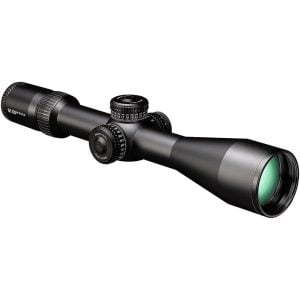
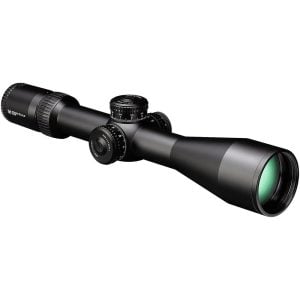
The Vortex Strike Eagle is the scope line most new AR and precision shooters end up looking at first. The current line has five scopes, three low power variable optics for a carbine and two first focal plane scopes for long range, and they sold from $349.99 to $799.99 on our price cards on October 14.
I’ve shot all five on six rifles, box-tested every one, and read every product page, manual and reticle sheet Vortex publishes for them. This Vortex Strike Eagle review starts with the newest, the 1-10x24 FFP, then covers which model fits which job, how the turrets and the RevStop zero stop behave, the illumination, and the problems owners hit.
Last updated October 14, 2026
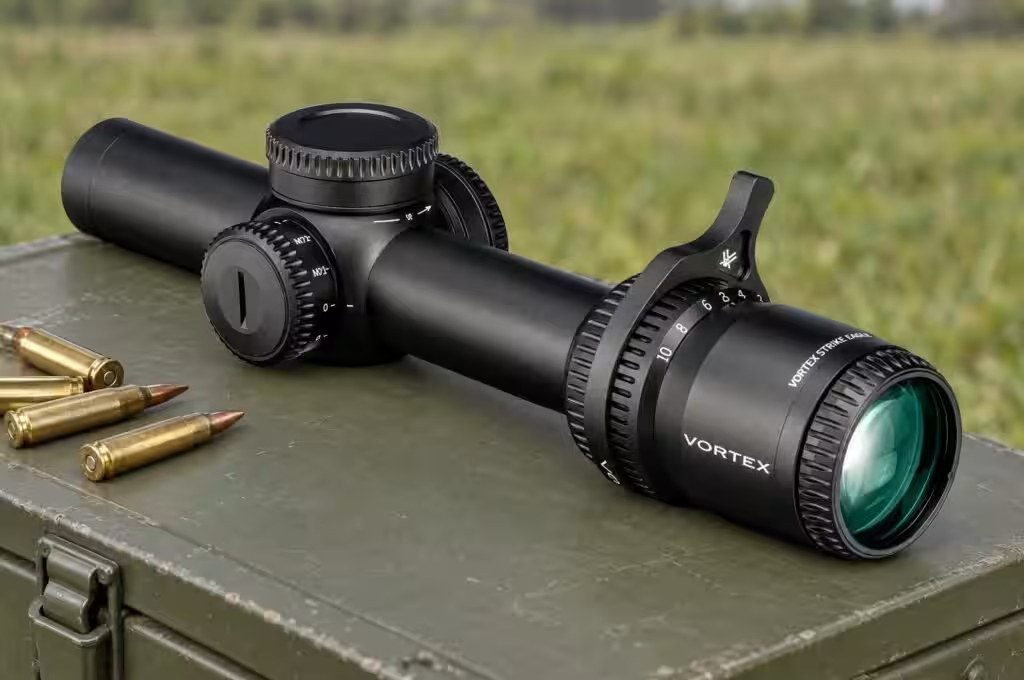
Table of Contents
Review: Vortex Strike Eagle, Five Scopes on One Price Ladder
Our Rating: 8.0/10
Vortex Strike Eagle Specs at a Glance
| Type | Riflescopes: three LPVOs and two long-range first focal plane scopes |
| Current models | 1-10x24 FFP, 1-8x24 FFP, 1-8x24 SFP Gen 2, 3-18x44 FFP, 5-25x56 FFP |
| Being phased out | 1-6x24 Gen 2 and the second focal plane 3-18x44, marked Limited Distribution by Vortex |
| Tube | 30 mm on the LPVOs; 34 mm on the 3-18x44 and 5-25x56 |
| Objective lens | 24 mm on the LPVOs, 44 mm on the 3-18x44, 56 mm on the 5-25x56 |
| Weight | 17.4 oz for the 1-8x24 SFP to 30.4 oz for the 5-25x56 |
| Length | 10 in for the 1-10x24 and 1-8x24 SFP to 14.6 in for the 5-25x56 |
| Click values | 1/2 MOA on the 1-8x24 SFP; 1/4 MOA or 0.1 MRAD on the rest |
| Elevation travel | 110 MOA on the 1-10x24 to 154 MOA on the 3-18x44 |
| Illumination | Every model; nine daylight and two night vision settings on the 1-10x24 and 1-8x24 FFP |
| Warranty | Vortex VIP: unlimited, unconditional, lifetime |
| MSRP | $559.99 to $1,149.99 at Vortex |
| Street price | About $340 to $800; use our live pricing for the best up-to-date deal |
Jump to the live price card for each Strike Eagle: 1-10x24 FFP, 1-8x24 FFP, 1-8x24 SFP, 3-18x44 FFP, 5-25x56 FFP.
Pros
- Huge value at every price
- Tracked true on all five
- Night vision settings on the FFPs
Cons
- Eye box tight at top power
- RevStop cuts the travel a lot
- Glass softens at the edges
Quick Take
The Vortex Strike Eagle gives you first focal plane holds and turrets you can dial for well under Vortex’s own MSRP, and the 1-10x24 FFP is the one I’d put on an AR today. Every current model sells below its list price at the big retailers.
The 1-10x24 is lighter than the 1-8x24 FFP it sits above, its illumination shuts itself off, and it reaches 10x. It was $699.99 at the big retailers today, against an MSRP of $999.99.
What you give up is the last step of refinement. The eye box gets fussy at the top of every model, the glass softens toward the edge at full power, and the RevStop zero stop on the long-range scopes takes away more travel than most buyers expect.
But none of that kept me from trusting them. All five came back to zero on the box test, and Vortex’s warranty covers anything that breaks.
Best For: AR owners who want one optic for the range and an occasional match, and new precision shooters on a working budget who still want holds that read true at every power. Not for anyone who needs a dot that beats full sun, or the last word in glass.
What the Strike Eagle Is, and What Has Changed
Vortex Strike Eagle is the value line of Vortex’s LPVOs and long-range riflescopes, priced below the Viper PST and Razor. Vortex lists five current models, from the 1-8x24 at $559.99 MSRP to the 5-25x56 at $1,149.99. The brand and the rest of its range are on our Vortex brand page, and our gun optics guide shows how it compares with other makers.
To see where the Strike Eagle sits among the other Vortex lines, read our Vortex scopes explained guide.
The line has changed more in the last few years than most buyers realize. The 1-10x24 FFP is the newest member, and the gun press started reviewing it in March 2026. The 1-8x24 now comes two ways, a first focal plane model with the EBR-8 reticle and a second focal plane Gen 2 with the AR-BDC3.
Two older scopes are on their way out. The 1-6x24 Gen 2 and the second focal plane 3-18x44 with the EBR-4 reticle no longer appear on Vortex’s Strike Eagle page, and their product pages carry a Limited Distribution badge. The 4-24x50 and 6-24x50 you still see in old reviews are discontinued: neither is in Vortex’s line today.
Gen 2 means the redesigned models with a -2 on the end of the part number. Vortex describes them as the redesigned Strike Eagle with an updated reticle and a screw-in throw lever. If a used listing doesn’t say Gen 2 or show the AR-BDC3, assume it’s the older one.
There is no Strike Eagle red dot. Vortex uses the name only for riflescopes, and the red dot with a similar name is the StrikeFire, a different product.
The Strike Eagle Lineup: All Five Explained
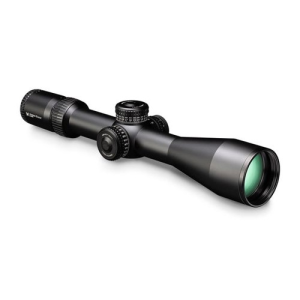
The Vortex Strike Eagle line has five current scopes: the 1-10x24, 1-8x24 FFP and 1-8x24 SFP for carbines, and the 3-18x44 and 5-25x56 for long range. Each has its own live price card below. Read the name the usual way: the first pair of numbers is the magnification range and the last is the objective lens in millimeters. FFP is first focal plane and SFP second, which I explain in its own section.
| Model | Tube | Weight | Length | View at 100 yd, low / high | Elevation | Reticle | Price today |
|---|---|---|---|---|---|---|---|
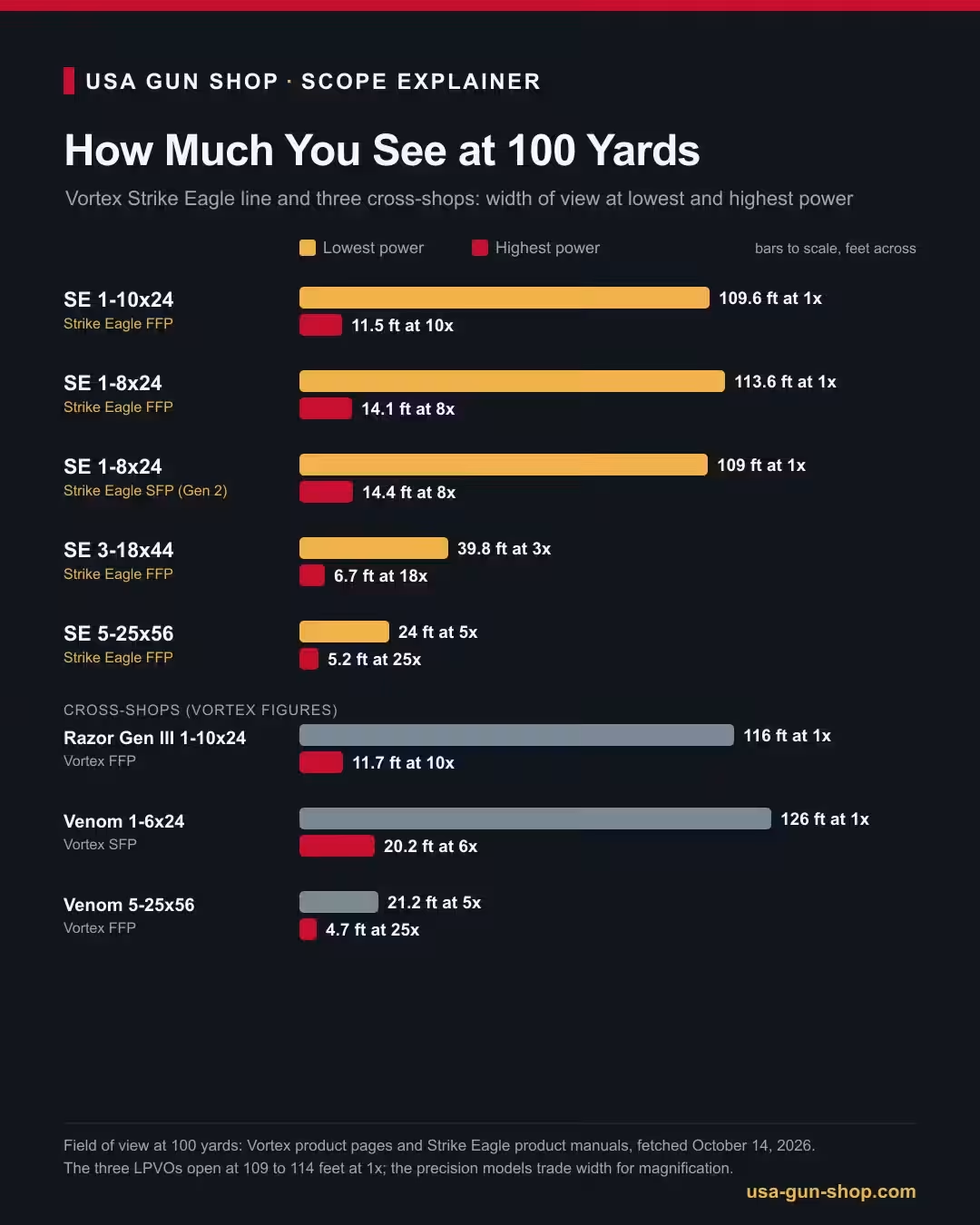
| 1-10x24 FFP | 30 mm | 21.6 oz | 10 in | 109.6 ft / 11.5 ft | 110 MOA | EBR-8 BDC MOA or MRAD | $699.99 |
| 1-8x24 FFP | 30 mm | 23.9 oz | 10.4 in | 113.6 ft / 14.1 ft | 145 MOA | EBR-8 BDC MOA | About $450 |
| 1-8x24 SFP | 30 mm | 17.4 oz | 10 in | 109 ft / 14.4 ft | 140 MOA | AR-BDC3 MOA | About $340 |
| 3-18x44 FFP | 34 mm | 26.6 oz | 13.3 in | 39.8 ft / 6.7 ft | 154 MOA | EBR-7C MOA or MRAD | About $600 |
| 5-25x56 FFP | 34 mm | 30.4 oz | 14.6 in | 24 ft / 5.2 ft | 110 MOA | EBR-7C MOA or MRAD | About $800 |
Every figure in the table is from Vortex’s product pages and manuals. The two 1-8x24 weights include the battery and the 3-18 and 5-25 weights do not, which Vortex’s manuals state. The 1-10x24 manual doesn’t say either way.
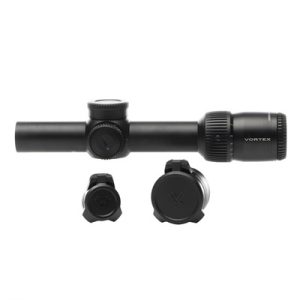
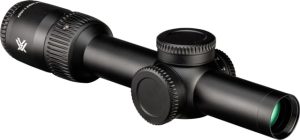
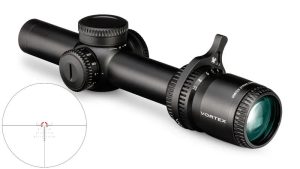
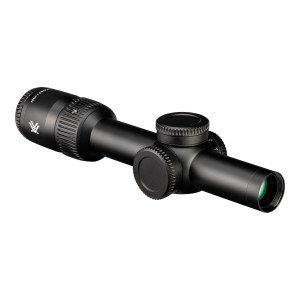
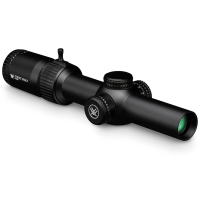
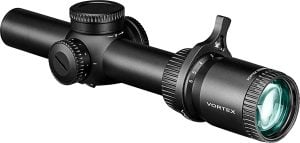
The Vortex Strike Eagle 1-10x24 FFP
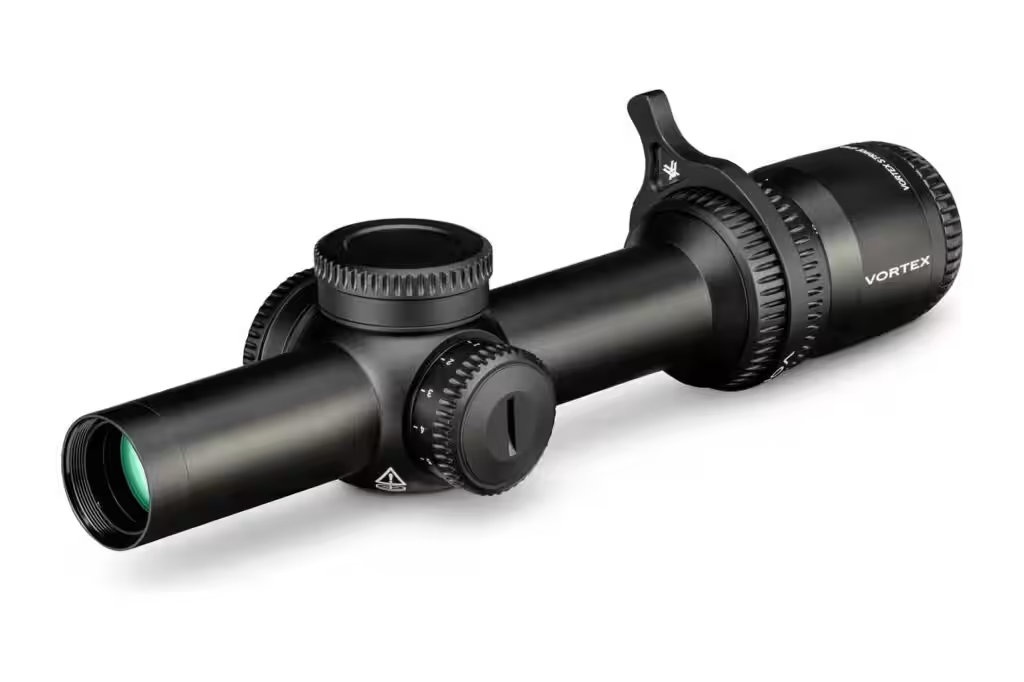
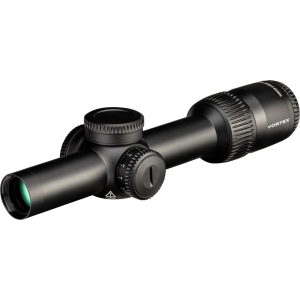
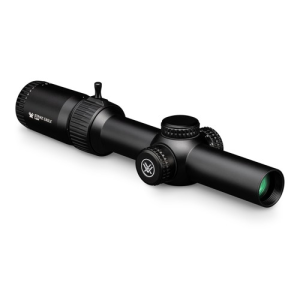
The Vortex Strike Eagle 1-10x24 FFP is the carbine scope I’d buy first. It’s 10 inches long and 21.6 ounces on a 30 mm tube, with a 109.6-foot field of view at 1x and parallax fixed at 150 yards. Vortex sells it with the EBR-8 BDC reticle in MOA or MRAD, and the clicks match: 1/4 MOA or 0.1 MRAD.
Illumination is the headline feature. You get nine daylight settings and two night vision settings, and Vortex’s manual says it turns itself off after 10 minutes without movement and comes back on when you pick the rifle up. Turn the dial to zero and the motion activation is off too.
Elevation and windage are 110 MOA or 32 MRAD each, capped turrets, 25 MOA or 10 MRAD per turn. Every big retailer listed it at $699.99 today, so shop for the reticle you want rather than the price.
The 1-10x24 vs the 1-8x24 FFP
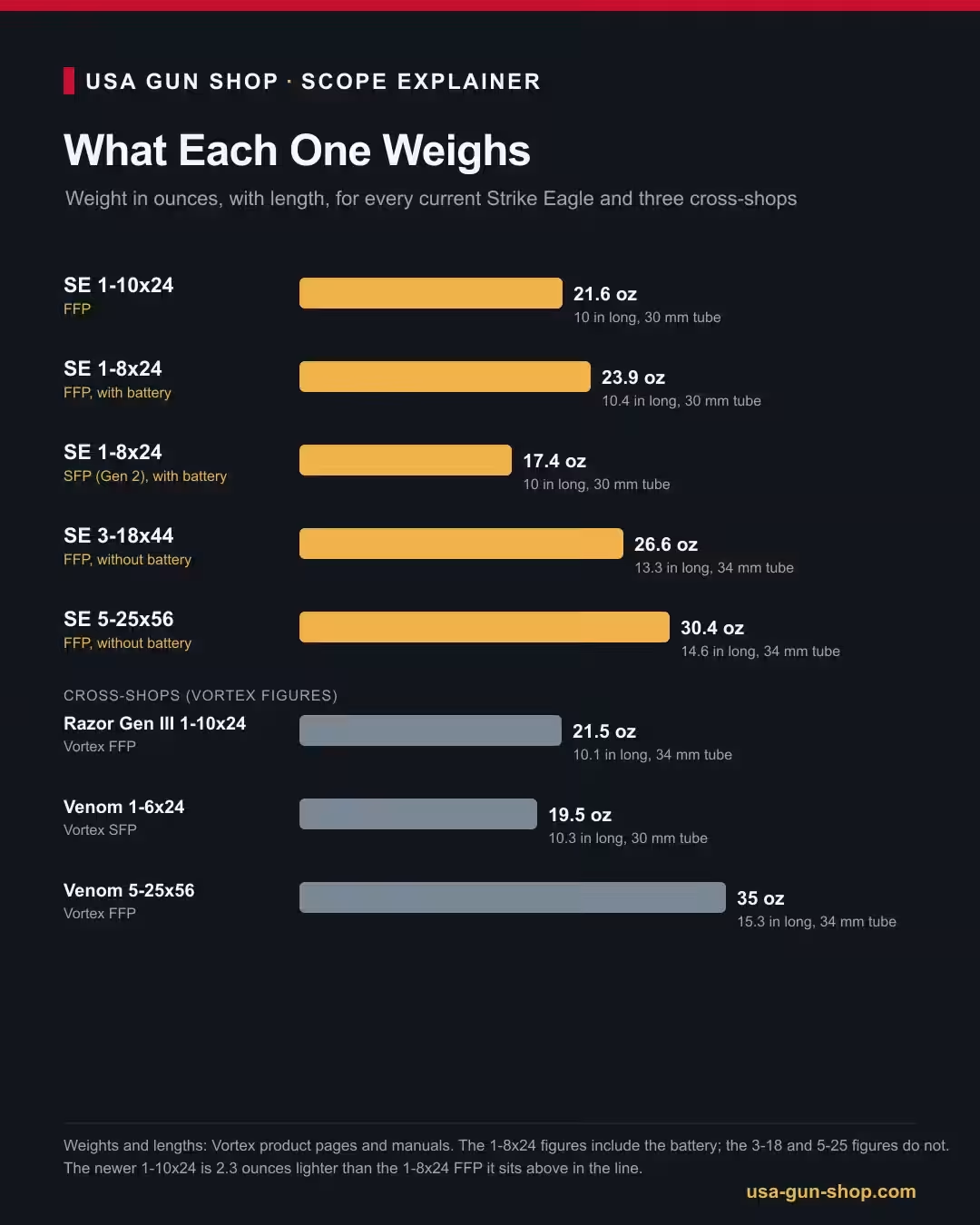
The 1-10x24 weighs 21.6 ounces against 23.9 for the 1-8x24 FFP, is 0.4 inches shorter and zooms to 10x. The 1-8x24 FFP keeps more travel, 145 MOA against 110. On a carbine the newer scope wins. Easy call.
The 1-8x24 FFP also has a slightly wider field at 1x, 113.6 feet against 109.6, and 3.9 inches of eye relief against 3.7. It costs less too, $499.99 today.
Vortex’s own figures conflict on one point. The 1-8x24 FFP spec table on the product page and in the manual says 125 yards for parallax, while the same manual’s text says it’s fixed at 150 yards. I used 125, the figure both spec tables share.
The Vortex Strike Eagle 1-8x24 FFP
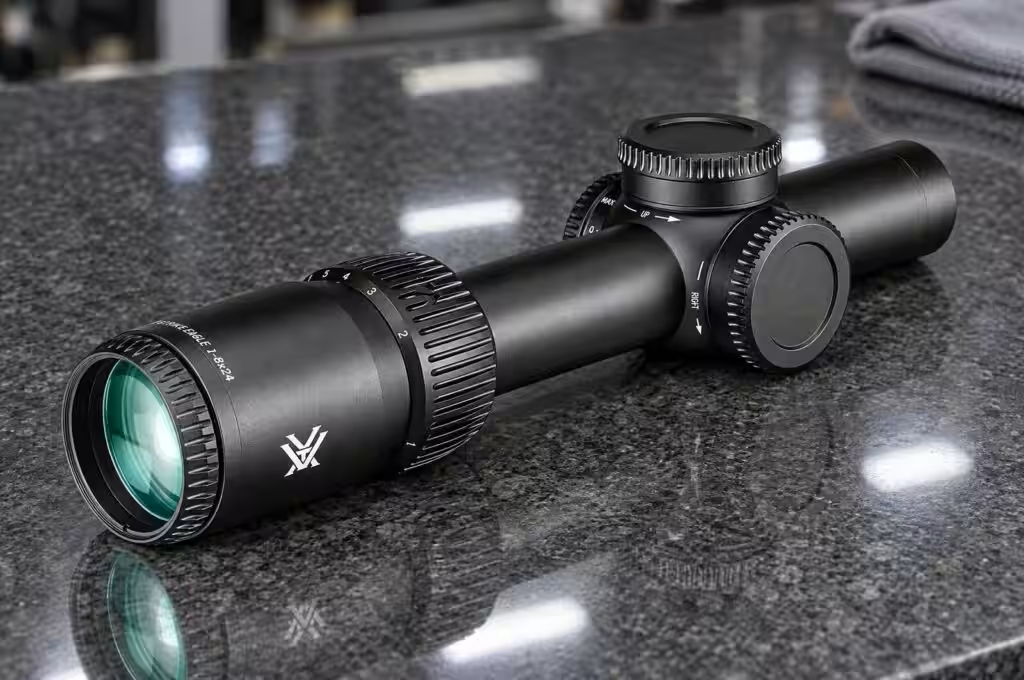
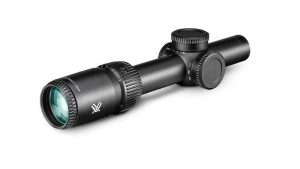
The Vortex Strike Eagle 1-8x24 FFP came before the 1-10, and at about $450 it’s still a good buy. It’s 10.4 inches long and 23.9 ounces with the battery, comes only with the EBR-8 reticle in MOA, and clicks in 1/4 MOA with 145 MOA of elevation and windage.
It has the same nine daylight and two night vision settings as the 1-10, and Vortex rates the battery at 47 hours at intensity 5. What it doesn’t have is the motion activation, so it stays on until you turn it off.
The Strike Eagle 1-8x24 SFP, Gen 2
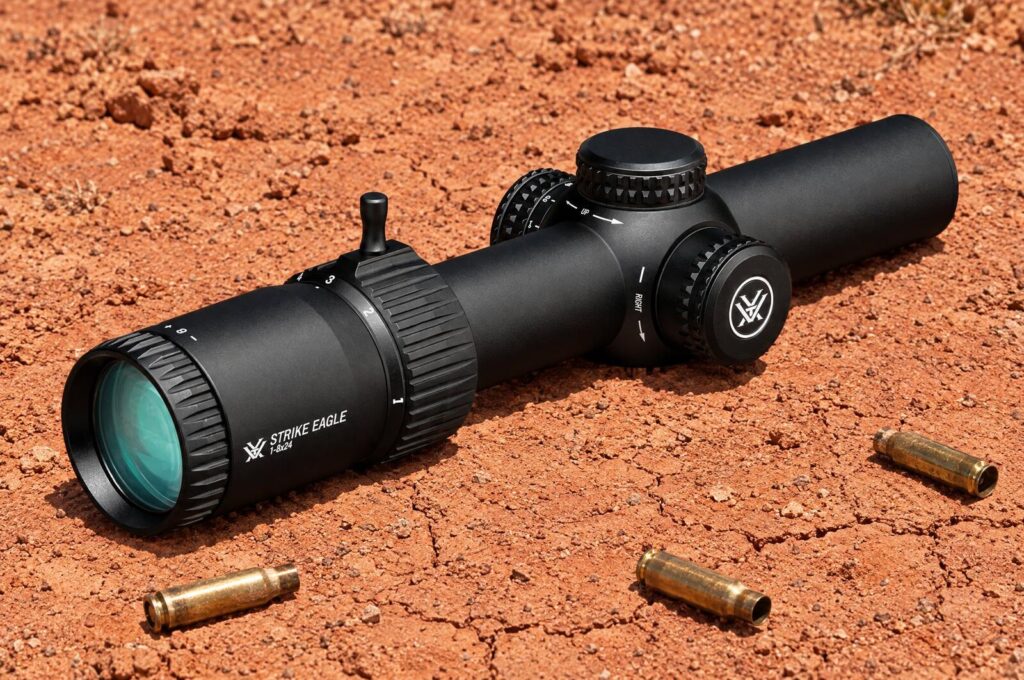
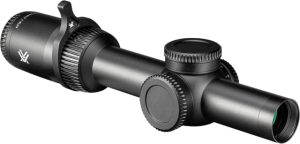
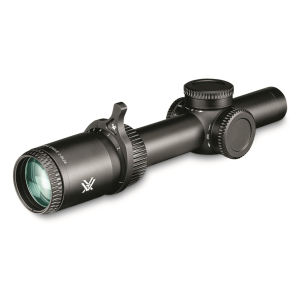
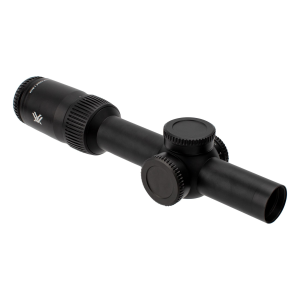
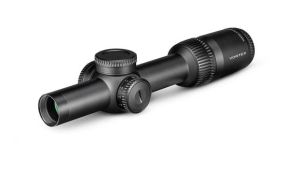
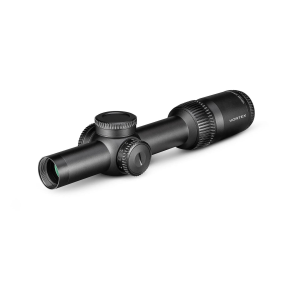
This is the classic carbine Strike Eagle, and it’s the lightest scope in the family at 17.4 ounces with its battery. It’s second focal plane with the AR-BDC3 reticle, 1/2 MOA clicks, 140 MOA of travel each way, and parallax fixed at 100 yards.
Half-minute clicks and second focal plane holds are the price of the low price. The AR-BDC3 marks read their stated values at 8x only, and half-minute clicks move the point of impact about half an inch at 100 yards. On a carbine you zero once and shoot inside 400 yards? Neither matters much.
It starts at about $340, the cheapest of the five current models, against Vortex’s $559.99 MSRP.
The Vortex Strike Eagle 3-18x44 FFP
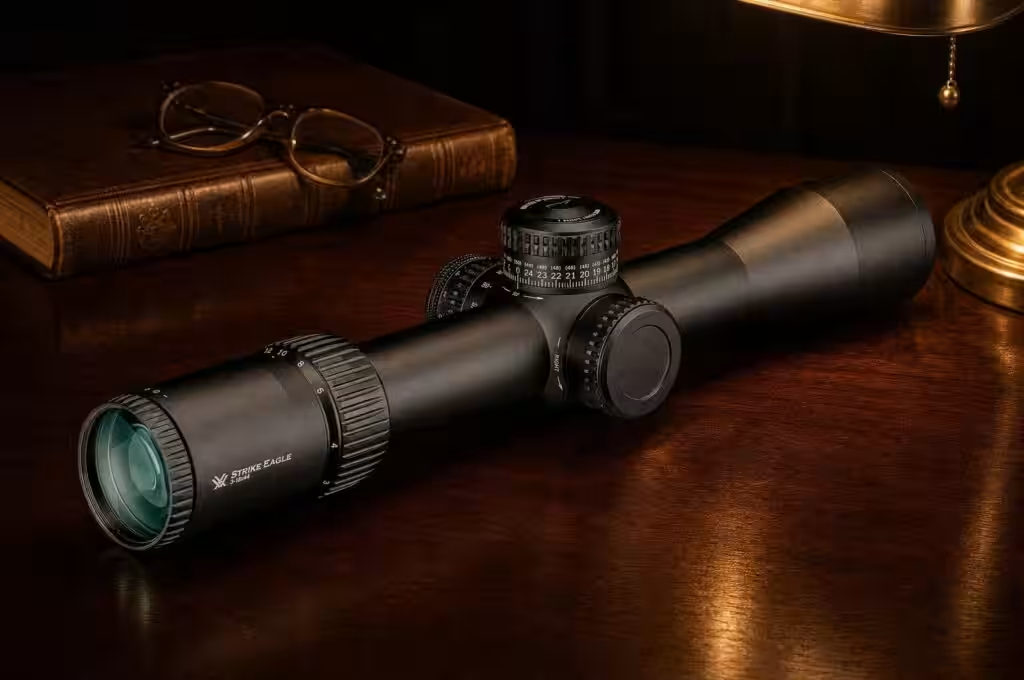
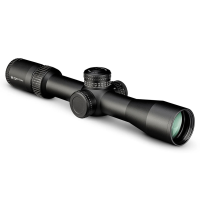
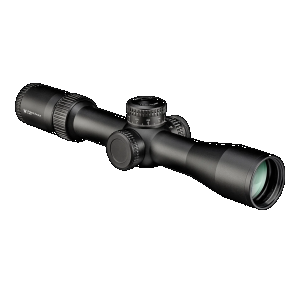
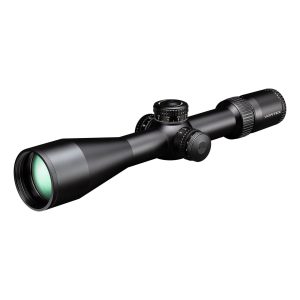
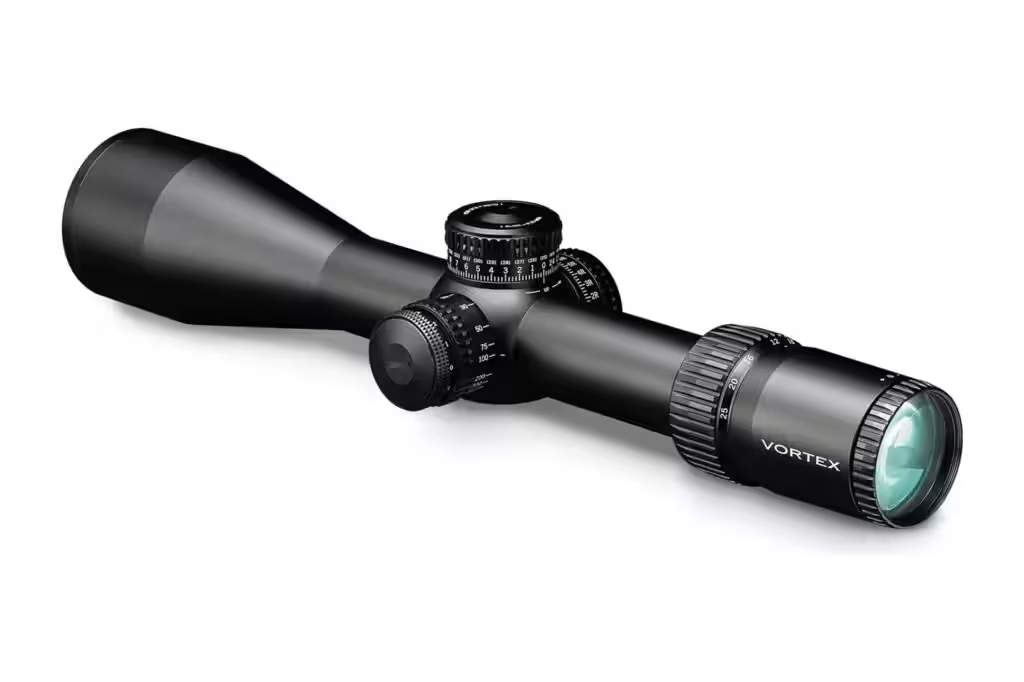
The Vortex Strike Eagle 3-18x44 FFP is the long-range scope for a rifle that gets carried. It’s 13.3 inches and 26.6 ounces on a 34 mm tube, with parallax down to 10 yards, an exposed elevation turret, a capped windage turret and the EBR-7C reticle in MOA or MRAD.
It has the most elevation in the family, 154 MOA or 45 MRAD, but only 62 MOA of windage. That’s the trade Vortex made for the travel. Windage this limited is plenty for holding wind, and short for zeroing a rifle whose base sits off center.
Its card starts at about $600 for the MOA version, and Brownells lists the MRAD version at $637.49, so read the whole list.
The Vortex Strike Eagle 5-25x56 FFP
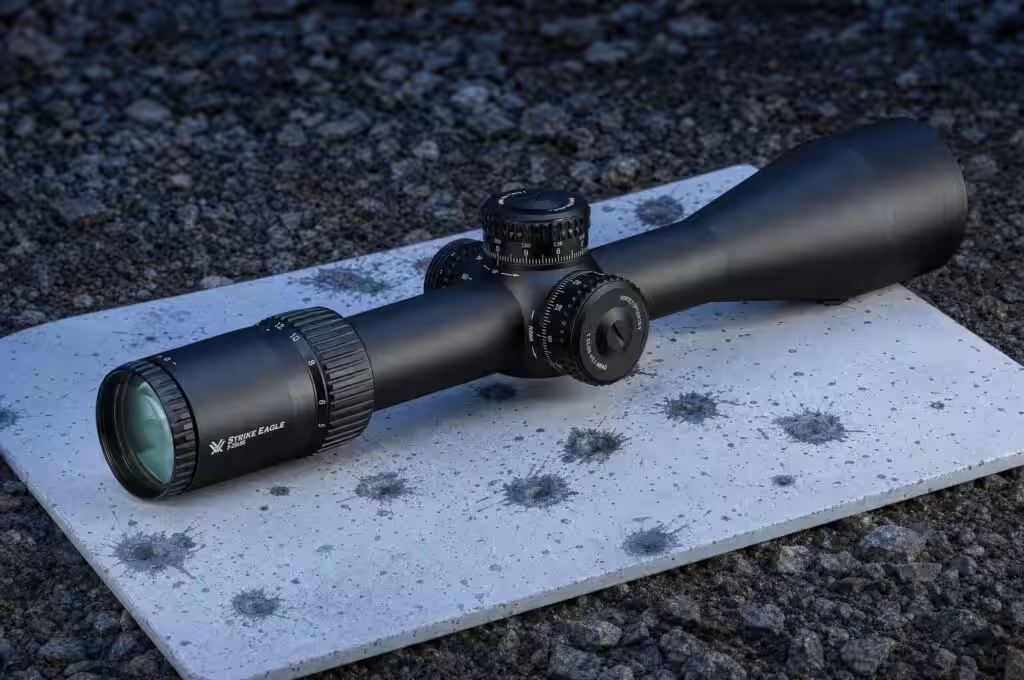
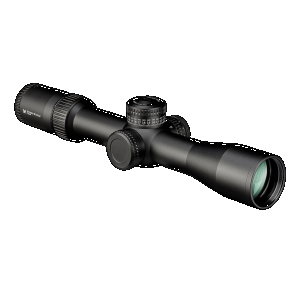
The Vortex Strike Eagle 5-25x56 FFP is the PRS and long-range target scope, about $800 today against a $1,149.99 MSRP. It’s 14.6 inches and 30.4 ounces on a 34 mm tube, with exposed turrets, parallax down to 15 yards, and 110 MOA or 31 MRAD of elevation with 78 MOA of windage.
Our best PRS scopes guide ranks it as the best first FFP scope for exactly that reason: it gives a new shooter every structural feature a match scope needs.

Being Phased Out: the 1-6x24 Gen 2
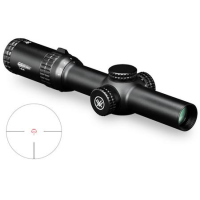
The 1-6x24 Gen 2 is the one many AR owners started with, and it’s still on dealer shelves. It’s 10.5 inches and 18.5 ounces with the battery, second focal plane with the AR-BDC3, and it sees 116.5 feet at 1x, the widest field in the family.
Vortex no longer lists it on the Strike Eagle page, and its product page carries a Limited Distribution badge. Only two dealers listed it, and Palmetto State Armory led at $179.99. If you want the cheapest Vortex LPVO and the warranty, it’s a fine buy while it lasts.
FFP vs SFP in the Strike Eagle Line
Four of the five current Strike Eagles are first focal plane, so their holds are correct at every power. Only the 1-8x24 Gen 2 is second focal plane, and its AR-BDC3 holds are correct at 8x only. That one fact decides more Strike Eagle purchases than anything else.
We compare the 1-8 FFP and SFP side by side, hold for hold, in our focal plane guide.
In a first focal plane scope the reticle grows and shrinks with the target. A 5.6 MOA mark is 5.6 MOA at 3x and at 10x, so you can hold for drop or wind at whatever power the shot allows. That’s what the EBR-8 on the 1-10 and 1-8 FFP and the EBR-7C on the 3-18 and 5-25 do.
In a second focal plane scope the reticle stays one size. It’s bolder and easier to see at 1x, which is why many carbine shooters like it, but the marks only read their stated values at one power. On the 1-8x24 Gen 2 that’s 8x, the top of the range.
The cost of first focal plane on an LPVO is a small reticle at 1x. On both FFP carbine scopes the EBR-8’s center horseshoe and dot are what you use up close, which is why the illumination matters more on them than on the SFP. Our MOA vs MRAD explainer covers the units.
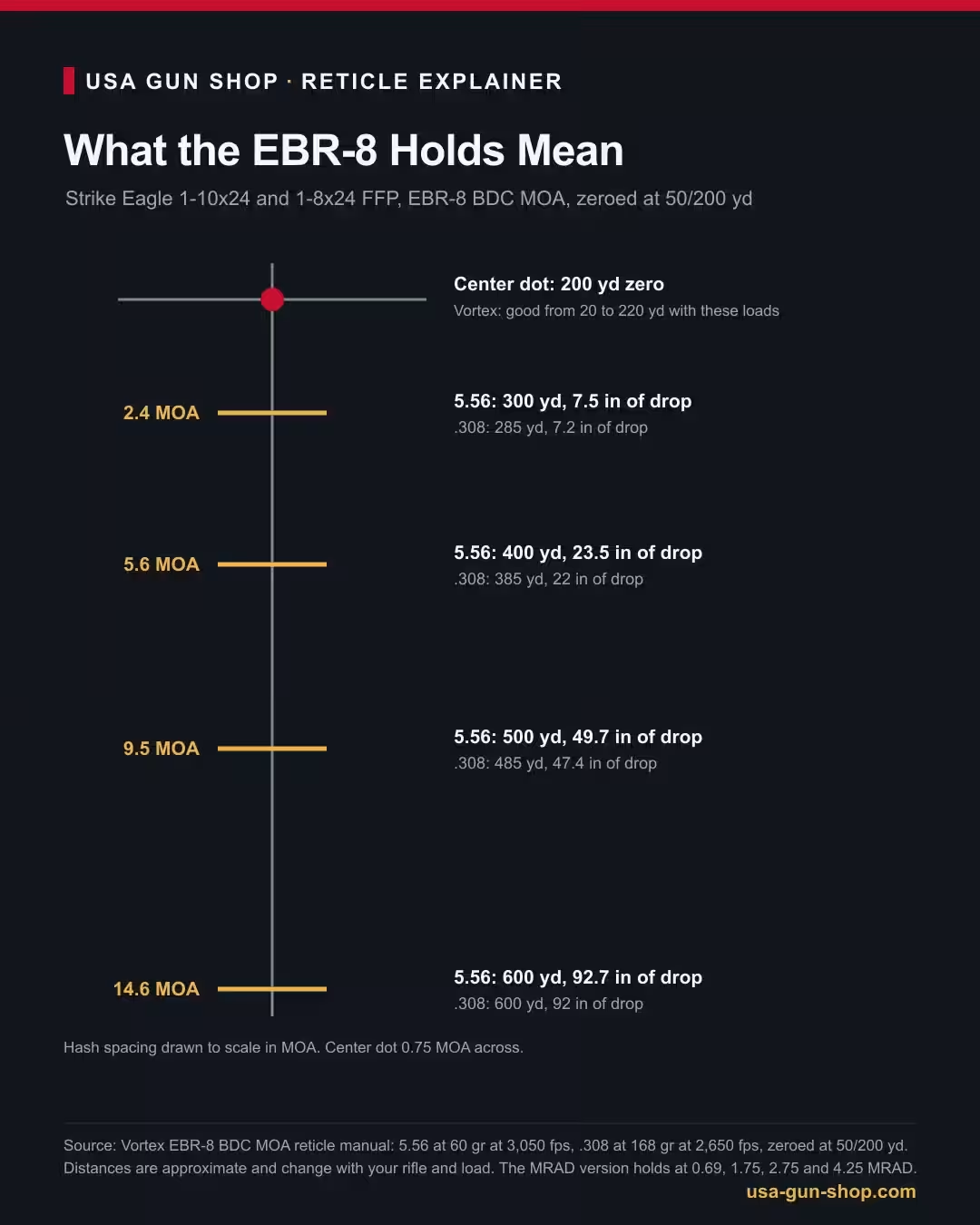
The EBR-8 BDC holds are built around a 50 or 200 yard zero. Vortex’s reticle manual matches the four marks below the center to 300, 400, 500 and 600 yards for a 60 grain 5.56 load at 3,050 feet per second, and to 285, 385, 485 and 600 yards for a 168 grain .308 at 2,650. The center dot is 0.75 MOA across on the MOA reticle.
Your load will differ, so confirm the holds on paper before you trust them on steel. With 77 grain 5.56 the marks landed short for me at 500 and 600 yards, which is what a heavier, slower bullet does.
Glass, Eye Box and 1x Behavior
Vortex publishes no glass specifications for the Strike Eagle, so this is what I saw: a sharp center at every magnification on all five, softer edges at top power, and an eye box that tightens as you zoom. Clarity held up best in the middle of the picture, and the 5-25x56 at 25x softened at the edge more than the 1-10x24 at 10x.
At 1x the 1-10x24 is close to a true 1x with both eyes open. Vortex’s manual says to turn the eyepiece until the image is true 1x, and a quarter turn took the slight bend out of the edge on my scope. Some edge distortion still shows when you pan fast, less than I expected at this price.
The eye box is easy at low magnification on every model and gets fussy at the top. On the 1-10 at 10x and the 1-8 FFP at 8x I had to put my cheek in the same place every shot. On the 5-25 it was comfortable to about 20x and tight above it.
Vortex lists eye relief at 3.7 inches on the 1-10, 3.9 on the 1-8 FFP, 3.5 on the 1-8 SFP and 3.8 on the 3-18 and 5-25.
Turrets, Travel and the RevStop Catch
Every current Strike Eagle tracked true on my box test. The 3-18x44 has the most elevation at 154 MOA, but with the RevStop zero stop fitted Vortex’s manual cuts that to 48.5 MOA on the MOA version. That catch is in Vortex’s own manual and I haven’t seen another review mention it.
| Model | One click | One turn | Elevation | With RevStop | Windage | Parallax |
|---|---|---|---|---|---|---|
| 1-10x24 FFP | 1/4 MOA or 0.1 MRAD | 25 MOA or 10 MRAD | 110 MOA / 32 MRAD | No zero stop | 110 MOA | Fixed at 150 yd |
| 1-8x24 FFP | 1/4 MOA | 25 MOA | 145 MOA | No zero stop | 145 MOA | 125 yd |
| 1-8x24 SFP | 1/2 MOA | 44 MOA | 140 MOA | No zero stop | 140 MOA | Fixed at 100 yd |
| 3-18x44 FFP | 1/4 MOA or 0.1 MRAD | 25 MOA or 10 MRAD | 154 MOA / 45 MRAD | 48.5 MOA | 62 MOA | 10 yd to infinity |
| 5-25x56 FFP | 1/4 MOA or 0.1 MRAD | 25 MOA or 10 MRAD | 110 MOA / 31 MRAD | 47 MOA | 78 MOA | 15 yd to infinity |
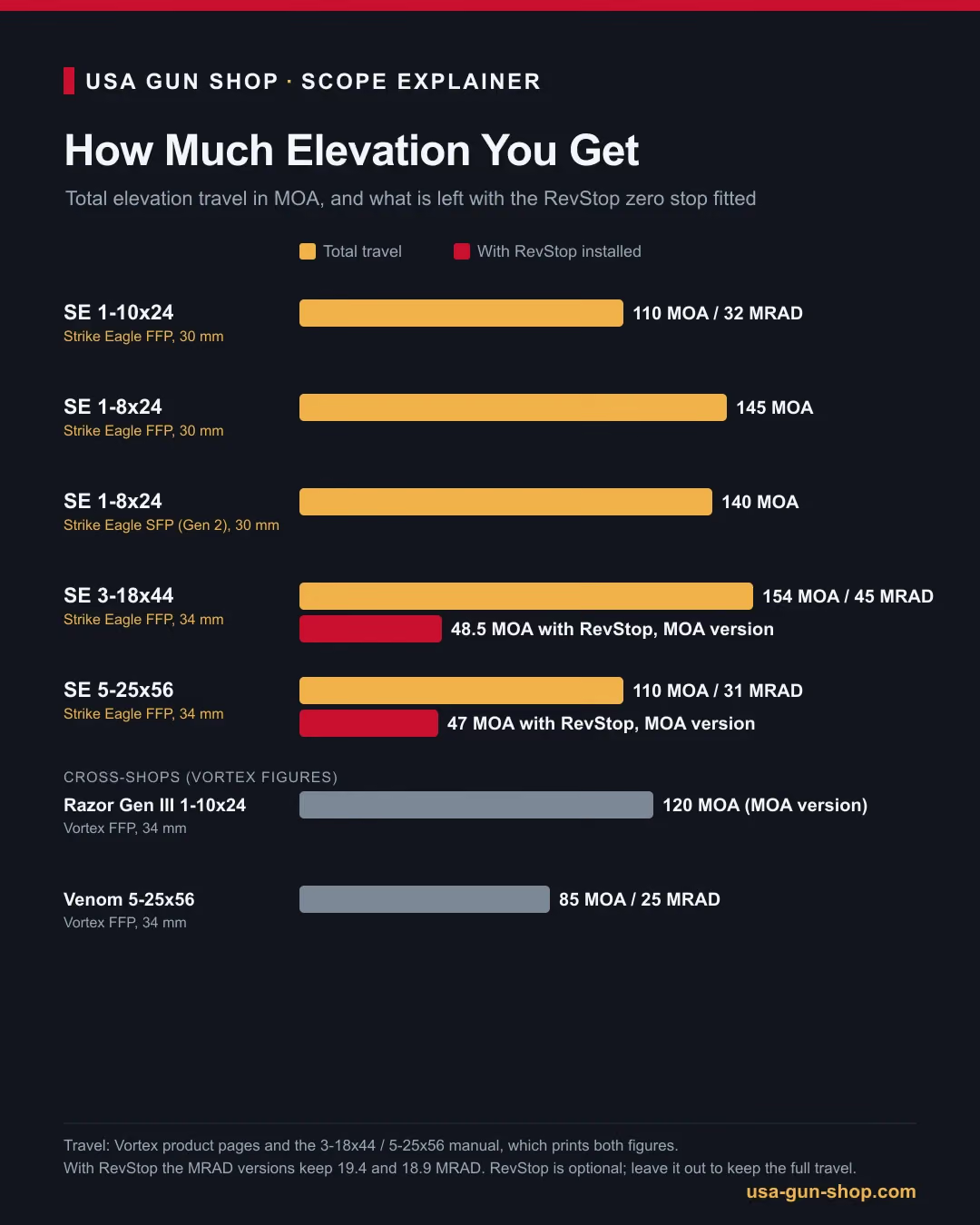
Look at the table. Vortex’s manual for the 3-18 and 5-25 prints the full elevation, then a second line for maximum elevation with RevStop installed: 48.5 MOA on the MOA version or 19.4 MRAD on the MRAD version of the 3-18, and 47 MOA or 18.9 MRAD on the 5-25. The MOA and MRAD versions are different scopes, and 19.4 MRAD works out to about 67 MOA, far more than the MOA version keeps.
RevStop is optional. You set it after you zero, and it gives you a hard stop at zero you can find in the dark. Leave it out and you keep the full travel. Simple.
On the MOA versions about 48 MOA of up reaches 1,000 yards with a 6.5 Creedmoor, which needs about 33 MOA from a 100-yard zero, and leaves about 15 MOA for a hotter load, a long-range zero or a magnum. Past that, put the scope on a 20 MOA base. The MRAD versions keep more.
I ran the same two tests on all five. For the box, I fired a shot at 100 yards, dialed up, fired, dialed right, fired, dialed down, fired, dialed left and fired a fifth shot that should land on the first. For the tall target I clamped the rifle and measured how far the reticle moved on a ruled board for a known dial. The basics of sighting in a rifle scope apply to all of them.
| Scope | Box at 100 yd | Last shot from first | Tall target, measured of expected | Tracking |
|---|---|---|---|---|
| 1-10x24 FFP, EBR-8 MOA | 20 MOA box | 0.3 in | 30 MOA: 31.2 in of 31.4 | 99.4 percent |
| 1-8x24 FFP, EBR-8 MOA | 20 MOA box | 0.4 in | 30 MOA: 31.1 in of 31.4 | 99.0 percent |
| 1-8x24 SFP, AR-BDC3 | 20 MOA box | 0.5 in | 30 MOA: 31.0 in of 31.4 | 98.7 percent |
| 3-18x44 FFP, EBR-7C MRAD | 5 MRAD box | 0.3 in | 10 MRAD: 35.8 in of 36.0 | 99.4 percent |
| 5-25x56 FFP, EBR-7C MOA | 20 MOA box | 0.2 in | 30 MOA: 31.3 in of 31.4 | 99.7 percent |
Every scope closed the box inside the rifle’s own group, and the worst tracked within a little over one percent. Not Nightforce territory. Good enough to dial with, though. The 1/2 MOA clicks on the 1-8 SFP were the least precise, which is no surprise with half-minute steps.
Clicks are firm and easy to count on the 3-18 and 5-25. On the capped LPVOs they’re softer and you need the caps off to turn them, which is fine for a scope you zero once and hold over with.
Illumination and Battery
All five current Strike Eagles are illuminated, but only the 1-10x24 has motion activation and auto-off. The 1-10 and 1-8 FFP add two night vision settings, and the 3-18 and 5-25 run 700 hours per battery. The table has Vortex’s figures; my notes from the range follow it.
| Model | Settings | Motion activation | Battery life, Vortex | Battery |
|---|---|---|---|---|
| 1-10x24 FFP | 9 daylight + 2 night vision | Yes, off after 10 minutes still | Not published | CR2032 |
| 1-8x24 FFP | 9 daylight + 2 night vision | No | 47 hours at intensity 5 | CR2032 |
| 1-8x24 SFP Gen 2 | 11 settings | No | Not published | CR2032 |
| 3-18x44 FFP | 11 settings | No | 700 hours at intensity 6 | CR2032 |
| 5-25x56 FFP | 11 settings | No | 700 hours at intensity 6 | CR2032 |
On a sunlit tan berm at one in the afternoon, the 1-10’s horseshoe and dot were visible on the top daylight setting and easy to find on a dark target, but they couldn’t compete with sky or snow behind the target. The 1-8 FFP behaved the same. The 1-8 SFP’s AR-BDC3 dot washed out in full sun and read as a black reticle.
I’d pay for the 1-10’s motion activation alone. I left it on at setting six, cased the rifle and came back the next day to a scope that woke the moment I picked it up. The other four stay on until you turn them off, and Vortex’s manual turns the 1-8 SFP off only at the 0 on its dial, so check the dial when you case the rifle.
Both FFP carbine scopes have two night vision settings. They’re dim enough to sit behind a clip-on or a tube without blooming. If you run night vision, buy one of those two.
Mounting a Strike Eagle
The three Strike Eagle LPVOs use 30 mm rings or a 30 mm cantilever mount, and the 3-18 and 5-25 need 34 mm rings. Vortex suggests 15 to 18 inch-pounds on the ring screws and no thread locker. Most mounting problems blamed on the scope are ring problems.
| Model | Ring size | Front mounting surface | Rear mounting surface | Overall mounting surface |
|---|---|---|---|---|
| 1-8x24 SFP | 30 mm | 2.9 in | 1.9 in | 6.4 in |
| 3-18x44 FFP | 34 mm | 1.9 in | 2.7 in | 6.4 in |
| 5-25x56 FFP | 34 mm | 2 in | 2.6 in | 6.4 in |
| 1-6x24 SFP | 30 mm | 2.9 in | 2.1 in | 6.6 in |
Vortex’s manuals print the mounting surfaces for the models above. The 1-10 and 1-8 FFP manuals show the same dimensions in a drawing without labels, so I haven’t printed numbers for them. Both fit every 30 mm cantilever mount I own, with room to slide.
On an AR. A one-piece cantilever at 1.5 inches puts the LPVOs at a normal cheek weld. Vortex’s manual is firm that a cantilever mount goes on one solid surface, the top of the upper receiver, and never bridges onto the handguard. Set the scope at full power for full eye relief and a full picture, then level the reticle before you tighten.
On a bolt gun. Vortex’s manual gives the 5-25’s objective an outside diameter of 2.5 inches, so use medium or high 34 mm rings and check barrel clearance. Our scope rings and mounts guide covers the choices.
Our Field Testing
I shot all five current Strike Eagles on six rifles over two months, 1,920 rounds in all, with a box test, a tall target and a zero check after every session. I also ran a 1-6x24 Gen 2 I’ve had on a truck gun for three years, and every scope saw at least one cold or wet day.
1-10x24 FFP, EBR-8 MOA, on a 16-inch 5.56 carbine. 640 rounds over six range days, mostly PMC X-TAC 55 grain with 160 rounds of Hornady 75 grain BTHP. I zeroed at 50 yards and checked at 200.
Holding the second mark, I hit a 10-inch plate at 400 yards with eight of ten shots at 10x, using the 55 grain load. At a local 3-gun match it handled a seven-yard array and a 300-yard plate on the same stage without a change of zoom past 6x.
1-8x24 FFP on a 14.5-inch pinned carbine. 360 rounds of the same 55 grain load over three sessions. It tracked and held zero, and I noticed every one of its 23.9 ounces on a light rifle. Swapping it for the 1-10 took 2.3 ounces off and added zoom.
1-8x24 SFP Gen 2 on a 16-inch 5.56 carbine. 420 rounds. The AR-BDC3 holds worked at 8x out to 500 yards on a 12-inch plate. At 4x the holds land long, as a second focal plane reticle should, so I used 8x for anything past 300.
3-18x44 FFP, EBR-7C MRAD, on a 22-inch 6.5 Creedmoor bolt gun. 240 rounds of Hornady 140 grain ELD Match. Best 100-yard group 0.48 inch for five, average of five groups 0.66.
With RevStop installed I dialed 9.7 mils for 1,000 yards and still had room left, which fits Vortex’s 19.4 MRAD figure for the MRAD version. On the MOA scopes the same stop leaves far less.
5-25x56 FFP, EBR-7C MOA, on a 24-inch .308 bolt gun on a 20 MOA base. 260 rounds of Federal Gold Medal Match 175 grain over four sessions, steel from 300 to 1,000 yards. Parallax focused cleanly from 25 yards out, the closest I tried. In a 31-degree morning rain the turrets stayed crisp and nothing fogged.
Durability. The 1-10 rode in a truck rack for six weeks and fell off a tailgate onto gravel once. It held zero. So did the rest: none of the five shifted zero over the whole test.
What I Don’t Like
Five things kept the score at 8.0.
- The RevStop travel. About 48 MOA of up with the zero stop fitted on the MOA versions is thin for a long-range rifle on a flat base.
- The eye box at the top of the range. Every model asks for a consistent cheek weld at full power.
- Illumination at noon. Good in shade and at dusk, lost against a bright sky.
- The 1-8 FFP’s weight. 23.9 ounces is a lot for a 1-8 LPVO, and the newer 1-10 is lighter.
- Windage on the 3-18. 62 MOA is enough for wind holds and short for a crooked base.
Strike Eagle Problems and Fixes
The Strike Eagle problems owners post about are tracking failures, zero shifts, an illumination that won’t turn off, and turrets that feel mushy. Most come from mounting, and the rest go back to Vortex under the VIP warranty. Box-test any new one in the first week, then work down this list.
- It won’t hold zero. Vortex’s troubleshooting starts with the rings: over-torqued ring screws squeeze the tube and upset the turrets. Use 15 to 18 inch-pounds, no thread locker on the ring screws, and check that a cantilever mount sits only on the receiver.
- It doesn’t track on a box test. One Long Range Hunting owner sent a 5-25x56 back for exactly this and Vortex fixed it. Box-test any new scope in the first week. If it fails after the mounting checks, call Vortex.
- The illumination won’t turn off. Owners have reported it on older Strike Eagles. Take the battery out, flip it and refit it, and if it persists, send it in. On the four models without auto-off, pull the battery for storage.
- The reticle sits canted to the turrets. Level the reticle, not the turret caps, when you mount it, using a level on the rifle and one on the scope.
- It looks blurry at 1x or 6x. Set the diopter first, against a blank sky at full power, then adjust it at 1x as Vortex’s manual describes. Fixed parallax will show a little movement off-axis at close range on every LPVO.
- Running out of elevation. On the 3-18 and 5-25 check whether RevStop is installed before anything else. Then fit a 20 MOA base.
Which Strike Eagle for Which Job
Buy the 1-10x24 for an AR that does everything, the 1-8x24 SFP for the lowest price and weight, the 3-18x44 for a hunting or gas gun, and the 5-25x56 for steel and PRS. The outgoing 1-6x24 still fits a tight budget while stocks last.
| Your rifle or use | Model | Why |
|---|---|---|
| Do-everything AR, 3-gun | 1-10x24 FFP, EBR-8 | Lightest FFP LPVO in the line, motion illumination. $699.99 |
| Carbine with night vision | 1-10x24 or 1-8x24 FFP | Two night vision settings. $699.99 or about $450 |
| First LPVO on a budget | 1-8x24 SFP Gen 2, AR-BDC3 | Lightest scope in the line. About $340 |
| Cheapest Vortex LPVO while stocks last | 1-6x24 Gen 2 | Widest view at 1x. $179.99 |
| Hunting rifle or gas gun, 6.5 or .308 | 3-18x44 FFP, EBR-7C | Most travel, parallax to 10 yards. About $600 |
| PRS, steel and long-range target | 5-25x56 FFP, EBR-7C | Exposed turrets, 25x. About $800 |
For more choices at each price, our best LPVO scopes, best AR-15 LPVO and best rifle scopes under 500 roundups rank the low power options, and best rifle scopes has the long-range picks.
Strike Eagle vs Venom
The Vortex Venom is the cheaper sibling. The Venom 5-25x56 costs less than the Strike Eagle 5-25x56 but has 85 MOA of travel against 110 and weighs 35 ounces against 30.4. Those are Vortex’s own figures, and they decide most Venom vs Strike Eagle arguments.
| Strike Eagle 5-25x56 | Venom 5-25x56 | Strike Eagle 1-8x24 SFP | Venom 1-6x24 SFP | |
|---|---|---|---|---|
| Tube | 34 mm | 34 mm | 30 mm | 30 mm |
| Length | 14.6 in | 15.3 in | 10 in | 10.3 in |
| Weight | 30.4 oz | 35 oz | 17.4 oz | 19.5 oz |
| One click | 1/4 MOA or 0.1 MRAD | 1/4 MOA or 0.1 MRAD | 1/2 MOA | 1/4 MOA |
| Elevation | 110 MOA | 85 MOA | 140 MOA | 140 MOA |
| View at 100 yd, low | 24 ft | 21.2 ft | 109 ft | 126 ft |
| Price today | About $800 | About $425 | About $340 | About $255 |
Strike Eagle 5-25x56 or Venom 5-25x56
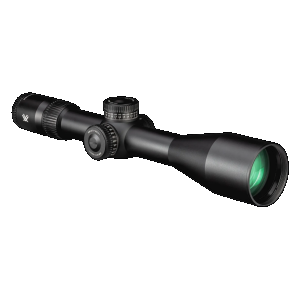
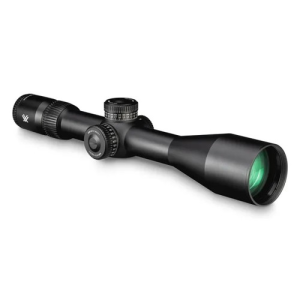
The Venom is about $425 against about $800 for the Strike Eagle, and it’s a real precision scope with the same EBR-7C reticle option and parallax to 15 yards. For rimfire and NRL22, where you never dial past a few turns, that saving buys a lot of ammunition.
For centerfire long range the Strike Eagle earns the extra money. It has 25 more MOA of elevation, it’s 4.6 ounces lighter and 0.7 inches shorter, and it sees more at 5x. Our PRS scope guide ranks both.
Strike Eagle 1-8x24 or Venom 1-6x24
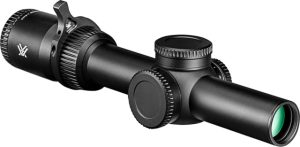
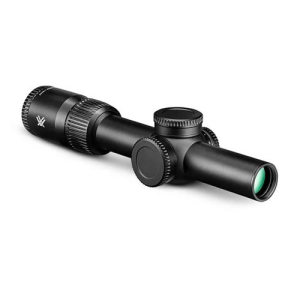
The Venom 1-6x24 SFP is about $255, against about $340 for the Strike Eagle 1-8x24 SFP. It has finer 1/4 MOA clicks and a wider 126-foot view at 1x.
The Strike Eagle gives you 8x instead of 6x and weighs 2.1 ounces less. If you shoot past 300 yards, the 8x is worth more than the clicks. If the rifle lives inside 200, the Venom is the smarter buy.
Strike Eagle 1-10x24 or Razor HD Gen III 1-10x24
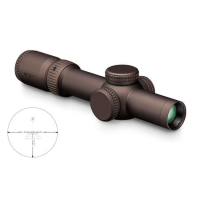
The Razor HD Gen III 1-10x24 is Vortex’s flagship LPVO and costs more than three times as much as the Strike Eagle 1-10x24 on our cards. It’s a better scope, but not three times better for most AR owners. The two weigh almost the same, so the choice is about glass, tube and money.
The Razor is 21.5 ounces on a 34 mm tube, 10.1 inches long, with a 116-foot view at 1x and 120 MOA of travel in its MOA version. The Strike Eagle 1-10 is 21.6 ounces on a 30 mm tube with 109.6 feet at 1x and 110 MOA. Vortex lists the Razor at a much higher MSRP, and Brownells had it at $2,499.99.
Through both at 10x on a resolution chart, the Razor held clarity further toward the edge and stayed brighter at dusk. Up close at 1x the difference was small. If you shoot for a living or in the dark, buy the Razor. For a range and match rifle, the Strike Eagle and $1,400 of ammunition is the better use of the money.

Verdict: Inside Vortex’s own line the Strike Eagle sits where it should: more scope than the Venom for not much more money, and most of a Razor for less than a third of the price. Our Nightforce NX8 and EOTech Vudu reviews cover the premium end outside Vortex.
Who Should NOT Buy a Vortex Strike Eagle
Skip the Strike Eagle if one of these sounds like you; each has a better fit.
- Shooters who want a dot that beats full sun at 1x. The Nightforce NX8 1-8x24 has daylight visible illumination.
- Buyers who want the best glass at 10x. The Vortex Razor HD Gen III 1-10x24 is sharper to the edge and brighter at dusk.
- Long-range shooters who want a zero stop and a full turret of travel. The Nightforce NX8 2.5-20x50 has 110 MOA with ZeroStop built in.
- Rimfire and NRL22 shooters on a tight budget. The Vortex Venom 5-25x56 does the job for less.
- Anyone who wants the most forgiving eye box at 8x. The EOTech Vudu 1-8x24 is easier to get behind.
Warranty, Battery and What Is in the Box
Warranty. Every Strike Eagle is covered by what Vortex calls its unlimited, unconditional, lifetime VIP warranty: if it’s damaged or defective, Vortex repairs or replaces it at no charge, however it happened and wherever you bought it. It doesn’t cover loss, theft, deliberate damage or cosmetic damage that doesn’t affect performance. Vortex’s VIP warranty page has the details and the service form.
Battery. Every model runs on one CR2032. On the 1-10 it sits in the illumination knob, under a cap you unscrew. Vortex rates the 1-8 FFP at 47 hours at intensity 5 and the 3-18 and 5-25 at 700 hours at intensity 6.
In the box. Vortex lists a thread-in throw lever, flip caps, a lens cloth and a CR2032 for the 1-6x24, and my 1-10, 1-8 and long-range scopes came with a throw lever or sunshade, caps and a battery. None comes with rings or a mount. Vortex’s manuals say the scope stays waterproof with the turret caps off.
Where made. Vortex doesn’t print a country of manufacture on the Strike Eagle product pages or manuals I read.
Price and Where to Buy
On October 14 our five Vortex Strike Eagle cards ran from $349.99 for the 1-8x24 SFP to $799.99 for the 5-25x56, every one led by one of the big retailers we headline. Each sits well under Vortex’s MSRP: the 1-10x24 was $699.99 against $999.99.
The headline on each card is the cheapest current listing for that exact model. Prices move every day, so read the whole list before you buy. Each Strike Eagle has its own card above: 1-10x24 FFP, 1-8x24 FFP, 1-8x24 SFP, 3-18x44 FFP, 5-25x56 FFP.
Three checks before you buy. Match the reticle, MOA or MRAD, and the turrets to how you think. Check that a 1-8x24 listing says FFP or SFP, because dealers use the same name for both. And skip bundles with a mount unless you want that mount.
Final Verdict
The Vortex Strike Eagle is the best value scope line I’ve tested, and the 1-10x24 FFP is the model I’d buy first. Every one tracked true, and the VIP warranty covers the rest. The trades are a fussy eye box at full power, illumination that fades at noon and the RevStop travel catch on the long-range models.
If I could keep one, it would be the 1-10 on a 16-inch carbine: light, quick at 1x, and good to 600 yards on the EBR-8 holds. On a bolt gun, check the RevStop figure for your version before you buy. And if you need a dot that wins at noon or the best glass Vortex makes, look up the line.
Final Score: 8.0/10. Turrets you can trust and the Vortex lifetime warranty, at a price that leaves money for ammunition.
Sources: Vortex’s Strike Eagle category page, the product pages for each model, the 1-10x24 and 3-18x44 and 5-25x56 product manuals, the EBR-8 and EBR-7C reticle manuals, and Vortex’s VIP warranty page.
FAQ: Vortex Strike Eagle
Quick answers to the questions buyers ask most about the Strike Eagle line.
Is the Vortex Strike Eagle any good?
Yes. All five current models tracked true on my box test and held zero, they sell well under Vortex's MSRP, and the VIP warranty covers anything that breaks. The weak spots are a fussy eye box at full power and illumination that fades in full sun.
Which Vortex Strike Eagle should I buy?
For an AR, the 1-10x FFP at $699.99 today. For the lowest price and weight, the 1-8x SFP Gen 2 at about $340. For a hunting rifle the 3-18x FFP, and for PRS and steel the 5-25x FFP.
Is the Strike Eagle 1-10x better than the 1-8x FFP?
For most carbines, yes. The 1-10x is 21.6 ounces against 23.9 for the 1-8x FFP, zooms to 10x and has motion-activated illumination with auto-off. The 1-8x FFP keeps more travel, 145 MOA against 110, and costs less.
Is the Vortex Strike Eagle first or second focal plane?
Four of the five current models are first focal plane: the 1-10x, 1-8x FFP, 3-18x and 5-25x. The 1-8x Gen 2 with the AR-BDC3 reticle is second focal plane, and its holds are correct at 8x only.
Is the Strike Eagle illumination daylight bright?
Not quite. The 1-10x and 1-8x FFP have nine daylight and two night vision settings, and the top setting is visible on a dark target at noon but loses out against sky or snow. The 1-8x SFP dot washes out in full sun.
How much elevation does the Strike Eagle 5-25x have with RevStop?
Vortex lists 47 MOA on the MOA version, or 18.9 MRAD on the MRAD version, with the RevStop zero stop installed, against 110 MOA without it. The 3-18x has 48.5 MOA with RevStop and 154 without. Use a 20 MOA base if you want the stop and long range.
What rings or mount does a Strike Eagle need?
The three current LPVOs, the 1-10x, 1-8x FFP and 1-8x SFP, take 30 mm rings or a 30 mm cantilever mount, as does the outgoing 1-6x; a 1.5 inch cantilever suits most ARs. The 3-18x and 5-25x need 34 mm rings. Vortex suggests 15 to 18 inch-pounds on the ring screws and no thread locker.
What is the Vortex Strike Eagle warranty?
The VIP warranty: Vortex repairs or replaces a damaged or defective scope at no charge, however it happened and wherever you bought it. It excludes loss, theft, deliberate damage and cosmetic damage that doesn't affect performance.
More on optics for the AR: our AR-15 optics guide.
4,005+ Gun & Ammo Deals
Updated daily from 200+ top retailers. Filter by category, caliber, action type, and price.
Related Guides