
Last updated October 2026
Some of the links below are affiliate links, meaning at no additional cost to you, we may earn a commission if you click through and make a purchase.
- Treat every gun as loaded
- Point the muzzle in a safe direction
- Keep your finger off the trigger until you’re ready to shoot
- Know your target and what’s beyond
If you’ve ever held a police revolver in an old photo, a movie or your grandfather’s nightstand, odds are it was a Smith & Wesson Model 10. S&W has made it continuously since 1899, first as the .38 Military and Police and from 1957 as the Model 10, and the company puts the total at more than 6 million. American Rifleman calls it the most popular and prolific wheelgun of the 20th century. It was the issue revolver for American police for decades, it went to war as the Victory Model, and S&W still sells a new one today.
That long run is exactly what makes it confusing to buy. There are pre-war guns, British .38/200 guns, Victory Models, a dozen dash numbers and a brand-new Classic, and the most-visited dash chart online gets most of them wrong. This guide sorts it out, with 634 completed sales broken down by variant, era, dash number and barrel, a correct dash-number decoder, the real +P rules from S&W’s own documents, and a morning on the range with a 1960s police trade-in.
Quick take
A used Model 10 is one of the best values in classic revolvers: a superb double-action trigger, fixed sights that hit where they look, and a price most buyers can still afford. Buy a numbered Model 10 or a clean police trade-in to shoot, pay extra for a U.S.-marked Victory or a short barrel if you collect, and walk away from any British .38/200 that’s been reamed to .38 Special.
- Typical price (2024 to 2026 sales): about $450 median across 634 sales; about $425 for a numbered Model 10, $399 for a police trade-in, $600 for a Victory Model and $775 for a U.S.-marked Victory. A new Model 10 Classic lists at $1,019
- Caliber: .38 Special, six shots (British service guns are .38/200, which is the .38 S&W)
- Made: 1899 to today; named the Model 10 in 1957; more than 6 million
- Legal: guns made before about October 1976 are curios or relics; none is a federal antique
How we tested: Every pick here is ranked against our testing methodology. Minimum round counts, accuracy and reliability protocols, the failures that disqualify a gun.
Smith & Wesson Model 10 Pros and Cons
Pros
- Superb double-action trigger on older guns
- Police trade-ins still sell under $500
- Still made: the no-lock Model 10 Classic
- Victory Models carry real WWII history
- Fixed sights regulated for 158-grain loads
Cons
- Standard-pressure ammo only before 1957
- Pre-1945 guns are not drop-safe
- Online dash charts are often wrong
- Reamed British guns have no collector value
- Six shots and slow reloads
- Trade-in finish is often rough
Smith & Wesson Model 10 at a Glance
| Spec | Smith & Wesson Model 10 |
|---|---|
| Action | Double action and single action, swing-out cylinder, hand ejector |
| Frame | K (medium) frame, steel; round and square butts |
| Caliber | .38 Special; British service guns in .38/200 (.38 S&W) |
| Capacity | Six |
| Barrels | 2, 3, 4, 5 and 6 in. over the run; tapered (pencil) barrel, heavy barrel from 1959 |
| Sights | Fixed on every variant: a notch in the topstrap and a half-moon or ramp front blade |
| Weight | About 34 to 36 oz with a 4 in. barrel (S&W lists 34.6 oz for the current Classic) |
| Made | 1899 to today as the .38 Military and Police; named the Model 10 in 1957; more than 6 million |
| Current model | Model 10 Classic No Internal Lock, S&W item 14074, $1,019 list |
| Legal | Curio or relic if made before about October 1976; no federal antiques |
Table of Contents
What It’s Actually Like to Shoot a Model 10: Myth vs. Truth
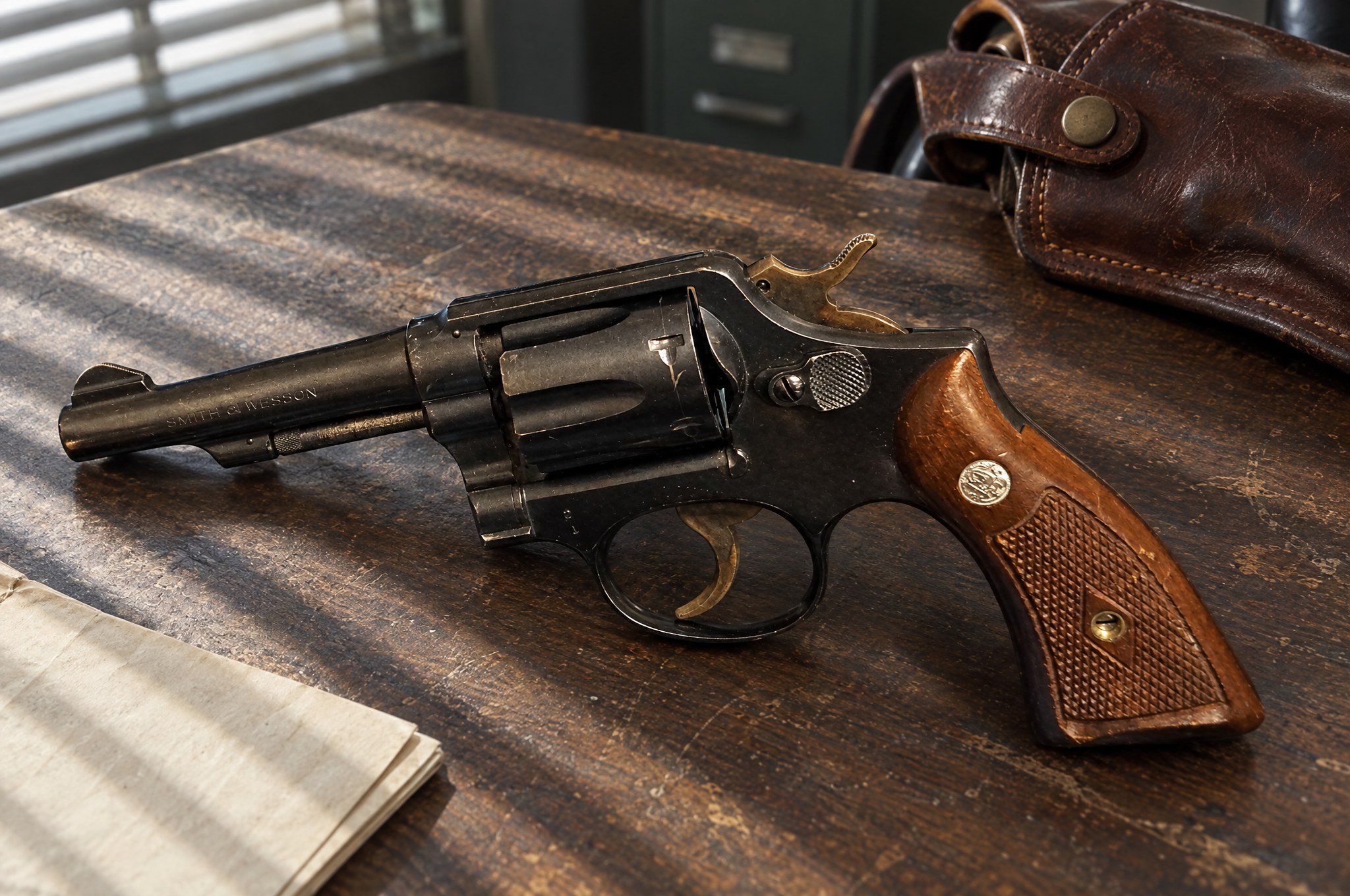
Our range gun is a 10-6, the heavy-barrel version, with a 4-inch barrel, a round butt and about 75% of its blue left after decades in a police holster. It came to us as a department trade-in with a rack number on the butt and a set of worn Magna stocks. Before we shot it we checked it like any used revolver: timing on all six chambers, endshake and the barrel-cylinder gap, which measured 0.006 in. It locked up tight.
Over two sessions we fired 300 rounds of standard-pressure .38 Special: Winchester 148-grain wadcutters, Remington UMC 158-grain lead round nose and Federal 158-grain semi-wadcutter hollow points. The double-action pull broke at 10 lb 4 oz and it’s the reason people still love these guns: smooth, even and predictable all the way through. Single action broke clean at 3 lb 8 oz. Recoil with these loads is a mild push in a 36-ounce steel gun, and the heavy barrel keeps the muzzle down.
On paper, the fixed sights did what the old police manuals promised. With 158-grain loads and a six o’clock hold, the gun shot to point of aim at 25 yards, and the lighter wadcutters printed about 2 inches low. Rested single action at 25 yards it averaged 2.1 inches for five shots with the wadcutters. Double action at 7 yards, six shots went into 1.6 inches, and at 15 yards into 2.8 inches. There were no malfunctions and nothing stuck on extraction.
| The myth | What we found | Evidence |
|---|---|---|
| “Any Model 10 can shoot +P+.” | No S&W revolver should. S&W’s manual says +P+ “must not be used in Smith & Wesson firearms.” | S&W J, K, L and N frame manual |
| “The dash number tells you the year.” | It tells you which engineering change the gun has. S&W ran tapered and heavy barrel dashes side by side, and old stock shipped for years. Only a factory letter fixes the date. | Standard Catalog of Smith & Wesson; S&W collectors |
| “Look for a pinned and recessed Model 10.” | Model 10s were pinned until about 1982, but none has a recessed cylinder. S&W recessed only magnums and rimfires. | American Rifleman |
| “Every Victory Model is Parkerized.” | Early guns were blued; most were sandblasted and Parkerized. A bright-blue “Victory” is very early, postwar or refinished. | Factory and collector records |
| “A Victory reamed to .38 Special is a bomb.” | The documented harms are bulged and split cases, sticky extraction, poor accuracy and zero collector value. Shoot .38 S&W in it if it still chambers it. | Gun Digest; Shooting Illustrated; S&W collectors |
| “A Model 10 can shoot .357 Magnum.” | Never. It’s a .38 Special. The fixed-sight .357 K-frames are the Model 13 and Model 65. | Smith & Wesson |
Who the Model 10 Is For (and Who Won’t Enjoy It)
Buy a Model 10 if you are
- A first-time revolver buyer. There’s no better place to learn a double-action trigger, and a police trade-in costs less than most new pistols.
- A collector of police or WWII arms. Department-marked trade-ins and U.S.-marked Victory Models carry real history at sane prices.
- A shooter who likes classic guns. A 4-inch Model 10 with wadcutters is a joy at 15 yards and an honest trainer for any revolver.
- Someone who wants a new classic. The no-lock Model 10 Classic is a new-production gun with a warranty and a +P rating.
Skip the Model 10 if you are
- Shopping for a concealed carry gun. A steel K-frame is big and heavy for the belt. Look at a J-frame or a modern 9mm; our .38 Special vs 9mm guide explains the trade.
- Set on .357 Magnum. The Model 10 is .38 Special only. See our .357 Magnum vs .38 Special guide and look at a Model 13, 65 or 19.
- A shooter who wants adjustable sights. Every Model 10 has fixed sights. A Model 14 or Model 15 fixes that.
- Committed to hot +P loads in an old gun. Buy a current Classic marked for +P instead.
What a Smith & Wesson Model 10 Costs in 2026
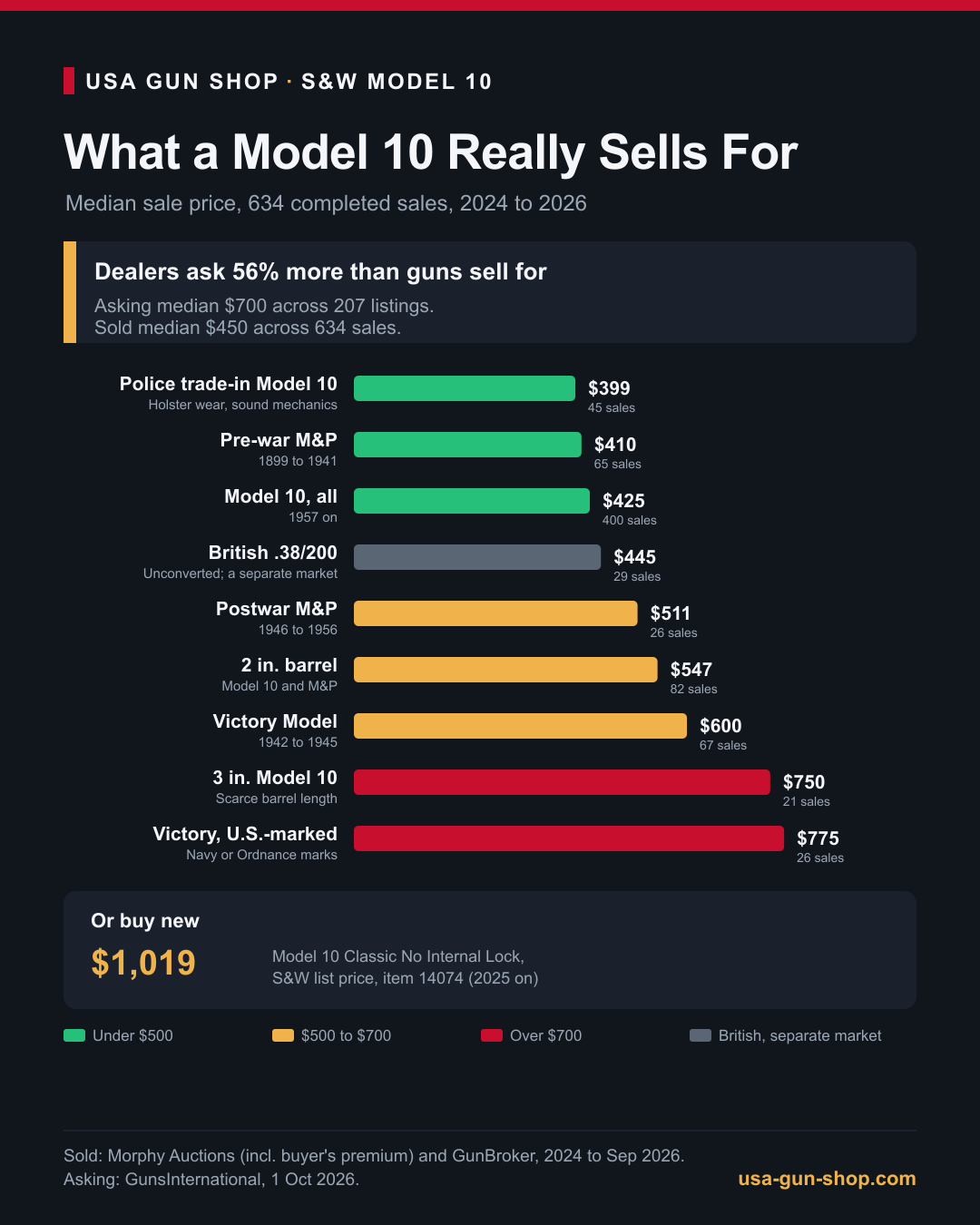
These are sale prices, not asking prices. We tracked 634 completed sales of Model 10 family revolvers: Morphy Auctions lots, which include the buyer’s premium, and GunBroker sales from October 2025 to September 2026. British .38/200 service revolvers and new Model 10 Classics sell in their own markets, so they’re counted separately below. Most GunBroker sellers don’t state a grade, so treat the condition figures as a guide.
Prices by variant and era
| Variant | Median sale | Range seen | Sales tracked |
|---|---|---|---|
| Pre-war Military and Police (1899 to 1941) | $410 | $123 to $1,792 | 65 |
| Victory Model (1942 to 1945) | $600 | $162 to $1,350 | 67 |
| Victory Model, U.S.-marked | $775 | $270 to $1,350 | 26 |
| Postwar Military and Police (1946 to 1956) | $511 | $282 to $1,151 | 26 |
| Model 10, made 1957 to 1981 | $450 | $215 to $1,124 | 58 |
| Model 10, made 1982 on | $400 | $250 to $915 | 20 |
| Police trade-in Model 10 | $399 | $200 to $1,125 | 45 |
| All Model 10 family revolvers | $450 | $123 to $1,792 | 634 |
Prices by dash number and barrel
| Dash or barrel | Median sale | Range seen | Sales tracked |
|---|---|---|---|
| 10-5 and 10-6 | $426 | $136 to $1,199 | 182 |
| 10-7 and 10-8 | $450 | $185 to $1,124 | 157 |
| 10-9 and later | $361 | $205 to $1,125 | 36 |
| 2 in. barrel | $547 | $270 to $1,476 | 82 |
| 3 in. barrel | $750 | $162 to $915 | 23 |
| 4 in. barrel | $405 | $136 to $1,285 | 278 |
| 5 in. barrel | $482 | $165 to $1,099 | 54 |
| 6 in. barrel | $461 | $123 to $737 | 33 |
A few things stand out. The 4-inch gun everybody pictures is the cheapest way in, at a $405 median. Short barrels cost more: 2-inch guns brought $547, and the 3-inch Model 10s, a heavy-barrel configuration common among Australian police trade-ins, brought a $750 median, the highest of any barrel length. Police trade-ins sell a little under other Model 10s ($399 against $430), which makes them the value buy if you check the mechanics. And U.S.-marked Victory Models with Navy or Ordnance markings sell well above the plain ones ($775 against $565).
British guns and new Classics
| Separate market | Median sale | Range seen | Sales tracked |
|---|---|---|---|
| British .38/200 service revolver, unconverted | $445 | $300 to $885 | 29 |
| New-production Model 10 Classic (sold used or new) | $643 | $380 to $965 | 12 |
Asking prices run well above what these guns sell for. On the day we checked, 207 Model 10 family revolvers were listed on GunsInternational with a $700 median, about 56% over the $450 median sale. Pre-1957 Military and Police guns showed the widest gap: an $825 asking median against $450 sold.
These are the Model 10s our dealers have listed right now. Police trade-ins are single used guns and go fast.
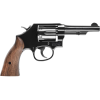
If you’d rather buy new, this is the current Model 10 Classic at our dealers:
Guns.com lists a deep selection of used Model 10s and Victory Models, with close-up photos of each gun. See every Smith & Wesson Model 10 on Guns.com
Compare other guns in the USA Gun Shop price checker, and see our guide to buying used handguns and our guide to buying vintage guns online.
Which Model 10 to Buy: The Variants
The Model 10 has worn four names in its life, and each era has its own quirks and its own market.
Early Military and Police (1899 to 1941)
S&W introduced the .38 Hand Ejector, Military and Police in 1899, its first K-frame swing-out revolver. The first Army and Navy contract guns, about 2,000 of them, were chambered for the .38 Long Colt service cartridge, and S&W brought out the longer, more powerful .38 S&W Special for the M&P. The Model of 1902 added the front lockup under the barrel, the Model of 1905 followed with its own series of changes, and the 1915 version brought the first hammer block and larger sights. These are the collector’s M&Ps, and a clean one is getting hard to find.
British Service Revolvers (.38/200)
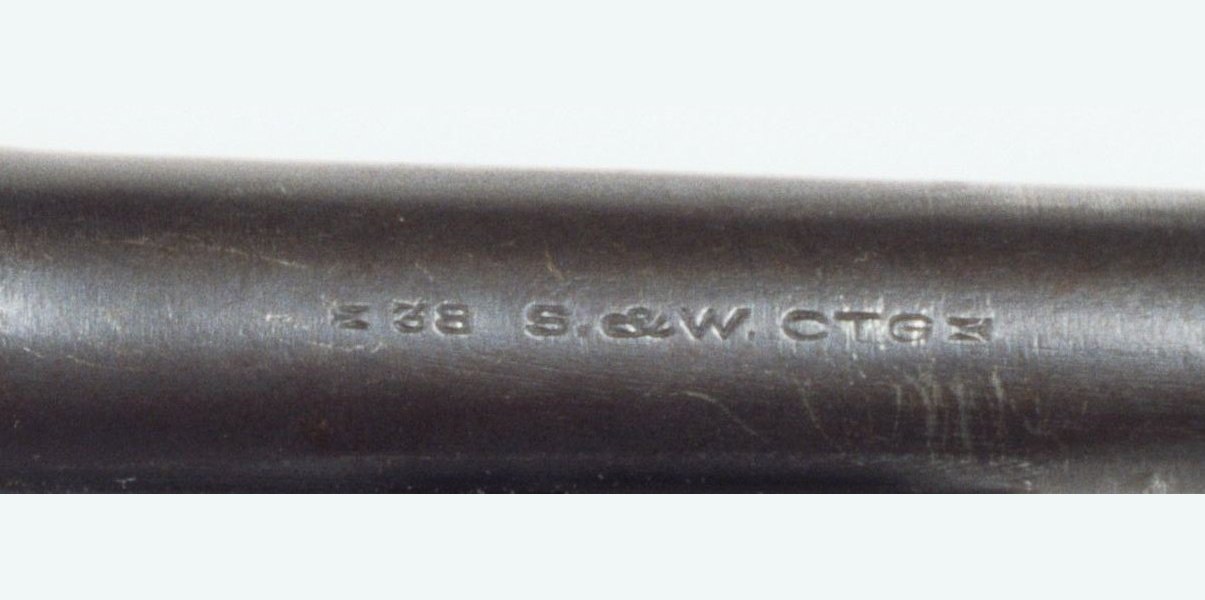
From 1940 the British bought M&Ps chambered for their .38/200 service round, which is the .38 S&W cartridge, shorter and slightly fatter than the .38 Special. Ordnance records show 590,305 delivered from October 1941 to March 1945, most with 5-inch barrels. The barrel reads “.38 S&W CTG.” An unconverted one is a real piece of history; one that’s been reamed to .38 Special is a shooter at best.
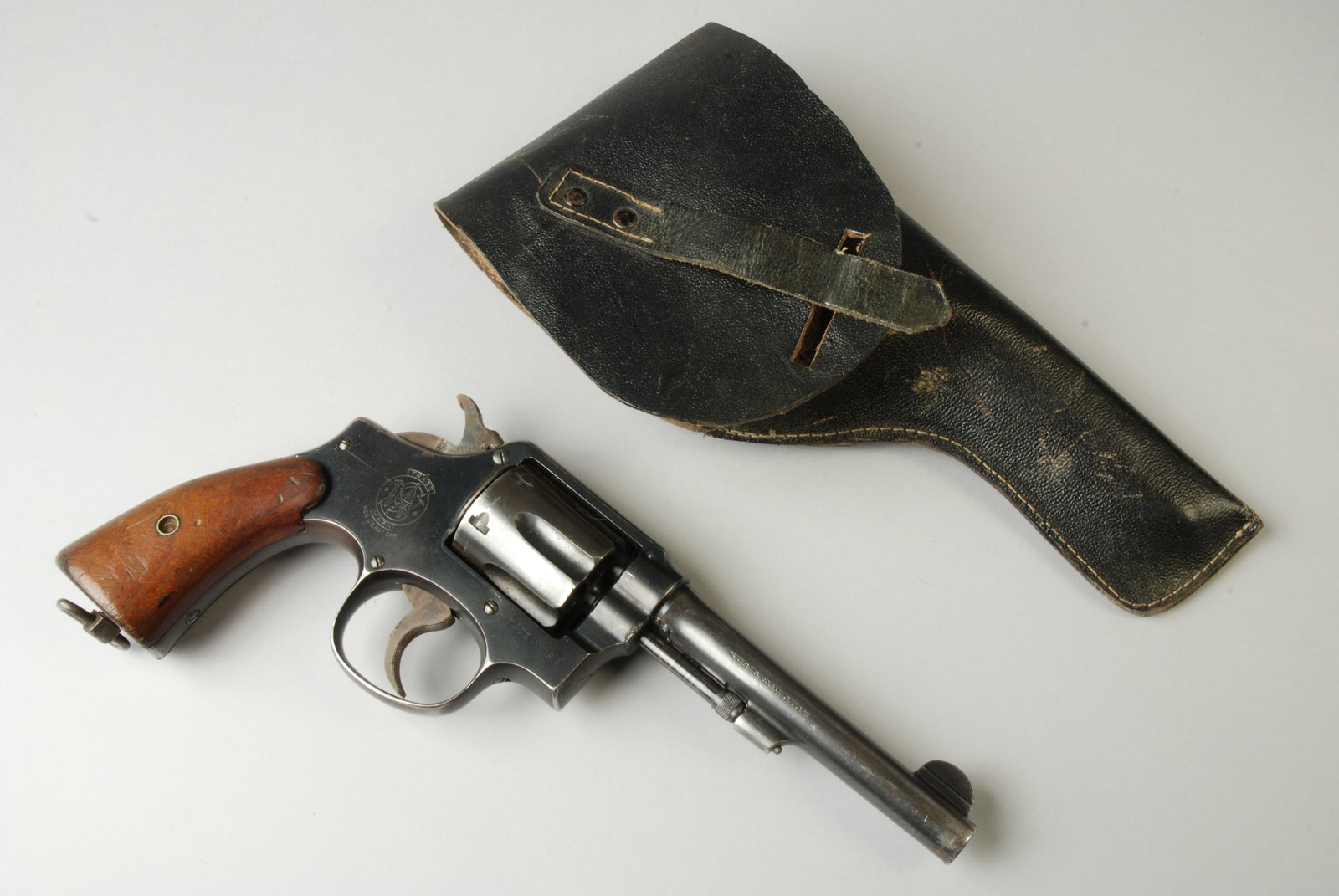
Victory Models (1942 to 1945)
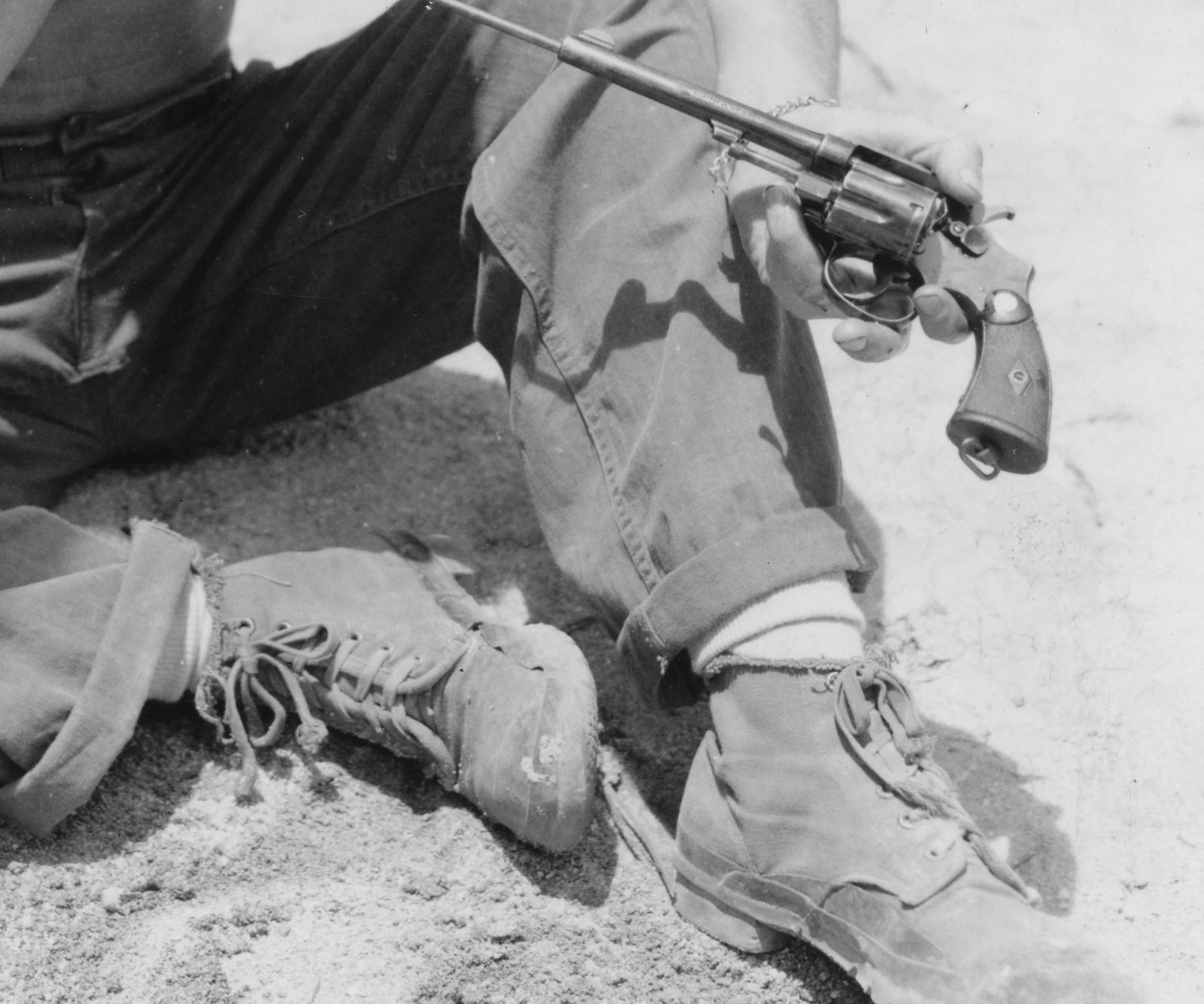
On April 24, 1942, the M&P reached serial 1,000,000 and S&W restarted the count with a “V” prefix. “Victory Model” most often means the .38 Special, 4-inch guns built on U.S. Navy, Ordnance and Defense Supplies contracts, and Ordnance records count 352,315 of them. Look for the lanyard ring on the butt, smooth walnut stocks, “U.S. Property G.H.D.” or Navy markings, and a matte finish. About 500 were made with 2-inch barrels and shipped to the OSS in August 1944, so a 2-inch Victory is almost always a cut-down 4-inch gun.
Postwar Military and Police (1946 to 1956)
After the war the M&P went back to commercial production with the improved hammer block. Serials ran with an S prefix, then a C prefix from March 1948. These are the “pre-Model 10” guns, and they’re good shooters that cost little more than a numbered gun.
Numbered Model 10s (1957 to 2001)
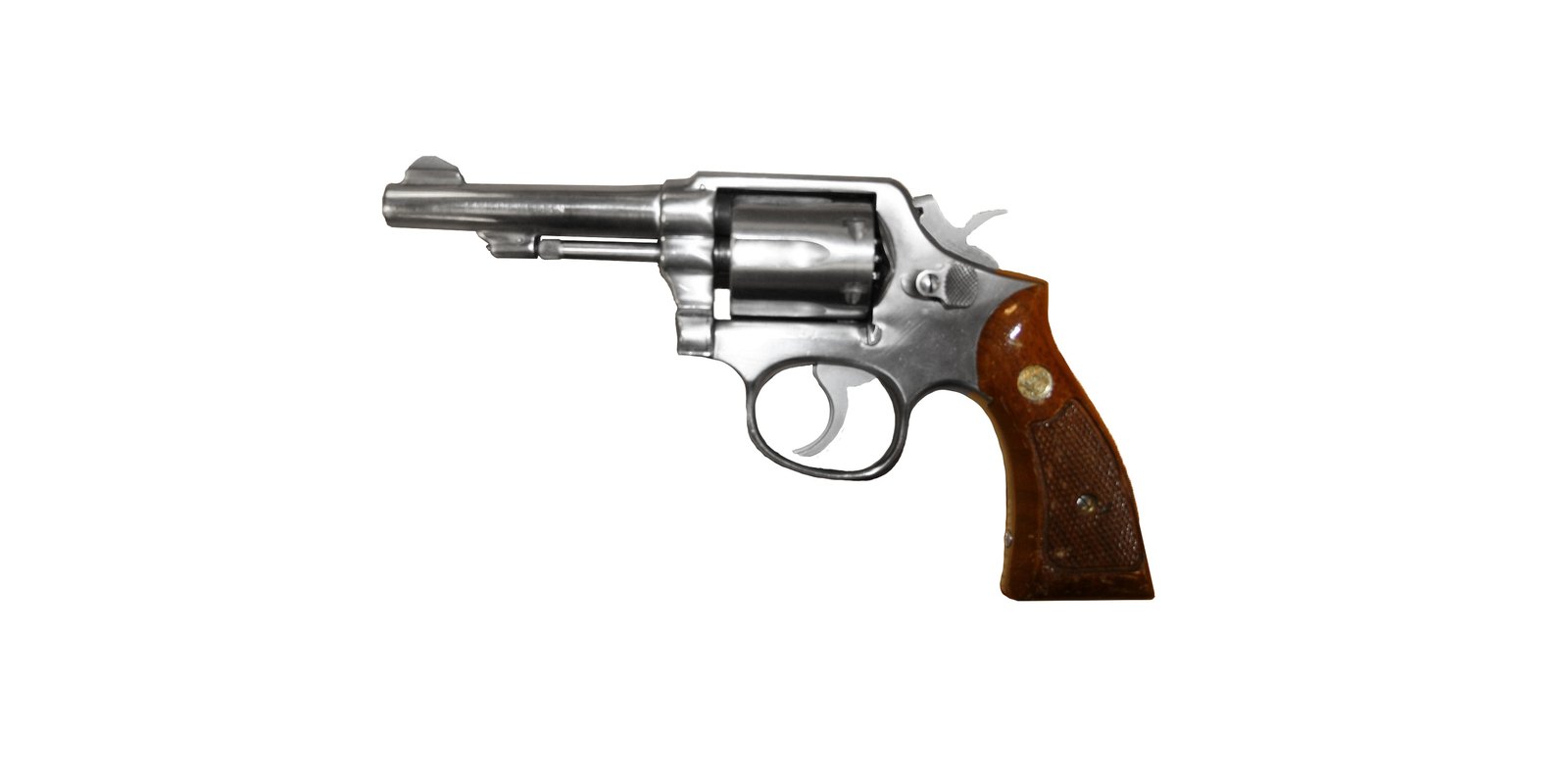
In 1957 S&W gave its revolvers model numbers, and the M&P became the Model 10, stamped in the yoke cut. The heavy-barrel version arrived in 1959, the barrels stayed pinned until about 1982, and the hammer-mounted firing pin lasted until 1997. Many of the police trade-ins on the market today are 10-5 through 10-8 guns. See the decoder below to read yours.
Police Trade-Ins
When departments switched to semi-autos, their revolvers went back to distributors by the thousands. Bud’s alone took in more than 10,000 Model 10s from Australia. Expect holster wear, often a good bore from light use, aftermarket stocks and a rack or department number stamped on the gun. Royal Hong Kong Police guns returned through S&W carry no import marks. Expect a rough finish and sound mechanics.
The Model 10 Classic (2001 to Today)
The internal key lock arrived around 2001 to 2002 on the 10-14, which later became the Classic, item 150786, now discontinued. In 2025 S&W launched the Model 10 Classic No Internal Lock, item 14074: a 4-inch tapered barrel, a half-moon front sight, walnut stocks, no lock and a +P rating, at $1,019 list. A 250th-anniversary version, item 14662, is a Rural King exclusive at $1,029. Its frame-mounted firing pin means old Model 10 action parts don’t fit.
The Siblings
The Model 64 is the stainless Model 10, from 1970. The Model 12 is the aluminum-frame M&P Airweight, not to be confused with Winchester’s Model 12 shotgun. The Model 13 is the heavy-barrel K-frame in .357 Magnum, and the Model 65 is the stainless 13. The postwar Model 11 is the M&P in .38 S&W for Commonwealth contracts.
Smith & Wesson Model 10 Condition Guide
Collectors grade a Model 10 on original finish, original stocks and matching numbers. Shooters should grade it on timing and lockup first, because a pretty revolver that spits lead isn’t worth much.
| Grade | What you see | What it does to price |
|---|---|---|
| 90%+ original | Deep original blue or bright nickel, sharp roll marks, crisp checkering on the stocks, a clean cylinder face and tight lockup | $666 median across 18 sales; a 90%+ Victory brought $840 |
| Honest holster wear | Blue worn at the muzzle and cylinder, handling marks, original stocks, mechanically tight | The bulk of the market, around the $425 to $450 medians |
| Shooter, refinished, altered or under 70% | Reblued or re-nickeled finish, pitting, a cut barrel, replaced stocks or loose timing | $350 median across 21 sales |
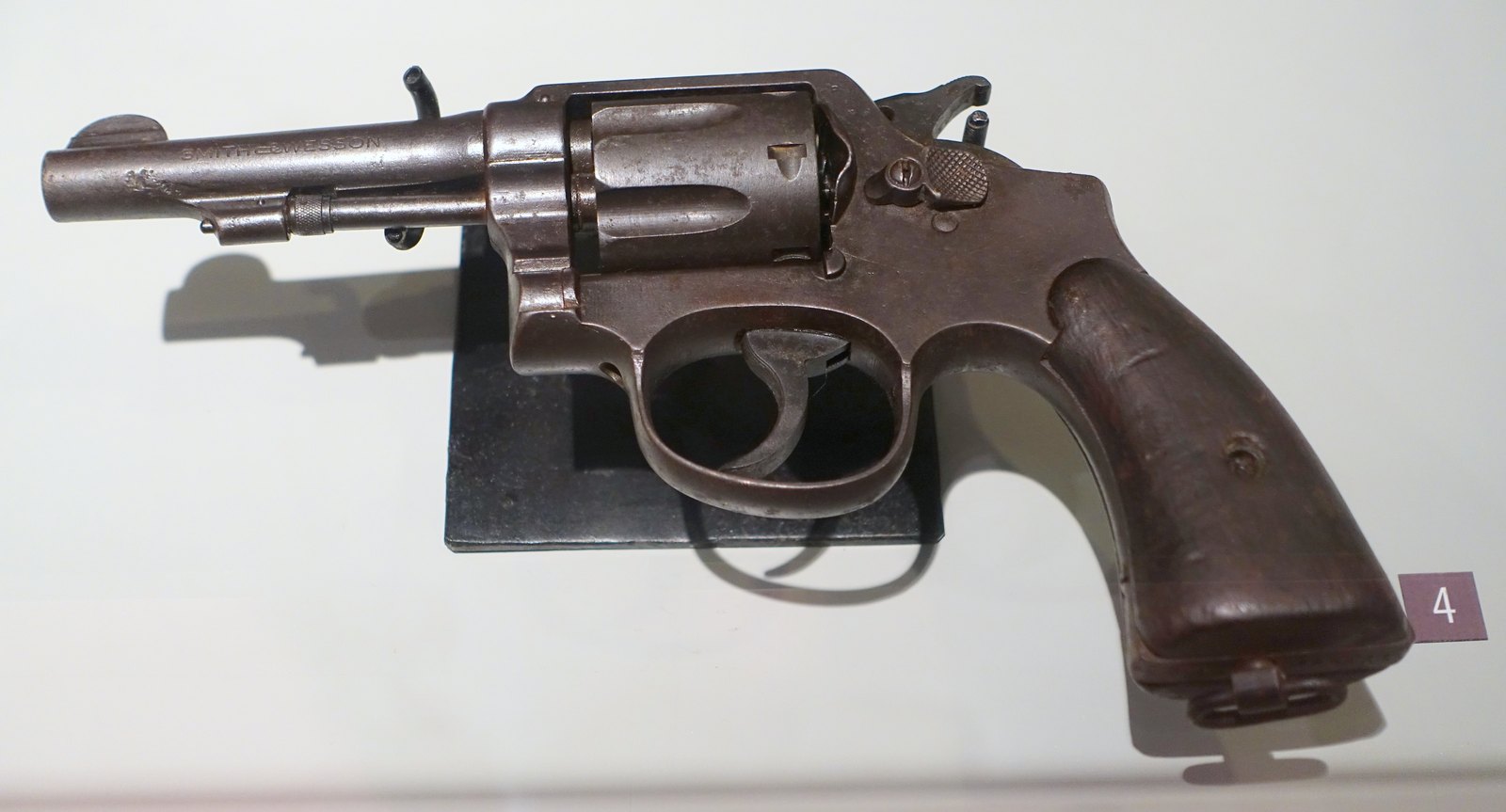
The wear points on a K-frame are timing and carry-up, endshake (the cylinder sliding front to back), the barrel-cylinder gap, erosion of the forcing cone, holster wear at the muzzle and cylinder, flaking nickel and buggered sideplate screws. A reblue shows itself in washed-out roll marks, rounded edges and a sideplate line you can see too clearly. Replaced stocks and police rack numbers aren’t faults, but they move the price.
Model 10 Markings, Serial Numbers and Dash Numbers
Open the cylinder and look in the yoke cut, the slot in the frame behind the crane. That’s where S&W stamped the model and dash number from 1957. The serial of record is on the butt. On pre-war and wartime guns it’s also on the barrel and cylinder, and those should match; the numbers in the yoke cut on an older gun are assembly numbers, not the serial.
Here’s the decoder. Each dash marks an engineering change, and S&W ran the tapered and heavy barrel versions side by side:
| Dash | Adopted | What changed | Barrel |
|---|---|---|---|
| 10 (no dash) | 1957 | Model number stamped in the yoke cut; 4-screw frame | Tapered |
| 10-1 | 1959 | Heavy barrel introduced | Heavy |
| 10-2 | 1961 | Ejector-rod thread changed | Tapered |
| 10-3 | 1961 | Ejector-rod thread changed; wider front sight | Heavy |
| 10-4 | 1962 | Trigger-guard screw dropped (3-screw frame) | Tapered |
| 10-5 | 1962 | Front sight widened from 1/10 to 1/8 in. | Tapered |
| 10-6 | 1962 | Trigger-guard screw dropped | Heavy |
| 10-7 | 1977 | Gas ring moved from the yoke to the cylinder | Tapered |
| 10-8 | 1977 | Gas ring moved from the yoke to the cylinder | Heavy |
| 10-9 | 1988 | New yoke retention, floating hand, hammer-nose bushing | Tapered |
| 10-10 | 1988 | Same changes as the 10-9 | Heavy |
| 10-11 | 1997 | MIM hammer and trigger, frame-mounted firing pin | Tapered |
| 10-12 | 1997 | Same changes as the 10-11 | Heavy |
| 10-13 | 2002 | Limited 1899 commemorative | Special |
| 10-14 | 2001 to 2002 | Internal key lock; later the Classic, item 150786 | Varies |
| 10-15 | 2025 | Model 10 Classic with no internal lock | Tapered |
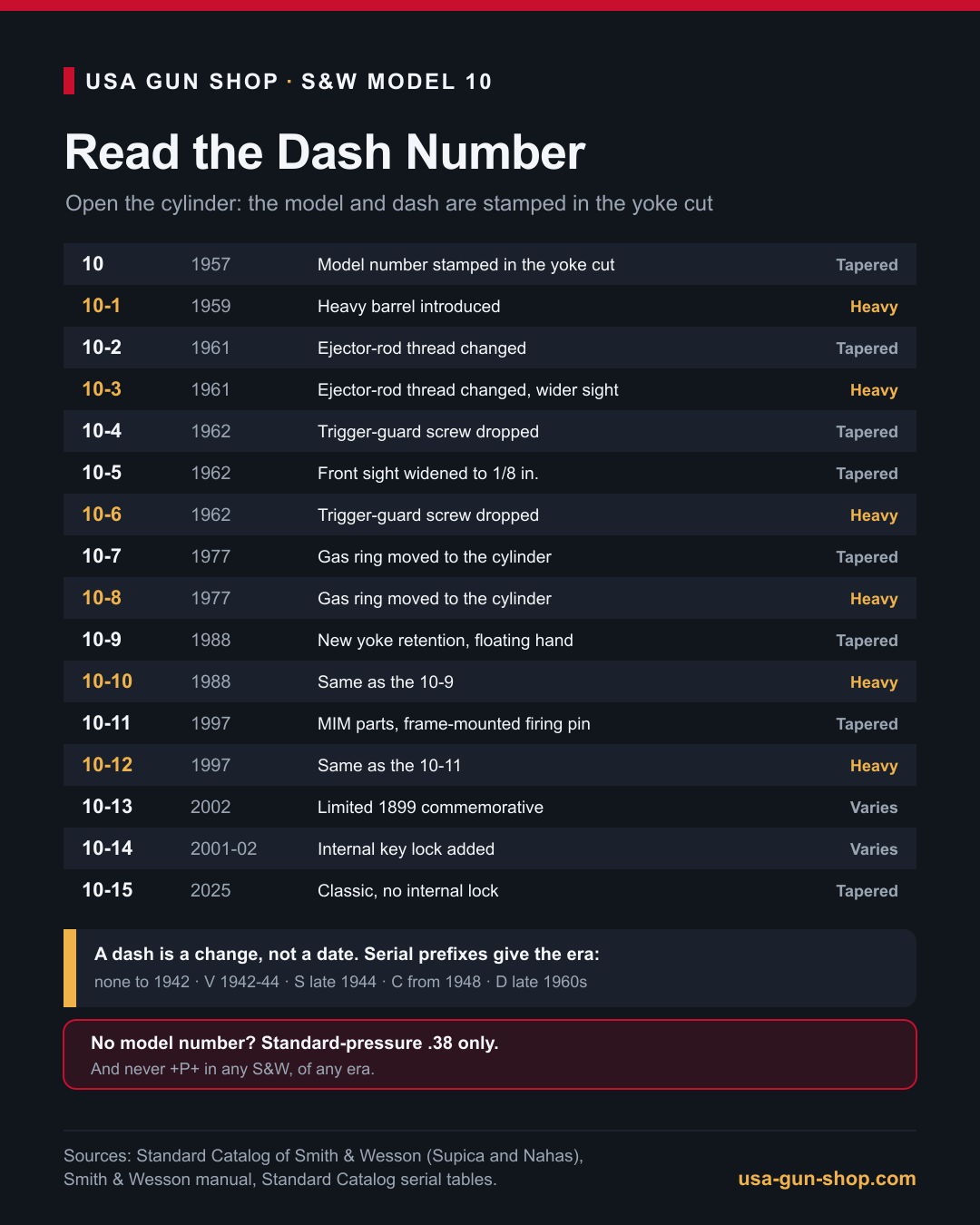
Three cautions. First, a dash tells you the change, not the year. Old stock shipped for years, so a no-dash gun can ship in 1959 and a 10-5 in 1977. Second, the barrel pin was dropped around 1982, a change no Model 10 dash records. Third, serial tables give ship dates. Serial prefixes give you the era: no prefix to April 1942, V for the Victory years, S from late 1944, C from March 1948, D from the late 1960s and three letters plus four digits from the early 1980s. For the exact story, order a factory letter from the Smith & Wesson Historical Foundation, which took over the letter service in 2016. It costs $100, or $75 to $90 for members, and tells you the ship date, the distributor and the original configuration.
Fakes, Conversions and Refinishes
Nobody fakes a standard Model 10. The traps are conversions and dressed-up guns, and they concentrate in the Victory and British guns, where the money is:
- British .38/200 guns reamed to .38 Special. Many came back to the U.S. after the war and were rechambered, often with cut barrels and a refinish. Tells: a “.38 S&W CTG” barrel stamp on a gun that takes .38 Special, British proof marks, a plugged lanyard hole, a commercial reblue or nickel, a “CAL. 38 SPECIAL” re-stamp and fired cases that come out bulged. These guns have no collector value.
- Cut-down “2-inch Victories.” Only about 500 left the factory, for the OSS. A cut 4-inch gun shows missing barrel lettering and a replaced front sight.
- Refinished “Victories.” Bright blue on a V-serial gun means very early production or a refinish. Arsenal-refinished guns are honest history but sell as non-original.
- Mismatched parts. On older guns, check that the barrel, cylinder and butt serials match.
- A Victory that’s really a British gun. Read the barrel. “.38 S&W SPECIAL CTG” and U.S. markings make it a U.S. Victory; “.38 S&W CTG” makes it British.
Smith & Wesson Model 10 Pre-Purchase Inspection Checklist
Here’s the check we run on every used Model 10 before we pay, with the cylinder open and empty:
- Open the cylinder and read the yoke cut: “MOD. 10-x” or nothing at all on a pre-1957 gun. Match it to the barrel profile with the decoder.
- Find the serial on the butt and, on older guns, on the barrel and cylinder. They should match.
- Check timing: thumb-cock slowly on all six chambers. The cylinder stop must drop into each notch before the hammer cocks. Repeat in double action.
- Check lockup: with the hammer back, feel for rotational play and front-to-back endshake.
- Measure the barrel-cylinder gap with feeler gauges. Tighter is better; anything past about 0.012 in. is worth a gunsmith’s opinion.
- Look at the bore and forcing cone for erosion, rings and pitting, and the muzzle crown for dings.
- Check the firing pin: on pre-1997 guns the hammer-nose pin should be intact; on later guns the frame pin should protrude on dry fire with a snap cap.
- On a Victory or British gun, read the barrel stamp and check for British proofs. A gun marked “.38 S&W CTG” that takes a .38 Special case has been reamed.
- Check the serial for the drop-safety era: a gun made before about serial 769,000 (late 1944) has the old hammer block.
- Look for refinish tells: washed roll marks, rounded edges, a prominent sideplate line, flaking nickel.
- Check the stocks: correct for the era, numbered on older guns, not cracked at the top of the frame.
- Ask for paperwork: a factory letter, a department letter, the box, and import marks on trade-ins.
Shooting and Caring for a Vintage Model 10
Ammunition is where the online advice goes wrong, so here’s what S&W has actually said. Its current manual says +P “may affect the wear characteristics and may result in the need for more frequent service,” and that +P+ “must not be used in Smith & Wesson firearms,” in any era. For numbered guns, a 1976 factory reply printed in American Rifleman said .38 Special guns with a model number stamped in the yoke cut are designed to fire all commercial .38 Special, including +P, though frequent +P shortens the life of aluminum-frame guns. We’ve only seen that reply quoted by collectors, not the magazine itself, and it doesn’t cover the pre-1957 guns with no model number. The current Classic is marked and rated for +P.
| Gun | What to feed it |
|---|---|
| Pre-1957 M&P and Victory (no model number) | Standard-pressure .38 Special only; 148-grain wadcutters and 158-grain lead are ideal |
| Numbered Model 10 (1957 on, steel frame) | Standard pressure for a steady diet; occasional +P per S&W’s 1976 reply, at the cost of wear |
| Model 10 Classic marked +P | +P rated |
| British .38/200, unconverted | .38 S&W only |
| British .38/200 reamed to .38 Special | .38 S&W if it still chambers it; otherwise mild standard-pressure .38 Special after a gunsmith check |
| Any S&W revolver | Never +P+ |
One more rule nobody tells new owners. During the war, a sailor was killed when a dropped, loaded Victory Model fired, and Navy tests found the old hammer block unsatisfactory. S&W redesigned it, and guns with the improved block were in production by early 1945, from about serial 769,000, when the prefix changed from V to VS. On any M&P made before that, load five and rest the hammer on the empty chamber.
These standard-pressure .38 Special loads are on sale at our dealers right now. We filter out +P, hollow points and hot loads.
Standard-Pressure .38 Special Deals for a Model 10
On-sale 38 special standard from 200+ retailers · Updated every 4 hours


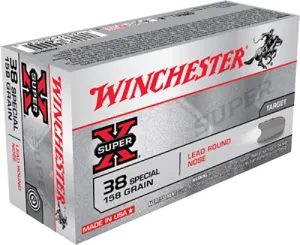
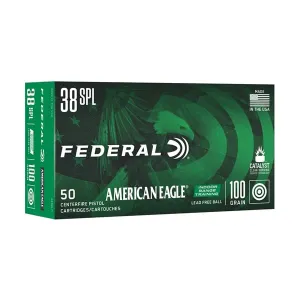

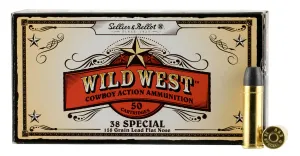
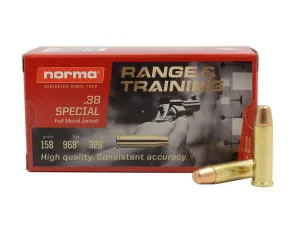


For care, keep the cylinder face and forcing cone clean, don’t snap the hammer on an empty chamber without a snap cap, and leave action work to a gunsmith who knows K-frames. For more loads, see our best .38 Special ammo guide.
A Short History of the Smith & Wesson Model 10
S&W’s 1899 Military and Police was its first K-frame swing-out revolver and the first M&P. The Navy took 1,000 in 1900 and the Army 1,000 in 1901, chambered for the .38 Long Colt service round, and S&W introduced the more powerful .38 S&W Special with the M&P around 1899 (some references say 1902). The cartridge and the gun grew up together. By April 24, 1942, about a million had been made.
World War II changed everything. The British bought more than half a million .38/200 revolvers, and the Victory Model armed U.S. Navy and Marine aviators, among others. Many aviators preferred the lighter revolver to the .45. After a sailor died when a dropped Victory fired, S&W and Ordnance designed the improved hammer block that’s been in the gun ever since. The last Victory, serial VS811119, was made in April 1945.
After the war the M&P became the standard American police revolver for decades. S&W claims that by 1960 an estimated 85% of the world’s police officers carried a .38 M&P. It got its model number in 1957, a heavy barrel in 1959 and a long list of engineering changes after that. The NYPD approved it, Detroit carried 5-inch guns, and the New York State Police eventually replaced theirs with the .357 Model 13. Victoria Police in Australia carried revolvers until 2010 and Hong Kong Police until 2024, which is why so many trade-ins still come onto the market.
The internal lock arrived around 2001 to 2002, and in 2025 S&W took it back out with the no-lock Model 10 Classic. More than 6 million later, it’s still in the catalog.
Why the Model 10 Is Still So Popular
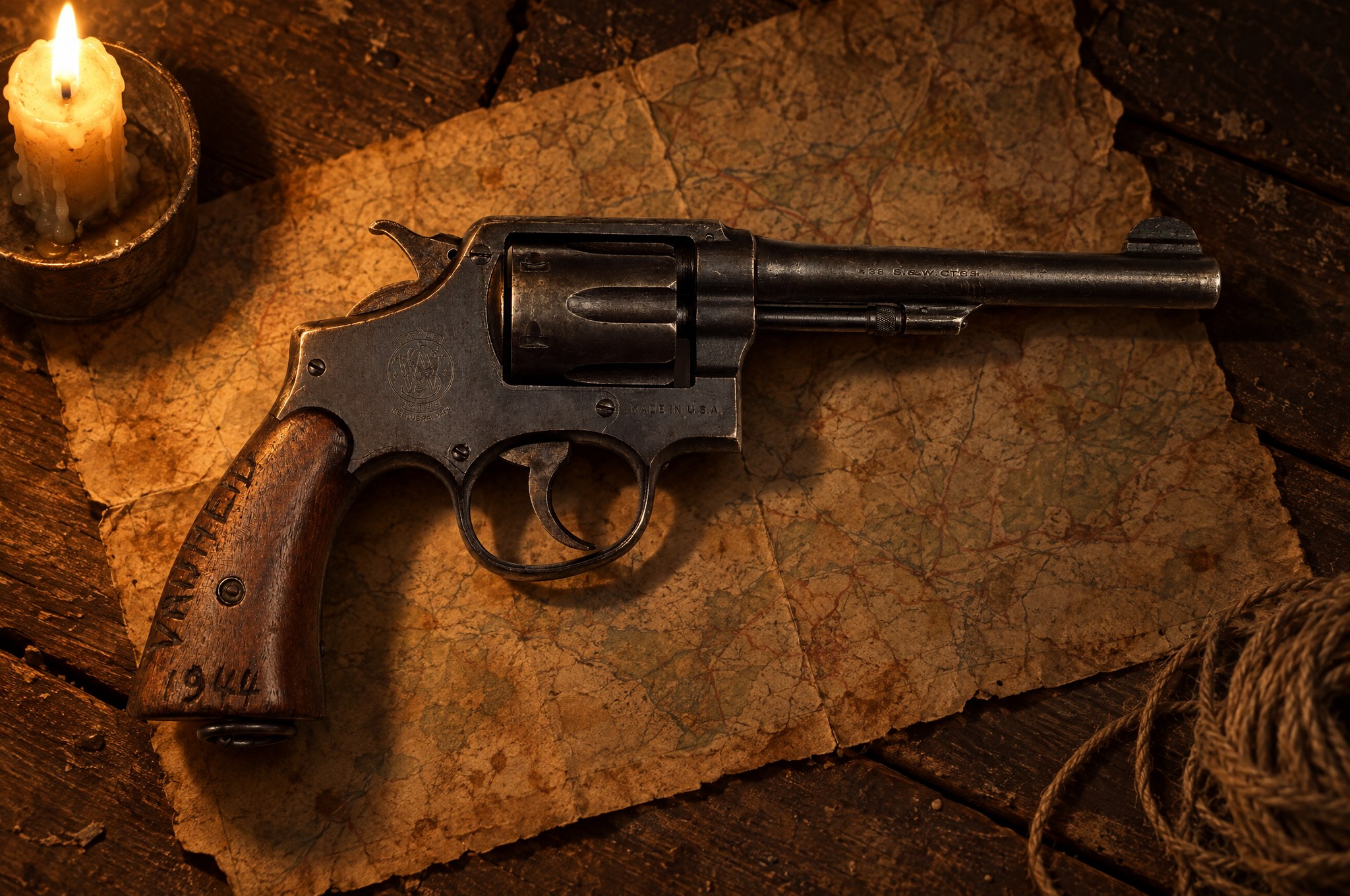
Part of it is the trigger. A good K-frame double-action pull is the standard every other revolver gets measured against, and the Model 10 has it at a price people can still pay. Part of it is history: this is the gun of the beat cop, the WWII aviator and the night watchman. And part of it is Hollywood. John Wayne carried one in McQ (1974), and Harrison Ford carried a Model 10 snub in Witness (1985).
It’s also simply honest. Six rounds of .38 Special, fixed sights that hit where they look, and a steel frame that’ll outlast its owner. For a first revolver, a fun range gun or a piece of police history, it’s hard to beat. See where it sits among our best .38 Special revolvers and our classic revolvers.
Model 10 Legal Status: C&R and Antiques
Under 27 CFR 478.11, a firearm made at least 50 years ago is a curio or relic, so every Military and Police, Victory Model and Model 10 made before about October 1976 qualifies, and the line moves forward every year. ATF’s C&R list also names the early guns directly: the “.38 Hand Ejector Military and Police” with serials 1 to 241,703. Because serial tables give ship dates, a factory letter settles any gun near the line.
No Model 10 is a federal antique firearm. That requires manufacture in or before 1898, and the M&P was introduced in 1899. State law may treat these guns differently, so check yours, especially in states with handgun rosters. One naming trap: the WWII revolver isn’t the SW22 Victory .22 pistol S&W sells today.
Where to Buy a Smith & Wesson Model 10
- Guns.com. A deep used selection with detailed photos. Browse Model 10s on Guns.com.
- Police trade-in importers and dealers. Lots come in batches; our price cards above show what’s listed today.
- Auction houses. The place for lettered Victory Models and early M&Ps, but expect a buyer’s premium on top of the hammer price.
- GunBroker and gun shows. The widest choice of shooters; inspect in person when you can.
- New from S&W dealers. The Model 10 Classic, if you want a new gun with a warranty.
Wherever you buy, ask the same questions before you pay:
- What does the yoke cut say, and what’s the serial?
- Does the timing hold on all six chambers?
- Is the finish original, and are the stocks correct?
- For a Victory or British gun, what does the barrel say, and has it been reamed?
- Can I return it if it isn’t as described?
Smith & Wesson Model 10 vs. Its Rivals
| Revolver | Caliber | Why you’d pick it |
|---|---|---|
| S&W Model 10 | .38 Special | The classic fixed-sight K-frame; cheapest way into a great trigger |
| S&W Model 64 | .38 Special | The same gun in stainless; tougher finish |
| S&W Model 13 and 65 | .357 Magnum | Fixed-sight K-frame magnums, blued and stainless |
| S&W Model 19 | .357 Magnum | The adjustable-sight K-frame magnum |
| Colt Detective Special | .38 Special | Colt’s six-shot snub on a smaller frame |
Model 10 vs. the Colt Detective Special
The Colt Detective Special is the snub-nose people compared against the 2-inch Model 10 for decades. The Colt is smaller and lighter on its D frame; the Model 10 is easier to shoot well and cheaper to buy. If you want a carry snub, the Colt makes more sense. If you want one revolver for the range and the nightstand, the Model 10 does.
Final Verdict
The Smith & Wesson Model 10 is still the best way into a great double-action revolver for the money. Buy a numbered Model 10 or a sound police trade-in to shoot, pay extra for a 3-inch heavy barrel, a 2-inch or a U.S.-marked Victory if you collect, and walk away from any British .38/200 that’s been reamed to .38 Special. Feed the old guns standard-pressure .38 Special, load five in anything made before late 1944, and never put +P+ in any of them.
More than 6 million made, 127 years in production and still in the catalog. That’s the definition of a classic.
FAQ
How much is a Smith and Wesson Model 10 worth?
In 634 completed sales from January 2024 to September 2026, the median Model 10 family revolver sold for about $450. Numbered Model 10s had a median of about $425, police trade-ins $399, pre-1957 Military and Police revolvers $450 and Victory Models $600, with U.S.-marked Victories at $775. Guns with 90% or more of their finish brought a median $666. Dealer asking prices run well above that, at a $700 median.
Can a Smith and Wesson Model 10 shoot +P ammo?
It depends on the era. S&W says never use +P+ in any of its firearms. The current Model 10 Classic is marked and rated for +P. For numbered Model 10s made from 1957 on, a 1976 S&W reply printed in American Rifleman said guns with a model number in the yoke cut can fire +P, though it adds wear. Pre-1957 Military and Police revolvers and Victory Models should get standard-pressure .38 Special only.
How do I date a Smith and Wesson Model 10?
Open the cylinder and read the model and dash number in the yoke cut, then check the serial on the butt. The dash tells you which engineering change the gun has, and the serial prefix gives the era: V for the Victory years, S from late 1944, C from March 1948, D from the late 1960s. Serial tables give ship dates, so for the exact date and configuration, order a factory letter from the Smith and Wesson Historical Foundation.
Does Smith and Wesson still make the Model 10?
Yes. In 2025 S&W launched the Model 10 Classic No Internal Lock, item 14074, with a 4-inch tapered barrel, walnut stocks and a +P rating, at $1,019 list. The earlier Classic with the internal lock, item 150786, is discontinued.
What is a Smith and Wesson Victory Model worth?
In our data, Victory Models sold for a median of about $600, and U.S.-marked guns with Navy or Ordnance markings brought about $775. British .38/200 service revolvers are a separate market at about $445 unconverted. A British gun that has been reamed to .38 Special has no collector value.
Is it safe to shoot a Victory Model converted to .38 Special?
Have a gunsmith check it first. The reamed chambers are oversized, so fired cases bulge and can split, extraction gets sticky and accuracy suffers. If it still chambers .38 S&W, shoot .38 S&W. Otherwise use mild standard-pressure .38 Special and never +P.
Are police trade-in Model 10s worth buying?
Most are worth it. They have rough finishes from holster wear but sound mechanics and good bores. In our data they sold for a median of about $399. Check the timing on all six chambers, the endshake and the barrel-cylinder gap before you buy.
What does pinned and recessed mean on a Model 10?
Pinned means a cross pin through the frame locks the barrel; S&W pinned Model 10 barrels until about 1982. Recessed means the cylinder counterbores cover the cartridge rims, which S&W did only on magnums and rimfires. So a Model 10 can be pinned but is never recessed.
5,513+ Gun & Ammo Deals
Updated daily from 200+ top retailers. Filter by category, caliber, action type, and price.