

Last updated September 2026
Some of the links below are affiliate links, meaning at no additional cost to you, we may earn a commission if you click through and make a purchase.
- Treat every gun as loaded
- Point the muzzle in a safe direction
- Keep your finger off the trigger until you’re ready to shoot
- Know your target and what’s beyond
Winchester called the Model 12 “The Perfect Repeater,” and for half a century a lot of American shooters agreed. It was the pump shotgun in duck blinds, on trap lines and in patrol cars, and in World War II about 80,000 went to the Marines, the Army Air Forces and the Navy. Winchester built nearly 2 million, mostly between 1912 and 1964, with machined steel and hand fitting that no modern pump at its price can match. A good one still runs like glass.
It also comes with rules that catch new owners out. Early 16 and 20 gauges have short chambers, there’s no trigger disconnector, so it will slam-fire, and no manufacturer approves steel shot in its old fixed chokes. This guide covers all of that, with 263 completed sales broken down by gauge, era and condition, how to tell a real trench gun from an assembled one, and a morning on the trap field with a 1954 field gun.
Quick take
A pre-1964 Model 12 is one of the best pump shotguns ever built and still a sensible hunting gun. Buy a 12 gauge field gun to shoot, a 20, 16 or 28 gauge if you want the collector’s gauges, and be very skeptical of trench guns. Measure the chamber on any pre-1927 gun and keep steel shot out of fixed chokes.
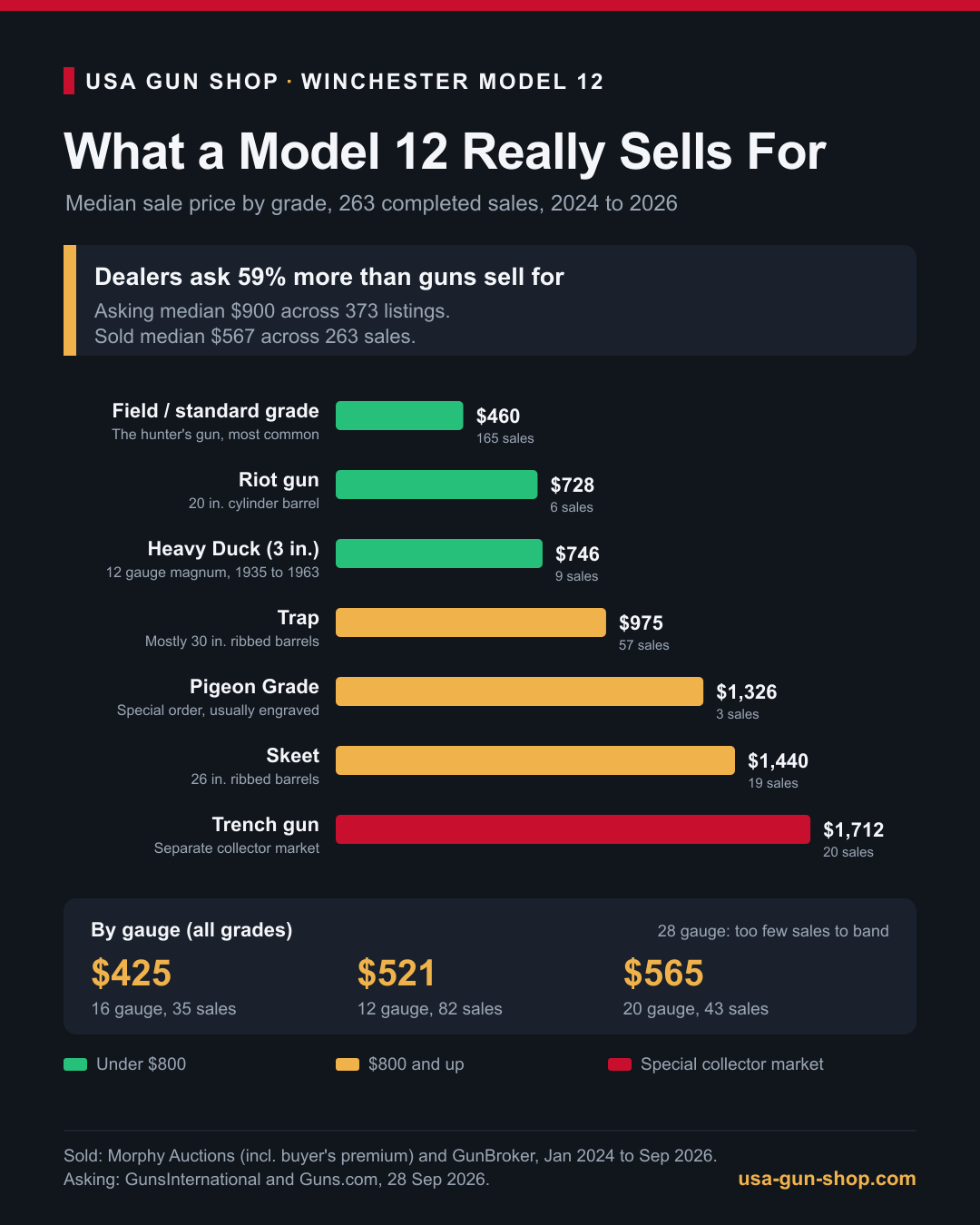
- Typical price (2024 to 2026 sales): about $567 median across 263 sales; about $460 for a field gun, $975 for a Trap gun and $1,440 for a Skeet gun
- Gauges: 20 (1912), 12 and 16 (late 1913), 28 (1934); 3 in. Heavy Duck 12 from 1935
- Made: 1912 to 1964 in New Haven, a 1972 to 1979 Y-series run, and Japanese-made limited editions from 1988
- Legal: ATF lists Model 12s made 1912 through 1963 as curios or relics
How we tested: Every pick here is ranked against our testing methodology. Minimum round counts, accuracy and reliability protocols, the failures that disqualify a gun.
Winchester Model 12 Pros and Cons
Pros
- Machined steel, hand-fitted, built to last
- Smoothest pump action of its era
- Takedown design breaks down in seconds
- Pre-1964 guns are curios and relics
- Plenty of 12 gauge field guns affordable
Cons
- No disconnector, so it will slam-fire
- Early 16 and 20 gauges have short chambers
- No steel shot through fixed chokes
- Fake trench and riot guns are common
- 28 gauge guns cost serious money
- Heavier than modern pumps
Winchester Model 12 at a Glance
| Spec | Winchester Model 12 |
|---|---|
| Action | Hammerless slide action with a tilting breechblock; takedown; no trigger disconnector |
| Gauges | 20 (1912), 12 and 16 (late 1913), 28 (1934); no .410 (that was the Model 42) |
| Chambers | 2-3/4 in. from September 1926; earlier 20 gauges 2-1/2 in. and 16 gauges 2-9/16 in.; 3 in. on the Heavy Duck |
| Capacity | Six folded-crimp 12 gauge shells in the magazine plus one chambered (five with rolled crimps) |
| Barrels | 20 in. (riot and trench) to 30 in., with 32 in. on special order until about 1948 |
| Weight | 20 gauge about 5-3/4 lb, 16 gauge about 6 lb, 12 gauge about 7-1/4 lb |
| Designer | Thomas Crossley Johnson, Winchester |
| Made | 1912 to 1964 (clean-up to 1966), 1972 to 1979, Japanese limited editions from 1988; nearly 2 million |
| Legal | Curio or relic (1912 to 1963 guns listed by ATF); never an antique |
Table of Contents
What a Model 12 Is Actually Like to Shoot: Myth vs. Truth
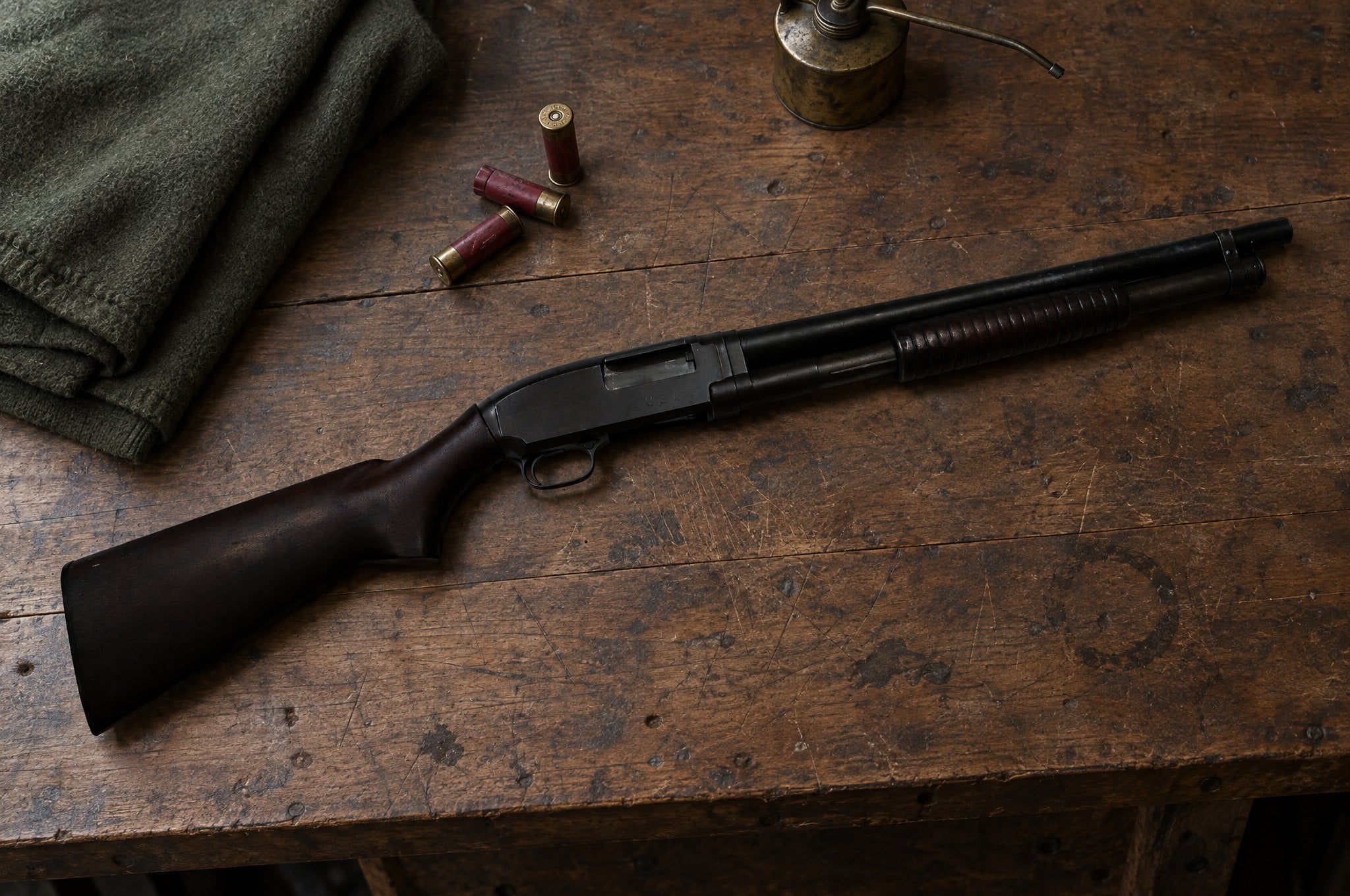
Our range gun is a 1954 12 gauge field gun, serial in the 1,43x,xxx range, with a 28-inch plain barrel choked Modified, its original stock and forearm, and about 80% of its blue. At 1954 it has 2-3/4 in. chambers, which we confirmed before buying a shell. We tightened the takedown joint one notch on the adjusting sleeve, cleaned out old grease from the action, and checked the safety and action release.
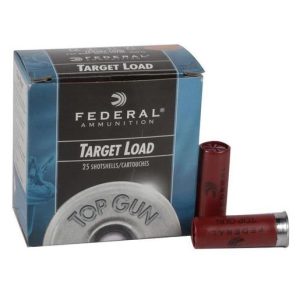
Over two sessions we fired 250 shells: Winchester AA 1 oz, Remington Gun Club 1-1/8 oz and Federal Top Gun 1-1/8 oz, all 2-3/4 in. and all lead. The action is the reason people love these guns. It’s slick, short and precise, and after a hundred rounds it felt smoother still. Recoil with 1-1/8 oz loads was a firm push, noticeably softer than a light modern pump with the same shells, thanks to the Model 12’s 7 lb 8 oz of steel. The trigger broke at 5 lb 2 oz with a little creep.
We shot trap and patterned the gun. From the 16-yard line we broke 22 of 25 and 21 of 25 with the AA loads, and at 40 yards the Modified barrel averaged 58% of its Federal 1-1/8 oz #8 pellets in a 30-inch circle, right in Modified’s range. There were no malfunctions, though the first shell in the magazine needs a thumb on it or it pops back out of the loading gate, which is a Model 12 habit, not a fault.
The one thing every new owner has to learn: the Model 12 has no trigger disconnector. Hold the trigger down and pump, and it fires every time the action closes. Collectors call it slam-fire. It’s how the gun was built, not a defect, but it means you keep your finger off the trigger while you work the slide, every time.
| The myth | What we found | Evidence |
|---|---|---|
| “If a 2-3/4 in. shell chambers, it’s safe.” | Not on an early gun. Winchester lengthened 16 and 20 gauge chambers only in September 1926. Measure any pre-1927 gun. | Winchester historian; Wikipedia warns a chambered shell “should never be taken as an indication” |
| “Steel shot is fine in a Model 12.” | No manufacturer approves steel in a vintage fixed choke. Use bismuth. | Winchester’s steel approval covers current guns only; Browning warns of ring bulges in older fixed chokes |
| “Slam-fire makes it a better defense gun.” | It’s a design trait, not a feature. A 60-to-110-year-old action isn’t a defense gun. | Winchester added a disconnector to the Model 1200 that replaced it |
| “Some Model 12s had Damascus barrels.” | No. They were nickel steel, stainless (rare) or Winchester Proof Steel. A “Damascus” Model 12 barrel is a reason to walk away. | Winchester’s own 1912 advertising stressed nickel steel |
| “20,000 Model 12 trench guns served in WWI.” | That’s the Model 1897’s number. Model 12 purchases in WWI were small. | American Rifleman; the 19,196 figure is the M97 order |
| “John Browning designed it.” | Winchester’s T.C. Johnson did, building on the layout of Browning’s Model 1897. | Every serious history credits Johnson |
Who the Model 12 Is For (and Who Won’t Enjoy It)
Buy a Model 12 if you are
- A bird hunter who wants a classic pump. A 12 gauge field gun with lead or bismuth loads is as good as it ever was.
- A trap or skeet shooter who likes vintage guns. Trap and skeet grades were built for it, and the action is fast and smooth.
- A collector. Four gauges, a dozen grades, trench and riot guns and a 60-year run give you plenty to hunt for.
- A C&R license holder. ATF lists every Model 12 made from 1912 through 1963.
- Someone who inherited one. This guide tells you what you have and how to shoot it safely.
Skip the Model 12 if you are
- A waterfowler shooting steel. Buy a modern gun with steel-rated tubes from our best duck hunting shotguns list.
- Looking for a home defense shotgun. Buy a modern pump with a disconnector and parts support, such as an Ithaca 37 or 870.
- On a tight budget. A used Remington 870 Wingmaster shoots almost as well for less.
- Chasing a trench gun without expertise. Most on the market are assembled or faked. Buy one only with an expert’s opinion.
What a Winchester Model 12 Costs in 2026
These are sale prices, not asking prices. We tracked 263 completed Model 12 sales from January 2024 to September 2026: 86 Morphy Auctions lots, which include the buyer’s premium, and 177 GunBroker sales. Trench guns, engraved guns and commemoratives sell in their own collector market, so they’re counted separately below. Most GunBroker sellers don’t state a grade, so read the condition figures as a guide, not a price list.
Prices by grade
| Model or grade | Median sale | Range seen | Sales tracked |
|---|---|---|---|
| Field / standard grade | $460 | $123 to $4,800 | 165 |
| Riot gun | $728 | $523 to $2,880 | 6 |
| Heavy Duck (3 in.) | $746 | $520 to $2,500 | 9 |
| Trap | $975 | $204 to $3,025 | 57 |
| Pigeon Grade | $1,326 | $1,320 to $1,400 | 3 |
| Skeet | $1,440 | $182 to $6,000 | 19 |
| All Model 12s | $567 | $123 to $6,000 | 263 |
Prices by gauge and era
| Gauge or era | Median sale | Range seen | Sales tracked |
|---|---|---|---|
| 16 gauge | $425 | $174 to $3,198 | 35 |
| 12 gauge | $521 | $123 to $3,025 | 82 |
| 20 gauge | $565 | $207 to $4,800 | 43 |
| 28 gauge | Too few sales to band | Dealers asked $4,995 to $9,000 | 5 listings |
| Prewar (1912 to 1941) | $461 | $123 to $3,025 | 71 |
| Postwar (1945 to 1964) | $705 | $148 to $4,800 | 95 |
| Y-series and late Winchester runs (1965 to 1980) | $770 | $584 to $975 | 6 |
A few things stand out. The 12 gauge field gun is the bargain of the whole line, and older doesn’t mean pricier: prewar 12 gauges sold for a median $395 across 21 sales, against $605 for 23 postwar 12 gauges. Ribs add money. Field guns with a vent rib stated brought a median $670 across 16 sales, against $517 for 40 with a plain barrel. And a box or papers helps most of all: the nine guns sold with them brought a median $1,599, though those also tend to be the cleanest guns.
Trench guns are a separate market. Across 20 sales the median was $1,712, from $406 to $8,400. The eight with U.S. military marks or a World War II claim had a median of $3,100, while police, prison and unmarked “trench configuration” guns had a median of $1,600. That spread is why paperwork and an expert opinion matter so much on these.
Asking prices run well above what these guns sell for. On the day we checked, 373 Model 12s were listed on GunsInternational and Guns.com with a $900 median, about 59% over the $567 median sale. Among the gauges, 20 gauge showed the widest gap: a $1,510 asking median against $565 sold.
These are the Model 12s our dealers have listed right now. Most are single used guns, so they come and go.
Guns.com lists more Model 12s than any other dealer we track, with close-up photos of each gun. See every Winchester Model 12 on Guns.com
Compare other guns in the USA Gun Shop price checker, and see our guide to buying used shotguns and our guide to buying vintage guns online.
Which Model 12 to Buy: Gauges, Grades and Eras
A Model 12’s value comes down to three things: gauge, grade and era. Gauge matters most, because the small gauges were made in far smaller numbers.
| Gauge | Introduced | Chamber | Notes |
|---|---|---|---|
| 20 | 1912 | 2-1/2 in. until September 1926, then 2-3/4 in. | The original Model 1912; built on the small frame |
| 12 | Late 1913 | 2-3/4 in. (measure pre-1927 guns) | The most common and the best value |
| 16 | Late 1913 | 2-9/16 in. until September 1926, then 2-3/4 in. | Small frame; check the chamber |
| 28 | 1934 | 2-3/4 in. | About 2,600 prewar; the most valuable and the most faked |
Field Guns
The plain field gun with a solid-top receiver and a plain barrel is the most common Model 12 and the best buy for a hunter. Ribs add value: collectors pay more for a factory solid rib, more again for the Winchester Special Ventilated Rib from 1954, and more still for the early milled rib. A Simmons-marked rib or offset proof marks point to an aftermarket rib, which lowers collector value.
Trap, Skeet, Heavy Duck and Featherweight
Winchester offered Trap, Tournament and Pigeon Grade guns from 1914, a Skeet gun from 1933 and the 3 in. Heavy Duck from 1935, roll-marked for “Super Speed and Super X” loads rather than “Heavy Duck.” The Featherweight, with a lightweight alloy trigger guard, came in the late 1950s. Pigeon Grade guns were special-order, most of them factory engraved, and they’re priced as collector pieces.
Riot and Trench Guns
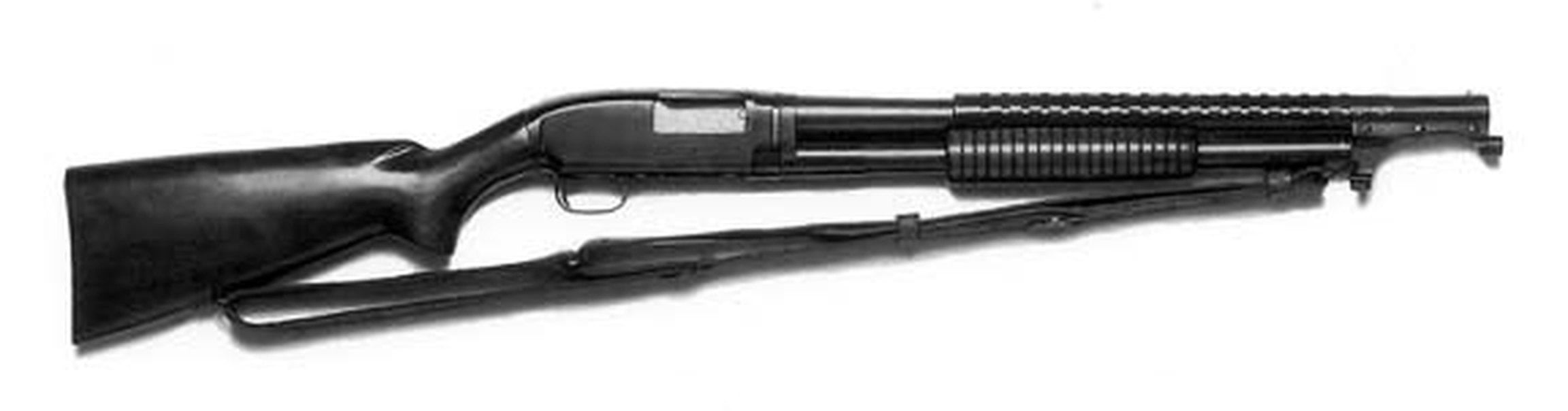
The Riot Gun ran from 1918 to 1963 with a 20-inch cylinder-bore barrel, sold to police, express messengers and railroad guards. The trench gun added a ventilated steel handguard and a bayonet adapter for the M1917 bayonet. In World War II about 80,000 military Model 12s of all types went to the Marine Corps, the Army Air Forces and the Navy, most of them for the Pacific, and about 61,000 of those were new-made guns, the rest rebuilt. Only a minority were trench guns.
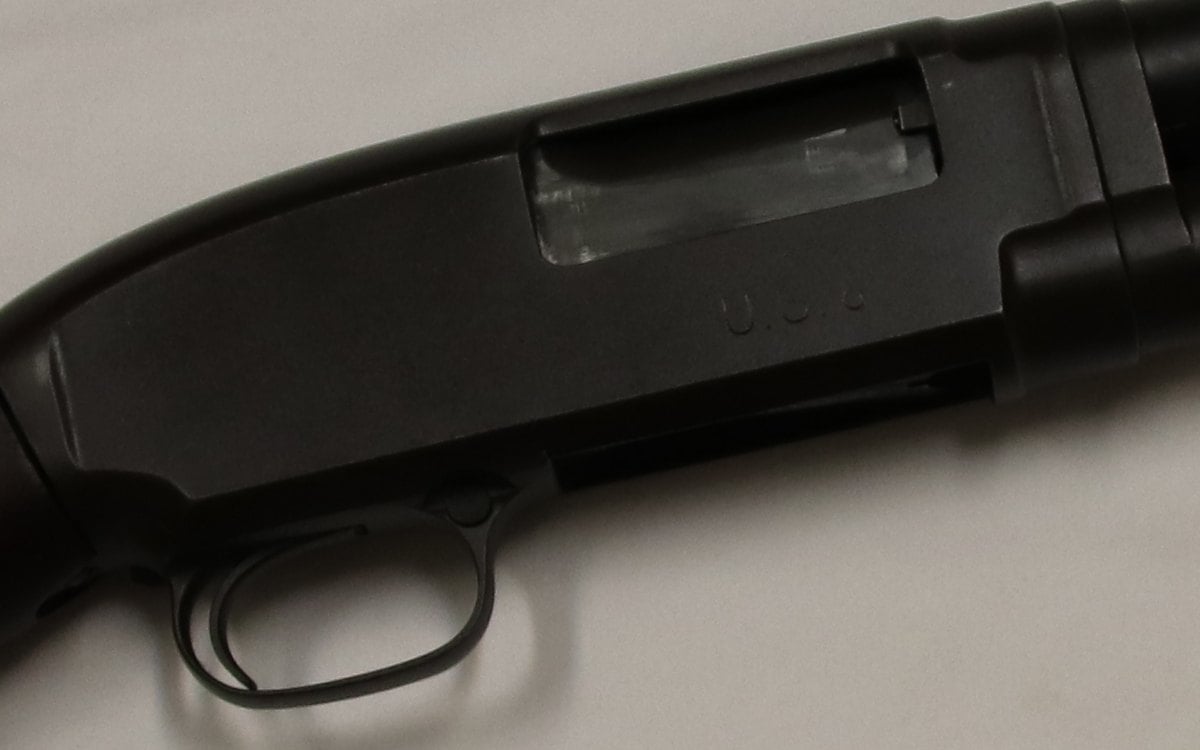
That’s why trench guns are the most faked Model 12s. A genuine WWII gun has a flaming bomb on top of the barrel, “U.S.” and a flaming bomb on the right side of the receiver, an inspector’s cartouche on the stock, and four rows of holes in the handguard; WWI guns have six. Most were blued, and only very late guns above about serial 1,030,000 were Parkerized at the factory, so a Parkerized early gun has most likely been rebuilt. Assume any trench gun was assembled until an expert proves otherwise.
Post-1964 Guns: The Y Series and the Japanese Model 12s
Winchester dropped the Model 12 in its May 1964 overhaul, when forged, hand-fitted steel had become too expensive to compete with the Remington 870, and replaced it with the Model 1200. Leftover parts were assembled into guns until 1966, ending at serial 1,970,875. From 1972 to 1979 Winchester made the Y-series Model 12, a 12 gauge vent-rib gun with Y-prefix serials and an investment-cast receiver, well made and hand-finished but priced below comparable pre-64 guns. From about 1988, Miroku in Japan built limited Model 12s in 20 and 28 gauge, first Browning-branded and then, from 1993, Winchester-branded. They’re fine guns, but they aren’t curios or relics.
Our dealers had these Model 12s listed when we checked, including a police trade-in. Trade-ins sell out fast, so check the card for what’s in stock today:
Winchester Model 12 Condition Guide
Collectors grade a Model 12 on original blue, original wood and an unaltered barrel. Shooters should add the action’s tightness, the takedown joint and the chamber.
| Grade | What you see | What it does to price |
|---|---|---|
| 90%+ original | Deep original blue on the receiver, crisp roll marks, sharp checkering on original wood, an unaltered barrel and a tight takedown | $861 median across 37 sales; $900 for a 90%+ 12 gauge and $1,000 for a 90%+ 20 gauge |
| 70% to 89% original | Thinning blue on the receiver edges and slide handle, honest handling marks, original wood and barrel | $569 median, from only 6 graded sales, so treat it as a guide |
| Shooter, refinished, altered or under 70% | Refinished metal or wood, a Cutts or Poly Choke, a cut barrel, an added recoil pad or a cracked wrist | $523 median across 47 sales; a 12 gauge shooter brought a median $310 |
At the median, a 90%+ gun sold for about $338 more than a shooter. On 12 gauges the gap is bigger still: a 90%+ gun brought a median $900 across 11 sales, nearly three times the $310 median for 13 shooters. Most of the graded sales are Morphy lots, which describe condition in detail, so these tiers lean on auction prices.
The things that cut value most are a refinish, a cut barrel and an add-on choke. Most Cutts Compensators and Poly Chokes are aftermarket; factory Cutts guns exist, and the tell is a forged flange on a barrel with no choke marking. A choke-marked barrel wearing a Cutts had it added later. Never refinish an original gun: a worn original sells for about what a refinished one does anyway, and the refinish can never be undone.
How to Date a Model 12 by Serial Number
Winchester publishes a year-end serial chart for the Model 12 and warns that it isn’t guaranteed accurate. Book and internet charts vary, and some are off by a year or more, so treat any date as approximate.
| End of year | Serial number |
|---|---|
| 1912 | 5,308 |
| 1914 | 79,765 |
| 1926 | 557,850 |
| 1927 | 600,834 |
| 1941 | 975,640 |
| 1946 | 1,029,152 |
| 1953 | 1,399,996 |
| 1962 | 1,956,990 |
| 1963 | 1,962,001 |
| 1964 to 1966 clean-up | to 1,970,875 |
| 1972 to 1979 Y series | Y2000100 to Y2026399 |
For a dated letter, the Cody Firearms Records Office at the Buffalo Bill Center of the West holds serial application records for most Model 12s. A Model 12 letter gives the date the serial was recorded, not the gun’s configuration, so it can’t prove a barrel, choke, rib or gauge. It costs $40 for non-members, and there are no records for serials 903,580 to 966,818.
Fakes, Refinishes and Parts Guns
- Assembled trench and riot guns. Cut-down field guns with reproduction handguards and restamped marks. Check the serial range, the cartouche, the handguard rows and the finish for the date.
- Fake 28 gauge guns. About 2,600 prewar 28s were made, and fakes exist. Verify the gauge against the serial and have it checked.
- Refinished guns sold as original. Soft roll marks, rounded edges and too-bright blue. A refinished duck gun often gives itself away at the rib.
- Aftermarket ribs and chokes sold as factory. Simmons-marked ribs, offset proofs, Poly Chokes and choke-marked barrels with a Cutts.
- Post-1964 or Japanese guns sold as pre-64. Y-prefix serials and U.S. Repeating Arms import marks tell you.
- A “Damascus” Model 12 barrel. They never existed. Walk away.
Winchester Model 12 Pre-Purchase Inspection Checklist
Here’s the check we run on every Model 12 before we pay, with the gun unloaded and pointed in a safe direction:
- Open the action and confirm the chamber and magazine are empty.
- Read the serial and date the gun. Anything before September 1926 in 16 or 20 gauge started with a short chamber.
- Have the chamber measured by a gunsmith who knows the Model 12, because part of the chamber is in the receiver ring.
- Check the barrel markings for gauge and choke, and look for add-on chokes, compensators or a cut barrel.
- Take the gun down and put it back together. The barrel should lock up tight; a loose joint can be tightened one notch on the adjusting sleeve.
- Work the action. It should be smooth and positive, with no binding.
- With the chamber empty, check the safety blocks the trigger and the action release works.
- Look down the bore with a light for pitting and for rings or bulges near the muzzle, a sign of steel shot in a tight choke.
- Check the rib type and markings against the serial and grade.
- Look for refinish tells on the metal and wood, and cracks at the wrist and forearm.
- On a trench or riot gun, check the serial window, cartouche, handguard rows and finish.
- Ask for a return privilege in writing if you can’t handle the gun first.
Shooting and Caring for a Collector Model 12
Three rules cover almost everything. First, match the shells to the chamber: 2-3/4 in. in a 2-3/4 in. chamber, 2-1/2 in. shells in an early 20 gauge and 65 mm or 2-9/16 in. shells in an early 16 unless the chamber has been lengthened. Only a Heavy Duck takes 3 in. shells. Second, no steel shot through a fixed choke. Winchester’s steel approval covers its current guns with steel-rated tubes, and its rule is no choke tighter than Modified even then; Browning, which built the Japanese Model 12s, warns that older fixed-choke barrels can ring-bulge near the muzzle. Use bismuth or another soft non-toxic load for waterfowl. Third, finger off the trigger while you pump.
| Use | Avoid |
|---|---|
| 2-3/4 in. lead target and field loads in a 2-3/4 in. chamber | Steel shot through any fixed choke |
| 2-1/2 in. or 65 mm shells in an early short-chambered gun | 2-3/4 in. shells in a short chamber |
| Bismuth for waterfowl | 3 in. shells in anything but a Heavy Duck |
| Folded-crimp shells for full magazine capacity | Cold bluing or refinishing an original gun |
For care, take the gun down after every outing, clean and lightly oil the action and magazine tube, and keep oil off the wood. If the barrel gets loose in the receiver, turn the adjusting sleeve one notch counterclockwise to tighten it. Leave trigger-group work to a gunsmith, since Winchester only lists outside suppliers for Model 12 parts.
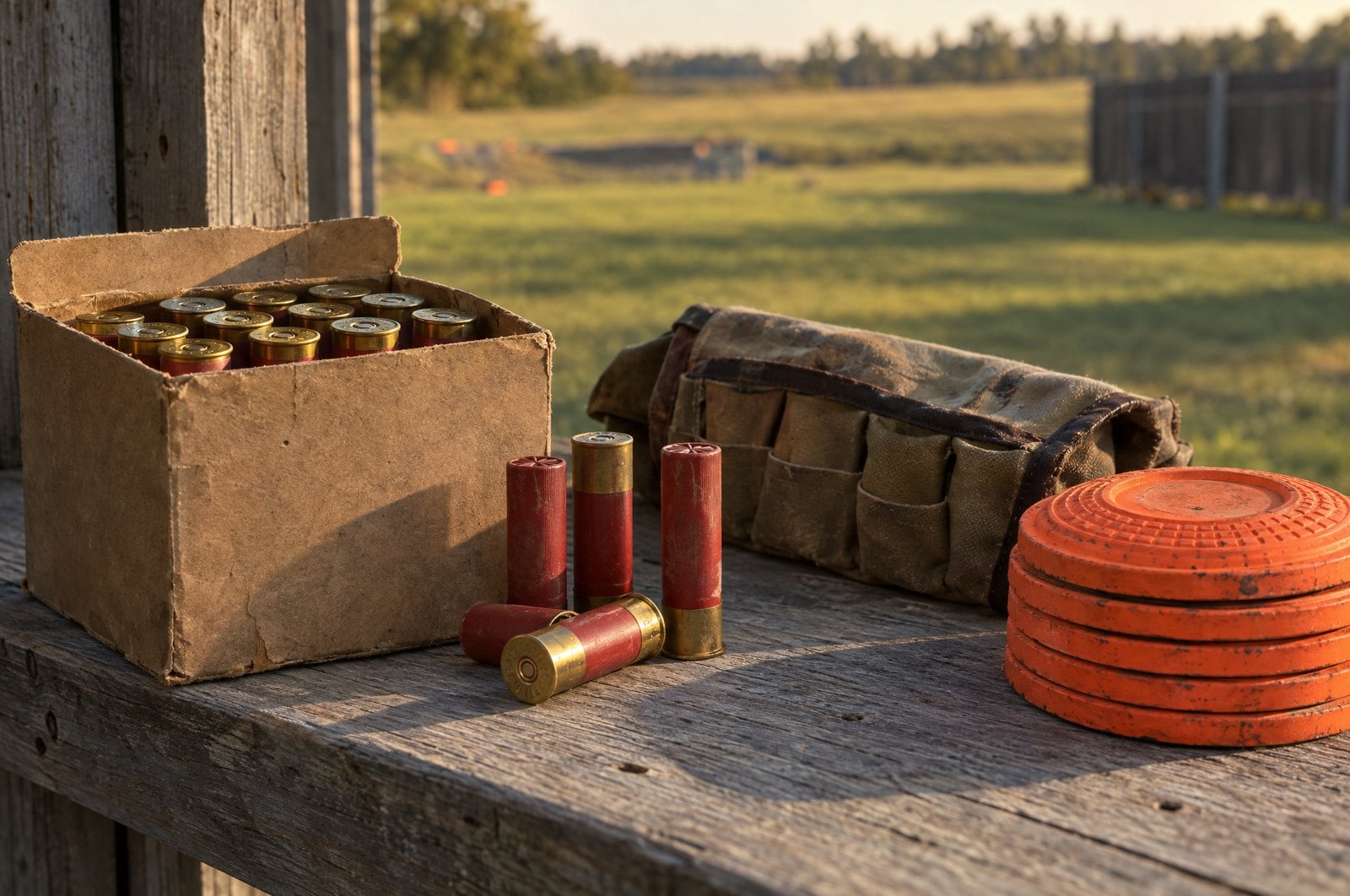
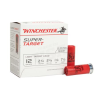
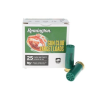
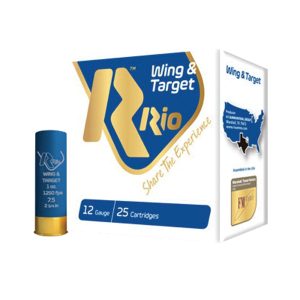
These 2-3/4 in. lead target and field loads are on sale at our dealers right now. We filter out steel, magnums, buckshot and slugs.
Vintage-Safe 12 Gauge Deals for a Model 12
On-sale 12 gauge vintage from 200+ retailers · Updated every 4 hours



For more on shotgun loads, see our dove hunting and pheasant hunting shotgun guides.
A Short History of the Winchester Model 12
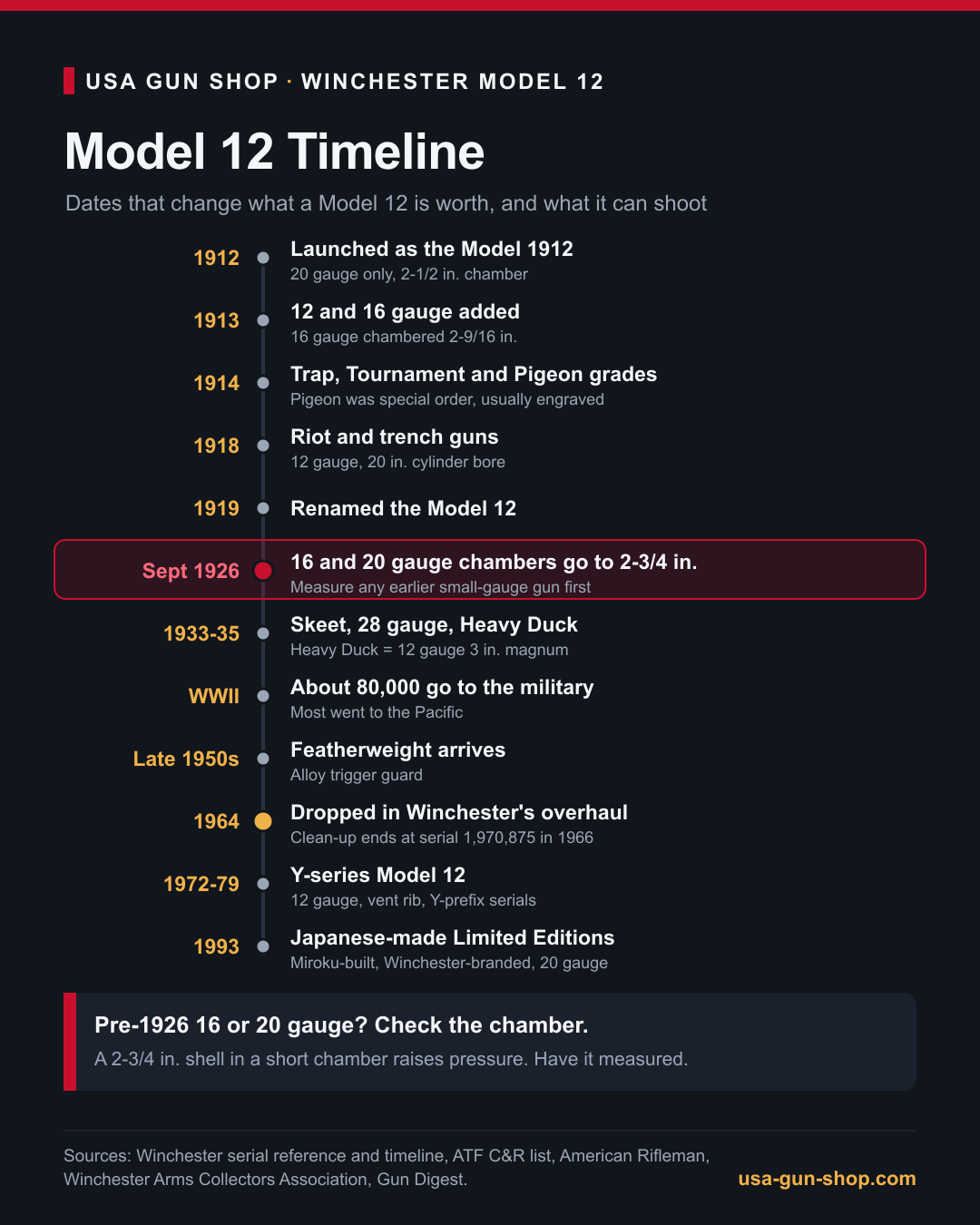
Winchester engineer Thomas Crossley Johnson designed the Model 1912 as a hammerless successor to the exposed-hammer Model 1897, using the same basic slide-action layout. It shipped from the warehouse on August 30, 1912, in 20 gauge only, Winchester’s first 20 gauge shotgun and its first hammerless pump. Winchester sold it as “The Perfect Repeater” and stressed its nickel-steel construction. The 12 and 16 gauges followed at the end of 1913, and sales passed 100,000 in the first two years.
The name was shortened to Model 12 in 1919. Winchester added the Skeet gun in 1933, the 28 gauge in 1934 and the 3 in. Heavy Duck in 1935. In World War II it went to war by the tens of thousands, and in 1943 Winchester presented its one-millionth Model 12 to General Henry “Hap” Arnold of the Army Air Forces. After the war it stayed in service through Korea and Vietnam, until the Ithaca 37 replaced it from the mid-1960s.
By then the machined steel and hand fitting that made the gun great had made it too expensive. Winchester dropped it in 1964 in favor of the Model 1200, finished the clean-up run in 1966, and brought it back in smaller runs from 1972. Nearly 2 million were made in all.
Why the Model 12 Is Still So Popular
For a lot of families the Model 12 is the shotgun: the one Grandpa hunted ducks with, the one that won the club trap shoot, the one in the corner of the farmhouse closet. It was also a working gun for police and soldiers for half a century, and the Los Angeles County Sheriff’s Department carried cut-down Model 12s in its patrol cars. Gun writer Wiley Clapp carried one in Vietnam.
It’s also simply a great shotgun. The action is smoother than almost any pump made today, the takedown design is brilliant, and a clean field gun still costs less than many new premium pumps. And every WWII movie that shows a trench gun sends another round of collectors looking for one.
Model 12 Legal Status: C&R and the NFA
ATF’s Curios or Relics List names “Winchester, Model 12, pump action shotguns, mfd. from 1912 through 1963, S/Ns 1 through 1962017,” and separately lists the 1972 to 1979 Y-series guns and the Ducks Unlimited commemoratives. The 1964 to 1966 clean-up guns qualify under the 50-year rule, and military-marked Model 12s made before 1946 in original configuration are covered by ATF’s military shotgun entry. The Japanese-made guns from 1988 on are not curios or relics yet. No Model 12 is an antique firearm, because that requires manufacture in or before 1898.
A cut-down barrel can turn any shotgun into an NFA short-barreled shotgun: under federal law, that’s a barrel under 18 inches or an overall length under 26 inches. Check any short Model 12 before you buy it, and see our guide to the National Firearms Act. State law may be stricter.
Where to Buy a Winchester Model 12
- Guns.com. The deepest used selection we track, with detailed photos. Browse Model 12s on Guns.com.
- Dealers. Police trade-ins and estate guns turn up at dealers like Sportsman’s Outdoor Superstore. Our price cards above show what’s listed today.
- Auction houses. Morphy, Rock Island and others describe the grade, rib, choke and any alterations, but add a buyer’s premium of roughly 20 to 25%.
- GunBroker, gun shows and trap clubs. The widest choice, and trap clubs are a good place to find a well-kept trap gun.
Wherever you buy, ask the same questions before you pay:
- What’s the serial, and what gauge and chamber?
- Is the finish original, and is the barrel unaltered?
- Is the rib factory or aftermarket?
- Does the takedown joint lock up tight?
- For a trench or riot gun, what proves it’s original?
- Can I return it if it isn’t as described?
Model 12 vs. Its Rivals
| Shotgun | Action | Years | Why you’d pick it |
|---|---|---|---|
| Winchester Model 12 | Hammerless pump | 1912 to 1964 | The smoothest classic pump, collector value |
| Winchester Model 1897 | Exposed-hammer pump | 1897 to 1957 | The WWI trench gun, cowboy-action favorite |
| Ithaca 37 | Bottom-eject pump | 1937 to today | Lighter, still made, replaced the Model 12 in service |
| Remington 870 Wingmaster | Pump | 1950 to today | Cheaper, parts everywhere, the gun that outsold it |
Model 12 vs. the Winchester Model 1897
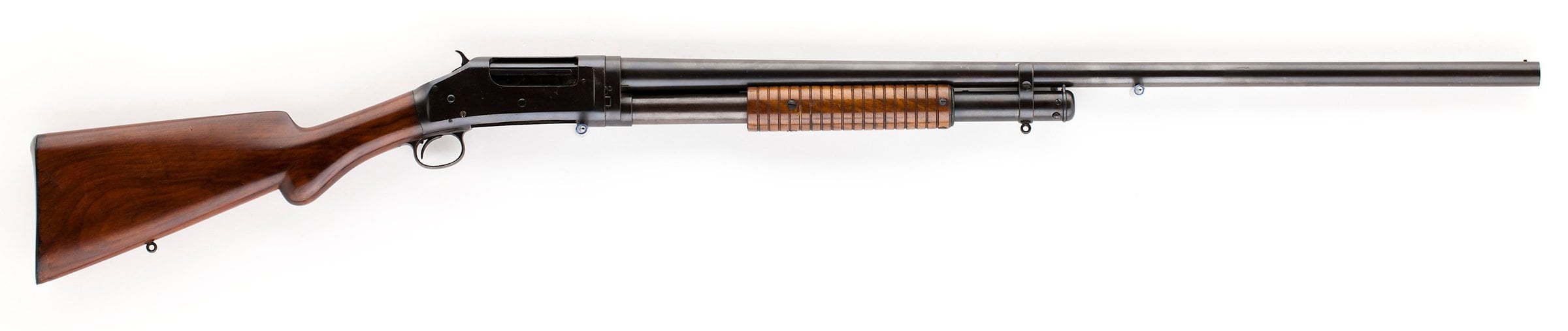
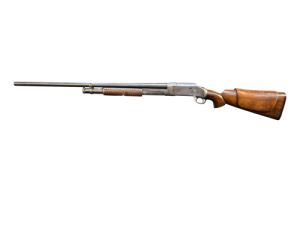
The Model 1897 is the Model 12’s exposed-hammer ancestor, and the shotgun most WWI trench guns were built on. It’s heavier-looking, it has a hammer you can see and thumb, and it’s the favorite of cowboy action shooters. The Model 12 is the smoother, more refined gun. Collectors often want both.
Model 12 vs. the Ithaca 37 and Remington 870
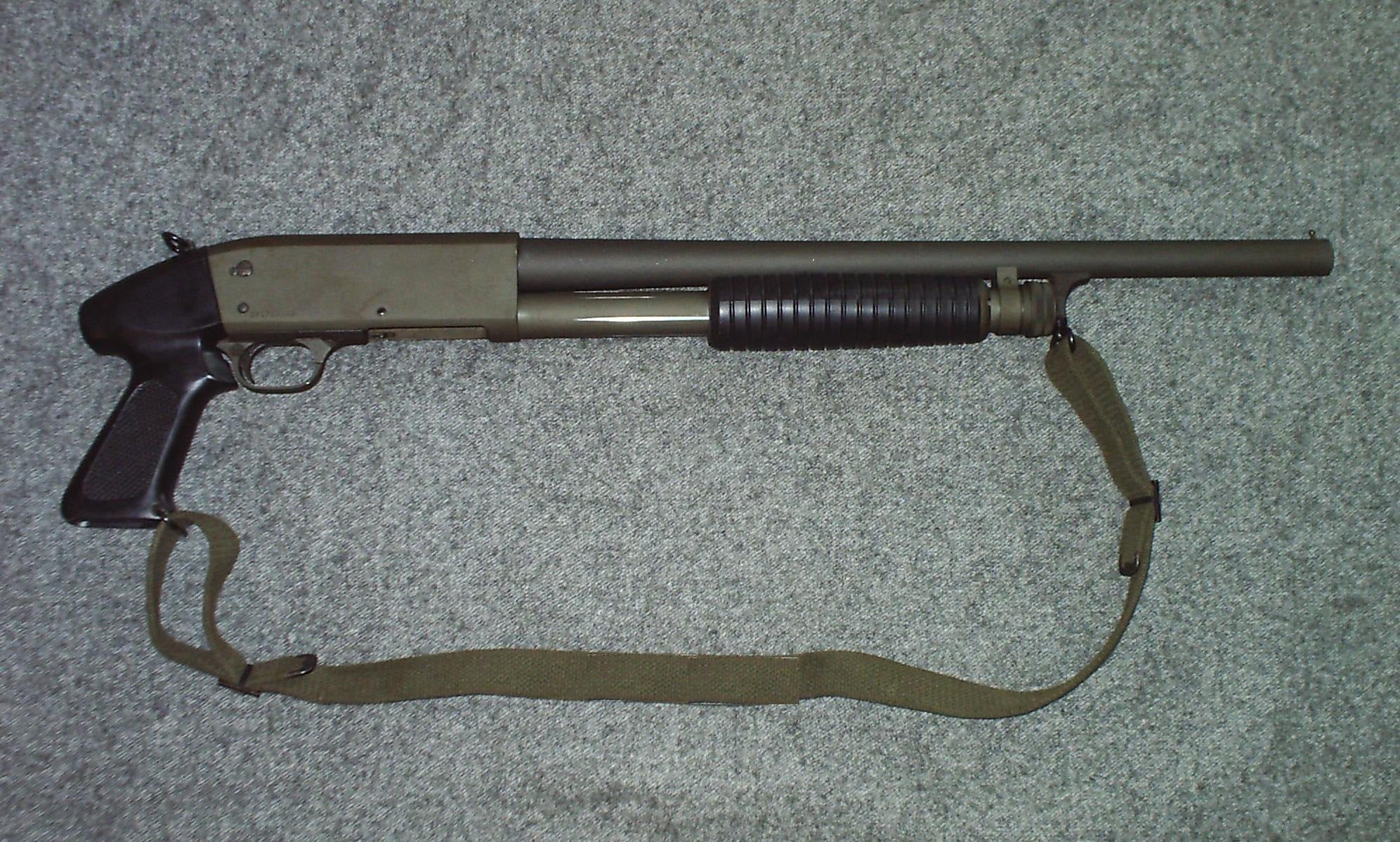
The Ithaca 37 replaced the Model 12 in military service in the 1960s and is still made, lighter and bottom-ejecting. The Remington 870 Wingmaster, introduced in 1950, was cheaper to build and helped end the Model 12’s run. Both are excellent pumps with parts and service everywhere. The Model 12 wins on machining, feel and collector value.
Final Verdict
The Winchester Model 12 earned its “Perfect Repeater” name, and a good one is still one of the best pump shotguns you can own. Buy a 12 gauge field gun to hunt with, pay up for 20, 16 and 28 gauges if you collect, and treat every trench gun as assembled until proven. Measure the chamber on anything pre-1927, keep steel out of fixed chokes, and keep your finger off the trigger while you pump.
Nearly 2 million made, 50 years as America’s favorite pump, and an action nobody has matched since.
FAQ
How much is a Winchester Model 12 worth?
In 263 completed sales from January 2024 to September 2026, the median Winchester Model 12 sold for about $567. Field guns had a median of about $460, Trap guns $975 and Skeet guns $1,440. By gauge, 16 gauges sold for about $425, 12 gauges $521 and 20 gauges $565, and 28 gauges are rare enough that each one is priced on its own. Guns with 90% or more original finish brought a median $861. Dealer asking prices run well above that, with a $900 median.
Can I shoot steel shot in a Winchester Model 12?
We would not. No manufacturer approves steel shot through a vintage fixed-choke Model 12. Winchester's steel approval covers its current guns with steel-rated choke tubes, and Browning, which built the Japanese Model 12s, warns that older fixed-choke barrels can bulge near the muzzle. Use bismuth or another soft non-toxic load for waterfowl.
Can I shoot 2-3/4 in. shells in my old Model 12?
It depends on the date and gauge. Winchester lengthened 16 and 20 gauge chambers to 2-3/4 in. in September 1926. Earlier 20 gauges had 2-1/2 in. chambers and 16 gauges 2-9/16 in. A 2-3/4 in. shell will chamber in a short chamber and raise pressure, so have any pre-1927 gun measured by a gunsmith.
What is slam-fire on a Model 12?
The Model 12 has no trigger disconnector, so if you hold the trigger down and pump the action, it fires every time the action closes. It is how the gun was designed, not a defect, but it means you should always keep your finger off the trigger while working the slide.
When was my Winchester Model 12 made?
Use Winchester's year-end serial chart as a guide. For example, 1926 ended at serial 557,850, 1946 at 1,029,152 and 1963 at 1,962,001. Y-prefix serials are the 1972 to 1979 run. Winchester warns the chart is not guaranteed accurate, so treat any date as approximate.
How can I tell if a Model 12 trench gun is real?
A genuine WWII trench gun has a flaming bomb on top of the barrel, U.S. and a flaming bomb on the right side of the receiver, an inspector's cartouche on the stock and a four-row ventilated handguard; WWI guns have six rows. Most were blued. Many trench guns on the market are assembled from field guns and reproduction parts, so get an expert opinion.
Is the Winchester Model 12 a curio and relic?
Yes. ATF's Curios or Relics List names Model 12s made from 1912 through 1963, serial numbers 1 through 1,962,017, and separately the 1972 to 1979 Y-series guns. The Japanese-made Model 12s from 1988 on are not curios or relics. No Model 12 is an antique.
Why did Winchester stop making the Model 12?
The forged, machined steel parts and hand fitting that made it so good also made it expensive, and it could not compete on cost with guns like the Remington 870. Winchester dropped it in 1964, replaced it with the Model 1200, and later built it only in smaller runs.
5,495+ Gun & Ammo Deals
Updated daily from 200+ top retailers. Filter by category, caliber, action type, and price.