

Last updated September 2026
Some of the links below are affiliate links, meaning at no additional cost to you, we may earn a commission if you click through and make a purchase.
- Treat every gun as loaded
- Point the muzzle in a safe direction
- Keep your finger off the trigger until you’re ready to shoot
- Know your target and what’s beyond
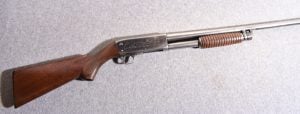
John Browning designed it, Winchester built it for 60 years, and it’s still the pump shotgun people picture when they hear the words “trench gun.” The Winchester Model 1897 was the best-selling pump on the market for decades. It went to the Philippines, to France in 1917 and to the Pacific in World War II, and it rode with express messengers and in patrol cars in between. Today it’s the only pump shotgun cowboy action shooters are allowed to use.
It’s also one of the easiest vintage guns to get wrong. The exposed hammer has no safety beyond half-cock, it slam-fires if you hold the trigger, early 16 gauges need short shells, and most “trench guns” for sale were built from field guns. Even Winchester’s own serial chart misdates guns by up to nine years. This guide covers all of it, with 189 completed sales broken down by grade, gauge and era, how to tell a real trench gun from a conversion, and a morning on the trap field with a 1925 field gun.
Quick take
A sound Model 1897 is a great piece of history that still shoots. Buy a 12 gauge field gun to shoot, pay up for a grade or a documented military gun if you collect, and assume every trench gun is a conversion until the markings prove otherwise. Keep 16 gauges made before 1930 on 2-9/16 in. shells and keep steel shot out of original chokes.
- Typical price (2024 to 2026 sales): about $650 median across 189 sales; about $630 for a field gun, $827 for a riot gun and $1,448 for a Trap, Tournament or Pigeon grade. Genuine military trench guns are their own market, at a $3,462 median
- Gauges: 12 (2-3/4 in. from the first gun) and 16 (2-9/16 in. until 1930)
- Made: 1897 to 1957, about 1,024,700 serial numbers but just under a million guns
- Legal: every one is a curio or relic; guns made in 1897 or 1898, up to about serial 63,867, are federal antiques
How we tested: Every pick here is ranked against our testing methodology. Minimum round counts, accuracy and reliability protocols, the failures that disqualify a gun.
Winchester Model 1897 Pros and Cons
Pros
- Browning’s design, still runs after a century
- Field guns cost about what copies do
- Takedown breaks down in seconds
- The only pump allowed in SASS
- 1897 and 1898 guns are federal antiques
Cons
- No safety, and it slam-fires
- Pre-1930 16 gauges need short shells
- No steel shot through original chokes
- Most “trench guns” are conversions
- Serial charts misdate many guns
- No factory parts or service
Winchester Model 1897 at a Glance
| Spec | Winchester Model 1897 |
|---|---|
| Action | Slide action with an exposed hammer, side ejection and a slide lock; no trigger disconnector, so it slam-fires |
| Gauges | 12 gauge (1897) and 16 gauge (1899, takedown only, on a smaller frame) |
| Chambers | 12 gauge 2-3/4 in. from the first gun; 16 gauge 2-9/16 in. until 1930, then 2-3/4 in. |
| Capacity | Five in the magazine plus one in the chamber; solid-frame Brush guns hold four in the magazine |
| Barrels | 30 in. full choke standard on the 12 gauge, 28 in. on the 16 gauge; 20 in. cylinder bore on riot and trench guns |
| Frames | Solid frame from 1897, takedown from 1898; by 1924 only the riot gun was still made as a solid frame |
| Safety | None; the hammer’s half-cock notch is the only “safe” position |
| Designer | John M. Browning and Matthew S. Browning, from their Model 1893 |
| Made | 1897 to 1957; about 1,024,700 serial numbers, just under a million guns |
| Legal | Curio or relic; federal antique if made in or before 1898 (about serial 63,867 and below) |
Table of Contents
What It’s Actually Like to Shoot a Winchester 1897: Myth vs. Truth
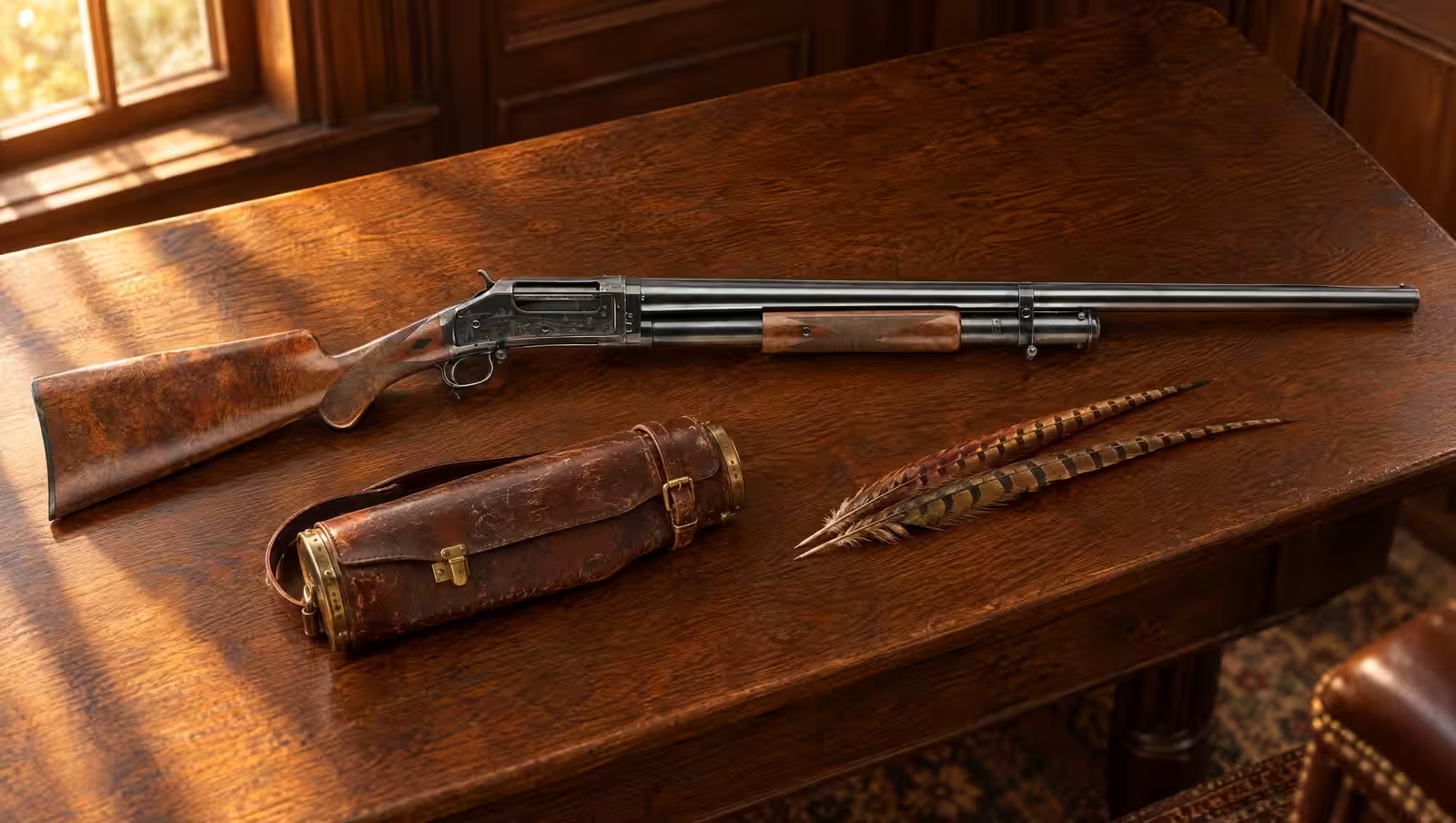
Our range gun is a 12 gauge takedown field gun with a 30-inch full-choke barrel and about 70% of its original blue. The factory-record lookup from the Winchester Arms Collectors Association puts it in 1925, which fits the “MODEL 97” marking on its barrel. Before we fired it, a gunsmith checked the headspace, tightened the takedown joint one step on the adjusting sleeve and confirmed the 2-3/4 in. chamber.
Over two sessions we fired 175 shells, all 2-3/4 in. lead: Winchester AA 1-1/8 oz #8, Remington Gun Club 1-1/8 oz #7-1/2 and Federal Top Gun 1-1/8 oz #8. The first thing you notice is how long and loose the pump stroke feels next to a modern gun. Then you learn to run it hard and it stops mattering. The trigger broke at 5 lb 6 oz with some creep, and the steel buttplate bites more than the load deserves.
We shot two rounds of trap from the 16-yard line and broke 21 and 23. At 40 yards the full choke put an average of 69% of its Top Gun #8 pellets in a 30-inch circle over five patterns, which is right where a full choke should be. There were two stoppages, and both were mine: I short-stroked the slide and had to clear a shell off the carrier. Run it all the way back and all the way forward and it feeds.
Then there’s the thing every new owner has to learn. The Model 1897 has no trigger disconnector, so if you hold the trigger back and work the pump, the hammer falls as the action closes. We confirmed it with snap caps. It isn’t a defect, it’s how Browning built it, but it means your finger stays off the trigger while you pump, every time. The only safety is lowering the hammer to half-cock, and lowering a hammer on a live shell with a cold thumb is the riskiest moment of the whole day.
| The myth | What we found | Evidence |
|---|---|---|
| “Old 1897s need 2-1/2 in. shells.” | Not the 12 gauge. Every 12 gauge was chambered 2-3/4 in. from the first gun. The short chamber is a 16 gauge fact: 2-9/16 in. until 1930. | Winchester Arms Collectors Association historian, from the factory ledgers |
| “Over a million were made.” | Serial numbers run to about 1,024,700, but they started at 34,151, where the Model 1893 left off. That’s just under a million guns. | Factory ledgers; ATF C&R list serial range |
| “It has a safety.” | It doesn’t. Half-cock is the only safe position, and there’s no cross-bolt or tang safety. | Every original gun we’ve handled |
| “The Army called it the Trench Gun, Model 1917.” | No. Period Army documents mostly call it a “riot gun with bayonet adapter.” “Trench gun” is the collector’s name. | American Rifleman, from primary documents (2024) |
| “Germany executed Americans caught with shotguns.” | Germany threatened it in a formal protest on September 19, 1918. No executions are known. | State Department correspondence as reported by American Rifleman |
| “Steel shot is fine.” | Not through an original choked barrel. Steel can bulge an old full choke. Use bismuth. | Winchester Arms Collectors Association |
Who the Model 1897 Is For (and Who Won’t Enjoy It)
Buy a Model 1897 if you are
- A cowboy action shooter. SASS allows the Model 1897 as its only pump shotgun. Start with our guide to cowboy action shooting.
- A collector of American military arms. A documented WWI or WWII trench gun is a centerpiece, and field and riot guns are the affordable way into the story.
- An upland hunter who likes old guns. A sound 12 gauge field gun with lead or bismuth loads still does the job in the pheasant field.
- A C&R license holder. Every Model 1897 qualifies, and the 1897 and 1898 guns are antiques.
- Someone who inherited Grandpa’s pump. This guide tells you what you have and how to shoot it safely.
Skip the Model 1897 if you are
- Looking for a home defense gun. Buy a modern pump with a safety and a disconnector, such as a Remington 870 or Mossberg 500. See our home defense shotgun picks.
- A waterfowler who shoots steel. You need a gun with steel-rated chokes. Start with our duck hunting shotguns.
- After a 16 gauge that takes modern shells. Buy a post-1930 16 gauge, or a Winchester Model 12 made after its own 1926 chamber change.
- Shopping for a trench gun without expertise. Most on the market are conversions. Buy one only with the markings checked by someone who knows them.
What a Winchester Model 1897 Costs in 2026
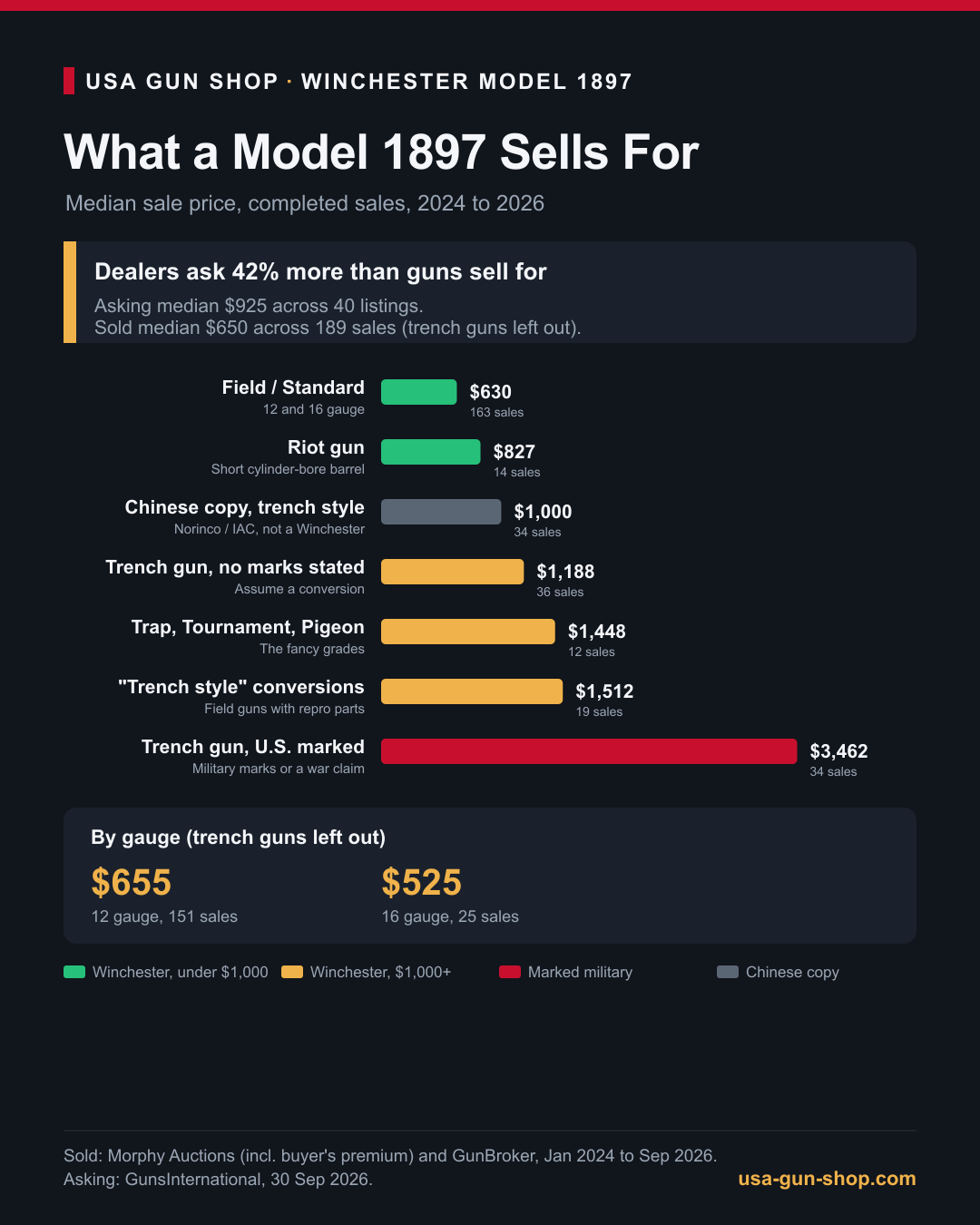
These are sale prices, not asking prices. We tracked 189 completed sales of Model 1897s from January 2024 to September 2026: 34 Morphy Auctions lots, which include the buyer’s premium, and 155 GunBroker sales. Trench guns sell in a market of their own, so they’re counted separately below, and so are the Chinese copies. Most GunBroker sellers don’t state a grade, so treat the condition figures as a guide, not a price list.
Prices by grade
| Model or grade | Median sale | Range seen | Sales tracked |
|---|---|---|---|
| Field / Standard | $630 | $184 to $1,722 | 163 |
| Riot gun | $827 | $582 to $2,880 | 14 |
| Trap, Tournament and Pigeon | $1,448 | $523 to $2,400 | 12 |
| All Model 1897s (trench guns left out) | $650 | $184 to $2,880 | 189 |
Prices by gauge and era
| Gauge or era | Median sale | Range seen | Sales tracked |
|---|---|---|---|
| 16 gauge | $525 | $282 to $1,400 | 25 |
| 12 gauge | $655 | $184 to $2,880 | 151 |
| Made 1899 to 1918 | $600 | $234 to $1,968 | 62 |
| Made 1919 to 1941 | $640 | $184 to $2,880 | 44 |
| Made 1942 to 1945 | $712 | $338 to $1,325 | 6 |
| Made 1946 to 1957 | $738 | $355 to $1,722 | 18 |
Two things stand out. First, a plain field gun is still affordable. Half of them sold for $630 or less, and the 16 gauge is the cheapest way in, at a $525 median. Second, age alone doesn’t add much. Guns made before 1919 sold for less than postwar guns in our data ($600 against $738). The exception is a proven 1897 or 1898 gun, which is a federal antique. We found too few of those to band, but two worn or altered 1898 guns sold for $2,275 and $4,294 at Lock, Stock and Barrel in 2025.
Trench guns and copies
| Trench guns and copies | Median sale | Range seen | Sales tracked |
|---|---|---|---|
| Trench guns with U.S. marks or a war claim | $3,462 | $905 to $12,000 | 34 |
| WWII-dated trench guns | $3,088 | $1,450 to $8,610 | 18 |
| “Trench style” guns and reproduction parts | $1,512 | $480 to $3,690 | 19 |
| Trench guns with no marks stated | $1,188 | $380 to $14,400 | 36 |
| Chinese copies, trench configuration | $1,000 | $585 to $1,700 | 34 |
| Chinese copies, riot or plain | $699 | $148 to $1,094 | 41 |
Read that table carefully. A genuine, marked military trench gun is a $3,000-plus collector piece, and the best ones go far higher. A trench gun with no marks, or one sold as “trench style,” sells for about half that, because most of them started life as field guns. The Chinese copies aren’t cheap either: a trench-configured copy brought a $1,000 median, which is more than a real Winchester field gun.
Asking prices run well above what these guns sell for. On the day we checked, 40 Model 1897s were listed on GunsInternational with a $925 median, about 42% over the $650 median sale.
This is the Model 1897 our dealers have listed right now. It’s a single used gun, so it can sell at any time.
Guns.com lists more used Model 1897s than any other dealer we track, with close-up photos of each gun. See every Winchester Model 1897 on Guns.com
Compare other guns in the USA Gun Shop price checker, and see our guide to buying used shotguns and our guide to buying vintage guns online.
Which Model 1897 to Buy: The Variants
Winchester built the 1897 in a handful of grades and two gauges, and the military guns sit in a world of their own. Here’s how they break down, and what each one means for a buyer.
Standard Field Guns
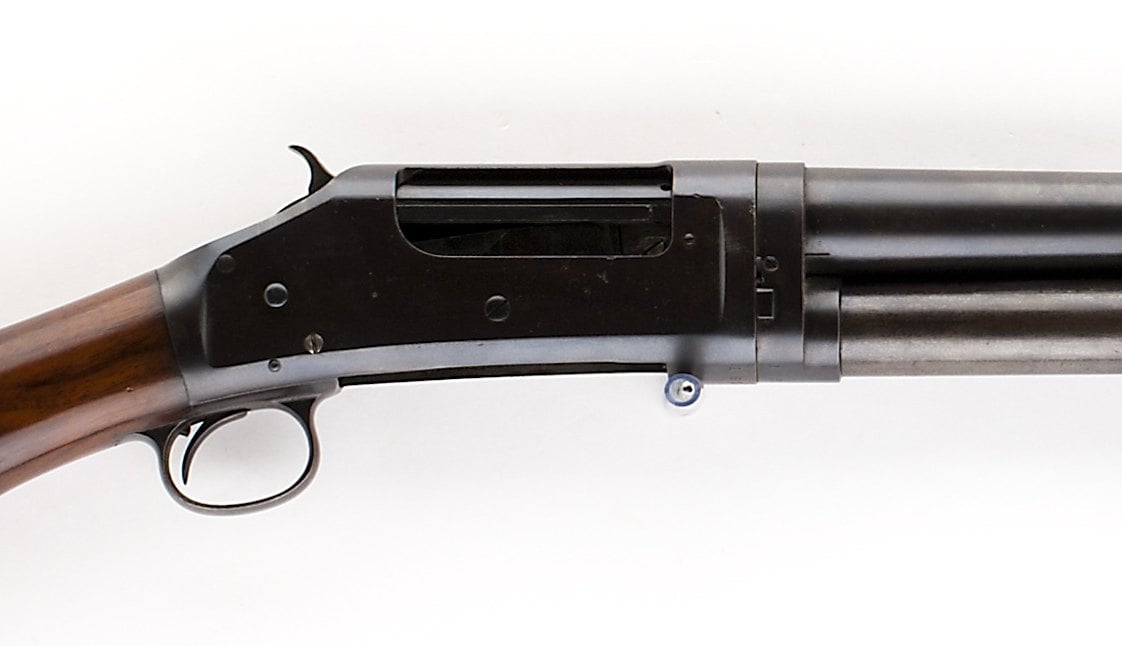
The plain Standard grade was made the whole run, from 1897 to 1957, in 12 and 16 gauge. The 12 gauge came with a 30-inch full-choke barrel as standard, and the 16 with a 28-inch. This is the gun to buy if you want to shoot. Look for a takedown, since it cleans and stores easily, and a barrel that hasn’t been cut. Solid-frame field guns are the early ones: Winchester added the takedown in 1898.
The 16 Gauge
The 16 gauge arrived in 1899, only as a takedown and on a smaller frame, so 12 and 16 gauge barrels don’t swap. By one historian’s estimate it’s roughly one in seven or eight 1897s. The catch is the chamber. Every 16 gauge made before 1930 has an unmarked 2-9/16 in. chamber. Winchester started stamping “2 3/4″ CHAM” on barrels in March 1930, and every barrel carried it from September 1930. No stamp means a short chamber until a gunsmith says otherwise.
Brush, Trap, Tournament and Pigeon
The Brush gun had a 26-inch cylinder-bore barrel for close cover, and the solid-frame version held one shell fewer. The Trap grade (1897 to 1931) added fancy checkered walnut and “TRAP” stamped on the bottom of the frame. The Tournament (1910 to 1931) was a 12 gauge with a 30-inch barrel and a receiver top matted against glare. The Pigeon grade (1897 to 1939) was the Trap with a hand-engraved receiver, and it’s the one collectors chase.
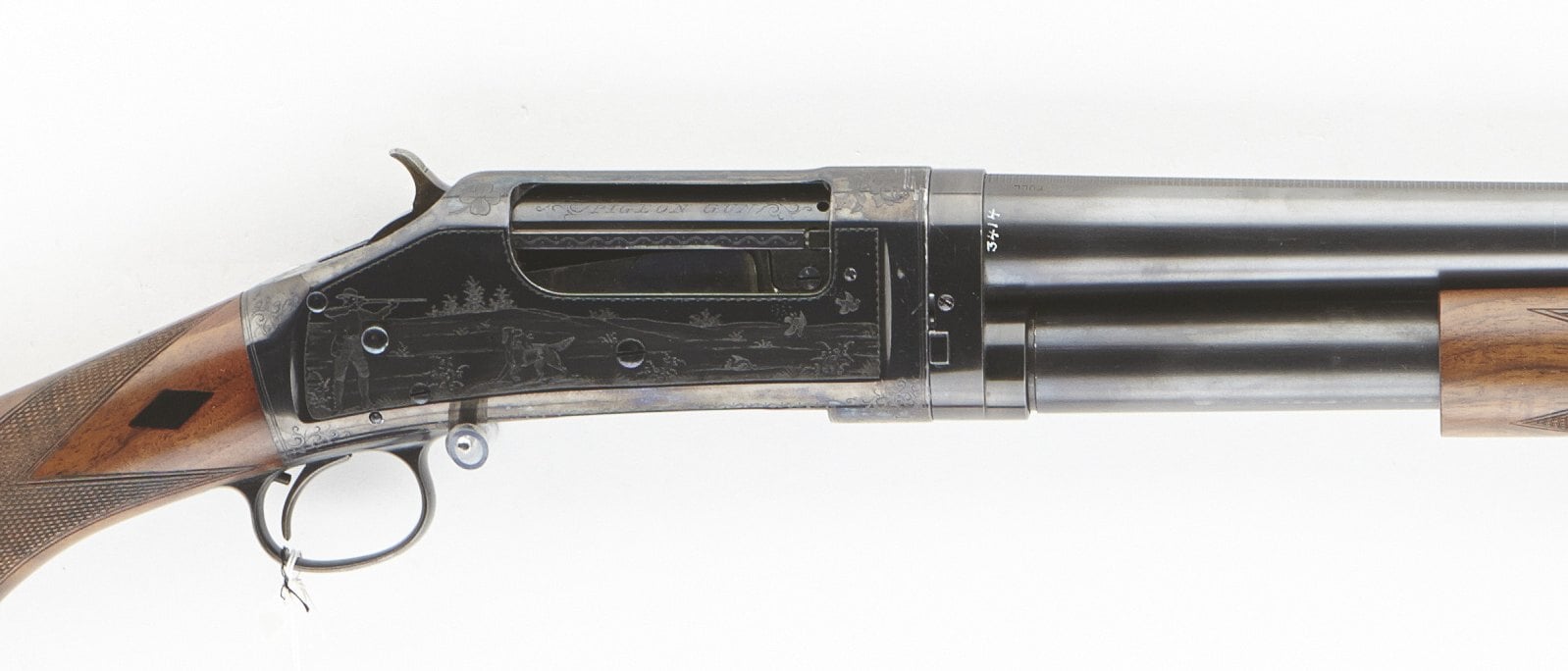
Riot Guns
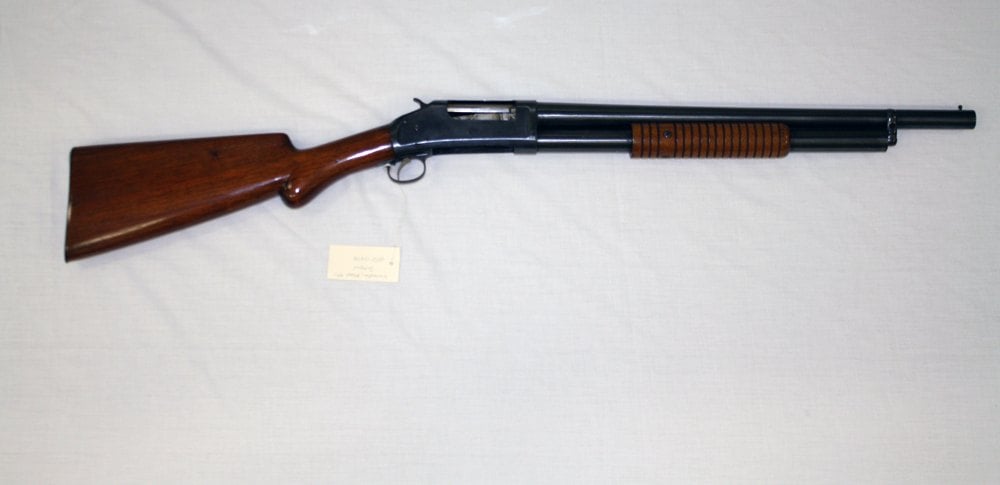
Winchester built riot guns from 1898 on: 12 gauge, 20-inch cylinder-bore barrels, in solid frame or takedown. Express companies, police departments and later the military bought them. A true riot gun is a desirable collector piece, but so many field guns have been cut to 20 inches that you should treat a short 1897 as a cut field gun until the bead, the crown and the markings say otherwise.
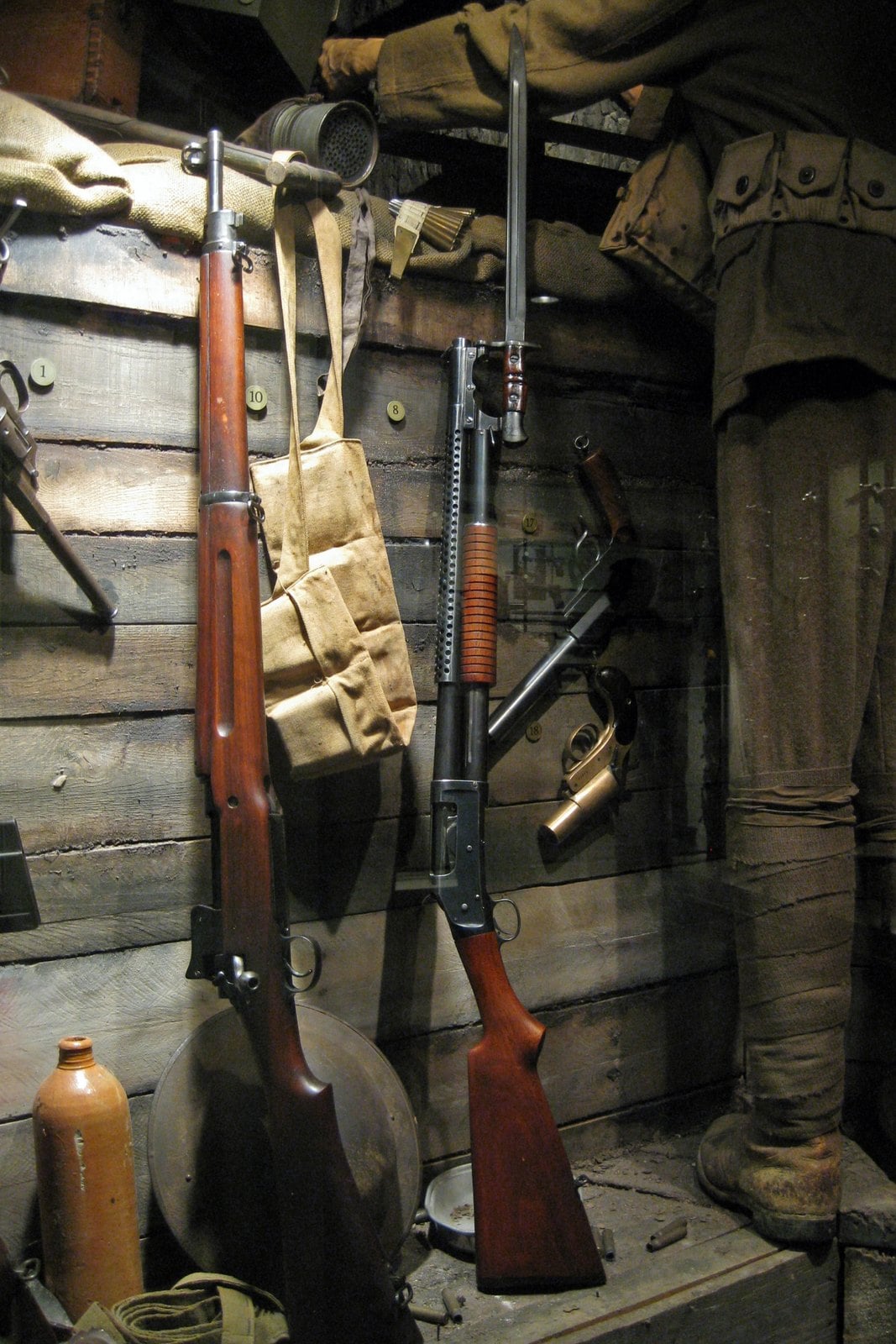
WWI Trench Guns
For the First World War, the Ordnance Department took the solid-frame riot gun and added a ventilated steel handguard with six rows of holes, a bayonet adapter for the M1917 bayonet and sling swivels. Ordnance records show Winchester delivered 19,196 of them, and several thousand more were converted from commercial guns. Some were hand-stamped “U.S.” with the flaming-bomb ordnance mark on the right of the receiver. Most weren’t martially marked at all, and none carried a stock inspector’s stamp.
WWII Trench Guns
The WWII guns are different. They’re takedowns, most have a four-row handguard, the “U.S.” and flaming bomb are machine-stamped on the barrel and receiver, and the stocks carry inspectors’ cartouches. They left the factory blued; a Parkerized one has been through a postwar rebuild. Most counts put WWII production at about 25,000, and the Winchester Arms Collectors Association historian places them in the serial range 919,600 to 960,000.
Damascus-Barreled Guns
Rolled steel was the standard barrel. Damascus was an extra-cost option on fancy grades until about 1913, recorded in the ledgers as “Good” and “Fine” grades, and one historian estimates about 7,000 were made. They’re rare and interesting. Have any Damascus barrel inspected by a gunsmith before firing it, or don’t fire it.
Chinese Copies
Norinco in China made a near-copy of the 1897, imported by Interstate Arms Corp. of Billerica, Massachusetts, as the IAC ’93/’97. The barrels are marked “IAC BILLERICA MA. CHINA S.D.I” on the right. Fit and finish are below the originals, and they aren’t curios or relics. As the price table shows, a trench-configured copy doesn’t sell for less than a real Winchester field gun, so don’t pay a Winchester price for one without reading the barrel.
Winchester Model 1897 Condition Guide
Collectors grade a Model 1897 on original finish, original wood and an unaltered barrel. Shooters should add the takedown joint, the slide lock and the chamber.
| Grade | What you see | What it does to price |
|---|---|---|
| 90%+ original | Deep original blue on the receiver, a bright bore, sharp roll marks, original wood and an unaltered barrel | $945 median, from only 5 graded sales; clean guns are scarce |
| Honest used | Thinning blue, handling marks, a patina receiver, original wood with some dings | Most of the market sits here, around the $630 field-gun median |
| Shooter, refinished, altered or under 70% | Reblued metal, a sanded or cracked stock, a cut barrel, an added recoil pad or aftermarket choke | $607 median across 38 sales; a field gun in this tier brought $480 |
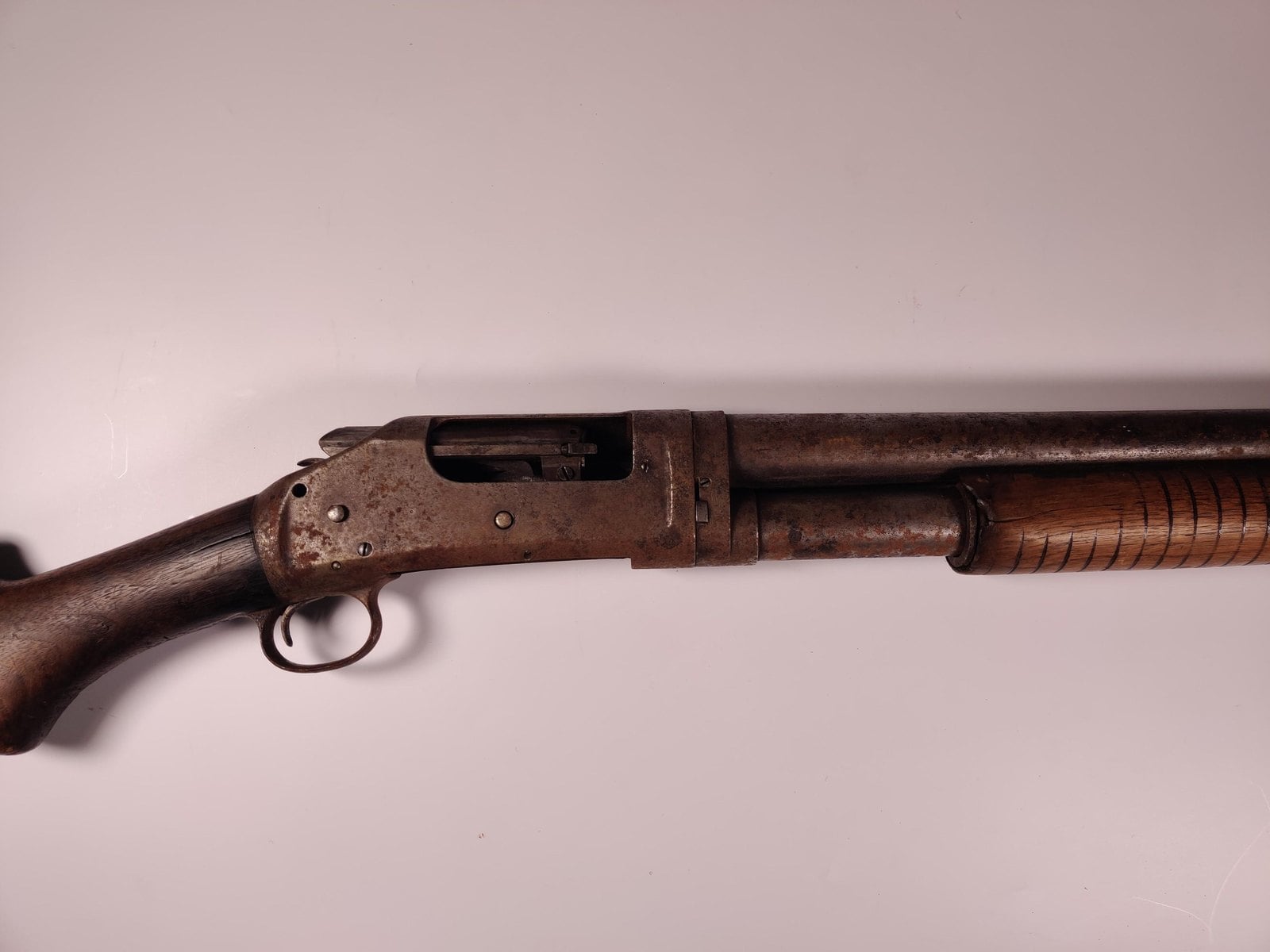
The wear points to check on any 1897 are the takedown joint (it should lock up without wobble), bulges near the choke from steel shot or an obstruction, a cut barrel (measure with a rod from the closed bolt; factory lengths were even inches), cracks in the wrist behind the tang, sanded wood and wrench marks. A refinish hurts value more than honest wear does. Never reblue an original gun: collectors will pay more for worn original blue than for a fresh reblue.
Model 1897 Markings, Serial Numbers and Dating
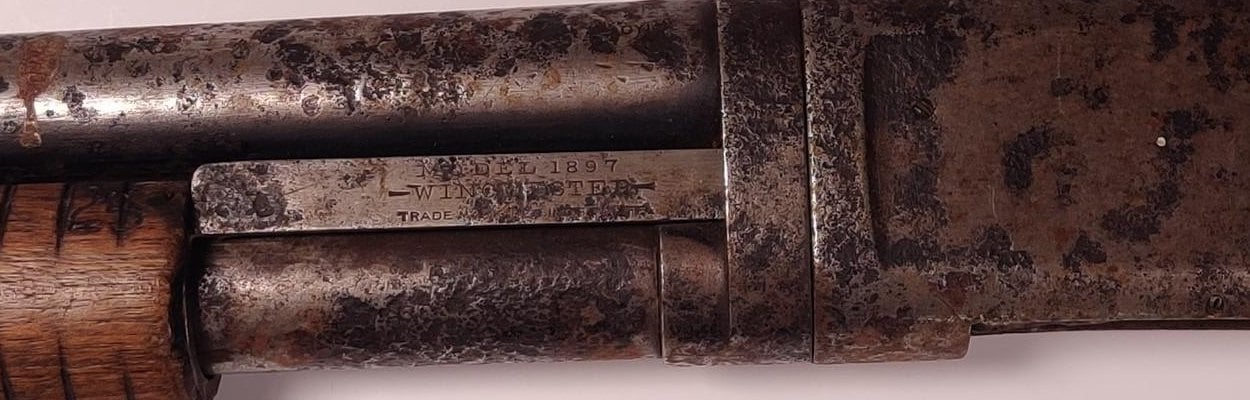
The serial number is on the bottom of the receiver, and on a takedown it’s on the barrel extension too. The two should match. Early guns carry a letter series next to the number (C, D and E), and solid-frame guns were numbered on the receiver only. Until June 1924 the model name was stamped on the left side of the action slide; after that it moved to the barrel as “MODEL 97.” Proof marks started in July 1905.
Here’s the trap nobody else warns you about. Winchester publishes a year-end serial table for the 1897, and so do most collector charts, but it drifts badly from the actual factory records after the First World War. Winchester itself says the numbers for 1897 to 1903 and 1949 to 1957 are estimates. These are real guns dated from the factory ledgers by the Winchester Arms Collectors Association historian, against the year the published table gives:
| Serial | Factory records say | Winchester’s table says |
|---|---|---|
| 391,087 | Late 1907 | 1908 |
| 793,285 | September 1924 | 1928 |
| 862,860 | July 1930 | 1939 |
| 865,796 | March 1931 | 1939 |
| 927,310 | November 1941 | 1947 |
| 954,260 | 1942 to 1943 (a WWII trench gun) | 1950 |
That matters. A 16 gauge the table calls 1939 might be a 1930 gun with a short chamber, and a WWII trench gun the table calls 1950 looks like a postwar gun. Use the factory-record lookup on the Winchester Arms Collectors Association site, and for serials up to 377,999, order a factory letter from the Cody Firearms Records Office, which still holds the full warehouse records for that range. Above 377,999 only the date the serial was recorded survives, so a letter can’t prove a later gun’s barrel, grade or configuration.
Fakes, Conversions and Parts Guns
The Model 1897 trench gun is one of the most faked U.S. military arms. Reproduction heat shields and bayonet adapters are sold openly, and plenty of them end up on cut-down field guns that get resold as the real thing. This reproduction shield, for example, was listed at our dealers for well under $200:
- The wrong frame for the war. WWI trench guns are solid frame with a six-row shield. WWII guns are takedowns with four rows on most. A takedown with a six-row shield, or a WWII gun with no cartouche, needs explaining.
- Markings that don’t fit. WWI guns never have a stock inspector’s cartouche, and many have no martial marks at all. WWII guns have machine-stamped “U.S.” and flaming bombs and a stock cartouche. The WACA historian says ordnance-marked guns outside the known serial ranges are more than likely fakes.
- A Parkerized “factory” gun. Trench guns left Winchester blued. Parkerizing means a rebuild, which isn’t a fake, but it isn’t original either.
- Cut field guns sold as riot guns. Check the crown, the bead position and whether the barrel length is an even inch.
- Mismatched barrel and receiver serials. A mixed gun is a shooter, not a collector piece.
- A Model 1893 sold as a 1897. They look almost the same. The 1893 predates smokeless loads and SASS bans originals as unsafe. Read the markings before you shoot it.
- A Norinco copy in a Winchester listing. Read the right side of the barrel for the IAC import mark.
Winchester Model 1897 Pre-Purchase Inspection Checklist
Here’s the check we run on every 1897 before we pay, with the gun unloaded, the muzzle pointed somewhere safe and the hammer down on an empty chamber:
- Open the action and confirm the chamber and magazine are empty.
- Read the barrel: gauge, choke, patent dates, any “2 3/4″ CHAM” stamp on a 16 gauge, and any Damascus pattern.
- Find the serial on the bottom of the receiver and, on a takedown, the barrel extension. Check that they match.
- Date the gun on the factory-record lookup, not a chart. Note whether it falls at or below 63,867 (antique) or in a military serial range.
- Take the gun down and reassemble it. The barrel should lock up tight with no wobble.
- Check the slide lock. After the hammer falls on an empty chamber, the action should stay locked until you push the slide forward.
- Work the hammer. It should hold at half-cock and full cock and not slip under your thumb.
- Cycle dummy rounds. The shells should feed one at a time, the carrier should lift cleanly and the extractors should grip.
- Look down the bore with a light for pitting, and check the muzzle for bulges, a new crown or an aftermarket choke.
- Check the stock for cracks at the wrist and behind the tang, sanded edges and an added recoil pad.
- On a trench or riot gun, check the frame type, shield rows, marks, cartouche, finish and serial range.
- Get a return privilege in writing if you can’t handle the gun first.
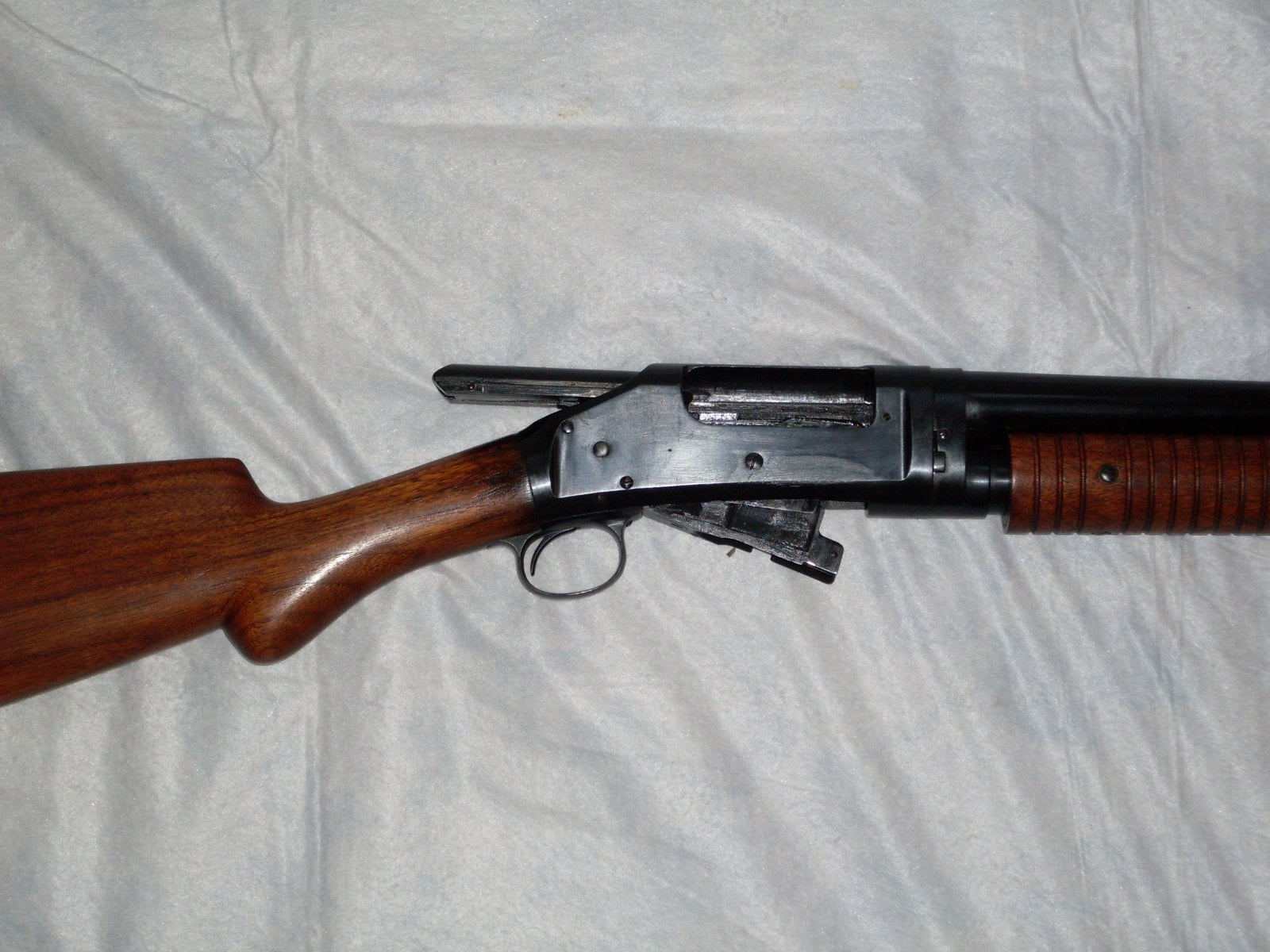
Shooting and Caring for an Old Model 1897
A sound 12 gauge 1897 with a steel barrel is fine with standard 2-3/4 in. lead target and field loads. That’s the advice of the Winchester Arms Collectors Association’s historian, not a factory statement, and he draws the line at a regular diet of magnum shells. We’d add that no factory 3 in. shell belongs in one, and that any 120-year-old gun deserves a gunsmith’s check before its first box.
| Use | Avoid |
|---|---|
| 2-3/4 in. lead target and field loads in any 12 gauge | 3 in. shells and a regular diet of magnums |
| 2-9/16 in. shells in a 16 gauge made before 1930 | Modern 2-3/4 in. shells in an unmarked pre-1930 16 gauge |
| Bismuth for waterfowl | Steel shot through an original choked barrel |
| A gunsmith’s inspection before firing a Damascus barrel | Firing any Model 1893 with modern loads |
For care, keep the takedown joint clean and lightly oiled, and keep oil off the wood. If the barrel gets loose in the receiver, the adjusting sleeve on the barrel extension tightens it. Back out the lock screw, slide the sleeve lock out of its teeth, turn the sleeve counterclockwise a step and lock it again. It’s a job best done by a gunsmith who knows the gun. Winchester lists no factory service or parts for the 1897; it sends owners to independent dealers such as Jack First, Gun Parts Corp. and Nu-Line Guns.
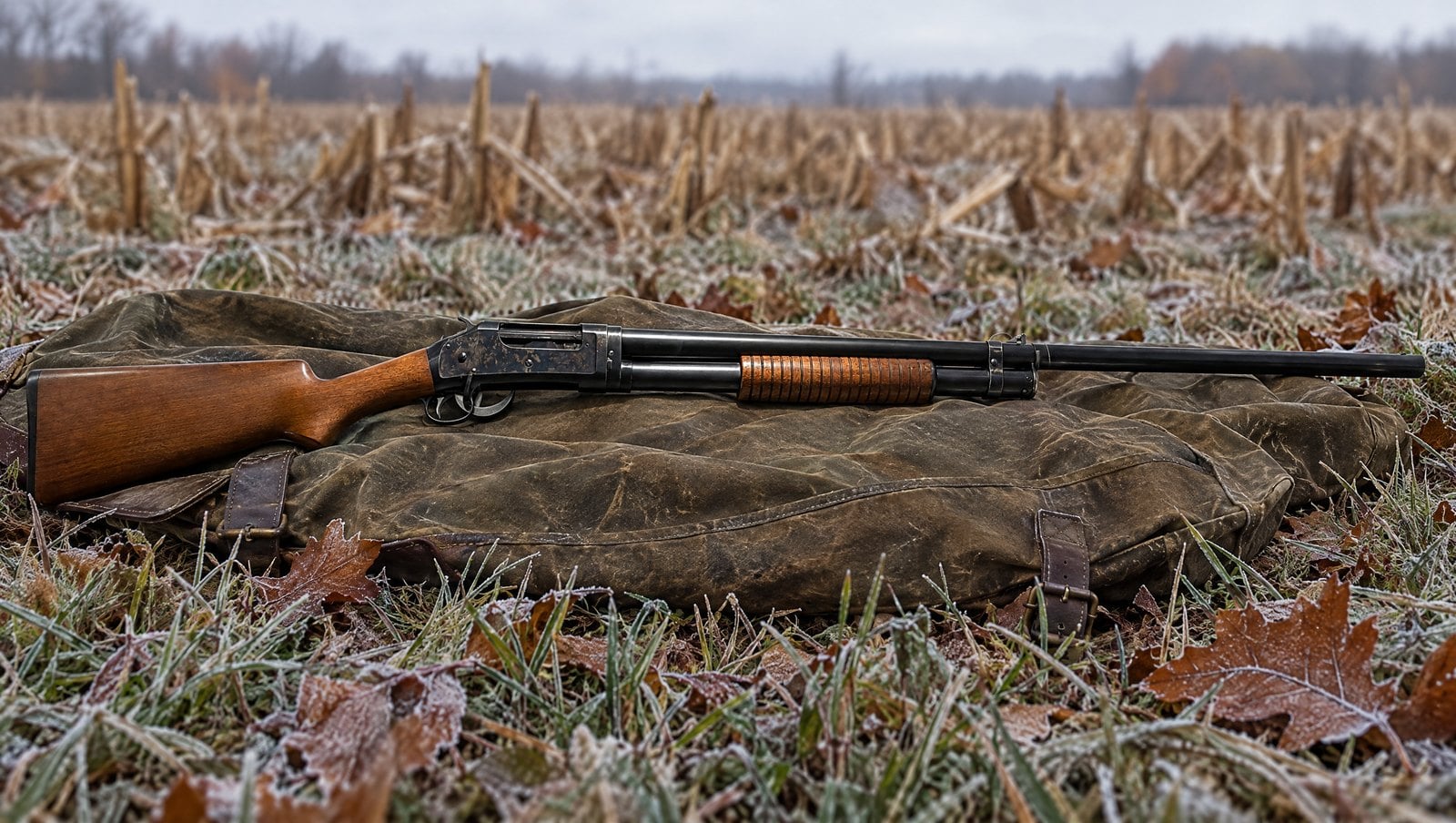
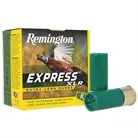
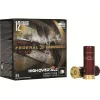
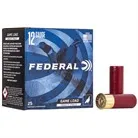
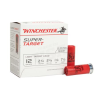
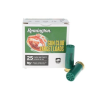
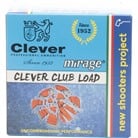
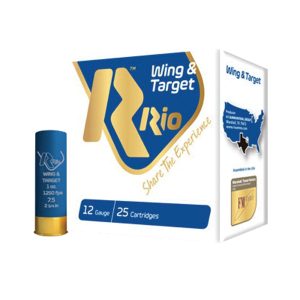
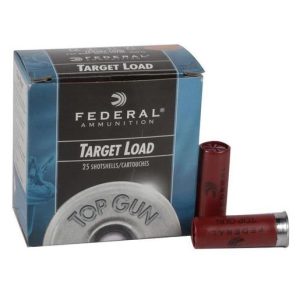
These 2-3/4 in. lead target and field loads are on sale at our dealers right now. We filter out steel, magnums, buckshot and slugs.
Vintage-Safe 12 Gauge Deals for a Model 1897
On-sale 12 gauge vintage from 200+ retailers · Updated every 4 hours



A Short History of the Winchester Model 1897
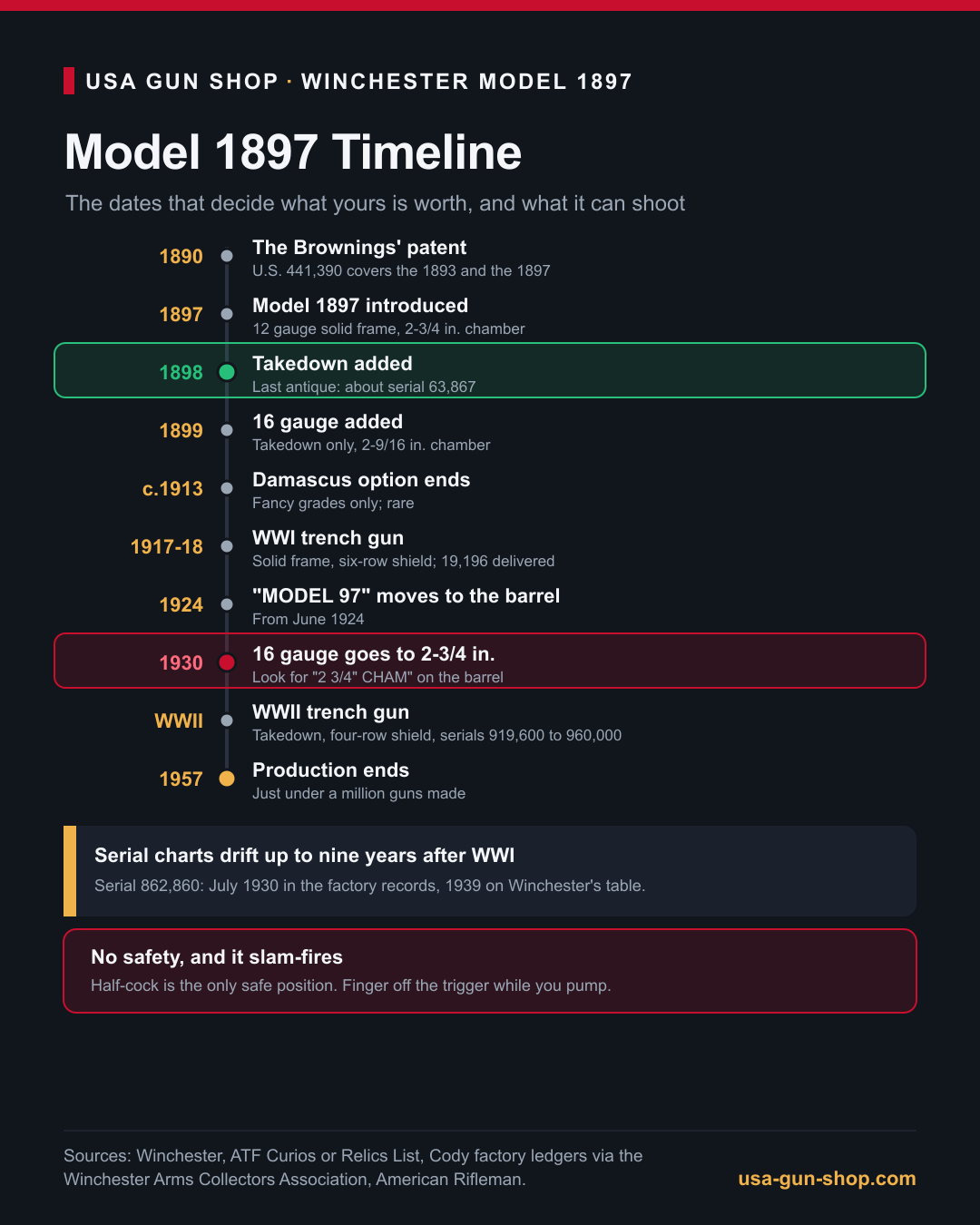
The Model 1897 started as the Model 1893, Winchester’s first slide-action shotgun, designed by John Browning and his brother Matthew. Their 1890 patent covers both guns, and “NOV. 25.90” leads the patent dates stamped on 1897 barrels. The 1893 was a 12 gauge only, and it was too weak for the new smokeless loads. So Winchester built a stronger, longer frame with a solid top and side ejection, added a slide lock and a longer, straighter stock, and cataloged the result in November 1897 as a 12 gauge solid frame.
It sold. Winchester called it the best-selling pump on the market, and the line grew fast: a takedown in 1898, the 16 gauge in 1899, and Trap, Pigeon, Brush and riot versions along the way. In the 1916 catalog a plain gun cost about $25 and an engraved one with fancy wood about $100. Riot guns went to the Philippines around 1900, and express messengers and police carried them for decades.
The First World War made it famous. The Army bought solid-frame riot guns fitted with heat shields and bayonet adapters, most of them to guard prisoners, with about a thousand set aside for combat trials. On September 19, 1918, Germany cabled a protest saying shotguns broke Article 23(e) of the Hague Convention and that any American captured with one “forfeits his life.” The Army’s acting Judge Advocate General, Brig. Gen. Samuel T. Ansell, rejected it a week later, the U.S. said it would keep using the gun, and no executions are known.
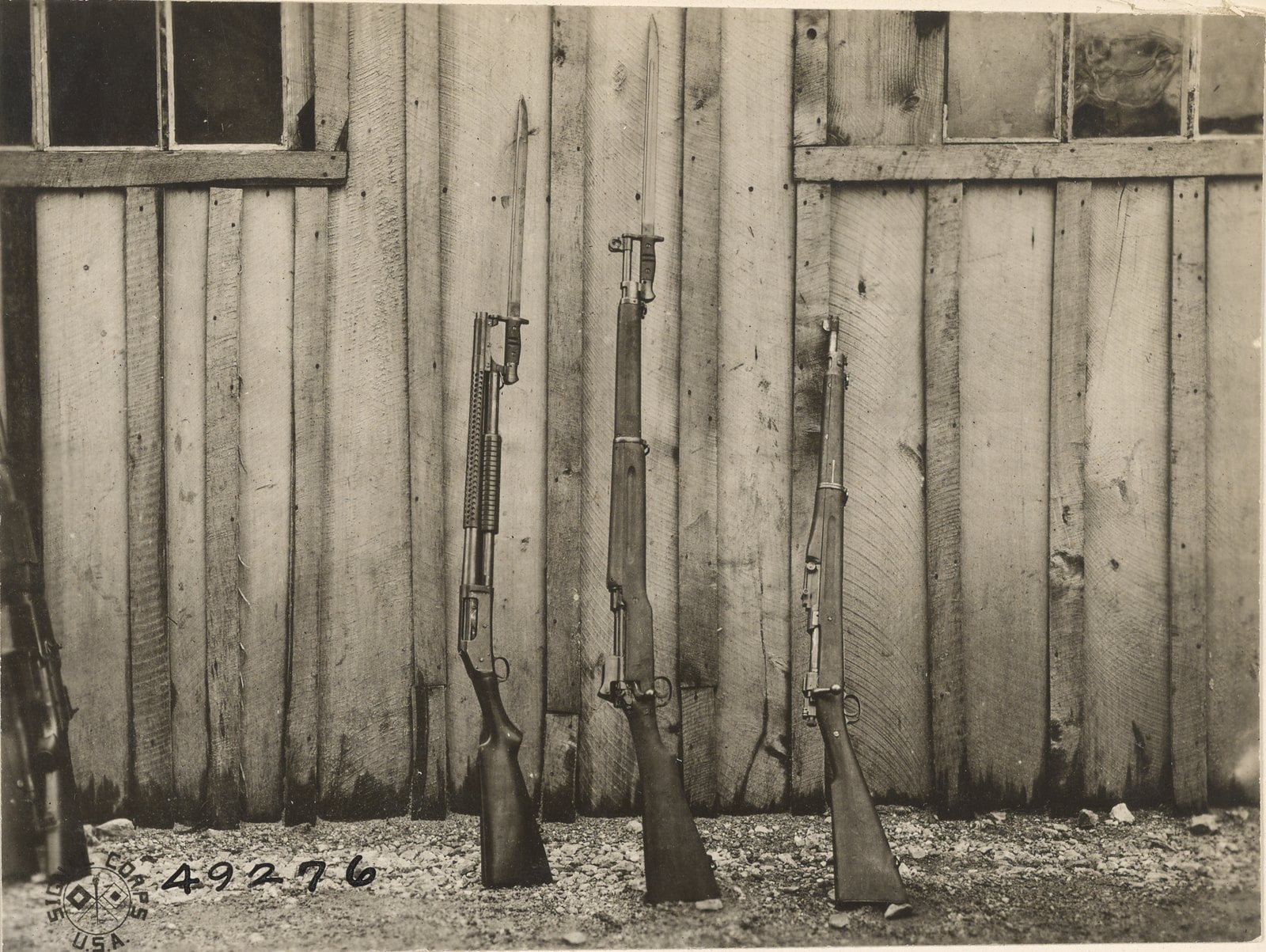
The takedown trench gun went back to war in World War II, and some served in Korea. By then the hammerless Model 12 had been on sale for decades, and Winchester finally dropped the 1897 in 1957. The serial numbers ended at about 1,024,700, but since they started at 34,151, where the Model 1893 left off, the true count is just under a million guns.
Why the Model 1897 Is Still So Popular
Cowboy action shooting brought it back. The Single Action Shooting Society’s 2026 handbook says it plainly: “The only slide action shotgun allowed is the Model 1897 Winchester shotgun, whether original or replica.” Military configurations aren’t allowed in SASS, but Wild Bunch matches accept civilian or military style, and the IAC copy is approved by name.
Hollywood helped too. The 1897 shows up in The Professionals (1966), The Wild Bunch (1969), The Untouchables (1987) and Captain America: The First Avenger (2011), and gamers know it from Call of Duty: World at War (2008). The sawn-off pump in No Country for Old Men (2007) was actually a Norinco copy. And it still has the working history of a real gun: police departments and agencies from the Texas Rangers to the U.S. Border Patrol carried it. See where it fits among our guns of World War I and World War II guns.
Model 1897 Legal Status: Antiques, C&R, Trench Guns and Slam-Fire
Federal law defines an antique firearm as one “manufactured in or before 1898.” From the Cody factory ledgers, the last 1898 gun was serial 63,867, so a Model 1897 made in 1897 or 1898 falls roughly between serials 34,151 and 63,867. Federal law doesn’t treat an antique as a firearm for GCA purposes, but state law may, so check yours. For any gun near the line, a Cody factory letter is the proof. See our guide to antique firearms.
Every other Model 1897 is a curio or relic. ATF’s list names the model directly, covering guns “manufactured between 1899 and 1957, S/Ns 1 through 1,024,700,” and riot guns with original Royal Irish Constabulary markings have their own entry. Trench guns are legal to own like any other shotgun, and slam-fire doesn’t make the 1897 a machine gun, since every shot still takes a stroke of the pump. What can land you in trouble is a cut-down barrel: under federal law a shotgun with a barrel under 18 inches or an overall length under 26 inches is a short-barreled shotgun. Measure any short 1897 before you buy it, and read our guide to the National Firearms Act.
Where to Buy a Winchester Model 1897
- Guns.com. The deepest used selection we track, with detailed photos. Browse Model 1897s on Guns.com.
- Dealers. Estate guns turn up at dealers all the time. Our price card above shows what’s listed today.
- Auction houses. Morphy, Rock Island, Lock, Stock and Barrel and others describe the grade, markings and alterations, but add a buyer’s premium on top of the hammer price. Documented trench guns mostly sell here.
- GunBroker, gun shows and cowboy action clubs. The widest choice of shooters, and club members often know a gun’s history.
- The Civilian Marksmanship Program. In August 2026 The Firearm Blog reported that the CMP expects about 400 Model 1897 trench guns in its first batch of Army shotguns, with terms not yet announced. Watch the CMP site.
Wherever you buy, ask the same questions before you pay:
- What’s the serial, and does the barrel number match the receiver?
- What gauge and chamber, and for a 16 gauge, is the barrel stamped “2 3/4″ CHAM”?
- Is the finish original, and is the barrel uncut?
- For a trench or riot gun, what proves it’s military?
- Can I return it if it isn’t as described?
Winchester 1897 vs. Its Rivals
| Shotgun | Action | Why you’d pick it |
|---|---|---|
| Winchester Model 1897 | Exposed-hammer pump, 1897 to 1957 | The trench gun, the cowboy action pump, Browning’s design |
| Winchester Model 12 | Hammerless pump, 1912 to 1964 | Smoother, stronger, hammerless; the refined successor |
| Browning Auto-5 | Long-recoil semi-auto, 1903 to 1998 | Browning’s other classic, if you want an autoloader |
| Ithaca 37 | Bottom-eject pump, 1937 to today | Still made, lighter, parts and service available |
| Norinco / IAC 97 | Chinese copy of the 1897 | Cowboy action on a budget; not a collector gun |
Model 1897 vs. the Winchester Model 12
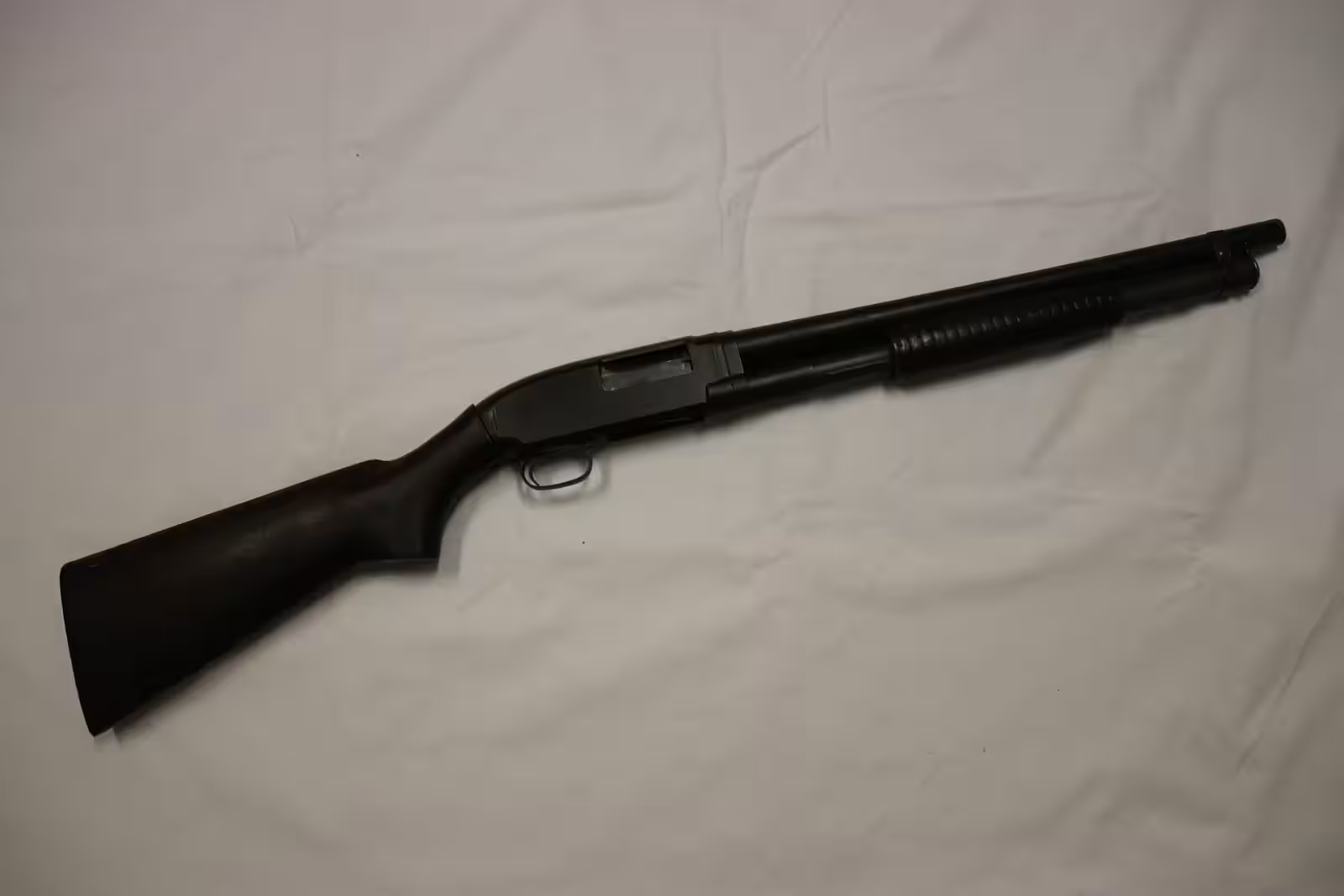
Google’s most-asked question about the 1897 is whether it’s better than the Model 12. For shooting, the Model 12 wins: it’s hammerless, smoother, stronger and far easier to keep running. For history and cowboy action, the 1897 wins, and its exposed hammer is the whole point. Our Winchester Model 12 buyer’s guide covers the Model 12 in the same detail.
Model 1897 vs. the Browning Auto-5 and Ithaca 37
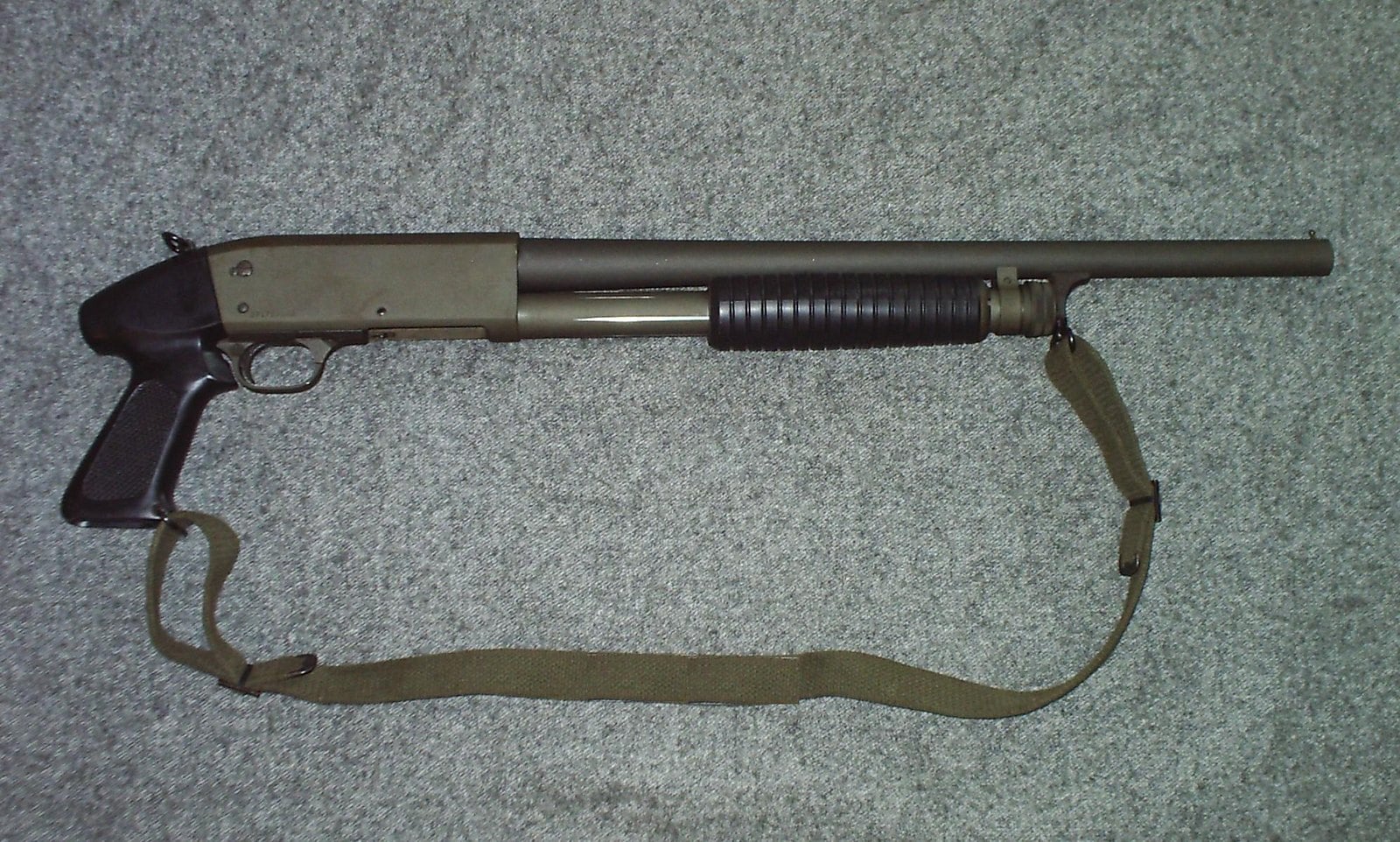
The Browning Auto-5 is Browning’s other long-lived classic, a semi-auto that came along six years later. The Ithaca 37 is the modern-era pump that’s still made, bottom-ejecting and hammerless. Both are better choices than an 1897 if you want a gun to hunt hard with and keep in service.
Final Verdict
The Winchester Model 1897 is Browning’s working-man’s pump, and a sound one still shoots as well as it did when your great-grandfather bought it. Buy a 12 gauge field gun to shoot, pay for a grade or a documented military gun if you collect, and treat every trench gun as a conversion until its frame, marks and serial range prove otherwise. Keep 16 gauges made before 1930 on short shells, keep steel out of original chokes, and keep your finger off the trigger while you pump.
Just under a million made, 60 years in production, and the only pump a cowboy action shooter is allowed to carry. That’s not a bad legacy for a gun with no safety.
FAQ
How much is a Winchester Model 1897 worth?
In 189 completed sales from January 2024 to September 2026, the median Winchester Model 1897 sold for about $650, trench guns left out. Field guns had a median of about $630, riot guns $827 and Trap, Tournament and Pigeon grades $1,448. By gauge, 12 gauges sold for about $655 and 16 gauges $525. Trench guns sell in their own market: the ones with U.S. military marks or a documented war claim had a $3,462 median, while "trench style" guns built from field guns brought about $1,512.
Can a Winchester 1897 shoot modern 2-3/4 inch shells?
A sound 12 gauge Model 1897 can. Every 12 gauge was chambered 2-3/4 in. from the first gun, and the Winchester Arms Collectors Association historian says standard 2-3/4 in. lead loads are fine in a sound gun, though not a regular diet of magnums. The 16 gauge is different: guns made before 1930 have 2-9/16 in. chambers and need 2-9/16 in. shells. Never use steel shot through an original choked barrel, and have any old gun checked by a gunsmith first.
What year is my Winchester 1897 by serial number?
Use the factory-record lookup on the Winchester Arms Collectors Association site rather than a chart. Winchester's published year-end table drifts by up to nine years after World War I: serial 862,860 was made in July 1930, but the table puts it in 1939. For serials up to 377,999, a factory letter from the Cody Firearms Records Office gives the full record.
Is a Winchester 1897 made in 1898 an antique?
Yes, under federal law. An antique firearm is one manufactured in or before 1898, and the factory ledgers put the last 1898 Model 1897 at serial 63,867. Guns made in 1897 and 1898 fall roughly between serials 34,151 and 63,867. State law may treat them differently, and a Cody factory letter is the proof for a gun near the line.
How can I tell if a Winchester 97 trench gun is real?
Start with the frame and markings. WWI trench guns are solid frame with a six-row heat shield and never have a stock inspector's cartouche. WWII guns are takedowns with a four-row shield on most, machine-stamped U.S. and flaming-bomb marks and a stock cartouche, and they left the factory blued. Check the serial against the known military ranges and get an expert opinion, because most trench guns for sale are conversions.
Is it legal to own a Winchester 1897 trench gun?
Yes. A trench gun is legal to own like any other shotgun, and every Model 1897 is a curio or relic. Slam-fire does not make it a machine gun, because each shot still takes a stroke of the pump. What matters is barrel length: under federal law a shotgun with a barrel under 18 inches or an overall length under 26 inches is a short-barreled shotgun.
Is the Winchester Model 1897 still made?
No. Winchester stopped making it in 1957. The Chinese Norinco copy, imported as the IAC '93/'97, and a Cimarron riot gun are the reproductions you will see. They are not curios or relics, and trench-configured copies sell for about $1,000, so read the barrel before you pay.
Which is better, the Winchester Model 1897 or the Model 12?
For shooting, the Model 12. It is hammerless, smoother and stronger. For history and cowboy action, the Model 1897, since it is the only pump SASS allows. A good field gun of either is affordable in 2026: the 1897 at about a $630 median and the Model 12 field gun at about $460.
5,495+ Gun & Ammo Deals
Updated daily from 200+ top retailers. Filter by category, caliber, action type, and price.
Related Guides