

Last updated September 2026 · By Nick Hall. Reviewed against Patrick Sweeney’s Gun Digest Book of the Glock (2014), C.J. Chivers’s The Gun (2010) on the M16/AK manufacturing-materials story, ANSI/SAAMI cartridge and barrel specifications, and the published engineering materials in the aerospace and firearms industries.
Some of the links below are affiliate links, meaning at no additional cost to you, we may earn a commission if you click through and make a purchase.
Table of Contents
Advances in Firearm Materials and Design
Modern firearms are dramatically lighter, more durable, more accurate, and more reliable than the firearms produced even thirty years ago, and the reason is not engineering genius. It is materials science. A 1986 Beretta M9 service pistol made of carbon steel, aluminum, and walnut weighed 35 ounces empty, corroded in salt environments within months without maintenance, and produced 4-inch groups at 25 yards under optimal conditions. The 2026 SIG M17, a roughly equivalent platform, weighs 29 ounces empty, has a stainless-steel slide over a polymer fire-control housing that resists corrosion essentially forever in normal environments, and produces 2-inch groups at the same distance. Same caliber. Same service role. Forty years of materials innovation separates them.
This guide walks through the major materials and design innovations that have reshaped the American firearms market since roughly 1980: the polymer revolution that Glock initiated, the modern steel and barrel-treatment processes that produce 20,000-round duty rifle barrels, the surface coatings that have made stainless and parkerized finishes obsolete in most applications, the modular chassis systems that have turned a service rifle into a Lego-style platform, the optic technology revolution that has made the red-dot sight standard equipment, the 3D-printing and additive-manufacturing dimensions that are now real if not yet dominant, the ammunition-projectile innovations that closed the 1986 ballistics gap, and the niche-but-important role of titanium and other premium materials.
Sources cited throughout: Patrick Sweeney, Gun Digest Book of the Glock (Gun Digest Books, 2014) for the polymer-pistol history; C.J. Chivers, The Gun (Simon & Schuster, 2010) for the M16/AK manufacturing-materials story; ANSI/SAAMI cartridge and barrel specifications; published manufacturer press materials from Glock, SIG Sauer, Smith & Wesson, Walther, and Springfield Armory; and the broader engineering materials literature on aerospace alloys, glass-filled nylons, and surface treatments adopted by the firearms industry.
Material Classes in Modern Firearms at a Glance
The table below maps the major material classes used in modern firearms to where they appear, what they replaced, and the practical consequence for the shooter. The shift from carbon-steel-and-walnut to polymer-and-modern-alloys is the single largest manufacturing change in the history of small arms, and it happened in living memory.
| Material class | Where it appears | What it replaced | Practical consequence |
|---|---|---|---|
| Glass-filled nylon (polymer) | Pistol frames, AR-15 furniture, magazines | Steel and walnut | 30-50% weight reduction; corrosion immunity; lower cost |
| 4140 / 4150 chrome-moly steel | Barrels, bolt carriers | Plain carbon steel | Extended service life (20,000+ rounds); heat resistance |
| 7075-T6 aluminum (forged) | AR-15 lowers, pistol frames | Steel forgings | 2/3 weight at comparable strength; corrosion resistance |
| Stainless steel | Pistol slides, bolt-action receivers | Blued carbon steel | Corrosion immunity in most environments; weight tradeoff |
| Titanium | Lightweight revolvers, suppressor tubes | Steel | 40% weight reduction; corrosion immunity; high cost |
| DLC / Cerakote coatings | Surface finishes | Bluing, parkerizing | Improved corrosion resistance; wear life |
| Chrome lining / Nitride | Barrel bores | Plain steel bore | 2-3x barrel life; better lubricity; harder to clean |
| Carbon fiber | Premium rifle stocks, barrel sleeves | Walnut, fiberglass | Stiffness-to-weight ratio; premium price segment |
The Polymer Revolution: How Glock Changed Everything
The single largest material innovation in modern handguns is the polymer-framed pistol. The 1982 Glock 17, designed by Gaston Glock for the Austrian Army’s pistol trials, used a glass-filled nylon polymer (specifically Glock calls it “Polymer 2”) for the entire fire-control housing, the part that holds the trigger group, magazine, and frame rails. The handgun community was openly skeptical. Polymer was for toys, not service firearms. The Austrian Army adopted the Glock 17 anyway in 1982, and within a decade essentially every major American police department had followed.
The case for polymer was decisive once the durability proved out. A glass-filled nylon frame weighs roughly 40-50 percent less than the equivalent steel frame, costs 70 percent less to manufacture, does not corrode in salt or sweat environments, can be molded to consumer-friendly ergonomic shapes that steel forging cannot easily produce, and absorbs recoil in a way that reduces felt impulse to the shooter. The trade-offs are real but smaller than the gains: polymer is more vulnerable to heat (a polymer frame can deform if left in a 180-degree car interior for extended periods), the wear surfaces still need steel inserts (the slide rails on a Glock are steel embedded in the polymer frame), and the aesthetic still strikes traditional shooters as cheap-looking. None of this has prevented polymer from becoming the dominant material in defensive pistols. Patrick Sweeney’s Gun Digest Book of the Glock (2014) is the participant-historical reference for the transition.
Every major American defensive pistol made today, Glock 17/19/43X, SIG P320 / M17 / M18, Smith & Wesson M&P series, Walther PDP, Springfield Hellcat, FN 509, H&K VP9, uses a polymer frame with steel slide and barrel. The 1911 platform and a handful of premium offerings (SIG P210, P226 with steel frame, custom-shop revolvers) hold out for traditional materials, but they are increasingly niche. The full coverage of the dominant defensive pistol platforms sits in best Glock pistols, SIG M18 / P320 review, and the M&P M2.0 Compact review.
Modern Barrel Technology
The modern centerfire barrel is dramatically more durable than its predecessor of forty years ago. The reason is twofold: better steel (4140 and 4150 chrome-moly alloys with controlled vanadium and chromium content have replaced the plain carbon steels of the World War II era) and better internal treatments (chrome lining, nitriding, and stress-relieving processes that extend barrel life by factors of two to four). A 1960 M14 barrel was good for roughly 5,000-7,000 rounds before accuracy meaningfully degraded. A 2026 chrome-lined 4150 chrome-moly AR-15 barrel routinely produces 20,000+ rounds at the same accuracy threshold.
The chrome-lined-vs-nitride debate is one of the recurring arguments in the AR-15 community. Chrome lining (a hard chrome electroplate deposited on the bore surface) extends bore life dramatically and provides excellent corrosion resistance, but adds approximately 0.0005-0.001 inch to the bore diameter, which can affect precision shooting at extreme ranges. Nitride treatment (Melonite, QPQ, salt-bath nitriding) hardens the surface chemically without changing dimensions, producing comparable wear life with marginally better accuracy potential. For service-grade and home-defense applications, both are excellent and the choice is essentially aesthetic; for precision shooting at 600+ yards, nitride is often preferred. The cluster on AR-15 platforms and the barrel-technology choices that underlie them sits in best AR-15 rifles, with the broader DI-vs-piston operating-system debate in direct impingement vs gas piston.
The premium end of the barrel market uses cold-hammer forging (CHF), where the bore is formed by hammering hot steel over a precision-machined mandrel that produces the rifling. CHF barrels from FN, Daniel Defense, BCM, and Knight’s Armament achieve dimensional consistency that cut-rifled or button-rifled barrels cannot match, at typical price premiums of $150-400 per barrel. For most American shooters the practical difference is negligible; for serious precision shooters and competitive carbine shooters, the difference is real but only emerges past 300 yards.
Finishes and Surface Treatments
The surface-treatment landscape has changed even more dramatically than the underlying steel. Bluing, the classic blue-black oxidation process that protected American firearms from roughly 1900 through the 1980s, provides modest corrosion resistance and pretty aesthetics but degrades to rust quickly without active maintenance. Parkerizing (manganese or zinc phosphate conversion coatings, standard on WWII M1 Garands and 1911s) is more durable but still vulnerable to chemical attack and visually utilitarian. Both have been displaced for serious-use firearms by modern coatings.
The current standard for serious-use surface protection is Cerakote, a ceramic-polymer coating applied by manufacturers and aftermarket shops, with thousands of color and pattern options and durability that resists corrosion, abrasion, and chemical attack better than any previous surface treatment. DLC (diamond-like carbon) coatings are the premium alternative, providing superior hardness and lubricity at significantly higher cost. Both are dramatically more durable than the 20th-century alternatives. The result is a firearm that can be carried daily in sweaty conditions, dropped in mud, taken to the beach, and cleaned with solvent without showing finish wear within the owner’s lifetime.
The cosmetic and customization dimension matters as well. The Cerakote color and pattern market has produced an aftermarket-customization category that essentially did not exist in 1990. A shooter who wants their carry pistol coated in Olive Drab, Cobalt Blue, or Multicam can have it done for $150-300 at any of the major Cerakote shops, and the coating will outlast the underlying steel. This is purely aesthetic but it has changed the relationship between owner and firearm in ways that the bluing-only era did not allow.
Modular Chassis Systems and the SIG MCX Revolution
The modular firearm chassis is the second-largest design innovation of the modern era, behind only the polymer-frame pistol. SIG Sauer’s 2010 P320 platform was the proof of concept: the legally-controlled fire-control unit is a small steel insert that lifts out of one grip module and drops into another, allowing the same pistol to be configured as full-size service pistol, compact CCW pistol, subcompact deep-concealment pistol, or X-Series competition pistol with no parts orders and no gunsmithing. The Army’s 2017 adoption of the M17 / M18 was, in significant part, an adoption of this modularity as a sustainment-and-training principle.
The modularity principle has spread. The SIG MCX rifle, introduced in 2015 and culminating in the XM7 NGSW adoption in 2022, applies the same logic to long arms: the chassis accepts barrel and stock modules to convert between PDW, carbine, designated-marksman rifle, and even (with caliber-conversion kits) different cartridge classes. The SCAR, the SteyrM and the H&K HK416 A8 all push the modularity principle in different directions. The full coverage of the procurement decisions that drove this lives in how the military buys its guns; the civilian-MCX evaluation in our SIG MCX coverage; the broader military-vs-civilian materials gap in military vs civilian firearms.
Optics Technology
The optical-sighting revolution between roughly 1990 and 2026 may be the largest single capability shift in American small arms in the last forty years, larger even than the polymer-pistol transition. The 1990 American infantryman and police officer carried iron-sighted firearms. The 2026 American operator carries red-dot or holographic-sighted pistols and magnified-or-LPVO-equipped rifles, frequently with thermal or image-intensified night-vision overlay. The hit probability at 300 yards roughly doubled in this period; the time to first aimed shot at close range fell by half.
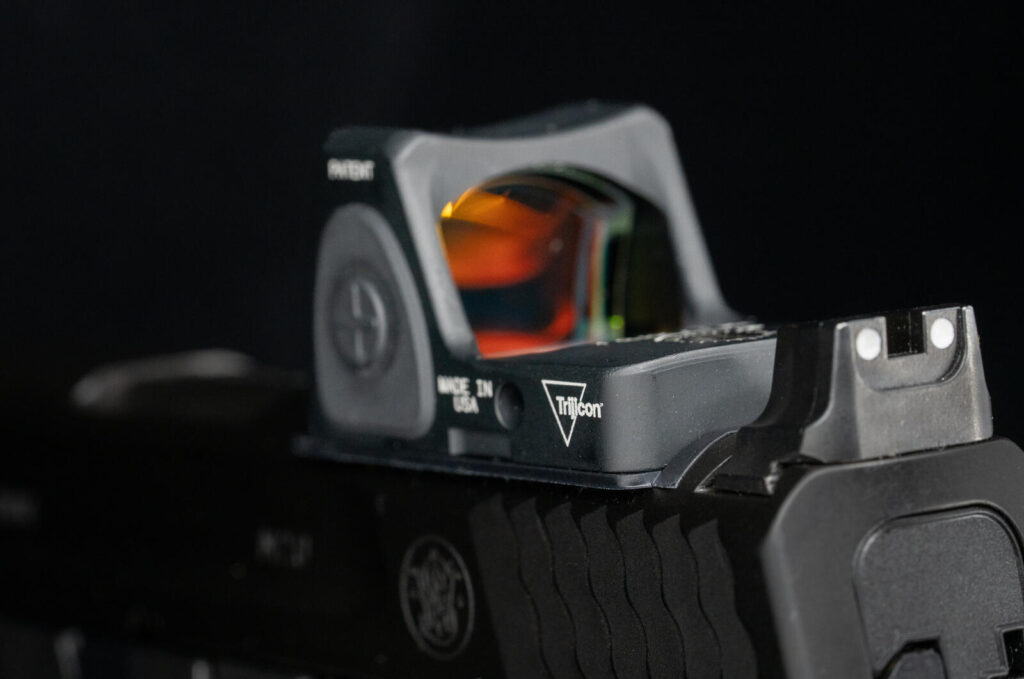
The materials story underneath this optical revolution is glass coating and LED technology. Modern multi-coated optical glass (Schott, Hoya, and the various proprietary coatings from Aimpoint, Trijicon, and EOTech) transmits 92-98 percent of visible light, where 1980-era optics transmitted 70-80 percent. The brightness, clarity, and color fidelity advantage is enormous, particularly in low-light conditions. Modern LED illumination with battery lives measured in years (an Aimpoint Comp M5 runs for 5+ years on a single AAA battery) has replaced the tritium-illuminated reticles that dominated 1990s tactical optics. The cluster on the optic market that has emerged from this technology sits in best red dot sights for pistols, best AR-15 red dot sights, best rifle scopes, and best thermal scopes.
3D Printing and Additive Manufacturing
Additive manufacturing, 3D printing, has moved from curiosity to legitimate manufacturing pathway for specific firearm components over the last decade. The current legitimate applications are concentrated in the polymer-frame and accessory markets, where FDM (fused deposition modeling) printing of glass-filled nylon and SLS (selective laser sintering) of nylon powder produce parts at quality levels acceptable for serious use. The Solid Concepts 1911 demonstration in 2013 proved that DMLS (direct metal laser sintering) could produce a fully metal-printed handgun that fires reliably, but the cost was orders of magnitude higher than commercial 1911 production and the application remained a proof of concept.
The legitimate-citizen at-home application of additive manufacturing has settled into accessories: magazine baseplates, grip panels, foregrip texture inserts, range-gear mounts. The federal legal framework permits manufacture of firearms for personal use by non-prohibited persons, with state laws varying significantly. The cluster on 3D printing specifically, including the FGC-9 hybrid-design pathway and the federal regulatory framework, sits in 3D printed guns; on the broader build-it-yourself pathway in how to build an AR-15.
Ammunition Innovation
The ammunition-projectile innovations of the last thirty-five years have closed the historical terminal-ballistics gap between major handgun calibers and have produced precision-rifle ammunition that delivers measurably better terminal performance and accuracy than the loads of the 1990s. The driving innovations: bonded-core jacketed hollow points (Speer Gold Dot, Federal HST, Winchester Ranger T-Series) that retain mass through barriers; controlled-expansion designs (Hornady Critical Duty, Critical Defense) that perform consistently across velocity ranges; lead-free projectiles (Barnes TSX, Hornady GMX) that meet California and some federal land restrictions; and case-improved cartridges (6.5 Creedmoor, 6.5 PRC, 6.8 Western, 6.8×51 Common Cartridge) that combine modern projectile design with optimized case geometry.
The polymer-cased ammunition family (True Velocity, SIG’s polymer-cased variants in the NGSW competition) represents the most aggressive recent innovation, with significant weight reductions over conventional brass-cased ammunition but manufacturing scale challenges. The Army’s 2022 selection of conventional brass-cased SIG 6.8×51 over Textron’s polymer-cased CTSAS was a manufacturing-risk decision, not a performance decision. Polymer-cased ammunition will likely come to market in the next decade as the manufacturing scale problems resolve. The cluster on the ammunition market that has emerged from these innovations sits in best 9mm ammo, best AR-15 ammo, and best defensive ammo.
Titanium and Premium Materials
Titanium occupies a niche in modern firearms where weight reduction matters more than cost. The classic titanium application is the lightweight snub-nose revolver: a Smith & Wesson 340PD or Ruger LCR with titanium cylinder weighs roughly 12 ounces empty versus 20+ ounces for the steel-cylinder equivalent. The recoil penalty is real (less mass to absorb the recoil impulse), but for a deep-concealment backup gun the weight advantage is decisive. The other major titanium application is suppressor construction, where titanium tubes (KGM, OSS, SureFire) provide acceptable thermal performance at significantly lower weight than steel.
Carbon fiber has emerged as the premium stock and barrel-sleeve material in the precision-rifle market. A carbon-fiber-wrapped barrel (Proof Research, Christensen Arms) provides the dimensional stability and stiffness-to-weight of a heavy steel barrel at the weight of a sporter contour, at significant price premium. Carbon-fiber stocks (McMillan, Manners, AG Composites) offer dimensional stability through temperature and humidity changes that walnut or fiberglass cannot match. For the precision-rifle community these materials have become standard; for general hunting and defensive use they remain premium options.
The broader materials landscape continues to evolve. The aerospace alloys, advanced polymers, and surface treatments developed for aircraft, automotive, and medical applications are routinely adopted by firearms manufacturers within five to ten years of their introduction in those primary industries. The cluster on the historical materials story that produced the modern firearm sits in how firearms changed warfare; the procurement context that drove specific material adoptions in how the military buys its guns; the rifle-market that benefits most directly from materials innovation in best hunting rifles.
The Bottom Line
The American firearms market in 2026 is the product of a materials and design revolution that happened in living memory. The polymer-frame pistol, the chrome-moly barrel with nitride lining, the Cerakote-coated stainless slide, the modular fire-control chassis, the red-dot or LPVO optic, the bonded-core JHP defensive ammunition, and the carbon-fiber precision-rifle barrel together produce firearms that outperform their 1986 ancestors on essentially every measurable dimension, weight, durability, accuracy, reliability, corrosion resistance, and consumer affordability. None of this was inevitable; all of it was the product of specific engineering decisions and specific manufacturing investments made over the last forty years.
The takeaway for the American shooter: the gun you can buy today is better than the gun your father bought, by a wide margin and across every metric that matters. The decisions made in materials-science laboratories, in optic-coating plants, and in modular-chassis design rooms have produced a defensive-firearm market that is more capable, more accessible, and more durable than at any point in American history. The next decade of innovation, polymer-cased ammunition, more aggressive carbon-fiber adoption, additive-manufacturing scale-up, will likely continue the trend.
Related Guides
- How Firearms Changed Warfare, the broader historical context.
- How the Military Buys Its Guns, procurement decisions that drove materials adoption.
- Military vs Civilian Firearms, materials and design differences between service and civilian markets.
- 3D Printed Guns, the additive-manufacturing dimension.
- Best Glock Pistols, the polymer pistol that started the revolution.
- SIG M18 / P320 Review, the modular fire-control unit in detail.
- Best AR-15 Rifles, the aluminum-frame service rifle market.
- Direct Impingement vs Gas Piston, the operating-system trade-off.
- Best Rifle Scopes, the optics revolution.
- Best Defensive Ammo, the projectile innovations.
Sources and Further Reading
- Patrick Sweeney, Gun Digest Book of the Glock (Gun Digest Books, 2014).
- C.J. Chivers, The Gun (Simon & Schuster, 2010).
- ANSI/SAAMI Voluntary Industry Performance Standards for Centerfire Ammunition.
- U.S. Department of Defense Next Generation Squad Weapon program documentation.
- Engineering Materials Handbook and the aerospace materials standards for 7075-T6 aluminum, 4140/4150 chrome-moly steel, and glass-filled nylon polymers.
- Manufacturer press materials from Glock, SIG Sauer, Smith & Wesson, Walther, Springfield Armory, FN, and H&K.
- U.S. Army Aberdeen Proving Ground published materials testing data.
Frequently Asked Questions
Why are modern guns made of polymer instead of steel?
Polymer frames offer 30 to 40 percent weight reduction compared to steel, excellent corrosion resistance, lower manufacturing cost, and the ability to mold complex ergonomic shapes. Modern glass-filled nylon polymers are remarkably strong and durable. Glock proved the concept in 1982, and today nearly every major manufacturer produces polymer-framed handguns. Military adoption by dozens of countries has proven their durability in harsh conditions.
What is a carbon fiber barrel?
A carbon fiber barrel wraps a thin steel liner with carbon fiber composite material. The result is a barrel that weighs 40 to 60 percent less than solid steel, dissipates heat faster to reduce mirage, and delivers accuracy comparable to premium match barrels. Companies like Proof Research, BSF Barrels, and Christensen Arms manufacture them. They cost 400 to 800 dollars but offer genuine performance advantages for lightweight hunting rifles and precision builds.
What is Cerakote?
Cerakote is a ceramic-based polymer coating applied to firearms for corrosion resistance, abrasion resistance, and aesthetics. It is sprayed on and cured at high temperature, creating a thin but extremely durable finish. Cerakote is available in hundreds of colors and patterns and has become the industry standard for custom and factory firearms finishes. It outperforms traditional bluing and parkerizing in corrosion and wear resistance.
How has ammunition technology improved?
Modern defensive ammunition uses bonded cores that prevent bullet fragmentation, engineered jacket designs that ensure consistent expansion, and advanced propellants that maximize velocity from given case volumes. These advances are why modern 9mm hollow points now match .45 ACP in FBI ballistic gel testing. Short-barrel-optimized loads like Hornady Critical Defense are designed specifically for concealed carry pistols. The Sig 6.8x51mm hybrid case pushes cartridge technology further.
Why is polymer used in modern handguns?
Polymer (glass-filled nylon) replaced steel as the dominant pistol-frame material because it offers a roughly 40-50 percent weight reduction at comparable strength, costs 70 percent less to manufacture, does not corrode in salt or sweat environments, and absorbs recoil in a way that reduces felt impulse to the shooter. The 1982 Glock 17 proved the concept; by 2000 essentially every major American police department had transitioned. The wear surfaces still need steel inserts (the slide rails on a Glock are steel embedded in polymer), and polymer is more vulnerable to extreme heat than steel, but the trade-offs are small relative to the gains.
What is the difference between chrome-lined and nitride barrels?
Chrome lining is a hard chrome electroplate deposited on the bore surface; it extends bore life dramatically and provides excellent corrosion resistance, but adds approximately 0.0005-0.001 inch to the bore diameter, which can affect precision shooting at extreme ranges. Nitride treatment (Melonite, QPQ, salt-bath nitriding) hardens the surface chemically without changing dimensions, producing comparable wear life with marginally better accuracy potential. For service-grade and home-defense applications, both are excellent and the choice is essentially aesthetic; for precision shooting at 600+ yards, nitride is often preferred.
How long does a modern AR-15 barrel last?
A modern chrome-lined or nitrided 4150 chrome-moly AR-15 barrel routinely produces 20,000+ rounds at the same accuracy threshold under normal use. A 1960-era M14 barrel was good for roughly 5,000-7,000 rounds before accuracy meaningfully degraded. The improvement comes from better steel (4140 and 4150 chrome-moly alloys with controlled vanadium and chromium content) and better internal treatments (chrome lining, nitriding, stress-relieving processes). Cold-hammer-forged (CHF) barrels from FN, Daniel Defense, BCM, and Knight's Armament can exceed 30,000 rounds at premium price points.
3,976+ Gun & Ammo Deals
Updated daily from 200+ top retailers. Filter by category, caliber, action type, and price.
Related Guides