

Last updated October 2026
Some of the links below are affiliate links, meaning at no additional cost to you, we may earn a commission if you click through and make a purchase.
- Treat every gun as loaded
- Point the muzzle in a safe direction
- Keep your finger off the trigger until you’re ready to shoot
- Know your target and what’s beyond
The Savage 99 is the lever action that doesn’t look like a cowboy gun. There’s no exposed hammer, no tube under the barrel, and a little window on the left side of the receiver tells you how many rounds are left in its rotary magazine. Arthur Savage’s design started as the Model 1895, became the Model 1899, was renamed the Model 99 in 1920, and stayed in production until 1997, with more than a million made. Its spool magazine let it use pointed bullets when other lever guns couldn’t, which is why it was chambered for everything from the .303 Savage to the .308 and .358.
It’s also a gun with a confusing family tree. The same model letters mean different rifles before and after World War II, serial numbers stop being easy to read after 1950, and Savage Arms won’t service most of them. This guide sorts it out, with 681 completed sales broken down by caliber and model, a serial and lever-code dating guide, and a range session with a 1920s .300 Savage takedown and a postwar 99F in .308.
Quick take
A Savage 99 is one of the best-handling deer rifles ever made, and good ones still sell for less than many new lever guns. Buy a postwar 99F, 99EG or 99C in .308 or .300 Savage to hunt with, pay extra for rare calibers like the .358 only if you collect, and check the magazine and the wood at the tang before you pay.
- Typical price (2025 to 2026 sales): about $799 for a typical Model 99; about $730 in .300 Savage, $809 in .308 and $847 in .250-3000; about $725 for a 99E, $885 for a 99C and $950 for a 99F
- Calibers: more than a dozen; .300 Savage and .308 Win. are the most common
- Made: Model 1895 from 1895, Model 1899 from 1899, renamed Model 99 in 1920, ended 1997; Savage has no plans to bring it back
- Legal: rifles made before about October 1976 are curios or relics; most Model 1895s are federal antiques
How we tested: Every pick here is ranked against our testing methodology. Minimum round counts, accuracy and reliability protocols, the failures that disqualify a gun.
Savage 99 Pros and Cons
Pros
- Takes pointed bullets safely
- Strong action for .308 and .358
- Scopes cleanly on postwar receivers
- Most sell for under $900
- Easy to date by lever code
- Slim, quick-handling receiver
Cons
- Savage no longer services most
- Model letters mean two guns
- .300 and .250 ammo is pricey
- Spool magazine hates long ammo
- Buttstocks crack at the tang
- Prewar rifles easy to devalue
Savage 99 at a Glance
| Spec | Savage Model 99 |
|---|---|
| Action | Lever action, hammerless (internal hammer), rear-locking bolt, cocking indicator pin on the tang from about 1908 |
| Magazine | Rotary spool, 5 rounds plus 1 in the chamber, with a cartridge counter on the left side; 4-round detachable box on the 99C (1965 on) |
| Calibers | .303 Savage, .30-30, .22 Hi-Power, .250-3000, .300 Savage, .243, .308, .358, .284, .22-250, 7mm-08, .375 Win. and more |
| Barrels | 20 to 26 in. on sporting rifles; 22 and 24 in. most common |
| Twist | 1:12 in. (.300 Savage, .308); 1:14 in. (.250-3000) |
| Weight | About 7.75 lb. for a 99C; featherweights about a pound lighter than standard rifles |
| Safety | Sliding catch on the lever to 1960; tang safety from 1960 (99E kept the lever safety) |
| Made | Utica, N.Y. to 1946; Chicopee Falls, Mass. 1947 to 1959; Westfield, Mass. 1960 to 1997 |
| Legal | Curio or relic if made before about October 1976; most Model 1895s are antiques |
Table of Contents
What It’s Actually Like to Shoot a Savage 99: Myth vs. Truth
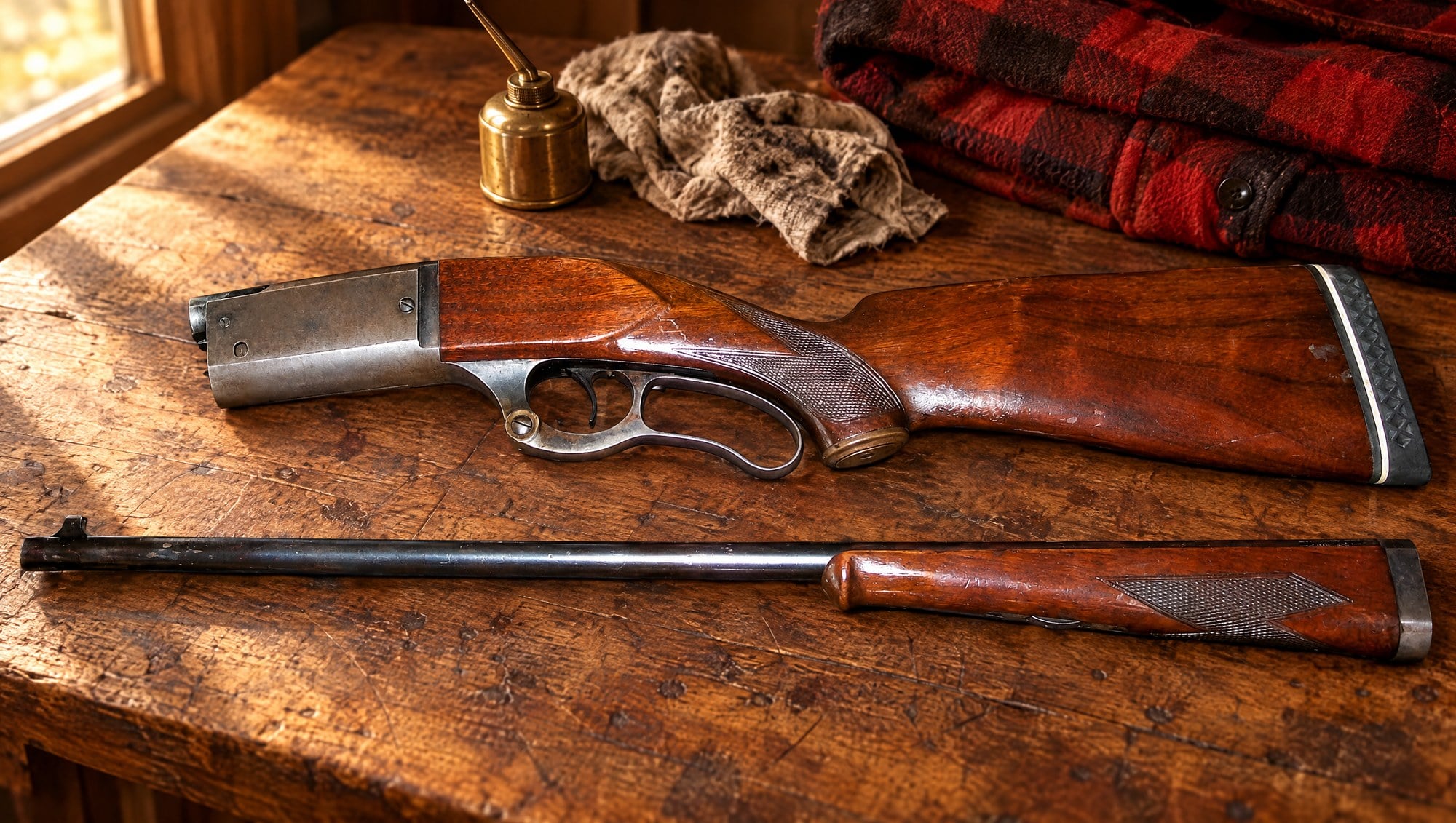
We shot two rifles. The first was a 1925 99G takedown in .300 Savage with a Lyman receiver sight, the kind of rifle that hunted deer for three generations. The second was a postwar 99F featherweight in .308 Win. with a low-power scope on its factory-drilled receiver. Before shooting we checked the counter on both by loading dummy rounds and watching it run 5, 4, 3, 2, 1, 0, looked hard at the wood behind the tang, and checked that the takedown joint on the old gun locked up tight.
We fired 300 rounds over two sessions: Federal’s 150-grain .300 Savage Power-Shok, a 150-grain soft-point handload and Remington Core-Lokt, plus 150-grain .308 soft points. The lever stroke is short and smooth, and the action feels like a single machined piece rather than a collection of parts. The old gun’s trigger broke at 4 lb 15 oz with a little creep, which is normal; leave the sear alone, because lightening it is how 99s get dangerous.
With the receiver sight, the 99G averaged 3.4 inches for five-shot groups at 100 yards, and it kept every shot in a 10-inch circle at 200. Offhand at 50 yards it held 2 to 3 inches all morning. The scoped 99F in .308 did better on the bench, averaging under 2 inches at 100 with factory soft points. Recoil from the .300 Savage is mild, and both rifles came up to the shoulder like a good shotgun. No feeding problems, though overall-length matters: one long handload dragged in the spool until we seated the bullet deeper.
| The myth | What we found | Evidence |
|---|---|---|
| “The .300 Savage is just a .308.” | It isn’t. The .308 has a longer neck and case, and SAAMI rates the .300 Savage at 47,000 psi against 62,000 for the .308. Never fire .308 in a .300 Savage rifle. | SAAMI; American Rifleman |
| “Prewar 99s are always worth more.” | Not in actual sales. Prewar rifles sold for a median of $755, below postwar guns at $805 and Westfield guns at $855. Rare calibers and condition bring the money, not age alone. | Our sales data |
| “Box-magazine 99Cs are worth less than rotary guns.” | It’s the reverse. Box-magazine rifles sold for a median of $894, against $806 for rotary-magazine guns. | Our sales data |
| “Tang-safety 99s are inferior.” | The tang safety arrived with the 1960 Westfield guns. It marks the era; it isn’t a defect. | American Rifleman; Gun Digest |
| “You can’t scope a Savage 99.” | Savage drilled and tapped receivers at the factory from about 1950. Scoping a postwar 99 is easy; drilling a prewar collector gun hurts its value. | Towsley; van Zwoll |
| “You can’t use pointed bullets in a lever gun.” | The 99’s spool holds each round apart, so pointed bullets are safe. That was the whole point of the design. | American Rifleman |
Who the Savage 99 Is For (and Who Won’t Enjoy It)
Buy a Savage 99 if you are
- A woods deer hunter. It carries flat, points fast and shoots modern pointed bullets in .308 or .300 Savage.
- A lever-gun fan who wants a scope. The postwar receivers take a scope cleanly, with no top ejection to get in the way.
- A collector of calibers and variants. More than a dozen chamberings and a long list of model letters make the 99 a collection in itself.
- Someone who wants a rifle with history. Few American hunting rifles stayed in production for nearly a century.
Skip it if you are
- A high-volume shooter or reloader who wants hot loads. A bolt-action .308 is the better tool; see our best deer rifles.
- Looking for a cheap lever gun to plink with. A Marlin 336 or a Winchester 94 in .30-30 costs less to feed.
- Expecting factory service. Savage only services guns made after November 1995, which leaves out almost every 99.
- A rimfire lever fan. Look at the Marlin 39A instead.
What a Savage 99 Costs in 2026
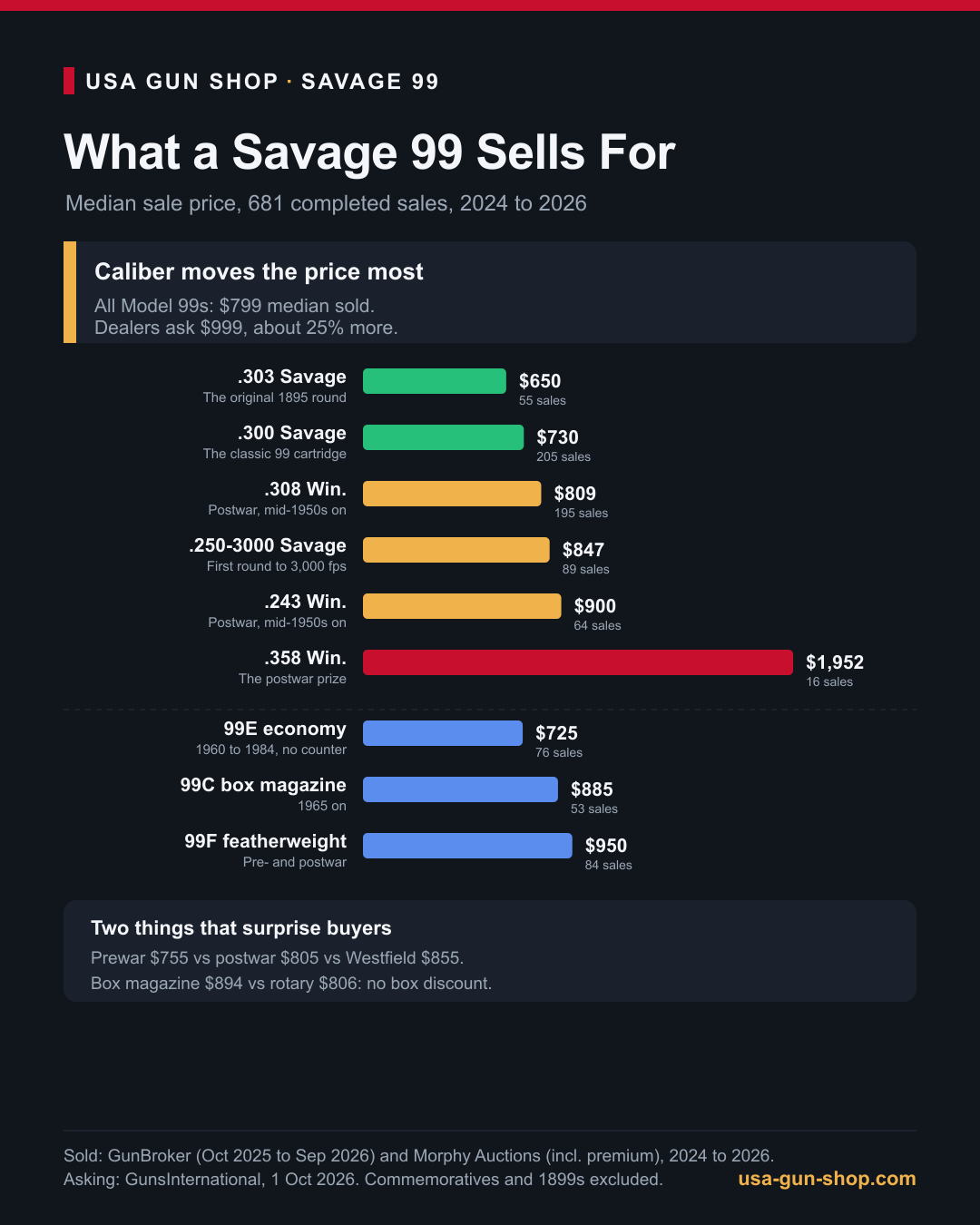
These are sale prices, not asking prices. We tracked 681 completed sales of Model 99s: GunBroker sales from October 2025 to September 2026 plus 50 Morphy Auctions lots from 2024 to 2026, which include the buyer’s premium. Model 1899s, Model 1895s and commemoratives are counted separately. Most sellers don’t state a grade, so treat the condition figures as a guide.
Prices by caliber
| Caliber | Median sale | Range seen | Sales tracked |
|---|---|---|---|
| .303 Savage | $650 | $271 to $1,825 | 55 |
| .300 Savage | $730 | $380 to $2,700 | 205 |
| .308 Win. | $809 | $400 to $5,531 | 195 |
| .250-3000 Savage | $847 | $500 to $1,851 | 89 |
| .30-30 Win. | $855 | $449 to $1,300 | 25 |
| .243 Win. | $900 | $505 to $4,075 | 64 |
| .22 Hi-Power | $946 | $450 to $1,600 | 14 |
| .375 Win. | $1,125 | $922 to $1,800 | 3 |
| .284 Win. | $1,400 | $1,376 to $2,550 | 5 |
| .358 Win. | $1,952 | $584 to $3,401 | 16 |
| All Model 99s | $799 | $271 to $6,126 | 681 |
Prices by model
| Model | Median sale | Range seen | Sales tracked |
|---|---|---|---|
| 99E | $725 | $455 to $1,150 | 76 |
| 99EG | $750 | $400 to $1,550 | 49 |
| 99M | $790 | $584 to $1,820 | 11 |
| 99C (box magazine) | $885 | $485 to $6,126 | 53 |
| 99T | $885 | $775 to $1,480 | 7 |
| 99G | $915 | $652 to $1,825 | 8 |
| 99A | $925 | $555 to $1,800 | 27 |
| 99F | $950 | $400 to $2,955 | 84 |
| 99R | $1,050 | $630 to $1,300 | 9 |
| 99H carbine | $1,090 | $449 to $1,300 | 6 |
| 99CD | $1,125 | $782 to $1,851 | 11 |
| 99DL | $1,212 | $584 to $1,650 | 8 |
| 99DE Citation (engraved) | $4,075 | $3,120 to $5,531 | 3 |
A few things stand out. Caliber moves the price more than anything: a .358 Win. brings more than twice what a .300 Savage does. Age alone doesn’t: prewar rifles sold for a median of $755, below postwar Chicopee Falls guns at $805 and Westfield guns at $855. Box-magazine rifles sold for $894 against $806 for rotary guns, and solid-frame rifles for $908 against $738 for takedowns.
Early rifles and special editions
| Gun | Median sale | Range seen | Sales tracked |
|---|---|---|---|
| Model 1899 | $750 | $326 to $1,920 | 113 |
| Model 1895 | $1,075 | $987 to $1,200 | 4 |
| 1970 Model 1895 75th Anniversary | $825 | $620 to $1,200 | 19 |
| 99CE Centennial | $3,825 | $3,500 to $4,825 | 3 |
Asking prices run above sale prices. On the day we checked GunsInternational, Model 99s had a $999 median asking price, about 25% over the $799 median sale. Prewar rifles were asked at 49% over what they sell for, and Model 1899s at 87% over.
The live cards below show current listings from more than 200 dealers. Savage 99s are all used guns now, so expect single rifles rather than stock, and expect the cards to change from week to week.
Guns.com lists dozens of used Savage 99s, from 99Es to prewar takedowns, with photos of each rifle. See every Savage 99 on Guns.com
One warning about price-guide sites: the “99” and “1899” pools on popular price sites mix in Arisaka Type 99 rifles, Barrett M99s and Krags dated 1899, which is why their averages make no sense. Use the sale prices above for the exact model and caliber you’re buying.
Which Savage 99 to Buy: The Model Letters
Savage used letters to name its variants, and it reused some of them. A prewar 99-C is a short rifle; a postwar 99C is the box-magazine gun. Read the letter together with the era, and the table below will keep you straight.
| Model | Years | What it is |
|---|---|---|
| 1895 | 1895 to 1899 | The first hammerless lever action, made by Marlin, .303 Savage only; about 5,000 to 6,000 made |
| 1899-A, B, C | 1899 to 1915 (A to 1926) | 26 in. round, octagon and half-octagon barrels |
| 1899-D musket | 1899 to 1915 | .303 military musket; a batch went to Canada’s Montreal Home Guard in WWI |
| 1899-F carbine | 1899 to 1919 | 20 in. saddle-ring carbine |
| 1899 .250-3000 | 1914 to 1921 | The deluxe takedown that launched the .250-3000 |
| 99-B, F, G, K | 1920 to 1940 | Prewar takedowns, from the lightweight F to the engraved K |
| 99-E, A, H, T | 1922 to 1940 | Lightweights, the 99-H carbine and the 99-T deluxe featherweight |
| 99-R, RS, EG | 1932 to 1960 | Solid-frame rifles that bridged the war; RS had a tang sight |
| 99F featherweight | 1955 to 1973 | Postwar lightweight, model name on the barrel, .243/.308/.358 |
| 99DL, DE, PE | 1960 to 1973 | Monte Carlo stocks; DE and PE were engraved |
| 99E | 1960 to 1984 | Economy model, birch stock, no counter, lever safety; the last rotary 99 |
| 99C | 1965 to 1997 | Detachable 4-round box magazine; reintroduced in .243 and .308 for the end of the run |
| 99A saddle gun, 99-375 | 1971 to 1982, 1980 | Straight-grip and brush guns, including .375 Win. |
Prewar takedowns (1899 to 1940)
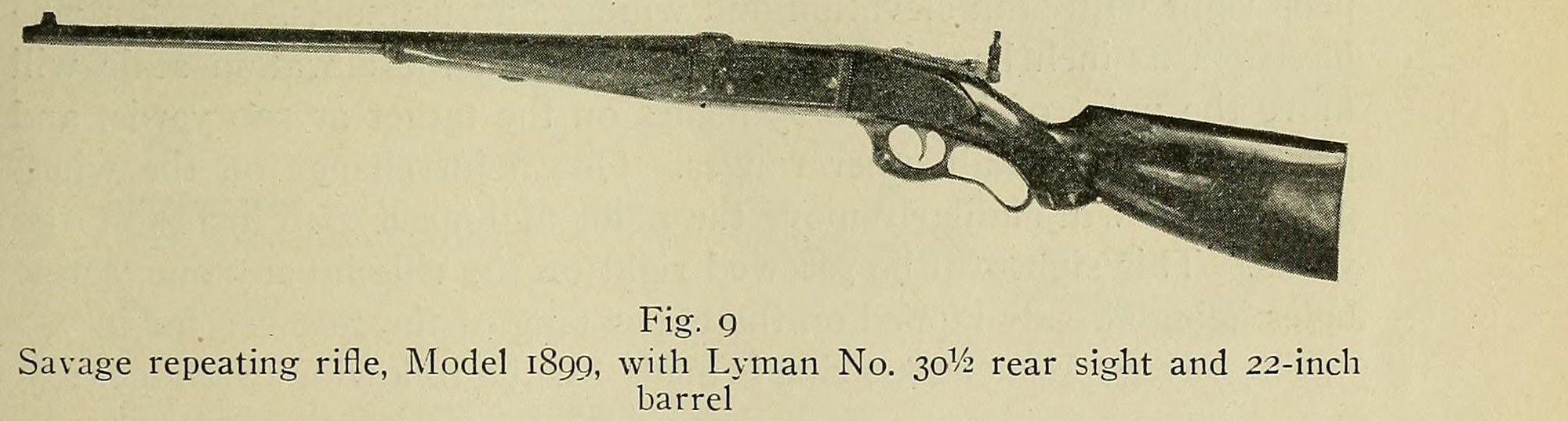
The prewar guns are the collector’s 99s: hand-cut checkering, case-colored levers, takedown barrels, and calibers like the .22 Hi-Power and .250-3000 that made the gun’s name. The takedown design lets the barrel and forend come off the receiver, so a whole rifle fits in a short case. The ATF lists Utica-made prewar Model 99s with serials below 450000 as curios or relics. Don’t drill a prewar receiver for a scope; it costs real money at resale.
Postwar hunting rifles (1946 to 1984)
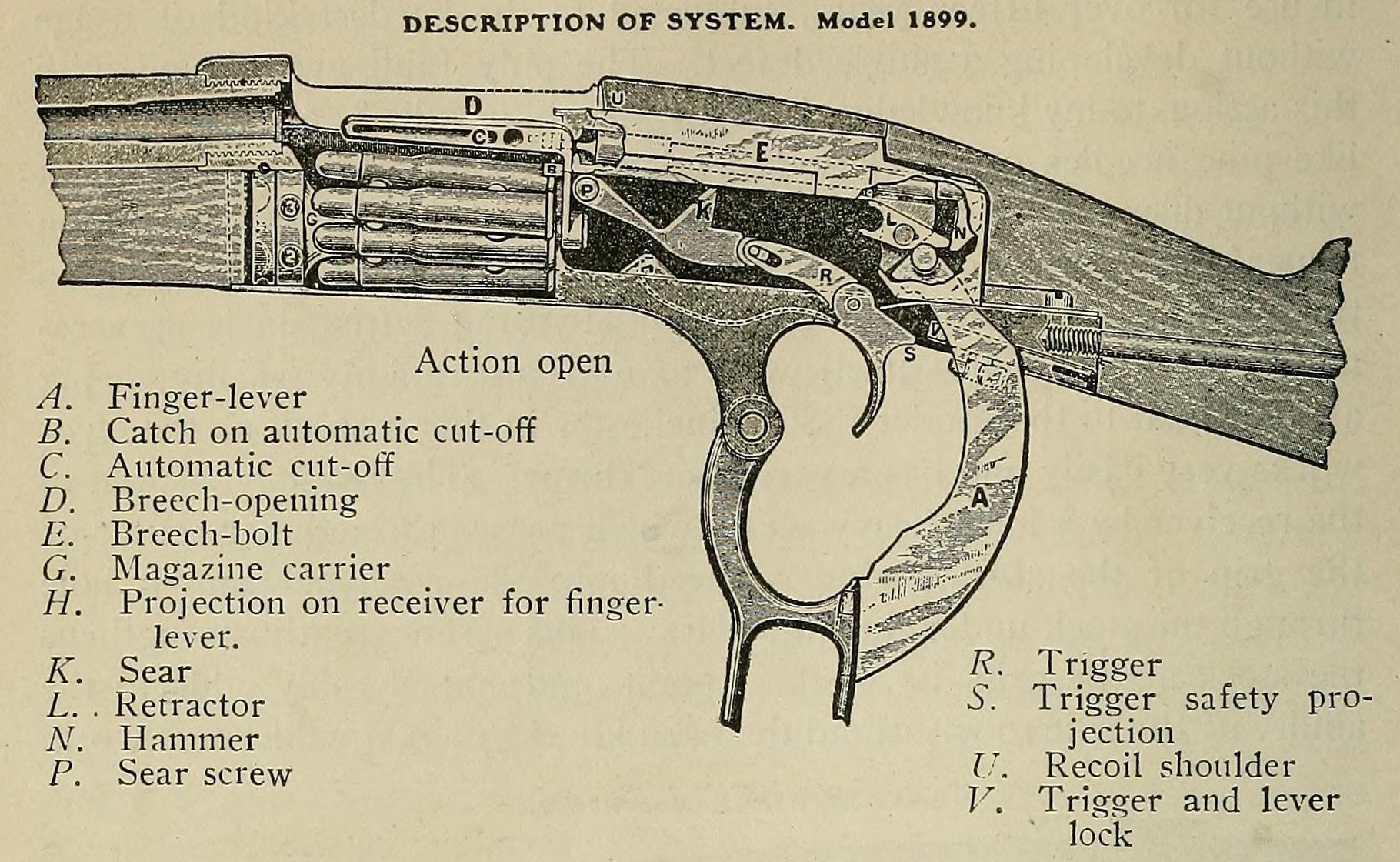
The postwar 99EG, 99R, 99F and 99DL are the hunter’s 99s. From the mid-1950s they came in .243, .308 and .358 Win., and from about 1950 Savage drilled and tapped the receivers for scopes at the factory. The 99F featherweight is the one many hunters want. From 1960 the safety moved to the top tang, except on the economy 99E, which kept the lever safety and dropped the counter. From about 1965 the cheaper models got pressed checkering and hardwood stocks.
The box-magazine 99C (1965 to 1997)
The 99C replaced the spool with a detachable four-round box in 1965, Savage’s first big change to the design in 66 years. It took longer cartridges like the .284 Win., .22-250 and 7mm-08, and it outlived the rotary guns: Savage reissued it in .243 and .308 in the 1990s, and it was the last 99 made.
Commemoratives and late guns
The 1970 75th Anniversary rifle is a reproduction of the Model 1895, not a 99; 9,999 were made in .308. The 99CE Centennial of the mid-1990s carried AS-prefix serials. Collectors also report Spanish-made 99Cs with an L serial prefix. Price special editions separately from shooting rifles.
Which Savage 99 Caliber to Choose
The 99 came in more calibers than almost any other lever action, and caliber decides both what you can do with the rifle and what you’ll pay for it. Here’s how they sort out for a buyer in 2026.
| Caliber | Years | Best for | Ammo today |
|---|---|---|---|
| .300 Savage | 1920 on | Deer at woods ranges; the classic 99 round | Loaded by Remington, Hornady, Federal and Winchester |
| .308 Win. | Mid-1950s on | Deer and bigger game at longer range | Everywhere, and the cheapest to feed |
| .243 Win. | Mid-1950s on | Deer, pronghorn and varmints | Easy to find |
| .250-3000 Savage | 1915 on | Deer and pronghorn with light recoil | Remington still loads 100-grain .250 Savage |
| .358 Win. | Mid-1950s on | Heavy brush cartridge for elk and bear | Scarce and costly |
| .303 Savage, .22 Hi-Power | 1895, 1912 | Collecting and handloading | No factory ammo; handload only |
For a rifle you’ll hunt with, the .308 is the easy choice: the ammunition is cheap and everywhere, and in our data a .308 99 sold for a median of $809. The .300 Savage is the traditional pick and sells for a little less, at $730, but its ammunition costs more. The .250-3000 is the one many hunters love for its light recoil and flat shooting. Early .250s have a slower 1:14 twist built for the original 87-grain bullet, so check before you buy heavier modern loads. The .358 is the collector’s prize among the postwar calibers, at a $1,952 median, and the .303 Savage and .22 Hi-Power are for collectors and handloaders.
Takedown or solid frame?
Takedown rifles let the barrel and forend come off for travel, and they’re a big part of the prewar 99’s charm. In our data, though, they sold for a median of $738 against $908 for solid-frame rifles, because most takedowns are older guns in older calibers. A takedown can work loose after years of being taken apart; a gunsmith can shim the joint. If you want a rifle to hunt with and scope, a solid-frame postwar gun is the simpler choice.
Savage 99 Condition Guide
| Grade | What you see | What it does to price |
|---|---|---|
| 90%+ original | Bright blue, sharp case colors on the lever, crisp checkering, a clean counter window | $984 median across 21 sales |
| Honest hunting rifle | Thinning blue at the edges, faded lever colors, handling marks, a working counter | Around the $750 to $850 medians |
| Shooter, refinished or altered | Refinish, cracked or replaced stock, extra holes, a counter that skips | $562 median across 27 sales |
Some wear is honest and normal on a hunting rifle: thinning blue at the receiver edges, faded case colors on the lever, and handling marks in the wood. What should worry you is a crack in the buttstock behind the tang, which is the 99’s best-known weak spot, a loose takedown joint, a counter that skips or sticks, sanded or reshaped wood, refinished case colors, and extra screw holes on a prewar receiver.
Serial Numbers, Lever Codes and Dating
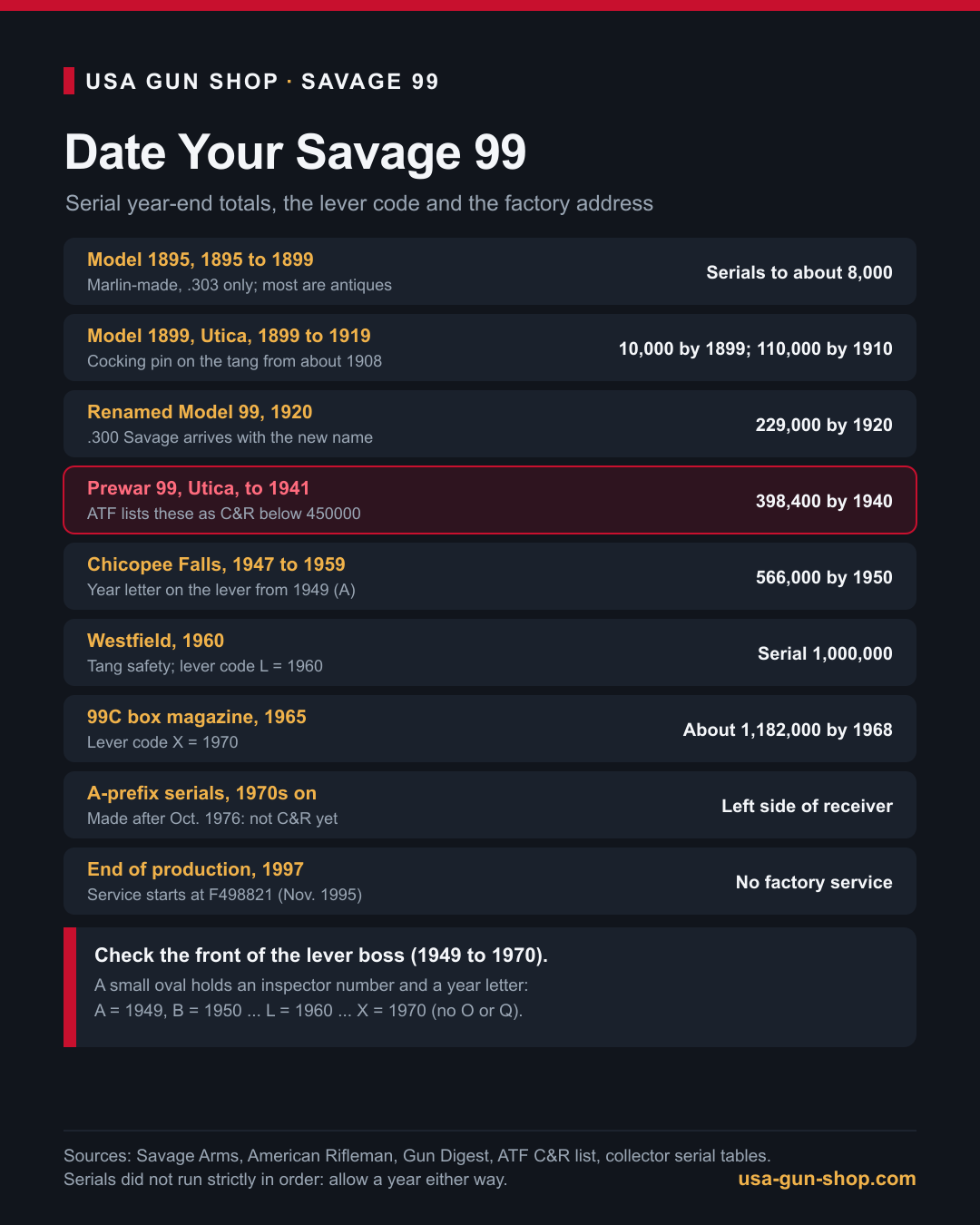
Start with the serial. On most 99s it’s on the lower tang or the receiver; later guns carry an A-prefix serial on the left side. Collector tables put serials up to about 8,000 as Model 1895s and give approximate year-end totals after that. Treat every year as plus or minus one, because serials didn’t run strictly in order.
| Serial reached by year end (approx.) | Year |
|---|---|
| 10,000 | 1899 |
| 110,000 | 1910 |
| 229,000 | 1920 |
| 398,400 | 1940 |
| 438,000 | 1946 (no wartime production) |
| 566,000 | 1950 |
| 1,000,000 | March 1960 (presented to the NRA) |
| About 1,182,000 | 1968 |
For rifles made from 1949 to 1970, look at the front of the lever boss, where the lever pivots. Many carry a small oval stamp with an inspector number and a year letter: A for 1949, B for 1950, L for 1960 and X for 1970, with O and Q skipped. The barrel address also dates the plant: Utica, N.Y. to 1946, Chicopee Falls, Mass. from 1947, and Westfield, Mass. from 1960.
For a prewar rifle, the Cody Firearms Records Office at the Buffalo Bill Center of the West holds Savage records from 1895 into late 1939. A factory letter costs $80 for non-members and takes about five weeks, and it’s the only way to prove a rare configuration.
Fakes, Refinishes and Parts Guns
Nobody fakes a whole Savage 99, but plenty are misrepresented:
- Restocked rifles sold under a better model letter. A 99E with a new walnut stock is still a 99E. Check the counter and the safety.
- Added checkering on straight-grip prewar guns. Factory checkering on those is extremely rare.
- Rebarreled or rechambered rifles. A .308 converted to .358 is a common gunsmith job. Make sure the caliber stamp matches the chamber.
- Refinished case colors and reblued receivers. Look for soft roll marks and rounded edges.
- Extra scope holes on a prewar receiver. They take a lot off a collector gun.
- Mismatched takedown barrels. Check that the barrel and forend belong to the receiver.
Pre-Purchase Inspection Checklist
- Identify it: serial, lever code, barrel address, caliber stamp and model letter. Match them to the dating table.
- Test the magazine with dummy rounds. The counter must read 5, 4, 3, 2, 1, 0, and the spool must not skip or bind.
- Cycle the action slowly and quickly. The bolt must lock up fully at the rear.
- Test the safety, lever or tang type. It must block the trigger, and the lever type must lock the lever.
- Check that the cocking indicator pin pops up when the rifle is cocked.
- Inspect the buttstock behind the tang and at the recoil-pad screws for cracks.
- On a takedown, check that the joint locks up tight and the barrel and forend match.
- Check the bore and crown. On an early .250-3000, check the twist before you choose bullets.
- Ask for a fired case if you can, or have a gunsmith check headspace on an old rifle.
- Judge the metal: original blue and case colors, or a refinish. Look for extra holes on prewar receivers.
- Judge the wood: sanding, added checkering or a replacement stock.
- Price it against sales of that model and caliber, not a pooled average. Letter a premium prewar rifle.
Shooting and Caring for a Savage 99
Shoot only the cartridge stamped on the barrel, and never fire .308 in a .300 Savage. The .300 Savage is still loaded by Remington, Hornady, Federal and Winchester, and Remington still loads the .250 Savage, but both cost more than .308. The .303 Savage and .22 Hi-Power are handloading cartridges now. Keep overall length to factory specs so the rounds turn freely in the spool, and use standard factory loads in old rifles. Have any old 99 checked by a gunsmith before you fire it.



Don’t take the rotary magazine apart; its spring has to be re-tensioned when it goes back together, and that’s a gunsmith job. Don’t lighten the trigger by working the sear, either; a pull of 3 to 4 pounds is normal and safe. Clean the bore carefully, protect the crown, and flush the action with solvent rather than stripping it. If a takedown barrel has worked loose after years of use, a gunsmith can shim it.
Putting a scope on a 99
Savage drilled and tapped receivers at the factory from about 1950, and on factory-drilled guns it moved the Savage logo from the top of the receiver to the side, which is a quick way to tell factory holes from gunsmith work. A low-power scope in low rings keeps the rifle’s handling, and because the 99 ejects to the side, the scope never gets in the way. On a prewar receiver, use a tang or receiver sight instead, or a mount that uses existing holes; new holes cut into a collector rifle cost far more at resale than the mount is worth.
Savage Arms services only firearms made after November 1, 1995, from serial F498821, so a vintage 99 isn’t covered. Savage points owners of older guns to parts suppliers such as Numrich Gun Parts, MidwayUSA and Brownells. Many internal parts are specific to the caliber, so order by caliber.
A Short History: Arthur Savage’s Hammerless Lever Gun
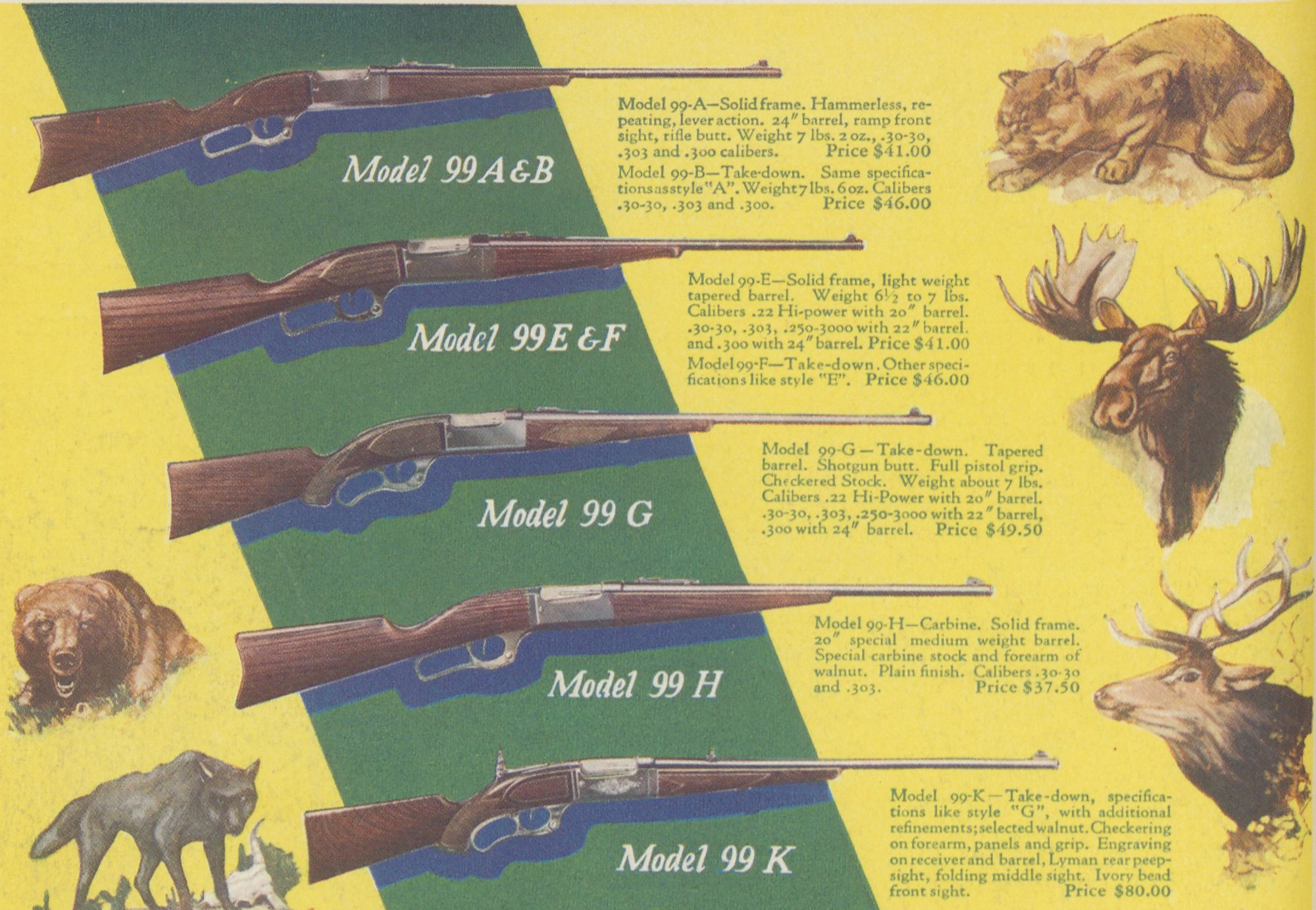
Arthur Savage, born in Jamaica in 1857, patented his rotary-magazine rifle in 1893 and lost the Army’s 1892 trials to the Krag. With backers in Utica, N.Y., he formed the Savage Repeating Arms Co. on April 5, 1894, to sell the Model 1895, the first hammerless lever-action rifle. Marlin built those first rifles under contract. The improved Model 1899 followed, and over the next two decades Savage added the .30-30, the .22 Hi-Power in 1912, and the .250-3000 in 1915, the first commercial cartridge to reach 3,000 feet per second.
In 1920 Savage introduced the .300 Savage and renamed the rifle the Model 99. Production moved from Utica to Chicopee Falls in 1947 and to Westfield in 1960, the year serial 1,000,000 was presented to the NRA. The box-magazine 99C arrived in 1965. Climbing costs ended production in 1997, two years short of the design’s centennial. Savage looked at a reissue around 2007 and couldn’t make the numbers work, and in 2021 it said it has no plans to bring the 99 back.
Why the Savage 99 Is Still So Popular
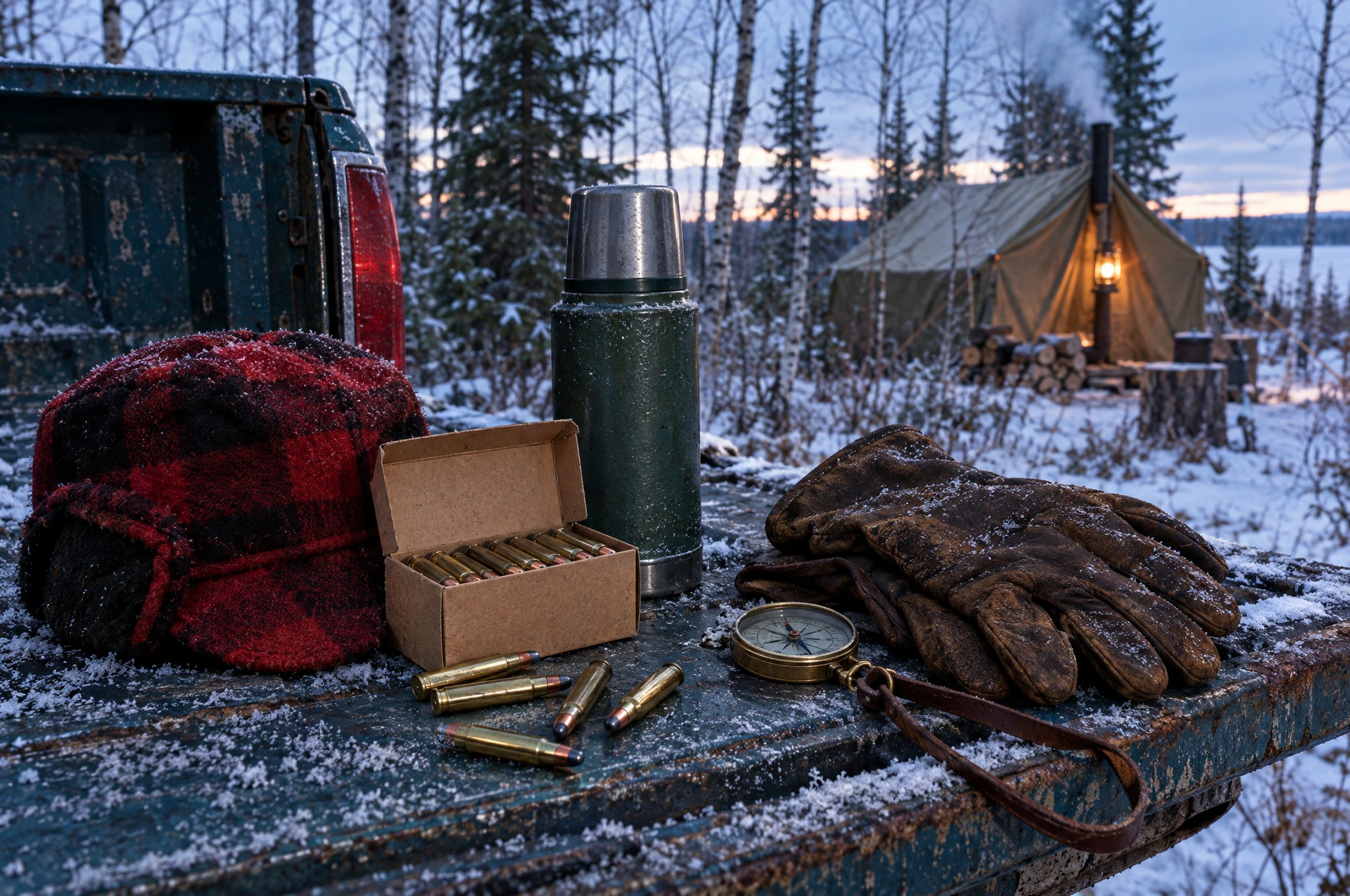
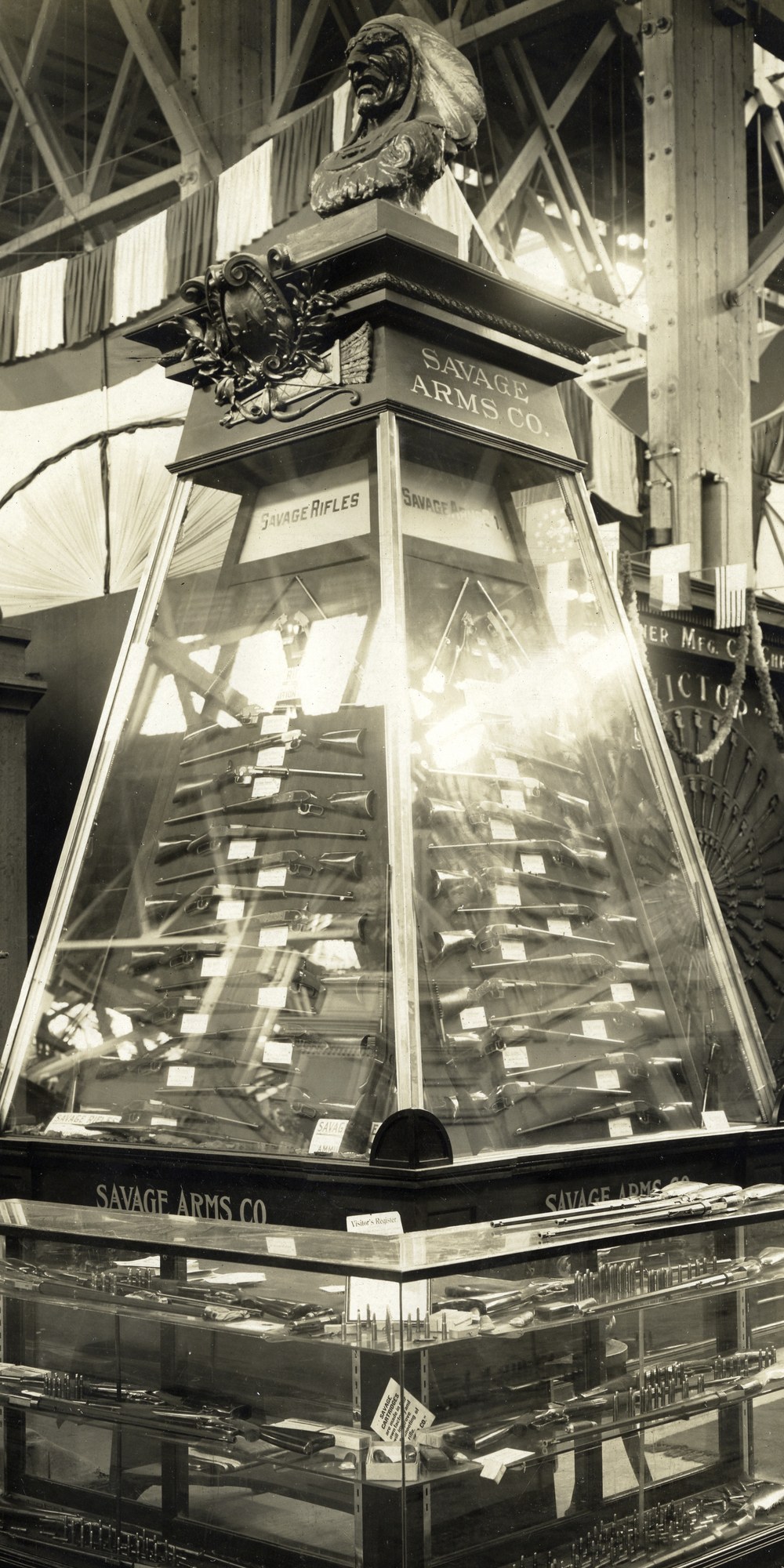
Part of it is the design. The 99 was a lever gun that could shoot pointed bullets, take a scope and handle cartridges like the .308 and .358, decades before most lever guns could. Part of it is the history: it was in production for most of a century, and for many families it was the deer rifle, handed down from grandfather to grandchild.
And part of it is how it handles. The slim receiver, the short lever throw and the balance make it come up like a good shotgun, and the counter on the side tells you at a glance what’s left in the magazine. Savage itself has said a new one would cost too much to build, which is the best reason of all to buy a good used one.
Legal: Curio and Relic and Antique Status
Under federal law, any firearm made at least 50 years ago is a curio or relic (27 CFR 478.11). In October 2026 that covers Savage 1895s, 1899s and 99s made before about October 1976. ATF’s list also names Utica-made Model 99s made before World War II with serials below 450000. Federal law treats a gun made in or before 1898 as an antique, so most, but not all, Model 1895s are antiques. Don’t call any Model 1899 an antique without a factory letter showing 1898 manufacture.
An interstate sale goes through a licensed dealer unless you hold a curio and relic license and the rifle qualifies. State laws vary, so check your state’s rules before you buy.
Where to Buy a Savage 99
- Guns.com. A steady run of used 99s with photos of each rifle. Browse Savage 99s on Guns.com.
- The dealers on our live cards. Used 99Es, 99Cs and police trade-ins as they come in.
- Auction houses. Prewar takedowns, engraved guns and rare calibers. Add the buyer’s premium to the hammer price.
- GunBroker completed sales. The best free price check for any model and caliber.
- Local gun shops and estate sales. Many 99s come out of family closets. Our guide to where to buy vintage guns online covers more.
Before you pay, ask the seller for the serial, the lever code, the barrel address, a photo of the counter window, the bore condition and whether the receiver has been drilled.
Savage 99 vs. Its Rivals
| Rifle | Price | Why pick it instead |
|---|---|---|
| Winchester Model 94 | About $1,189.99 new | The classic .30-30 carbine, still made |
| Marlin 336 | About $1,329.99 new | A side-ejecting .30-30 that scopes easily |
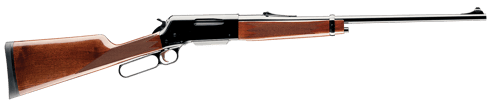
| Browning BLR | About $1,103.99 | A modern box-fed lever gun in .308 and magnum calibers |
Savage 99 vs. Winchester 94
This is the argument hunters have had for a century. The Winchester 94 is lighter, simpler and cheaper to feed in .30-30. The Savage 99 shoots pointed bullets, takes stronger cartridges like the .308 and .358, and scopes more cleanly. For brush hunting with iron sights, either works. For longer shots, the 99 wins.
Savage 99 vs. Browning BLR
The BLR is the modern answer to the same idea: a lever gun with a detachable box magazine that handles pointed bullets and modern cartridges. It’s still made and serviced. The 99 is slimmer, handles better and has a century of history behind it. Buy the BLR if you want a new rifle with a warranty, the 99 if you want the original.
Final Verdict
The Savage 99 is one of the great American hunting rifles, and the used market still lets you buy a good one for less than a new lever gun. Buy a postwar 99F, 99EG or 99C in .308 or .300 Savage to hunt, pay for condition and caliber rather than letters alone, check the counter and the wood at the tang, and leave prewar receivers undrilled.
Arthur Savage built a rifle that was ahead of its time in 1895. It still is.
FAQ
Does Savage still make the Model 99?
No. Production ended in 1997. Savage looked at a reissue around 2007 and found it couldn't make a profit, and in 2021 it said it has no current plans to bring the 99 back. Its 2024 Revel is a rimfire lever action, not a 99.
How much is a Savage 99 worth in 2026?
In 681 completed sales, the median Savage 99 sold for about $799. By caliber, .300 Savage rifles brought about $730, .308s $809, .250-3000s $847 and the scarce .358 Win. about $1,952. By model, a 99E brought about $725, a 99C $885 and a 99F $950. Model 1899s sold for about $750. Dealer asking prices run about 25% above sale prices.
What year was my Savage 99 made?
Check the serial against a collector table: about 110,000 was reached by 1910, 229,000 by 1920, 566,000 by 1950 and 1,000,000 in 1960. For rifles made from 1949 to 1970, the letter in the small oval on the front of the lever boss gives the year: A is 1949, L is 1960 and X is 1970. For prewar rifles, a Cody Firearms Records Office letter ($80) gives the exact ship date.
Is the Savage Model 99 rare?
Not in general: more than a million were made. Some versions are scarce, including the Model 1895, prewar takedowns in .22 Hi-Power or .250-3000, the engraved 99-K, and early guns in .25-35, .32-40 and .38-55.
Why was the Savage 99 discontinued?
Cost. Savage said the manufacturing costs had become too prohibitive, and it ended production in 1997. In 2021 it said a new 99 would cost more than $1,500 to sell.
What calibers did the Savage 99 come in?
More than a dozen, including .303 Savage, .30-30, .25-35, .32-40, .38-55, .22 Hi-Power, .250-3000, .300 Savage, .243, .308, .358, .284, .22-250, 7mm-08 and .375 Win. The .300 Savage and .308 are the most common and the easiest to feed.
Is .300 Savage the same as .308?
No. The .308 has a longer neck and case, and SAAMI rates the .300 Savage at 47,000 psi against 62,000 psi for the .308. They are not interchangeable: fire only the cartridge stamped on the barrel.
Can you put a scope on a Savage 99?
Yes. Savage drilled and tapped receivers at the factory from about 1950, so a postwar 99 scopes easily. Drilling a prewar collector rifle lowers its value.
5,513+ Gun & Ammo Deals
Updated daily from 200+ top retailers. Filter by category, caliber, action type, and price.
Related Guides