

Affiliate disclosure: This Winchester PDX1 Defender review contains affiliate links. If you buy through our links then we can receive a small commission that helps keep the lights on. You don’t pay anything more.
- Treat every gun as loaded
- Point the muzzle in a safe direction
- Keep your finger off the trigger until you’re ready to shoot
- Know your target and what’s beyond
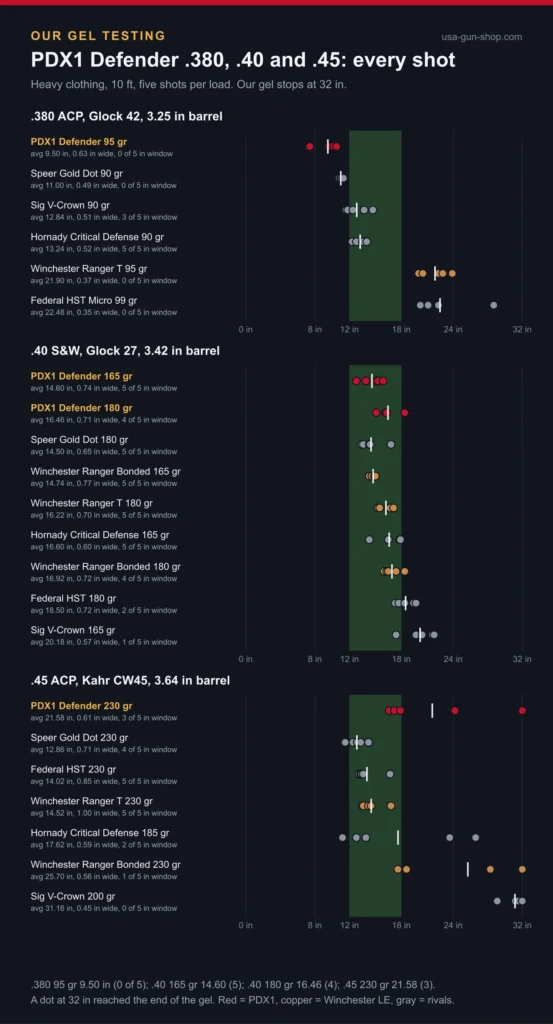
This Winchester PDX1 Defender review covers the whole line, handgun, shotgun and rifle, not one box. I shot ten PDX1 Defender handgun strings in six calibers, 50 shots in all, into gel through heavy clothing, and 32 of 50 stopped inside the FBI window of 12 to 18 inches.
It is excellent in .38 Special, .357 Magnum and .40, and from our compacts it ran deep in 9mm and .45 and shallow in .380. The famous 12 ga slug plus 00 buck, the segmenting slug and the .410 get their own sections. This is ammunition, not the Winchester SXP Defender pump shotgun.
Last updated October 16, 2026
On-sale 9mm from 200+ retailers · Updated every 4 hours


Table of Contents
Winchester PDX1 Defender at a Glance
Winchester PDX1 Defender is a civilian defensive line built around bonded hollow points, in 25 current loads: eleven handgun, eight shotshell and six rifle or rimfire. Our gel put 32 of 50 handgun shots in the window.
| Load | Symbol | Box fps | Our gun | Depth | Width | In window |
|---|---|---|---|---|---|---|
| 9mm +P 124 gr | S9MMPDB | 1,200 | S&W M&P9c 3.5 in | 19.60 in | 0.52 in | 1 of 5 |
| 9mm 147 gr | S9MMPDB1 | 995 | S&W M&P9c 3.5 in | 20.60 in | 0.54 in | 0 of 5 |
| .380 Auto 95 gr | S380PDB | 1,000 | Glock 42 3.25 in | 9.50 in | 0.63 in | 0 of 5 |
| .38 Special +P 130 gr | S38PDB | 950 | Kimber K6s 2 in | 12.30 in | 0.63 in | 4 of 5 |
| .38 Special +P 130 gr | S38PDB | 950 | Ruger GP100 4.2 in | 14.00 in | 0.63 in | 5 of 5 |
| .357 Magnum 125 gr | S357MPDB | 1,325 | Kimber K6s 2 in | 13.92 in | 0.63 in | 5 of 5 |
| .357 Magnum 125 gr | S357MPDB | 1,325 | Ruger GP100 4.2 in | 15.48 in | 0.65 in | 5 of 5 |
| .40 S&W 165 gr | S40SWPDB | 1,140 | Glock 27 3.42 in | 14.60 in | 0.74 in | 5 of 5 |
| .40 S&W 180 gr | S40SWPDB1 | 1,025 | Glock 27 3.42 in | 16.46 in | 0.71 in | 4 of 5 |
| .45 Auto 230 gr | S45PDB | 920 | Kahr CW45 3.64 in | 21.58 in | 0.61 in | 3 of 5 |
Box velocity is Winchester’s figure from its product pages. Depth and width are five-shot averages from our gel. Every PDX1 Defender handgun load comes 20 to the box, and the live cards below carry each load’s current price per round.
Pros
- Revolver loads: 19 of 20 in window
- 8 of 10 opened 1.5x bore
- Easy to find at retail
Cons
- 9mm and .45 averaged past 19 in
- .380 stopped at 9.50 in
- Some 00 pellets missed past 10 yd
Our Rating: 8.0/10
PDX1, PDX1 Defender or Defender? The Name Explained
They are the same line under three names. Winchester launched Supreme Elite Bonded PDX1 handgun ammunition in 2009, called the line PDX1 Defender from 2011, and sells it today as Defender. Searchers and stores still say PDX1.
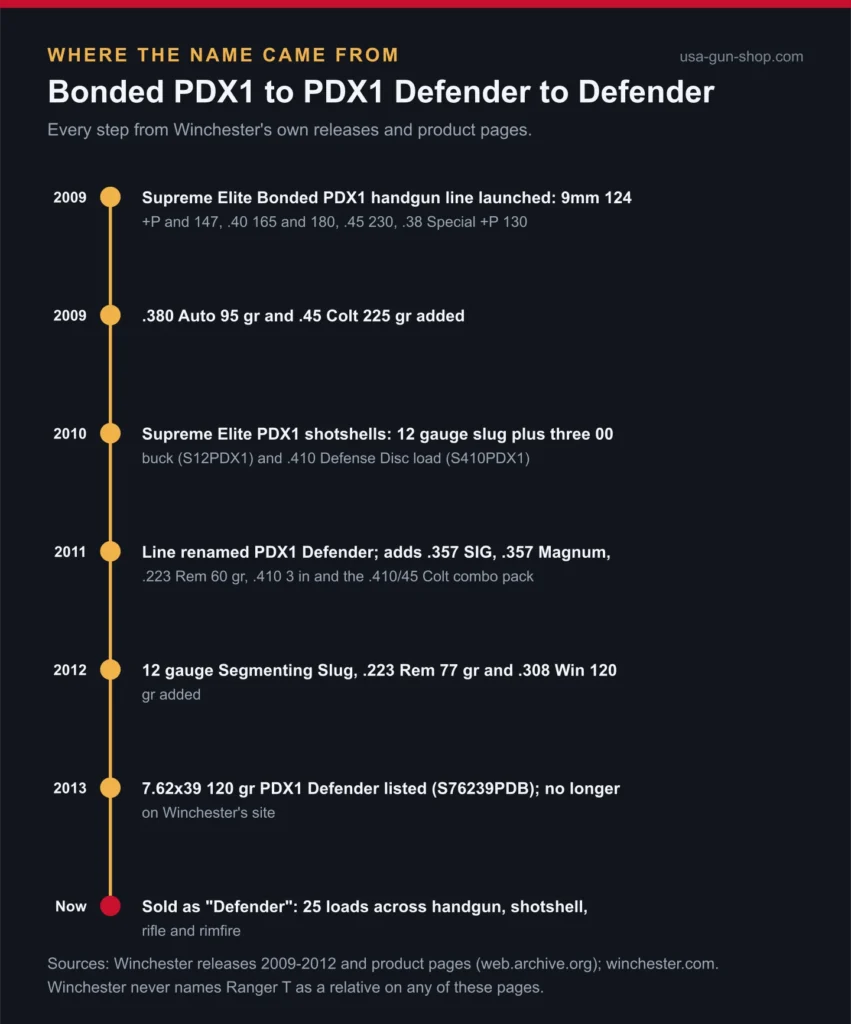
That matters when you read old test results: any older Winchester PDX1 review describes the same bonded bullets sold as Defender today, under the same symbols.
Some stores also list a Defender Elite 9mm and 10mm. Winchester’s own site lists no Defender Elite today, so we left those boxes off our cards. Winchester sold the first handgun loads as Supreme Elite Bonded PDX1, which is why some older reviews say PDX1 Elite.
Winchester’s January 2009 release said PDX1 “was chosen by the FBI as their primary service round.” That is Winchester’s 2009 claim about the bonded bullet, not a statement about what the FBI carries today. The first six loads were 9mm 124 gr +P and 147 gr, .40 165 gr and 180 gr, .45 230 gr and .38 Special +P 130 gr.
In December 2009 Winchester added .380 Auto and .45 Colt, and in 2010 came the shotshells: the 12 gauge slug plus 00 buck and the .410, which Winchester’s 2010 product page said was “Designed for use in the Taurus Judge.” The January 2011 release used the PDX1 Defender name and added .357 SIG, .357 Magnum, .223, the 3 inch .410 and a .410 and .45 Colt combo pack.
In 2012 came the segmenting slug, .223 77 gr and .308 120 gr. A 7.62x39 PDX1 Defender listed in 2013 is gone from Winchester’s site today. Current boxes print DEFENDER with no PDX1 at all, but Winchester’s own shotshell copy still calls the 12 gauge the “12-gauge PDX1 Defender.” Winchester Defender ammo in a store today is the line this review covers.
How the PDX1 Defender Bullet Works
PDX1 Defender handgun bullets are bonded hollow points. Winchester says its bonding process “welds the jacket to the lead core” and the notched jacket is “preprogrammed to expand into six uniform segments,” up to 1.5x the original diameter.
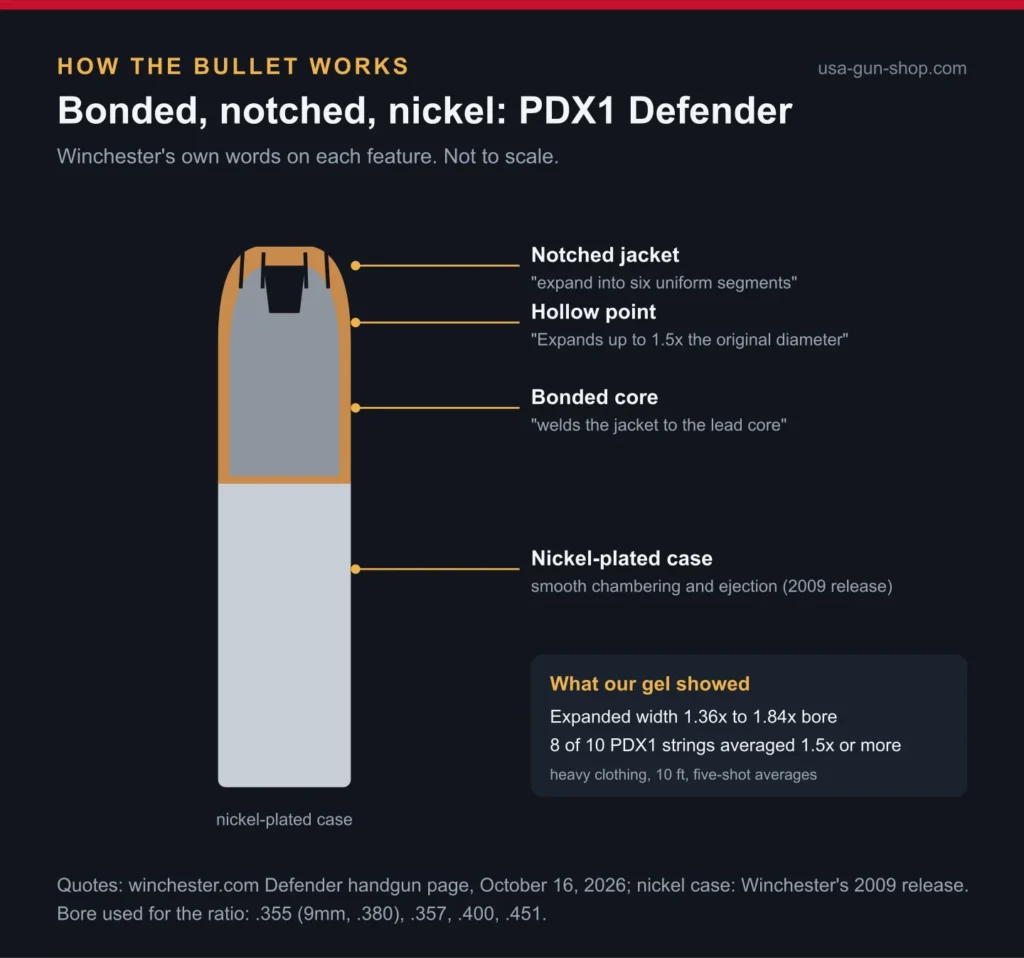
Bonding keeps the core and jacket together through clothing and barriers, which is why bonded bullets tend to hold weight and drive deeper. The notches control where the jacket tears, so the petals form the same way each time. Winchester’s Defender handgun page lists “Expands up to 1.5x the original diameter” as a feature.
Width in our gel backed that up. Our ten PDX1 strings opened to 1.36 to 1.84 times bore diameter, and eight of ten averaged 1.5x or wider. The two that fell short were the 9mm 124 gr +P and the .45 230 gr, both of which also ran deep.
The cases are nickel-plated, which Winchester’s 2009 release said “Helps ensure positive gun function through smooth chambering and shellcase ejection.” Winchester’s product data also lists “Reduced muzzle flash for low light applications” on most of the handgun loads.
How We Tested for This Winchester PDX1 Defender Review
For this Winchester PDX1 Defender review I shot every handgun load into gel through four layers of heavy clothing at 10 feet, five shots per load, from compact carry guns. The FBI window is 12 to 18 inches.
The guns: a S&W M&P9c 3.5 in for 9mm, a Glock 42 3.25 in for .380, a Glock 27 3.42 in for .40, a Kahr CW45 3.64 in for .45, and for .38 Special and .357 Magnum both a Kimber K6s 2 in snub and a Ruger GP100 4.2 in revolver. The clothing stack is a cotton T-shirt, a cotton shirt, fleece and denim, and a chronograph read muzzle velocity for every string, five shots each into ballistic gel.
Our blocks hold 32 inches of gel, so a shot that reached the end shows as 32.0. One PDX1 shot did that, from the .45. Shotgun, .410 and rifle loads are tested differently, on paper and in gel blocks, and each section says exactly how.
Winchester PDX1 Defender 9mm: 124 gr +P and 147 gr
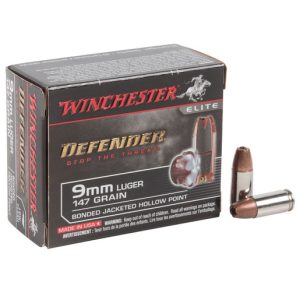
Both PDX1 9mm loads ran deep from our 3.5 inch compact. The 124 gr +P averaged 19.60 inches with one of five in the window, and the 147 gr averaged 20.60 with none.
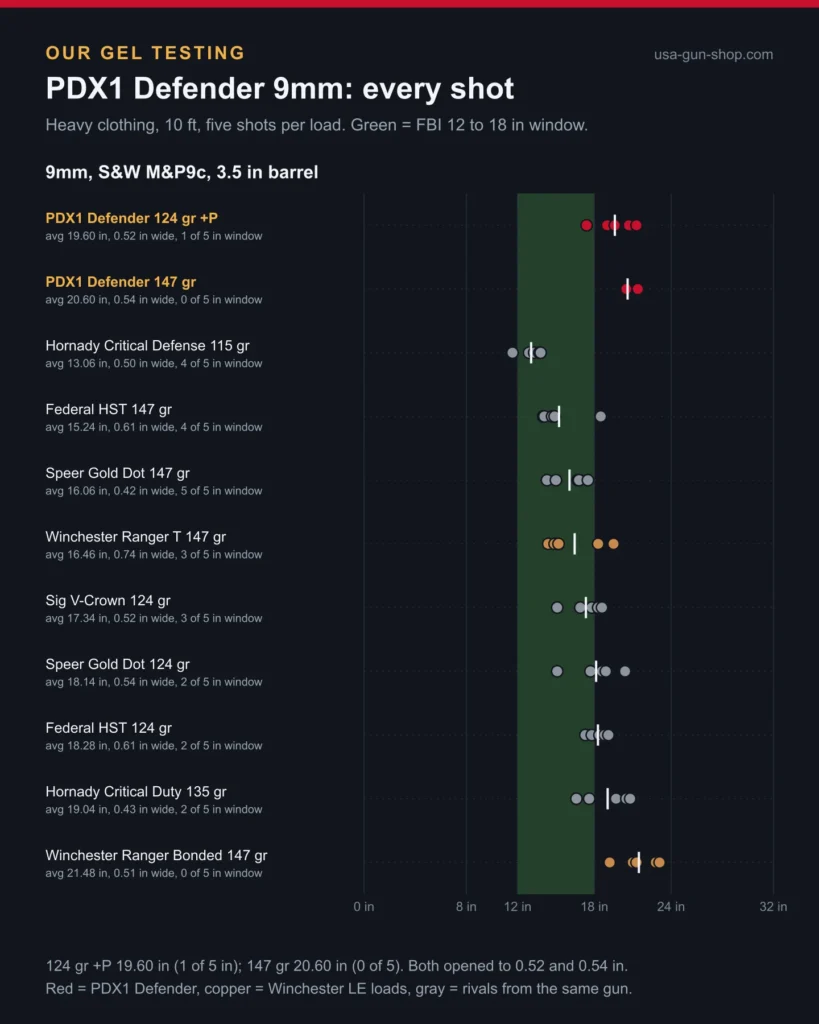
| Load | fps | Depth | Width | In 12 to 18 in | Every shot, in |
|---|---|---|---|---|---|
| PDX1 Defender 124 gr +P | 1,142 | 19.60 in | 0.52 in | 1 of 5 | 17.4, 19.0, 19.6, 20.7, 21.3 |
| PDX1 Defender 147 gr | 945 | 20.60 in | 0.54 in | 0 of 5 | 20.3, 20.4, 20.4, 20.5, 21.4 |
| Hornady Critical Defense 115 gr | 1,143 | 13.06 in | 0.50 in | 4 of 5 | 11.6, 12.9, 13.3, 13.7, 13.8 |
| Federal HST 147 gr | 973 | 15.24 in | 0.61 in | 4 of 5 | 14.0, 14.1, 14.7, 14.9, 18.5 |
| Speer Gold Dot 147 gr | 953 | 16.06 in | 0.42 in | 5 of 5 | 14.3, 15.0, 16.7, 16.8, 17.5 |
| Winchester Ranger T 147 gr | 941 | 16.46 in | 0.74 in | 3 of 5 | 14.4, 14.9, 15.2, 18.3, 19.5 |
| Sig V-Crown 124 gr | 1,072 | 17.34 in | 0.52 in | 3 of 5 | 15.1, 16.9, 17.8, 18.3, 18.6 |
| Speer Gold Dot 124 gr | 1,067 | 18.14 in | 0.54 in | 2 of 5 | 15.1, 17.7, 18.6, 18.9, 20.4 |
| Federal HST 124 gr | 1,135 | 18.28 in | 0.61 in | 2 of 5 | 17.3, 17.8, 18.4, 18.8, 19.1 |
| Hornady Critical Duty 135 gr | 1,053 | 19.04 in | 0.43 in | 2 of 5 | 16.6, 17.6, 19.7, 20.5, 20.8 |
| Winchester Ranger Bonded 147 gr | 966 | 21.48 in | 0.51 in | 0 of 5 | 19.2, 21.0, 21.3, 22.8, 23.1 |
The 147 gr was the tightest string in the table: all five shots fell between 20.3 and 21.4 inches. That is consistent, but from this gun every one of them went past 18 inches. Winchester rates it at 995 fps and we read 945, so it stays subsonic.
The 124 gr +P opened to 0.52 inches and averaged 19.60, with one shot at 17.4 inside the window. Federal HST 147 gr went 15.24 inches with four of five in, and Speer Gold Dot 147 gr kept five of five in, from the same pistol.
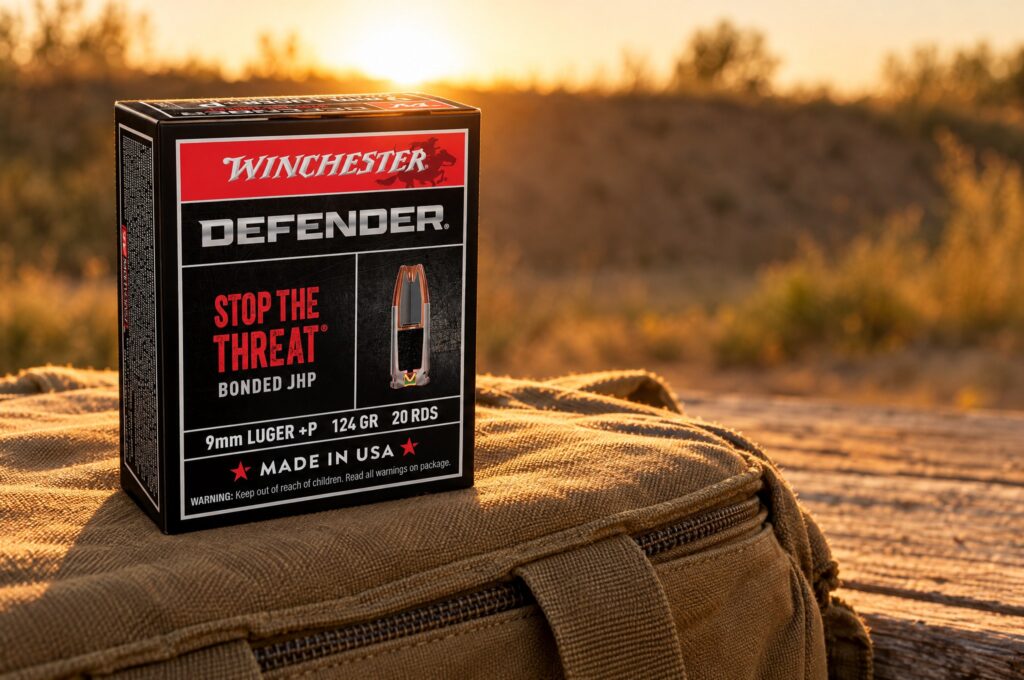
124 gr +P or 147 gr?
Neither stayed in the window from a 3.5 inch barrel, so in a small 9mm I would carry HST or Gold Dot instead. If you want PDX1 anyway, the 124 gr +P opened slightly less but put a shot in the window; the 147 gr is the quieter, subsonic choice with the tightest spread. PDX1 9mm from a full-size gun would arrive faster, but we did not test that.
Rival card for comparison, not PDX1 Defender: Federal HST 9mm 147 gr.

PDX1 Defender 380: 95 gr
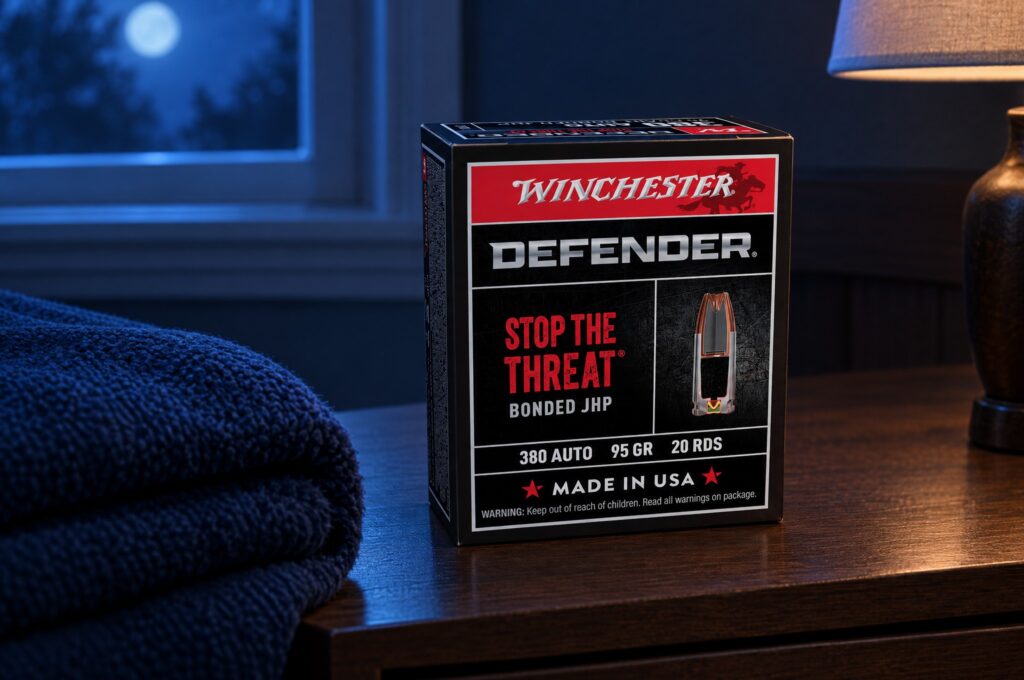
PDX1 Defender .380 opened the widest of the six .380 loads we shot from a Glock 42, at 0.63 inches, but it averaged only 9.50 inches and none of five shots reached 12. It trades depth for width.
| Load | fps | Depth | Width | In 12 to 18 in | Every shot, in |
|---|---|---|---|---|---|
| PDX1 Defender 95 gr | 870 | 9.50 in | 0.63 in | 0 of 5 | 7.4, 9.6, 9.8, 10.2, 10.5 |
| Speer Gold Dot 90 gr | 937 | 11.00 in | 0.49 in | 0 of 5 | 10.8, 10.8, 11.0, 11.1, 11.3 |
| Sig V-Crown 90 gr | 861 | 12.84 in | 0.51 in | 3 of 5 | 11.6, 11.8, 12.4, 13.7, 14.7 |
| Hornady Critical Defense 90 gr | 910 | 13.24 in | 0.52 in | 5 of 5 | 12.3, 12.8, 13.5, 13.6, 14.0 |
| Winchester Ranger T 95 gr | 918 | 21.90 in | 0.37 in | 0 of 5 | 20.0, 20.5, 22.3, 22.8, 23.9 |
| Federal HST Micro 99 gr | 893 | 22.48 in | 0.35 in | 0 of 5 | 20.1, 20.2, 21.1, 22.3, 28.7 |
Winchester rates the .380 at 1,000 fps and we read 870 from 3.25 inches, 130 fps slow. Hornady Critical Defense 90 gr kept five of five in the window from the same gun at 13.24 inches. For a pocket .380 I would carry that instead; see our .380 ammo test.

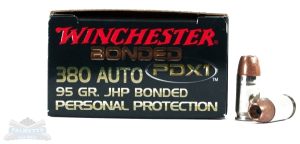
Rival card for comparison, not PDX1 Defender: Hornady Critical Defense .380 90 gr.
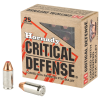
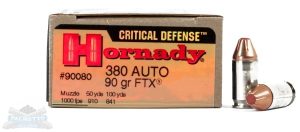

PDX1 Defender 38 Special +P and 357 Magnum From a Snub and a 4 Inch
PDX1 Defender did best in revolvers: from a 2 inch Kimber K6s and a 4.2 inch Ruger GP100, 19 of 20 shots of .38 Special +P and .357 Magnum landed in the window, and every string opened past 0.62 inches.
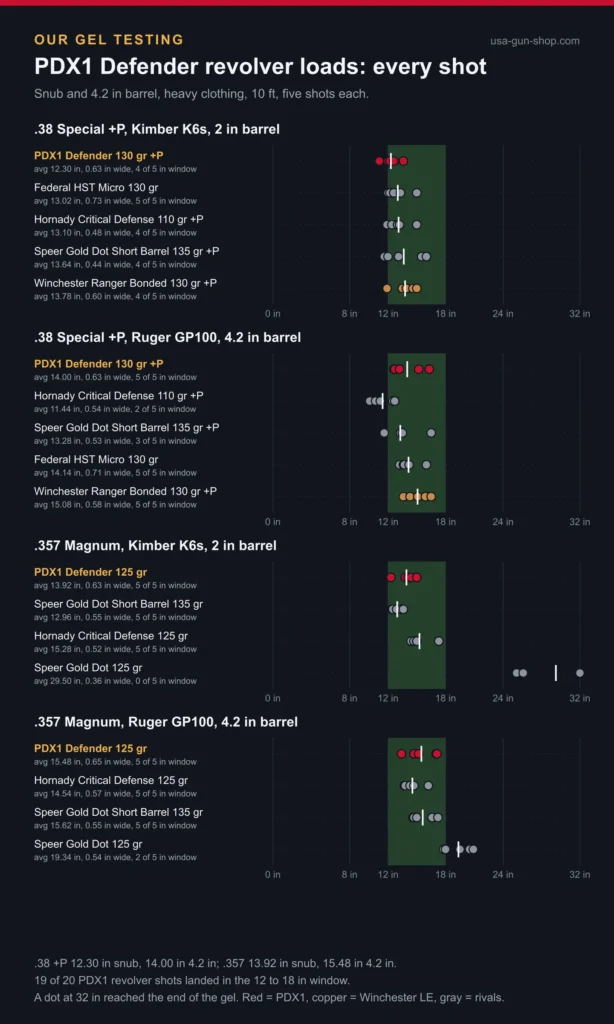
.38 Special +P 130 gr
| Load | fps | Depth | Width | In 12 to 18 in | Every shot, in |
|---|---|---|---|---|---|
| PDX1 130 gr +P, K6s 2 in | 823 | 12.30 in | 0.63 in | 4 of 5 | 11.1, 12.0, 12.2, 12.6, 13.6 |
| PDX1 130 gr +P, GP100 4.2 in | 885 | 14.00 in | 0.63 in | 5 of 5 | 12.6, 12.7, 13.2, 15.2, 16.3 |
| Federal HST Micro 130 gr, K6s 2 in | 824 | 13.02 in | 0.73 in | 5 of 5 | 12.0, 12.2, 12.6, 13.3, 15.0 |
| Hornady Critical Defense 110 gr +P, K6s 2 in | 945 | 13.10 in | 0.48 in | 4 of 5 | 11.9, 12.4, 13.0, 13.2, 15.0 |
| Speer Gold Dot Short Barrel 135 gr +P, K6s 2 in | 821 | 13.64 in | 0.44 in | 4 of 5 | 11.6, 12.0, 13.1, 15.5, 16.0 |
| Winchester Ranger Bonded 130 gr +P, K6s 2 in | 860 | 13.78 in | 0.60 in | 4 of 5 | 11.9, 13.5, 13.9, 14.6, 15.0 |
| Federal HST Micro 130 gr, GP100 4.2 in | 854 | 14.14 in | 0.71 in | 5 of 5 | 13.2, 13.6, 13.7, 14.2, 16.0 |
| Hornady Critical Defense 110 gr +P, GP100 4.2 in | 1,058 | 11.44 in | 0.54 in | 2 of 5 | 10.1, 10.7, 11.2, 12.5, 12.7 |
| Speer Gold Dot Short Barrel 135 gr +P, GP100 4.2 in | 890 | 13.28 in | 0.53 in | 3 of 5 | 11.5, 11.6, 13.3, 13.5, 16.5 |
| Winchester Ranger Bonded 130 gr +P, GP100 4.2 in | 921 | 15.08 in | 0.58 in | 5 of 5 | 13.6, 14.3, 15.1, 15.9, 16.5 |
From the snub the .38 +P averaged 12.30 inches with four of five in and one shot at 11.1, just short. From the 4.2 inch gun it went 14.00 with all five in. It opened to 0.63 inches from both, wider than Gold Dot Short Barrel and Critical Defense from the same guns.
.357 Magnum 125 gr
| Load | fps | Depth | Width | In 12 to 18 in | Every shot, in |
|---|---|---|---|---|---|
| PDX1 125 gr, K6s 2 in | 1,100 | 13.92 in | 0.63 in | 5 of 5 | 12.3, 13.8, 14.1, 14.4, 15.0 |
| PDX1 125 gr, GP100 4.2 in | 1,215 | 15.48 in | 0.65 in | 5 of 5 | 13.4, 14.7, 15.2, 17.0, 17.1 |
| Speer Gold Dot Short Barrel 135 gr, K6s 2 in | 1,069 | 12.96 in | 0.55 in | 5 of 5 | 12.4, 12.5, 12.9, 13.4, 13.6 |
| Hornady Critical Defense 125 gr, K6s 2 in | 1,208 | 15.28 in | 0.52 in | 5 of 5 | 14.4, 14.7, 15.0, 15.0, 17.3 |
| Speer Gold Dot 125 gr, K6s 2 in | 1,200 | 29.50 in | 0.36 in | 0 of 5 | 25.4, 26.1, 32.0, 32.0, 32.0 |
| Speer Gold Dot Short Barrel 135 gr, GP100 4.2 in | 1,184 | 15.62 in | 0.55 in | 5 of 5 | 14.6, 14.7, 15.0, 16.6, 17.2 |
| Hornady Critical Defense 125 gr, GP100 4.2 in | 1,350 | 14.54 in | 0.57 in | 5 of 5 | 13.7, 13.8, 14.3, 14.7, 16.2 |
| Speer Gold Dot 125 gr, GP100 4.2 in | 1,427 | 19.34 in | 0.54 in | 2 of 5 | 17.8, 18.0, 19.5, 20.5, 20.9 |
The .357 kept all ten shots in the window from both guns: 13.92 inches from the snub and 15.48 from the 4.2 inch. Speer Gold Dot 125 gr went 29.50 inches from the same snub without opening.
Velocity dropped hard from the snub: 1,100 fps against Winchester’s 1,325, a 225 fps gap. The bullet still opened to 0.63 inches. Our .357 Magnum ammo guide has more loads for these guns.
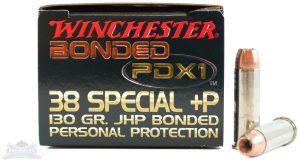

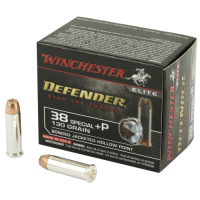

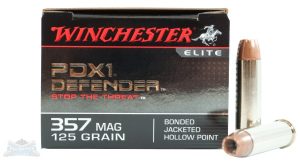
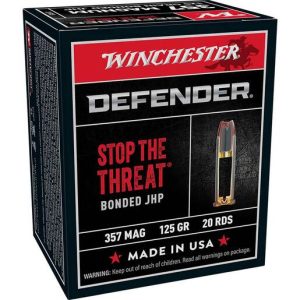
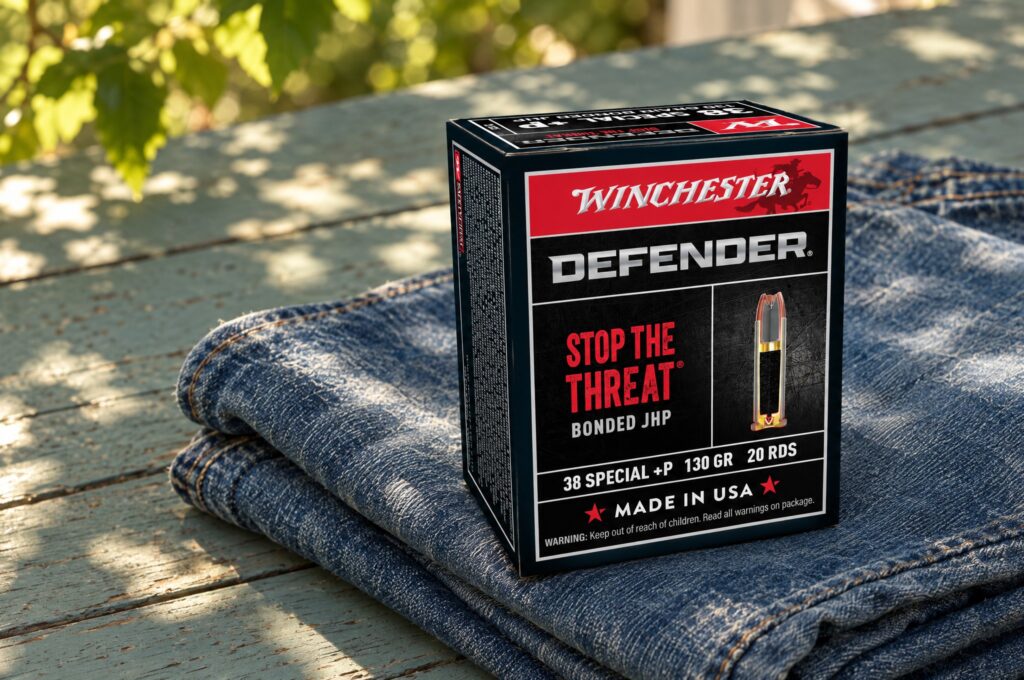
Rival card for comparison, not PDX1 Defender: Speer Gold Dot .38 Special +P 135 gr Short Barrel.

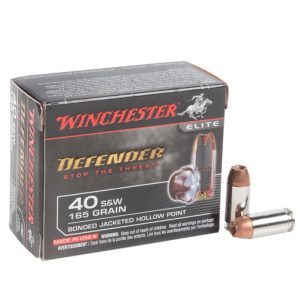
PDX1 Defender 40 S&W: 165 gr and 180 gr
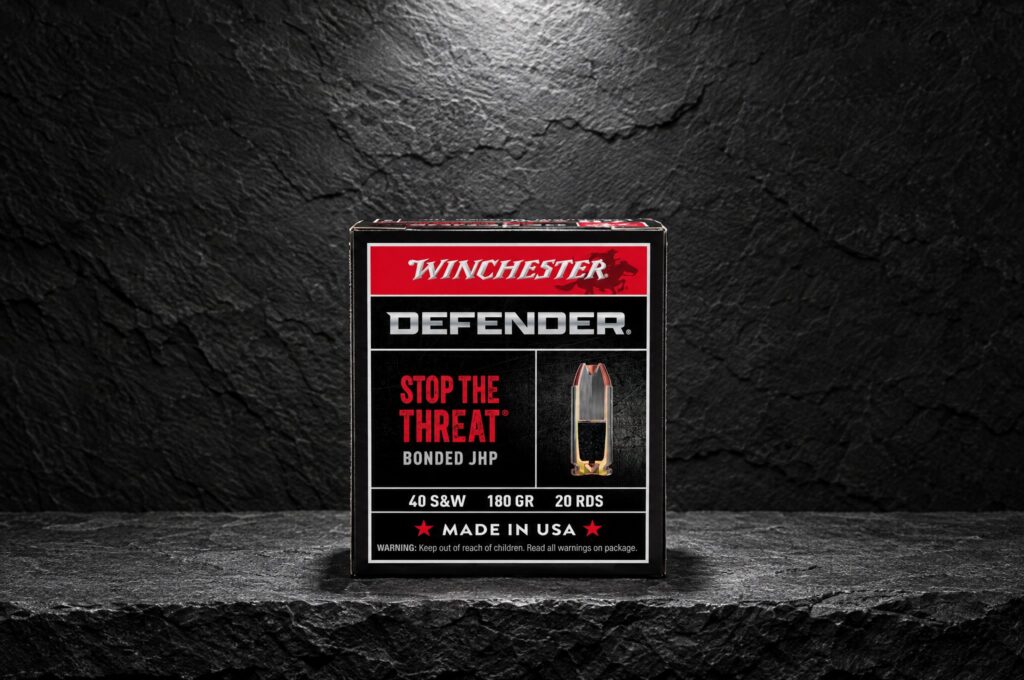
Both PDX1 Defender .40 loads did well from a Glock 27. The 165 gr kept all five in the window at 14.60 inches and opened to 0.74; the 180 gr put four of five in at 16.46 inches.
| Load | fps | Depth | Width | In 12 to 18 in | Every shot, in |
|---|---|---|---|---|---|
| PDX1 Defender 165 gr | 1,066 | 14.60 in | 0.74 in | 5 of 5 | 12.8, 13.9, 15.1, 15.3, 15.9 |
| PDX1 Defender 180 gr | 995 | 16.46 in | 0.71 in | 4 of 5 | 15.1, 16.2, 16.3, 16.3, 18.4 |
| Speer Gold Dot 180 gr | 955 | 14.50 in | 0.65 in | 5 of 5 | 13.4, 13.6, 14.3, 14.4, 16.8 |
| Winchester Ranger Bonded 165 gr | 1,098 | 14.74 in | 0.77 in | 5 of 5 | 14.3, 14.6, 14.9, 14.9, 15.0 |
| Winchester Ranger T 180 gr | 949 | 16.22 in | 0.70 in | 5 of 5 | 15.3, 15.5, 16.5, 16.7, 17.1 |
| Hornady Critical Defense 165 gr | 1,075 | 16.60 in | 0.60 in | 5 of 5 | 14.3, 16.5, 16.5, 17.8, 17.9 |
| Winchester Ranger Bonded 180 gr | 930 | 16.92 in | 0.72 in | 4 of 5 | 16.0, 16.3, 16.5, 17.4, 18.4 |
| Federal HST 180 gr | 964 | 18.50 in | 0.72 in | 2 of 5 | 17.3, 17.7, 18.4, 19.4, 19.7 |
| Sig V-Crown 165 gr | 1,014 | 20.18 in | 0.57 in | 1 of 5 | 17.4, 19.7, 20.4, 21.6, 21.8 |
The 165 gr was the widest PDX1 handgun string we shot, at 0.74 inches. Its 180 gr partner ran a little deeper, with one shot at 18.4. Federal HST 180 gr put two of five in from the same gun. Read our Federal HST review for that one.
From the Glock 27 the 180 gr read 995 fps against a 1,025 fps box figure, and the 165 gr 1,066 against 1,140.


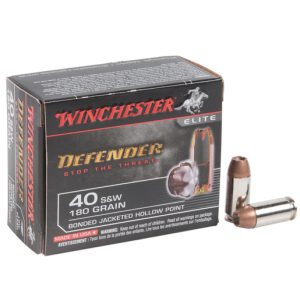
PDX1 Defender 45 ACP: 230 gr
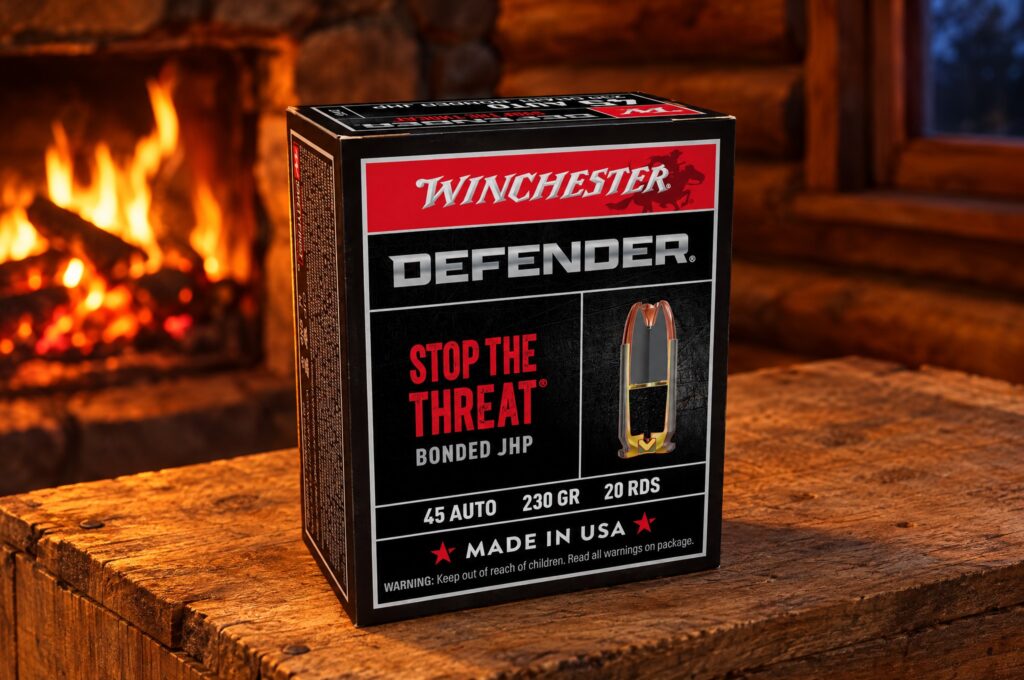
PDX1 Defender .45 ACP 230 gr ran deep and loose from a 3.64 inch Kahr CW45. It averaged 21.58 inches with three of five in the window, and one shot went the full 32 inches of our gel.
| Load | fps | Depth | Width | In 12 to 18 in | Every shot, in |
|---|---|---|---|---|---|
| PDX1 Defender 230 gr | 863 | 21.58 in | 0.61 in | 3 of 5 | 16.6, 17.2, 17.9, 24.2, 32.0 |
| Speer Gold Dot 230 gr | 752 | 12.86 in | 0.71 in | 4 of 5 | 11.5, 12.4, 12.9, 13.3, 14.2 |
| Federal HST 230 gr | 822 | 14.02 in | 0.85 in | 5 of 5 | 13.1, 13.3, 13.4, 13.6, 16.7 |
| Winchester Ranger T 230 gr | 900 | 14.52 in | 1.00 in | 5 of 5 | 13.5, 13.6, 14.2, 14.5, 16.8 |
| Hornady Critical Defense 185 gr | 941 | 17.62 in | 0.59 in | 2 of 5 | 11.2, 12.8, 13.9, 23.6, 26.6 |
| Winchester Ranger Bonded 230 gr | 862 | 25.70 in | 0.56 in | 1 of 5 | 17.6, 18.6, 28.3, 32.0, 32.0 |
| Sig V-Crown 200 gr | 871 | 31.16 in | 0.45 in | 0 of 5 | 29.1, 31.2, 31.5, 32.0, 32.0 |
Three shots landed between 16.6 and 17.9 inches, then one went 24.2 and one reached the end. It opened to 0.61 inches. Federal HST 230 gr kept five of five in at 14.02 inches and 0.85 wide from the same gun, and Winchester’s own Ranger T 230 gr did the same at 1.00 wide.
A 3.64 inch barrel is short for .45, and we read 863 fps against Winchester’s 920. A full-size 1911 would drive it faster, but we did not test one, so for a compact .45 I would pick HST or Gold Dot.
Rival card for comparison, not PDX1 Defender: Speer Gold Dot .45 Auto 230 gr.
PDX1 Defender 10mm, 357 SIG and 45 Colt
Winchester also makes PDX1 Defender in 10mm Auto 180 gr, .357 SIG 125 gr and .45 Colt 225 gr. We did not gel test these three, so the table holds Winchester’s own figures only, with no depth or width claim.
| Load | Symbol | fps | ft-lb | 25 yd fps | BC |
|---|---|---|---|---|---|
| 10mm Auto 180 gr | S10MMPDB | 1,240 | 614 | 1,170 | 0.181 |
| .357 SIG 125 gr | S357SPDB | 1,350 | 506 | 1,262 | 0.143 |
| .45 Colt 225 gr | S45CPDB | 850 | 361 | 832 | 0.163 |
The 10mm is the hottest PDX1 handgun load at 614 ft-lb. The .45 Colt also ships in a .410 and .45 Colt combo pack, ten .45 Colt and ten .410 shells, for Judge and Governor owners.
PDX1 Defender 12 Gauge: Slug Plus 00 Buck
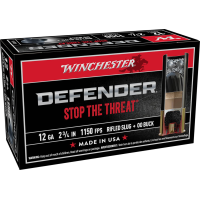
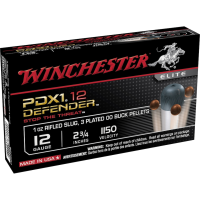
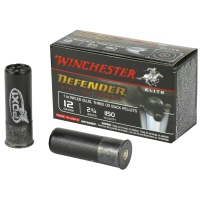
The famous PDX1 Defender 12 gauge stacks three plated 00 buck pellets on a 1 oz rifled slug, a modern buck and ball load at 1,150 fps. The slug is accurate; the three pellets are what you have to manage.
Winchester describes “3 pellets of Grex buffered 00 plated buckshot nested on top of a 1 oz rifled slug,” made for “compensating for aim error.” I ran 20 rounds of the 12 ga load through a Benelli M4 and a Mossberg 590A1, ten in each, with no malfunctions in either gun.
From a cylinder bore with ghost ring sights the slug stayed in a 10 inch gong at about 50 yards, and I got hits out to 75. Recoil was mild for a slug load in both the pump and the semi-auto.
The pellets are the problem. I fired one round each at a Q target from 15, 25 and 50 yards and found three slug holes but only six of nine pellet holes; one pellet missed the target at 15 yards. None flew off target at 10 yards and closer.
Inside a house, at 10 yards or less, the PDX1 12 gauge slug and buck load is fine. Past that, every pellet you cannot account for is a liability. Our home defense shotgun ammo test compares this load with straight buckshot.
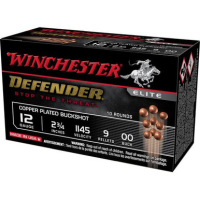
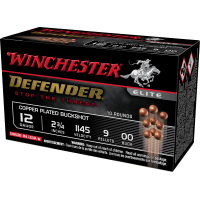
Winchester also sells plain Defender 00 buck, SB1200PD, with nine pellets at 1,145 fps, and a #2 shot load that Winchester says has “Substantially more pellets than 00 Buckshot loads, while reducing excessive penetration.” We did not test either.
Rival card for comparison, not PDX1 Defender: Hornady Critical Defense 12 Gauge 00 Buck.
PDX1 Defender 12 Gauge Segmenting Slug
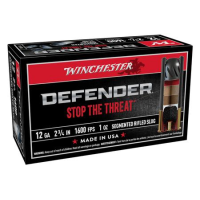
The PDX1 12 gauge segmenting slug is cut to break into three pieces. In our 10 percent gel it split at 3 to 4 inches, and the fragment I recovered stopped at 16 inches, 132.2 grains.
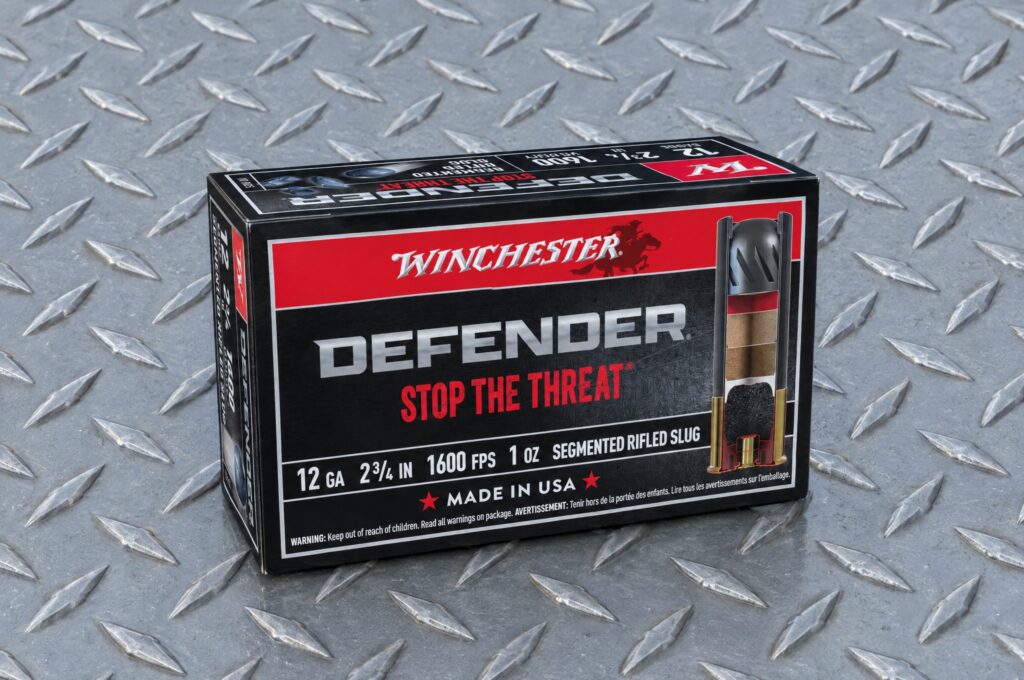
Winchester says “the slug breaks into three equal segments,” and its 2012 release said it “segments into three pieces when fired into FBI protocol barriers.” Rated at 1,600 fps, it read 1,451 fps on average from an 18.5 inch Beretta 1301 Tactical, from 1,443 to 1,458 across the string.
The block was a 16 inch Clear Ballistics 10 percent block with a second one behind it. The slug went in whole, broke up at 3 to 4 inches, and the three pieces fanned out; two left through the sides of the block and the third stopped against the backup block.
That makes the segmenting slug the better PDX1 12 gauge choice when you want one projectile you can aim and no loose pellets. It still goes through interior walls like any slug. The box calls it a segmented rifled slug, so stores list it as the PDX1 segmented slug too. Our 12 gauge slug guide covers rifled and sabot slugs.
PDX1 Defender 410: Defense Discs and BBs
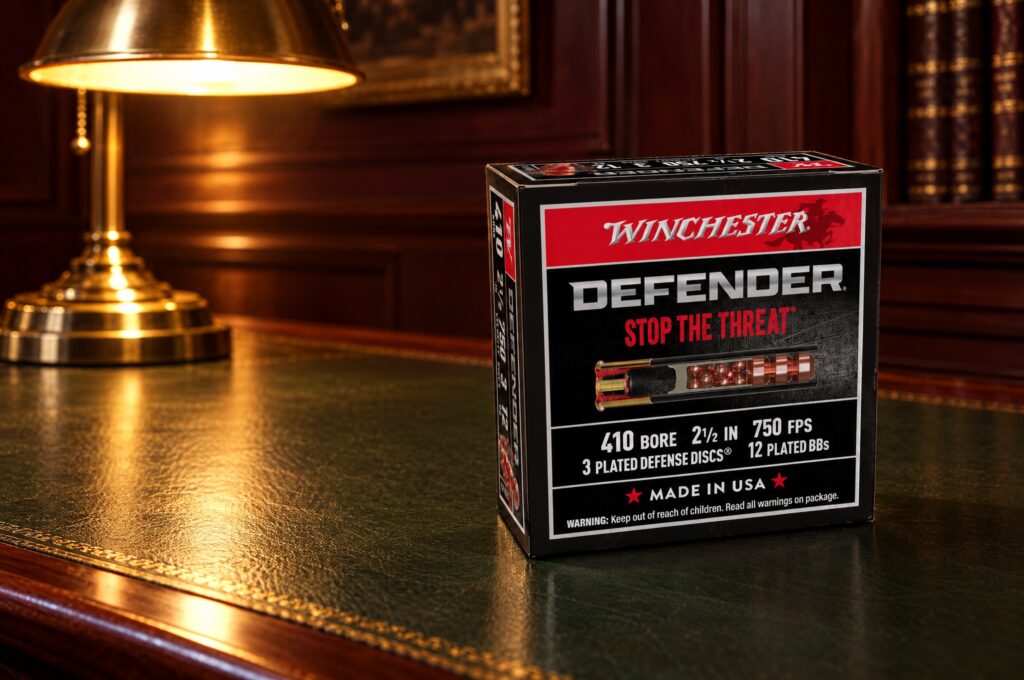
PDX1 Defender .410 loads plated Defense Discs over plated BBs: 3 discs and 12 BBs in the 2.5 inch shell, 4 and 16 in the 3 inch. The discs went 13 to 16 inches in gel; the BBs scattered.
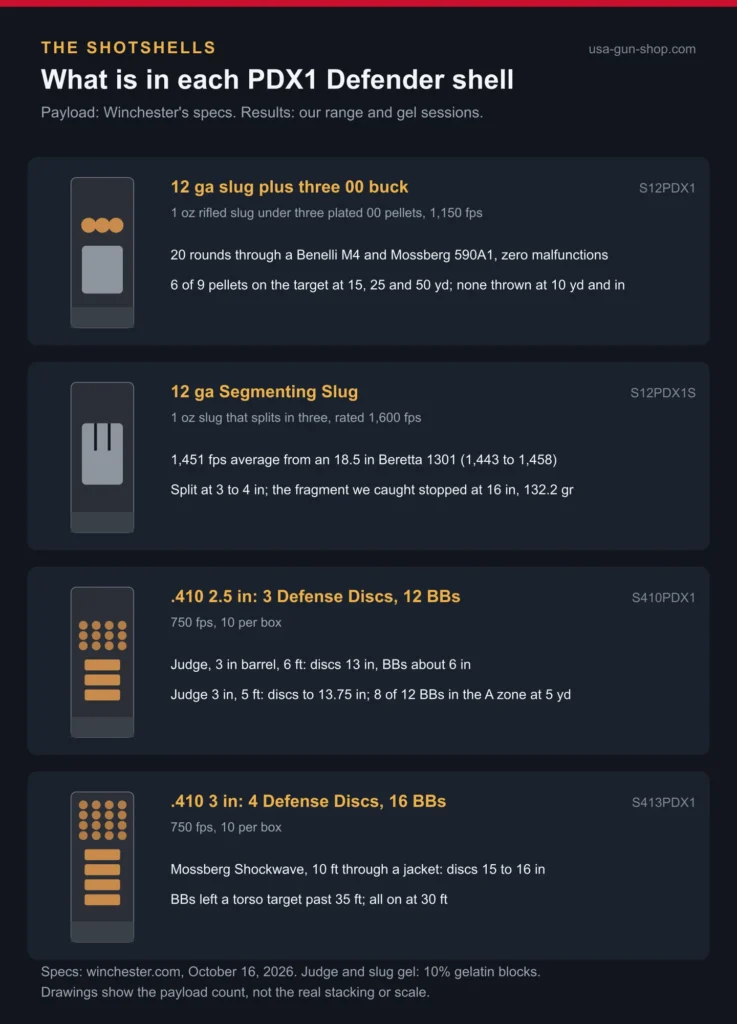
From a Taurus Judge with a 3 inch barrel at 6 feet, the three discs of the 2.5 inch load went 13 inches into 10 percent gel and the BBs about 6, in a wound pattern about 4 inches across. The discs weigh about 68 grains each.
One round from a second Judge, 3 inch chamber and barrel, fired by a TFB reader at 5 feet, pushed the discs to 13.75 inches; most BBs stopped between 8 and 14 inches and two left the block. On paper at 5 yards, a second round from that Judge put eight of 12 BBs in the A zone and four in the C zone.
Barrel length matters with this load. From a 2 inch Public Defender, two discs went into one hole and the third landed about an inch away, but at 7 yards most BBs landed beyond the target area. From a smooth-bore Mossberg Shockwave, the 3 inch shell put the discs 15 to 16 inches deep through a jacket at 10 feet.
The same Shockwave threw BBs clear off a torso target past 35 feet; at 30 feet all pellets stayed on. Winchester built the load for the Judge, and a Mossberg HS 410 smooth bore also threw BB flyers at about seven yards. In a shotgun, plain .410 buckshot patterns tighter than PDX1 410.
See our Taurus Judge review and Public Defender review for the guns. Winchester’s 2010 page said the load was “Designed for use in the Taurus Judge,” and that is where PDX1 410 belongs.
Against Hornady Critical Defense .410 Triple Defense, which stacks a .41 caliber FTX slug over two round balls, PDX1 did better from the smooth-bore Shockwave: both rounds of the Hornady I fired for a group sent the slug through the target sideways. From the rifled barrel in our Public Defender test it grouped tightest of the .410 loads at 7 yards; our Critical Defense review covers the rest of the Hornady line.
Rival card for comparison, not PDX1 Defender: Hornady Critical Defense .410 Triple Defense.
PDX1 Defender Rifle Loads: 223, 308 and More
The .223 and .308 Defender loads use Winchester’s Split Core bullet, a soft front core ahead of a rear core welded to the jacket. The 5.56 uses a bonded solid base bullet, the 350 Legend a fully bonded one.
| Load | Symbol | Bullet | fps | ft-lb | BC |
|---|---|---|---|---|---|
| .223 Rem 60 gr | S223RPDB | Split Core Hollow Point | 2,750 | 1,007 | 0.208 |
| .223 Rem 77 gr | S223RPDB2 | Split Core Hollow Point | 2,500 | 1,068 | 0.319 |
| 5.56mm 64 gr | S556PDB | Bonded Solid Base | 2,800 | 1,115 | 0.177 |
| .308 Win 120 gr | S308PDB | Split Core Hollow Point | 2,850 | 2,164 | 0.256 |
| 350 Legend 160 gr | S350PDB | Bonded; Winchester lists the type as Defender | 2,170 | 1,673 | 0.202 |
| .22 WMR 40 gr | S22MPDX1 | Jacketed Hollow Point | 1,320 | 155 | 0.110 |
For the .223, Winchester says the “Front core expands rapidly to deliver quick impact shock,” while the bonded rear core holds weight. I shot the .223 60 gr in a LaRue OBR, where it left at 2,768 fps and averaged 1 inch groups at 100 yards, and in an M16A1 with a 16.5 inch 1:12 barrel at 2,807 fps, 1.25 inch groups at 50 yards with irons.
Winchester’s own lab gel for the .223 60 gr puts it just under 12 inches in bare gel, about 11 inches after wallboard with 55 to 60 percent of its weight kept, and 5 to 6 inches after auto glass with about 40 percent kept. That is shallow by design: it fragments rather than over-penetrating.
We have no test data for the .308, 5.56 or 350 Legend loads, and the 7.62x39 is gone. The .22 WMR 40 gr, the PDX1 22 Mag load, also wears the PDX1 Defender name in its symbol, S22MPDX1.
Barrel Length and Velocity
Every PDX1 Defender handgun string we shot ran under Winchester’s box velocity, from 30 to 225 fps slow. Winchester does not print the test barrel on its product pages, and our carry guns ran from 2 to 4.2 inches.
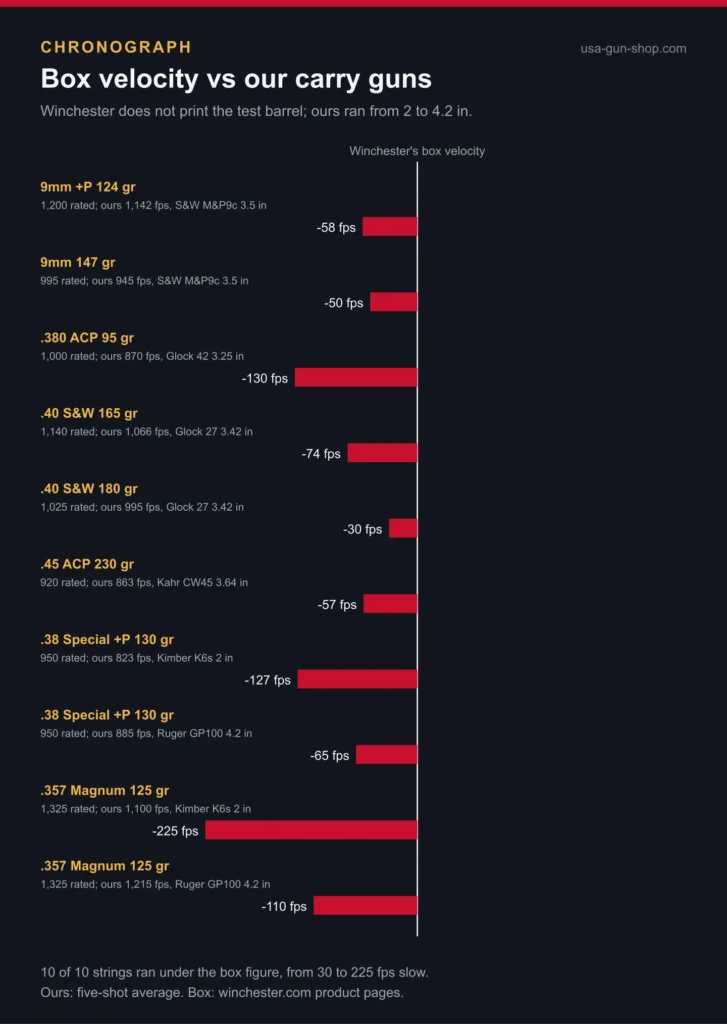
| Load | Our gun | Box fps | Ours | Difference |
|---|---|---|---|---|
| 9mm +P 124 gr | S&W M&P9c 3.5 in | 1,200 | 1,142 | -58 |
| 9mm 147 gr | S&W M&P9c 3.5 in | 995 | 945 | -50 |
| .380 Auto 95 gr | Glock 42 3.25 in | 1,000 | 870 | -130 |
| .40 S&W 165 gr | Glock 27 3.42 in | 1,140 | 1,066 | -74 |
| .40 S&W 180 gr | Glock 27 3.42 in | 1,025 | 995 | -30 |
| .45 Auto 230 gr | Kahr CW45 3.64 in | 920 | 863 | -57 |
| .38 Special +P 130 gr | Kimber K6s 2 in | 950 | 823 | -127 |
| .38 Special +P 130 gr | Ruger GP100 4.2 in | 950 | 885 | -65 |
| .357 Magnum 125 gr | Kimber K6s 2 in | 1,325 | 1,100 | -225 |
| .357 Magnum 125 gr | Ruger GP100 4.2 in | 1,325 | 1,215 | -110 |
The biggest loss was the .357 Magnum from the 2 inch snub, 225 fps. The same load lost 110 fps from the 4.2 inch GP100. The 180 gr .40 and 147 gr 9mm lost the least.
Underwood shows the same pattern from short barrels; our Underwood Ammo review checks 18 of its strings against the box.
PDX1 Defender vs HST, Gold Dot and Critical Defense
On the same guns PDX1 Defender was wide in revolvers and .380 and deep in 9mm and .45, where HST and Gold Dot stayed in the window more. Gold Dot and Critical Defense opened narrower in .38, .357 and .380.
| Caliber | Load | Depth, in | Width, in | In window |
|---|---|---|---|---|
| 9mm | PDX1 147 gr | 20.60 | 0.54 | 0 of 5 |
| 9mm | Federal HST 147 gr | 15.24 | 0.61 | 4 of 5 |
| 9mm | Speer Gold Dot 147 gr | 16.06 | 0.42 | 5 of 5 |
| 9mm | Hornady Critical Defense 115 gr | 13.06 | 0.50 | 4 of 5 |
| .380 | PDX1 95 gr | 9.50 | 0.63 | 0 of 5 |
| .380 | Hornady Critical Defense 90 gr | 13.24 | 0.52 | 5 of 5 |
| .38 +P snub | PDX1 130 gr +P | 12.30 | 0.63 | 4 of 5 |
| .38 +P snub | Gold Dot Short Barrel 135 gr +P | 13.64 | 0.44 | 4 of 5 |
| .357 snub | PDX1 125 gr | 13.92 | 0.63 | 5 of 5 |
| .357 snub | Hornady Critical Defense 125 gr | 15.28 | 0.52 | 5 of 5 |
| .40 | PDX1 180 gr | 16.46 | 0.71 | 4 of 5 |
| .40 | Federal HST 180 gr | 18.50 | 0.72 | 2 of 5 |
| .45 | PDX1 230 gr | 21.58 | 0.61 | 3 of 5 |
| .45 | Federal HST 230 gr | 14.02 | 0.85 | 5 of 5 |
All rows come from the same guns as the caliber sections above. Our HST, Gold Dot and Critical Defense cover each rival in more detail. For a head-to-head on Federal and Winchester as brands, see Federal vs Winchester.
Hornady Critical Duty is the other bonded duty option, and in 9mm it also ran deep from this compact; our Critical Duty review has those numbers.
Winchester’s other civilian hollow point is Silvertip. Its page lists a “Hollow Point” with an “Engineered Jacket Profile” and does not call Silvertip bonded; Defender is bonded and notched. We have no Silvertip strings from these guns, so we make no depth claim for it.
PDX1 Defender vs Ranger T and Ranger Bonded
Winchester never ties PDX1 Defender to Ranger T. It used the same FBI wording for Bonded PDX1 and its police Ranger Bonded line, and in our gel those two behaved alike while Ranger T opened wider in 9mm and .45.
Winchester’s 2010 release for the police Ranger Bonded .38 said it “uses the same technology the Federal Bureau of Investigation uses as its primary service round,” the same line its December 2009 release used for Bonded PDX1. It added: “This product is only available to law enforcement divisions.”
| Load | Gun | PDX1 Defender: depth / width / in | Ranger Bonded | Ranger T |
|---|---|---|---|---|
| 9mm 147 gr | S&W M&P9c 3.5 in | 20.60 / 0.54 / 0 of 5 | 21.48 / 0.51 / 0 of 5 | 16.46 / 0.74 / 3 of 5 |
| .40 165 gr | Glock 27 3.42 in | 14.60 / 0.74 / 5 of 5 | 14.74 / 0.77 / 5 of 5 | 20.96 / 0.67 / 2 of 5 |
| .40 180 gr | Glock 27 3.42 in | 16.46 / 0.71 / 4 of 5 | 16.92 / 0.72 / 4 of 5 | 16.22 / 0.70 / 5 of 5 |
| .45 230 gr | Kahr CW45 3.64 in | 21.58 / 0.61 / 3 of 5 | 25.70 / 0.56 / 1 of 5 | 14.52 / 1.00 / 5 of 5 |
| .38 +P 130 gr | Kimber K6s 2 in | 12.30 / 0.63 / 4 of 5 | 13.78 / 0.60 / 4 of 5 | not made |
Ranger T is a different bullet, a reverse taper jacket design sold through police distributors, and it opened wider than PDX1 in 9mm 147 gr and .45 230 gr from the same guns. Our Winchester Ranger T-Series review covers it, and Winchester’s pages do not name a Black Talon link for either line.
Which PDX1 Defender Load for Which Gun
Pick PDX1 Defender for revolvers and .40 pistols first. In a snub .38 or .357 and a compact .40 it stayed in the window and opened wide; in a compact 9mm, pocket .380 or short .45 it did not.
- Snub .38 Special or .357, like a Kimber K6s or S&W J-frame: .38 +P 130 gr or .357 125 gr. Nine of 10 snub shots landed in the window.
- 4 inch revolver, like a Ruger GP100: either load; all 10 shots from our GP100 landed in the window.
- Compact .40, like a Glock 27: 165 gr for width, 180 gr for the lower price per round on our cards.
- Compact 9mm: PDX1 9mm is not our first choice; both loads averaged past 19 inches from 3.5 inches. Our 9mm ammo test lists better fits.
- Pocket .380, like a Glock 42: skip it; 9.50 inches is too shallow.
- Taurus Judge or Governor: the .410 2.5 inch, inside 7 yards, or the .45 Colt.
- Home defense 12 gauge: the segmenting slug, or the slug plus 00 buck inside 10 yards. Our SXP Defender review and Shockwave review cover the guns.
Known Problems
The PDX1 Defender problems we found are depth in some calibers and dispersion in the shotshells. The one reliability test we ran, 20 rounds of the 12 gauge slug load through a semi-auto and a pump, had no malfunctions.
- Deep from compact 9mm and .45: 11 of 15 shots from those three strings went past 18 inches.
- Shallow .380: 9.50 inches average, none of five past 12.
- Shotgun flyers: in one round each at 15, 25 and 50 yards, 3 of the 9 00 pellets in the slug load missed the target; .410 BBs left the target at 7 yards from a 2 inch Public Defender and a smooth bore, and past 35 feet from a Shockwave.
- Name confusion: boxes now say Defender, stores still say PDX1, and the Winchester SXP Defender is a shotgun.
- Retail-only extras: some stores list a Defender Elite 9mm and 10mm that Winchester’s own site does not show; we left them off our cards and did not review them.
Hollow point rules vary by state and city, and a few places restrict them, so check your local law before you buy defensive ammunition.
PDX1 Defender Variants
Winchester lists 25 current PDX1 Defender loads: eleven handgun, eight shotshell and six rifle or rimfire. The cards below show Winchester’s velocity and box count for the fourteen you are most likely to buy.
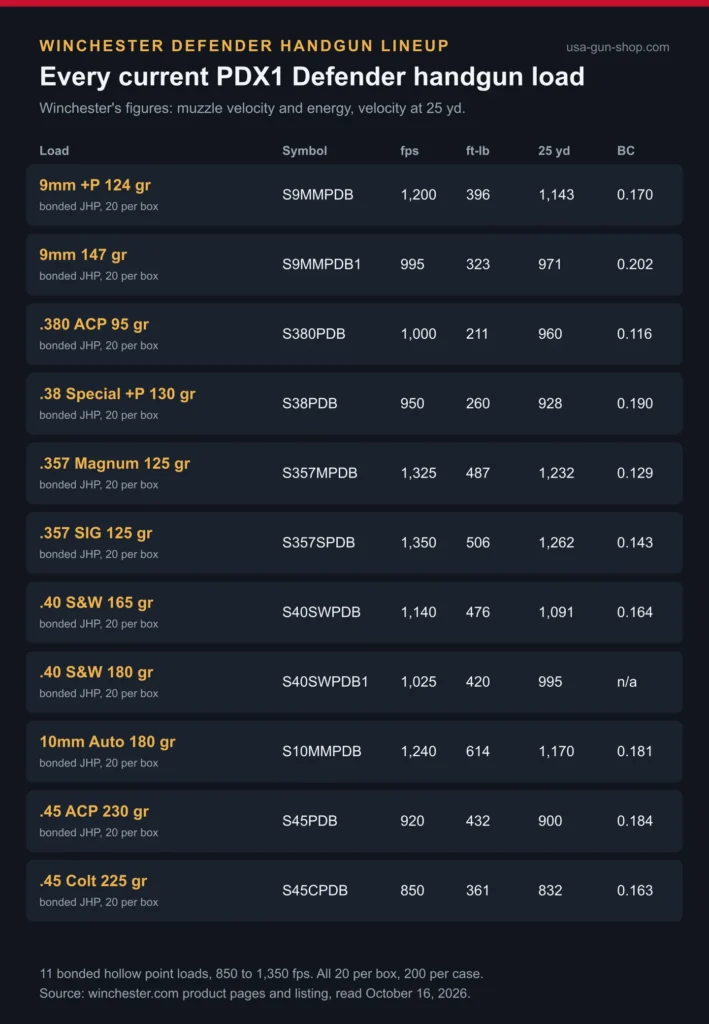
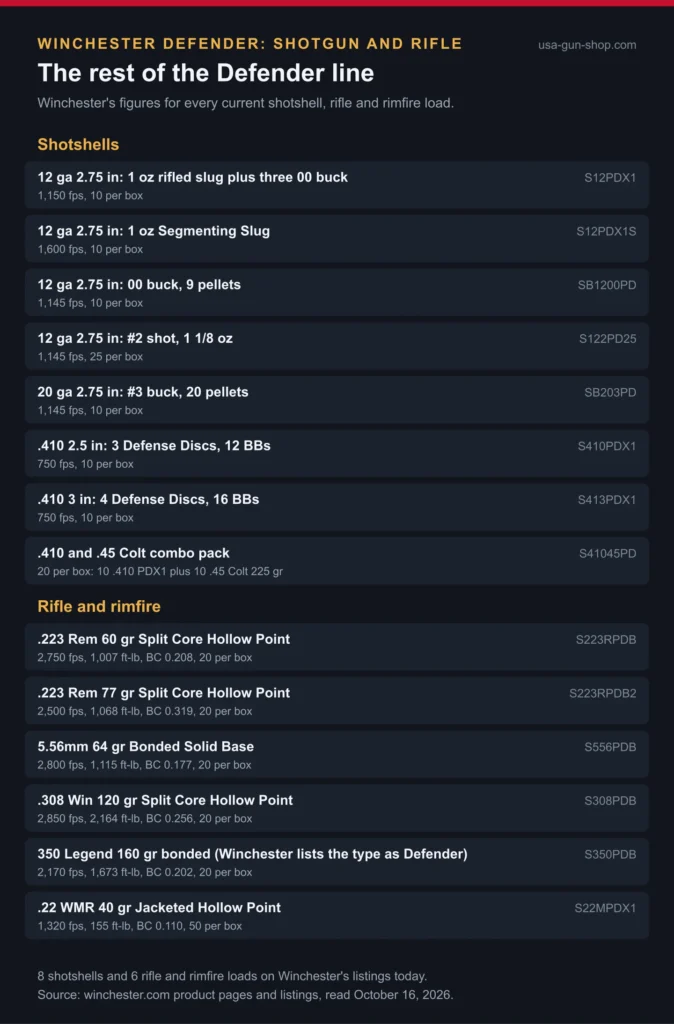
Not in the compare cards above: the .410 3 inch S413PDX1, the .410 and .45 Colt combo S41045PD, plain 00 buck SB1200PD, #2 shot S122PD25, 20 gauge #3 buck SB203PD, and the rifle and rimfire loads in the table above. Every one passed our still-made check against Winchester’s live listings on October 16.
Who Should NOT Buy Winchester PDX1 Defender
PDX1 Defender is a strong revolver and .40 load, but in 9mm, .380 and .45 our carry guns pushed it out of the FBI window. Look elsewhere if one of these four buyers is you.
- Compact 9mm carriers: both loads ran past 19 inches from 3.5 inches. Carry Federal HST 147 gr or Speer Gold Dot 147 gr.
- Pocket .380 owners: 9.50 inches is too shallow. Carry Hornady Critical Defense 90 gr.
- Short .45 owners: one shot of five went the full 32 inches. Carry Federal HST 230 gr.
- Shotgun owners in apartments: slugs and loose pellets both go through walls. Read our slugs vs buckshot guide first.
Price and Where to Buy
PDX1 Defender sits in the same price band as the other premium defensive lines on our cards: cheaper than some rivals, dearer than others. Handgun loads come in 20-round boxes and the 12 gauge loads in 10-round boxes.
Prices move daily, so the live cards on this page carry the current price per round for each load. Winchester’s own site rates Defender with four dollar signs, its top price mark, against two for its Silvertip line. Our concealed carry ammo guide and Winchester brand page list more options.
Retail stock is wide: Winchester Defender ammo sells through ordinary gun stores and big-box chains, unlike the police-only Ranger lines. Older Winchester PDX1 review pages and store listings use the PDX1 name for the same boxes. Our .410 shotgun guide and .38 Special ammo guide cover the guns these shells fit.
Winchester PDX1 Defender Review: The Verdict
Winchester PDX1 Defender earns an 8.0/10. It is a top snub revolver load in our tests and a strong .40, but in compact 9mm, pocket .380 and short .45 it missed the window too often.
Buy PDX1 Defender for a .38 or .357 revolver, a compact .40 or a Judge. For a 12 gauge, the segmenting slug is a cleaner choice than the slug plus buck. For a 9mm or .380 carry gun, our 9mm ammo test and .380 ammo test point to better fits from the same guns.
Our .45 ACP ammo guide and shotgun ammo test cover the rest of each field, and our Ranger T review covers Winchester’s police duty line.
Winchester PDX1 Defender FAQ
Short answers, from our gel data and Winchester’s own pages.
Is Winchester PDX1 Defender good for self-defense?
Yes in .38 Special, .357 Magnum and .40. From our guns 19 of 20 revolver shots and nine of 10 .40 shots stayed in the 12 to 18 inch window. From compacts the 9mm averaged past 19 inches, the .45 averaged 21.58 and the .380 stopped at 9.50 inches.
Is PDX1 the same as Winchester Defender?
Yes. Winchester sold Supreme Elite Bonded PDX1 from 2009, renamed the line PDX1 Defender in 2011 and now prints Defender on the box. The symbols and bullets carried over.
What is the difference between PDX1 and Ranger T?
PDX1 Defender is a bonded, notched hollow point sold to civilians. Ranger T is a reverse taper jacket hollow point sold through police distributors. From the same 9mm compact, Ranger T 147 gr put three of five in the window and PDX1 147 gr none. See our Ranger T review.
Is PDX1 the same as Black Talon?
Winchester's pages do not say so. Its releases trace PDX1 to the 2009 Supreme Elite Bonded PDX1 line and never name Black Talon.
Is Winchester PDX1 Defender bonded?
Yes, the handgun loads. Winchester says its process welds the jacket to the lead core, and the notched jacket opens into six segments. The .223 and .308 use a split core with a bonded rear core, the 5.56 a bonded solid base and the 350 Legend a fully bonded bullet.
Should I carry 124 gr +P or 147 gr PDX1 in 9mm?
From our 3.5 inch compact, neither stayed in the window: 19.60 inches for the 124 gr +P and 20.60 for the 147 gr. The 147 gr is subsonic and the most consistent; in a small 9mm we would carry HST or Gold Dot.
Is the PDX1 12 gauge good for home defense?
Inside 10 yards, yes. The 1 oz slug is accurate and cycled in a pump and a semi-auto. In one round each at 15, 25 and 50 yards, 6 of the 9 00 pellets hit the target and 3 missed; none flew off at 10 yards and closer. The segmenting slug puts everything in one projectile.
Does PDX1 410 work in a shotgun?
It fires, but the BBs scatter from a smooth bore. Winchester designed it for the Taurus Judge. From a Shockwave the BBs left a torso target past 35 feet, while the discs went 15 to 16 inches into gel.
Does the FBI use PDX1?
In 2009 Winchester said PDX1 was chosen by the FBI as its primary service round. That is Winchester's claim from 2009 about its bonded bullet; we found no current FBI statement naming PDX1 Defender.
Is 147 gr PDX1 Defender subsonic?
Yes. Winchester rates it at 995 fps, and it read 945 fps from our 3.5 inch gun, both under the speed of sound.