

Affiliate disclosure: This CCI Blazer Brass review contains affiliate links. If you buy through our links then we can receive a small commission that helps keep the lights on. You don’t pay anything more.
- Treat every gun as loaded
- Point the muzzle in a safe direction
- Keep your finger off the trigger until you’re ready to shoot
- Know your target and what’s beyond
Blazer Brass is the box most of us grab when the job is putting rounds downrange, and it is the range load behind a lot of our gun reviews. For this CCI Blazer Brass review I pulled every Blazer Brass round count, group and stoppage from those reviews: 10,330 rounds through 45 guns. Then I put 17 chronograph strings next to the velocity CCI prints on the box.
The short version: Blazer Brass is reliable range ammo with honest 9mm velocity, groups that are fine for practice, and reloadable brass. The catch is the .45 Auto, which ran 80 to 90 percent of its box speed in our guns, and the fact that CCI tells you not to shoot it through a ported barrel or a compensator.
Last updated October 22, 2026
On-sale 9mm from 200+ retailers · Updated every 4 hours


Table of Contents
How we tested: Every pick here is ranked against our testing methodology. Minimum round counts, accuracy and reliability protocols, the failures that disqualify a gun.
CCI Blazer Brass Review at a Glance
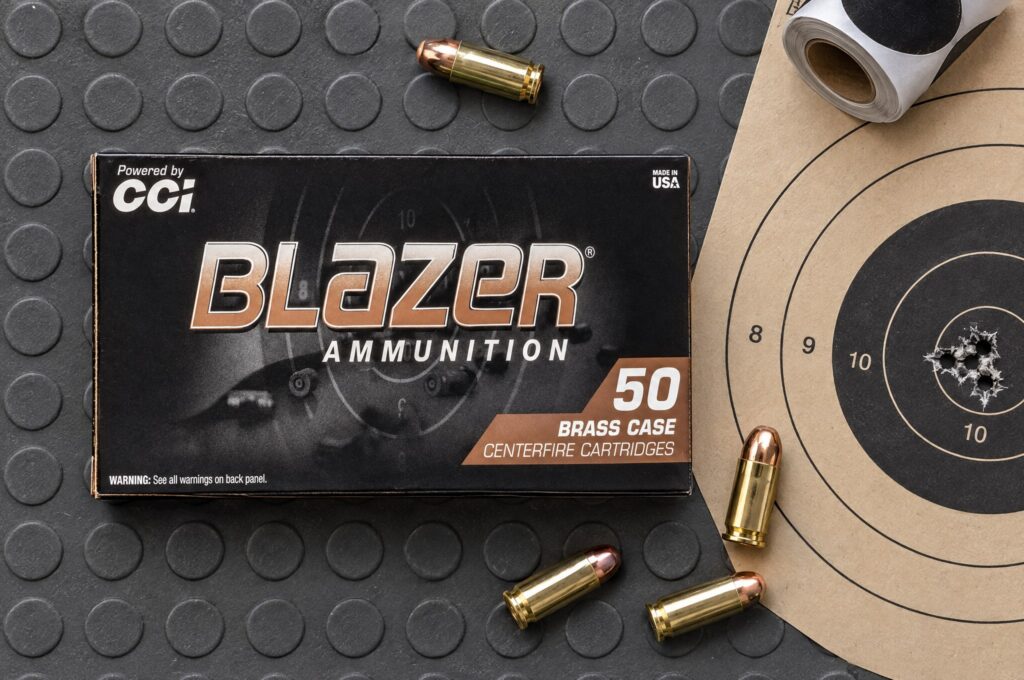
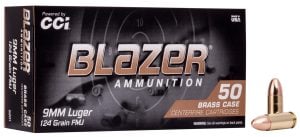
CCI Blazer Brass is brass-cased, boxer primed FMJ range ammunition made in Lewiston, Idaho, in 24 loads across 9 calibers. In our guns it ran 10,330 rounds with 8 stoppages, grouped 2.63 inches on average, and the 9mm stayed close to its box velocity.
Our Rating: 8.0/10
Pros
- Ran clean in almost every gun
- Reloadable boxer primed brass
- Nine calibers, 30 Super Carry to .44
Cons
- The .45 runs well under box
- Not for ported barrels or comps
- American Eagle grouped tighter
| What we checked | Result |
|---|---|
| Rounds counted in our gun reviews | 10,330 rounds in 45 guns, 8 stoppages (99.92 percent clean) |
| Five-shot groups, 20 guns | 2.63 inch average, 1.42 to 4 inches |
| 9mm 115 gr velocity, six pistols | 1,050 to 1,156 fps against 1,145 on the box |
| .45 Auto 230 gr velocity, four pistols | 667 to 749 fps against 830 on the box |
| Price, 9mm 115 gr, per round on our cards | 27.5 cents, against 26.0 for American Eagle 115 gr |
| Current CCI part numbers | 28, including Blazer Brass HP and Clean-Fire Suppressor |

What Is CCI Blazer Brass?
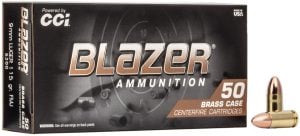
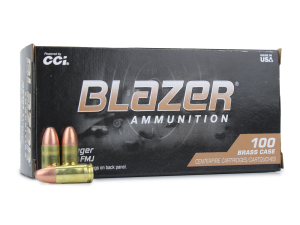
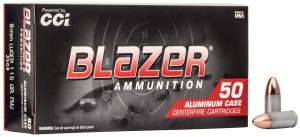
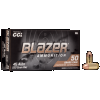
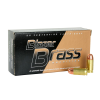
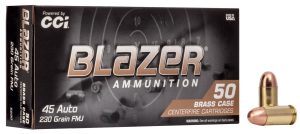
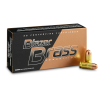
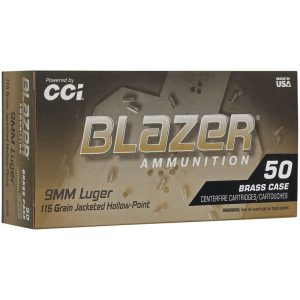
Blazer Brass is CCI’s brass-cased centerfire range line. It uses standard boxer primers in reloadable brass cases, with a full metal jacket bullet, and CCI sells it in 50 round boxes with 100, 200 and 500 round packs for the 9mm.
CCI’s own description is short: “Blazer® Brass handgun ammunition features reloadable brass cases, quality primers and clean-burning propellants.” It adds: “Standard boxer-type primers and primer pockets make reloading easy” CCI also calls its primers “non-corrosive, non-mercuric CCI primers”, and of the brass loads it says: “Like all Blazer brass loads, it is accurate and 100-percent American made.”
The name causes confusion because there are two Blazers. Plain Blazer uses an aluminum case with a Berdan-style primer, and you cannot reload it. Blazer Brass is the brass version, and the empties are worth picking up. If you see a box that just says Blazer, check the case before you buy it for reloading.
The line has two newer branches. Blazer Brass HP puts a jacketed hollow point in the same brass case, and CCI pitches it as “affordable enough to train and defend with the same round” The Blazer Brass Clean-Fire Suppressor loads, new for 2026, are subsonic with a fully enclosed TMJ bullet and lead-free primers. CCI says “The accurate loads leave less fouling in the barrel and suppressor to minimize maintenance and maximize your time at the range.”
One rule from CCI that matters: every Blazer Brass product page carries the line “DO NOT USE IN FIREARMS WITH PORTED BARRELS OR PORTED RECOIL COMPENSATOR.” CCI does not give the reason on the page, so take it at face value. If your carry gun or race gun is ported, buy a different practice load. CCI’s sister brand Speer makes the Lawman TMJ line for that job.


How We Tested Blazer Brass
Blazer Brass is our default range load, so it is in the round count, accuracy and reliability sections of 45 of our gun reviews. This review pulls those numbers together and adds 17 chronograph strings from 12 pistols.
Groups are five-shot groups from a rest, at 15 or 25 yards depending on the gun, and every one links back to the review it came from. Velocity strings ran six to 15 shots across a chronograph a few feet from the muzzle. Stoppages are logged by round number, and we note when a gun was still in break-in.
That makes this a long-run review rather than a one-box test. The 10,330 rounds were fired over many months, through striker guns, 1911s, 2011s, DA/SA pistols, carbines and a revolver, and across several lots of ammunition.
Blazer Brass Velocity: Box Speed vs Our Chronograph
The 9mm Blazer Brass ran close to its box velocity, 1,050 to 1,156 fps for the 115 gr from barrels of 3.39 to 5.31 inches. The .45 Auto did not: it ran 667 to 749 fps against 830 on the box.
| Load | Gun, barrel | Shots | Average fps | Extreme spread | CCI box fps | Share of box |
|---|---|---|---|---|---|---|
| 9mm 115 gr | Glock 43, 3.39 in | 6 | 1,050 | 1,145 | 92% | |
| 9mm 115 gr | Glock 19, 4.02 in | 6 | 1,104 | 1,145 | 96% | |
| 9mm 115 gr | Glock 34, 5.31 in | 6 | 1,156 | 1,145 | 101% | |
| 9mm 115 gr | Sig P365XL, 3.7 in | 10 | 1,100 | 1,145 | 96% | |
| 9mm 115 gr | Glock 19X, 4.02 in | 10 | 1,114 | 1,145 | 97% | |
| 9mm 115 gr | M&P9 Pro, 5 in | 10 | 1,135 | 1,145 | 99% | |
| 9mm 124 gr | Sig P365XL, 3.7 in | 10 | 1,080 | 1,090 | 99% | |
| 9mm 124 gr | Glock 19X, 4.02 in | 10 | 1,084 | 1,090 | 99% | |
| 9mm 124 gr | M&P9 Pro, 5 in | 10 | 1,122 | 1,090 | 103% | |
| 380 Auto 95 gr | Glock 42, 3.25 in | 10 | 872 | 49 fps | 945 | 92% |
| 380 Auto 95 gr | Glock 42, 3.25 in | 10 | 869 | 48 fps | 945 | 92% |
| 380 Auto 95 gr | Glock 42, 3.25 in | 10 | 868 | 68 fps | 945 | 92% |
| 45 Auto 230 gr | 1911 Government, 5 in | 6 | 735 | 830 | 89% | |
| 45 Auto 230 gr | Sig P320 full size, 4.7 in | 6 | 749 | 830 | 90% | |
| 45 Auto 230 gr | Sig P320 Compact, 3.9 in | 6 | 700 | 830 | 84% | |
| 45 Auto 230 gr | S&W M&P Shield 45, 3.3 in | 6 | 667 | 830 | 80% | |
| 10mm Auto 180 gr | Glock 29, 3.78 in | 15 | 1,012 | 1,200 | 84% |
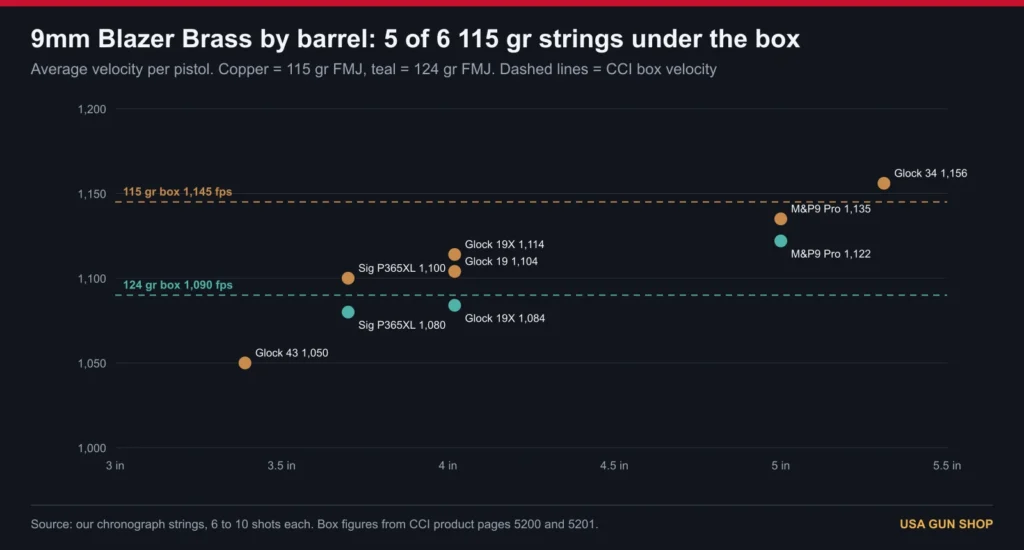
Barrel length explains the 9mm. The 3.39 inch Glock 43 ran the 115 gr at 1,050 fps, the 4 inch Glock 19 at 1,104 and the 5.31 inch Glock 34 at 1,156, which is above the box. The 124 gr tracked its box figure more closely: 1,080, 1,084 and 1,122 fps from the P365XL, Glock 19X and M&P9 Pro against 1,090 printed.
The .380 was steady. Three different lots from the same Glock 42 averaged 872, 869 and 868 fps, with extreme spreads of 48 to 68 fps over ten shots. That is about 92 percent of the 945 fps box figure, which is normal from a 3.25 inch barrel.
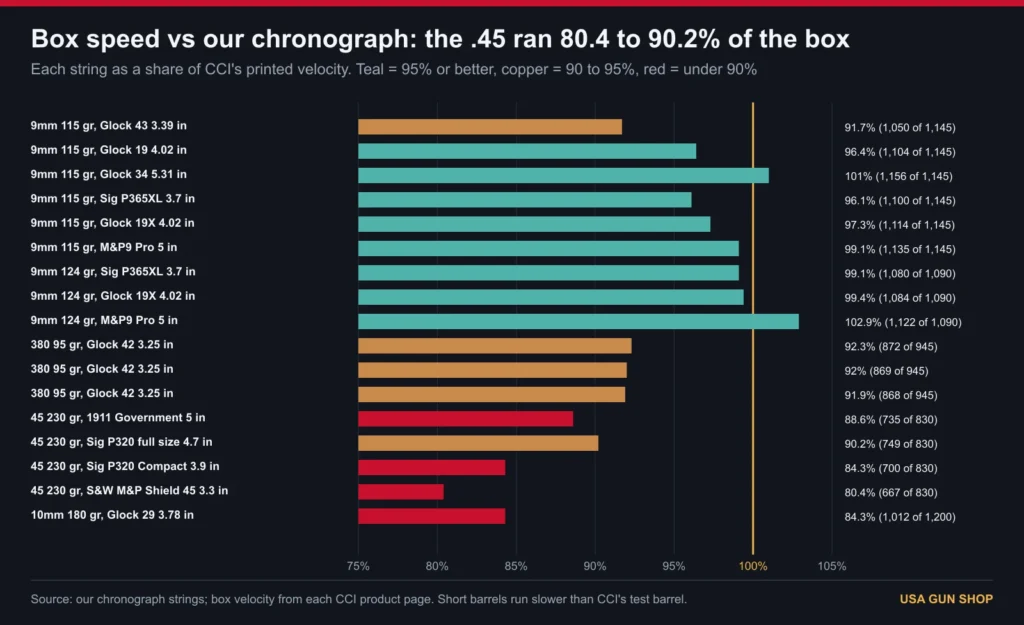
The .45 is the real gap. From a 5 inch 1911 it ran 735 fps, from the 4.7 inch P320 749, from the 3.9 inch P320 Compact 700 and from the 3.3 inch Shield 45 only 667. CCI prints 830. American Eagle 230 gr FMJ from the same 1911 and P320s ran 813, 824 and 800 fps, about 80 fps faster.
That matters for two reasons. Soft .45 ball can short-stroke a gun with a heavy recoil spring, and in USPSA a .45 needs a power factor of 165 to make Major. Blazer Brass works out to 169.1 from the 1911 but 153.4 from the Shield 45. If you shoot Major, chronograph your lot first. The 10mm told the same story: 1,012 fps from a 3.78 inch Glock 29 against 1,200 on the box.



Blazer Brass Accuracy in 20 Guns
Across 20 of our gun reviews, Blazer Brass averaged 2.63 inch five-shot groups, from 1.42 inches out of a Walther PDP-F to 4 inches out of a Sig P365. That is practice-grade accuracy: usually a little wider than the defensive loads tested in the same session.
| Gun (our review) | Blazer Brass load | Distance | Five-shot group | American Eagle FMJ, same session |
|---|---|---|---|---|
| Walther PDP-F | 147 gr | 15 yd | 1.42 in | |
| Beretta APX A1 | 115 gr | 15 yd | 1.9 in | 1.8 in |
| Staccato P | 124 gr | 25 yd | 2.1 in | |
| Shadow Systems MR920 | 124 gr | 15 yd | 2.1 in | |
| Kimber Rapide (9mm) | 115 gr | 25 yd | 2.2 in | |
| Canik METE MC9 | 124 gr | 15 yd | 2.25 in | |
| Kimber Custom II (9mm) | 115 gr | 25 yd | 2.3 in | 2.1 in |
| Stealth Arms Platypus | 115 gr | 25 yd | 2.4 in | 1.8 in |
| Girsan Regard MC | 115 gr | 15 yd | 2.5 in | 2.2 in |
| FN High Power | 124 gr | 25 yd | 2.5 in | 2.8 in |
| Springfield Ronin (.45) | 230 gr | 25 yd | 2.6 in | |
| Glock 29 (10mm) | 180 gr | 15 yd | 2.6 in | |
| Kimber R7 Mako | 124 gr | 15 yd | 2.8 in | 3 in |
| Ruger SR1911 (.45) | 230 gr | 25 yd | 2.9 in | 2.4 in |
| Glock 34 Gen 5 MOS | 115 gr | 25 yd | 3 in | |
| Ruger Security-380 | 95 gr | 15 yd | 3 in | 2.7 in |
| Glock 45 Gen 6 | 115 gr | 25 yd | 3.1 in | |
| Taurus 1911 (.45) | 230 gr | 25 yd | 3.4 in | |
| Walther PDP | 115 gr | 25 yd | 3.5 in | |
| Sig P365 | 115 gr | 15 yd | 4 in |
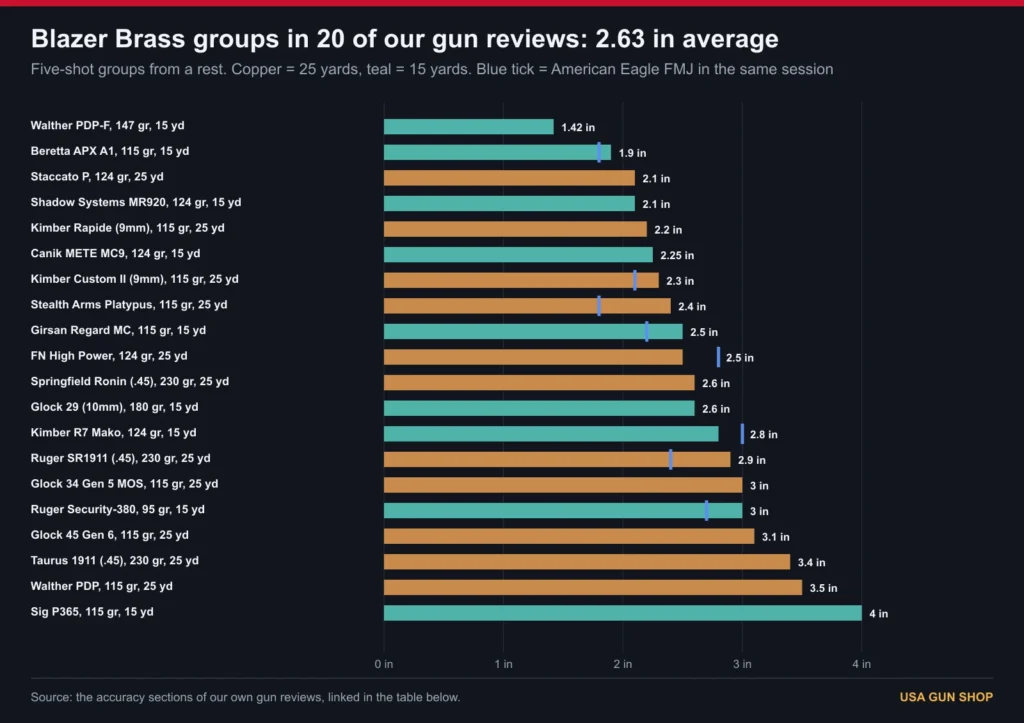
The tightest groups came from the Walther PDP-F, which printed 1.42 inches with the 147 gr at 15 yards, the Beretta APX A1 1.9, and the Staccato P 2.1 inches at 25 yards with the 124 gr. The worst came from short guns: 4 inches from the P365 at 15 yards.
In the 8 sessions where we also shot American Eagle FMJ, American Eagle was tighter 6 times and Blazer Brass 2 times. The margins were small, mostly 0.1 to 0.5 inch, and in our Springfield XD models guide Blazer Brass 124 gr was the most accurate load of the whole test.
Blazer Brass Reliability: 10,330 Rounds, 8 Stoppages
In the 45 gun reviews where we logged a Blazer Brass round count, it ran 10,330 rounds with 8 stoppages, 99.92 percent clean. Six of the eight came during break-in, in the first 75 rounds or so of a new gun.
| Gun (our review) | Load | What happened |
|---|---|---|
| Beretta 80X Cheetah (.380) | 95 gr | one failure to feed at round 431, from a full 15-round extended magazine |
| PSA Dagger Compact | 115 gr | two failures to feed, both in the first 75 rounds |
| PSA Dagger Micro | 124 gr | one failure to go into battery during break-in |
| Ruger LCP MAX (.380) | 95 gr | one failure to feed around round 30, none in later sessions |
| Glock 29 (10mm) | 180 gr | one stovepipe at round 212, shot weak hand only |
| Ruger Security-380 | 95 gr | one failure to feed at round 58, nose into the feed ramp |
| Colt Combat Commander Lightweight (9mm) | 115 gr | two failures to go fully into battery, rounds 31 and 64 |
| Kel-Tec P15 | 115 gr | one failure to eject at round 58, nothing after |
| S&W M&P9 M2.0 | 115 gr | one failure to feed at round 140, none after |
| Walther PDP-F | 147 gr | one failure to go into battery in the first 30 rounds, no repeat |
Read the table for the pattern rather than the count. Two failures to feed in the first 75 rounds of a PSA Dagger Compact, one in the first 30 of an LCP MAX, two failures to go into battery in a new Colt Lightweight Commander. Those are new guns with tight springs. The one stoppage deep into a session was the Beretta 80X Cheetah at round 431, from a fully loaded extended magazine.
The rest of the record is long runs without a problem: 500 rounds through our Glock 19 Gen 5, 500 through the Staccato P, 500 through the Kimber Rapide, 400 through the HK VP9, and 300 through the Glock 45 Gen 6 and the PSA AR-V carbine. Blazer Brass also ran our .380s and the 10mm Glock 29, where the one stovepipe came while shooting weak hand only.
Is Blazer Brass Dirty? Cleanliness and Reloading
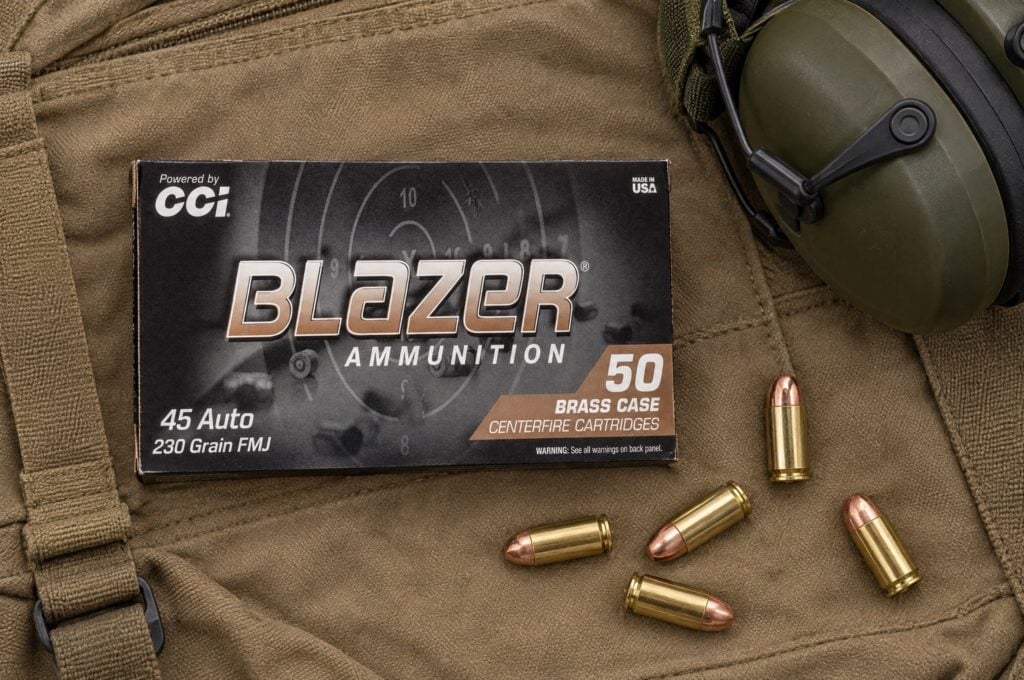
Blazer Brass is not the cleanest range ammo. CCI says it uses clean-burning propellants, but after a couple of hundred rounds you will see more carbon in the action than with Federal or Sellier & Bellot ball. It is not enough to cause stoppages in any gun we ran.
Our best 9mm ammo guide says the same: after 200 rounds of Blazer Brass you notice the extra fouling. If clean is the priority, CCI now makes the Clean-Fire Suppressor loads, and Federal has its Syntech line. Our American Eagle review covers the Federal options.
For reloaders, Blazer Brass is good range pickup. The cases are boxer primed with standard primer pockets, which is what CCI means when it says reloading is easy. Plain aluminum Blazer is the one to leave on the ground.
Blazer Brass vs American Eagle
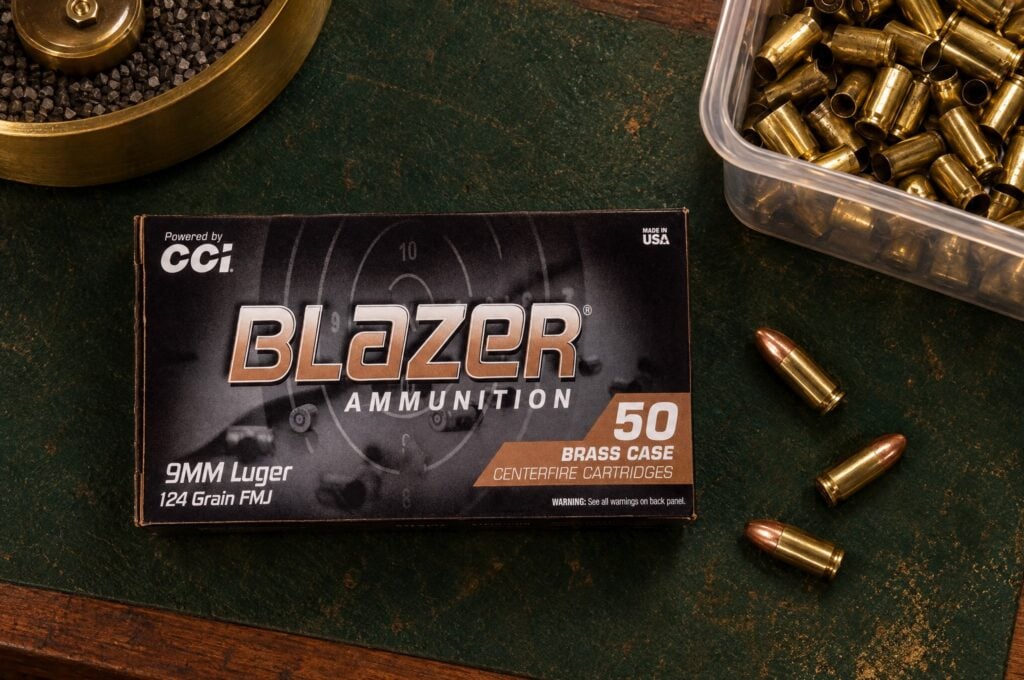
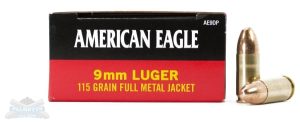
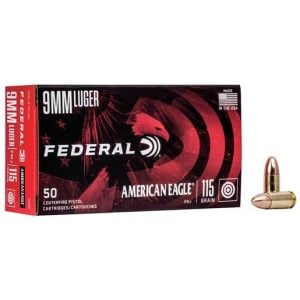
Blazer Brass vs American Eagle is close. American Eagle 9mm 115 gr ran faster from the Glock 19 and 34 but slower from the short Glock 43, grouped tighter in 6 of 8 head to heads, and was 26.0 cents a round on our cards against 27.5 for Blazer Brass.
| CCI Blazer Brass 9mm 115 gr | Federal American Eagle 9mm 115 gr | |
|---|---|---|
| Glock 43, 3.39 in | 1,050 fps | 1,026 fps |
| Glock 19, 4.02 in | 1,104 fps | 1,146 fps |
| Glock 34, 5.31 in | 1,156 fps | 1,206 fps |
| Groups, same session | Tighter in 2 of 8 | Tighter in 6 of 8 |
| Price per round on our cards | 27.5 cents | 26.0 cents |
| Made in | Lewiston, Idaho | Anoka, Minnesota |
Both are brass-cased, boxer primed and reloadable, both come from the same parent company, and both ran reliably for us. Our Federal American Eagle review has its full chronograph table. In .45 Auto the gap is bigger, and American Eagle is the better pick if your gun needs a full-power load.
Pick by price on the day. In 9mm the difference is a cent or two a round, and stock moves daily. Winchester White Box and PMC Bronze sit in the same price band; our best 9mm ammo guide ranks them.
Every Current Blazer Brass Load
CCI lists 28 Blazer Brass part numbers: 13 FMJ loads from .380 Auto to .44 Remington Magnum, 8 Blazer Brass HP loads and 3 Clean-Fire Suppressor loads. The .357 Magnum and .44 Magnum FMJ loads are new for 2026.
| Line | Caliber | Bullet | Style | Muzzle fps | Muzzle ft-lb | Box | CCI part |
|---|---|---|---|---|---|---|---|
| FMJ | 10mm Auto | 180 gr | Full Metal Jacket | 1,200 | 575 | 50 | 5221 |
| FMJ | 30 Super Carry | 115 gr | Full Metal Jacket Flat Nose | 1,150 | 338 | 50 | 5205 |
| FMJ | 357 Magnum | 158 gr | Full Metal Jacket Flat Nose | 1,250 | 548 | 50 | 5337 |
| FMJ | 38 Special | 125 gr | Full Metal Jacket | 865 | 208 | 50 | 5204 |
| FMJ | 380 Auto | 95 gr | Full Metal Jacket | 945 | 188 | 50 | 5202 |
| FMJ | 40 S&W | 165 gr | Full Metal Jacket | 1,050 | 404 | 50 | 5210 |
| FMJ | 40 S&W | 180 gr | Full Metal Jacket | 985 | 388 | 50 | 5220 |
| FMJ | 44 Rem Magnum | 240 gr | Full Metal Jacket | 1,200 | 767 | 50 | 5244 |
| FMJ | 45 Auto | 230 gr | Full Metal Jacket | 830 | 352 | 50 | 5230 |
| FMJ | 9mm Luger | 100 gr | Full Metal Jacket | 1,130 | 284 | 50 | 5296 |
| FMJ | 9mm Luger | 115 gr | Full Metal Jacket | 1,145 | 335 | 50 | 5200 |
| FMJ | 9mm Luger | 115 gr | Full Metal Jacket | 1,145 | 335 | 500 | 5200BK500 |
| FMJ | 9mm Luger | 124 gr | Full Metal Jacket | 1,090 | 327 | 50 | 5201 |
| FMJ | 9mm Luger | 124 gr | Full Metal Jacket | 1,090 | 327 | 100 | 52011BB |
| FMJ | 9mm Luger | 124 gr | Full Metal Jacket | 1,090 | 327 | 200 | 52012BB |
| FMJ | 9mm Luger | 147 gr | Full Metal Jacket | 950 | 295 | 50 | 5203 |
| Clean-Fire | 40 S&W | 180 gr | Total Metal Jacket Flat Nose | 970 | 376 | 50 | 5220S |
| Clean-Fire | 45 Auto | 230 gr | Total Metal Jacket | 800 | 327 | 50 | 5230S |
| Clean-Fire | 9mm Luger | 147 gr | Total Metal Jacket Flat Nose | 900 | 264 | 50 | 5203S |
| HP | 10mm Auto | 180 gr | Jacketed Hollow Point | 1,175 | 552 | 50 | 5251 |
| HP | 357 Magnum | 158 gr | Jacketed Hollow Point | 1,150 | 464 | 50 | 5207 |
| HP | 38 Special +P | 125 gr | Jacketed Hollow Point | 970 | 261 | 50 | 5338 |
| HP | 380 Auto | 98 gr | Jacketed Hollow Point | 920 | 184 | 50 | 5238 |
| HP | 40 S&W | 180 gr | Jacketed Hollow Point | 1,015 | 412 | 50 | 5241 |
| HP | 45 Auto | 230 gr | Jacketed Hollow Point | 850 | 369 | 50 | 5245 |
| HP | 9mm Luger | 115 gr | Jacketed Hollow Point | 1,145 | 335 | 20 | 5239A |
| HP | 9mm Luger | 115 gr | Jacketed Hollow Point | 1,145 | 335 | 50 | 5239 |
| HP | 9mm Luger | 124 gr | Jacketed Hollow Point | 1,100 | 333 | 50 | 5246 |
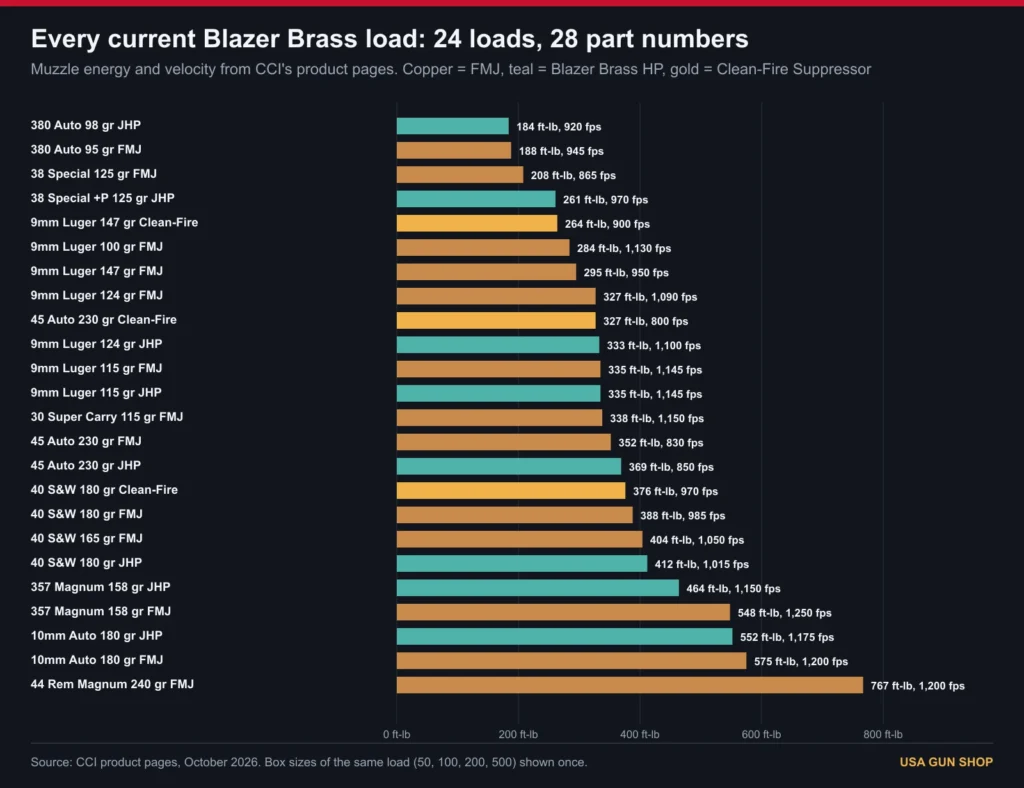
The 30 Super Carry 115 gr is worth a note: CCI lists it at 1,150 fps, right with its own 9mm 115 gr at 1,145. Our .380, .45 ACP and 10mm guides cover the full field in those calibers. CCI’s brand page has its rimfire lines.
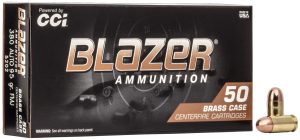
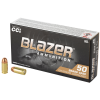
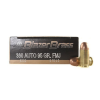
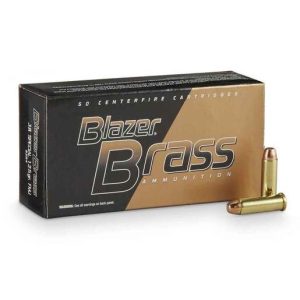

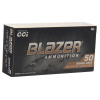
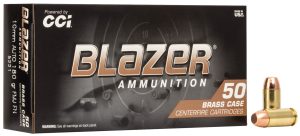
The two magnum loads are the newest. Our news story covers their launch: the .357 Magnum 158 gr FMJ flat nose is listed at 1,250 fps and the .44 Magnum 240 gr at 1,200.

Blazer Brass HP and Clean-Fire Suppressor
Blazer Brass HP is CCI’s cheap hollow point for people who want to practice with what they carry. Clean-Fire Suppressor is a subsonic, lead-free primer load for cans. Neither replaces a premium defensive load.
The 9mm Blazer Brass HP 115 gr is listed at 1,145 fps, the same as the FMJ, and it ran 47.6 cents a round on our cards, against 27.5 for the FMJ. For carry we would still buy one of the loads in our best 9mm ammo guide. For a range day that matches your carry gun’s point of impact, the HP is a reasonable middle step.
Clean-Fire Suppressor runs the 9mm 147 gr at 900 fps, the .40 180 gr at 970 and the .45 230 gr at 800. CCI says the three loads also make power factor for competition. On our cards the 9mm was 30.3 cents a round, which is cheap for a subsonic suppressor load.
Who Should NOT Buy Blazer Brass
Blazer Brass is the wrong buy for four kinds of shooter, and each has a better pick.
- Anyone with a ported barrel or compensator: CCI says not to. Buy Speer Lawman TMJ instead.
- USPSA Major shooters with a short .45: our Shield 45 string worked out to a 153.4 power factor, under the 165 floor. Buy American Eagle 230 gr or a dedicated Major load and chronograph it.
- Anyone looking for carry ammo: FMJ is for the range. Even Blazer Brass HP is a budget hollow point.
- Shooters who need clean ammo indoors: standard Blazer Brass uses lead-core bullets and conventional primers. Buy the Clean-Fire Suppressor loads or Federal Syntech.
Which Blazer Brass to Buy
Buy the 9mm 124 gr if you want the steadiest 9mm load and the closest match to your carry ammo, the 9mm 115 gr if price is everything, and the .380 95 gr for small .380 pistols.
Our Verdict on CCI Blazer Brass
Is Blazer Brass good ammo? Yes. It ran 10,330 rounds through 45 of our guns with 8 stoppages, most of them in break-in, and it gives you reloadable brass. It is not the most accurate ball ammo we shoot, and the .45 is soft. For 9mm practice it is one of the safe buys, so buy whichever of Blazer Brass and American Eagle is cheaper that week.
CCI Blazer Brass FAQ
Quick answers to the questions buyers ask most about Blazer Brass.
Is Blazer Brass good ammo?
Yes. It ran 10,330 rounds through 45 of our test guns with 8 stoppages, most of them during break-in, and grouped 2.63 inches on average across 20 guns.
Who makes Blazer Brass?
CCI, in Lewiston, Idaho. CCI calls the brass loads 100 percent American made, and they use CCI primers.
Is Blazer Brass reloadable?
Yes. Blazer Brass uses boxer primed brass cases with standard primer pockets. Plain Blazer with the aluminum case is not reloadable.
Is Blazer Brass better than American Eagle?
They are close. American Eagle 9mm 115 gr ran faster from our Glock 19 and 34, slower from the Glock 43, and grouped tighter in 6 of 8 head to heads. Blazer Brass was 27.5 cents a round on our cards against 26.0 for American Eagle.
How fast is Blazer Brass 9mm?
CCI lists the 115 gr at 1,145 fps and the 124 gr at 1,090. We measured the 115 gr at 1,050 to 1,156 fps from barrels of 3.39 to 5.31 inches.
Why is Blazer Brass .45 slow?
CCI lists the 230 gr at 830 fps, but our pistols ran it at 667 to 749. American Eagle 230 gr ran about 80 fps faster in the same guns.
Can you shoot Blazer Brass in a ported barrel?
No. CCI prints a warning on every Blazer Brass product page not to use it in firearms with ported barrels or ported recoil compensators.
Is Blazer Brass dirty?
It runs a little dirtier than Federal or Sellier and Bellot ball in our guns, but never enough to cause a stoppage. CCI's Clean-Fire Suppressor loads are the cleaner option.
Is Blazer Brass good for self defense?
No. The FMJ loads are for practice. Blazer Brass HP is a budget hollow point; for carry, buy a premium defensive load such as Federal HST or Speer Gold Dot.
What calibers does Blazer Brass come in?
CCI lists 28 part numbers in 10mm Auto, 30 Super Carry, 357 Magnum, 38 Special, 380 Auto, 40 S&W, 44 Rem Magnum, 45 Auto and 9mm Luger.
4,798+ Gun & Ammo Deals
Updated daily from 200+ top retailers. Filter by category, caliber, action type, and price.
Related Guides