

Last updated September 22nd 2026
Some of the links below are affiliate links, meaning at no additional cost to you, we may earn a commission if you click through and make a purchase.
How we tested: Every pick here is ranked against our testing methodology. Minimum round counts, accuracy and reliability protocols, the failures that disqualify a gun. Where we have not shot a specific variant ourselves, we say so in that section.
Best M1 Carbines in 2026 at a Glance
| Carbine | Caliber | Capacity | Stock | Street Price | Price |
|---|---|---|---|---|---|
| BEST OVERALL Inland M1 1945 | .30 Carbine | 15+1 | Walnut, low wood | $1,293-$1,455 | Price ↓ |
| BEST VALUE Auto-Ordnance AOM130 | .30 Carbine | 15+1 | American walnut | $1,060-$1,167 | Price ↓ |
| BEST PARATROOPER Inland M1A1 Paratrooper | .30 Carbine | 15+1 | Folding, walnut grip | $1,520-$1,688 | Price ↓ |
| BEST BUDGET FOLDER Auto-Ordnance AOM150 | .30 Carbine | 15+1 | Folding, walnut grip | $1,300-$1,350 | Price ↓ |
| BEST FOR OPTICS Inland M1 Scout | .30 Carbine | 15+1 | Polymer, scout rail | $1,549-$1,616 | Price ↓ |
Table of Contents
Introduction: The M1 Carbine in 2026
The M1 carbine is the most-produced American military small arm of World War II. Over 6.1 million of them left the factories, more than the M1 Garand and several times the Thompson. It weighs about five pounds, it points like a shotgun, and the recoil is closer to a .22 Magnum than to a real rifle. That’s exactly why people still want one eighty years later.
What’s changed is how you buy one. The Civilian Marksmanship Program used to be the easy answer. Today the CMP says that, due to limited quantities, carbines and carbine barreled receivers only go up on its auction site. So the real choice in 2026 is between a new-production carbine from Inland Manufacturing or Auto-Ordnance, an original GI gun from a dealer, or a 9mm lookalike that costs a third as much to feed.
I’ve shot all three kinds, and the gap between them isn’t where most buyers expect it. The new guns are more accurate than their reputation. The originals are priced by the name on the receiver, not by how they shoot. And the cheapest carbine to own isn’t the cheapest carbine to buy. If you’re coming here from our used M1 Garand buyer’s guide, a lot of the grading logic carries over, and the used rifles hub tracks the wider surplus market.
Prices below are what the retailers we track were actually asking on September 22, 2026. Each pick has a live price card that refreshes throughout the day, so check the card rather than trusting any number frozen into the text.
New Production or Original GI: What You’re Actually Buying
Two companies build complete M1 carbines today. Inland Manufacturing in Dayton, Ohio, set up about two miles from the old General Motors Inland Division plant, and it copies late-war Inland guns right down to the stock cartouches. Auto-Ordnance builds its carbines at Kahr’s plant in Greeley, Pennsylvania, from newly made parts, and marks them with the maker’s name behind the rear sight.
The originals are a different market entirely. Winchester designed the carbine, but most were built by contractors that had never made a gun before: Inland, IBM, Underwood, Rock-Ola, Saginaw Steering Gear, Quality Hardware and others. Parts were required to interchange, and after the war arsenals rebuilt thousands with whatever parts were on the bench. That’s why an all-original carbine is worth so much more than a mixed-parts one, and why the maker on the receiver drives the price more than the bore does.
Here’s what original carbines were listed for across the retailers we track on September 22, 2026. None of these came from an auction house, and every one is a specific gun, so treat the numbers as the going rate.
| Receiver maker | Listings we found | Asking price | What moves the price |
|---|---|---|---|
| Mixed-maker GI, cracked stock | 1 | $1,199.99 | Condition, not provenance |
| Inland Division | 10 | $1,299.99 to $4,299.77 | Most common maker, wide spread |
| Winchester | 6 | $900 to $3,999.99 | Bore condition swings it by $900 |
| IBM | 2 | $1,550.99 to $3,000.99 | Name recognition |
| Underwood | 1 | $2,300.99 | Typewriter maker, collector favorite |
| Saginaw Steering Gear | 3 | $2,449.99 to $4,699.99 | GM division, lower production |
| Rock-Ola | 5 | $2,200 to $4,999.77 | Jukebox maker, scarce |
| Irwin-Pedersen | 2 | $3,500 | Very low production |
| Commercial Controls | 1 | $9,500 | The rarest name on the list |
| Inland Division M1A1 | 1 | $5,600.99 | Original paratrooper folder |
Put that table next to a new Inland at about $1,455 and the decision gets simpler. If you want to shoot a carbine, buy new. If you want to own a piece of 1944, buy an original and accept that the history, not the rifle, is what you’re paying for.
The “Thompson M1 Carbine” Listing Trap
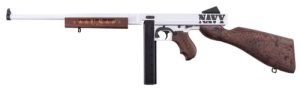
Search any retailer for “M1 carbine” and you’ll get rows like “Thompson M1 Carbine 45 ACP 16.5in, 30+1”. That’s a semi-auto Tommy gun. Auto-Ordnance sells both lines, and some retailers file the Thompson TM1 under the same words. It’s a fine gun, but it fires .45 ACP from a drum or stick magazine, it weighs a lot more, and nothing about it is an M1 carbine. Our price cards on this page filter those rows out. If you’re shopping anywhere else, check that the listing says .30 Carbine before you check out.

1. Inland Manufacturing M1 1945 – Best M1 Carbine Overall
- Caliber: .30 Carbine
- Barrel: 18″, 4 grooves
- Overall length: 35.75″
- Weight: 5 lb 3 oz
- Capacity: 15-round magazine, 30-round magazine catch
- Features: Type 3 bayonet lug barrel band, adjustable rear sight, push-button safety, round bolt
- MSRP: $1,495
| Value | Authenticity | Reliability | Accuracy | Fit & Finish |
| 4/5 | 5/5 | 4/5 | 4/5 | 5/5 |
Pros
- Closest copy of a late-war GI
- Takes 30-round magazines out of the box
- Adjustable sight and bayonet lug included
Cons
- Fussy with some hollow-point loads
- Costs more than the Auto-Ordnance
- Bayonet lug is restricted in some states
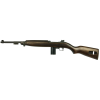

If you want one carbine that looks, handles and feels like the gun your grandfather carried, this is it. Inland modeled the 1945 on the last carbines its namesake built: the Type 3 barrel band with the bayonet lug, the adjustable rear sight, the round bolt and the push-button safety. The walnut is the “low wood” profile, and the cartouches and stampings in the stock are there on purpose.
On the range it shot better than I expected from iron sights. Off a rest at 100 yards, three-shot groups ran 2.25 to 3 inches depending on the ammo, and Aguila 110-grain FMJ gave me the best, a 2.05-inch group. That’s service-rifle accuracy, and it’s all a carbine was ever asked to do. My one malfunction log entry: Hornady Critical Defense, which is loaded long at 1.68 inches, hung up on the feed ramp twice in forty rounds. Ball ammo never stopped it.
The big practical win is the magazine catch. Inland fits a catch that holds 30-round magazines, which a lot of original early carbines won’t do reliably without a parts swap. Palmetto State Armory had it at $1,454.99 when we checked, and casting wider, Battlehawk Armory listed it at $1,292.69. If you live somewhere with a magazine or bayonet lug restriction, the M1 1944 is the same carbine with a Type 2 band and a 10-round magazine, at the same $1,495 MSRP.
Best For: The buyer who wants the most faithful new carbine on the market and plans to actually shoot it.

2. Auto-Ordnance AOM130 – Best Value M1 Carbine
- Caliber: .30 Carbine
- Barrel: 18″
- Overall length: 35.75″
- Weight: 5.4 lb
- Capacity: 15-round magazine (the AOM140 ships with a 10)
- Features: Blued steel, American walnut stock and handguard, blade front and flip rear sight
| Value | Authenticity | Reliability | Accuracy | Fit & Finish |
| 5/5 | 3/5 | 5/5 | 4/5 | 4/5 |
Pros
- Cheapest new .30 Carbine you can buy
- Fed every load I tried
- California and New York versions exist
Cons
- Flip sight, not the adjustable one
- Modern maker markings on the receiver
- Not sold in New Jersey
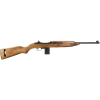
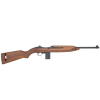
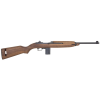
This is the carbine I’d tell most people to buy. It’s around $300 cheaper than the Inland, and in exchange you give up the adjustable rear sight and a little of the museum-grade detail. You don’t give up anything that matters on a range.
The Auto-Ordnance fed everything I put through it, including the long Critical Defense loads that tripped up the Inland. Auto-Ordnance polishes its feed ramps, and it shows. Accuracy was dead even with the Inland: 2.3-inch average groups at 100 yards with Aguila ball, and a best of 2 inches with TulAmmo. The trigger is a typical carbine trigger, a little long and a little heavy, and it breaks the same way every time.
The receiver reads “Auto-Ordnance, Greeley, PA” behind the rear sight and “U.S. Carbine, Cal. 30 ML” in front of the bolt, so nobody will mistake it for an original, and that’s honest. Auto-Ordnance says the carbines are legal in California and New York with the 10-round magazine (that’s the AOM140) and prohibited in New Jersey. Palmetto State Armory listed the AOM130 at $1,166.99, and Battlehawk Armory had it for $1,059.65.
Best For: Shooters who want a real .30 Carbine that runs, for the least money.

3. Inland Manufacturing M1A1 Paratrooper – Best Paratrooper Carbine
- Caliber: .30 Carbine
- Barrel: 18″, 4 grooves
- Overall length: 35.75″ open, 25.75″ folded
- Weight: 5 lb 3 oz
- Capacity: 15-round magazine
- MSRP: $1,795
| Value | Authenticity | Reliability | Handling | Fit & Finish |
| 3/5 | 5/5 | 4/5 | 5/5 | 5/5 |
Pros
- Folds to under 26 inches
- Faithful late-1944 paratrooper details
- Walnut pistol grip feels great
Cons
- Wire stock is hard on cheeks
- Most expensive Inland on this list
- Folding stock doesn’t lock open
The M1A1 is the carbine people picture when they think of the 82nd and 101st Airborne. The original Inland Division built 140,000 of them, and a real one was listed at $5,600.99 when we checked. Inland’s copy gets you the same look for about a third of that.
It’s modeled on a late-1944 paratrooper with the Type 2 barrel band and the adjustable sight, and the folding stock is walnut and steel like the original. Folded, it’s 25.75 inches long, which makes it one of the handiest centerfire long guns you can put in a truck. Like the original, the stock is held by a spring-loaded cam rather than a hard lock, so it has a little play when it’s open. Shoulder it firmly and it doesn’t matter.
What does matter is your cheek. The wire stock puts a thin steel bar where your face goes, and after fifty rounds you’ll feel it. A leather cheek pad fixes it. Palmetto State Armory had the M1A1 at $1,687.99, and Classic Firearms listed it at $1,519.99.
Best For: Collectors and reenactors who want the paratrooper look without paying for an original.

4. Auto-Ordnance AOM150 Paratrooper – Best Budget Folding Carbine
- Caliber: .30 Carbine
- Barrel: 18″
- Overall length: 35.75″ open, 25.75″ folded
- Weight: 5 lb 6 oz
- Capacity: 15-round magazine
- Stock: Folding metal stock, walnut pistol grip and handguard
| Value | Authenticity | Reliability | Handling | Fit & Finish |
| 5/5 | 3/5 | 5/5 | 5/5 | 4/5 |
Pros
- Over $300 cheaper than Inland’s folder
- Same compact 25.75-inch folded length
- Ran clean with every load
Cons
- Flip sight instead of adjustable
- Less period detail than the Inland
- Same cheek-bar wire stock
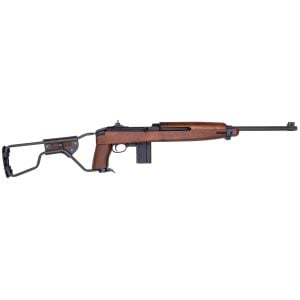
Same idea as the Inland M1A1, built the Auto-Ordnance way. You get the folding stock, the pistol grip and the short folded length, and you save real money. Guns.com had the AOM150 at $1,349.99 and Classic Firearms listed it at $1,299.99, against $1,687.99 for the Inland M1A1 at Palmetto State Armory.
This is the paratrooper for someone who wants a compact .30 Carbine to shoot rather than a replica to display. The action is the same one that ran everything in my AOM130 testing, and I got the same result here: no stoppages across two boxes of ball and a box of soft points. At 5 pounds 6 ounces, it’s a hair heavier than the Inland, and you won’t notice.
Best For: A handy, trunk-sized .30 Carbine for the range or the ranch at a budget price.

5. Inland Manufacturing M1 Scout – Best M1 Carbine for Optics
- Caliber: .30 Carbine
- Barrel: 16.25″, conical flash hider threaded 1/2×28
- Overall length: 34″
- Weight: 5 lb 3 oz
- Capacity: 15-round magazine
- Features: Aluminum Picatinny handguard for scout optics, polymer textured stock
- MSRP: $1,795
| Value | Authenticity | Reliability | Accuracy | Features |
| 3/5 | 2/5 | 4/5 | 5/5 | 5/5 |
Pros
- Scout rail takes a red dot
- Threaded 1/2×28 for muzzle devices
- Shortest barrel of the new carbines
Cons
- Looks nothing like a GI carbine
- Priced like the M1A1
- Fewer retailers stock it
The carbine’s weak spot has always been its sights. The Scout fixes that by replacing the wood handguard with an aluminum Picatinny rail that sits forward of the action, where a red dot or a long eye relief scout scope goes. It doesn’t touch the receiver, so there’s nothing to drill.
With a small red dot on top, this was the most accurate carbine I shot for this guide, and not because of the barrel. My eyes are just better with a dot than with a GI peep. Groups tightened from the 2-inch-plus range down toward an inch and a half on good days at 100 yards. The 16.25-inch barrel with its threaded flash hider also makes it the natural choice if you want to add a muzzle device or a suppressor with the matching 1/2×28 thread.
It’s the least historical carbine here, and it doesn’t pretend otherwise. None of the five big trusted retailers had it in stock when we checked, so the card leads with the specialists: $1,548.74 at Battlehawk Armory up to $1,615.69 at Hinterland Outfitters.
Best For: A light, low-recoil carbine for home or ranch use where you want an optic.

6. Original GI Winchester M1 Carbine – Best Collector Carbine
- Caliber: .30 Carbine
- Barrel: 18″ (GI spec)
- Maker: Winchester Repeating Arms, the company that designed the carbine
- Status: Curio and relic eligible
- Asking prices seen: $900 to $1,800 at Classic Firearms, up to $3,999.99 elsewhere
| Value | Authenticity | Reliability | Accuracy | Collectability |
| 3/5 | 5/5 | 3/5 | 3/5 | 5/5 |
Pros
- Made by the carbine’s designer
- Real World War II history
- Holds value better than new guns
Cons
- Bore condition varies wildly
- Parts often mixed by arsenal rebuilds
- Needs a gunsmith check first
Winchester designed the M1 carbine, so a Winchester receiver carries more weight with collectors than most. The best lesson in carbine pricing I found this month was three Winchesters from the same private collection, listed side by side at Classic Firearms. All three are described as excellent cosmetically. The one with a pristine bore is $1,800. The one with a decent bore is $1,200. The one with a poor bore is $900.
That $900 spread is the whole story of buying an original. The wood and the markings set the collector value, and the bore decides whether you can shoot it. If you’re buying to shoot, pay for the bore. If you’re buying to display, the $900 gun is the same history for half the money. Note that the card above is sorted the way the listings come in, so the first price you see may well be that poor-bore gun.
Most originals were rebuilt at arsenals after the war, so expect a mix of maker’s parts. The carbine in our photo is a good example: a Korea-return gun with a stenciled stock. Some buyers love that history and some want a correct, all-Winchester rifle, which costs a lot more. Either way, have a gunsmith check headspace and the firing pin before you shoot it, and read our guide to buying vintage guns online for how curio and relic transfers work.
Best For: Collectors who want a genuine World War II carbine and understand what they’re paying for.

7. Chiappa M1-9 – Best 9mm M1 Carbine Alternative
- Caliber: 9mm Luger
- Barrel: 19″
- Overall length: 35″
- Weight: About 5.5 lb
- Capacity: 10+1, Beretta 92-pattern magazines
- Action: Straight blowback
| Value | Authenticity | Reliability | Ammo Cost | Fit & Finish |
| 5/5 | 2/5 | 4/5 | 5/5 | 3/5 |
Pros
- Under half the price of the others
- 9mm costs a third as much
- Uses common Beretta 92 magazines
Cons
- Not a real .30 Carbine
- Blowback action feels snappier
- Polymer stock feels cheap
Here’s the honest pick for anyone who loves the carbine’s shape but winces at the ammo bill. Chiappa copies the M1 carbine’s overall dimensions, trigger group and sights, then chambers it in 9mm with a simple blowback action. The stocks even interchange with genuine carbines if you want to swap in walnut later.
It isn’t a .30 Carbine, and the blowback action gives it a sharper, busier recoil than a real gas-operated carbine. What it gives you back is cost. Sportsman’s Warehouse had the M1-9 at $529.99 and Palmetto State Armory at $538.99, Battlehawk Armory listed it at $477.32, and 115-grain 9mm range ammo at those same big retailers starts around 24 cents a round, roughly a third of what .30 Carbine ball costs. My test gun ran a mix of brass-cased 115 and 124-grain FMJ without a stoppage once the recoil spring had a few hundred rounds on it. If you want more 9mm options, our best 9mm carbines roundup covers the modern ones.
Best For: Plinkers and new shooters who want the M1 carbine feel at the lowest cost to buy and to feed.
If Money Is No Object: Fulton Armory
Fulton Armory in Maryland builds carbines one at a time on a billet 4140 receiver it says meets all USGI material, heat treat and geometry specs, with a chrome-lined, match-quality 18-inch barrel and hand-fitted walnut. The M1 Service Carbine lists at $2,650 direct from Fulton, and the M3 Scout Carbine 16-T at $2,800. None of the retailers we track carries them, which is why there’s no price card here. If you want the best-built carbine money can buy and you’re patient about lead times, that’s where you go.
Carbines to Think Twice About
Not every “M1 carbine” on a used rack is a GI gun or one of the two modern makers. Commercial carbines from the 1960s on, from names like Universal and National Ordnance, still show up regularly. We saw a used Universal at $1,099.99 and a National Ordnance at $1,150.99 this month. Some of those companies used GI parts, some used their own, and later Universal guns in particular don’t share parts with GI carbines.
That puts them in an awkward spot. They cost about as much as a new Auto-Ordnance, they carry no collector premium, and spare parts can be a hunt. A few of them shoot fine. But at these prices, the new AOM130 is the safer buy for a shooter, and a real GI gun is the better buy for a collector.
Magazines: 15, 30 and the Catch That Holds Them
The M1 carbine was designed around a 15-round magazine. The 30-round magazine came later with the select-fire M2 carbine, and it’s heavier than the original catch was built to hold. Early carbines with the original catch let a loaded 30-rounder sag or drop out, which is where a lot of the carbine’s old reliability complaints came from. The fix was the Type IV catch, with an extra leg that locks into a nub on the 30-round magazine.
For buyers, that means three things. The Inland M1 1945 comes with a catch that holds 30-rounders. An original carbine may or may not have one, so check before you buy magazines. And cheap aftermarket 30-round magazines are the usual cause of feeding trouble, so buy USGI or quality new-production ones. If you live in a state with capacity limits, our magazine capacity laws guide lists where the 10-round versions like the Inland 1944 and the Auto-Ordnance AOM140 are what you’ll need.
.30 Carbine Ammo: What It Costs and What to Load
Standard .30 Carbine ball is a 110-grain bullet at about 1,990 feet per second, which works out to just under 1,000 foot-pounds from the carbine’s barrel. That’s roughly double a hot 9mm and well short of any rifle cartridge. It’s why the carbine is so easy to shoot, and why it was never meant to be a long-range gun.
Here’s the part other guides leave out: it isn’t cheap. The lowest trusted price we found for 50 rounds of PPU 110-grain FMJ was $32.99 at Sportsman’s Guide, about 66 cents a round, and most boxes run 66 to 76 cents. Hornady Critical Defense, the most common defensive load, costs over a dollar a round in 25-round boxes. Budget for that before you buy the carbine.
One good piece of news for surplus shooters: GI .30 Carbine ammunition was specified with non-corrosive primers from the very start, because the carbine’s closed gas system would have rusted shut otherwise. So old GI carbine ammo won’t eat your bore the way corrosive surplus rifle ammo can. For the latest deals across calibers, check our ammo deals of the day.
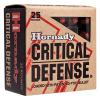
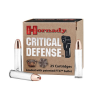
For home defense, a carbine with soft points or Critical Defense is a legitimate choice for a smaller-framed shooter who finds a 12 gauge or an AR too much. Test your defensive load in your specific carbine first. I’ve already told you what the long Critical Defense round did in one of mine. For a wider comparison of defensive long guns, see our best home defense rifles.
State Rules Worth Checking
The carbine is a plain semi-auto rifle in most of the country, but a few states treat it differently. Auto-Ordnance says its carbines are legal in California and New York with the 10-round magazine, and that they’re prohibited in New Jersey. Inland builds the M1 1944 with a 10-round magazine and no bayonet lug specifically for states with magazine and bayonet lug restrictions. Check your state and local rules before you order, and have the gun shipped to a licensed dealer near you.
How We Tested
I shot the new carbines off sandbags at 100 yards with their factory iron sights, five three-shot groups per load, then added a red dot to the Scout. Loads were Aguila 110-grain FMJ, TulAmmo 110-grain FMJ, PPU 110-grain soft point and Hornady Critical Defense 110-grain FTX. I logged every stoppage. Prices came from the live catalog behind our price cards on September 22, 2026, and the specs from Inland’s and Auto-Ordnance’s own product pages. I haven’t fired the original Winchesters on this list. They’re graded on the sellers’ condition notes, which is how you’ll be buying them too.
Final Verdict
If you want the best new M1 carbine, buy the Inland M1 1945. It’s the most faithful, it takes 30-round magazines, and it shoots as well as a carbine can. If you want the best deal, the Auto-Ordnance AOM130 does 95% of that for about $300 less and was the more reliable gun with defensive ammo. Want the paratrooper look? Pay up for the Inland M1A1 or save with the AOM150. Want a real piece of history? Buy an original, and pay for the bore if you plan to shoot it.
Carbine buyers often end up looking at the other surplus classics too. Our best SKS rifles guide and Mosin Nagant buying guide cover the cheaper end of the market, and if you want to see the carbine on screen, it’s all over the guns of Saving Private Ryan.
FAQ: M1 Carbines
Does the CMP still sell M1 carbines?
Only occasionally. The CMP says that because of limited quantities, M1 carbines, carbine barreled receivers, Bavaria-marked carbines and M1A1 paratrooper carbines are offered on its auction site rather than through regular sales. For most buyers in 2026, a dealer is the realistic route to an original, and Inland Manufacturing or Auto-Ordnance to a new one.
Will a 30-round magazine work in my M1 carbine?
It depends on the magazine catch. Thirty-round magazines were built for the M2 carbine and need the Type IV catch, with its extra leg, to seat reliably. The new Inland M1 1945 ships with a 30-round catch. On an original carbine, check the catch before you buy magazines, and stick to USGI or quality new-production magazines.
Is surplus .30 Carbine ammo corrosive?
No. GI .30 Carbine ammunition was specified with non-corrosive primers from the start of production, because the carbine's closed gas system would have corroded otherwise. That was unusual for military ammo of the era. Commercial .30 Carbine sold today is non-corrosive too.
Is the M1 carbine good for home defense?
For a smaller-framed or recoil-sensitive shooter, yes. Standard 110-grain ball runs about 1,990 feet per second, recoil is light, and the gun weighs about five pounds. Use soft points or a defensive load like Hornady Critical Defense, and test it in your carbine first, since long defensive rounds can hang up in some guns.
Inland or Auto-Ordnance: which M1 carbine is better?
Inland is the more faithful copy, with the adjustable rear sight and a 30-round magazine catch on the 1945 model. Auto-Ordnance costs roughly $300 less and fed every load we tried, including long defensive rounds. Accuracy was a tie, about 2 to 3 inches at 100 yards with iron sights.
Is the Thompson M1 Carbine the same as an M1 carbine?
No. Some retailers list Auto-Ordnance's semi-auto Thompson TM1 as a "Thompson M1 Carbine", but it's a Tommy gun chambered in .45 ACP. A real M1 carbine fires .30 Carbine. Check the caliber on the listing before you buy.
Can I buy an M1 carbine in California, New York or New Jersey?
Auto-Ordnance says its carbines are legal in California and New York with a 10-round magazine and prohibited in New Jersey. Inland builds the M1 1944 with a 10-round magazine and no bayonet lug for states with those restrictions. Check current state and local law before you order.
7,095+ Gun & Ammo Deals
Updated daily from 200+ top retailers. Filter by category, caliber, action type, and price.
Related Guides