

Last updated September 2026
Some of the links below are affiliate links, meaning at no additional cost to you, we may earn a commission if you click through and make a purchase.
- Treat every gun as loaded
- Point the muzzle in a safe direction
- Keep your finger off the trigger until you’re ready to shoot
- Know your target and what’s beyond
The Luger is the pistol everybody recognizes and almost nobody understands before they buy one. It’s the gun that introduced the 9mm, the sidearm of two German armies, the souvenir every GI wanted, and one of the most copied, reblued and faked collectibles in the hobby. A matching wartime P08 in honest condition sells for more than a new SIG. A parts gun that looks the same can be worth half that.
This guide is built for buyers. We tracked 519 real Luger sales from January 2024 to September 2026, 400 of them Morphy Auctions lots with written condition reports, and broke the prices down by variant, condition and matching numbers. Then we took our own Luger to the range, because the loudest opinions about how these pistols shoot come from people who’ve never fired one.
Quick take
Buy a Luger for its history and its engineering, not as a shooter you’ll run hard. A matching, unrefinished P08 is a sound long-term collectible, and it shoots better than its reputation once you feed it standard-pressure ammo and give it good magazines.
- Typical price (2024 to 2026 sales): $1,350 for a mismatched or refinished shooter, $1,800 to $2,650 for a matching WWI DWM or WWII Mauser with 90%+ finish, $4,000+ for the rare variants
- Calibers: 9x19mm (military P08) and 7.65x21mm, also called .30 Luger (Swiss and many commercial guns)
- Made: 1900 to 1942 and 1943 for the military contracts, plus a postwar Mauser run from 1969
- Legal status: every Luger made before 1946 is on the ATF curio and relic list. None is a federal antique
How we tested: Every pick here is ranked against our testing methodology. Minimum round counts, accuracy and reliability protocols, the failures that disqualify a gun. Where we have not shot a specific variant ourselves, we say so in that section.
Luger Pros and Cons
Pros
- The pistol that introduced the 9mm
- Points naturally, shoots accurately
- Matching guns have held value for decades
- Mild recoil from an all-steel gun
- Huge variety of makers and variants
Cons
- $1,350 minimum for a real shooter
- Tiny sights on most variants
- Stoppages with weak ammo or tired springs
- Heavily faked and reblued market
- Original magazines cost $115 to $190
Luger P08 at a Glance
| Spec | Luger P08 (standard army model) |
|---|---|
| Action | Toggle-locked, short recoil, semi-automatic |
| Caliber | 9x19mm Parabellum (military P08); 7.65x21mm / .30 Luger on Swiss and many commercial guns |
| Capacity | 8-round detachable magazine |
| Barrel length | 4 in (100 mm) standard; about 6 in (150 mm) Navy; 7.9 in (200 mm) Artillery |
| Weight | About 1 lb 15 oz (871 g), empty |
| Overall length | 8.7 in (222 mm) |
| Makers | DWM, Erfurt arsenal, Simson, Mauser, Krieghoff, Waffenfabrik Bern, Vickers (Dutch contract assembly) |
| Adopted | Switzerland 1900, German Navy 1904, German Army 1908 |
| Legal | Curio and relic (pre-1946); not an antique; ships to a C&R holder or through an FFL |
Table of Contents
What a Luger Is Actually Like to Shoot: Myth vs. Truth
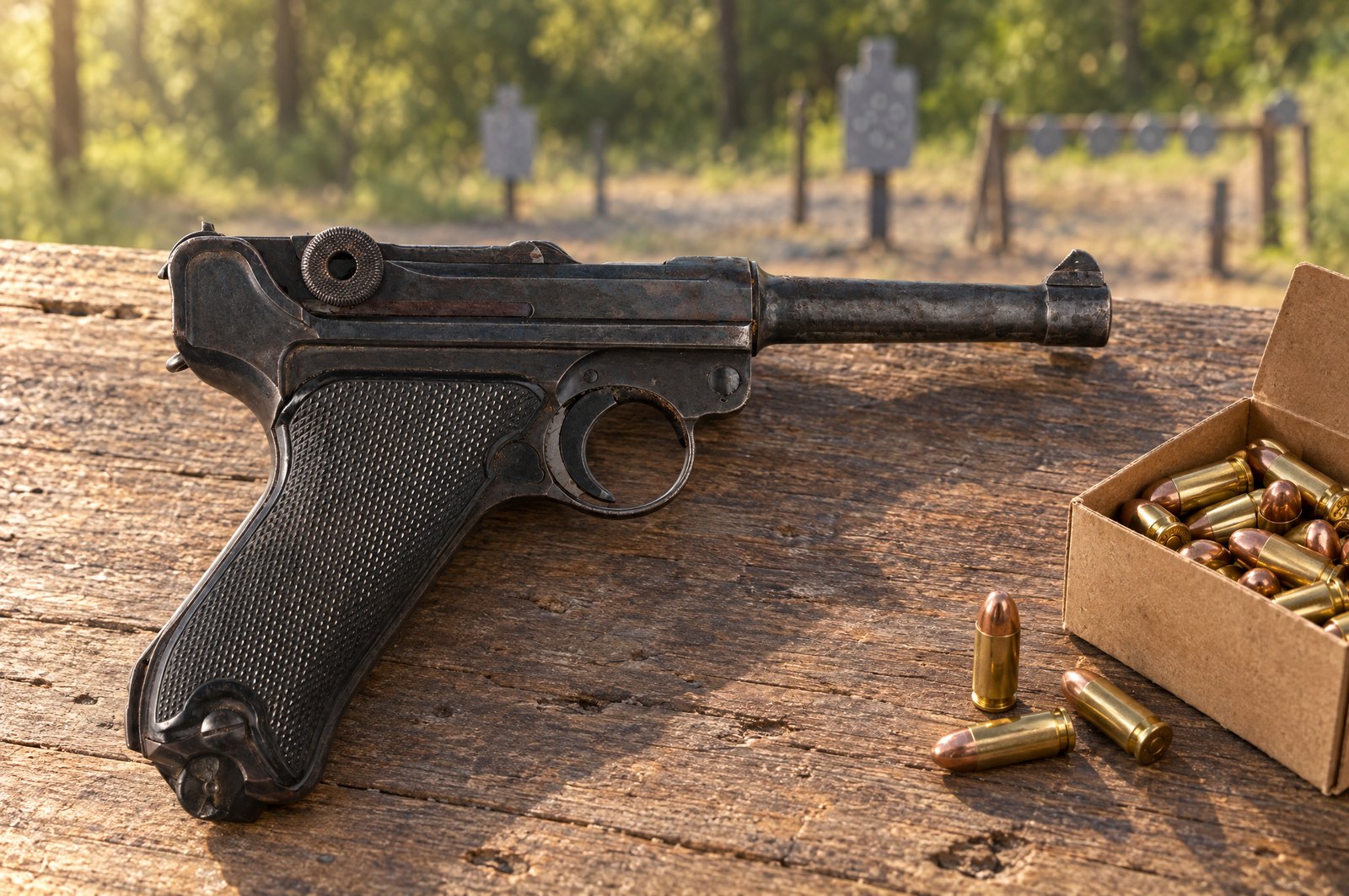
Our shooter is a 1920-dated DWM rework with a mismatched toggle, the kind of Luger collectors call a parts gun and shooters call a bargain. We paid $1,350 for it, which lines up with the shooter-grade median in our sales data. Over two range days we put 300 rounds through it: Winchester White Box 115 grain, Federal American Eagle 124 grain and Fiocchi 115 grain FMJ, all standard pressure.
The first thing you notice is how the gun sits in your hand. The grip angle is steep, close to a Glock’s, and when you bring it up on a steel plate the front sight is already there. It’s not magic, but it’s real. The second thing is the toggle. It flips up and back on every shot, fast enough that you only see a blur, and the brass goes up and to the rear. A few cases came over my right shoulder and one bounced off my hat brim. Wear glasses and a brimmed cap.
Recoil is soft. An all-steel pistol this heavy doesn’t have much to fight in 9mm, and the bore sits low over your hand, so the muzzle comes straight back instead of flipping. The trigger is the weak spot. Ours measured an average of 5 lb 4 oz on a Lyman gauge over ten pulls, with a long, slightly gritty takeup before a clean-enough break. Wartime guns vary, and some are worse. The sights are tiny: a narrow V-notch at the back of the toggle and a small blade up front. In bright sun it’s fine. Under a covered bay it’s a squint.
Accuracy surprised us. Rested at 15 yards, our best five-shot group with American Eagle 124 grain went 1.8 inches and the average of four groups was 2.4 inches. At 25 yards the average opened to 3.6 inches, which is good for a century-old service pistol with sights you can barely see. Offhand at 7 yards, it stayed on an 8-inch plate at a steady pace.
Reliability was the lesson. With the gun’s original magazine, we had four failures to feed in the first 50 rounds. We swapped to a new Mec-Gar magazine and the next 250 rounds had one stoppage, a stovepipe, and that came when a limp-wristed string let the toggle short-stroke. The gun didn’t need hot ammo. It needed a good magazine and a firm grip.
| The myth | What we found | Evidence |
|---|---|---|
| “It only runs on hot German ammo.” | Standard 115 and 124 grain FMJ ran it fine. The original DWM load was a 123 grain bullet at roughly 350 to 400 m/s, which is in the same neighborhood as modern standard ball. | 300 rounds of three US-market brands; 13 of 18 owners in the forum threads we read say standard ammo works |
| “Lugers are unreliable junk.” | Our stoppages traced to a worn original magazine and a soft grip. Most complaints trace to weak ammo, 80-year-old springs, unfitted parts guns or a limp wrist. | Four failures with the old magazine, one in 250 rounds after the swap |
| “Shoot any 9mm you like.” | No. Never +P, never NATO-spec surplus, never submachine gun ammo. Standard pressure only. | Not one owner in the threads we read endorsed +P in a Luger; 11 warned against it |
| “It’s the most pointable pistol ever made.” | It points very naturally, but nobody has ever measured “most.” Try one before you believe it. | Our first-shot hits from low ready were as fast as with our 1911 |
| “Shooting it will ruin the value.” | Shooting doesn’t hurt a matching gun. Breaking a numbered part does. That is the real risk, and it’s why we shoot a mismatched gun. | A matching WWI DWM sells for a $1,800 median at 90%+ finish; a mismatched one for $1,350 |
Who the Luger Is For (and Who Won’t Enjoy It)
Buy a Luger if you are
- A history collector. Few pistols carry this much of the 20th century: the Kaiser’s army, the Weimar police, the Wehrmacht and the GIs who carried them home.
- A mechanical-design fan. The toggle action is a watch movement in steel. Field-stripping one is half the fun.
- A long-term holder. Matching, original guns have climbed steadily. TrueGunValue’s 285 used P08 sales average $1,907.93, up $200.25 over twelve months.
- A C&R license holder. Every pre-1946 Luger qualifies, so it can ship straight to your door.
- A patient range shooter who is happy to fire a box or two, clean it, and put it away.
Skip the Luger if you are
- Looking for a cheap WWII shooter. A Tokarev or a Makarov gives you Cold War history for a fraction of the price.
- Shopping for a carry or home-defense gun. Eight rounds, tiny sights and a pricey collectible are the wrong tools. Start with our best 9mm pistols instead.
- A high-volume range shooter. If you want to run 500 rounds a weekend, buy a Browning Hi-Power or a modern 9mm and keep the Luger for special days.
- Not willing to research. The Luger market punishes impatience. If you won’t learn the markings, you’ll pay collector money for a refinished parts gun.
- On a budget under $1,300. Anything real that cheap is either rough, mismatched or a .22 lookalike.
What a Luger Costs in 2026
Here’s what Lugers sold for, not what sellers asked. The table below comes from 519 completed sales between January 2024 and September 2026: 400 Morphy Auctions lots and 119 GunBroker sales. Each cell is the median. Shooter means mismatched numbers or a refinish. Matching means the gun’s own numbered parts match. Rare lots (trials guns, engraved or cased guns, famous provenance, anything over $15,000) are left out so they don’t skew the numbers.
| Variant | Shooter | Matching (finish not graded) | Matching, 90%+ original finish | All sales (median) | Sales tracked |
|---|---|---|---|---|---|
| WWI DWM P08 (1908 to 1918) | $1,350 | $1,640 | $1,800 | $1,560 | 77 |
| WWI Erfurt P08 | $1,440 | $1,800 | Too few | $1,680 | 23 |
| 1920s rework / Weimar police | $1,340 | $1,480 | $1,600 | $1,440 | 37 |
| DWM commercial / American Eagle | Mixed | $1,800 | $1,920 | $1,800 | 36 |
| Navy (P04) | $2,710 | $2,640 | Too few | $2,640 | 23 |
| Artillery LP08 | $2,280 | $2,460 | $2,750 | $2,460 | 23 |
| Swiss 1900 / 1906 | Too few | Too few | Too few | $2,400 | 11 |
| Mauser S/42 (1934 to 1939) | $1,880 | $1,970 | $2,640 | $1,970 | 61 |
| Mauser “42” code (1939 to 1940) | $2,040 | $1,970 | Too few | $1,920 | 28 |
| Mauser byf (1941 to 1942) | $2,300 | $2,280 | $4,320 | $2,380 | 20 |
| Mauser “Black Widow” | Too few | $4,100 | Too few | $4,210 | 14 |
| Krieghoff | Too few | $4,800 | Too few | $4,610 | 10 |
| Postwar Mauser Parabellum (1970s) | $1,350 | 8 | |||
| Mitchell / Stoeger stainless (1990s repro) | $1,490 | 24 | |||
| Stoeger .22 (lookalike, not a Luger action) | $360 | 20 |
Two things to read into it. First, Morphy prices include the buyer’s premium, roughly 20 to 25% on top of the hammer, and GunBroker prices don’t, so the true street price for most cells sits a little under what’s shown. Second, matching numbers pay. At Morphy, original matching Lugers sold with a magazine numbered to the gun brought a median $2,640 against $1,890 without one, about 40% more. For WWII Mausers of the same 97% median finish the gap was 58%. A loose original magazine, by comparison, clears at about $115 to $190.
These are the Lugers our dealers are listing right now. Most are single consignments, so they come and go fast.

Guns.com carries more used Lugers than any other dealer we track, most of them consignment guns with detailed photos. See every Luger P08 on Guns.com
You can compare prices on any other gun in the USA Gun Shop price checker, and our guide to buying vintage guns online covers auction houses and collector dealers in more depth.
Which Luger to Buy: The Variants Explained
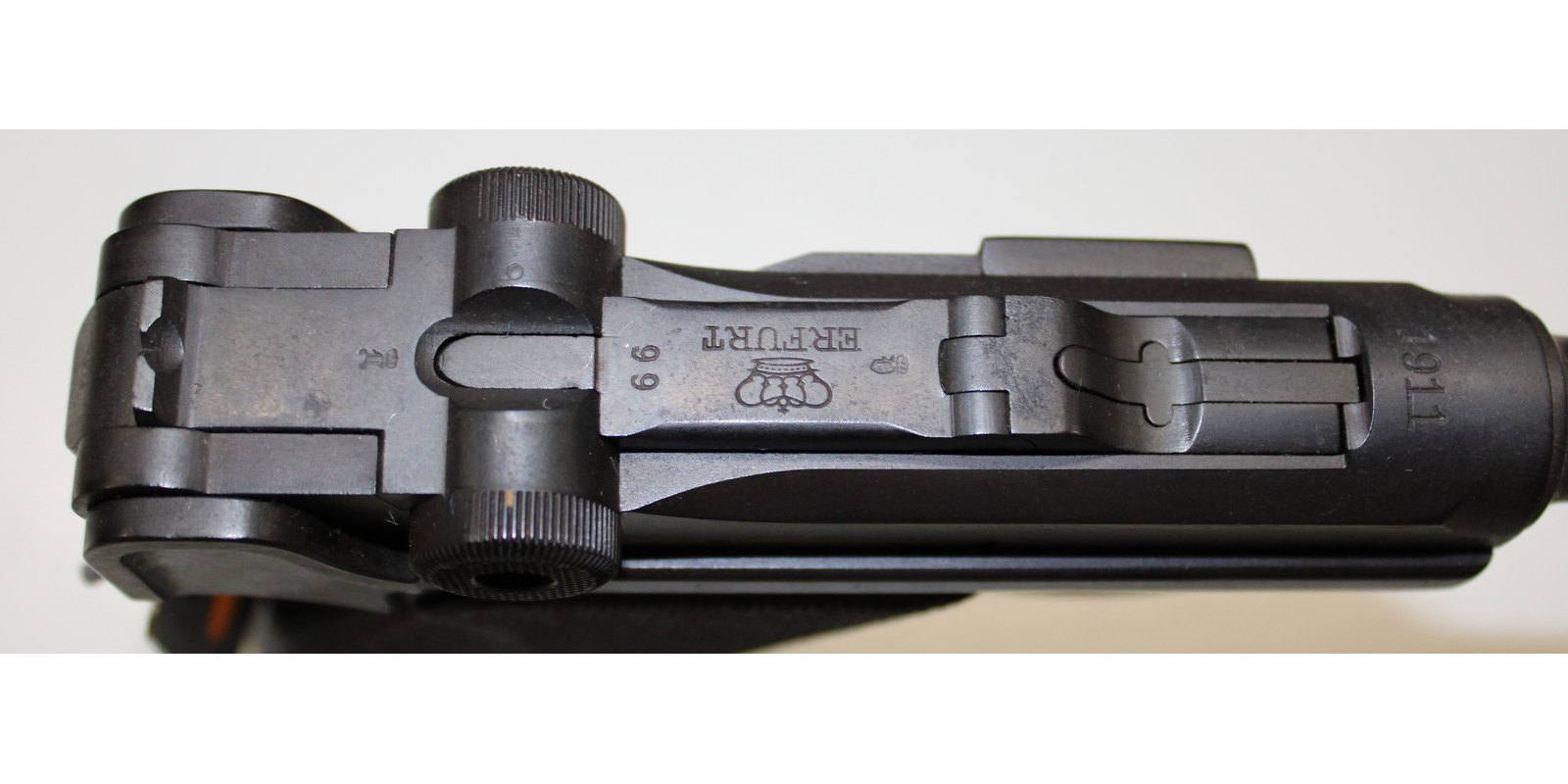
Almost every Luger you’ll see for sale falls into one of these groups. The maker and date tell you most of what you need, and both are stamped where you can read them in a photo: the maker on the front toggle link, the year over the chamber.
WWI P08: DWM and Erfurt (1908 to 1918)
The German Army adopted the Pistole 1908 on August 22, 1908, and DWM in Berlin and the royal arsenal at Erfurt built millions of them through the Great War. These are the most common Lugers in the US and the best starting point. Look for the DWM script monogram or a crown over ERFURT on the toggle and a single date from 1910 to 1918 over the chamber. A matching WWI DWM with honest wear is the Luger we’d tell most first-time buyers to hunt for.
1920s Reworks, Police and Commercial Guns
After 1918 the Treaty of Versailles capped Germany’s army, and thousands of wartime P08s were reworked, marked as government property with a second date of 1920, or issued to police. DWM and later Simson also built commercial pistols in both calibers, many for export. These are the cheapest real Lugers in our data, with a $1,440 median. They make excellent shooters, and a matching double-dated gun is a legitimate collectible in its own right.
Artillery LP08 (1913 to 1918)
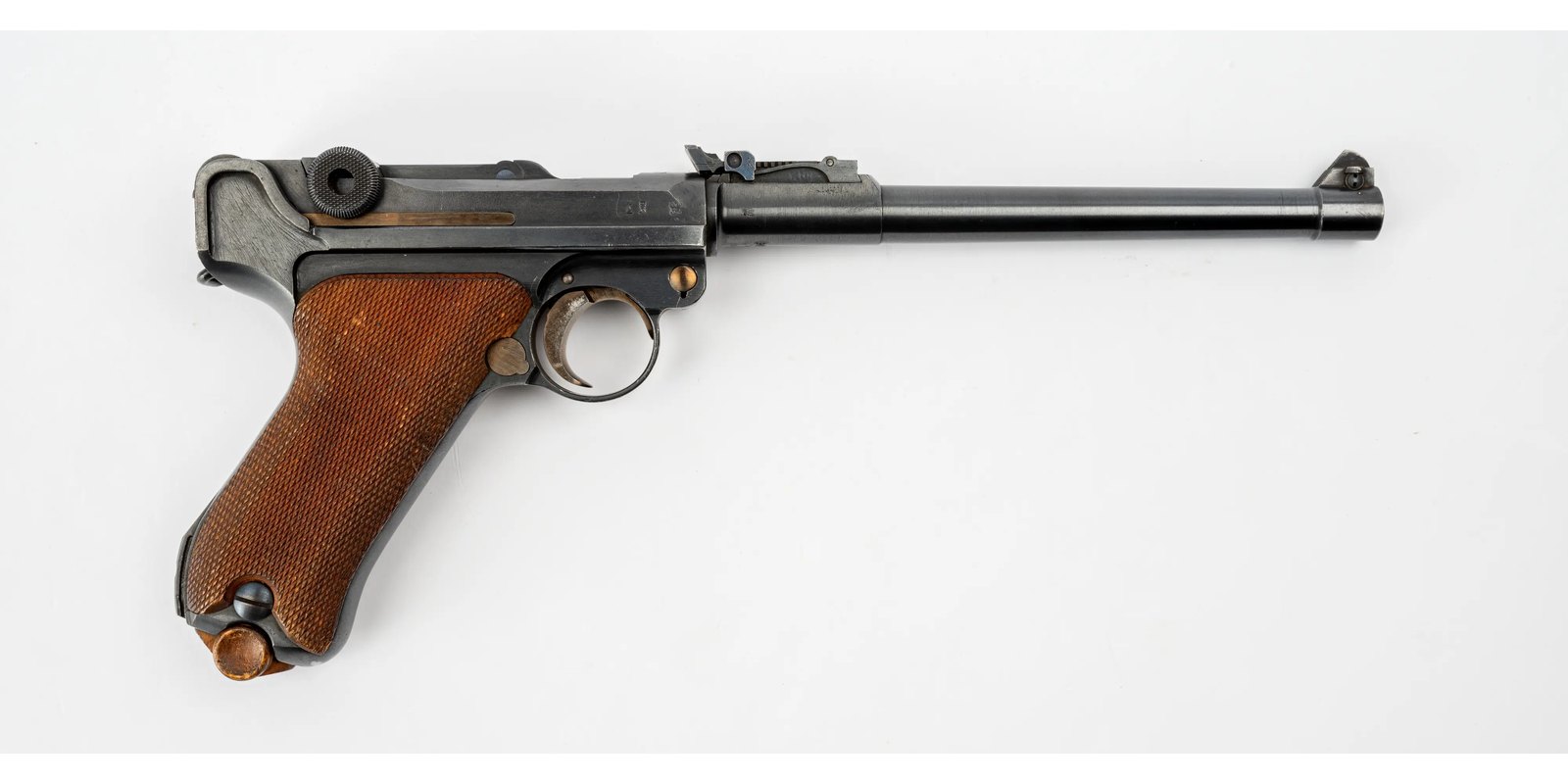
The long Luger. Authorized on July 2, 1913, it carries a 7.9 inch barrel, an eight-position tangent rear sight graduated to 800 meters, and a lug for a detachable board stock. The 32-round TM08 snail drum came later, in 1916. Artillery Lugers sell for about $2,460 at the median, and a correct stock and holster add real money.
Navy Luger (P04)
The Imperial German Navy adopted its Luger in 1904. You’ll often see 1906 quoted, because deliveries took almost two years to arrive. The Navy gun has a barrel of about 6 inches (150 mm) and a two-position rear sight on the rear toggle link, set for 100 and 200 meters. They’re scarce and faked often, so buy the gun with a paper trail. Median: $2,640.
Swiss Lugers (1900, 1906 and 06/29)
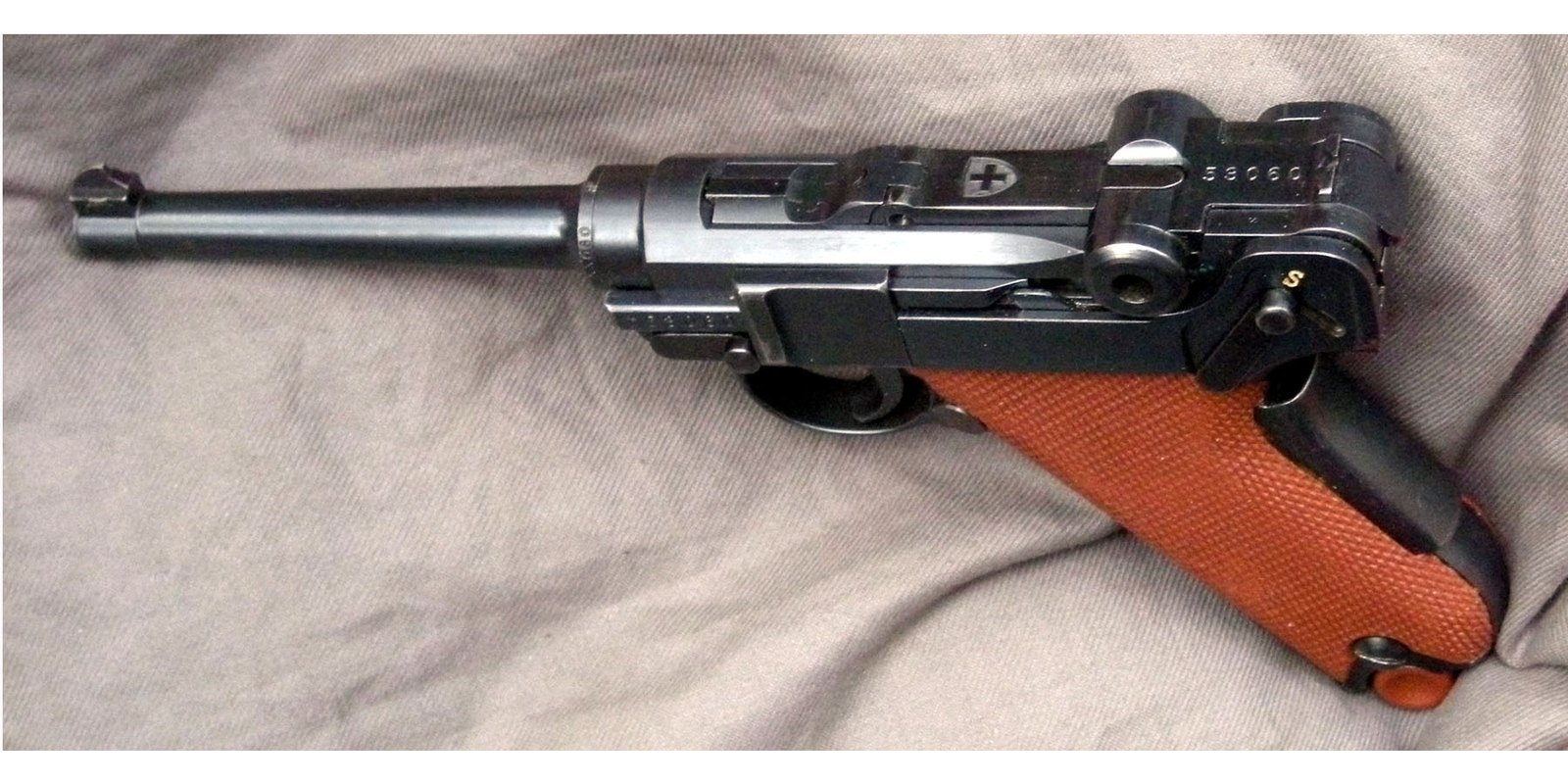
Switzerland adopted the Luger first, in 1900, and many Swiss guns are chambered in 7.65x21mm. The early ones were made by DWM, and from 1918 the Swiss arsenal at Bern built its own. Look for the Swiss cross on the chamber or receiver. Swiss guns were well kept, and it shows in their condition. They’re also the ones to check on caliber before you buy ammo.
Mauser WWII P08: S/42, 42 and byf (1934 to 1942)
Mauser took over Luger production from DWM in 1930 and built the WWII guns under code marks. The toggle reads S/42 with a chamber letter K for 1934 or G for 1935, then S/42 with a full year from 1936 to 1940, then the numeral 42, and finally byf with chamber dates of 41 or 42. Some late guns wore black bakelite grips, and the ones with them carry the dealer-coined nickname “Black Widow.” The WWII Mausers are the most popular Lugers with American buyers, and a matching byf with 90%+ finish brought a $4,320 median.
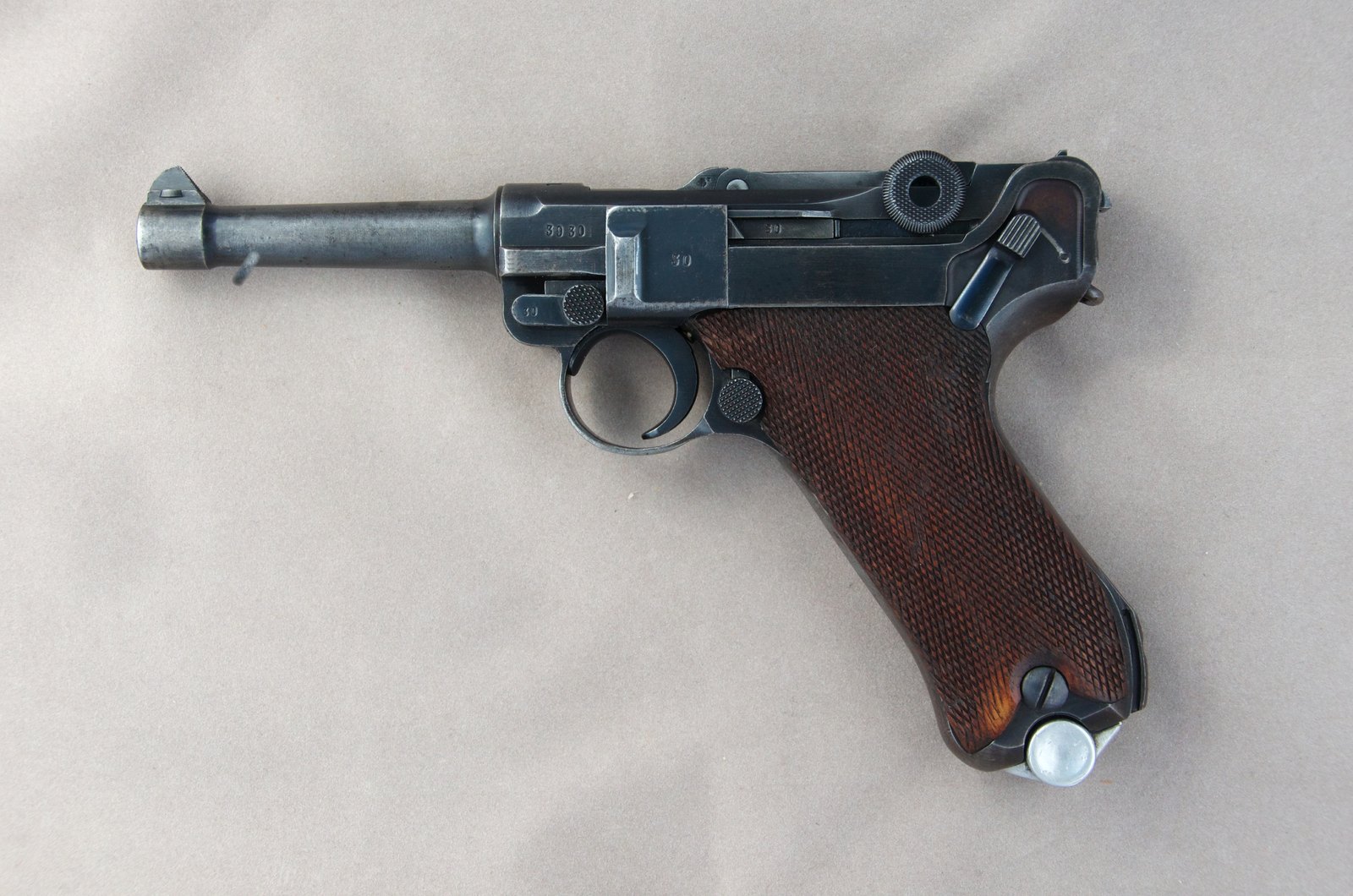
Krieghoff
Heinrich Krieghoff of Suhl got a Luftwaffe contract in 1935 and built Lugers until 1944. Production was small and fakes are common. At a $4,610 median in our data, this is not a gun to buy from photos alone.
American Eagle and Commercial .30 Lugers
DWM stamped an American eagle over the chamber on pistols made for the US commercial market, the early Model 1900 guns in .30 Luger and later ones in both calibers. The postwar Mauser Parabellum revived the eagle in the 1970s for importer Interarms, so read the date and the maker before you pay DWM money for a 1970s gun.
Postwar Mauser Parabellum, Reproductions and .22s
Mauser made new Parabellum parts from 1969 to 1986 and sold guns assembled from them into the late 1990s. These are the best shooting Lugers for the money: new springs, tight fitting, no numbered-part guilt. Mitchell Arms built a stainless copy in Houston in the 1990s, and it sells for about $1,490. The Stoeger .22 made from 1969 to 1985 only looks like a Luger. It’s a simple blowback with no locking toggle, and it’s worth about $360.
Luger Condition Guide: How to Grade One Before You Pay
Luger sellers describe condition by the percentage of original finish left on the gun, and auction houses add words like “excellent” or “very good” on top. What matters most is that the finish is original. A 70% original gun is worth more than a gun that looks 98% because somebody reblued it.
| Grade | What you see | What it does to price |
|---|---|---|
| 90% to 98% original | Deep factory blue, sharp markings, straw-colored small parts still bright, crisp grip checkering | Top of the table. Matching WWII Mausers here sold for $2,640 to $4,320 |
| 70% to 89% original | Holster wear on the edges and front strap, blue thinning on the barrel, markings still sharp | The honest collector grade and the best value per dollar |
| 40% to 69% original | Gray patina on high points, light pitting possible, grips worn | Priced near shooter money unless the variant is scarce |
| Under 40% or refinished | Mostly gray, or an even, glossy blue that covers everything | Shooter grade, about $1,350 for a common P08 |
Check the bore, too. A bright bore with sharp rifling adds to any grade, and a dark, pitted bore takes money off even a clean outside. On the frame, look hard at the toggle joints and the area around the front toggle pin, where cracks show up on worn guns.
Luger Markings, Serial Numbers and Matching Numbers
A Luger is “matching” when the serial number stamped on the front of the frame is repeated on the numbered parts, most of them stamped with its last two digits. That includes the barrel extension, toggle links, sideplate, takedown lever, trigger, safety and often the grips and magazine. Collectors record the full serial including any suffix letter, because the same number was reused across blocks.
| Marking | Where | What it means |
|---|---|---|
| DWM script monogram | Front toggle link | Deutsche Waffen- und Munitionsfabriken, Berlin (WWI and commercial) |
| Crown over ERFURT | Front toggle link | Royal arsenal at Erfurt (WWI) |
| S/42 with K or G on chamber | Toggle / chamber | Mauser, 1934 (K) or 1935 (G) |
| S/42 with full date | Toggle / chamber | Mauser, 1936 to 1940 |
| 42 | Toggle | Mauser code, 1939 to 1940 |
| byf with 41 or 42 | Toggle / chamber | Mauser code, 1941 to 1942 |
| Two dates, one of them 1920 | Chamber | Weimar-era government property rework |
| Swiss cross | Chamber or receiver | Swiss military contract |
| American eagle | Over the chamber | US commercial model (DWM, or 1970s Mauser) |
| Importer name and city | Frame or barrel | Imported after 1968. Normal on many guns, and it tells you it came in commercially, not as a GI bring-back |
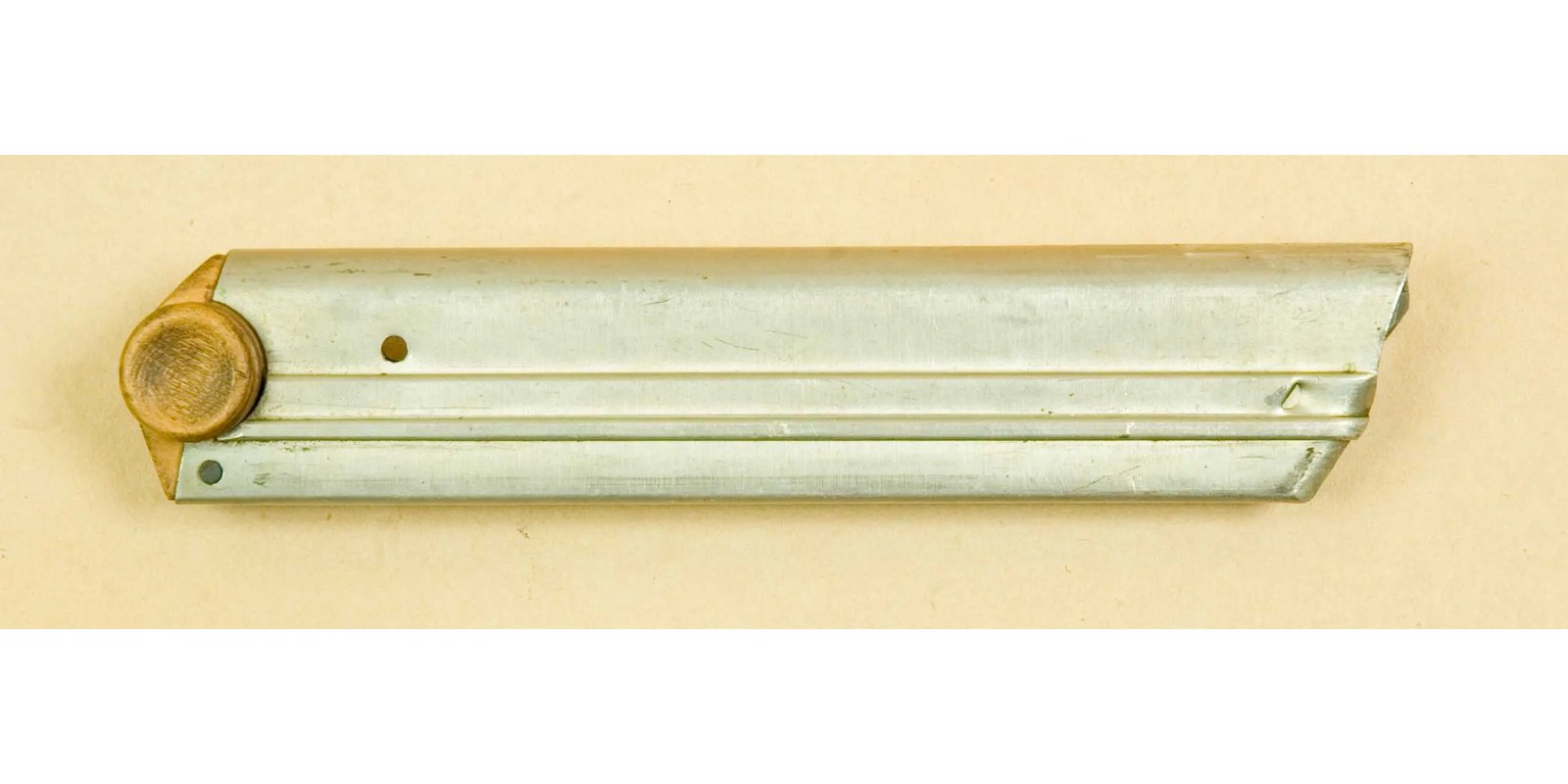
Magazines are their own subject. WWI magazines have wooden bases, and later ones have aluminum or bakelite bases. A magazine numbered to the gun is the piece most often missing, and as the price table shows, it’s worth far more on the gun than off it.
How to Spot a Fake, Reblue or Parts Gun
Lugers might be the most faked collector pistols there are, because a few stamps can turn a $1,400 gun into a $4,000 one. These are the tells we check every time:
- Markings that look soft or washed out under deep, even bluing. A refinish buffs the edges of stamps. Original guns have sharp stamps with finish wear around them.
- Small parts that are blue when they should be straw. Many Lugers had heat-colored straw parts. Blue ones, or straw that looks painted, point to a refinish or replacement.
- Numbers that don’t match in style. Compare the font, depth and alignment of every number. A restamped part often has crisper or shallower digits than the frame.
- Rare stamps on common guns. Added unit marks, Nazi-era police or SS markings, and “Navy” or “Artillery” parts on standard frames are the classic upgrades. Be most suspicious of the marks that add the most money.
- Magazines that look too good. Reproduction magazines with fresh numbers are cheap to make. Check the numbering against the gun and the base style against the date.
- A story with no paper. “My grandfather brought it back” is lovely and proves nothing. Price the gun on what you can see.
Luger Pre-Purchase Inspection Checklist
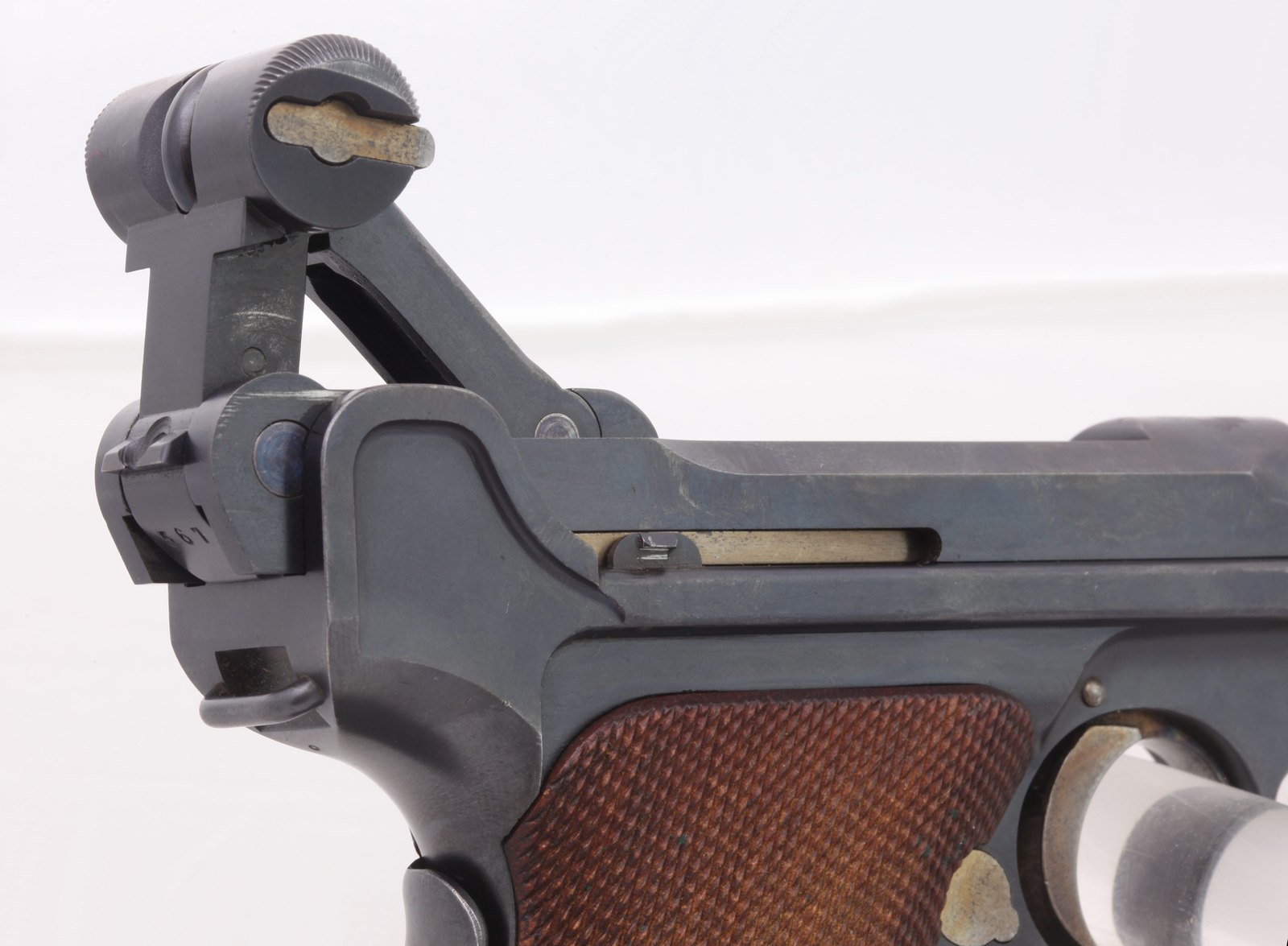
- Clear the gun and confirm it’s empty. Remove the magazine.
- Read the toggle and chamber: maker, date, and whether both fit the variant the seller claims.
- Record the frame serial and suffix letter, then check every numbered part against it.
- Look at the finish under good light for buffing, washed stamps and blue where straw should be.
- Check the toggle joints and the front toggle pin area for cracks.
- Work the action. The toggle should run smoothly and lock up without slop.
- Check that the toggle locks open on an empty magazine, if the variant has a hold-open.
- Look down the bore with a light. Bright and sharp beats dark and pitted.
- Test the safety. It should block the trigger action firmly.
- Inspect the grips for cracks and chips, especially the left panel.
- Check the magazine: base type, numbering and whether the spring feels strong.
- Ask for a return privilege or a written description, and get close-up photos of every number before you pay.
Shooting and Caring for a Collector Luger
You can shoot a Luger. Most owners do, and nothing in our sales data suggests shooting hurts value. Breaking a numbered part does. A matching gun with a replaced toggle link or firing pin is no longer a matching gun, which is why the smart move is to shoot a mismatched gun or a postwar Mauser and keep your matching gun for occasional outings.
| Use | Avoid |
|---|---|
| Standard-pressure 115 or 124 grain FMJ in brass cases | +P or +P+ loads of any kind |
| Name brands like Winchester, Federal, Fiocchi, PPU and Magtech | NATO-spec or submachine gun surplus |
| .30 Luger (7.65x21mm) for guns chambered in it | Very light target loads that may not cycle the toggle |
| New Mec-Gar magazines for range use | Your numbered original magazines at the range |
| A fresh recoil spring kit on a shooter | Dry-firing a collector gun without a snap cap |
Our range time came down to three habits. Keep your original magazines at home and shoot new ones. Replace the springs on any Luger you plan to shoot often, because 80-year-old springs are behind a lot of “unreliable” reputations. And hold it firmly. The toggle needs a solid platform to cycle. We also leave the grips alone. The left panel is notorious for chipping if it’s forced off, and a chipped original grip costs money.
How to Field-Strip a Luger
Field-stripping a Luger looks intimidating the first time and takes about a minute once you’ve done it. This is the sequence from American Rifleman’s P08 exploded view, and it’s the same on every model:
- Remove the magazine and confirm the chamber is empty.
- Press the muzzle against a hard surface to push the barrel and receiver back about 1/4 inch. That takes tension off the recoil spring.
- Holding it there, turn the takedown lever on the left side of the frame to the vertical position.
- Lift the sideplate (the trigger plate) off the left side of the frame.
- Slide the barrel, receiver and toggle assembly forward and off the frame. Note how the coupling link at the rear of the toggle sits in front of the recoil lever, because it has to go back the same way.
- To remove the toggle, lift the rear toggle knobs slightly, press the receiver axle in from the right side, pull it out from the left and draw the toggle and breechblock out of the back of the receiver.
That’s as far as you need to go for cleaning. Reassembly is the reverse. The one step people get wrong is the coupling link: if it doesn’t drop in front of the recoil lever arms, the toggle won’t cycle. Take your time with the sideplate and the takedown lever on a matching gun, because both are numbered parts and a burr from a screwdriver shows forever.
These are standard-pressure loads our dealers carry right now. Anything marked +P or NATO has been filtered out.
9mm Ammo Deals Safe for a Luger
On-sale 9mm luger standard from 200+ retailers · Updated every 4 hours



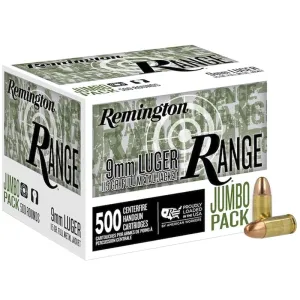
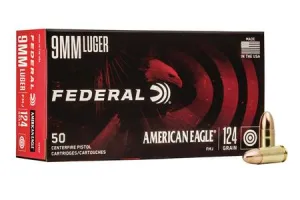
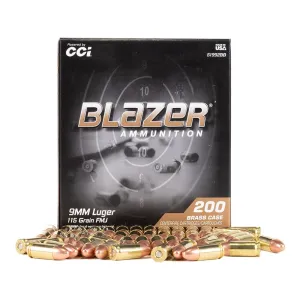

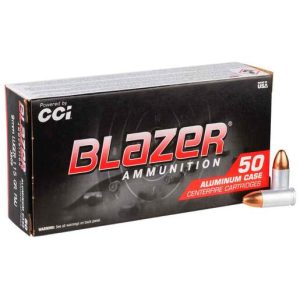
For Swiss and commercial guns in 7.65mm, .30 Luger is still loaded by PPU and a few others. It sells out fast, so grab a box when you see one.
For more 9mm options, our best 9mm ammo guide covers range and defense loads in detail.
A Short History of the Luger
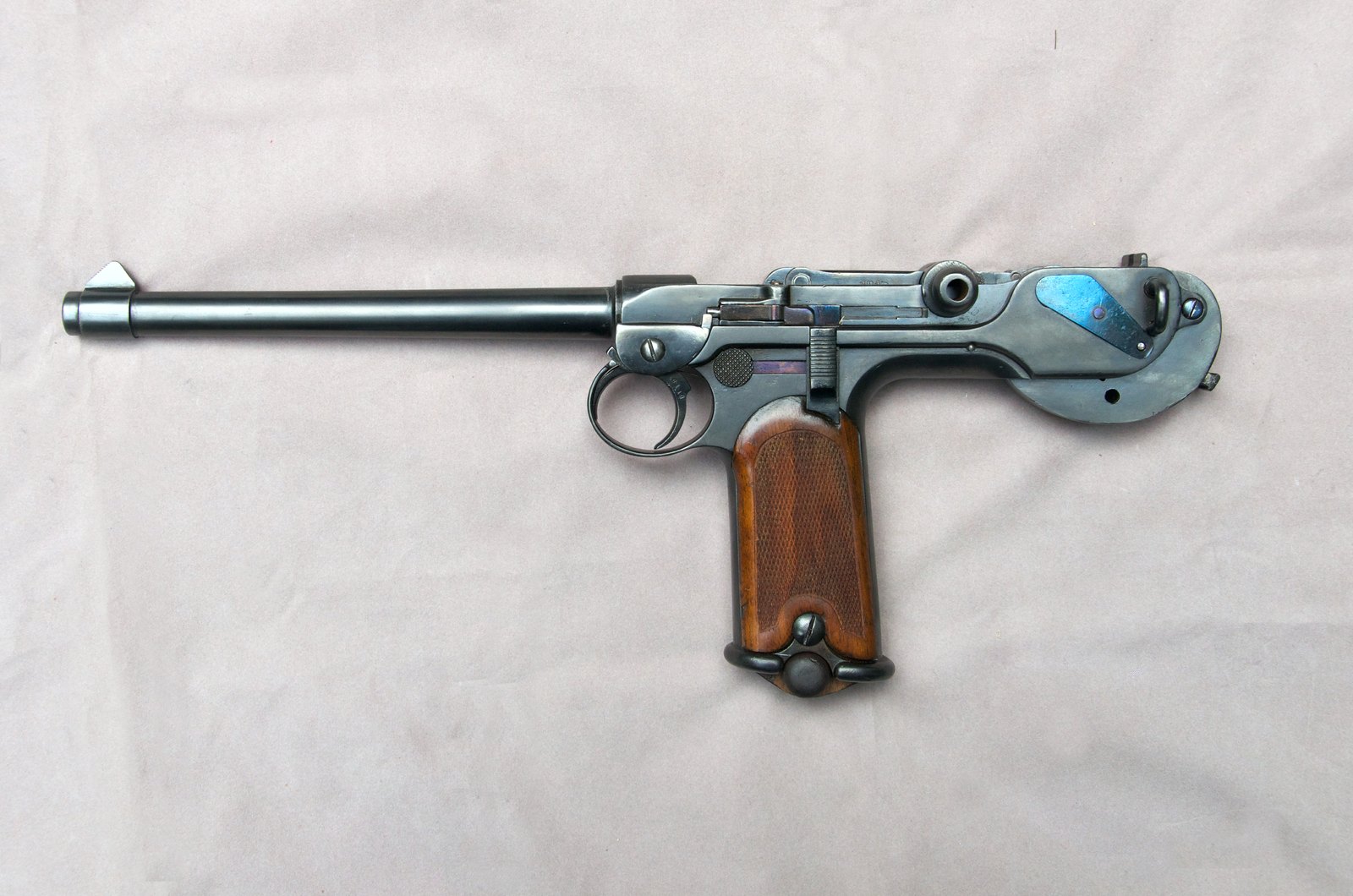
The Luger started as somebody else’s pistol. Hugo Borchardt’s C93 of 1893 was one of the first working self-loading pistols, but it was big and awkward. When Borchardt wouldn’t change his design, DWM gave the job to Georg Luger, born March 6, 1849, who kept the toggle lock and turned it into something a soldier could carry.
The first cartridge was the 7.65x21mm, introduced in 1898, and Switzerland became the first country to adopt the new pistol in 1900. Luger then opened up the case mouth for a bigger bullet. The result, the 9x19mm Parabellum, arrived with DWM’s Model 1902 and went on to become the most widely used pistol cartridge in the world.
The German Navy took the 9mm Luger in 1904 and the Army in 1908, which gave the P08 its name. Through the Great War, DWM and Erfurt built them by the hundreds of thousands, including the long Artillery model of 1913. After the war, Weimar Germany reworked and re-dated what it was allowed to keep, and Simson held the military contract for a time.
Mauser took over production in 1930 and built the P08 under code marks as Germany rearmed. The Walther P38 was adopted in 1938 to replace it, but P08 production ran on until 1942 and 1943, and Krieghoff kept building Luftwaffe guns until 1944. Estimates put total production at roughly 3 million. Mauser revived the design for the commercial market from 1969, and the name lived on in the US through Stoeger, which registered “Luger” as a trademark in the 1920s.
One footnote collectors love: in 1907 DWM built two Lugers in .45 ACP for US Army trials. Only one survives, and it sold at auction in 2010 for $494,500.
Why the Luger Is Still So Popular
Part of it is the look. The raked grip, the round toggle knobs and the exposed barrel make a silhouette nobody mistakes for anything else. Part of it is that it gave the world the 9mm, the round in most police and military holsters today.
Mostly, though, it’s the story. American soldiers in both world wars prized the Luger above every other souvenir, and thousands came home in duffel bags. That’s why so many surface today from estates, and why a Luger is often the first collectible pistol a family owns. It shows up in films and video games for the same reason: one glance tells the audience where and when you are. Values have followed. Our data shows the median original P08 selling for well above what a new service pistol costs, and the trend line still points up.
Luger Legal Status: C&R, Antiques, Import Marks and State Rules
Under federal law, an antique firearm has to be made in or before 1898. Luger series production started in 1900, so no Luger you’re likely to buy is an antique, and every one ships like a modern firearm, through an FFL dealer or to a Curio and Relic license holder.
The ATF’s curio and relic list covers “Luger, pistol, all models and variations mfd. prior to 1946.” Guns also qualify once they’re 50 years old, which now covers the early 1970s Mauser Parabellums. A C&R license costs $30 for three years and lets eligible guns ship straight to your door.
Stocked Lugers need care. The ATF has removed original WWI Artillery and Navy Lugers from the National Firearms Act when they’re paired with their original, correct shoulder stock. Put a reproduction stock on a Luger, or a Navy stock on an Artillery gun, and you may have built a short-barreled rifle. State rules on handgun rosters, permits and C&R transfers vary widely, so check yours before you buy.
Where to Buy a Luger
- Online dealers. Guns.com and Classic Firearms list Lugers with photos and ship to your FFL. Our price cards above show what they have today. Browse Lugers on Guns.com.
- Auction houses. Morphy, Rock Island and others offer the best selection and written condition reports, but add a buyer’s premium of roughly 20 to 25% to every hammer price.
- GunBroker. The biggest pool and the most variable quality. Buy from sellers who post close-ups of every number and offer an inspection period.
- Gun shows and specialist dealers. The chance to handle the gun is worth a lot. Bring a flashlight and this checklist.
Whoever you buy from, ask the same questions: are all numbered parts matching, including the magazine? Has it been refinished? Is there an import mark? Can I get a return if it isn’t as described?
Luger vs. Its Rivals
| Pistol | Adopted | Caliber | Capacity | Why you’d pick it |
|---|---|---|---|---|
| Luger P08 | 1908 (Germany) | 9x19mm | 8 | The history, the design and the collector market |
| Walther P38 | 1938 (Germany) | 9x19mm | 8 | The Luger’s replacement: double action, easier to shoot, cheaper to buy |
| Mauser C96 | 1896 (commercial) | 7.63x25mm / 9x19mm | 10 | The Broomhandle: even older, fed from stripper clips |
| Browning Hi-Power | 1935 (Belgium) | 9x19mm | 13 | Double the capacity and a far better shooter today |
If you like the Luger’s era but want a gun you can shoot hard, the Hi-Power is the obvious partner. For more surplus history on a budget, see our Mauser rifle guide and Lee-Enfield buyer’s guide.
Final Verdict
A Luger isn’t a practical pistol, and that’s fine. It’s the gun that started the 9mm, and it’s still one of the best-made handguns ever built. Buy a matching WWI DWM or a WWII Mauser in honest original condition and you own a piece of the century that should keep its value. Buy a mismatched rework or a postwar Mauser if you want to shoot one without worrying.
Just don’t buy the story. Buy the numbers, the finish and the bore, and walk away from any gun that looks better than it should.
FAQ
How much is a Luger worth in 2026?
In 519 completed sales from January 2024 to September 2026, a mismatched or refinished WWI DWM P08 sold for a median of about $1,350 and a matching one with 90% or more original finish for about $1,800. Matching WWII Mauser S/42 guns at that grade brought about $2,640, and rare variants such as the Black Widow and Krieghoff sold for $4,000 and up.
Is it legal to own a Luger?
Yes, in most of the US. A Luger is a regular handgun under federal law, not an antique, because series production began in 1900. The ATF lists every Luger made before 1946 as a curio or relic, so it transfers through an FFL dealer or ships to a C&R license holder. Check your state and local rules before you buy.
Are Lugers still made?
Not by the original makers. German military production ended in 1942 and 1943. Mauser made new Parabellum parts from 1969 to 1986 and sold guns assembled from them into the late 1990s, and Mitchell Arms built a stainless copy in the 1990s. The Stoeger .22 only looks like a Luger.
Can you shoot modern 9mm ammo in a Luger?
Yes, if it is standard-pressure 115 or 124 grain FMJ from a name brand. Never use +P, NATO-spec surplus or submachine gun ammo. Our shooter ran 300 rounds of Winchester, Federal American Eagle and Fiocchi, and its only real problems came from a worn original magazine.
Was the Luger a good gun?
It was an excellent pistol for its time: accurate, natural pointing and soft shooting. It was also expensive and slow to make, which is why Germany adopted the Walther P38 in 1938. Most modern reliability complaints trace to weak ammo, old springs, worn magazines or mismatched parts guns.
What does P08 mean?
P08 stands for Pistole 1908, the German Army designation for the Luger it adopted on August 22, 1908. The Navy version adopted in 1904 is often called the P04.
How can I tell if a Luger is all matching?
Find the full serial number on the front of the frame, including any suffix letter, then check that its last two digits appear on the numbered parts: barrel extension, toggle links, sideplate, takedown lever, trigger and safety, and ideally the grips and magazine. Compare the style and depth of every number, because restamped parts are common.
Why are Lugers so valuable?
They introduced the 9mm, they served in both world wars, and American soldiers prized them as souvenirs, so demand has always been strong. They are also complex, hand-fitted pistols that are no longer made the old way. A matching magazine numbered to the gun is associated with a median sale about 40% higher.
4,617+ Gun & Ammo Deals
Updated daily from 200+ top retailers. Filter by category, caliber, action type, and price.