

Last updated October 2026
Some of the links below are affiliate links, meaning at no additional cost to you, we may earn a commission if you click through and make a purchase.
- Treat every gun as loaded
- Point the muzzle in a safe direction
- Keep your finger off the trigger until you’re ready to shoot
- Know your target and what’s beyond
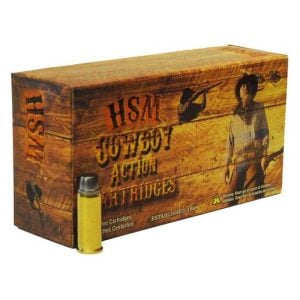
.38-40 ammo is still loaded in 2026, though only by a handful of companies. Our dealers had HSM, Black Hills and Buffalo Bore boxes on October 3, and they started at about a dollar a round for HSM’s cowboy load in boxes of 50.
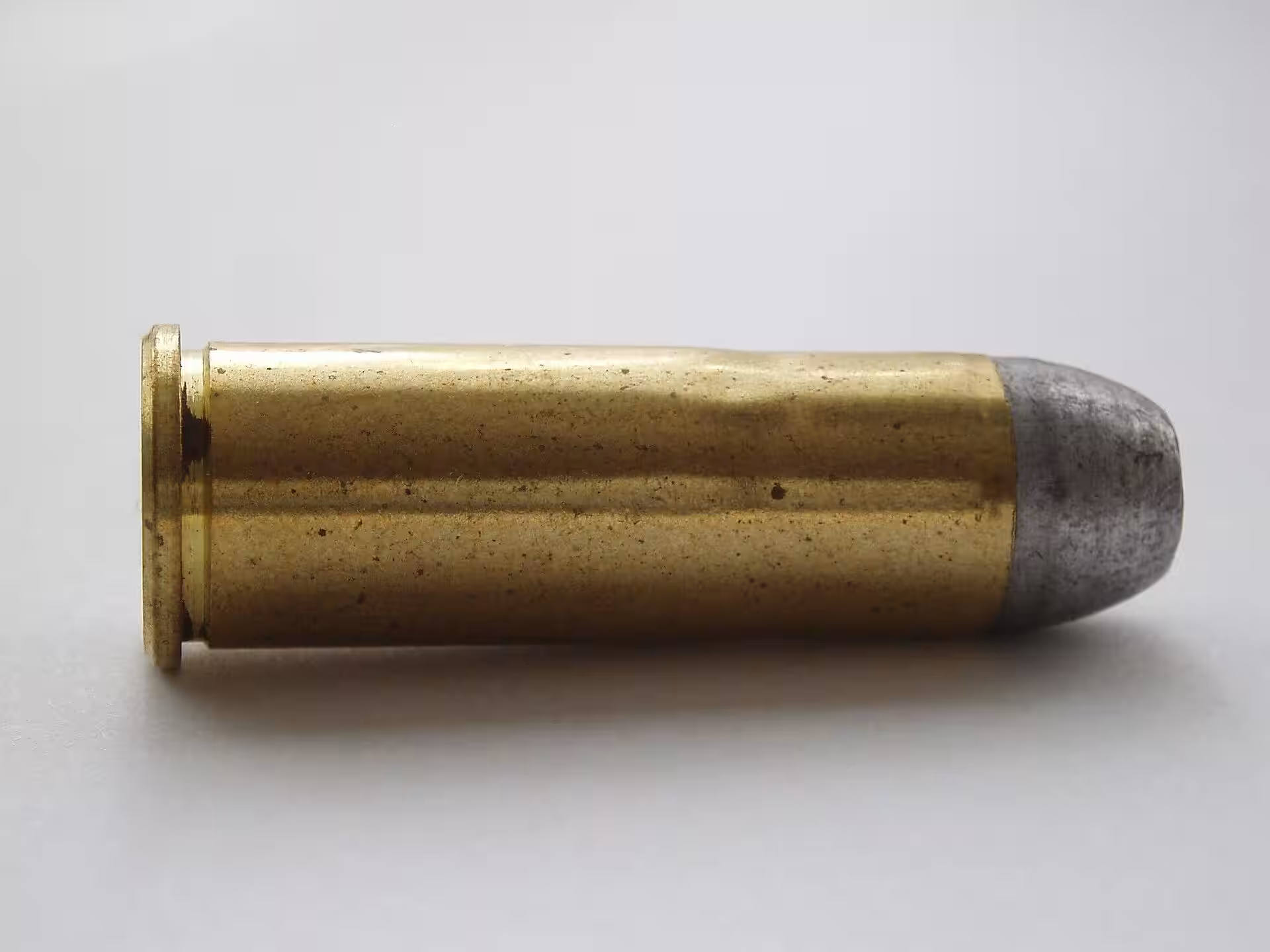
The .38-40 Winchester, also sold as the .38 WCF, is a strange one. It isn’t a .38 at all. It fires a .40-caliber bullet, the same diameter as a 10mm Auto, from a necked-down .44-40 case, at far lower pressure than the 10mm.
Below you’ll find who still makes it, what it costs, SAAMI’s pressure figure and why there’s no psi number, how it stacks up against the 10mm and the .44-40, and which loads are safe in an old Colt or a new Cimarron. We also shot the three loads our dealers had in stock.
Quick answer
.38-40 Winchester and .38 WCF are one cartridge, and it fires a .400 to .401-inch bullet, so it’s really a .40. Buy the mild cowboy loads from HSM or Black Hills for an old gun a gunsmith has passed, and keep Buffalo Bore’s full-power load for modern guns and checked smokeless-era rifles. Never fire 10mm or .40 S&W in a .38-40, even though the bullet is the same size.
- Price on October 3, 2026: $1.00 to $1.46 a round in boxes of 50, $2.45 a round for Buffalo Bore in boxes of 20
- Also sold as: .38 WCF, 38 Winchester, 38 Marlin and 38 Remington. SAAMI’s name is 38-40 Winchester
- Pressure limit: 14,000 CUP by SAAMI’s crusher method. SAAMI sets no psi figure for it
- Bullet: .400 to .401 in., the same size as the 10mm and .40 S&W, but never interchangeable

How we tested: Every pick here is ranked against our testing methodology. Minimum round counts, accuracy and reliability protocols, the failures that disqualify a gun.
.38-40 Winchester at a Glance
The .38-40 Winchester is a rimmed, bottlenecked cartridge that Winchester made by necking down its .44-40 to hold a 180-grain, .40-caliber bullet. It was introduced in 1879, and SAAMI’s reference load is that 180-grain bullet at 1,150 fps from a 24-inch rifle barrel, at up to 14,000 CUP.
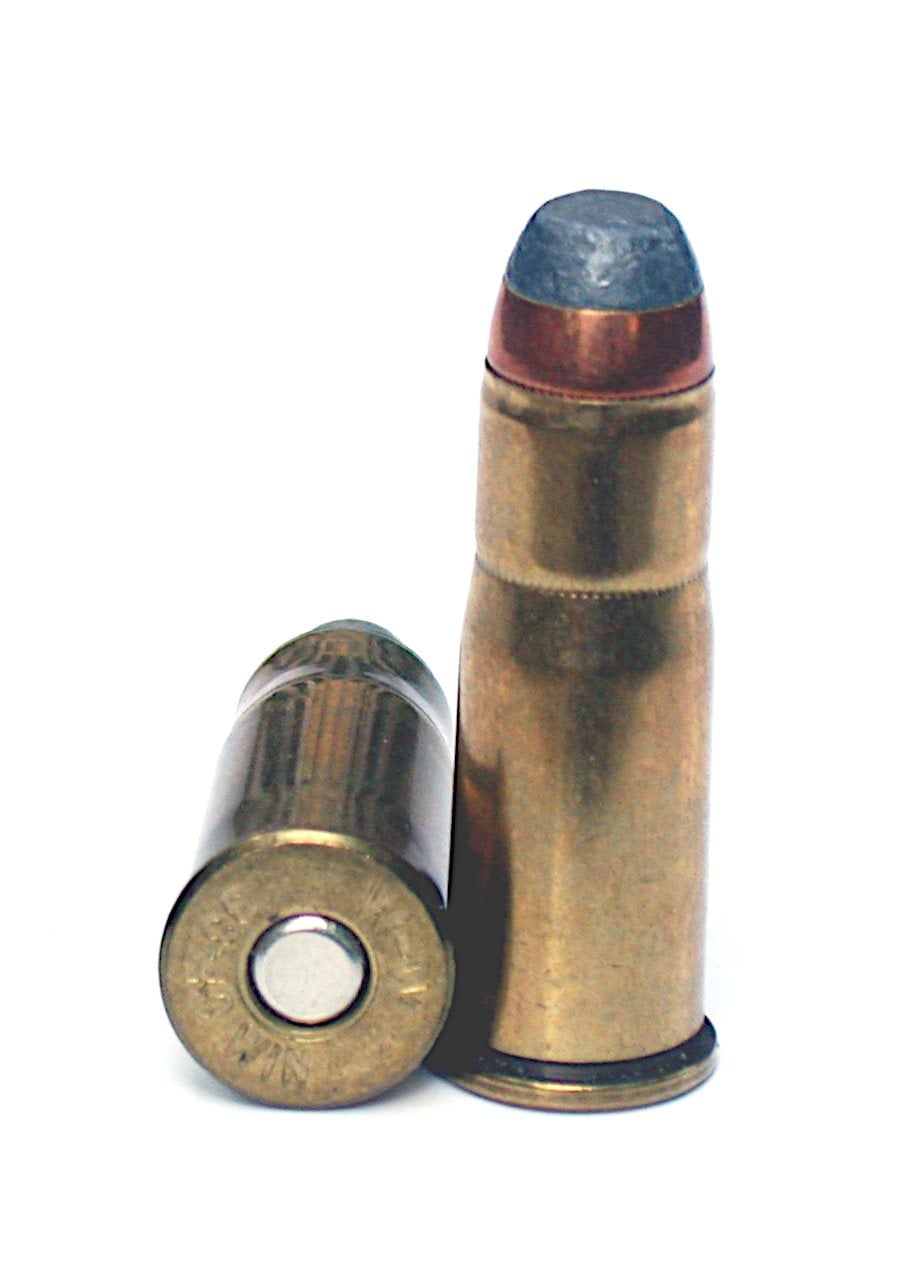
| Spec | .38-40 Winchester |
|---|---|
| Names | 38-40 Winchester by SAAMI, which also accepts 38 Marlin, 38 Winchester, 38 Remington and 38 WCF. C.I.P. lists 38-40 Win. |
| Introduced | 1879. The first Model 1873 rifle in .38-40 shipped in 1880 |
| Parent case | .44-40 Winchester, necked down |
| Bullet diameter | .400 to .401 in. Up to .4005 in. by the SAAMI drawing |
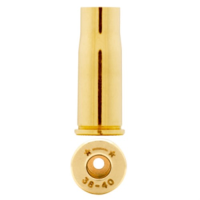
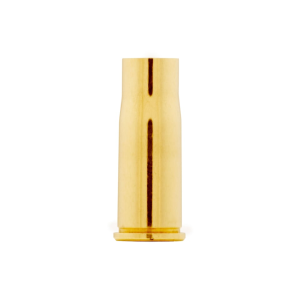
| Case | Rimmed bottleneck, 1.305 in. long. Rim .525 in. across, .065 in. thick |
| Overall length | 1.560 to 1.592 in. |
| Barrel | Bore .394 in., groove .400 in., 6 grooves, 1 turn in 36 in., right-hand twist |
| Headspace | On the rim |
| SAAMI pressure limit | 14,000 CUP by crusher. SAAMI lists the transducer figure as not established |
| SAAMI reference load | 180 gr at 1,150 fps from a 24 in. test barrel |
| SAAMI standard | The centerfire rifle standard. It has no entry in the pistol and revolver standard |
| SAAMI +P standard | None |
.38-40 Ammo: The Good and the Bad
It’s a mild round for classic single actions and lever guns, and new ones still come in it. The catch is the ammo: few makers, about a dollar a round at best, and thin case mouths that dent easily.
Pros
- Same .40 bullet as the 10mm
- Mild cowboy loads, kind to old guns
- New guns from Cimarron and Taylor’s
Cons
- Only a few makers still load it
- About a dollar a round at best
- Thin case mouths dent easily
Table of Contents
Is a .38-40 a .38? No, It’s a .40
A .38-40 is not a .38. It fires a bullet of .400 to .401 inch, and SAAMI’s drawing allows up to .4005, the same maximum it sets for the 10mm Auto and the .40 S&W. Nothing on the cartridge measures .38 inch.
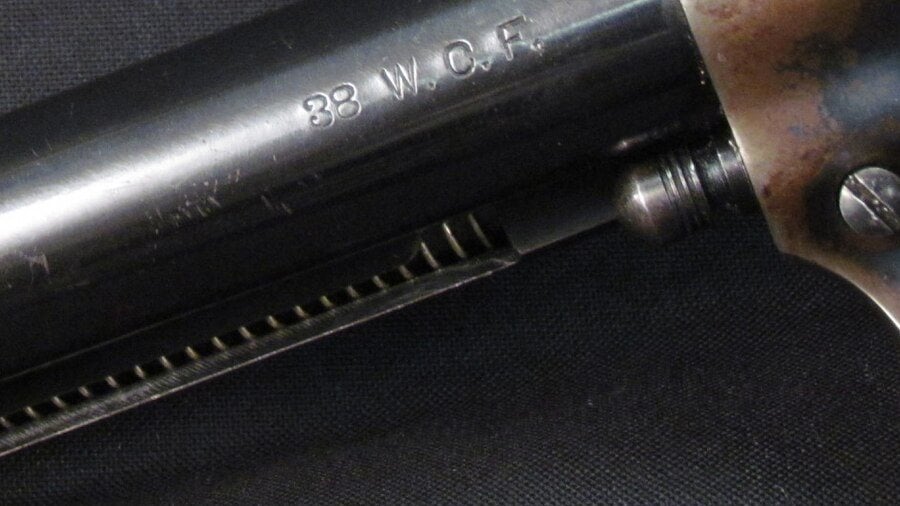
Nobody is sure where the .38 came from. American Rifleman‘s Dave Campbell writes that by Winchester’s own naming it would have been the .40-40 WCF, and that someone at Winchester picked the catchier name. Mike Venturino, writing for Starline, says why Winchester named it .38 “is a mystery”, and Shooting Times calls it “a gross misnomer”.
The 40 is easier. It stands for the original charge of black powder, 38 to 40 grains behind a 180-grain bullet. Winchester stamped its guns .38 WCF, for Winchester Center Fire, and Colt followed, which is why so many old barrels read 38 W.C.F.
Same cartridge, different names
SAAMI’s list of accepted names counts 38 Marlin, 38 Winchester, 38 Remington and 38 WCF as the same round. So a box of .38 WCF ammo or 38 Remington ammo fits a .38-40 gun. You’ll also see it written 10.17x33mmR.
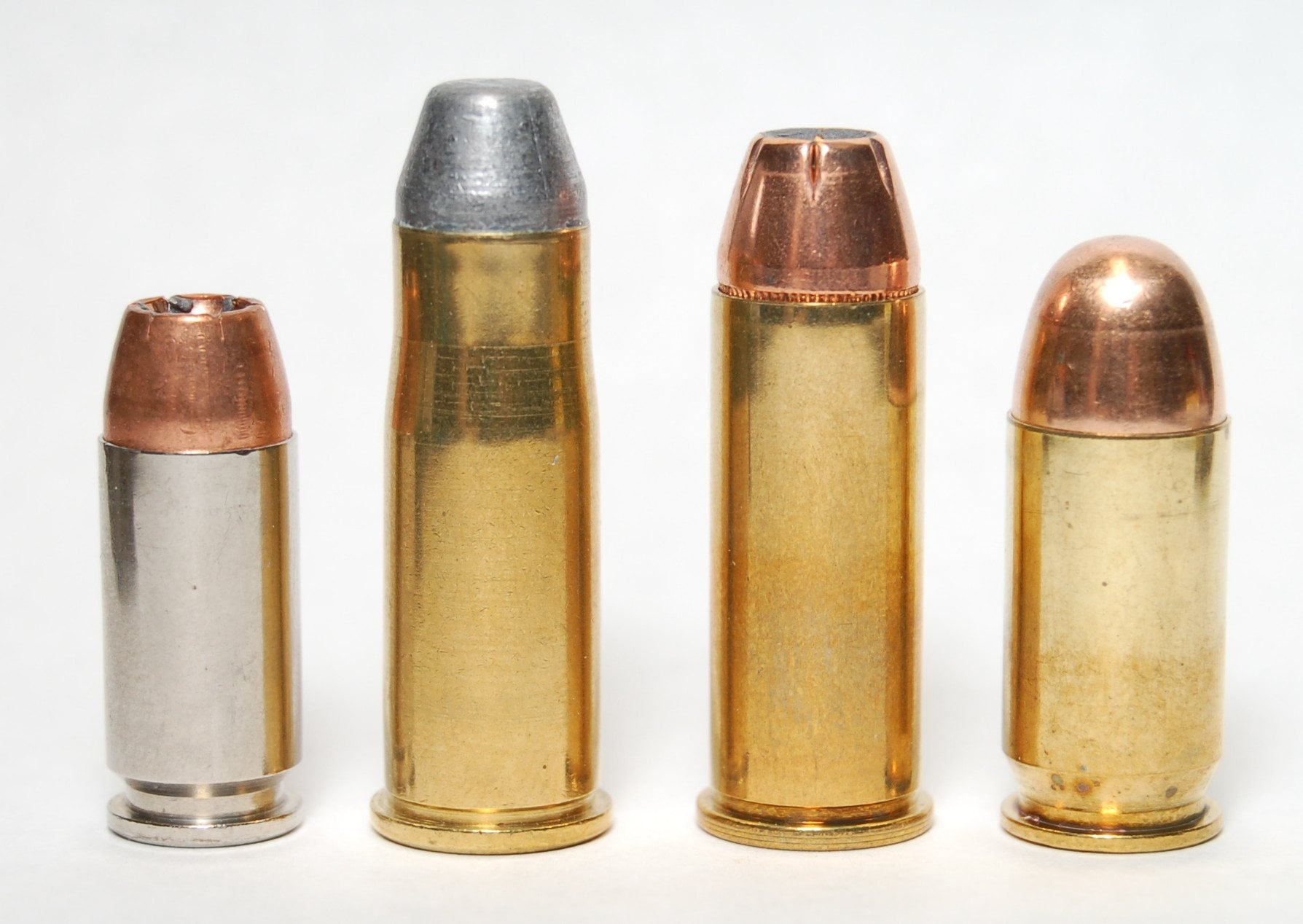
The .38s and .40s that are not .38-40
| Cartridge | What it is | In a .38-40 gun? |
|---|---|---|
| .38 Special | A separate revolver cartridge with a smaller .357-class bullet | No |
| .38-55 Winchester | A longer rifle cartridge with its own SAAMI listing and a .379-inch groove | No |
| 10mm Auto | A rimless straight case with the same .4005-inch bullet, rated by SAAMI at 37,500 psi | No |
| .40 S&W | A shorter rimless case with the same .4005-inch bullet | No |
| .44-40 Winchester | The parent case, with a .427-inch bullet | No |
Who Makes .38-40 Ammo in 2026
Our dealers had three brands of loaded .38-40 on October 3: HSM, Black Hills and Buffalo Bore. Winchester still lists its Super-X X3840 on its site, Ultramax loads a cowboy round sold through Buffalo Arms, and Choice Ammunition loads it by hand. Cowboy loads are mild lead-bullet rounds made for cowboy action matches.
Read the barrel column before you compare. Black Hills rates its load from a 5.5-inch test barrel, Buffalo Bore gives figures for both a revolver and a rifle, and HSM and Winchester don’t say what they used.
| Maker and load | Bullet | Listed velocity | Barrel the maker states |
|---|---|---|---|
| Winchester Super-X X3840 | 180 gr Power-Point jacketed soft point | 1,160 fps, 538 ft-lb | Not stated. Listed under rifle ammunition |
| HSM Cowboy Action | 180 gr lead round nose flat point | 930 fps, 346 ft-lb | Not stated |
| Black Hills Authentic Cowboy Action | 180 gr lead flat point | 850 fps | 5.5 in. |
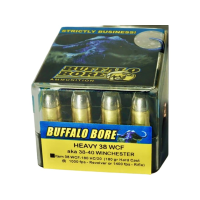
| Buffalo Bore 38 WCF-180 HC | 180 gr hard cast flat nose | 1,000 fps revolver, 1,400 fps rifle | Measured 1,020 fps from a 5.5 in. revolver and 1,421 fps from a 24 in. Model 1892 |
| Ultramax cowboy load | 180 gr lead round nose flat point | 750 fps | 7.5 in. |
| Choice Ammunition | 180 gr coated round nose flat point | 920 fps, or 480 fps for its light cowboy load | Not stated |
For handloaders, Starline makes the brass, part number 3800. It calls the case “basically a .44-40 necked down” to take a .401-inch bullet, and it uses a large pistol primer. Starline doesn’t sell loaded ammo.
What .38-40 Ammo Costs in 2026
Prices for .38-40 ammo ran from $1.00 a round for HSM in boxes of 50 to $2.45 a round for Buffalo Bore in boxes of 20 at our dealers on October 3, 2026. HSM was the cheapest and the easiest to find, with listings from $49.83 to $60.99 a box.
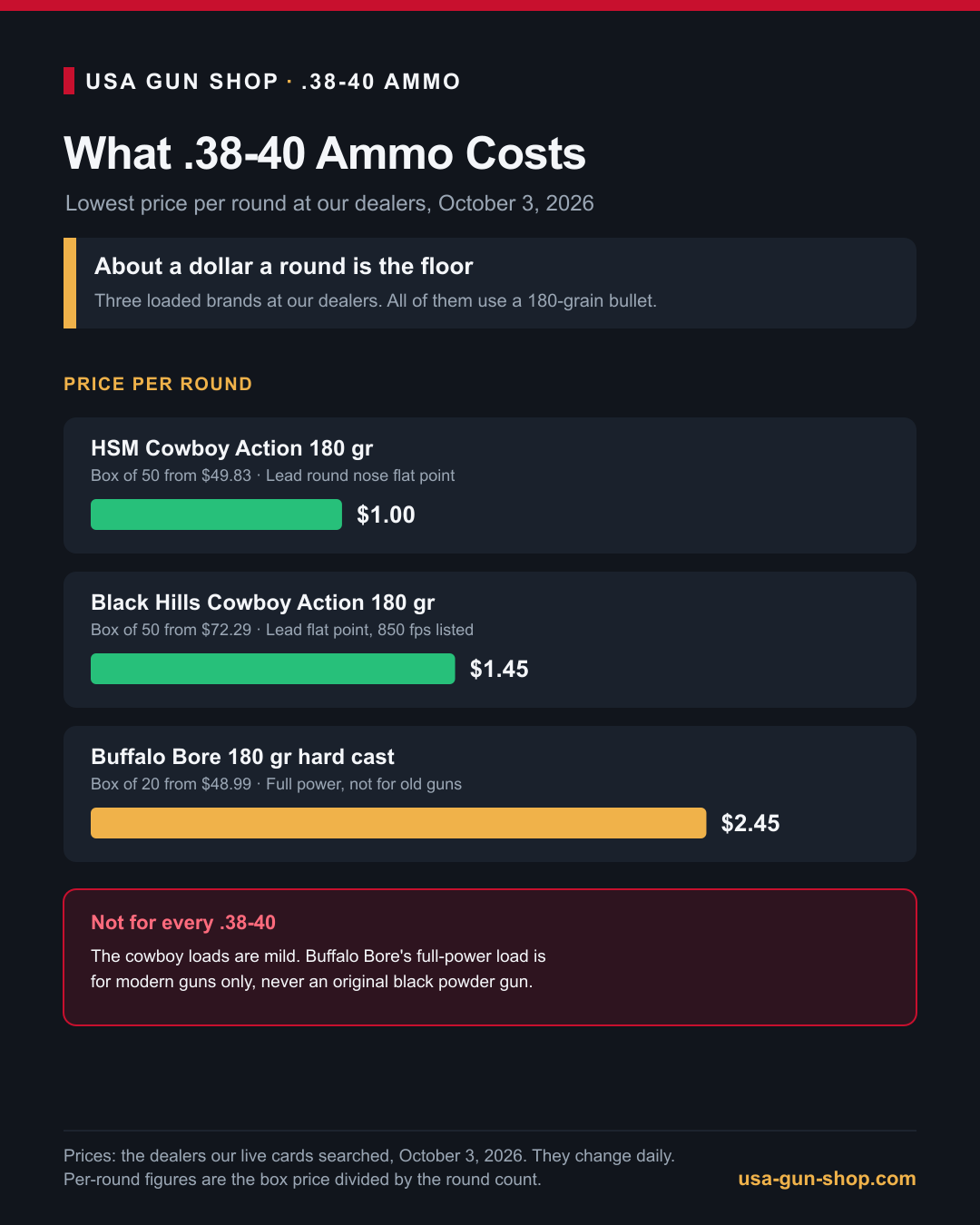
| Load | Box | Box price | Per round |
|---|---|---|---|
| HSM Cowboy Action 180 gr | 50 | $49.83 to $60.99 | $1.00 to $1.22 |
| Black Hills Cowboy Action 180 gr | 50 | $72.29 to $72.90 | $1.45 to $1.46 |
| Buffalo Bore 180 gr hard cast | 20 | $48.99 | $2.45 |
| Ultramax cowboy 180 gr, from Buffalo Arms | 50 | $54.59 | $1.09 |
Few makers and small runs keep the price up, and there’s no cheap imported practice ammo the way there is for common calibers. Each card on this page leads with a dealer we trust when one has stock, so its headline price can be higher than the cheapest box listed below it.
Watch the search results, too. A plain 38-40 search drags in .38 Special, .38-55 and .22 LR boxes listed by bullet weight, because the numbers match. The cards on this page filter those out, and our ammo price index tracks the common calibers for comparison.
.38-40 Pressure: 14,000 CUP, and Why There’s No psi Figure
SAAMI’s maximum average pressure for the .38-40 Winchester is 14,000 CUP, measured with the old copper crusher method, in its rifle standard. CUP stands for copper units of pressure, read from how far a small copper slug gets squashed. Its newer electronic transducer method gives most cartridges a psi figure, but for the .38-40 SAAMI’s table reads “Piezo Pressures Not Established”. So there’s no SAAMI psi limit, and any page that prints one made it up or converted it.
You can’t convert CUP to psi. They come from two different tests, and SAAMI never treats one as a translation of the other.
The .38-40 runs at a higher limit than its parent, the .44-40, which SAAMI rates at 13,000 CUP. Europe’s proof authority, the C.I.P., agrees on the order, with 1,150 bar for the 38-40 Win. against 1,100 bar for the .44-40, by its own method.
SAAMI files the .38-40 in its rifle standard, not its pistol and revolver standard, even though most people now shoot it in revolvers. Buffalo Bore says its full-power load “does not exceed the old SAAMI max. average of 14,000 CUP”, and no SAAMI or C.I.P. +P exists for it.
.38-40 vs 10mm and .40 S&W
The .38-40, the 10mm and the .40 S&W all fire a bullet of up to .4005 inch by SAAMI’s drawings. That’s where the likeness ends: the .38-40 is a long rimmed bottleneck case, the other two are short rimless straight cases, and SAAMI rates the 10mm at 37,500 psi by transducer. The .38-40 has only a crusher figure, so all we can honestly say is that the 10mm runs far higher.
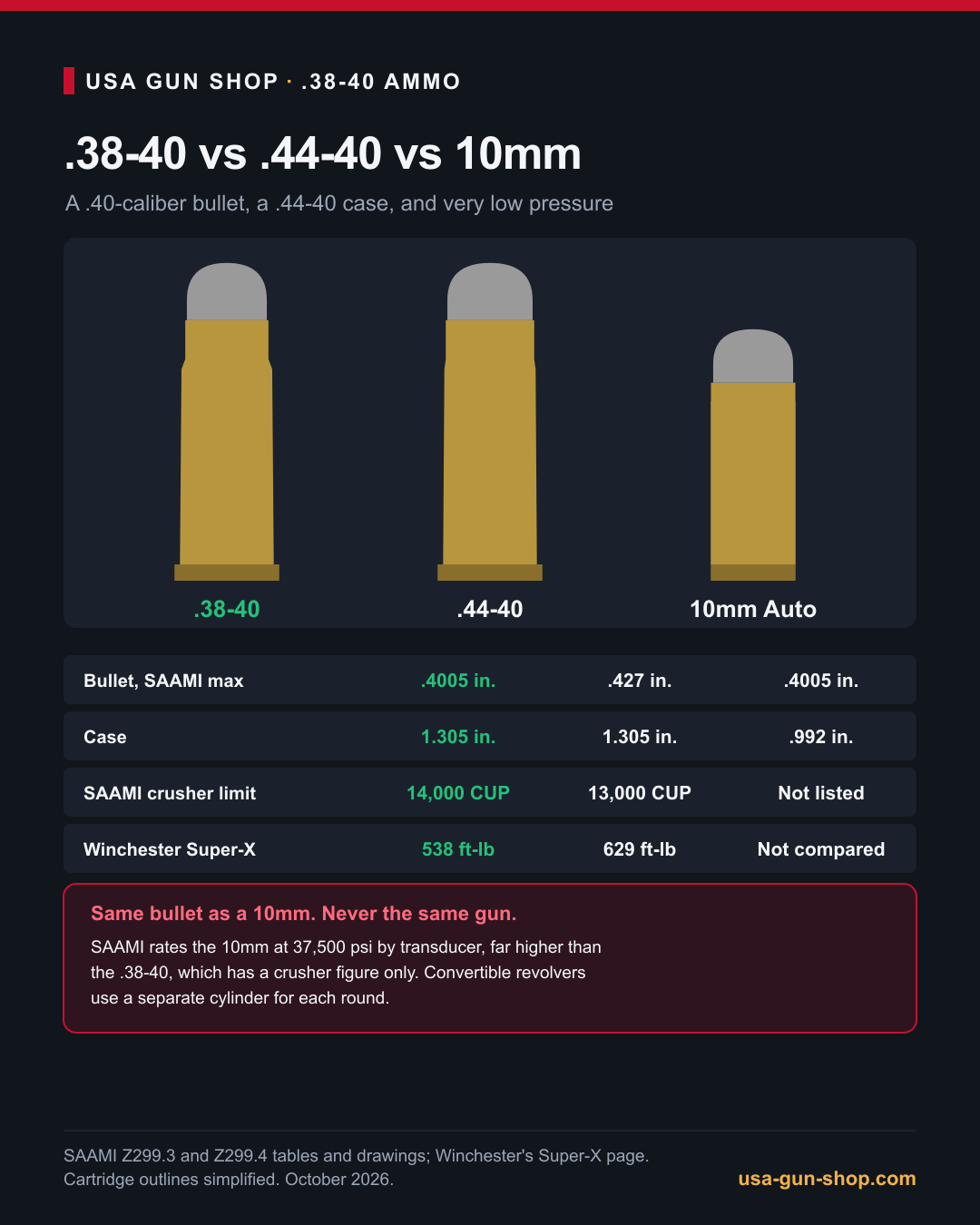
Buffalo Bore calls its .38-40 load “the equivalent of the 40 S&W”, and Venturino calls the .40 S&W the “ballistic twin” of the black powder .38 WCF. Both are talking about bullet and speed, not pressure.
A few revolvers fire both, but only with a second cylinder. Ruger’s discontinued Blackhawk Convertible came with a .38-40 and a 10mm cylinder, and its manual says “Do not use any other ammunition in the 38-40 cylinder”. Cimarron’s Bad Boy, built by Uberti, comes in a “10MM/.38-40 Dual Cylinder version”.
If you want the modern version of this idea in a pistol, our best 10mm pistols guide covers it.
.38-40 vs .44-40
The .38-40 and the .44-40 share a case length, a rim and the same guns. The difference is the bullet: 180 grains of .400 to .401 inch against 200 grains of .427 inch. Winchester’s own Super-X figures put the .38-40 at 1,160 fps and 538 foot-pounds and the .44-40 at 1,190 fps and 629, a gap of 91 foot-pounds, with no barrel stated for either.
| Figure | .38-40 | .44-40 | Source |
|---|---|---|---|
| Bullet diameter, SAAMI max | .4005 in. | .427 in. | SAAMI drawings |
| Case length | 1.305 in. | 1.305 in. | SAAMI drawings |
| SAAMI crusher limit | 14,000 CUP | 13,000 CUP | SAAMI Z299.4 |
| Winchester Super-X | 180 gr, 1,160 fps, 538 ft-lb | 200 gr, 1,190 fps, 629 ft-lb | Winchester listing |
| Black Hills cowboy load | 180 gr, 850 fps | 200 gr, 800 fps | Black Hills, 5.5 in. barrels |
The .44-40 is easier to find and hits harder. The .38-40 holds its own on speed, though: Black Hills’ cowboy loads show the lighter bullet running 50 fps faster from the same barrel length. Our .44-40 ammo guide covers that round in the same detail.
What’s Safe in Your .38-40 Gun
The rule is simple: only .38-40 ammo in a .38-40 chamber, and only the loads your gun’s maker allows. SAAMI’s interchangeability list names no substitute. Its unsafe-combinations sheet also warns against firing a .38-40 in a gun chambered for .45 Colt, .45 Auto or .270 WSM.
| Your gun | What to feed it |
|---|---|
| Original Colt SAA, Bisley or 1878 double action | Cowboy loads or black powder only. Buffalo Bore says not to use its load in original black powder guns |
| Original Winchester Model 1873 | Cowboy loads or black powder only. Shooting Times notes its action is weaker than a Marlin 1894 or Remington 14 1/2 |
| Winchester 1892, Marlin 1894, Remington 14 1/2 in good order | Standard factory loads, after a gunsmith checks it |
| New Cimarron, Taylor’s or Uberti guns | Commercial loads to SAAMI or C.I.P. standards. Uberti says never to use cartridges marked High Speed or High Velocity |
| Ruger Blackhawk Convertible | .38-40 in the .38-40 cylinder only. Ruger allows regular and high speed factory loads there |
| Any .45 Colt, .45 Auto, 10mm or .40 S&W gun | Never a .38-40 |
Buffalo Bore puts it bluntly for the old guns. Some of them “are in very poor condition and should not be fired with any ammo”, so have a gunsmith look at any original before it sees a range.
Old High Velocity .38-40 Boxes
Years ago, by Campbell’s account, a factory high-velocity load drove a 180-grain jacketed soft point at 1,775 fps from a 24-inch rifle barrel. It was meant for rifles only. Campbell writes that it had to be withdrawn because shooters were stuffing it in black powder revolvers “and blowing them up”.
Those boxes still turn up at gun shows and estate sales. Treat one as a collectible, not as ammo. Never fire it in any revolver or in a Model 1873, and if you’re not sure what a box holds, don’t shoot it.
But no current maker sells a high-velocity .38-40. Buffalo Bore’s full-power load, the hottest load sold today, stays inside SAAMI’s 14,000 CUP limit.
Black Powder .38-40
The .38-40 began as a black powder round, and you can still shoot it that way. Buffalo Arms lists a black powder load with a 175-grain round nose flat point in boxes of 50, though it was out of stock on October 3.
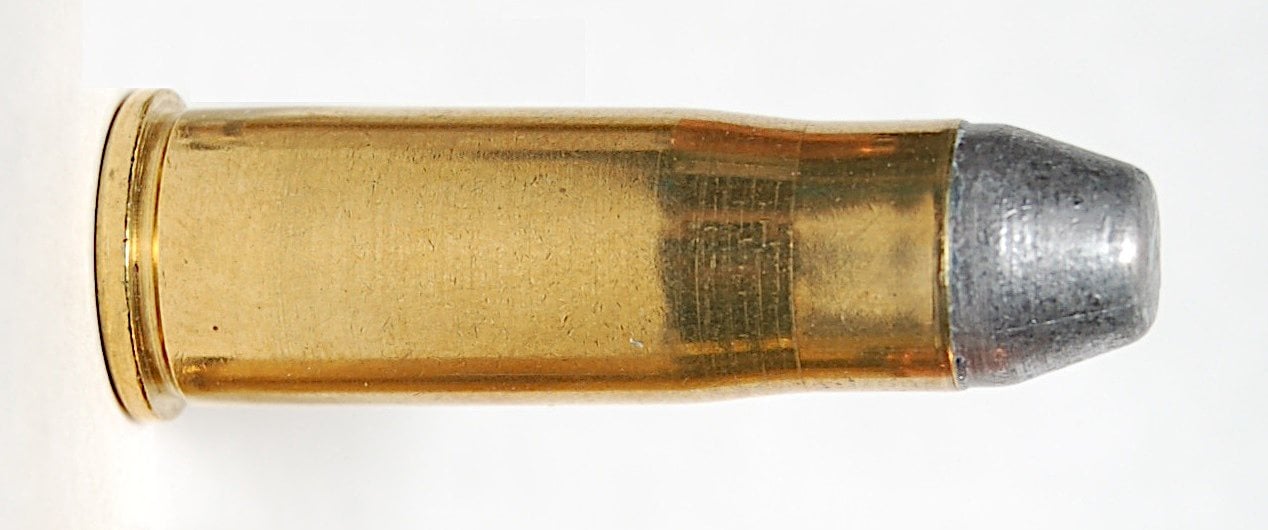
Every factory load we found uses a lead flat-nose bullet except Winchester’s, which has a jacketed soft point. Flat noses matter in a lever gun, because the rounds ride nose to primer in a tubular magazine.
Black powder fouls fast and draws moisture, so clean the gun the same day. Old .38-40 ammo of unknown age may be corrosive too, so give it the same treatment.
.38-40 Ballistics and What It’s Good For
From a rifle, the .38-40 moves a 180-grain bullet at 1,150 fps by SAAMI’s reference load, about 1,160 fps from Winchester’s Super-X. The cowboy loads are listed at 480 to 930 fps, and the makers that state a barrel used 5.5 and 7.5-inch revolver barrels. Buffalo Bore’s full-power load reaches about 1,000 fps from 5.5 inches.
Campbell called it “a fine cartridge for self-defense and smaller game” and added, “It’s not much of a deer gun, unless the range is very short.” Buffalo Bore rates its own load for deer to 100 yards from a rifle. That’s the maker’s claim, from a rifle, with its hottest load.
For most owners the .38-40 is a cowboy action and plinking round, and a good one. It’s pleasant to shoot in a heavy single action, and from a lever gun it’s a capable small-game round at short range.
.38-40 Guns You Can Buy Today
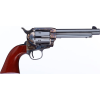
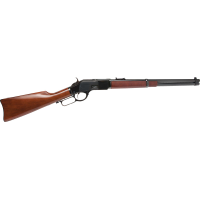
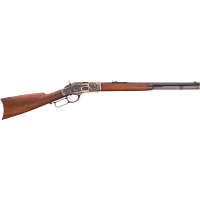
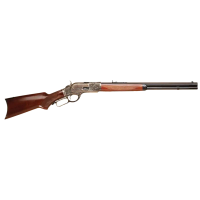
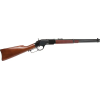
New .38-40 guns come from two importers. Cimarron sells the Model P single action in 38 WCF, which dealers list with 4.75, 5.5 and 7.5-inch barrels, plus the 1873 Short Rifle and Carbine and an 1866 Yellowboy. Taylor’s sells Uberti-built Cattleman and Bisley revolvers and a 1873 rifle in .38-40.
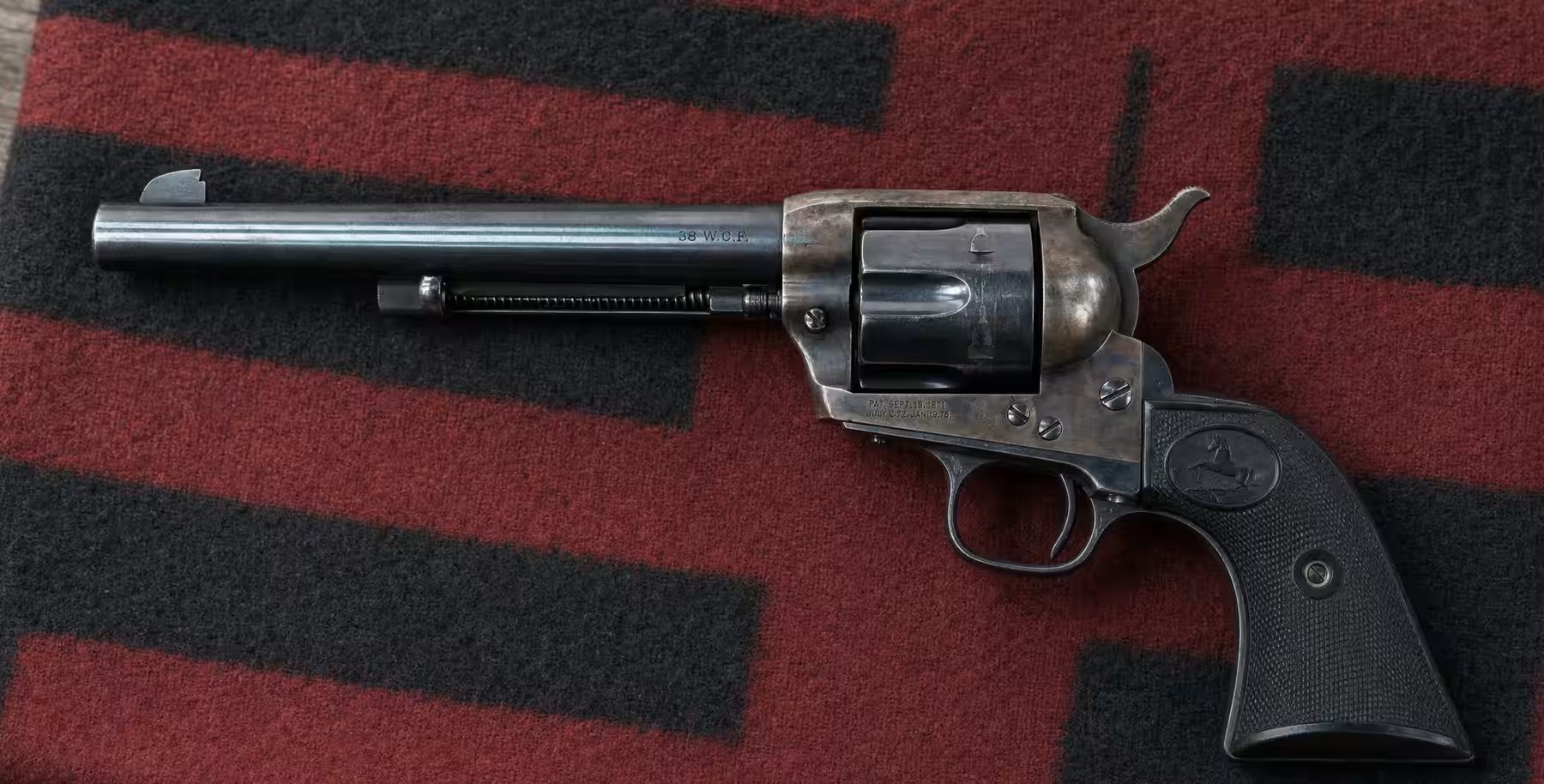
| Gun | What to know | Price at our dealers, Oct. 3 |
|---|---|---|
| Cimarron Model P | Single action in 38 WCF. Dealers list 4.75, 5.5 and 7.5 in. | From $556.03 new |
| Taylor’s Cattleman | Uberti single action, six shots | From $728.01 new |
| Cimarron 1873 Short Rifle and Carbine | 20 and 19 in. barrels | $1,261.17 at the card’s first dealer. One carbine listed at $1,188.45 |
| Taylor’s 1873 Rifle | 20 in. barrel, 10 rounds | Varies |
| Cimarron Bad Boy | Uberti-built 10mm with a .38-40 cylinder | Varies |
| Colt SAA, Winchester 1873 and 1892, Marlin 1889 and 1894 | Originals. Colt made about 50,000 Single Action Army and Bisley revolvers in .38-40 before 1941 | Used and collector prices |

Colt’s own Single Action Army came back in .38-40 in its third generation, starting in 1993. Our Colt Single Action Army guide covers the revolver, and our Winchester 1892 review covers the lever gun Winchester built after the 1873.
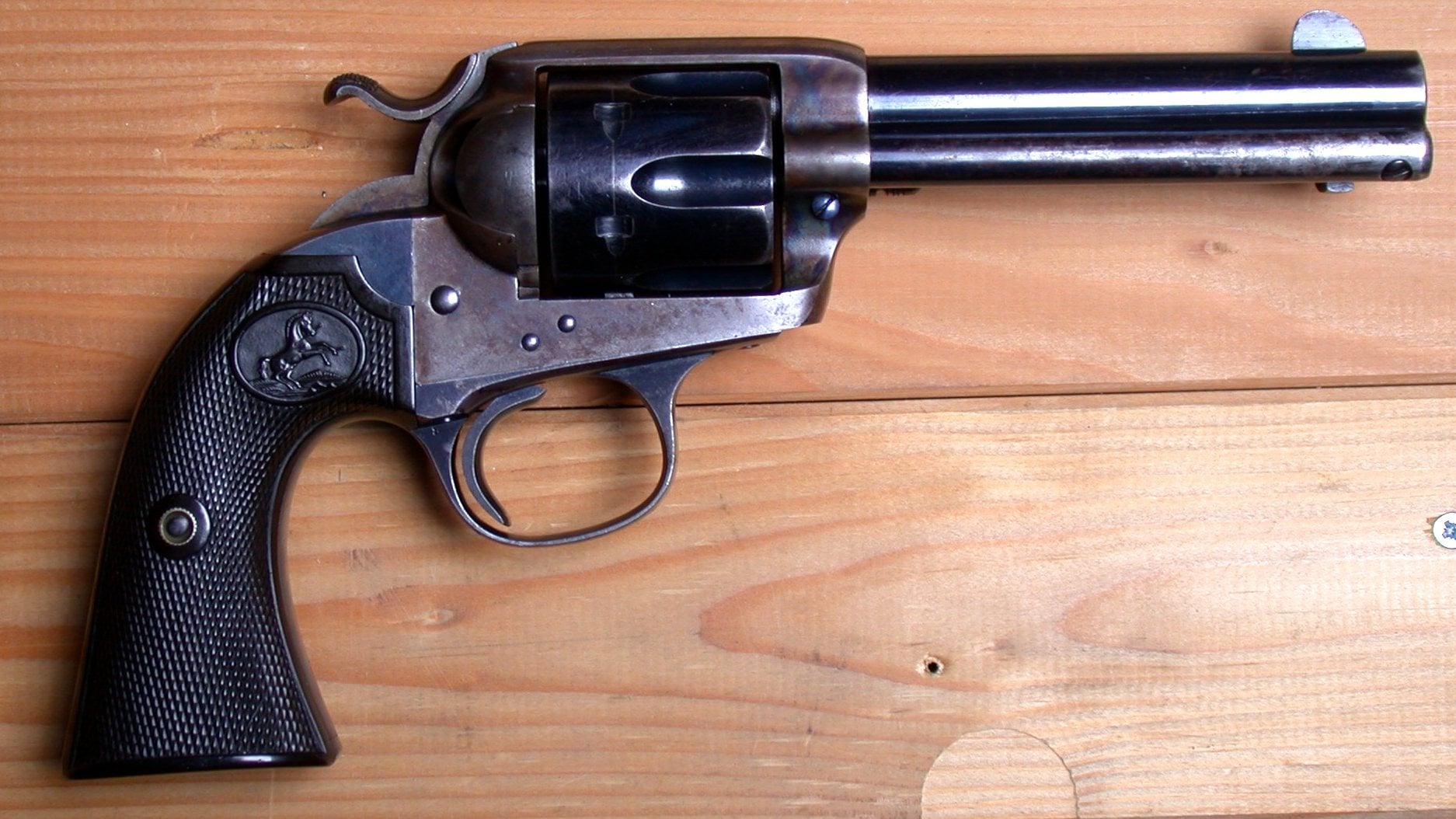
Original guns made in or before 1898 count as antiques under federal law. Our antique firearms guide explains what that means for buying one, and why an original still needs a gunsmith’s look before you shoot it.

.38-40 Myths vs. the Truth
The .38-40 has more confusion around it than almost any old round. Here’s each common claim, checked against SAAMI and the makers.
| The myth | The truth |
|---|---|
| “The .38 is the bullet size.” | The bullet is .400 to .401 in. Nothing on the cartridge measures .38 in. |
| “Any .40 will work in a .38-40.” | No. A 10mm or .40 S&W is a different case. Only a second cylinder lets one gun fire both. |
| “The .40 S&W is the .38-40 reborn.” | Same bullet, similar speed, far higher pressure, and a different case. |
| “It was introduced in 1874.” | Winchester historian George Madis dates it to 1879, and the Cody Firearms Museum’s records show the first Model 1873 shipped in 1880. |
| “The .38-40 has a psi pressure rating.” | SAAMI sets no psi figure for it. Its limit is 14,000 CUP by crusher, and CUP never converts to psi. |
| “38 Remington is a different round.” | SAAMI lists 38 Remington as another name for the same cartridge. |
| “You can’t find .38-40 ammo.” | Three brands were in stock at our dealers on October 3, from $1.00 a round. |
Our Range Notes: Three Loads in a Model P and a Model 1892
We shot the three loads our dealers had in stock through a Cimarron Model P with a 5.5-inch barrel and a used Miroku-made Winchester 1892 with a 24-inch barrel. That’s 360 rounds in all, fired in late September 2026, in ten-shot strings over a Garmin Xero C1 Pro chronograph.
| Load | Listed velocity | Model P, 5.5 in. | Model 1892, 24 in. | Model P group, 15 yd | 1892 group, 50 yd |
|---|---|---|---|---|---|
| HSM Cowboy Action 180 gr | 930 fps, barrel not stated | 884 fps | 1,087 fps | 2.6 in. | 2.9 in. |
| Black Hills Cowboy Action 180 gr | 850 fps, 5.5 in. | 841 fps | 1,019 fps | 2.4 in. | 2.7 in. |
| Buffalo Bore 180 gr hard cast | 1,000 fps revolver, 1,400 fps rifle | 1,012 fps | 1,388 fps | 3.1 in. | 3.3 in. |
Groups were the best of three five-shot groups from a rest. Black Hills came within 10 fps of its listed 850 from the same 5.5-inch barrel length, and Buffalo Bore landed close to its own revolver and rifle figures.
Both cowboy loads left soot on the case necks in the rifle. That’s the low pressure at work: the thin brass never quite seals the chamber. Nothing failed to feed or fire in either gun.
Buffalo Bore’s load was the only one that felt like more than a plinker in the Model P. We’d keep it out of any original Colt or Model 1873, as Buffalo Bore itself says.
A Short History of the .38-40
Most references date the .38-40 to 1874, but Winchester’s own records don’t support it. George Madis, author of The Winchester Book, dates its introduction in the Model 1873 to 1879, and the Cody Firearms Museum’s records show the first Model 1873 in .38-40 shipped in 1880. Venturino put it plainly in GUNS Magazine: “The proper date was 1879, not 1874 as sometimes written.”
Colt chambered the Single Action Army for it from 1884, by Venturino’s account, and by Campbell’s count it was the third most popular chambering of the first-generation guns. Colt also built the Bisley, the 1878 double action, the New Service and the Lightning rifle in .38-40. Marlin chambered its 1889 and 1894 rifles for it, and Remington added the Model 14 1/2 in 1913.
By 1937, Campbell writes, most of the interest in the cartridge had waned. Cowboy action shooting brought it back. Colt reintroduced it in its third-generation Single Action Army in 1993, and today’s new guns come from Cimarron and Taylor’s.
A Note on Reloading
Handloaders call the .38-40 fussy. The old cases had paper-thin mouths that crumpled in the dies, and bottleneck cases need lube before sizing. Starline’s brass fixed much of that, and lever guns want a firm crimp so bullets don’t get pushed back in the tubular magazine.
We don’t publish load data on this page. Use a current manual from a bullet or powder maker, and start with our beginner’s guide to reloading if you’re new to it.
Bottom Line: Which .38-40 Ammo to Buy
For most owners the .38-40 ammo to buy is a 50-round box of HSM or Black Hills cowboy loads, at $1.00 to $1.46 a round on October 3, 2026. Both are mild, lead flat-nose loads that are kind to old guns and accurate in new ones.
- For an original Colt or Model 1873: cowboy loads or black powder only, after a gunsmith checks the gun.
- For a Cimarron, Taylor’s or Uberti revolver: HSM or Black Hills for practice, Buffalo Bore if you want full power.
- For a Model 1892 or Marlin 1894 in good order: any standard factory load. Buffalo Bore reached 1,388 fps in our 1892.
- For a convertible with a 10mm cylinder: each round in its own cylinder, never swapped.
- For old High Velocity boxes: keep them as unfired collectibles.
We’ve done the same job for other old calibers: the 8mm Mauser ammo guide, the .30-40 Krag ammo guide, the .32-20 ammo guide, the .303 British ammo guide, the 7.62×25 Tokarev ammo guide, the .44-40 ammo guide, the .45 Colt ammo guide, the 9×18 Makarov ammo guide, the .32 H&R Magnum ammo guide, the .32 ACP ammo guide and the .25 ACP ammo guide.
Lead image: composite based on a photo of a Colt Bisley marked 38 W.C.F. and a photo of a .38-40 cartridge, both by Hmaag, CC BY-SA 3.0. The composite is shared under the same license.
.38-40 Ammo FAQ
Is a .38-40 a .38?
No. A .38-40 fires a bullet of .400 to .401 inch, and SAAMI allows up to .4005, so it's really a .40. Nobody knows for sure why Winchester called it a .38. The 40 refers to the original charge of black powder.
Is 38 WCF the same as 38-40?
Yes. .38 WCF, for Winchester Center Fire, is Winchester's own name for the .38-40. SAAMI also accepts 38 Marlin, 38 Winchester and 38 Remington as names for the same cartridge, and Colt stamped its barrels 38 W.C.F.
Is 38-40 the same as 38 Special?
No. The .38 Special is a separate revolver cartridge with a smaller bullet and its own SAAMI listing. Never fire one in a .38-40 gun, or the reverse.
What is 38-40 good for?
Cowboy action shooting, plinking and small game at short range. American Rifleman called it a fine cartridge for self-defense and smaller game, but not much of a deer gun unless the range is very short.
How powerful is the .38-40?
Winchester lists its Super-X load at 1,160 fps and 538 foot-pounds, with no barrel stated. SAAMI's reference load is a 180-grain bullet at 1,150 fps from a 24-inch rifle barrel, and the cowboy loads are listed at 480 to 930 fps.
Who makes 38-40 ammo?
Our dealers had HSM, Black Hills and Buffalo Bore on October 3, 2026. Winchester still lists its Super-X X3840, Ultramax loads a cowboy round sold through Buffalo Arms, Choice Ammunition loads it by hand, and Starline makes the brass.
Can I shoot 10mm or .40 S&W in a .38-40?
No. They share the .4005-inch bullet, but the 10mm and .40 S&W are short rimless cases and run at far higher pressure. Only a revolver with a second cylinder, such as Cimarron's 10mm Bad Boy with its extra .38-40 cylinder, can fire both, each in its own cylinder.
Is 38-40 more powerful than 44-40?
No. Winchester's own figures put the .44-40 at 629 foot-pounds and the .38-40 at 538, with no barrel stated for either. The .38-40 runs at a slightly higher SAAMI limit, 14,000 CUP against 13,000.
5,492+ Gun & Ammo Deals
Updated daily from 200+ top retailers. Filter by category, caliber, action type, and price.
Related Guides