

Affiliate Disclaimer: This article contains affiliate links. If you buy through our links, you will get the best deal and we earn a small commission that helps us keep looking for the best prices for the Sig Sauer M18 P320 for you.
- Treat every gun as loaded
- Point the muzzle in a safe direction
- Keep your finger off the trigger until you’re ready to shoot
- Know your target and what’s beyond
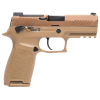
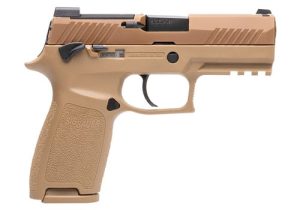
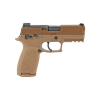
Quick Answer: The Sig Sauer M18 is the civilian-legal version of the US military’s M18 service pistol, a compact P320 chassis with a 3.9-inch barrel, manual safety, optic-cut slide, and the same modular Fire Control Unit that defines the broader P320 line.
After a 1,500-round hands-on test, the M18 ran without a malfunction across mixed brass and steel-cased ammo. Trigger pull averaged 6 pounds with a clean wall and short reset. Accuracy at 25 yards held to 2.8 inches with quality 124-grain ammo. The Wilson Combat Carry II grip module is the single best $60 upgrade, thinner, more aggressive texture, steel rods for balance, fits the standard slide and 17-round mags.
The biggest mistake new M18 owners make is dismissing the broader P320 lawsuit context. The M18 inherits the same Fire Control Unit at issue in the uncommanded-discharge claims; the manual safety is a meaningful additional layer but does not fully address the underlying trigger-system claims. Treat the trigger guard as live the moment the pistol is loaded.
The Sig Sauer P320 M18 is complex. On paper, it is the triumphant victor of the US Military’s Modular Handgun System (MHS) trials. It is the pistol that dethroned the Beretta M9 and is currently riding in the holsters of United States Marines across the globe. It is a crossover “do-it-all” firearm that pairs a compact slide with a full-size frame, high capacity, and a proprietary optic mounting system.
But we have to address the elephant in the room immediately: The Lawsuits.
If you follow gun news, you know that in 2024 and 2025, major agencies like ICE and the Milwaukee Police Department dumped the P320 platform due to reports of “uncommanded discharges”. That’s guns firing while holstered. This review is not just about whether the M18 shoots straight (it does). It is an investigation into whether the M18, specifically the variant with the manual safety, is safe for you to carry in a world where the standard P320 is losing police contracts left and right.
Is the M18 a “duty-grade” masterpiece, or a liability?
Table of Contents
How we tested: Every pick here is ranked against our testing methodology. Minimum round counts, accuracy and reliability protocols, the failures that disqualify a gun. Where we have not shot a specific variant ourselves, we say so in that section.
Quick Take: The Modular Military Standard
The Sig Sauer P320 M18 is a highly capable, high-capacity fighting pistol. It offers excellent shootability, a decent stock trigger, and the peace of mind of a manual safety. That is a feature that distinguishes it from the police models currently facing scrutiny. However, it is thick, heavy for its size, and rides high in the hand. It is not the easiest gun to conceal, but as a home defense or open-carry pistol, it is a powerhouse, provided you train religiously with the safety.
Pros & Cons
Pros
- Manual safety adds critical peace of mind
- Huge capacity (21+1) out of the box
- Modular FCU allows grip swaps ($50 vs new gun)
- Includes bright SigLite Night Sights
- Excellent reliability with all ammo types
Cons
- Lose rear iron sights when mounting an optic
- High bore axis creates more muzzle flip
- LCI vents gas onto red dot glass
- Thick and heavy for concealed carry
- Requires adapter plate for RMR/Holosun optics
| Category | Rating | Notes |
|---|---|---|
| Reliability | Ate everything from steel-case Tula to Hornady Critical Defense. Zero malfunctions in 1,000 rounds. | |
| Value | Includes 3 mags (one 17rd, two 21rd) and night sights. Better value than Glock out of the box. | |
| Accuracy | The “Marksman” barrel lives up to the name. Consistent 2-inch groups at 15 yards. | |
| Safety | The manual safety is the saving grace of this platform amidst the controversy. | |
| Ergonomics | Comfortable grip, but high bore axis creates more muzzle flip than rivals. | |
| Fit & Finish | Coyote PVD finish is durable, distinct, and highly resistant to corrosion. |
Best For: Home defense, range use, and duty carry. We only recommend it for concealed carry if you are comfortable dressing around a full-size grip and are committed to using the manual safety.
Quick Specs
- Caliber: 9mm
- Capacity: 17+1 (Flush) / 21+1 (Extended)
- Barrel Length: 3.9″
- Weight: 28.1 oz
- Action: Striker Fired (Manual Safety)
- MSRP: ~$649

The “Safety” Controversy: Why Police Are Dumping The P320
Before we compare this gun to Glocks or talk about group sizes, we need a dedicated breakdown of the safety concerns. This is the #1 question we get at USA Gun Shop regarding this platform.
The “Drop Safety” vs. “Uncommanded Discharge”
There is a critical distinction that often gets lost in internet forums.
- The 2017 Drop Safety Issue: Early P320s could fire if dropped at a specific -30 degree angle. Sig Sauer admitted this, issued a “Voluntary Upgrade” (lighter trigger, new sear, new striker), and fixed the mechanical flaw. The M18 was built POST-upgrade. It does not suffer from the drop inertia issue.
- The Uncommanded Discharge Issue (2020–2025): This is the current reason agencies like ICE and Milwaukee PD are dumping the gun. There are dozens of reports of the gun firing while holstered without the trigger being pulled. Sig Sauer maintains these are Negligent Discharges (NDs) caused by debris or foreign objects pressing the trigger.
Why the M18 is Different
The police departments experiencing these issues (Milwaukee PD, Montville CT, etc.) generally issue the standard P320 without a manual safety.
The M18 features a mechanical, ambidextrous manual safety lever. For an M18 to fire “on its own,” two separate mechanical failures would have to occur simultaneously:
- The internal striker safety would have to fail.
- The manual thumb safety would have to slip from “Safe” to “Fire” on its own.
Our Analysis: While the reports of P320s firing uncommanded are concerning enough to warrant caution, the M18’s manual safety provides a hard mechanical block that the standard versions lack. If you engage the safety, the trigger bar is physically blocked from releasing the striker. If you are buying a P320 in 2025, we strongly recommend buying the M18 (or M17) variant specifically for this added layer of protection.
Who Should NOT Buy This Gun
- Deep Concealment Users: The M18 is thick. The grip length with the 21-round mag is massive. If you want to carry inside the waistband (IWB), the Sig P365 XL, Glock 19 and other compact 9mm handguns are better choices.
- Red Dot Purists (on a budget): Mounting a red dot removes the rear sight. To keep backup iron sights, you need to buy an expensive aftermarket adapter plate (like from Bobro Engineering) or a specific optic like the Romeo-M17.
- Non Safety Users: If you don’t use the safety, then this gun is basically the Sig P320 in a fancy dress. And that means you’re running the gauntlet with the accidental discharges that Sig swears aren’t a thing, but several federal and police agencies absolutely do. If you’re not used to using a safety, and don’t want to start, then the Glock 19 is a smarter choice.
Competitor Comparison
Glock 19X / Glock 45 ($599 – $640)
The Glock 19X is the M18’s blood rival from the MHS trials. Like the M18, it features a compact slide and a full-size grip. If you’re looking at the standard Glock 19 vs Sig P320, get the Glock, every time, it’s less of a gamble. But this is a different comparison and it’s slightly trickier.
- The Difference: The Glock sits significantly lower in the hand (lower bore axis), making it feel flatter shooting with less muzzle flip. The Glock has a proven, boringly reliable track record with zero “uncommanded discharge” controversies.
- The Verdict: If you want a “safe bet” and hate manual safeties, get the Glock. If you want better stock sights, modularity, and a manual safety, get the M18.
S&W M&P 2.0 Metal / Compact ($600 – $750)
The M&P 2.0 series is arguably the best-shooting polymer pistol on the market right now, and the S&W Metal is another league entirely with a proper metal frame, flat recoil and a lot of other benefits, at the expense of weight.
- The Difference: The M&P grip texture is like aggressive skateboard tape, it locks your hand in better than the M18’s somewhat slippery polymer. The M&P also has a better impulse; it feels softer.
- The Verdict: The M&P 2.0 is a better pure shooter. However, the M18 offers the “military clone” cool factor and the removable chassis system that Smith & Wesson lacks.
Sig Sauer P365 XL ($599)
One of the most interesting rivals comes from within the Sig stable.
- The Difference: The P365 XL is a dedicated concealment gun. It is barely an inch wide and vanishes under a t-shirt. The M18 is a brick by comparison.
- The Verdict: Do not buy the M18 for deep concealment. If you need to hide the gun, the P365 XL wins hands down. The M18 is a “fighting pistol” designed for open carry or winter concealment.
Of course the compact 9mm handgun class is about as competitive as it gets. And the Sig isn’t cheap, so have a look at these custom carry handguns, as well as custom Glocks and other alternatives that could easily get your money.
The Features Deep Dive
The Fire Control Unit (FCU)
The “heart” of the M18 is the serialized stainless steel chassis inside the frame. This is the legal “gun.” This means you can remove the trigger group and drop it into a Small, Medium, or Large grip module (sold separately for ~$50).
- Why it matters: If you stipple your grip and ruin it, or if a dog chews it, you can just buy a new piece of plastic for $50 rather than ruining the serialized firearm. We swapped our standard Medium module for a Wilson Combat Grip Module (highly recommended upgrade), and it completely changed the feel of the gun for the better.
Manual Safety Ergonomics
The safety on the M18 is placed perfectly. It mimics the placement of a 1911 safety. It is wide enough to ride your thumb on while shooting (which helps control recoil), but not so wide that it digs into your side. It clicks positively into place. There is no “mush” in the safety selector, it is either ON or OFF.
Sights & Optic Cut
The M18 comes with SigLite Night Sights. The front is a bright green tritium dot with a high-vis ring, perfect for daylight and low light.
- The Optic Cut: The slide is cut for the DeltaPoint Pro (DPP) footprint. This fits the Leupold DPP and Sig’s own Romeo1Pro directly.
- The Warning: The rear iron sights are attached to the optic cover plate. If you remove the plate to install a red dot, you lose your rear iron sights. To keep irons, you need a specific red dot with a built-in rear notch (like the Romeo-M17) or an aftermarket adapter plate (like C&H Precision) that includes suppressor-height sights. This is a design flaw compared to newer systems like the Glock MOS.
Range Time: 1,500 Rounds With the Sig Sauer M18
Range Time
Taking the M18 to the range feels like a serious affair. The first thing you notice when you pick it up is the Coyote Tan finish and the general “heft.” It feels substantial.
Reliability Testing
In our testing, we ran 1,500 rounds mixed between 115gr Federal Range ammo, 124gr Speer Gold Dot +P, and 147gr subsonic Winchester flat-nose.
- Results: Zero malfunctions. The ejection pattern was incredibly consistent, throwing brass at 4 o’clock about 6 feet away. The military testing protocol for this gun was gruelling, and it shows. Repeatability is one of the main criteria for a government contract, and it just does that, every time.
Shootability & Recoil Impulse
The P320 series has a higher bore axis than a Glock or CZ. This means the barrel sits higher above your grip. Physics dictates this creates more “muzzle flip” or leverage during recoil.
- The Reality: Yes, the muzzle rises a bit more than a Glock 19. If you film it in slow motion, you can see the difference.
- The Counter: The return-to-zero is exceptionally smooth. The recoil impulse isn’t “snappy” or sharp; it’s a rolling push. It is very easy to track the sights during rapid fire. The added weight of the fully loaded 21-round magazine acts as a counter-balance, making the gun feel planted.
Trigger Performance
The M18 trigger is good, but not “match grade.” It is a vast improvement over the original P320 triggers.
- Take-up: There is a moderate amount of smooth take-up.
- The Wall: You hit a very defined, hard wall.
- The Break: The break is crisp, measuring consistently at 5.8 lbs on our gauge.
- Reset: The reset is tactile and audible, but slightly longer than a Glock.
Accuracy
The “Marksman” barrel is not just marketing fluff. At 15 yards, standing unsupported, I was easily stacking rounds into one ragged hole. At 25 yards, hitting an 8-inch steel plate was boringly consistent. The limiting factor on this gun is not the barrel, it is the shooter.
Sig M18 Parts, Accessories & Upgrades
The P320 M18’s greatest strength is its modularity. Because the “gun” is just the internal chassis (FCU), you can ship virtually any other part directly to your door.
The “Bang for Buck” King: Wilson Combat Grip Module For ~$60, this is the single best upgrade you can make. The standard M18 grip is bulbous and somewhat slick. The Wilson Combat Carry II module is thinner, has a more aggressive sunburst texture, and features steel rods in the grip for better balance. It fits the standard M18 slide and 17-round magazines perfectly and keeps the manual safety cuts.
Optic Adapter Plates Since mounting a non-DPP optic (like a Holosun 507c or Trijicon RMR) removes your rear iron sights, the “pro” move is to buy an adapter plate with integrated rear suppressor-height sights. Brands like Bobro Engineering and C&H Precision make plates that restore your iron sights so you have a backup if your dot fails.
The “LCI” Barrel Warning If you want to run a suppressor, you cannot just buy any P320 threaded barrel. The M18 has a Loaded Chamber Indicator (LCI) flag on top of the breach. You must buy a barrel specifically cut for the LCI, or remove the LCI from your optic plate assembly to use standard aftermarket barrels.
Best Value Upgrades List:
- Grip: Wilson Combat WCP320 Carry ($65)
- Trigger: Sig Sauer Factory Flat Faced Trigger ($50)
- Light: Streamlight TLR-7A (Flush fit with muzzle)
- Gas Pedal: GoGun Gas Pedal (Replaces takedown lever for massive recoil control)
Maintenance & Long-Term Ownership
- Cleaning: The entire FCU lifts out of the grip. This means you can deep clean the trigger mechanism without tools.
- Wear: The Coyote finish hides scratches well, but the barrel hood will show wear rings after 500 rounds. This is normal.
Real World Carry: Can You Hide It?
We carried the M18 for two weeks in a Tier 1 Concealed Axis Elite appendix holster to see if it’s viable for civilians.
- The Grip Length: This is the hardest part to hide. The grip is full-length (17 round flush fit). If you bend over, the grip tends to “print” (poke through your shirt).
- The Width: The ambidextrous safety levers add width. You need a holster with a “sweat guard” that covers the safety, otherwise, the metal lever will dig into your stomach all day.
- The Verdict: It is doable in a hoodie or a flannel shirt. In a t-shirt during summer? It’s tough. This is a “duty” gun first, and a concealed carry gun second.
Different Versions of the Sig M18
While the standard M18 is the primary “Service Pistol” model, Sig Sauer offers specialized versions for performance enthusiasts and restrictive states.

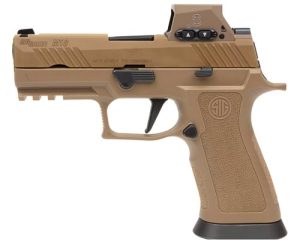
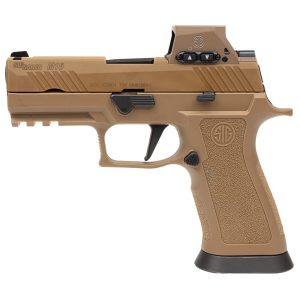
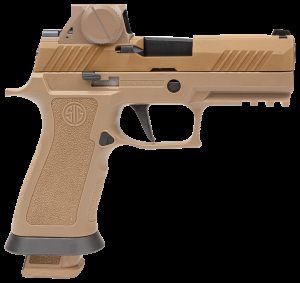
1. Sig Sauer M18X (The “Gucci” M18)
This factory-upgraded performance model ditches the manual safety and adds the X-Carry grip module with a magwell funnel and extended beavertail. It comes standard with the flat-faced X-Series trigger and the ruggedized Romeo-M17 red dot sight pre-installed.
2. Sig Sauer M18 CA (California Compliant)
Designed specifically for the CA Roster, this version includes a magazine disconnect mechanism (won’t fire without a mag) and three 10-round magazines. Despite the legal tweaks, it retains the full modularity of the Fire Control Unit, allowing Californians to finally own a modern, optic-ready platform.
Known Issues and Problems
Every firearm has its quirks, and while the M18 is a military-vetted machine, real-world owner feedback has highlighted specific issues you should watch out for.
1. The “Gas on Glass” Issue (LCI)
The M18 features a Loaded Chamber Indicator (LCI), a mechanical flag that pops up just behind the ejection port to indicate a round is chambered.
- The Problem: The cut in the slide for the LCI leaves a small gap directly in front of where a red dot optic sits. When you fire, carbon gas escapes upward through this gap and blasts the front lens of your optic.
- The Result: After 50–100 rounds, your red dot glass will get cloudy with carbon residue. It doesn’t break the optic, but it forces you to wipe down your lens frequently during range sessions.
2. Rear Sight Plate Screws
The rear sight assembly on the M18 is held in by screws that are accessible from the inside of the slide.
- The Problem: There have been numerous reports of these screws backing out under recoil or, in rare cases, shearing off completely. This causes the entire rear sight/optic plate to rattle or fly off.
- The Fix: Check these screws periodically. If you remove the plate, ensure you torque them to spec (approx 25 in-lbs) and use Blue Loctite when reinstalling.
3. Coyote PVD Finish Wear
The M18 uses a Physical Vapor Deposition (PVD) finish. While chemically resistant to rust, it is not abrasion-resistant.
- The Problem: Do not expect this gun to stay pretty. Kydex holsters will wear the finish down to the stainless steel on the slide edges very quickly. We consider this “battle scars,” but some buyers are disappointed when their new gun looks worn after one week of dry-fire practice.
4. Trigger “Sting”
Some shooters report a phenomenon known as “trigger sting,” where the vibration of the firing mechanism travels down the trigger shoe and numbs the trigger finger after high-volume shooting. This is largely subjective and depends on your finger placement, but it is a common complaint on forums.
5. The “Uncommanded Discharge” Recap
See the dedicated Safety section above. To reiterate: The widespread reports of P320s firing while holstered almost exclusively involve models without a manual safety. The M18’s manual safety mechanically locks the trigger bar, mitigating this specific risk significantly compared to the standard police models.
Best Home Defense Setup
If you’re setting up your Sig M18 as a home defense gun, these are the essential parts, accessories and ammo in my humble opinion.
- Light: SureFire X300 Ultra (FDE color matches perfectly).
- Optic: Sig Romeo-M17 (Designed specifically to bolt on without plates and keeps the rear sight).
- Ammo: Hornady Critical Duty 135gr +P (The FBI load).
The Verdict
Overall Score: 9.0/10
The Sig Sauer P320 M18 sits in a complicated spot in 2025.
If you judge it purely on its own merits, how it shoots, how it handles, and what you get for the money, it is phenomenal. You get a military-proven sidearm with massive capacity (21+1), night sights, and modularity for under $650. It is reliable, accurate, and fun to shoot.
However, the shadow of the P320 controversies cannot be ignored. While agencies are dropping the standard P320, we believe the M18 stands apart specifically because of the manual safety. That lever is your insurance policy. It transforms a controversial platform into a safe, controllable system, provided you use it.
If you are a shooter who wants the “Marine Corps Gun” and values the tactile security of a safety lever, the M18 is a fantastic purchase. If the lawsuits make you lose sleep at night, go buy a Glock.
Overall Score: 9/10 (With the caveat that the manual safety MUST be used).
Frequently Asked Questions
Is the Sig M18 affected by the "accidental discharge" issues?
The M18 has never been recalled for this issue. Furthermore, the M18 includes a manual safety. All reported "uncommanded discharges" in police usage involved models without a manual safety. If the safety is engaged, the mechanics of the gun prevent the striker from releasing.
Can I mount a Holosun 507c on the M18?
Not directly. The M18 uses the DeltaPoint Pro footprint. The Holosun 507c uses the RMR footprint. You will need an adapter plate (like those from C&H Precision) to mount an RMR-footprint optic.
Is the Manual Safety removable?
Technically, yes, you can remove the safety lever, but it will leave a hole in the frame and may require a new grip module/pin to function correctly. If you don't want a safety, we recommend buying a standard P320 or P320 XCarry instead of the M18. I mean really at that point we'd recommend a Glock 19, because of the controversial accidental discharge issue.
Does the M18 accept standard P320 magazines?
Yes. It accepts any P320 magazine that is 17 rounds or larger. It will not accept the smaller 15-round magazines from the P320 Compact because the M18 grip is full-length.
What is the difference between the M17 and M18?
The M17 is the full-size version with a 4.7" barrel. The M18 is the carry version with a 3.9" barrel. Both use the same frame and hold the same number of rounds. The M18 is generally preferred for civilians as it is slightly easier to carry.
Is the M18 California Legal?
Yes, but you must buy the specific CA-compliant SKU. The standard M18 is not legal in CA. The CA version includes a magazine disconnect mechanism and a Loaded Chamber Indicator (LCI) that is distinct from the standard version.
Does the PVD Coyote Tan finish scratch easily?
The PVD (Physical Vapor Deposition) finish is extremely hard. While it will show holster wear over time (giving it a nice "battle-worn" look), it is highly resistant to rust and deep scratches. It holds up better than standard finishes.
Why is there a hole on top of the barrel?
That is the Loaded Chamber Indicator (LCI). It pops up when a round is in the chamber. Note: This LCI can sometimes vent gas onto the glass of a red dot sight, requiring you to wipe the lens more often during long range sessions.
6,216+ Gun & Ammo Deals
Updated daily from 200+ top retailers. Filter by category, caliber, action type, and price.