

Last updated August 26th 2026 · By Nick Hall, AR-15 builder who has tuned buffer weights across multiple gas systems
This post contains affiliate links. If you click and buy, I may earn a small commission at no extra cost to you. Full disclosure.
- Treat every gun as loaded
- Point the muzzle in a safe direction
- Keep your finger off the trigger until you’re ready to shoot
- Know your target and what’s beyond
Table of Contents
Buffer is one of those AR-15 parts that most people never think about until something goes wrong. Your rifle short-strokes and won’t lock back on empty. Or it beats itself to death with excessive bolt velocity. Both problems trace back to buffer weight, and fixing them costs about $15.
I’ve tuned more buffers than I can count across carbines, pistols, and rifle-length setups. It’s one of the easiest and most impactful upgrades you can make. Here’s everything you need to know to pick the right one.
How we tested: Every pick here is ranked against our testing methodology. Minimum round counts, accuracy and reliability protocols, the failures that disqualify a gun. Where we have not shot a specific variant ourselves, we say so in that section.
What the Buffer Does
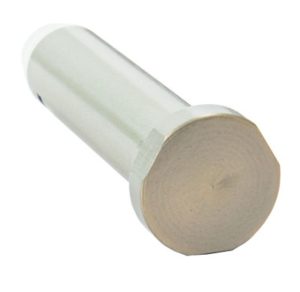
Buffer sits inside the buffer tube (receiver extension) behind the bolt carrier group. When you fire, gas pushes the BCG rearward. The buffer absorbs that energy and, with help from the buffer spring, sends the BCG forward again to strip a new round from the magazine and chamber it.
AR-15 remains the most popular rifle platform in America with over 24 million in civilian hands according to NSSF estimates.
Weight of the buffer determines how fast the BCG moves rearward and how much energy it takes to cycle. Heavier buffer means slower, softer cycling. Lighter buffer means faster, snappier cycling. Getting the right weight is about finding the balance between reliable cycling and smooth operation.
Buffer Weight Chart
Here’s the standard weight progression for carbine-length buffers. These are the most common type used in collapsible-stock AR-15s.
One naming note before you shop, because it trips people up. H and H1 are the same buffer. Both mean the 3.8 oz heavy buffer with one tungsten weight, and makers use the two labels interchangeably, so an “H1” listing is not an upgrade over an “H”. There is no standard H4, either, whatever a few charts online suggest. The designations that actually mean something are carbine, H/H1, H2 and H3.
| Buffer Type | Weight | Internal Weights | Best For |
|---|---|---|---|
| Carbine | 3.0 oz | 3 steel weights | Rifle-length gas, light loads |
| H / H1 (Heavy) | 3.8 oz | 1 tungsten + 2 steel | Standard carbine gas 16″ barrels |
| H2 | 4.6 oz | 2 tungsten + 1 steel | Mid-length gas, suppressed, 10.5-12.5″ |
| H3 | 5.4 oz | 3 tungsten | Over-gassed guns, suppressed SBRs |
| HSS (Heavy Stainless) | 6.5 oz | 3 stainless steel | Extremely over-gassed, .308/AR-10 |
Rifle-length buffers are longer and heavier (about 5.0-5.3 oz) and only work with fixed A2-style stocks and rifle-length buffer tubes. They are not interchangeable with carbine buffers. Don’t try to put a rifle buffer in a carbine tube. It won’t fit and could cause problems.
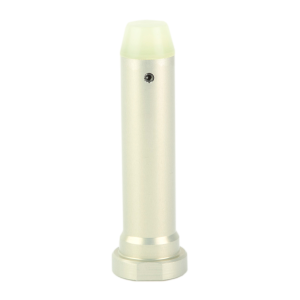
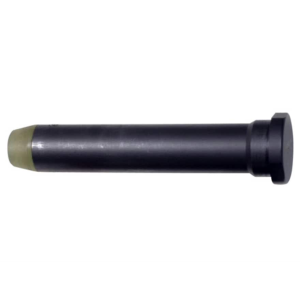
What Does an H2 Buffer Weigh?
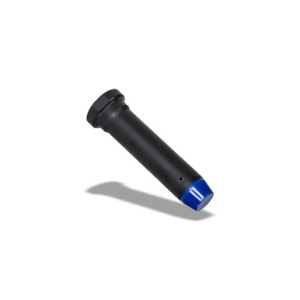
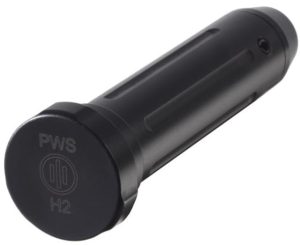
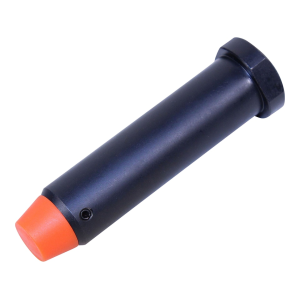
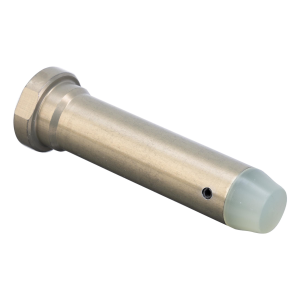
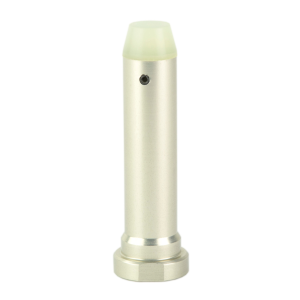
An H2 buffer weighs 4.6 oz. Some makers list 4.5 or 4.7 depending on how they finish the weights, and anything in that band is a genuine H2. Inside the tube it is two tungsten weights and one steel, against the carbine buffer’s three steel.
It is the most useful buffer on this page for most people. If you have a 16 inch carbine-gas rifle that runs hot, a 10.5 to 12.5 inch barrel, or a can on the end, the H2 is the one to try first. It is heavy enough to calm a violent carrier without being so heavy that the rifle stops locking back on the last round.
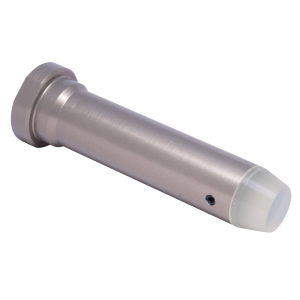
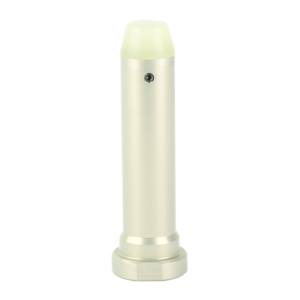
One thing to check before you buy. A lot of cheap buffers are sold as “similar weight to H2” rather than as an H2. When I ran the live prices for this update, the cheapest result on the H2 search was a $9.99 buffer listed at 4.9 oz, described as similar to an H2. It is a perfectly good heavy buffer and it is not an H2: it is 0.3 oz over spec, and it gets that weight from steel rather than tungsten, so the mass sits differently in the tube. If you are tuning a rifle by swapping one known quantity for another, buy the actual spec. If you just want it heavier, the cheap one will do that.
What Does an H3 Buffer Weigh?
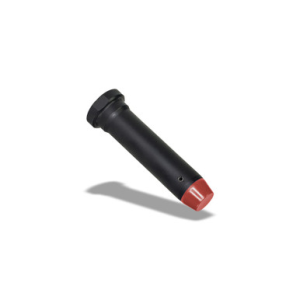
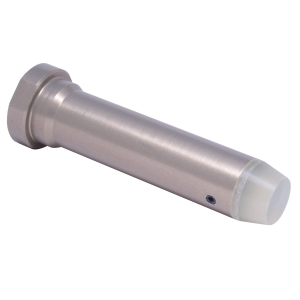
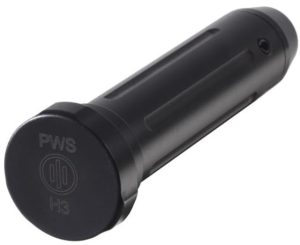
An H3 buffer weighs 5.4 oz, and some makers list theirs at 5.5. It is three tungsten weights, no steel, which is why it costs roughly a third more than an H2.
The H3 is a fix for a specific problem rather than a general upgrade. Reach for it when the rifle is genuinely over-gassed and the H2 was not enough: a short suppressed barrel, a pistol-gas build, or brass landing forward of three o’clock with an H2 already fitted. On a normally gassed 16 inch rifle an H3 is heavy enough to short-stroke the action, so do not fit one hoping it will smooth things out. Heavier is not better. Heavier is a correction.
A Word on the A5 System
Search for buffers and you will run into Vltor A5 parts sitting alongside the carbine ones. They are not interchangeable and the labels do not mean the same thing.
The A5 is a different buffer system built around a rifle-length receiver extension with a carbine-length spring, so an A5 buffer is physically longer than a carbine buffer and will not fit a carbine tube. The naming also overlaps confusingly: an A5-labelled “H2” is not a carbine H2. One in our own price data is listed at 5.3 oz, where a carbine H2 is 4.6. If your rifle has a standard collapsible stock on a carbine tube, everything on this page applies to you and the A5 parts do not.
How Buffer Weight Affects Cycling
Think of it this way: the gas system pushes the BCG back with a fixed amount of force (determined by barrel length, gas port size, gas system length, and ammo). The buffer is the resistance on the other end. More resistance (heavier buffer) means slower bolt carrier movement.
Slower bolt carrier movement means softer recoil impulse, less bolt bounce, less wear on the receiver extension, gentler extraction (better for brass), and quieter operation. It also means less margin for cycling with weak ammo or when the gun is dirty.
Goal is to run the heaviest buffer that still lets the gun cycle reliably with your chosen ammo in all conditions. You want the bolt to lock back on the last round consistently. If it doesn’t, your buffer is too heavy or your gas system is too restricted.
Matching Buffer to Gas System
Your gas system length determines how much gas hits the BCG, which directly affects what buffer weight you need. Shorter gas systems (pistol, carbine) send more gas at higher pressure, so they need heavier buffers. Longer gas systems (mid-length, rifle) are gentler and can run lighter buffers.
| Gas System | Barrel Length | Recommended Buffer |
|---|---|---|
| Pistol | 7.5″ – 10.3″ | H2 or H3 |
| Carbine | 10.5″ – 14.5″ | H or H2 |
| Carbine | 16″ | Carbine or H |
| Mid-Length | 14.5″ – 16″ | Carbine or H |
| Mid-Length | 18″ | Carbine |
| Rifle | 18″ – 20″ | Rifle buffer (different size) |
These are starting points, not absolutes. Your specific barrel’s gas port size, your ammo, and whether you run a suppressor all affect the ideal weight. Start with the recommendation and adjust based on function testing. For more on gas system pairing, see our gas system length guide.
Suppressed vs Unsuppressed
Running a suppressor increases backpressure significantly. That extra gas hitting the BCG means you need a heavier buffer to slow things down. If your unsuppressed gun runs perfectly with an H buffer, you’ll probably want an H2 when you add a can.
I run H2 buffers on almost all my suppressed carbines and it works great. Some really over-gassed setups (short barrel plus suppressor) need an H3. The signs of being over-gassed while suppressed include brass getting flung 20+ feet, primer cratering, and the charging handle smacking you in the face.
Better solution for dedicated suppressor use is an adjustable gas block. That lets you tune the gas at the source instead of trying to compensate with buffer weight. But if you’re swapping between suppressed and unsuppressed, buffer weight is the simpler adjustment.
Troubleshooting: Short-Stroking
Short-stroking means the BCG doesn’t travel far enough rearward to pick up the next round or lock the bolt back on empty. Symptoms include failure to feed, failure to lock back, and double feeds. The fix is a lighter buffer.
Before swapping buffers, check your gas system first. A clogged gas port, loose gas block, or gas tube leak can all cause short-stroking that no buffer change will fix. Also try different ammo. Steel-cased cheap stuff generates less gas than brass-cased NATO-spec loads.
If the gas system checks out, drop down one buffer weight. Running an H2 and short-stroking? Try an H. Still short-stroking? Go to a standard carbine buffer. If a carbine buffer still doesn’t fix it, the problem is your gas system, not your buffer.
Troubleshooting: Over-Gassing
Over-gassing is far more common than short-stroking, especially on factory AR-15s. Manufacturers drill gas ports slightly oversized to ensure reliability with the widest range of ammo. The result is a gun that runs but beats itself up in the process.
Signs of over-gassing: brass ejecting at 1-2 o’clock (should be 3-4 o’clock), excessive recoil, primer cratering, chewed-up brass, and excessive bolt carrier velocity that wears out the buffer tube and lower receiver. The easy fix is a heavier buffer. The better fix is an adjustable gas block.
I use the ejection pattern as my primary diagnostic. Brass at 4 o’clock is ideal. At 3 o’clock, you’re slightly over-gassed but fine. At 1-2 o’clock, you need a heavier buffer or gas adjustment. At 5-6 o’clock, you’re under-gassed and need a lighter buffer.
Adjustable Gas Blocks as an Alternative
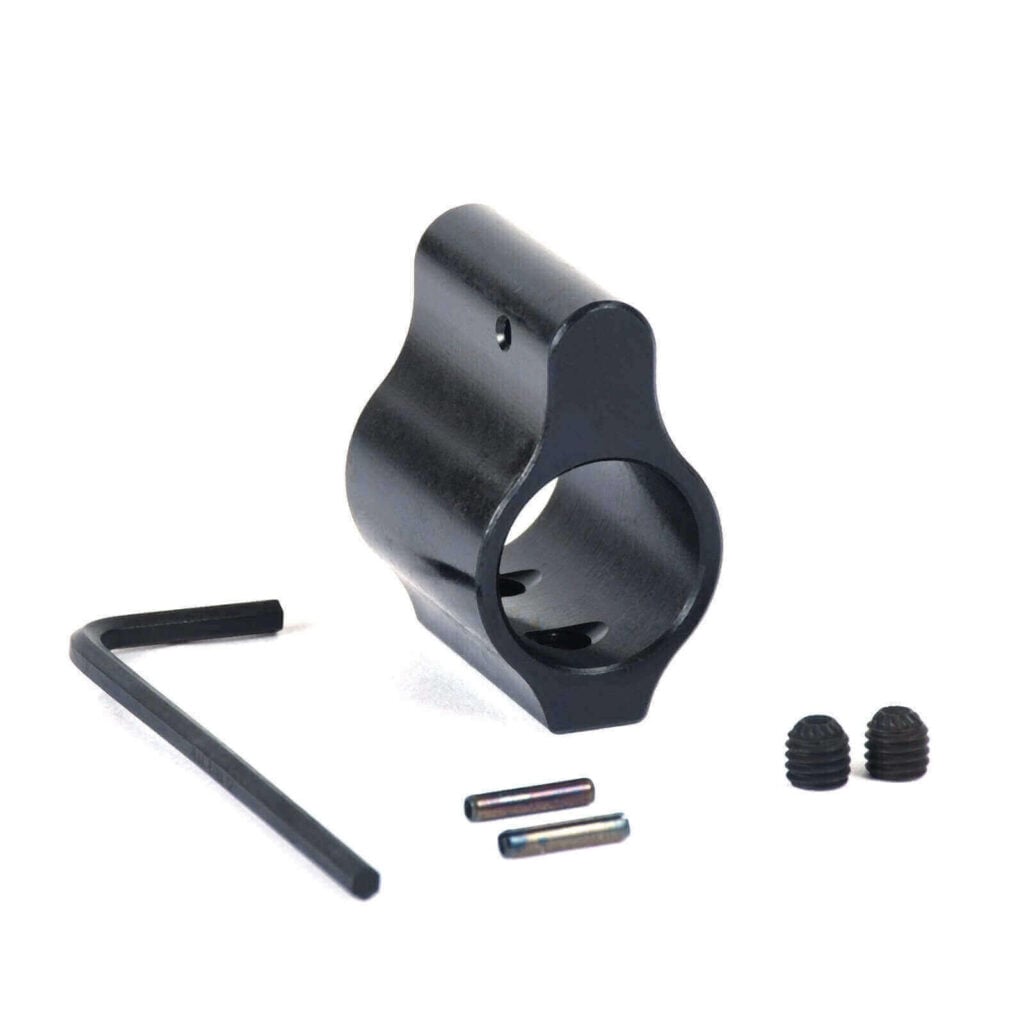
An adjustable gas block lets you control gas volume at the source. You can tune it for minimum reliable cycling, which gives you the softest recoil, least wear, and best brass condition. It’s a better long-term solution than stacking buffer weight.
Superlative Arms, SLR Rifleworks, and Wojtek Weaponry make excellent adjustable gas blocks. The Superlative bleed-off design is my favorite because it vents excess gas instead of restricting it, which keeps the gas system cleaner. Pair one with whatever buffer gives you reliable cycling on the lowest gas setting.
Downside of adjustable gas blocks is complexity and the possibility of the adjustment moving under recoil or heat. For a duty or home defense gun, I’d rather run a fixed gas block with the right buffer weight. For a range or competition gun, adjustable all the way. Our best AR-15 parts and accessories guide covers top gas block picks.
Buffer Spring Types
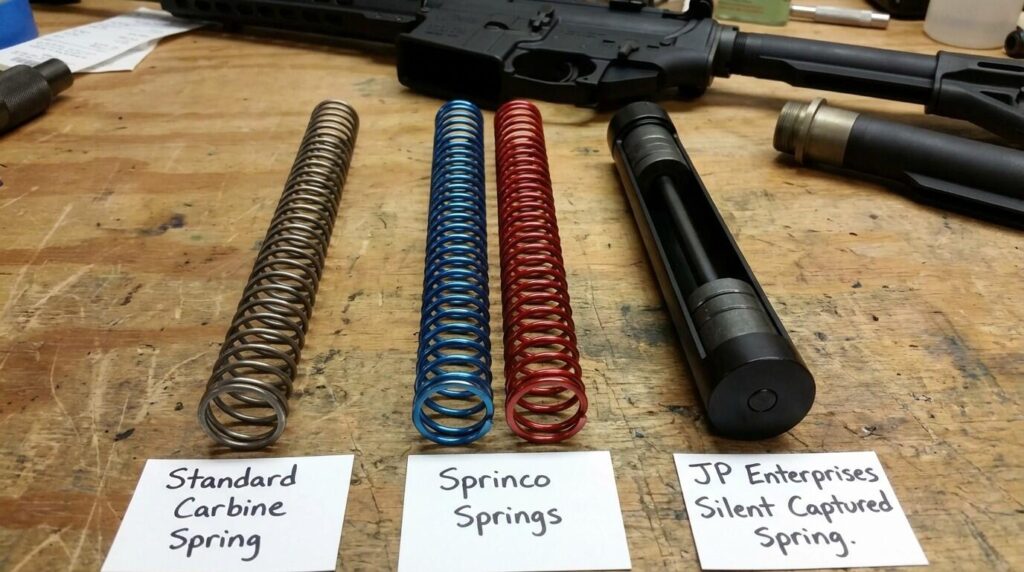
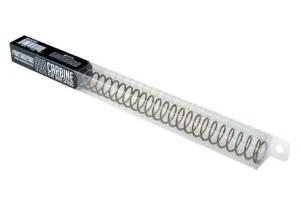
The buffer spring matters just as much as the buffer weight, and it’s the part most people forget about. A standard carbine spring works fine for most builds, but upgraded springs can make a noticeable difference in feel and consistency.
Standard Carbine Spring
The milspec spring that comes in every parts kit. It works. It’s cheap. It also makes that annoying “sproing” sound when you charge the rifle. Replace it when it gets weak (after 5,000-10,000 rounds or when it’s noticeably shorter than a new one).
Sprinco Springs
Sprinco makes color-coded springs in different weights: white (standard), blue (extra power), red (even more power), and green (rifle power in a carbine package). They’re chrome silicon wire, which lasts longer than standard music wire. I run Sprinco blues on most of my carbines and love them.
JP Enterprises Silent Captured Spring
This is the Cadillac of buffer/spring combos. It replaces both the buffer and spring with a single captured unit. No sproing sound, incredibly smooth cycling, adjustable weight with different internal configurations. It’s $100+ but worth every penny for a precision or competition build. I’ve been running one in my match rifle for three years and it’s still perfect.
Hydraulic and Specialty Buffers
Hydraulic buffers like the KynSHOT use fluid to dampen bolt carrier movement. They reduce felt recoil noticeably and eliminate bolt bounce. They’re popular in competition guns and suppressed builds where smooth cycling is a priority.
The Armaspec Stealth Recoil Spring is another captured system that uses a dual spring design. It’s more affordable than the JP SCS and does a good job eliminating the sproing sound. It’s a solid mid-price option.
For most shooters, a standard buffer in the right weight plus a Sprinco spring is all you need. The fancy captured systems are nice-to-haves that make a good gun feel great, but they’re not necessary for reliable function. Build your AR-15 with the basics first and upgrade later.
Buffer Weight for Specific Calibers
Different calibers on the AR-15 platform have different buffer requirements. 300 Blackout subsonic loads need a lighter buffer to cycle. 6.5 Grendel and 6.8 SPC work best with standard carbine or H buffers. .22 LR conversions need the lightest buffer possible or a dedicated lightweight BCG.
For 300 Blackout, especially if you’re running both supersonic and subsonic loads, an H buffer is a good compromise. Supers will cycle fine, and most subs will too (though some really quiet subsonic loads might need a carbine buffer). An adjustable gas block makes this much easier to tune.
For the standard 5.56/.223 AR-15, stick with the recommendations in the gas system chart above. If you’re exploring alternative calibers, our AR-15 caliber guide covers buffer considerations for each one.
Shop AR-15 Parts & Upgrades
Best-scored parts across 200+ retailers · Updated every 4 hours


Frequently Asked Questions
What buffer weight should I use for a 16 inch AR-15 with a mid-length gas system?
Start with a standard carbine buffer at 3.0 oz. If ejection is at 1-2 o clock, step up to an H buffer at 3.8 oz. A 16 inch mid-length is the most forgiving setup.
Can I use an H3 buffer in any AR-15?
You can install one in any carbine buffer tube, but it may be too heavy for your gas system to cycle reliably. H3 buffers are for short barrels and heavily suppressed setups, not general use.
How do I know if my buffer is too heavy?
If the bolt fails to lock back on an empty magazine consistently, or you get failures to feed, your buffer is probably too heavy. Try one weight class lighter.
How do I know if my buffer is too light?
Brass ejecting forward of 3 o clock, excessive felt recoil, bolt bounce causing double feeds, and primer cratering all suggest your buffer is too light.
Are rifle buffers and carbine buffers interchangeable?
No. Rifle buffers are longer and only fit in rifle-length buffer tubes with fixed stocks. Carbine buffers are shorter and only fit in carbine-length buffer tubes with collapsible stocks.
Does buffer weight affect accuracy?
Indirectly yes. A properly weighted buffer reduces felt recoil and bolt bounce, helping you stay on target for follow-up shots. For single-shot accuracy it is a minor factor.
How often should I replace my buffer spring?
Standard carbine springs should be inspected every 5,000 rounds and replaced around 10,000 rounds. Chrome silicon springs last significantly longer. Captured systems are essentially lifetime parts.
What buffer do I need for a suppressed AR-15?
One weight class heavier than unsuppressed. If you run an H buffer unsuppressed, try an H2 suppressed. An adjustable gas block is the best long-term solution.
4,617+ Gun & Ammo Deals
Updated daily from 200+ top retailers. Filter by category, caliber, action type, and price.
Related Guides