

Last updated October 2026
Some of the links below are affiliate links, meaning at no additional cost to you, we may earn a commission if you click through and make a purchase.
- Treat every gun as loaded
- Point the muzzle in a safe direction
- Keep your finger off the trigger until you’re ready to shoot
- Know your target and what’s beyond
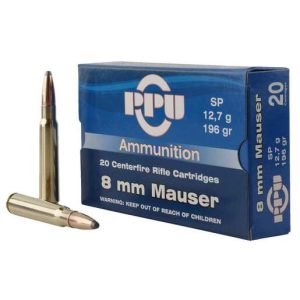
Yes, 8mm Mauser ammo is still made, and there’s more of it on dealer shelves than most people expect. Federal, Winchester, Hornady, Prvi Partizan, Sellier & Bellot, Norma, Nosler and Buffalo Bore all load it. On the day we checked, the dealers on our price cards had more than 60 different listings in stock, and a box of 20 new brass-cased rounds started at under $27.
The catch is that “8mm Mauser” on a box tells you less than you’d think. An American box and a European box can sit side by side on the same shelf and differ by more than 800 foot-pounds at the muzzle, because the US pressure limit for this cartridge is lower than the one for the .30-30.
Some old rifles should never see the hot one. Most are fine with it. And a few boxes that show up under the 8mm Mauser name won’t chamber in your rifle at all. This guide sorts out who makes what, what it costs per round, and which load belongs in which old rifle.
Quick answer
For a K98k, Yugo M48 or any other sound .323-bore Mauser, buy brass-cased 196 or 198-grain ammunition from Prvi Partizan or Sellier & Bellot. It’s the cheapest new ammo and it isn’t corrosive. For hunting, the European 196-grain soft points hit far harder than the American 170-grain load. For a Gewehr 88 or an old sporter of unknown bore, don’t shoot anything until a gunsmith has measured it.
- Price in October 2026: about $1.32 to $1.90 a round for new FMJ and soft points from PPU and Sellier & Bellot, $2.75 to $3.50 for Federal’s 170-grain load, $3.60 and up for Nosler
- Also sold as: 8×57 JS, 8×57 IS, 7.92x57mm Mauser
- Bullet: .323 in. Old “J-bore” rifles take a .318 in. bullet and are a different matter
- Not the same thing: 8×57 JRS and 8×57 JR are rimmed rounds for break-action guns and won’t work in a Mauser bolt rifle
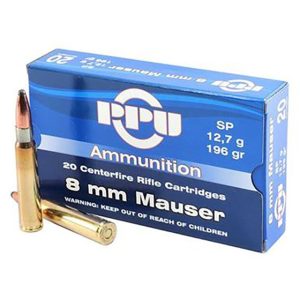

How we tested: Every pick here is ranked against our testing methodology. Minimum round counts, accuracy and reliability protocols, the failures that disqualify a gun.
8mm Mauser at a Glance
| Spec | 8mm Mauser (8×57 IS / JS) |
|---|---|
| Names on the box | 8mm Mauser or 8x57mm (Federal, Winchester); 8×57 JS (Hornady, Norma, Sellier & Bellot, Nosler); 8 x 57 IS (the official European name); 7.92x57mm (the military name) |
| Bullet diameter | .323 in. (the 1888 original used a .318 in. bullet) |
| Case | Rimless, bottleneck, 57 mm long |
| US pressure limit (SAAMI) | 35,000 psi |
| European pressure limit (C.I.P.) | 3,900 bar, about 56,500 psi |
| Common bullet weights | 170 gr (US loads); 196 to 198 gr (European and military-pattern loads) |
| Adopted | 1888 as the Patrone 88; the .323 in. S cartridge was designed in 1903 and in service by 1905 |
| Rifles | Gewehr 98, Karabiner 98k, Czech vz. 24, Yugoslav M24/47 and M48, Turkish and Persian Mausers, Hakim, FN-49, Gewehr 43 |
| Status | In production from at least eight makers |
8mm Mauser Ammo: The Good and the Bad
Pros
- Still made by eight or more makers
- New brass FMJ from about $1.32
- European loads run with the .30-06
- Mild US load is soft on the shoulder
- Plenty of rifles chambered for it
Cons
- US 170-grain loads are weak
- Costs more than .308 or .30-06
- Military surplus is corrosive
- Rimmed look-alikes sold beside it
- Unsafe in .318-bore rifles
Table of Contents
Who Still Makes 8mm Mauser Ammo in 2026
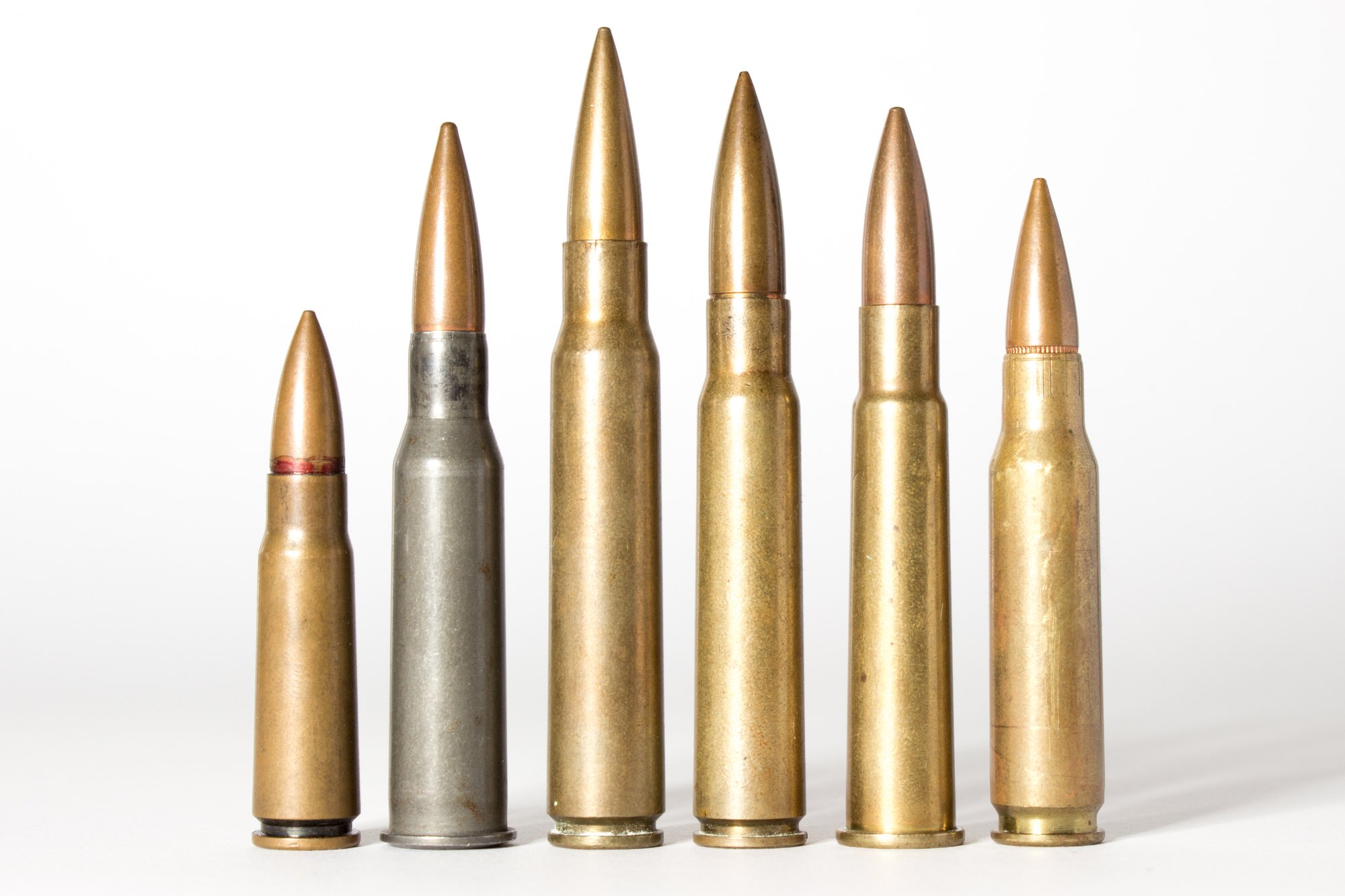
At least ten companies load 8mm Mauser ammo in 2026: Federal, Winchester, Hornady, Prvi Partizan, Sellier & Bellot, Norma, Nosler, Buffalo Bore, RWS and Lapua. Three of them sell it under the 8mm Mauser name and the rest call it 8×57 JS.
More companies than you’d guess. We went to each maker’s own product pages on October 1, 2026 and wrote down what they list. The velocity column is the maker’s own number. Where a European maker publishes meters per second, we’ve converted it, so treat those as close rather than exact.
| Maker and load | Bullet | Listed velocity | Listed energy | Power level |
|---|---|---|---|---|
| Federal Power-Shok (8A) | 170 gr soft point | 2,250 fps | 1,911 ft-lb | Mild US load |
| Winchester Power-Point (X8MM) | 170 gr Power-Point | Not shown on Winchester’s page | Not shown | Mild US load |
| Prvi Partizan “8 mm Mauser” line | 196 gr SP, 198 gr FMJ | About 2,180 fps | About 2,070 to 2,090 ft-lb | Mild |
| Prvi Partizan “8 x 57 IS” line | 196 gr SP, 198 gr FMJ | About 2,430 to 2,460 fps | About 2,590 to 2,635 ft-lb | Full power |
| Sellier & Bellot 8×57 JS | 196 gr FMJ | About 2,560 fps | About 2,850 ft-lb | Full power |
| Sellier & Bellot 8×57 JS | 196 gr SPCE soft point | About 2,590 fps | About 2,920 ft-lb | Full power |
| Norma Whitetail and Oryx | 196 gr soft point | 2,525 to 2,526 fps | 2,775 to 2,777 ft-lb | Full power |
| Norma Tipstrike | 180 gr tipped | 2,625 fps | 2,753 ft-lb | Full power |
| Hornady Vintage Match | 196 gr BTHP | 2,500 fps (24 in. barrel) | 2,720 ft-lb | Military-spec |
| Buffalo Bore | 150 gr and 195 gr spitzer | 2,900 and 2,500 fps | 2,971 and 2,706 ft-lb | High velocity; the maker says within SAAMI limits |
| RWS (Evolution, ID Classic, HIT) | 160 to 200 gr hunting bullets | About 2,440 to 2,720 fps | About 2,635 to 2,835 ft-lb | Full power |
A few notes on that table. Nosler loads a 180-grain E-Tip and a 180-grain Ballistic Tip in 8×57 JS, and our dealers stock both, but we couldn’t confirm a current velocity from Nosler for either. HSM’s 175-grain load is on our dealers’ shelves too. Remington’s Core-Lokt page had no 8mm Mauser entry on the day we looked, and we couldn’t find a statement from Remington either way, so we’ve left it out.
The one that throws people is Prvi Partizan. PPU is made in Serbia, so shooters assume it’s hot European ammo. The boxes sold here under the “8mm Mauser” name aren’t. PPU lists its 198-grain FMJ at 665 meters per second, about 2,180 fps, which is slower than the old military load by about 300 fps.
PPU does make a full-power line, and it sells it under the “8 x 57 IS” name with the same bullets at about 2,430 fps. If full power matters to you, read the velocity on the box and ignore the country of origin.
What 8mm Mauser Ammo Costs in 2026
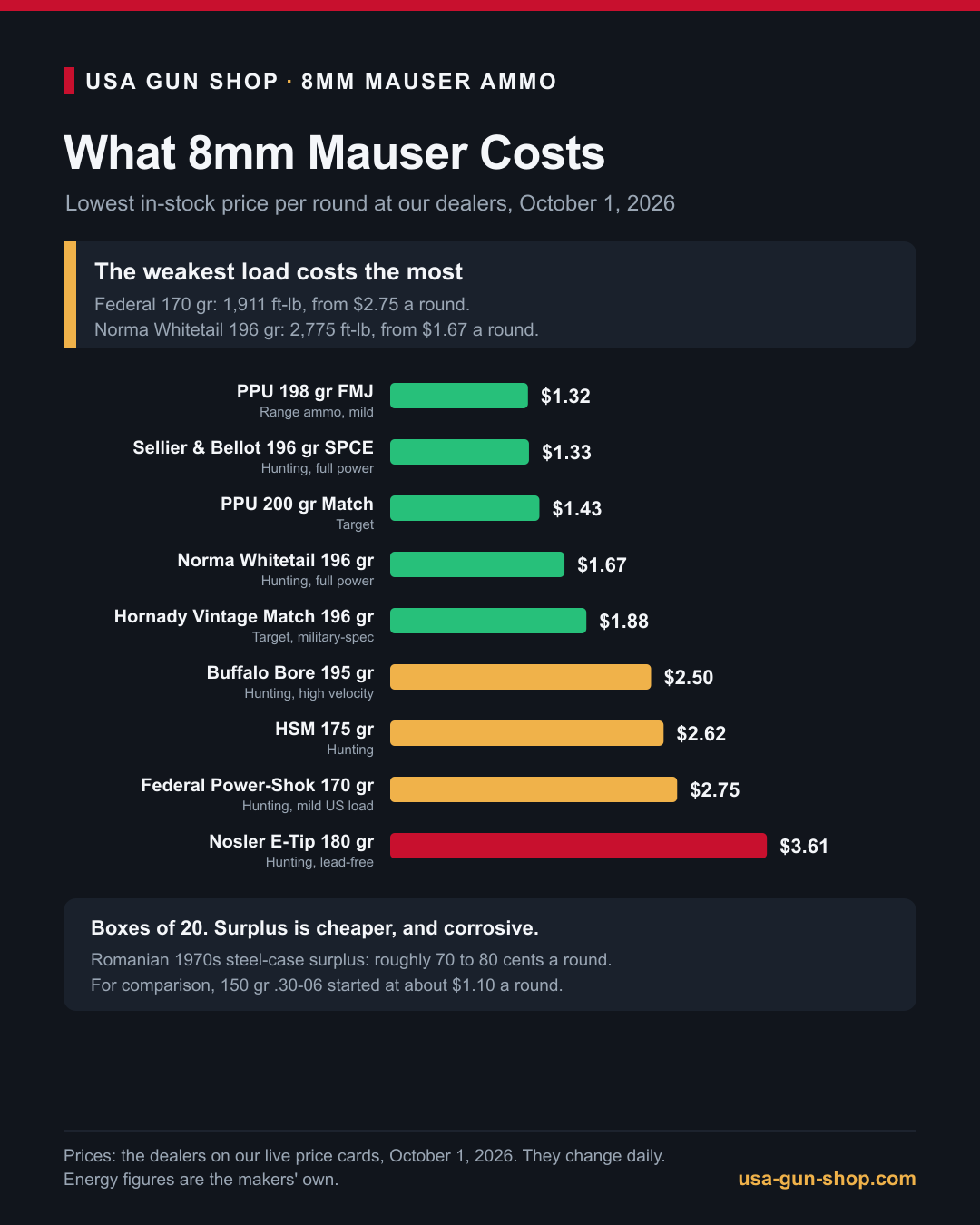
New 8mm Mauser ammo costs about $1.32 to $1.90 a round for brass-cased FMJ and soft points from Prvi Partizan and Sellier & Bellot, and $2.75 to $3.50 a round for Federal’s American load, going by dealer listings on October 1, 2026.
We pulled every 8mm Mauser listing from the dealers on our cards on October 1, 2026 and sorted them by type. Prices are for a box of 20 unless noted, and they move, so use the live cards for today’s number.
| Type | Typical loads | Box of 20 | Per round |
|---|---|---|---|
| New brass full metal jacket | PPU 198 gr FMJ, Sellier & Bellot 196 gr | $26.40 to $37.99 | $1.32 to $1.90 |
| European soft point | PPU 196 gr, Sellier & Bellot SPCE, Norma Whitetail | $26.59 to $42.49 | $1.33 to $2.12 |
| Match | PPU 200 gr Match | $28.62 to $35.49 | $1.43 to $1.77 |
| Match, military-spec | Hornady Vintage Match 196 gr | $37.65 to $59.99 | $1.88 to $3.00 |
| US soft point | Federal Power-Shok 170 gr | $54.94 to $69.99 | $2.75 to $3.50 |
| US soft point | HSM 175 gr | $52.47 to $66.49 | $2.62 to $3.32 |
| Premium hunting | Nosler E-Tip and Ballistic Tip, Buffalo Bore | $49.99 to $98.99 | $2.50 to $4.95 |
Read that table twice, because it’s upside down from what you’d expect. The weakest load in the caliber, Federal’s 170-grain soft point, costs about double what Sellier & Bellot’s full-power hunting load costs, and well over the Norma. You’re paying for a low-volume American production run. For a sound military Mauser, the European boxes are the better buy.
How does it compare with other rifle rounds? It costs more. On the same day, 150-grain .30-06 started at $21.99 a box on our cards. The gap comes down to volume: nobody makes 8mm Mauser in the quantities that .308 and .30-06 are made in.
For the wider market, our ammo price report tracks what the common calibers cost.
Surplus is the other option. Our dealers didn’t have any military surplus 8mm in stock when we checked, but dedicated surplus sellers do, mostly Romanian steel-case from the 1970s in sealed tins, at roughly 70 to 80 cents a round. It’s cheaper, it’s corrosive, and it comes with rules. We cover those below.
What’s Safe in Your Rifle
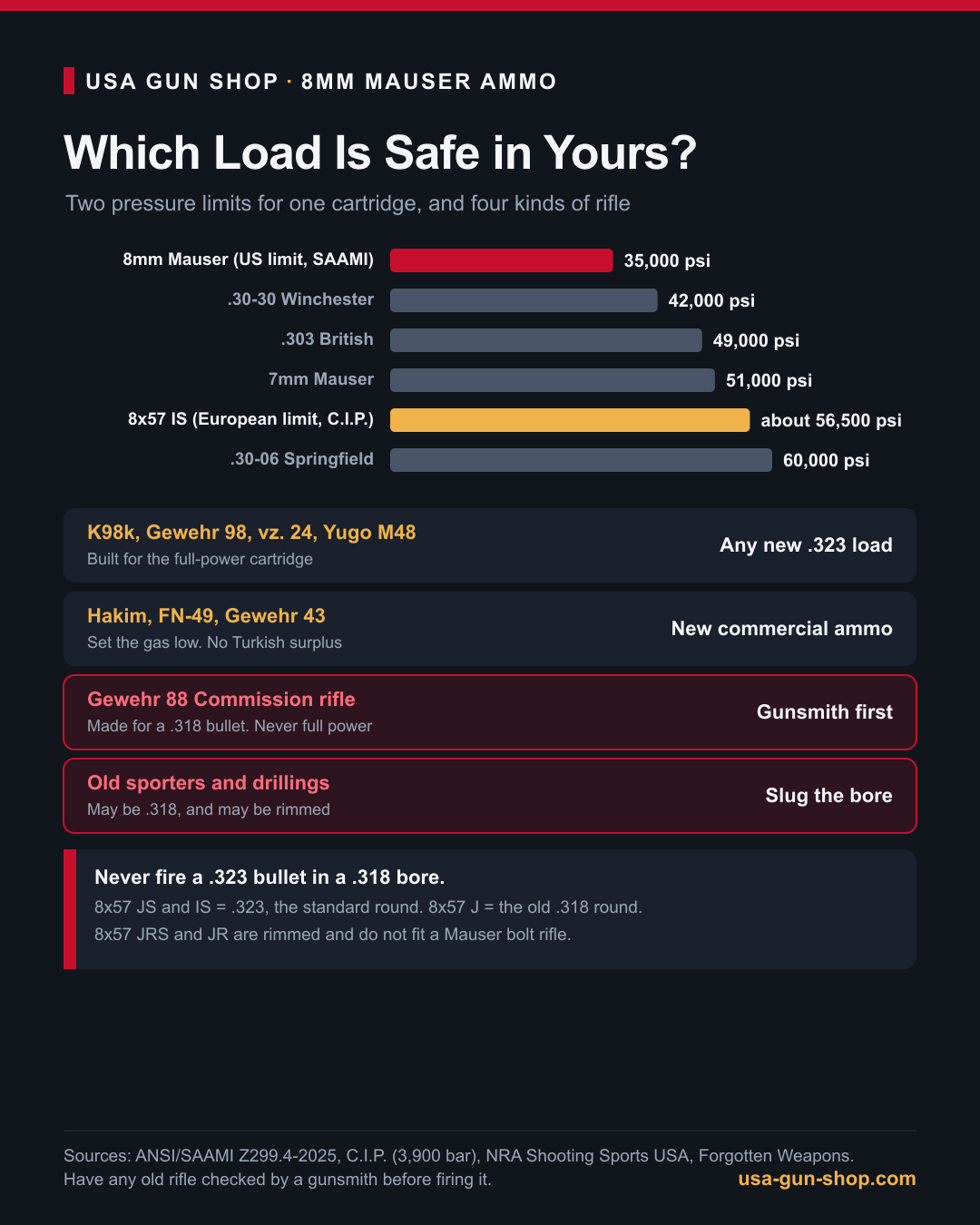
Any current .323 factory load is safe in a sound Karabiner 98k, Gewehr 98, vz. 24 or Yugoslav M48, while a Gewehr 88 or an old German sporting rifle needs a gunsmith’s inspection before it fires anything.
This is the part no ammo listing tells you. Find your rifle in the table.
“Mild US load” means the 170-grain Federal or Winchester and PPU’s “8 mm Mauser” line. “Full power” means Norma, Sellier & Bellot, Hornady Vintage Match and the like. Every row assumes a gunsmith has checked the rifle’s headspace and condition, which any 80-year-old military rifle deserves before its first shot.
| Rifle | Bore | Mild US load | Full power | Surplus | Notes |
|---|---|---|---|---|---|
| Karabiner 98k | .323 | Yes | Yes | Yes | What the full-power load was made for |
| Gewehr 98 | .323 from 1905 | Yes | Yes | Yes | Early rifles were built for the 1888 round; have one checked |
| Czech vz. 24, Persian 98/29 | .323 | Yes | Yes | Yes | Strong 98-pattern actions |
| Yugoslav M24/47 and M48 | .323 | Yes | Yes | Yes | Yugoslav M49 ball was made for these |
| Turkish Mausers | .323 | Yes | Yes | Bolt rifles in good order only | Conditions vary a lot; get it inspected |
| Gewehr 88 “Commission rifle” | .318, or converted | Only if a gunsmith clears it | No | No | See the J-bore section below |
| Old German sporters and drillings | Either | Only if a gunsmith clears it | Only if measured as .323 | No | Many are .318, and many are rimmed (JR or JRS) |
| Hakim, FN-49, Gewehr 43 | .323 | Yes | Yes | No Turkish; other surplus with care | The Hakim and FN-49 have gas systems you adjust with a tool; set them for the load |
| Modern bolt-action rifles such as the Mauser 98, Mauser 18, Mauser 12 and Zastava M70 | .323 | Yes | Yes | Not worth the cleaning | Anything marked 8×57 IS or JS |
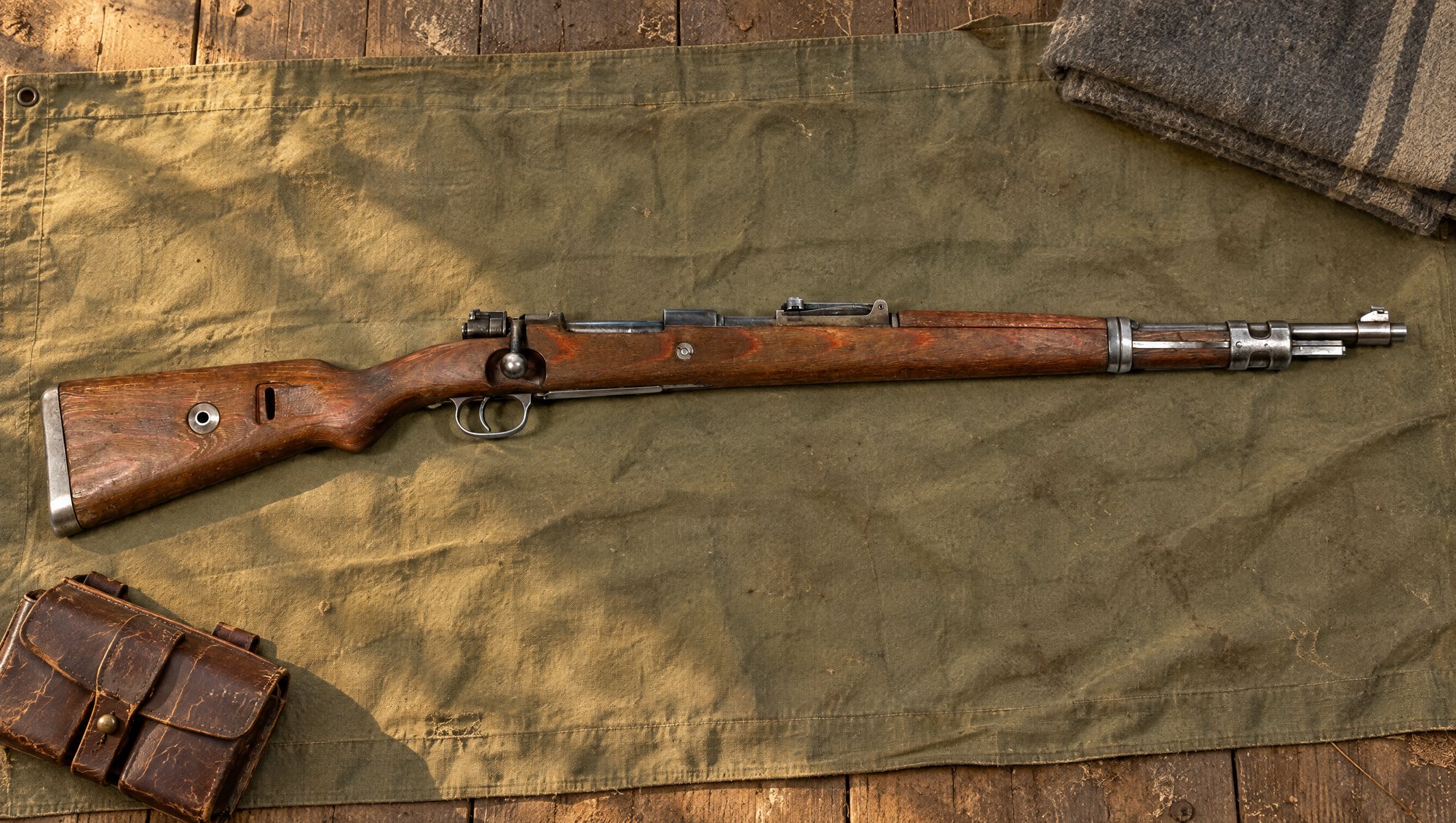
Two things in that table do most of the work. First, a 98-pattern military Mauser in good condition is a strong rifle built around the full-power cartridge, so the European loads are what it was designed to shoot.
Second, the semi-autos are fussier than the bolt guns. The Hakim and the FN-49 both have gas systems that are adjusted with a special tool, so the rifle has to be set up for the load you feed it. If you don’t know how yours is set, have a gunsmith check it before you change ammunition.
Forgotten Weapons tested 1940s Turkish surplus at 2,948 fps from a K98k, called it “definitely overpressure” and warned against using it in any self-loading rifle. We’d follow that.
Don’t have the rifle yet? These are the surplus rifles in 8mm Mauser our dealers have right now. Our Mauser rifle buyer’s guide covers which ones to buy, and the best military surplus rifles roundup compares them with the rest.
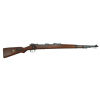
Why American 8mm Mauser Is Loaded So Light
American 8mm Mauser ammo is loaded light because SAAMI caps the cartridge at a maximum average pressure of 35,000 psi, while Europe’s C.I.P. allows the same round 3,900 bar, about 56,500 psi.
There are two rulebooks for this cartridge. In the US, SAAMI sets the maximum average pressure for 8mm Mauser at 35,000 psi. In Europe, C.I.P. sets the limit for the same cartridge, which it calls 8 x 57 IS, at 3,900 bar. That’s about 56,500 psi, roughly 60 percent higher.
You can read both for yourself in the SAAMI centerfire rifle standard and the C.I.P. data sheet.
To see how low the American number is, line it up against other cartridges in the same SAAMI table:
| Cartridge | SAAMI pressure limit |
|---|---|
| 8mm Mauser | 35,000 psi |
| .30-30 Winchester | 42,000 psi |
| .32 Winchester Special | 42,000 psi |
| .303 British | 49,000 psi |
| 7mm Mauser | 51,000 psi |
| .30-06 Springfield | 60,000 psi |
| .308 Winchester | 62,000 psi |
A cartridge that armed Germany through World War I and World War II is held below the .30-30. SAAMI does not publish its reasons, but gun writers give two. American Hunter blames “older rifles, whose metallurgy may not be capable of handling higher pressures.” Others point to the bore mix-up we cover next: if someone fires a modern .323 bullet through an old .318 barrel, a low-pressure load gives them a margin.
The result is on the box. SAAMI’s reference load is a 170-grain bullet at 2,340 fps, and Federal lists its 170-grain Power-Shok at 2,250 fps and 1,911 foot-pounds. For comparison, Federal’s own 180-grain .308 load makes 2,640 foot-pounds and its 180-grain .30-06 makes 2,913.
In American trim, the 8mm Mauser is a .32 Special. In European trim, with a 196-grain bullet at about 2,525 fps, it makes close to 2,780 foot-pounds and sits between the .308 and the .30-06.
That doesn’t make the mild load bad. It’s easy on an old rifle and easy on your shoulder, and at woods ranges a 170-grain soft point at 2,250 fps kills deer the same way a .30-30 always has. It’s just a different tool from the box next to it.
J Bore vs. S Bore: .318 or .323
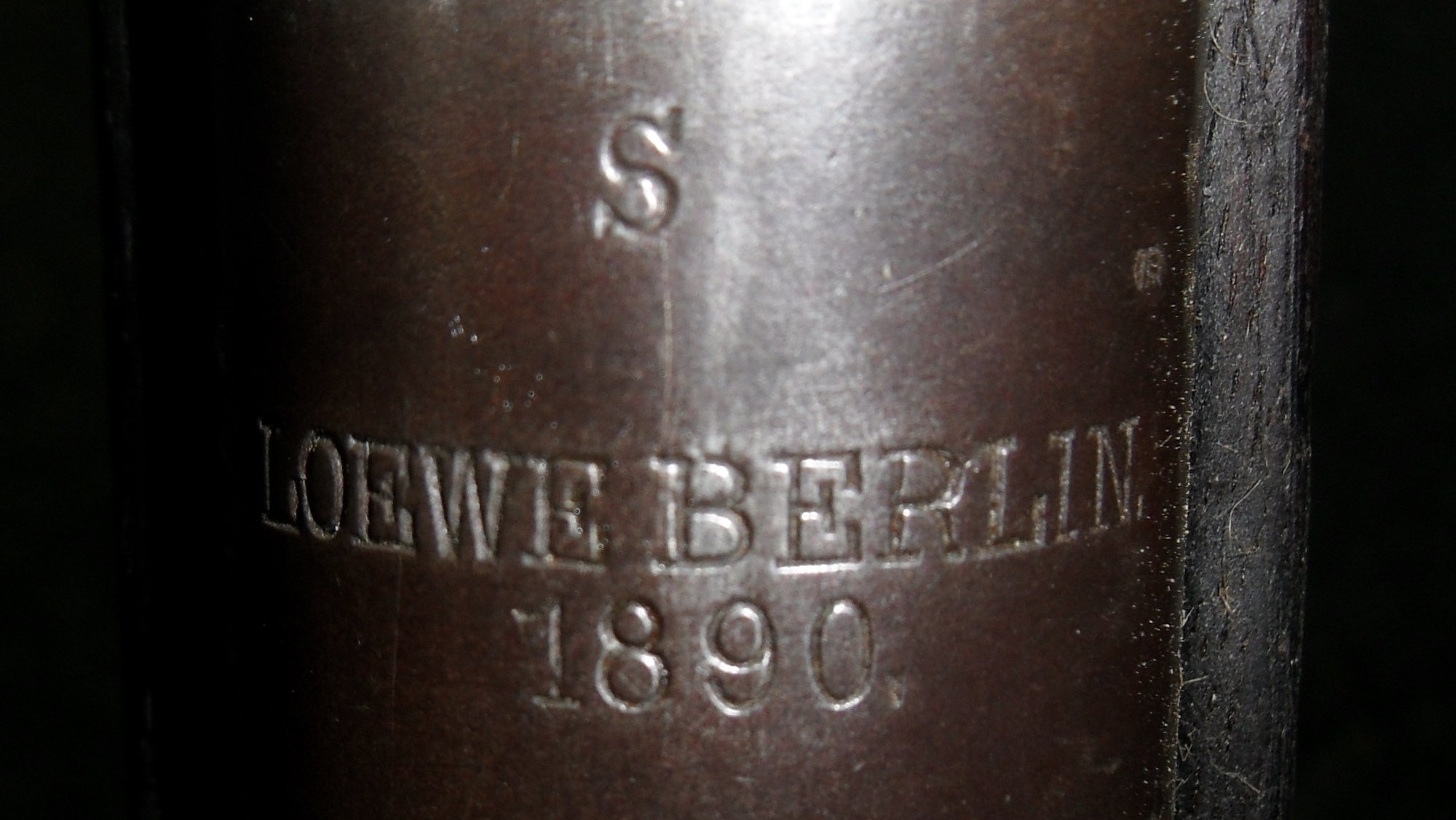
8mm Mauser rifles come in two bore sizes: the original 1888 J bore takes a .318-inch bullet, and the S bore, standard on military rifles since 1905, takes the .323-inch bullet that every current factory load uses.
Here’s the one mix-up in this caliber that can hurt you. The original 1888 cartridge, made for the Gewehr 88 “Commission rifle,” used a round-nosed bullet .318 inches across. In 1903 Germany designed a new pointed bullet .323 inches across, the S cartridge, and by 1905 it was the service round. Every military Mauser built for it since has the larger bore.
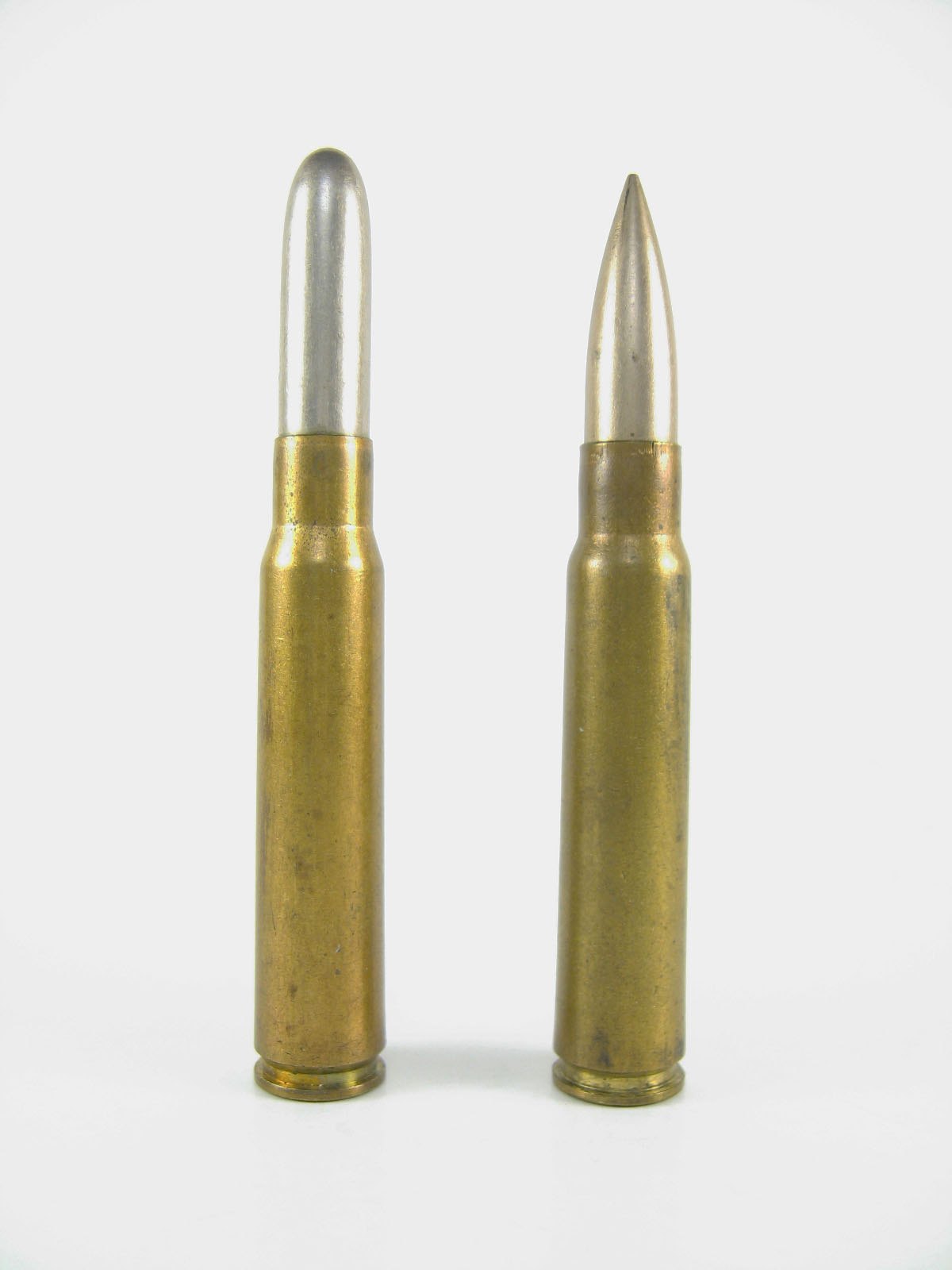
The letters come from that history. The “I” stands for Infanterie, and the “J” you see on most boxes is the same letter misread. The “S” stands for Spitzgeschoss, pointed bullet, and today it marks the .323 bore.
So 8×57 JS and 8×57 IS are the same round, and it’s the one everybody means by 8mm Mauser. Plain 8×57 J, with no S, is the old .318 round.
And no, Paul Mauser didn’t design the cartridge. A German army commission did, and the Mauser name stuck later because of the Gewehr 98.
The rule comes from the NRA’s Shooting Sports USA: “it is not safe to fire the 8×57 mm Mauser ammunition with .323″ diameter bullets in rifles having .318″ diameter bores.” A fat bullet in a tight barrel means dangerous pressure. All current American factory ammunition and nearly all surplus is .323.
Which rifles are the risk?
- Gewehr 88 Commission rifles. Many were converted for the S cartridge and stamped with an “S” on the receiver. Shooting Sports USA says not to fire even the S-marked ones. We wouldn’t shoot one without a gunsmith’s say-so.
- Pre-war German sporting rifles, drillings and combination guns. These can be .318 or .323, and many are chambered for the rimmed versions. Nothing on the outside tells you for sure.
- Any rifle you can’t identify. If the markings are gone or the rifle has been rebarreled, treat it as unknown.
What to do is simple. Take the rifle to a gunsmith and ask for the bore to be slugged and the chamber checked. Slugging means driving a soft lead slug through the barrel and measuring it.
Ask for both, because groove diameter on its own doesn’t settle it: some later Gewehr 88 barrels were cut with deeper grooves while the chamber stayed the old size. Ammunition with true .318 bullets is a specialty item, so if your rifle turns out to be a J bore, that’s a conversation to have with the gunsmith too.
8×57 JS, 7.92×57 and the Names That Look Right but Aren’t
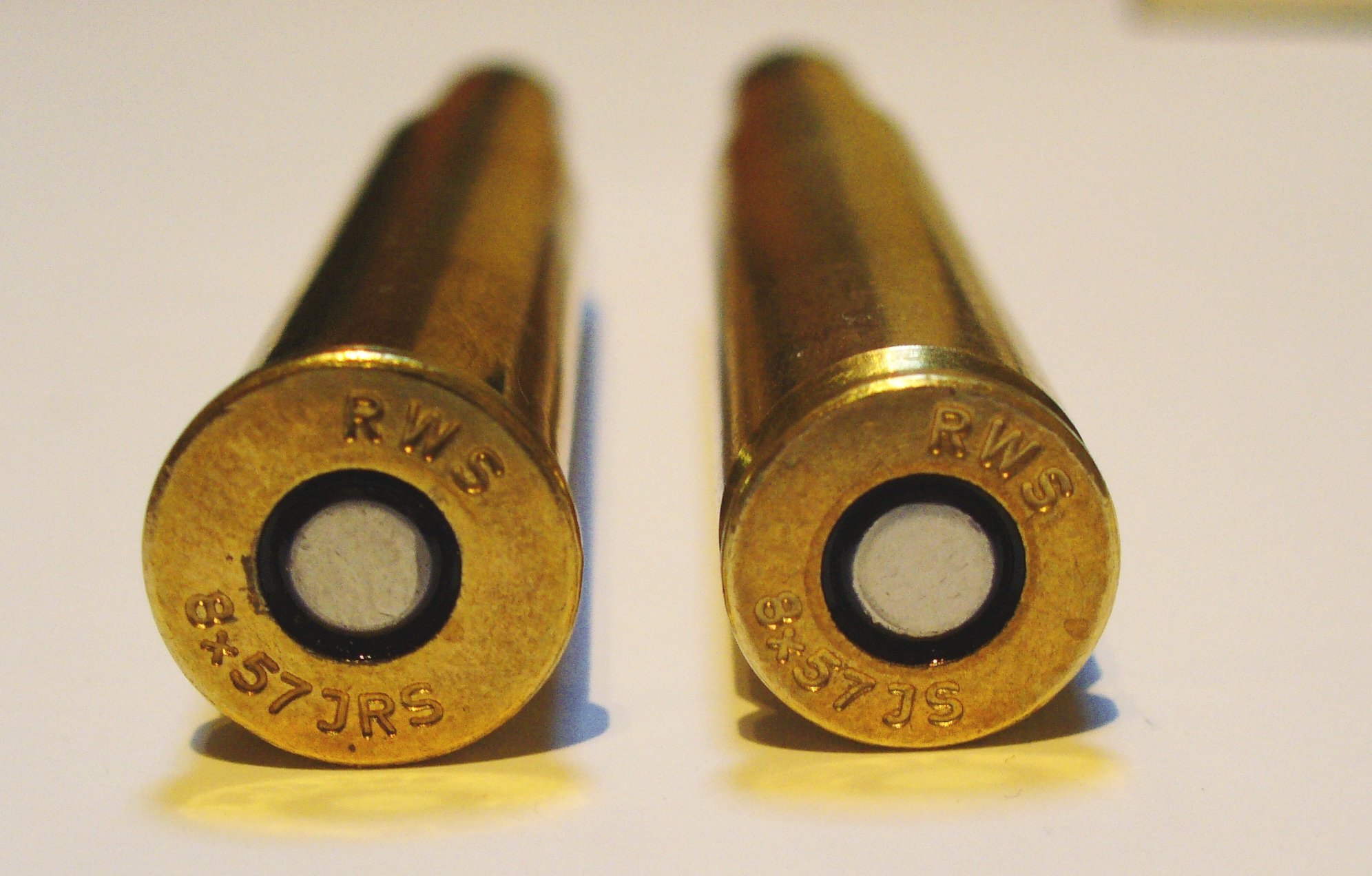
Boxes marked 7.92×57 ammo, 8×57 JS, 8×57 IS and 8mm Mauser all hold the same cartridge. The trouble starts with the names that sit next to them.
Ammo feeds and store shelves file several different cartridges under “8mm.” One forum poster described being handed a box of 8×57 JRS over a gun-store counter when he asked for 8mm Mauser. Here’s the full list of what fits a standard 8mm Mauser bolt rifle and what doesn’t.
| On the box | What it is | Fits an 8mm Mauser rifle? |
|---|---|---|
| 8mm Mauser, 8×57 JS, 8×57 IS, 7.92×57 | The standard rimless .323 round | Yes |
| 8×57 J or 8×57 I | The 1888 round with a .318 in. bullet | It chambers, but it’s made for .318 barrels and shoots poorly in a .323 |
| 8×57 JRS or IRS | Rimmed .323 round for break-action guns and drillings | No |
| 8×57 JR or IR | Rimmed .318 round for older break-action guns | No |
| .30-06 Springfield | A longer American cartridge. SAAMI lists 8mm Mauser as unsafe in a .30-06 chamber | No. Never |
| 7×57 (7mm Mauser) | A smaller cartridge. SAAMI lists it as unsafe in an 8mm chamber | No. Never |
| 8x56R | Austrian and Hungarian rimmed round with a .329 in. bullet | No |
| 8mm Lebel | French rimmed round from 1886 | No |
| 7.92×33 Kurz | The short StG 44 round | No |
| 8mm Remington Magnum, .325 WSM | Modern magnums that use .323 in. bullets in bigger cases | No |
| 8mm-06 | A wildcat. Some surplus Mausers were rechambered for it | No, and a rechambered rifle no longer takes 8mm Mauser |
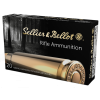
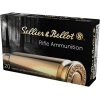
The rimmed JRS is the one that catches buyers, because it’s cheap and it sits in the same search results. That’s why the cards on this page filter it out. If you own a drilling or a single-shot stalking rifle marked 8×57 JRS, it’s the right round for you, and the card below is the only one on this page you want.
8mm Mauser Surplus Ammo: What’s Worth Buying
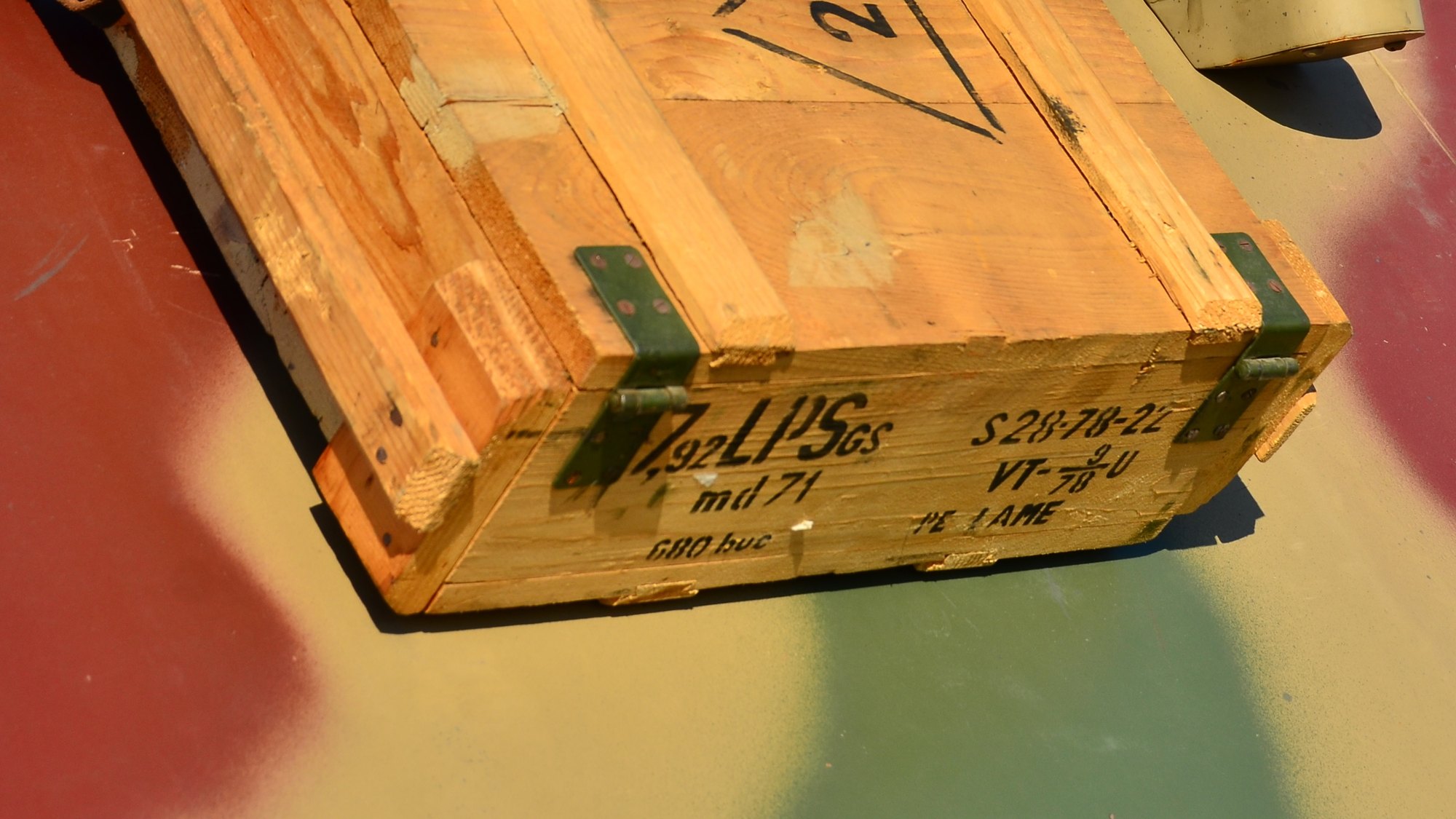
8mm Mauser surplus ammo is corrosive, Berdan primed and cheaper than new production, at roughly 70 to 80 cents a round for 1970s Romanian steel-case against about $1.32 for new brass-cased FMJ.
For decades surplus was how people fed these rifles, and some of it is still around. Treat all of it as corrosive unless the seller can prove otherwise, and expect it to be Berdan primed, which means the cases aren’t practical to reload. Here’s what’s documented about the common types.
| Origin | Era | Case | Corrosive | What’s known |
|---|---|---|---|---|
| Yugoslav M49 ball | 1950s | Brass | Yes | 196 to 198 gr FMJ. Clean brass, made for the M48 |
| Romanian | 1970s | Lacquered steel | Yes | 154 gr steel-core bullet at about 2,670 fps. Sold in sealed tins. Forgotten Weapons reported no duds or hangfires |
| Turkish | Mostly 1940s | Brass | Yes | 154 gr at about 2,950 fps from a K98k. Hot, with hangfires reported. Bolt rifles only |
| Greek | About 1940 | Brass, Boxer primed | Yes | 198 gr |
| Iranian | 1930s to 1950s | Not recorded | Yes | Duds and hangfires. Sold for components only |
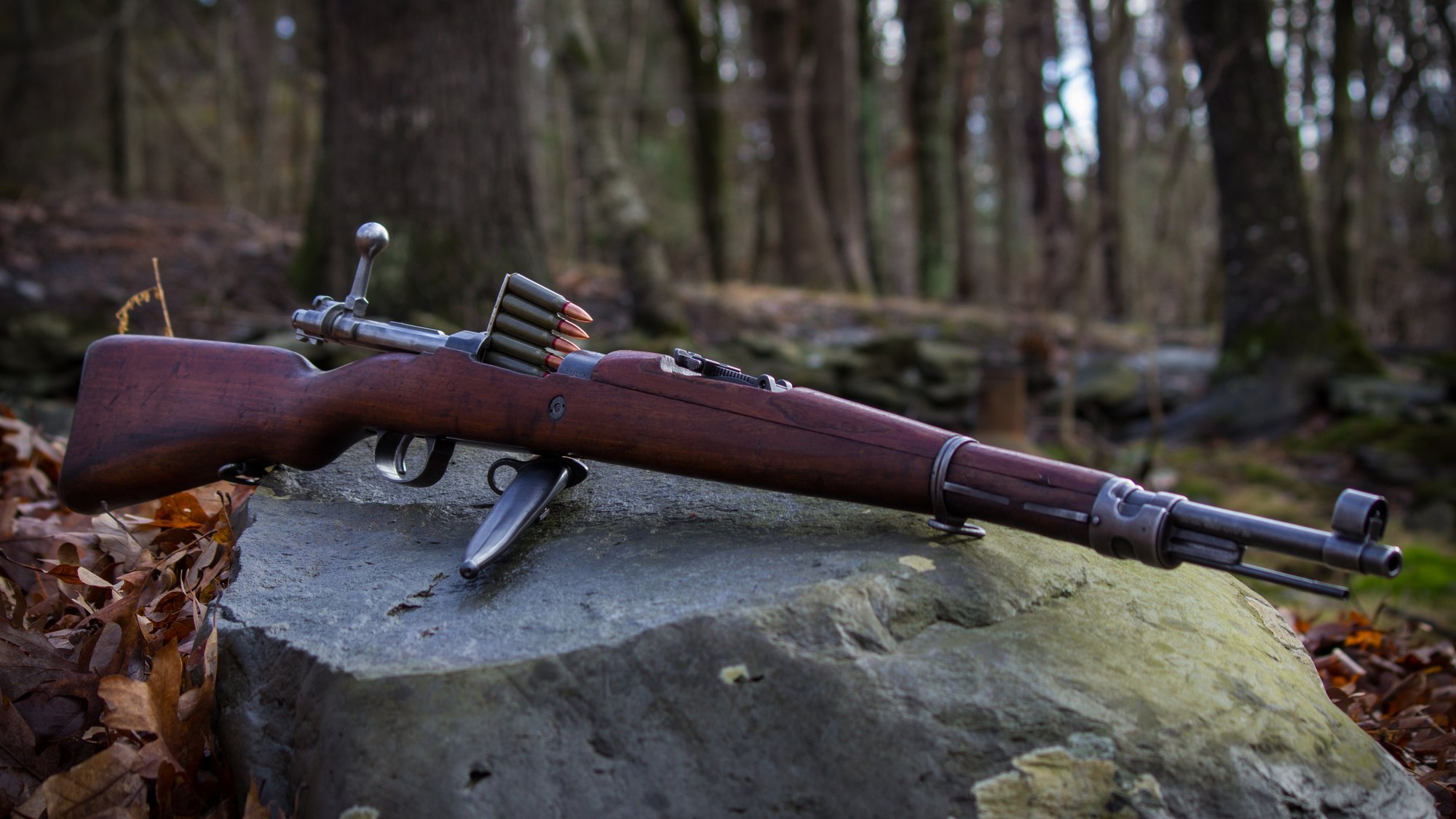
Turkish surplus has a reputation, and it’s partly earned. It’s 80-year-old ammunition loaded warm. Firearms News shot 1940 Turkish ball in a K98k in 2026 and got its best groups of the test at 2,877 fps, so a good lot can shoot very well.
A bad lot gives you hangfires. Keep it to sound 98-pattern bolt-action rifles and out of anything semi-automatic.
If you get a hangfire
A hangfire is a delay between the firing pin falling and the round going off. If you pull the trigger and get a click, keep the rifle on your shoulder with the muzzle pointed downrange and wait. The NRA’s range safety guidance says at least 60 seconds before opening the action. The delay with old surplus can be longer than you’d think, and a round that fires with the bolt half open is how people get hurt.
Cleaning after corrosive ammo
A corrosive primer leaves potassium chloride and sodium chloride in the bore, salts that pull moisture out of the air and rust the steel. Ordinary solvent will not dissolve them. Water does. Clean the same day:
- Flush the bore from the chamber end with hot water, or wet patches with an ammonia-based window cleaner.
- Do the same to the bolt face. On a Hakim, FN-49 or G43, do the gas system and bolt carrier too.
- Dry everything with clean patches.
- Clean the normal way with a brush and bore solvent.
- Oil all the metal, and check the bore again the next day.
If that sounds like a chore, it’s the best argument for new ammunition. PPU says its commercial primers are non-corrosive, and Hornady built Vintage Match as a modern stand-in for military ball.
8mm Mauser for Hunting
With a European 196-grain soft point at about 2,525 fps and 2,775 foot-pounds, the 8mm Mauser is a full big game cartridge, and Gun Digest calls it adequate for any North American big game with the proper bullets and full loadings.
In Europe this is still an everyday hunting round, and with the right box it’ll do anything a .30-06 will. Gun Digest puts it this way: as loaded by Norma and the other European companies, “it’s in the same class as our .30-06.” The catch, again, is which box.
| Load | Bullet | Muzzle velocity | Muzzle energy |
|---|---|---|---|
| 8mm Mauser, Federal Power-Shok | 170 gr | 2,250 fps | 1,911 ft-lb |
| 8mm Mauser, Norma Whitetail | 196 gr | 2,525 fps | 2,775 ft-lb |
| 8mm Mauser, Sellier & Bellot SPCE | 196 gr | About 2,590 fps | About 2,920 ft-lb |
| .308 Winchester, Federal Power-Shok | 180 gr | 2,570 fps | 2,640 ft-lb |
| .30-06, Federal Power-Shok | 180 gr | 2,700 fps | 2,913 ft-lb |
For whitetails inside 150 yards, the American 170-grain load is plenty, and the light recoil is a bonus in a steel-buttplate military rifle. For elk, hogs, black bear or longer shots, use a European 196-grain soft point or a premium load. Norma’s Whitetail is the easy pick, since it’s widely stocked and costs less than the Federal. Never hunt with FMJ, surplus or otherwise.
Is it better than a .308? With a European load it carries a heavier bullet and a little more energy than Federal’s 180-grain .308. With the American load it gives up more than 700 foot-pounds to it.
Recoil follows the power. Chuck Hawks’ recoil table puts a 170-grain load at 2,400 fps in an eight-pound rifle at about 13.6 foot-pounds, against 18.5 for a 195-grain load at 2,500 fps and 20.3 for a 180-grain .30-06. Our guide to the best deer hunting cartridges puts those numbers in context, and if you’re weighing an old Mauser against a modern rifle, our .30-06 guide is the fair comparison.
8mm Mauser Myths vs. the Truth
These are the claims that come up most on the forums, and where the evidence lands on each.
| The myth | The truth |
|---|---|
| “Nobody makes 8mm Mauser anymore.” | At least eight makers do, and our dealers had more than 60 listings in stock when we checked. What dried up was cheap surplus. |
| “8mm Mauser, 8×57 JS and 7.92×57 are all the same, so buy any of them.” | Same chamber, same case. Not the same pressure. A US box and a European box can be more than 800 foot-pounds apart. |
| “PPU is hot European ammo.” | Not the boxes marked 8mm Mauser. PPU lists them at about 2,180 fps. Its full-power line is sold as 8 x 57 IS. |
| “It’s more powerful than a .30-06.” | With European loads it lands between the .308 and the .30-06. With American loads it’s a .32 Special. |
| “All surplus is corrosive.” | Treat it as true. You can’t confirm an exception from a listing. |
| “An S-marked Gewehr 88 takes any 8mm.” | No. It was never built for full-power ammunition. Gunsmith first, and mild loads only if it’s cleared. |
| “J means the small bore.” | J is just a misread I, for Infanterie. The S is what tells you it’s the .323 bore. |
| “Paul Mauser designed it.” | A German army commission designed it in 1888. Mauser’s rifles made it famous. |
Our Range Notes: Five Loads in a Yugo M48
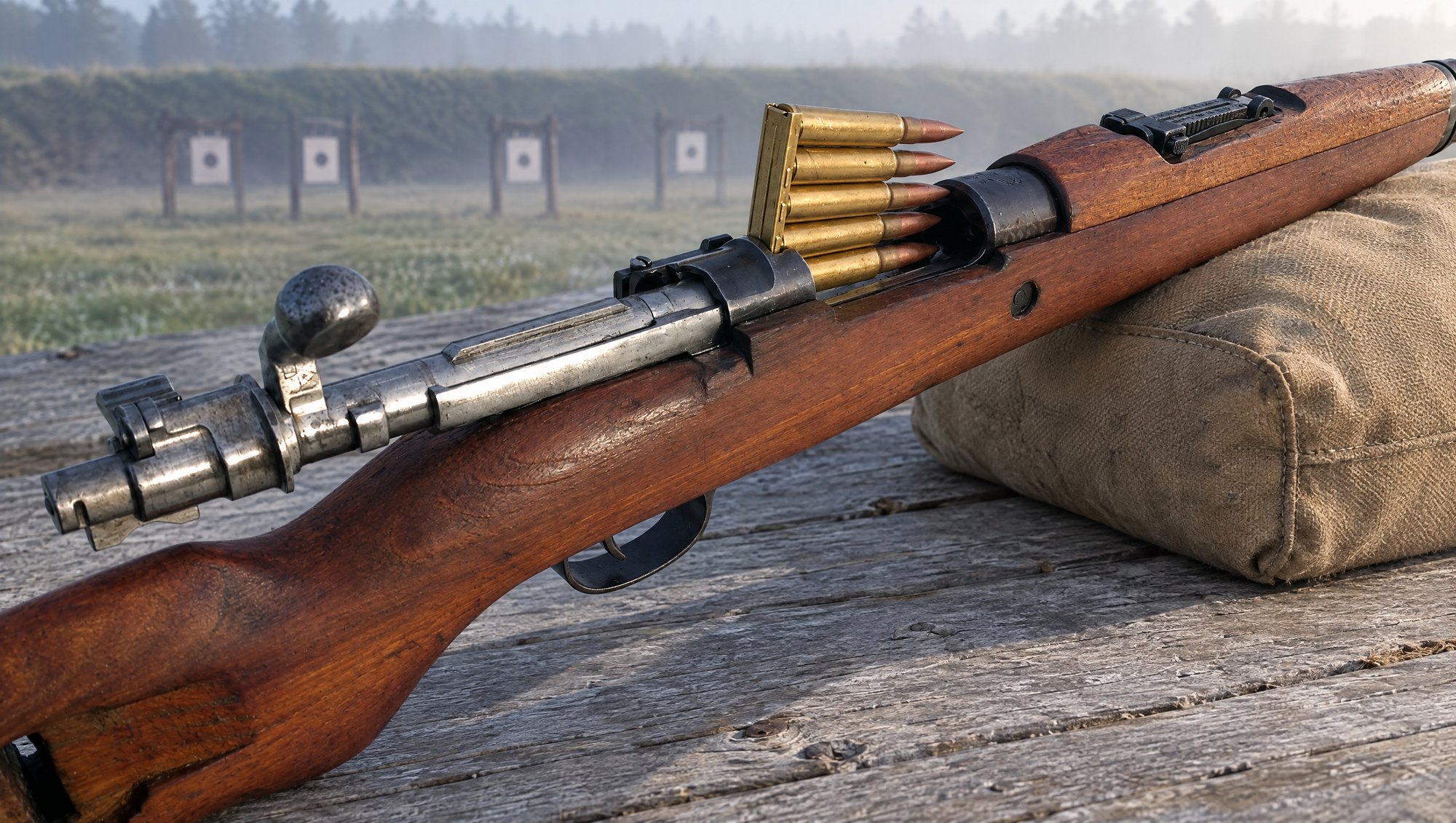
We took a Yugoslav M48 with a bright bore and a chronograph to the range for two mornings in September and shot 180 rounds: four commercial loads and one tin of 1970s Romanian surplus. Groups were five shots at 100 yards from a rest with the issue sights.
| Load | Listed velocity | Our velocity | Average group |
|---|---|---|---|
| PPU 198 gr FMJ (8mm Mauser line) | About 2,180 fps | 2,155 fps | 2.9 in. |
| Federal Power-Shok 170 gr | 2,250 fps | 2,228 fps | 2.3 in. |
| Hornady Vintage Match 196 gr | 2,500 fps | 2,471 fps | 1.8 in. |
| Sellier & Bellot 196 gr SPCE | About 2,590 fps | 2,541 fps | 2.4 in. |
| Romanian 1970s surplus, 154 gr | Not listed | 2,648 fps | 3.6 in. |
The chronograph backed up the makers. The PPU and the Federal were soft, pleasant loads, and the M48’s steel buttplate wasn’t a problem with either. The Sellier & Bellot was a different rifle: sharper recoil and a lot more blast. That’s the cartridge the M48 was built for.
The Hornady shot the best groups by a clear margin, which is what a match bullet should do.
We had no misfires with any commercial load. The Romanian surplus fired every time too, but it was the least accurate ammunition of the day and the dirtiest, and it meant a water flush of the bore and bolt before we left the range. With the battle sight on its lowest setting, every load printed high at 100 yards, the heavy bullets by the most, so plan on holding low or installing a taller front sight.
If we were stocking up for this rifle, we’d buy PPU for casual range days, Sellier & Bellot or Norma for hunting, and a few boxes of Hornady for the days we want to see what the rifle can do.
A Short History of the 8mm Mauser
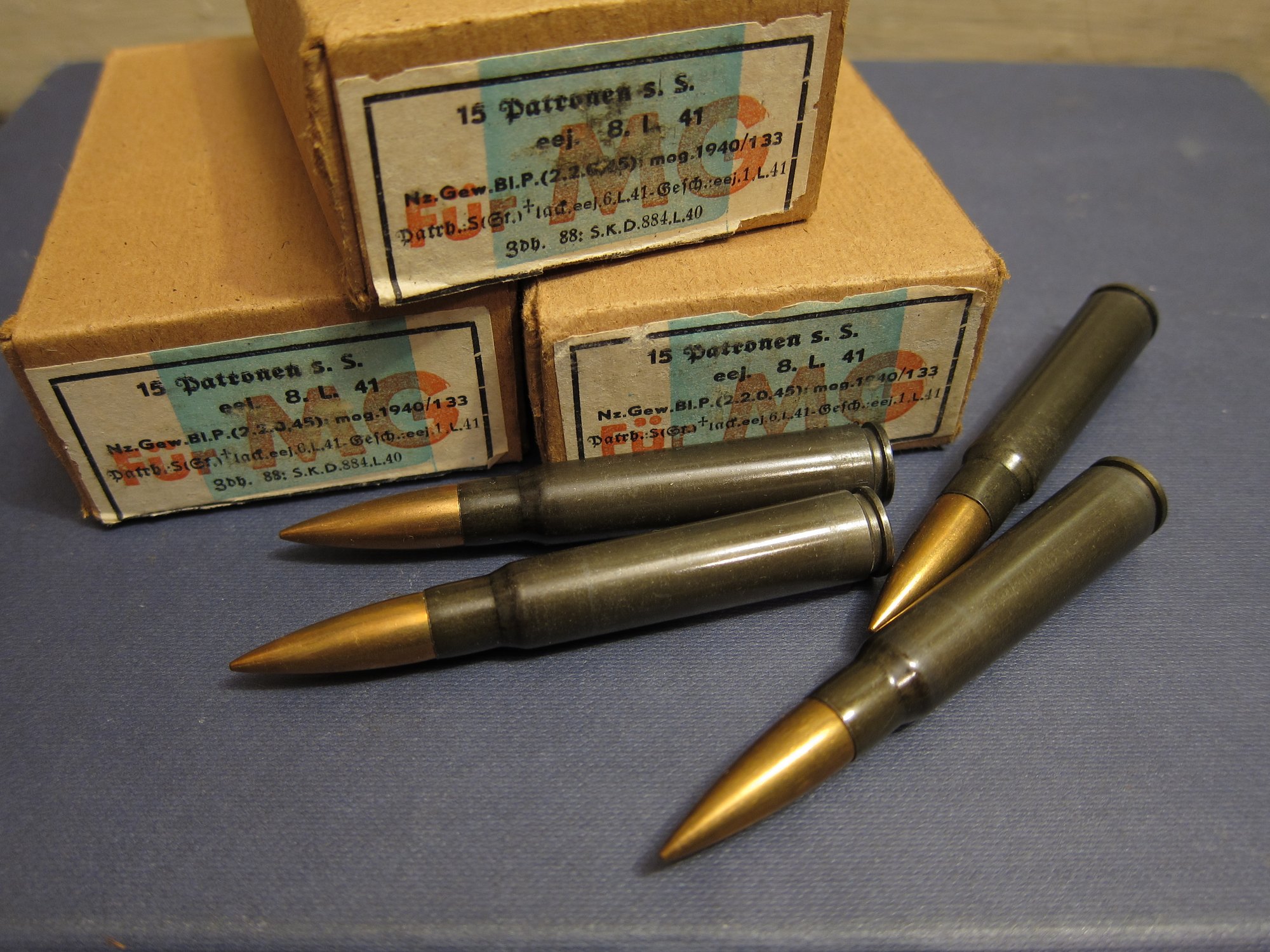
Germany adopted the cartridge in 1888 with the Gewehr 88, using a 226-grain round-nosed bullet at a little over 2,000 fps. The Gewehr 98 followed in April 1898. The big change came with the S cartridge, designed in 1903 and in service by 1905: a 154-grain pointed bullet at about 2,880 fps, fired from a wider .323 bore. Sierra credits it with pushing the US to turn the .30-03 into the .30-06.
A heavier 198-grain full metal jacket boat-tail bullet arrived late in World War I for machine guns and became the standard rifle load in 1933. That’s the round the Karabiner 98k, adopted in 1935, carried through World War II. After 1945 it faded from front-line service as armies moved to NATO and Soviet calibers, but Yugoslavia kept the M48 as its standard rifle until 1964, and Egypt, Turkey and Iran all used it.
That long service life is why so many rifles are still out there, next to the Mosin-Nagant and the Lee-Enfield on every surplus rack. If you plan to collect more than one, a curio and relic license is worth a look.
A Note on Reloading
Handloaders like this cartridge, because the mild American factory loads leave a lot on the table and components are easy to find. Bullets are .323 inches, in weights from about 125 to 220 grains, and new Boxer-primed brass comes from several makers. Sierra names a 150-grain spitzer for deer and a 175-grain spitzer for larger game.
We do not publish load data on this page. Use a current manual from a bullet or powder maker, and start with our beginner’s guide to reloading if you’re new to it.
Bottom Line: Which 8mm Mauser Ammo to Buy
- For a K98k, M48, vz. 24 or other sound military Mauser: PPU or Sellier & Bellot brass-cased FMJ for the range. It’s the cheapest new ammo and there’s nothing to scrub out afterward.
- For hunting: Norma Whitetail or Sellier & Bellot SPCE in 196 grains. Full power, and a lot cheaper than the American load.
- For a Gewehr 88, an old sporter or a rifle you’re unsure about: nothing until a gunsmith has slugged the bore and checked the chamber, and then only what the gunsmith approves.
- For a Hakim, FN-49 or G43: new commercial ammunition, with the gas system set for the load on a Hakim or FN-49. Leave Turkish surplus alone.
- For the best groups: Hornady Vintage Match.
8mm Mauser Ammo FAQ
Is 8mm Mauser ammo still made?
Yes. Federal, Winchester, Hornady, Prvi Partizan, Sellier & Bellot, Norma, Nosler and Buffalo Bore all load 8mm Mauser in 2026. When we checked on October 1, 2026, the dealers on our price cards had more than 60 listings in stock, with new brass-cased boxes of 20 from under $27.
Is 8mm Mauser the same as 7.92x57 and 8x57 JS?
Yes. 7.92x57 ammo, 8x57 JS, 8x57 IS and 8mm Mauser are names for the same rimless cartridge with a .323 inch bullet. They are not always loaded to the same pressure, though: European 8x57 JS loads are much more powerful than American 8mm Mauser loads. 8x57 J has a .318 inch bullet, and 8x57 JR and JRS are rimmed, so they are different cartridges.
Is an 8mm Mauser more powerful than a .30-06?
It depends on the box. European loads such as Norma's 196-grain soft point at 2,525 fps make about 2,775 foot-pounds, which is between Federal's 180-grain .308 at 2,640 and its 180-grain .30-06 at 2,913. American 170-grain loads make about 1,911 foot-pounds, which is .32 Winchester Special territory.
Why is American 8mm Mauser ammo so weak?
The US standards body, SAAMI, limits 8mm Mauser to a maximum average pressure of 35,000 psi, which is lower than its 42,000 psi limit for the .30-30. The European C.I.P. limit for the same cartridge is 3,900 bar, about 56,500 psi. SAAMI does not publish a reason, but writers point to weak old rifles and to the risk of a .323 bullet being fired in an old .318 barrel.
Can I shoot modern 8mm Mauser in a Gewehr 88?
Not without a gunsmith checking it first. The Gewehr 88 was built for a .318 inch bullet, and NRA Shooting Sports USA says it is not safe to fire .323 inch ammunition in a .318 bore. Many Gewehr 88s were converted and stamped with an S, but they were never built for full-power ammunition. Have the bore slugged and the chamber checked, and never use European-spec loads or surplus in one.
Is 8mm Mauser surplus ammo corrosive?
Treat all 8mm Mauser surplus ammo as corrosive. Yugoslav, Romanian, Turkish, Greek and Iranian surplus are all documented as corrosive. Clean the same day: flush the bore and bolt with hot water or an ammonia-based window cleaner, dry them, then clean and oil as normal.
Is Turkish 8mm Mauser surplus safe to shoot?
Only in a sound 98-pattern bolt-action rifle, and with care. Forgotten Weapons measured 1940s Turkish ball at about 2,950 fps from a K98k and called it overpressure, and hangfires are reported. Do not use it in a Hakim, FN-49, Gewehr 43 or any other semi-automatic.
How much does 8mm Mauser ammo cost per round?
In October 2026, new brass-cased FMJ and soft points from Prvi Partizan and Sellier & Bellot cost about $1.32 to $1.90 a round. Hornady Vintage Match runs about $1.90 to $3.00, Federal's 170-grain Power-Shok $2.75 to $3.50, and Nosler's hunting loads $3.60 and up. Corrosive Romanian surplus from surplus dealers is roughly 70 to 80 cents a round.
5,513+ Gun & Ammo Deals
Updated daily from 200+ top retailers. Filter by category, caliber, action type, and price.