

Last updated September 29, 2026
Some of the links below are affiliate links, meaning at no additional cost to you, we may earn a commission if you click through and make a purchase.
- Treat every gun as loaded
- Point the muzzle in a safe direction
- Keep your finger off the trigger until you’re ready to shoot
- Know your target and what’s beyond
Civil War guns are the rifled muskets, breechloaders, repeaters and revolvers that Union and Confederate soldiers carried from 1861 to 1865. Most men fought with a muzzle-loading rifled musket firing a Minie ball, and by the end of the war Union cavalry had seven-shot Spencer carbines.
Here are the 14 Civil War guns that mattered most, from the Springfield 1861 to the LeMat. For each one I’ll tell you who carried it, what made it special and which reproduction you can buy today, with a live price card wherever our dealers stock one.
This list sticks to the Civil War weapons a soldier carried and fired, so swords, artillery and the Gatling gun aren’t on it.
How we tested: Every pick here is ranked against our testing methodology. Minimum round counts, accuracy and reliability protocols, the failures that disqualify a gun.
Civil War Guns at a Glance
Here are all 14 Civil War guns on this list, what kind of gun each one is and which side carried it.
| Gun | Why It Matters | Key Facts | Check Price |
|---|---|---|---|
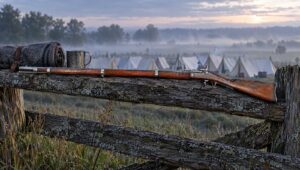 |
THE UNION STANDARD
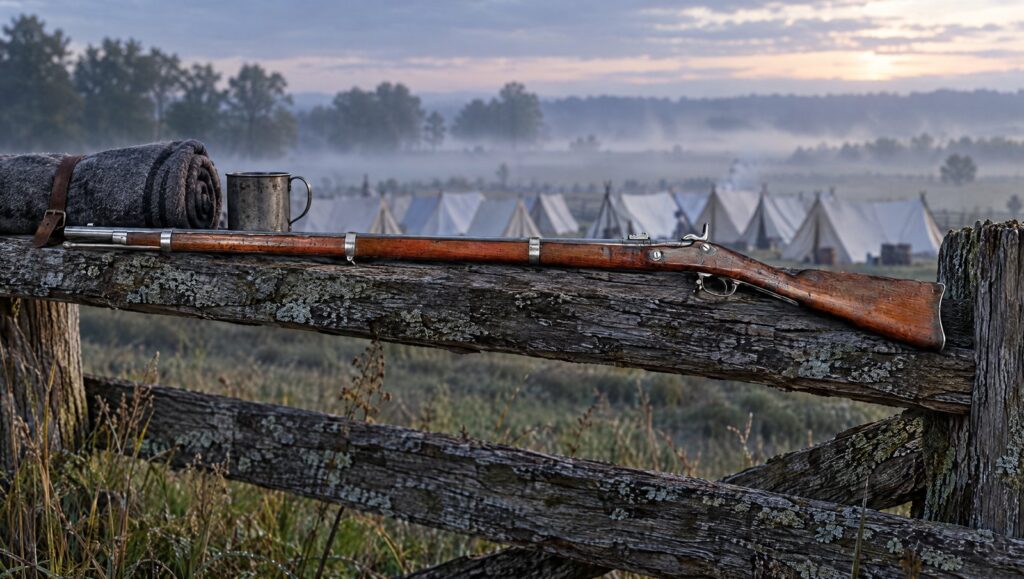
Springfield Model 1861
Reenactors and shooters who want the rifle most Union soldiers actually carried. |
Type: Rifled musket Caliber: .58 Minie ball Carried by: Union |
Check Price ↓ |
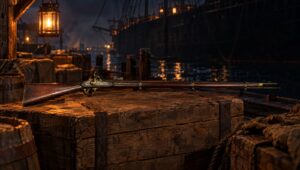 |
THE BLOCKADE RUNNER
Pattern 1853 Enfield
Collectors who want the rifle that armed the Confederate infantry. |
Type: Rifled musket Caliber: .577 Minie ball Carried by: Both sides |
Read More ↓ |
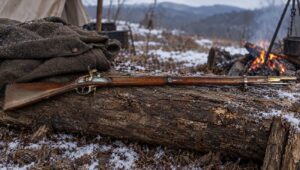 |
THE AUSTRIAN IMPORT
Lorenz Rifle
Western-theater reenactors and anyone collecting both sides of the war. |
Type: Rifled musket Caliber: .54, some bored to .58 Carried by: Both sides |
Check Price ↓ |
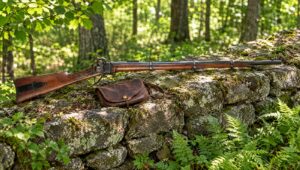 |
THE CAVALRY BREECHLOADER
Sharps Rifle and Carbine
Collectors who want the carbine Union cavalry rode with before the Spencer. |
Type: Breechloader or repeater Caliber: .52 Carried by: Union |
Check Price ↓ |
 |
THE GENERAL’S CARBINE
Burnside Carbine
Collectors of Union cavalry arms who want something less common than a Sharps. |
Type: Breechloader or repeater Caliber: .54 Carried by: Union |
Read More ↓ |
 |
THE SEVEN-SHOT REPEATER
Spencer Repeating Rifle
Shooters who want to run the lever on the gun that changed cavalry warfare. |
Type: Breechloader or repeater Caliber: .56-56 Spencer rimfire Carried by: Union |
Check Price ↓ |
 |
THE SIXTEEN-SHOOTER
Henry Rifle
Lever-action fans who want the rifle that started it all. |
Type: Breechloader or repeater Caliber: .44 Henry rimfire Carried by: Union |
Check Price ↓ |
 |
THE CONFEDERATE SNIPER RIFLE
Whitworth Rifle
Long-range black powder shooters who want the most accurate rifle of the war. |
Type: Sharpshooter rifle Caliber: .45, hexagonal bore Carried by: Confederate |
Check Price ↓ |
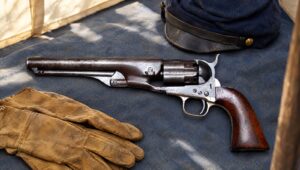 |
THE UNION CAVALRY REVOLVER
Colt 1860 Army
Anyone who wants the revolver a Union cavalryman most likely carried. |
Type: Revolver Caliber: .44 percussion Carried by: Union |
Check Price ↓ |
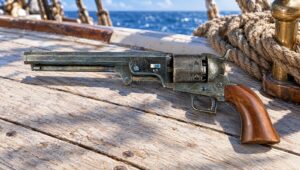 |
THE PREWAR FAVORITE
Colt 1851 Navy
Shooters who want the classic Colt Navy in its original .36 caliber. |
Type: Revolver Caliber: .36 percussion Carried by: Both sides |
Check Price ↓ |
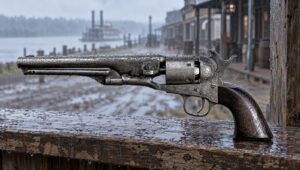 |
THE STREAMLINED NAVY
Colt 1861 Navy
Collectors who want a Navy Colt that most people don’t already own. |
Type: Revolver Caliber: .36 percussion Carried by: Both sides |
Check Price ↓ |
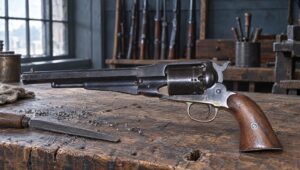 |
THE SOLID-FRAME RIVAL
Remington 1858 New Model Army
Shooters who want the sturdiest cap-and-ball revolver of the war. |
Type: Revolver Caliber: .44 percussion Carried by: Union |
Check Price ↓ |
 |
THE OFFICER’S POCKET GUN
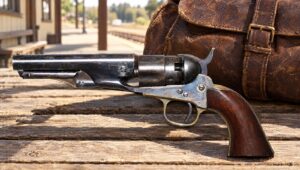
Colt 1862 Police
Collectors who want a small, elegant Civil War Colt. |
Type: Revolver Caliber: .36 percussion Carried by: Union |
Check Price ↓ |
 |
THE GRAPESHOT REVOLVER
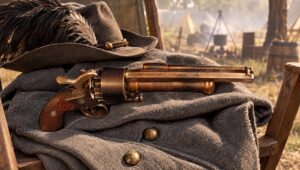
LeMat Revolver
Collectors who want the most famous Confederate revolver. |
Type: Revolver Caliber: .42 or .36 plus a smoothbore shot barrel Carried by: Confederate |
Check Price ↓ |
Table of Contents
What Guns Were Used in the Civil War?
The most common Civil War guns were rifled muskets. The Springfield Model 1861 and the British Pattern 1853 Enfield both fired the Minie ball, a hollow-based lead bullet that slid down a rifled barrel and expanded to grip the rifling. More than 1,000,000 Model 1861s were made, and an estimated 900,000 Enfields were imported.
Early in the war plenty of men still carried old smoothbores. A British survey found nearly 70% of the western Confederate forces armed with smoothbore muskets at first, and more than 75% had a rifle later in the war, mostly Enfields. Here’s which side carried the 14 guns on this list.
| Side | Guns | Why |
|---|---|---|
| Mainly Union | Springfield 1861, Sharps carbine, Burnside carbine, Spencer, Henry, Colt 1860 Army, Remington 1858, Colt 1862 Police | The North made its own guns in volume and bought breechloaders and repeaters for its cavalry, though captured Sharps and Burnsides turned up in Confederate hands |
| Confederate | Whitworth, LeMat | The South imported most of its best guns through the blockade |
| Both sides | Enfield 1853, Lorenz, Colt 1851 Navy, Colt 1861 Navy | Imports, captured guns and prewar Colts turned up in both armies |
Civil War Rifles: The Rifled Muskets the Infantry Carried
Most Civil War rifles were rifled muskets, long muzzleloaders that fired a .58 or .577 Minie ball. You loaded each one from the muzzle with a paper cartridge, then put a percussion cap on the nipple.
The Minie ball Americans fired owed a lot to James H. Burton, an armorer at the Harpers Ferry Armory who deepened the hollow in its base so it gripped the rifling better.
1. Springfield Model 1861: The Union Standard
- Caliber: .58, Minie ball
- Action: Percussion muzzleloader, single shot
- Made: More than 1,000,000, at the national armory in Springfield, Massachusetts, and 20 contractors
- Carried by: Union infantry, the most widely used Union shoulder arm
| Category | Rating |
|---|---|
| History | 5/5 |
| Shootability | 4/5 |
| Easy to Buy | 5/5 |
Pros
- The most-used Union infantry rifle
- Reproductions ship as antiques
- Rugged, simple flip-up sights
Cons
- Slow to load from the muzzle
- Sights only reach 500 yards
- Long and heavy to carry
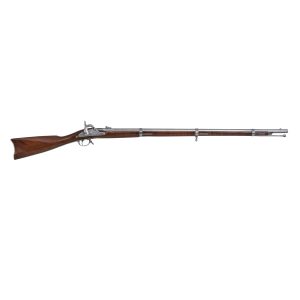
The Model 1861 was the most widely used Union shoulder weapon of the war, and more than 1,000,000 were made. The national armory at Springfield, Massachusetts, built them for about $15 each and contracted out to twenty other firms, including Colt. The old armory is now a National Park Service historic site.
It was good out to 200 to 400 yards in the average soldier’s hands, and marksmen could hit a man at 500. It dropped the Maynard tape primer of the Model 1855, because plain percussion caps worked better in wet weather.
Palmetto State Armory lists the Traditions 1861 Springfield at $1,019.99, and there’s a second version on the card at $1,294.99. Our traditional muzzleloaders roundup covers other percussion rifles.
Best For: Reenactors and shooters who want the rifle most Union soldiers actually carried.
2. Pattern 1853 Enfield: The Blockade Runner
- Caliber: .577, Minie-type bullet
- Action: Percussion muzzleloader, single shot
- Made: In Britain from 1853, more than 900,000 imported into America
- Carried by: Both sides, and the Confederacy’s most-imported arm
| Category | Rating |
|---|---|
| History | 5/5 |
| Shootability | 4/5 |
| Easy to Buy | 2/5 |
Pros
- Second most-used gun of the war
- Ladder sights reach 900 yards
- Beautifully made British rifle
Cons
- Reproductions are hard to find
- Originals cost more than Springfields
- Needs .577, not .58
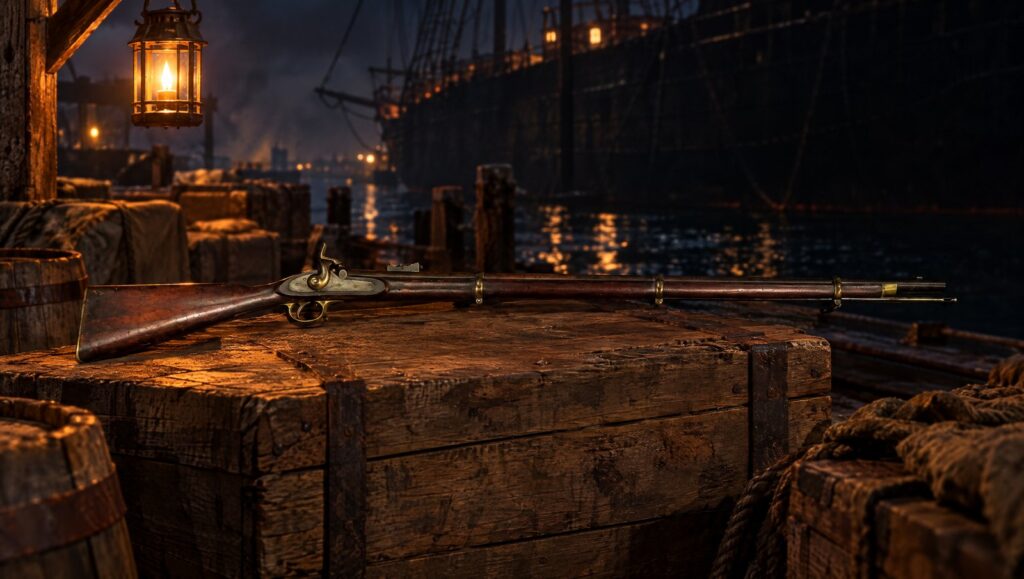
The Enfield was the second most widely used infantry weapon of the war, behind only the Springfield. The Confederacy imported more Enfields than any other small arm, buying from private contractors and smuggling them through the blockade.
It’s estimated that over 900,000 came into America, and they fought in every major battle from Shiloh to the end of the war. Its 39-inch barrel had three-groove rifling, and its ladder sight was graduated to 900 yards, though few soldiers were trained to use it that far.
Pedersoli and Armi Sport both make an Enfield reproduction, but none of our dealers had one when I checked, so there’s no price card here. Look for them at black powder specialists, and see our guide on where to buy vintage guns before you buy an original.
Best For: Collectors who want the rifle that armed the Confederate infantry.
3. Lorenz Rifle: The Austrian Import
- Caliber: .54, some bored to .58 for the Union
- Action: Percussion muzzleloader, single shot
- Made: In Austria from 1854
- Carried by: Both sides, the third most-used rifle of the war
| Category | Rating |
|---|---|
| History | 4/5 |
| Shootability | 4/5 |
| Easy to Buy | 3/5 |
Pros
- Third most-used rifle of the war
- Armed the Army of Tennessee
- Reproductions ship as antiques
Cons
- Quality varied a lot
- Priciest musket reproduction here
- Less famous than the big two
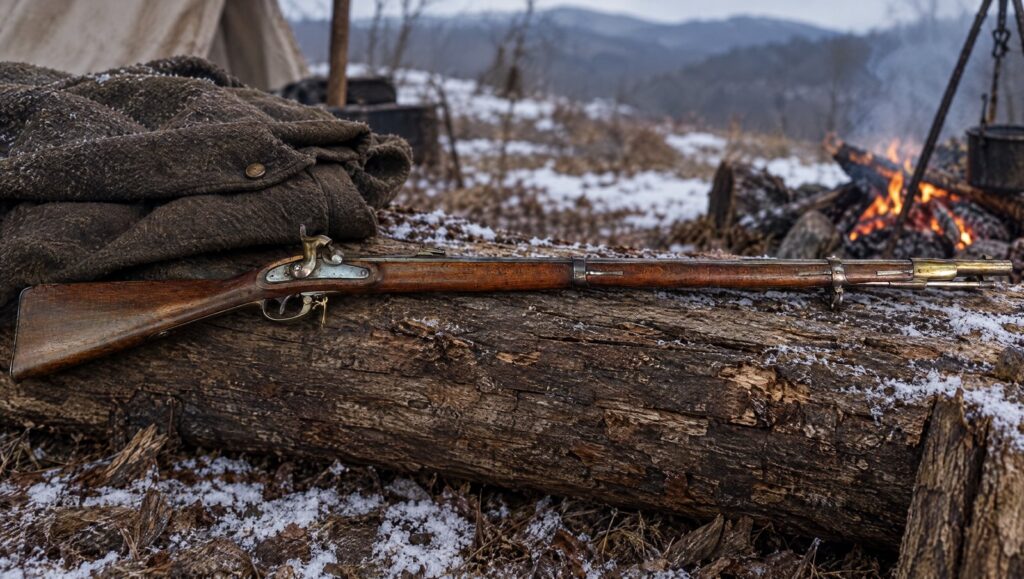
Austria adopted the Lorenz in 1854, and it became the third most widely used rifle of the Civil War. The Union bought about 226,000 of them and the Confederates as many as 100,000.
In the western theater it was the most used rifle of the Confederate Army of Tennessee. Some Union rifles were bored out from .54 to .58 so they could share ammunition with the Springfield.
Palmetto State Armory lists Taylor’s Lorenz Infantry at $1,931.99, and Battlehawk Armory had one at $1,434.99 when I checked.
Best For: Western-theater reenactors and anyone collecting both sides of the war.
Breechloaders and Repeaters
The guns that pointed at the future. Well-trained troops could get off about three aimed shots a minute with a Springfield 1861, so a breechloader, and then a seven-shot repeater, changed the math fast. Union cavalry got breech-loading carbines first, then the Spencer and Henry repeaters that fired metallic cartridges.
4. Sharps Rifle and Carbine: The Cavalry Breechloader
- Caliber: .52
- Action: Falling-block breechloader, percussion
- Made: Almost 90,000 carbines
- Carried by: Union cavalry mainly, the most common cavalry arm by 1863
| Category | Rating |
|---|---|
| History | 5/5 |
| Shootability | 4/5 |
| Easy to Buy | 3/5 |
Pros
- Loaded from the breech, lying down
- Most common Union cavalry arm
- Legendary long-range accuracy
Cons
- Civil War models not on our cards
- Postwar 1874 is a cartridge gun
- Originals are expensive
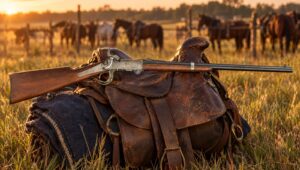
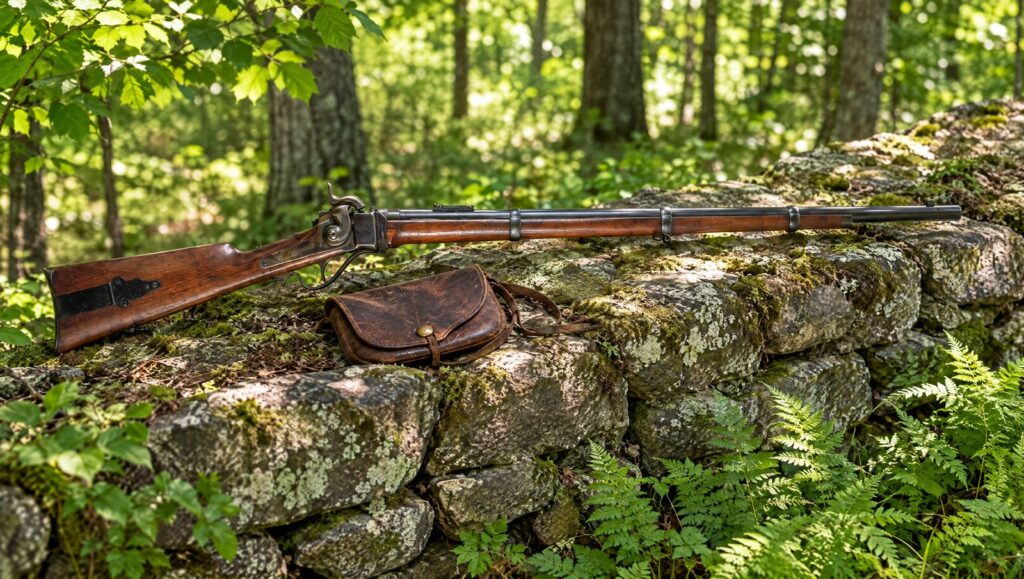
Christian Sharps designed his falling-block breechloader in 1848, and the carbine version was a hit, with almost 90,000 made. By 1863 it was the most common weapon in Union cavalry regiments, until Spencers replaced many of them in 1864.
The rifle in the photo is a Model 1859, the kind carried by the 5th New York Zouaves. Some Civil War carbines even had a small hand-cranked grinder built into the stock, long called a coffee mill, though tests suggest it was meant for grain or charcoal.
Our dealers didn’t have a Civil War Sharps reproduction when I checked. The card shows Pedersoli’s postwar 1874 Cavalry Carbine instead, at $1,896.70 from Battlehawk Armory, and that one is a cartridge gun. Our classic American rifles list covers the 1874.
Best For: Collectors who want the carbine Union cavalry rode with before the Spencer.
5. Burnside Carbine: The General’s Carbine
- Caliber: .54, copper or foil-cased cartridge
- Action: Breechloader, percussion ignition
- Made: Over 55,000 bought by the Union
- Carried by: Union cavalry, and captured ones by Confederates
| Category | Rating |
|---|---|
| History | 4/5 |
| Shootability | 3/5 |
| Easy to Buy | 1/5 |
Pros
- Third most popular carbine of the war
- Designed by a future Union general
- Early metallic-cased cartridge
Cons
- No reproduction on our cards
- Odd cartridges are hard to make
- Overshadowed by Sharps and Spencer
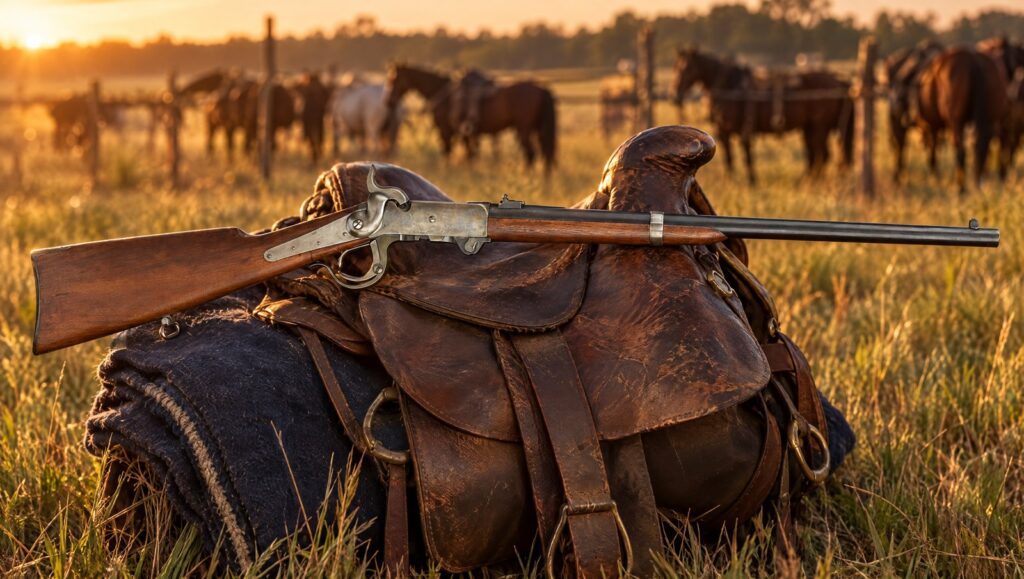
Ambrose Burnside designed this carbine in the 1850s, and it beat 17 other designs in a competition at West Point in 1857. When the war came, the Union bought over 55,000 of them for its cavalry.
That made it the third most popular carbine of the war, behind only the Sharps and the Spencer. An estimated 43 Union cavalry regiments used it in 1863 and 1864, and at least 7 Confederate cavalry units carried captured ones.
Burnside himself went on to command the Army of the Potomac, with mixed results. No dealer on our network had a Burnside reproduction when I checked, so originals from antique dealers are the way to own one.
Best For: Collectors of Union cavalry arms who want something less common than a Sharps.
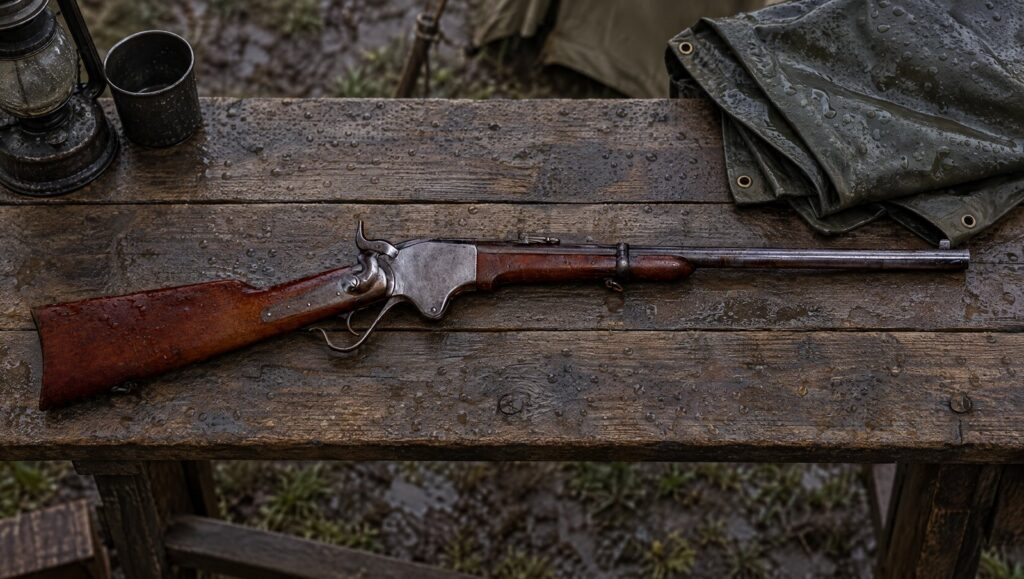
6. Spencer Repeating Rifle: The Seven-Shot Repeater
- Caliber: .56-56 Spencer rimfire
- Action: Lever action, 7-round tube magazine in the stock
- Made: Over 200,000, 1860 to 1869
- Carried by: Union cavalry and mounted infantry
| Category | Rating |
|---|---|
| History | 5/5 |
| Shootability | 4/5 |
| Easy to Buy | 4/5 |
Pros
- First military metallic-cartridge repeater
- Seven shots from a stock tube
- Chiappa makes a faithful copy
Cons
- Reproductions cost about $2,000
- Our dealers had no loaded .56-50
- Originals need handloaded ammo
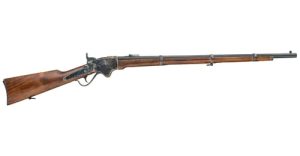
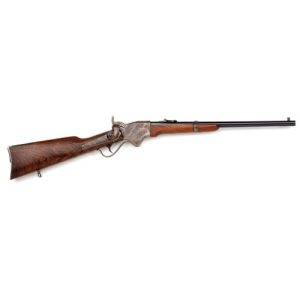
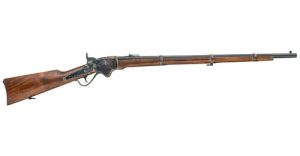
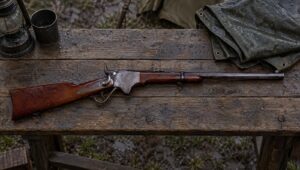
The Spencer was the world’s first military metallic-cartridge repeating rifle, and over 200,000 were made between 1860 and 1869. The Navy adopted it first, then the Army, and by the end of the war it gave Union cavalry a firepower edge the South couldn’t match. Custer’s Michigan Brigade carried Spencers in the Gettysburg campaign, at Hanover and East Cavalry Field.
At the Battle of Nashville, 9,000 Union mounted infantrymen carried Spencers. The Confederates captured some, but they couldn’t make the copper cartridges to feed them. The carbine in the photo is the late-war Model 1865.
Guns.com lists Chiappa’s 1860 Spencer at $2,119.99, and Midway USA has one in the late-war .56-50 Spencer chambering at $2,099. Our guns ahead of their time list covers the Spencer’s place in history.
Best For: Shooters who want to run the lever on the gun that changed cavalry warfare.
7. Henry Rifle: The Sixteen-Shooter
- Caliber: .44 Henry rimfire
- Action: Lever action, 16-shot tube magazine
- Made: About 14,000, 1860 to 1866
- Carried by: Union soldiers, most bought privately
| Category | Rating |
|---|---|
| History | 5/5 |
| Shootability | 5/5 |
| Easy to Buy | 5/5 |
Pros
- Sixteen shots before reloading
- Father of the Winchester lever gun
- Several good reproductions available
Cons
- Government bought only 1,731
- No bayonet, no forend
- Originals cost a fortune
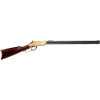
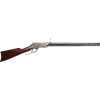
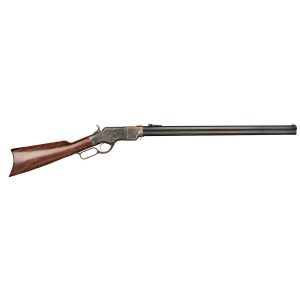
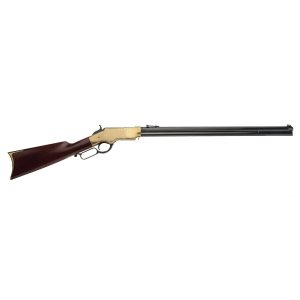
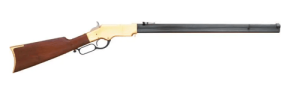
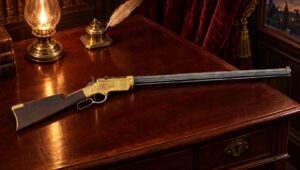
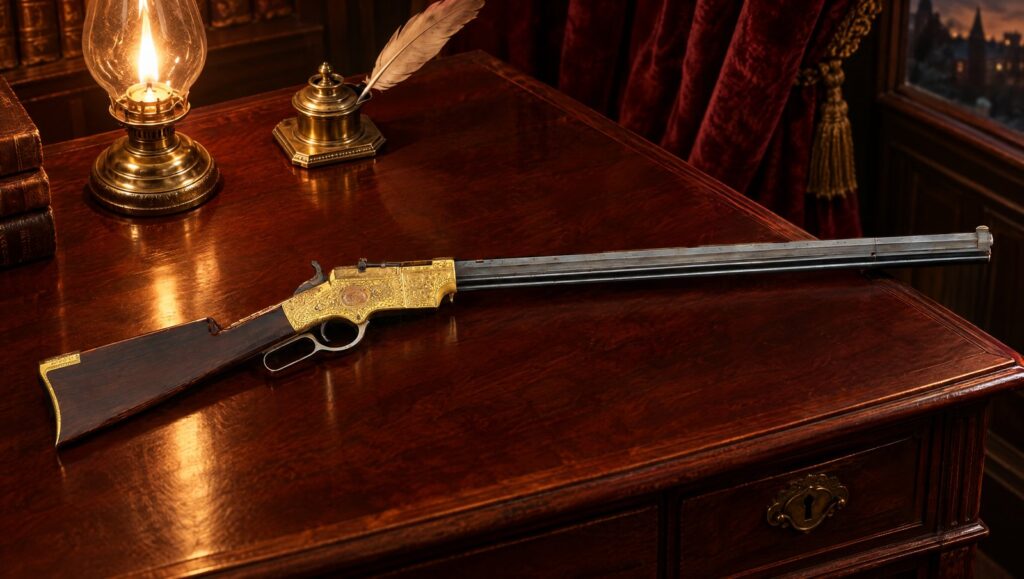
Benjamin Tyler Henry patented his sixteen-shot lever action in 1860, and New Haven Arms made about 14,000 up to 1866. The government bought just 1,731, but over 10,000 saw service, because soldiers bought them with their own money.
One Ohio sharpshooter paid a steamboat captain $65 for his just before the Vicksburg campaign, about $1,700 in today’s money. The rifle in the photo is serial number 6, engraved and presented to President Abraham Lincoln.
Palmetto State Armory lists Cimarron’s steel-frame 1860 Henry at $1,564.99, and Classic Firearms had the brass-frame version at $1,513.10 when I checked. Our best lever action rifles roundup covers what came after it.
Best For: Lever-action fans who want the rifle that started it all.
The Sharpshooter’s Rifle
One rifle earned a reputation all its own, and it belonged to the Confederacy.
8. Whitworth Rifle: The Confederate Sniper Rifle
- Caliber: .45, hexagonal bore
- Action: Percussion muzzleloader, single shot
- Made: In England, from the late 1850s
- Carried by: Confederate Whitworth sharpshooters
| Category | Rating |
|---|---|
| History | 5/5 |
| Shootability | 4/5 |
| Easy to Buy | 3/5 |
Pros
- Hit targets at 2,000 yards
- The famous Confederate sharpshooter rifle
- Reproductions are precision target rifles
Cons
- Originals sell for six figures
- Needs its own hexagonal bullets
- Second-priciest reproduction here
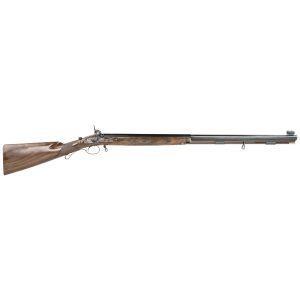
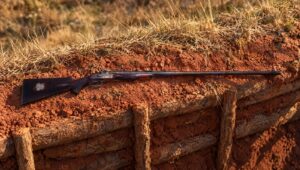
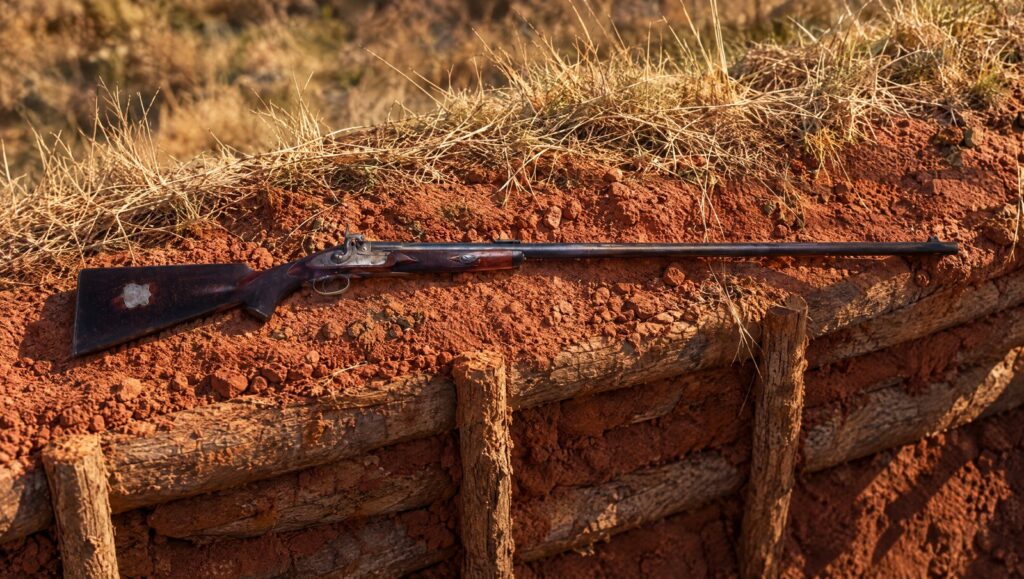
Joseph Whitworth’s rifle used a twisted hexagonal bore instead of grooves, with a tight 1-in-20 twist. In British trials it hit a target at 2,000 yards, where the Enfield could only reach 1,400.
Confederate Whitworth sharpshooters used it to pick off Union artillery crews, and one is widely credited with killing Major General John Sedgwick at Spotsylvania on May 9, 1864. A surviving Confederate Whitworth sold at auction in 2017 for a hammer price of $161,000.
The photo shows a Whitworth patent target rifle from 1871. Palmetto State Armory lists Taylor’s Mortimer Whitworth percussion rifle at $2,002.99, and Battlehawk Armory had one at $1,860.58.
Best For: Long-range black powder shooters who want the most accurate rifle of the war.
Civil War Revolvers
Most Civil War revolvers were cap-and-ball guns, loaded from the front of the cylinder with powder, a ball and a cap on each nipple. Here are six of them, from the Colts every cavalryman wanted to the Confederate LeMat, whose cylinder turns on a shotgun barrel.
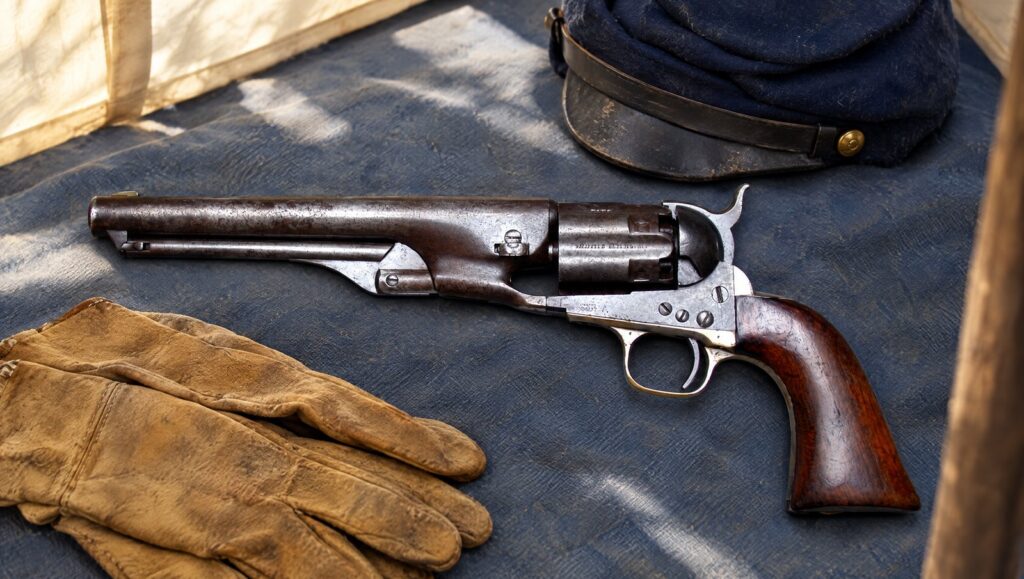
9. Colt 1860 Army: The Union Cavalry Revolver
- Caliber: .44 percussion
- Action: Single action, six-shot cap-and-ball cylinder
- Made: More than 200,000, 1860 to 1873
- Carried by: Union army, its most-used revolver
| Category | Rating |
|---|---|
| History | 5/5 |
| Shootability | 4/5 |
| Easy to Buy | 5/5 |
Pros
- The most-used Union revolver
- Slim, fast-pointing frame
- Replicas cost under $450
Cons
- Barrel off to swap cylinders
- Open top is less rigid
- Slow cap-and-ball loading
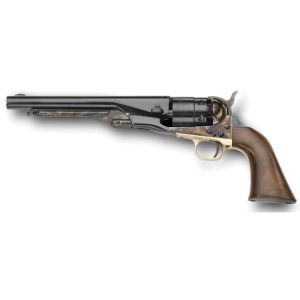
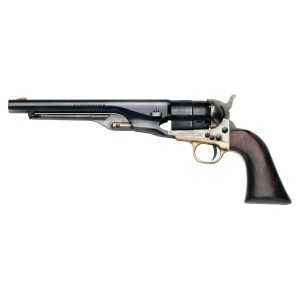
The 1860 Army was the most widely used revolver of the Union forces, and the government bought at least 129,730 of them. More than 200,000 were made before 1873, and by April 1861, 2,230 of the earliest ones had gone to dealers in the South.
It used the same size frame as the 1851 Navy and had no top strap over the cylinder, which made it slimmer and lighter than the Remington. The catch is that you have to take the barrel off to change the cylinder.
Palmetto State Armory lists Pietta’s case-hardened 1860 Army at $376.99, and Battlehawk Armory had the same revolver at $334.47. Our Colt Single Action Army guide covers the Colt that replaced it in 1873.
Best For: Anyone who wants the revolver a Union cavalryman most likely carried.
10. Colt 1851 Navy: The Prewar Favorite
- Caliber: .36 percussion
- Action: Single action, six-shot cap-and-ball cylinder
- Made: About 215,000 in America and 42,000 in London
- Carried by: Officers and cavalry on both sides
| Category | Rating |
|---|---|
| History | 5/5 |
| Shootability | 4/5 |
| Easy to Buy | 5/5 |
Pros
- Carried on both sides of the war
- Light and well balanced
- Replicas are cheap
Cons
- Lighter .36 caliber
- Octagon barrel adds front weight
- Many replicas are fantasy variants
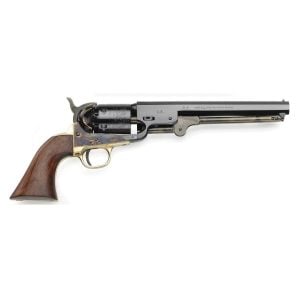
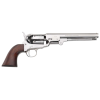
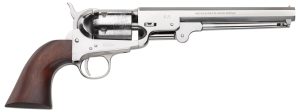
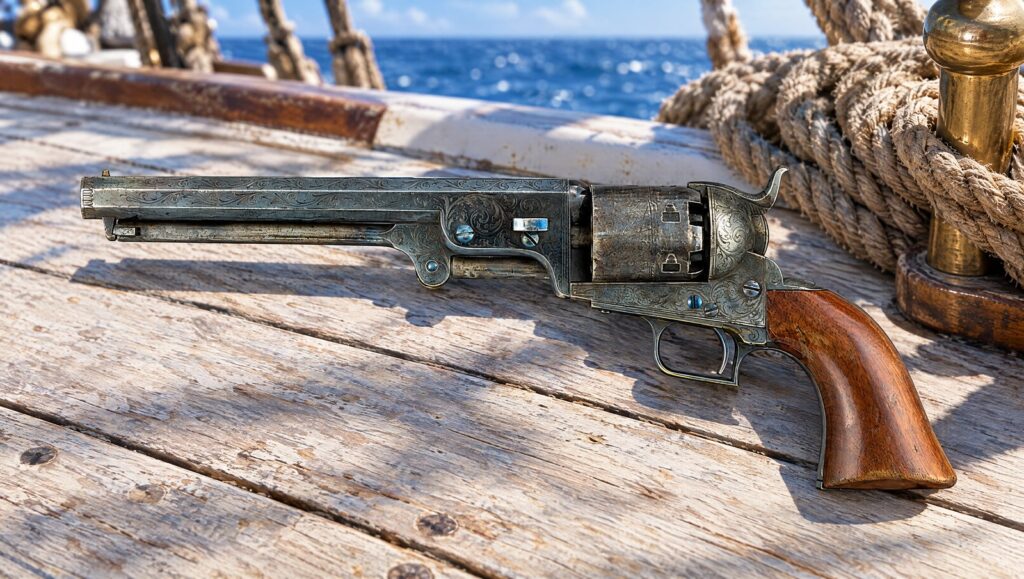
The 1851 Navy was a decade old when the war started, so men on both sides already owned one. Colt made about 215,000 in America and another 42,000 at its London armory.
Its .36 ball hit about as hard as a modern .380. The cylinder is engraved with the Texas Navy’s victory at Campeche in 1843, and the photo shows serial number 2.
Palmetto State Armory lists Pietta’s 1851 Navy London in .36 at $344.99. Skip the brass-frame and .44 versions if you want one that matches the original.
Best For: Shooters who want the classic Colt Navy in its original .36 caliber.
11. Colt 1861 Navy: The Streamlined Navy
- Caliber: .36 percussion
- Action: Single action, six-shot cap-and-ball cylinder
- Made: 38,000, 1861 to 1873
- Carried by: Cavalry and officers on both sides
| Category | Rating |
|---|---|
| History | 4/5 |
| Shootability | 4/5 |
| Easy to Buy | 4/5 |
Pros
- Round barrel, creeping loading lever
- Lighter recoil than the Army
- Rarer original than the 1851
Cons
- Far fewer made than the 1851
- Still only .36 caliber
- Replicas cost more than 1851s
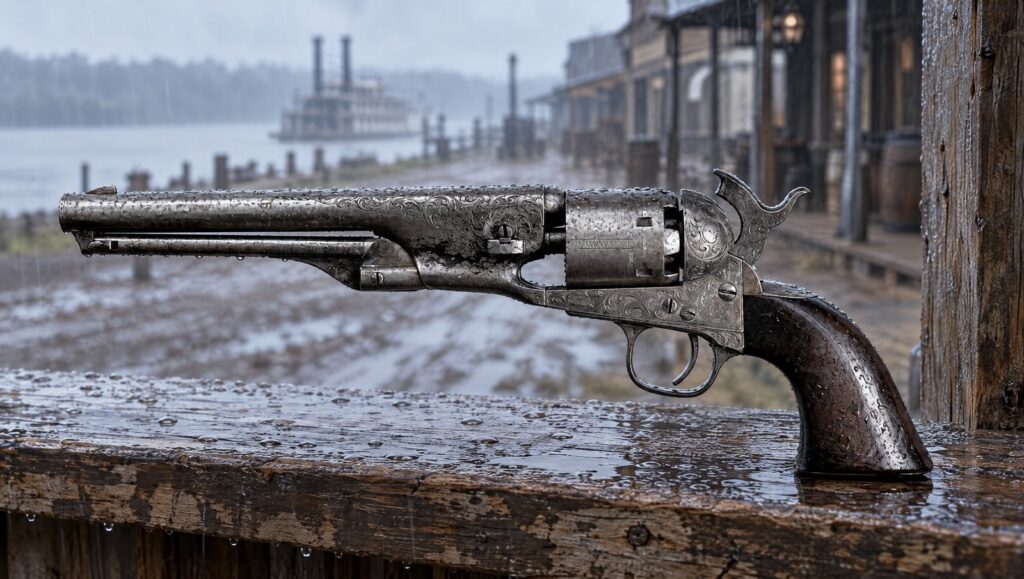
The 1861 Navy took the round barrel and creeping loading lever of the 1860 Army and put them on the .36-caliber Navy frame. Colt made 38,000 of them before 1873.
Some cavalry troopers preferred it to the 1860 Army because the lighter .36 kicked less. It was built to load nitrated paper cartridges that burned away completely when it fired.
Farnsworth Firearms lists Cimarron’s 1861 Navy Civilian at $353.50, and Kentucky Gun Co had one at $427.21 when I checked.
Best For: Collectors who want a Navy Colt that most people don’t already own.
12. Remington 1858 New Model Army: The Solid-Frame Rival
- Caliber: .44 percussion
- Action: Single action, six-shot cap-and-ball, solid frame
- Made: Remington-Beals from 1860, New Model 1863 to 1875
- Carried by: Union army, heavily after 1864
| Category | Rating |
|---|---|
| History | 4/5 |
| Shootability | 5/5 |
| Easy to Buy | 5/5 |
Pros
- Solid top strap, very rigid
- Cylinder swaps without tools
- Tough, easy-to-clean replica
Cons
- Barrel can’t come off to clean
- Heavier than the Colt
- Second choice until 1864
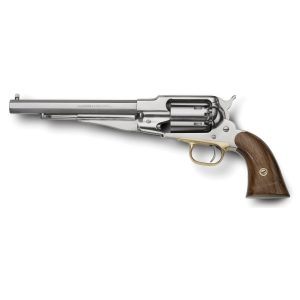
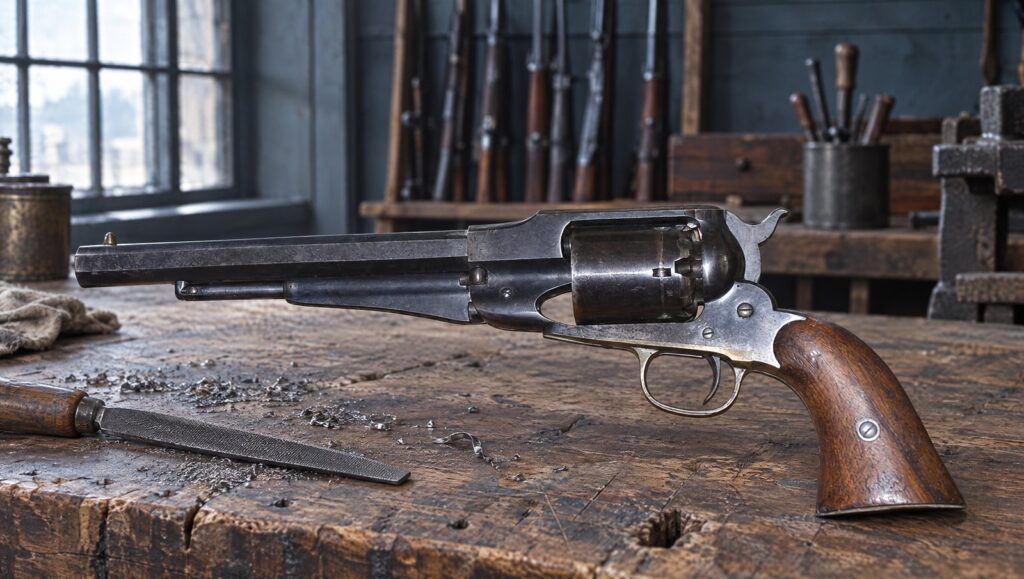
Remington offered its .44 revolver to the government at $15, which was $10 less than Colt was charging. It stayed a secondary issue until a fire at the Colt factory in 1864 left the Army short of 1860s.
The solid frame with a top strap is stronger than the open-top Colt, and you can swap the cylinder by pulling one pin. The downside is that the barrel doesn’t come off for cleaning.
Palmetto State Armory lists Pietta’s 1858 Remington Army at $386.99, and Sportsman’s Warehouse has one at $409.99. Our classic revolvers list covers it too.
Best For: Shooters who want the sturdiest cap-and-ball revolver of the war.
13. Colt 1862 Police: The Officer’s Pocket Gun
- Caliber: .36 percussion
- Action: Single action, five-shot fluted cylinder
- Made: About 28,000, 1861 to about 1873
- Carried by: Union officers and civilians
| Category | Rating |
|---|---|
| History | 4/5 |
| Shootability | 3/5 |
| Easy to Buy | 4/5 |
Pros
- Small, handsome pocket revolver
- Five shots of .36
- Replicas under $450
Cons
- Only five rounds
- Small grip for big hands
- Not a front-line weapon
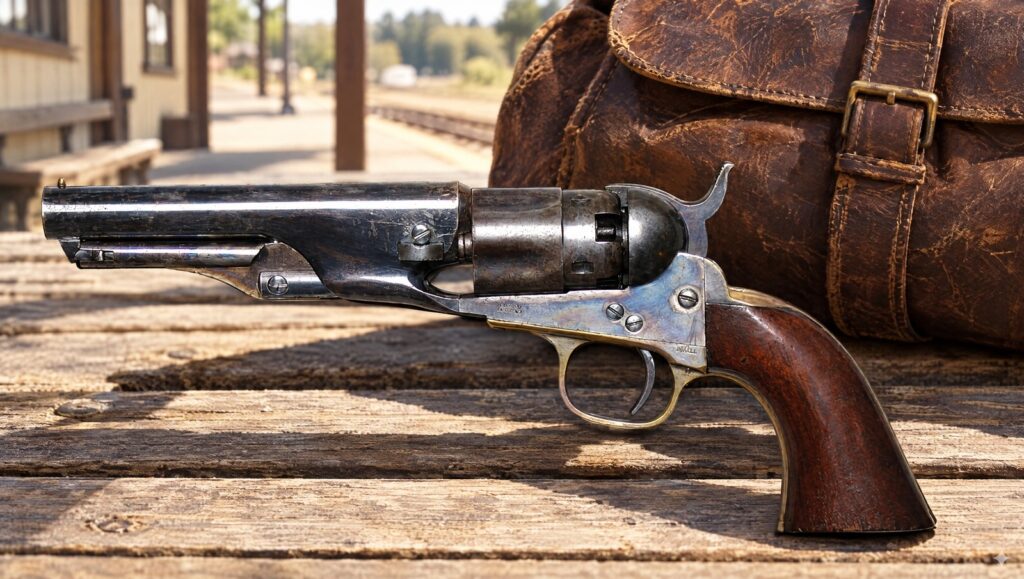
The 1862 Police was Colt’s pocket-sized .36, and about 28,000 were made from 1861 to about 1873. It shared serial numbers with the 1862 Pocket Navy, so originals turn up numbered as high as 47000.
The NRA National Firearms Museum shows one in its case of Union pistols and revolvers. It’s a lovely little revolver with a fluted five-shot cylinder.
Kentucky Gun Co lists Uberti’s 1862 Police at $437.99.
Best For: Collectors who want a small, elegant Civil War Colt.
14. LeMat Revolver: The Grapeshot Revolver
- Caliber: .42 cylinder, .63 smoothbore barrel on early guns
- Action: Single action, cap-and-ball with a shot barrel
- Made: About 2,900, in Liege and Paris
- Carried by: Confederate officers and cavalry
| Category | Rating |
|---|---|
| History | 5/5 |
| Shootability | 3/5 |
| Easy to Buy | 3/5 |
Pros
- A revolver with a shotgun barrel
- Pure Confederate history
- Taylor’s replica is well made
Cons
- Heavy and awkward
- Costs three times a Colt replica
- Loading both barrels is slow
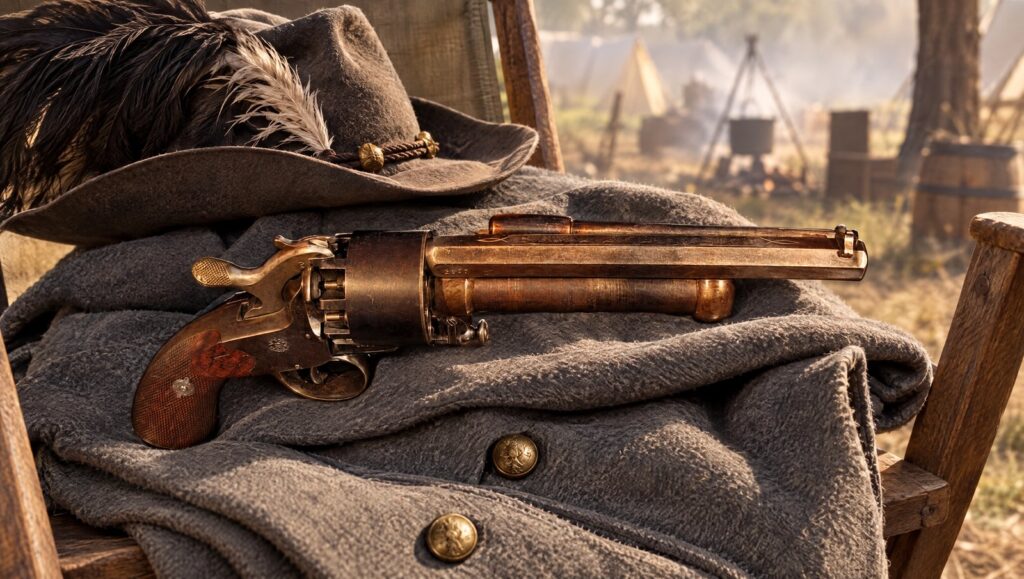
Jean Alexandre Le Mat of New Orleans developed this revolver in 1856 with backing from P.G.T. Beauregard, who became a Confederate general. A smoothbore barrel under the main barrel fired a load of shot.
About 2,900 were made in Liege and Paris. About 900 went to the Confederate Army and 600 to the Navy through Bermuda, and some estimates put the total in Confederate hands near 2,500.
GrabAGun lists Taylor’s LeMat Cavalry at $1,103.99. It’s the most expensive revolver on this list and the most fun to show off.
Best For: Collectors who want the most famous Confederate revolver.
Can You Buy a Civil War Gun Today?
Yes, and most of them ship straight to your door. Federal law treats a replica of a pre-1899 gun as an antique if it can’t fire conventional fixed ammunition, and it covers muzzleloaders built for black powder the same way. That means every percussion reproduction on this list is an antique as sold under 18 U.S.C. 921(a)(16), unless it’s built on a modern frame or receiver or fitted to fire cartridges.
| Guns | What you buy | Federal status |
|---|---|---|
| Springfield 1861, Lorenz, Whitworth | Percussion rifle reproduction | Antique under federal law, no FFL needed |
| Colt 1860 Army, 1851 Navy, 1861 Navy, 1862 Police, Remington 1858, LeMat | Percussion revolver replica | Antique under federal law, no FFL needed |
| Henry, Spencer, Sharps 1874 | Cartridge reproduction | Modern firearm, ships to an FFL |
| Any original made in or before 1898 | Original | Antique under federal law, no FFL needed |
The cartridge reproductions are different. A Henry or Spencer chambered for .45 Colt or .44-40 is a modern firearm and ships to a dealer like any other gun. And some states and cities regulate black powder guns anyway, so check your local law before you order.
What Civil War Guns Cost Then and Now
Here’s what a few of these guns cost in the 1860s, next to what a reproduction or an original costs today.
| Gun | In the 1860s | Today |
|---|---|---|
| Springfield 1861 | About $15 each at the national armory in Springfield | $1,019.99 for a Traditions reproduction |
| Remington 1858 | $15 each, offered to the government | $386.99 for a Pietta replica |
| Colt 1860 Army | About $25 each to the government | $376.99 for a Pietta replica |
| Henry rifle | $65 paid by one Ohio sharpshooter | $1,564.99 for a Cimarron reproduction |
| Whitworth rifle | Made in England and imported | $161,000 hammer price for an original in 2017 |
Remington undercut Colt by $10 a revolver, but its big Army orders only came after Colt’s factory burned in 1864. And a Henry cost a soldier $65 of his own money, which is why so many of them were bought with reenlistment bounties in 1864. For what an original is worth today, see our guide to gun values.
Ammo for the Cartridge Reproductions
The percussion guns only need black powder or a substitute, caps and lead balls or Minie bullets. The cartridge reproductions need loaded ammo, and here’s how many listings of it our dealer network had on September 29, 2026.
| Cartridge | Guns | Ammo listings | Dealers carrying it |
|---|---|---|---|
| .45 Colt | Henry and Spencer reproductions | 285 | 14 |
| .45-70 Government | Pedersoli 1874 Sharps | 270 | 15 |
| .44-40 Winchester | Henry and Spencer reproductions | 48 | 12 |
| .56-50 Spencer | Chiappa Spencer in the late-war chambering | 0 | 0 |
| .44 Henry rimfire | Original Henry rifles | 0 | 0 |
Buy your Henry or Spencer reproduction in .45 Colt or .44-40 if you want to shoot it much. A Spencer in the late-war .56-50 is a handloader’s gun, because none of our dealers had a single box.
Buying Civil War Guns: What to Check
- Original or reproduction. Italian makers like Pedersoli, Uberti, Pietta and Armi Sport build most reproductions, and some are aged to look original. A reputable antique dealer will tell you which is which, in writing.
- Never shoot an original without a gunsmith’s okay. A 160-year-old barrel can hide rust, cracks and old loads. Have it checked before it goes anywhere near powder.
- Black powder only. Percussion guns are built for black powder or a substitute made for them. Smokeless powder can blow one apart.
- Check the caliber. An Enfield is .577 and a Springfield is .58, so buy balls and bullets sized for your gun.
- Know your state. Federal law treats percussion reproductions as antiques, but a few states and cities have their own rules for black powder guns.
- Watch for fantasy variants. Brass-frame Colt Navies, .44 Navies and snub-nose Sheriff models are fun, but they aren’t what soldiers carried. Our best black powder revolvers guide covers which replicas are faithful.
How I Picked These 14 Civil War Guns
I picked the Civil War guns that mattered most on the battlefield and that you can still buy, as a reproduction or an original. I checked what our 200+ retailers had on September 29, 2026, and each price card says whether it shows a percussion reproduction or a cartridge one.
History comes from the Smithsonian’s National Museum of American History, the NRA National Firearms Museum and published histories of each gun. For more on pre-1899 originals, see our antique firearms guide, and for the wars that followed, see our WW1 guns list.
Photos: each gun is a real museum or Wikimedia Commons photograph, credited under it, placed in a period scene. The featured image is built around a photo of the Colt 1860 Army of Col. Charles G. Stifel, public domain.
The Bottom Line
If you want one Civil War gun to shoot, start with a Pietta 1860 Army for under $400, because it’s the revolver the Union carried most and it ships as an antique. For a long gun, the Traditions 1861 Springfield is the rifle most Union soldiers actually carried. And if you want a repeater, a Henry reproduction in .45 Colt is the most fun you can have with the history.
Frequently Asked Questions
What guns were used in the Civil War?
The most common Civil War guns were rifled muskets, led by the Springfield Model 1861 and the British Pattern 1853 Enfield, with the Austrian Lorenz third. Cavalry carried breech-loading carbines like the Sharps and Burnside and later the Spencer repeater, and both sides used Colt and Remington cap-and-ball revolvers.
What was the most common rifle in the Civil War?
The Springfield Model 1861 rifled musket. More than 1,000,000 were made, and it was the most widely used Union shoulder weapon. The Enfield 1853 was second, with an estimated 900,000 imported.
What guns did the Confederates use?
The Confederates relied on imports, above all the British Enfield 1853, which they imported more than any other small arm. They also used the Austrian Lorenz, captured Springfields, Colt revolvers, the LeMat revolver and the Whitworth rifle for their sharpshooters.
What was the best gun in the Civil War?
For firepower, the Spencer repeater, which let Union cavalry fire seven shots without reloading. For accuracy, the Whitworth rifle, which hit targets at 2,000 yards in trials. For most soldiers, the Springfield 1861 was simply the gun that did the job.
What revolver was most used in the Civil War?
The Colt 1860 Army. The Union government bought at least 129,730 of them, and it was the most widely used revolver of the Union forces. The Remington 1858 became the main alternative after a fire at the Colt factory in 1864.
Can you buy a real Civil War gun?
Yes. Originals made in or before 1898 are antiques under federal law and can ship without an FFL, subject to state and local law. Antique dealers and auction houses sell them. Most people buy a reproduction, and percussion reproductions are also antiques under federal law.
Do you need an FFL to buy a Civil War reproduction?
Not for a percussion reproduction like a Springfield 1861 or a Pietta 1860 Army, which federal law treats as an antique. Cartridge reproductions like a Henry or Spencer in .45 Colt are modern firearms and ship to an FFL. Some states have their own rules, so check yours.
What is a Minie ball?
A Minie ball is a conical lead bullet with a hollow base that expands when fired to grip the rifling. It let soldiers load a rifled musket as fast as a smoothbore, and both the Springfield 1861 and the Enfield 1853 fired it.
How far could a Civil War rifle shoot?
A Springfield 1861 was effective at 200 to 400 yards for the average soldier, and marksmen could hit a man at 500 yards. The Enfield sights reached 900 yards, and a Whitworth hit targets at 2,000 yards in British trials.
What was the first repeating rifle in the Civil War?
The first lever-action repeaters were the Spencer and the Henry, though Colt revolving rifles saw service earlier. The Spencer was the first military metallic-cartridge repeating rifle and held seven rounds. The Henry held sixteen, but the government bought only 1,731, so most were bought privately by soldiers.
How much is an original Civil War rifle worth?
It depends on the model, condition and history. Common rifled muskets cost far less than rare guns, and a documented Confederate Whitworth sold for a $161,000 hammer price in 2017. Auction results for the same model are the best guide.
4,715+ Gun & Ammo Deals
Updated daily from 200+ top retailers. Filter by category, caliber, action type, and price.