

Last updated and checked October 28, 2026 · By Nick Hall, firearm enthusiast familiar with military-spec and civilian-market differences
Some of the links below are affiliate links, meaning at no additional cost to you, we may earn a commission if you click through and make a purchase.
- Treat every gun as loaded
- Point the muzzle in a safe direction
- Keep your finger off the trigger until you’re ready to shoot
- Know your target and what’s beyond
Quick Answer: Military rifles are select-fire and built to NATO mil-spec standards; civilian firearms are semi-auto-only (with NFA exceptions for SBRs, suppressors, and registered machine guns) and built to commercial-grade standards that can equal or exceed mil-spec. The mechanical differences are smaller than most shooters assume.
Civilian-legal versions of military weapons (M16 → AR-15, M4 → AR-15 SBR or pistol, MP5 → HK SP5, M9 → Beretta 92FS) are dimensionally similar but lack full-auto fire control. Civilian semi-auto AR-15s use the same forged 7075-T6 receivers, mil-spec barrels, and BCGs as military M4s; the fire control group, built around the auto sear, is the difference that matters.
The biggest mistake new shooters make is assuming military-grade automatically means better quality than civilian premium offerings. Quality civilian manufacturers (BCM, Daniel Defense, Knights Armament, Geissele) build to specifications that meet or exceed mil-spec; the only consistent advantage of military firearms is the full-auto fire control mode that civilians cannot legally own without NFA registration.
Table of Contents
How we tested: Every pick here is ranked against our testing methodology. Minimum round counts, accuracy and reliability protocols, the failures that disqualify a gun.
Military vs Civilian Firearms: What’s Actually Different?
If you’ve spent any time watching the news, you’ve heard the phrase “weapons of war on our streets” about a hundred times. It’s almost always aimed at guns like the AR-15.
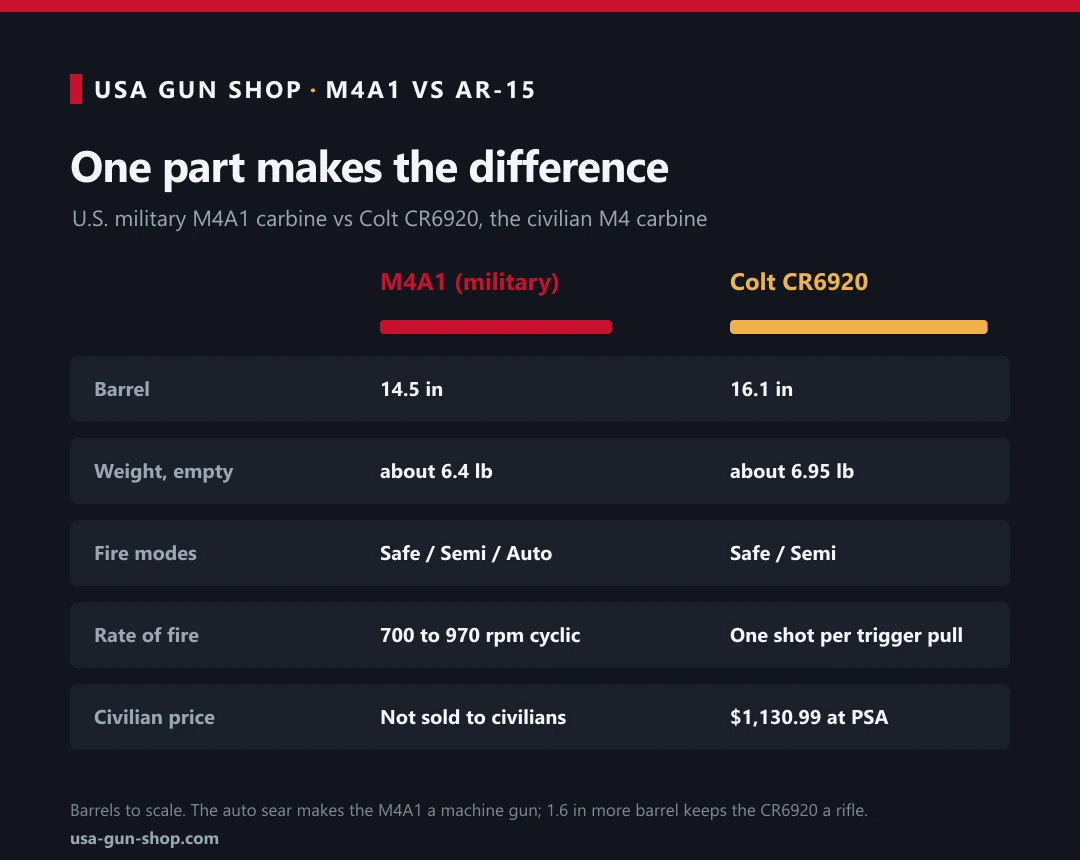
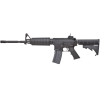
Here’s the reality: on the outside, a military M4A1 and a civilian AR-15 look almost the same, and the one difference that matters is fundamental. The core mechanical distinction between a military M4A1 and a civilian AR-15 is the difference between a machine gun and a regular semi-automatic rifle. One fires multiple rounds per trigger pull. The other fires one. That’s not a small detail. That’s the whole ballgame.
This guide breaks down every real difference between military and civilian firearms, compares specific models side by side, explains the federal laws that govern what civilians can and can’t own, and clears up the myths that keep getting repeated. If you’ve ever wanted a fact-based reference to point someone to when they call your AR-15 a “weapon of war,” this is it.
Select Fire vs Semi-Auto: The Core Mechanical Difference
The single biggest difference between military firearms and civilian firearms is the fire selector. Military rifles are select-fire, meaning the shooter can switch between semi-automatic (one round per trigger pull), burst (three rounds per trigger pull), and fully automatic (continuous fire as long as the trigger is held and there’s ammo in the magazine).
Civilian firearms sold in the United States are semi-automatic only. One trigger pull, one round. That’s it. This isn’t a minor modification or a loophole. The part that turns a rifle into a machine gun is the auto sear (ATF Ruling 81-4), working with a select-fire trigger group. Full-auto-profile bolt carriers are sold openly; it’s the auto sear and a select-fire lower that civilians can’t make or own outside the frozen pre-1986 registry under the National Firearms Act.
To put it in perspective: a fully automatic M4A1 has a cyclic rate of 700 to 970 rounds per minute. A civilian AR-15 fires as fast as you can pull the trigger, which for most shooters is somewhere around 45 to 60 rounds per minute. That’s not the same thing. Not even close.
Quick Reference: Fire Modes
- Semi-automatic: One trigger pull = one round fired. The action cycles automatically to chamber the next round. This is how virtually all civilian pistols, rifles, and shotguns work.
- Burst fire: One trigger pull = a fixed number of rounds (three). Used on the M16A2/A4 and some military pistols. Not available on civilian firearms.
- Fully automatic: Hold the trigger = continuous fire until release or empty magazine. Used on the M4A1, M249 SAW, and most military machine guns. Civilian ownership is heavily restricted to pre-1986 registered weapons only.
Military vs Civilian Firearms: Side-by-Side Comparisons
The best way to understand the differences is to compare specific military weapons to their closest civilian equivalents. These guns may look similar on the outside, but the internals and capabilities tell a very different story.
M4A1 Carbine vs Civilian AR-15
| Spec | M4A1 (Military) | AR-15 (Civilian) |
|---|---|---|
| Fire Modes | Safe / Semi / Full Auto | Safe / Semi only |
| Caliber | 5.56x45mm NATO | 5.56 NATO / .223 Rem |
| Barrel Length | 14.5″ (would be an SBR for a civilian) | 16″ federal minimum (Colt CR6920: 16.1″) |
| Rate of Fire (Auto) | 700 to 970 rpm | N/A (semi-auto only) |
| Effective Range | 500m (point target) | ~500m (similar ballistics) |
| Trigger Group | Select-fire with auto sear | Standard semi-auto FCG |
| Barrel Profile | SOCOM profile (heavier), chrome-lined, 1:7 twist | Varies (many options available) |
| Civilian Legal? | No (post-1986 machine gun) | Yes (in most states) |
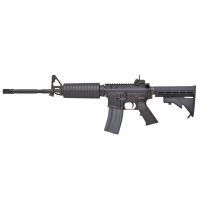
| Civilian Price | Not sold to civilians | Colt CR6920: $1,130.99 at Palmetto State Armory (MSRP $1,099) |
The M4A1 is the standard-issue carbine for the U.S. military. The civilian AR-15 looks almost identical externally, which is where 90% of the public confusion comes from. But the internals are fundamentally different. A civilian AR-15 cannot be converted to full auto by “flipping a switch” or any simple modification. The difference is the select-fire trigger group and the auto sear. Converting a civilian AR-15 to fire fully automatic is a federal felony carrying up to 10 years in prison.
For an in-depth look at the civilian side, see our 10 Best AR-15 Rifles guide, our complete history of the AR-15, and our breakdown of what “AR” actually stands for (hint: it’s not “assault rifle”). If you want to know why you actually need an AR-15, we covered that too.
M9/M9A1 vs Beretta 92FS (Civilian)
| Spec | M9A1 (Military) | Beretta 92FS (Civilian) |
|---|---|---|
| Fire Modes | Semi-auto (DA/SA) | Semi-auto (DA/SA) |
| Caliber | 9x19mm NATO | 9x19mm Luger |
| Capacity | 15 rounds | 15 rounds |
| Barrel Length | 4.9″ | 4.9″ |
| Weight | 33.9 oz (empty) | 33.3 oz (empty) |
| Key Difference | Sand-resistant magazine, PVD coating, accessory rail | Commercial finish, standard magazine |
| Civilian Legal? | The 92FS is essentially the same gun | Yes |
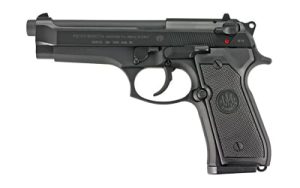
Here’s one that proves the point about perception vs reality. The M9 was selected in 1985, issued from 1986, and served as the standard U.S. military sidearm until the M17 replaced it starting in 2017, and the civilian Beretta 92FS is essentially the same firearm. Same caliber, same capacity, same semi-automatic action. The military version has some minor finish and magazine upgrades for harsh environments, but functionally they’re identical. Nobody calls the Beretta 92FS a “weapon of war,” yet it literally is the same weapon the military used for over 30 years. Check our best Beretta pistols guide for the full lineup. Beretta lists the 92FS from $809.

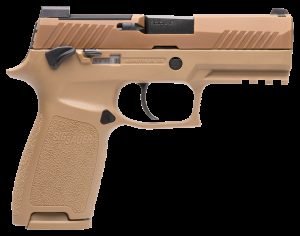
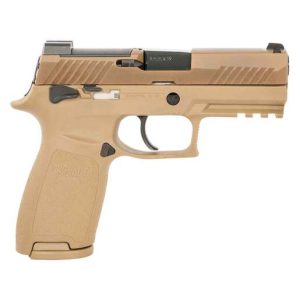
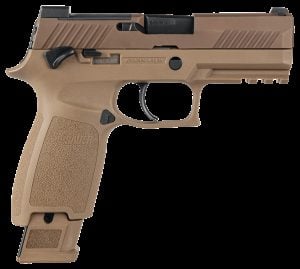
M17/M18 vs Sig Sauer P320 (Civilian)
| Spec | M17/M18 (Military) | Sig P320 (Civilian) |
|---|---|---|
| Fire Modes | Semi-auto (striker-fired) | Semi-auto (striker-fired) |
| Caliber | 9x19mm NATO | 9mm / .357 SIG / .40 S&W / .45 ACP |
| Capacity | 17 rounds, 21-round extended (M17 and M18) | 17 and 21-round magazines ship with the P320-M17 and M18 |
| Manual Safety | Yes (required by military) | Optional (available on some models) |
| Key Difference | Coyote finish, manual safety, military contract parts | Available in dozens of configurations |
| Civilian Legal? | The P320 M17/M18 is sold commercially | Yes |
The SIG Sauer P320 won the Modular Handgun System competition on January 19, 2017, beating Glock, FN and Beretta, and fielding began that November. The M17 replaced the M9 and the compact M18 replaced the M11. The civilian version is virtually identical. Same modular chassis system, same caliber, same capacity. Sig even sells a commercial “M17” model with the coyote tan finish. Again: same gun, same capability, no select-fire, no magical “military” power. We did a 1,500-round hands-on review of the M18 if you want the deep dive.
AK-47 / AKM vs Civilian AK Rifles
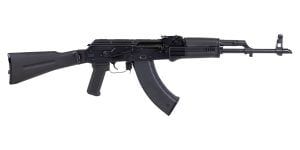
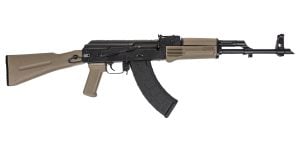
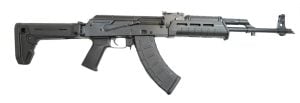
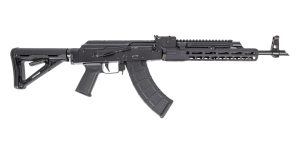
The original AK-47 and its improved AKM variant are select-fire assault rifles chambered in 7.62x39mm. The military versions are capable of fully automatic fire at roughly 600 rounds per minute. Civilian AK-pattern rifles sold in the US (like the WASR-10, PSA AK-47, and Zastava ZPAP) are semi-automatic only. Same caliber, same iconic action, but no full-auto capability.
The same confusion applies here: the civilian AK looks identical to the military version, but it’s mechanically a different animal. Check our 10 best AK-47 rifles guide for the top civilian options, and our AK-47 vs AR-15 comparison for the eternal debate.
Weapons With No Civilian Equivalent
Some military weapons have no real civilian counterpart. The M249 SAW is a belt-fed machine gun; FN does sell a semi-automatic, belt-fed FN M249S, but it fires one round per trigger pull. The M240B is a medium machine gun. The M203 grenade launcher, the AT-4 rocket launcher and the Mk 19 automatic grenade launcher have no civilian equivalents, and nobody is selling them at your local gun shop.
Lumping an AR-15 in with these platforms confuses a semi-automatic rifle with crew-served automatic weapons.
What Replaces the M4A1 and M249
The Army has type-classified SIG Sauer’s 6.8mm M7 rifle and M250 automatic rifle and is fielding them to its close combat units to replace the M4A1 and M249, under a contract awarded in April 2022. The Army calls them its first new rifle and automatic rifle in 65 years.
The AR-15 Is Not a Weapon of War
This deserves its own section because it’s the single most repeated myth about civilian firearms. The name has a military past: the U.S. Air Force bought 8,500 Colt AR-15 rifles, approved in 1961, before the rifle was standardized as the M16 in December 1963. Since then, the select-fire military rifle has been the M16 and M4. What you buy at a gun store today is a semi-automatic-only rifle that shares the external appearance and ergonomics of the M16/M4 platform but lacks the select-fire internals that define an actual military weapon.
Here’s a comparison that makes the absurdity obvious. A Ruger Mini-14 fires the same cartridge (5.56/.223), uses detachable box magazines (Ruger’s own, not AR magazines), is semi-automatic, and has the same effective range as an AR-15. But because the Mini-14 has a wooden stock and looks like a “regular” rifle, it gets zero political attention. Put a black polymer stock, a pistol grip, and a rail system on the same mechanical action and suddenly it’s a “military-style assault weapon.” The function is identical. Only the cosmetics changed.
The AR-15 is America’s most popular rifle platform. Millions of Americans own them for home defense, sport shooting, hunting, and competition. If you’re curious about the full story, our history of the AR-15 covers everything from the original ArmaLite patent to today.
Guns the Military and Civilians Both Use
Some firearms are genuinely the same whether a soldier carries them or you buy one at a retailer. These are all semi-automatic platforms where the military version has no select-fire capability. The confusion comes from the fact that these guns exist, so people assume all military guns are available to civilians. They’re not.
- Glock 19: Used by multiple military and law enforcement units worldwide. The civilian version is identical. See our best Glock pistols guide and our Glock 19 Gen 6 review.
- Sig Sauer P320 (M17/M18): Current U.S. military sidearm. Civilian model is functionally the same. Our M18 review covers it in detail.
- Beretta 92FS (M9): Former military sidearm, civilian version is essentially identical. See our best Beretta pistols guide.
- Remington 700 (M24 SWS): The military M24 sniper system is based on the Remington 700 bolt action. The civilian 700 is the same rifle in different furniture. See our best sniper rifles and military sniper rifles guides.
- Mossberg 590 (military contract shotgun): The 590A1 is used by the U.S. military and the civilian version is nearly identical. Our Mossberg 590A1 review covers both.
- Barrett M82/M107 (.50 BMG): The military’s anti-materiel rifle. Civilians can buy the same semi-automatic Barrett in most states. See our best .50 BMG rifles and Barrett rifles guides.
Notice a pattern? Every one of these is semi-automatic, bolt-action or pump-action. None of them are machine guns. The military uses the same semi-auto pistols and bolt-action rifles that civilians buy because semi-auto handguns and bolt rifles don’t need select-fire to be effective. For a full breakdown of what the military buys and why, see our military firearms procurement guide and most popular military small arms article.
What “Military Grade” Actually Means
Here’s something that always makes me laugh. “Military grade” is used by the media and politicians as if it means “extremely deadly super weapon.” Anyone who’s actually served in the military knows that “military grade” means “built by the lowest bidder.” It means “mil-spec,” which is a set of durability and reliability standards. It doesn’t mean more powerful, more accurate, or more lethal.
Premium civilian rifles beat issued M4s where it shows: triggers, barrels and tolerances. Our best AR-15s under $2,000 guide covers rifles built to that standard. The military prioritizes durability and cost over precision because they’re buying hundreds of thousands of them.
Mil-spec means a chrome-lined barrel (durable but not the most accurate), a government-profile barrel contour (compromise between weight and heat resistance), and a trigger that’s functional but nothing special. Companies like Daniel Defense, BCM, and Knights Armament build civilian rifles to standards that exceed mil-spec in every category. Our best custom AR-15s guide covers the premium end of the market.
NFA, Hughes Amendment, and Federal Gun Laws
The legal framework separating military and civilian firearms is well established and has been in place for decades. Here’s how it actually works.
The National Firearms Act (1934)
The National Firearms Act (NFA) regulates certain categories of weapons that go beyond standard firearms. NFA items include machine guns, short-barreled rifles (SBRs), short-barreled shotguns (SBSs), suppressors, any other weapons (AOWs) and destructive devices. Since January 1, 2026, the federal tax to make or transfer a suppressor, SBR, SBS or AOW is $0; machine guns and destructive devices still carry the $200 tax set in 1934. On October 9, 2026, ATF said it will not enforce approval, registration or tax-stamp rules for those four categories, after the Silencer Shop Foundation v. ATF ruling. That is enforcement policy, not repeal: state laws still apply, and taking an SBR or SBS across state lines still needs a Form 20.
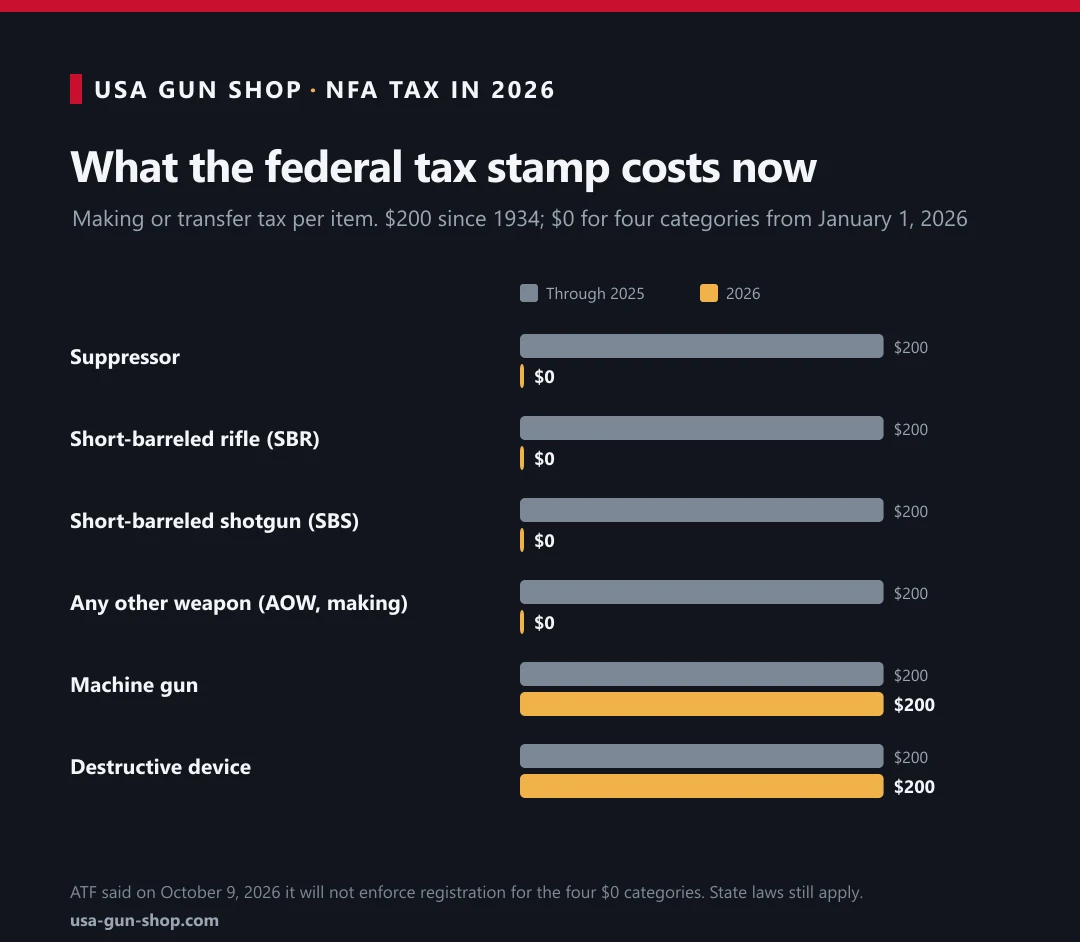
Machine guns are the exception that matters for this guide: they still need ATF approval, registration and the $200 tax.
The Hughes Amendment (1986)
This is the big one. The Firearm Owners Protection Act of 1986 included the Hughes Amendment, which banned the manufacture and sale of new machine guns for civilian ownership. Only machine guns lawfully possessed and registered before May 19, 1986 can be transferred to civilians. ATF counted 175,977 transferable machine guns as of February 2016, a fixed supply that keeps prices far above any semi-automatic rifle.
So when someone says “civilians can buy machine guns,” they’re technically correct but practically wrong. It’s like saying “civilians can buy a Ferrari F40.” Sure, you can, but there are only so many in existence and they cost a fortune. The overwhelming majority of civilian gun owners will never own or even fire a fully automatic weapon.
Other Regulated Items
- Short-barreled rifles (SBRs): Rifles with barrels under 16″. Legal under the NFA in most states, with a $0 federal tax since 2026. This is why civilian AR-15s have 16″ barrels while military M4s have 14.5″ barrels. The pistol brace saga was all about this distinction.
- Suppressors: Legal to own in 42 states; the federal tax dropped to $0 in 2026. Hollywood makes them silent. In reality, they reduce a gunshot from “hearing damage” to “still loud.” The military uses them extensively.
- Body armor: Perfectly legal for civilians in most states. See our best body armor and plate carriers guide. Military plates are tested to military specifications rather than NIJ standards.
For state-specific regulations, check our gun law guides for Alabama, Alaska, Arizona, California, and more on our gun laws by state hub.
How Hollywood and Media Get Firearms Wrong
Movies and television shape what most people think guns do. John Wick is incredible entertainment (and those guns are real, we covered the guns of John Wick 2, John Wick 3, and John Wick 4), but it’s not reality. Bottomless magazines, one-handed rifle shooting, and pistols that knock people backward are pure fiction.
The bigger problem is the news media. Reporters who don’t know the difference between semi-auto and full-auto write stories that conflate civilian rifles with military weapons. “AR-15 style assault weapon” is a meaningless phrase that sounds terrifying to someone who doesn’t know what an AR-15 actually is.
This is why education matters. Every time a gun owner takes a non-shooter to the range, explains how firearms actually work, or corrects misinformation in a conversation, it does more good than any argument online. For resources to share with new shooters, check our simple guide to guns, gun safety rules, and best handguns for beginners.
Can Civilians Own Military Weapons?
The short answer: some of them, with major restrictions.
- Semi-automatic versions of military platforms (AR-15, AK-pattern, Beretta 92FS, Sig P320, etc.): Yes, legal in most states with a standard background check.
- Pre-1986 registered machine guns: Legal with ATF approval and the $200 tax, but the supply is fixed: ATF counted 175,977 transferable machine guns in 2016.
- Post-1986 machine guns: No. Not legal for civilian ownership under any circumstance. Period.
- Destructive devices (grenades, rockets, etc.): Legal on paper with NFA registration, but effectively unavailable. No one is selling live grenades at gun shows.
- Military surplus rifles: Yes, and they’re great values. Semi-automatic M1 Garands through the CMP, bolt-action Mosin Nagants and similar surplus rifles are legal and popular with collectors.
Our special forces rifles and pistols you can buy article covers specific military platforms that have direct civilian counterparts you can actually purchase.
Where to Buy Civilian Versions of Military Firearms
Every civilian firearm mentioned in this article is available from reputable online retailers. They ship to your local FFL dealer where you complete the background check and pick it up. Here are the retailers we trust:
- Palmetto State Armory: Best prices on AR-15s, AK-47s, and Glocks. Their PSA AR-15 is one of the best budget options available.
- Guns.com: Huge selection for finding specific models like the Sig M17 or Beretta 92FS.
- Brownells: The go-to for AR-15 parts, accessories, and complete rifles. Our best AR-15 parts guide covers their top offerings.
- EuroOptic: Premium rifles and optics. Best for precision rifle platforms like the .50 BMG rifles.
- Sportsman’s Guide: Great for military surplus, ammo, and tactical gear.
If you’re new to buying firearms online, our guide to buying guns online explains the entire process step by step. Use our price checker tool to compare prices across all major retailers.
Related Guides
- 10 Best AR-15 Rifles (2026)
- 9 Best AK-47 Rifles (2026)
- 11 Best Glock Pistols (2026)
- America’s Most Popular Rifles
- Most Popular Rifle Calibers in America
- What Is the National Firearms Act?
- DI vs Gas Piston AR-15
- How to Build an AR-15
- Shotgun vs AR-15 for Home Defense
- 10 Best Guns for Home Defense
Facts and Figures
- M4A1: 14.5 in barrel, about 6.4 lb, safe/semi/auto, 700 to 970 rpm cyclic
- Colt CR6920 (civilian M4): 16.1 in barrel, safe/semi, MSRP $1,099, $1,130.99 at Palmetto State Armory
- Federal minimums: rifle barrel 16 in, shotgun barrel 18 in, overall length 26 in
- NFA tax in 2026: $0 for suppressors, SBRs, SBSs and AOWs; $200 for machine guns and destructive devices
- Machine gun cutoff: lawfully registered before May 19, 1986; 175,977 transferable as of February 2016 (ATF)
- U.S. sidearms: M9 selected 1985; SIG won the M17/M18 contract January 19, 2017
- Next U.S. rifle: SIG 6.8mm M7 and M250, contract April 2022
The Bottom Line
Military firearms and civilian firearms share a lot of DNA, but the differences that matter are real, fundamental, and legally enforced. The select-fire capability that defines actual military weapons is not available on civilian guns. The federal laws separating the two have been in place for decades. And the cosmetic similarities between an M4 and an AR-15 don’t make them the same thing any more than a race car livery on a Honda Civic makes it a Formula 1 car.
The best thing you can do is know the facts and share them. Take a new shooter to the range, and correct misinformation when you see it.
Military vs Civilian Firearm Questions Most Guides Don’t Answer Directly
What is the actual difference between an M16 and a civilian AR-15?
The M16 service rifle is select-fire, semi-auto and full-auto or three-round-burst capable. The civilian AR-15 is semi-auto only. The two rifles share most of their components and the same operating system. The difference is in the fire-control group, where the M16 carries an auto-sear and a different hammer and trigger geometry. Functional conversion of an AR-15 to M16 capability is a federal felony without NFA registration as a pre-1986 transferable machine gun.
Why does the military still use Beretta 92 / M9 variants if civilians have moved on?
The military M17 / M18 service pistol replaced the Beretta M9 with a SIG P320-derived design in 2017. Beretta M9 stocks remain in inventory for unit-level use and reserve issue, but the standard service pistol for new procurement is the M17 / M18 family. The civilian market has shifted toward striker-fired carry pistols largely independent of military procurement, which has its own performance criteria and accounting timelines.
Are military firearms actually more reliable than civilian-market equivalents?
No, not in current production. Civilian firearms produced for the modern competitive market, Glock, SIG, Smith & Wesson M&P, Daniel Defense, BCM, match or exceed military-issue reliability standards in controlled testing. Military firearms are designed for use by issued operators with mandatory maintenance schedules; civilian competitive firearms are designed for owner-maintained use across millions of units. The reliability bar has converged across the past two decades.
Can a civilian own a real machine gun?
Yes, under federal law, with restrictions. Machine guns manufactured before May 19, 1986 and registered with the ATF are legally transferable to civilians who meet the National Firearms Act requirements: $200 transfer tax stamp, chief law enforcement officer notification, and the receiving party’s state laws permitting machine gun ownership. The fixed supply of pre-1986 transferable machine guns keeps prices far above any semi-automatic firearm. Newer machine guns can only be owned by FFL/SOT licensees and certain government entities.
Frequently Asked Questions
Is the AR-15 a military weapon?
Not today. The U.S. Air Force did buy 8,500 Colt AR-15 rifles in the early 1960s before the design was standardized as the M16 in 1963, but the AR-15 sold to civilians now is semi-automatic only. The military's M16 and M4A1 are select-fire, and the auto sear is the part that makes them machine guns.
Can civilians own military weapons?
Civilians can own semi-automatic versions of military platforms like the AR-15, AK-pattern rifles, the Beretta 92FS and the SIG P320-M17 and M18. Machine guns lawfully registered before May 19, 1986 can be transferred with ATF approval and the $200 tax, but ATF counted only 175,977 of them in 2016. Newer machine guns are off-limits to civilians.
What is the difference between military and civilian firearms?
The fire selector. Military rifles like the M4A1 are select-fire, with semi-automatic and fully automatic modes, and the M16A2 and A4 have three-round burst. Civilian rifles are semi-automatic only, one round per trigger pull. Many service pistols, like the M17 and M18, are the same semi-automatic guns civilians can buy.
What does military grade mean for firearms?
Military grade, or mil-spec, is a set of durability and reliability standards, not a measure of lethality or accuracy. It covers materials, coatings and tolerances built to survive hard use at a contract price. Many premium civilian rifles beat it on triggers, barrels and tolerances.
Are military guns more powerful than civilian guns?
No. Military and civilian firearms in the same caliber fire the same cartridge. A civilian AR-15 in 5.56 NATO fires the same round as an M4A1; the M4A1's full-auto mode changes the rate of fire, not the power of each shot. Many hunting cartridges are far more powerful than 5.56.
Why do civilian AR-15s have 16-inch barrels?
Federal law sets a 16-inch minimum barrel length for rifles; anything shorter is a short-barreled rifle (SBR) under the National Firearms Act. The military M4A1 has a 14.5-inch barrel. Colt's civilian CR6920 uses a 16.1-inch barrel, which keeps it out of SBR territory.
What does an NFA tax stamp cost in 2026?
$0 for suppressors, short-barreled rifles, short-barreled shotguns and AOWs since January 1, 2026; $200 for machine guns and destructive devices. On October 9, 2026, ATF also said it will not enforce approval or registration rules for the four $0 categories. That is enforcement policy, not repeal, and state laws still apply.
What is replacing the M4A1?
The Army has type-classified SIG Sauer's 6.8mm M7 rifle and M250 automatic rifle and is fielding them to close combat units to replace the M4A1 and M249, under a contract awarded in April 2022. The Army calls them its first new rifle and automatic rifle in 65 years.
3,213+ Gun & Ammo Deals
Updated daily from 200+ top retailers. Filter by category, caliber, action type, and price.