
Last updated March 17th 2026
Some of the links below are affiliate links, meaning at no additional cost to you, we may earn a commission if you click through and make a purchase.
- Treat every gun as loaded
- Point the muzzle in a safe direction
- Keep your finger off the trigger until you’re ready to shoot
- Know your target and what’s beyond
3D Printed Guns: The Complete Guide
3D printed guns are one of those topics where the hysteria has always outpaced the reality. The tabloids painted a picture of millions of plastic ghost guns breezing past metal detectors and flooding the streets. That never happened. What did happen is more interesting: a dedicated community of hobbyists and activists proved that you can manufacture functional firearms with a $300 printer and free files from the internet. And that changed the gun control debate forever.
Right now, the vast majority of gun owners will never print a firearm. It’s easier, safer, and cheaper to buy a gun online from a major manufacturer. A factory Glock or AR-15 will outperform any 3D printed gun in durability, accuracy, and reliability. That’s just reality.
But the technology matters, and the implications are massive. This guide covers everything: the history, the most notable printed firearms, how the technology works, what’s legal and what isn’t, and why 3D printed guns are the most powerful argument against a total firearms ban that has ever existed.
A Brief History of 3D Printed Firearms
The story of 3D printed guns starts with one man: Cody Wilson. In 2013, Wilson, a self-described crypto-anarchist and founder of Defense Distributed, successfully fired the first known 3D printed gun. He called it the Liberator, a single-shot .380 ACP pistol made almost entirely from ABS plastic on a consumer-grade 3D printer. It was crude, unreliable, and kind of terrifying to shoot. It was also a gamechanger.
Wilson uploaded the Liberator’s CAD files to the internet, and within 48 hours they’d been downloaded over 100,000 times before the State Department forced him to take them down. The legal battle that followed went all the way to a federal settlement in 2018, with the government acknowledging that distributing firearms CAD files is protected under the First Amendment. Our coverage of that ruling is in our 3D Printed Gun Is Legal article, and the state-level fallout is covered in Individual States Block 3D Printed Guns.
Since then, the technology has evolved dramatically. What started as a plastic curiosity that might blow up in your hand has become a legitimate (if niche) method of manufacturing functional semi-automatic pistols, rifles, and pistol caliber carbines.
The Most Notable 3D Printed Firearms
The Liberator (2013)
The gun that started it all. The Liberator was a single-shot .380 ACP pistol made from 16 pieces of ABS plastic, with a single metal nail as a firing pin (and a small piece of steel included to comply with the Undetectable Firearms Act). It was clunky, inaccurate, and had a tendency to crack or fail after a handful of shots. But it proved a point that resonated around the world: anyone with a consumer 3D printer could make a functional firearm.
The FGC-9 (2020)
The FGC-9 (which stands for exactly what you think it does) represents the evolution of 3D printed firearms into genuinely capable weapons. Designed by a European developer known as JStark1809, the FGC-9 is a semi-automatic 9mm pistol caliber carbine that uses 3D printed components alongside hardware store parts and an electrochemically machined barrel. No regulated gun parts required.
The FGC-9 Mk II improved on the original with better reliability and easier construction. It fires standard 9mm Luger ammunition, accepts Glock-pattern magazines, and is reportedly capable of several thousand rounds before major components need replacement. For context on the cartridge, see our best 9mm ammo guide.
3D Printed Glock Frames
One of the most popular applications of 3D printing in the firearms community is printing Glock-compatible frames. Using readily available slide kits, barrels, and small parts, builders can assemble a functional Glock-pattern pistol with a 3D printed lower frame. The Glock platform’s simplicity makes it particularly well-suited to this approach. If you’re interested in the factory versions instead, our best Glock pistols guide covers every model, and our best custom Glocks guide goes deep on modifications.
For a related DIY approach using an 80% frame instead of 3D printing, see our how to build a Glock 19 from an 80% frame guide.
3D Printed AR-15 Lowers
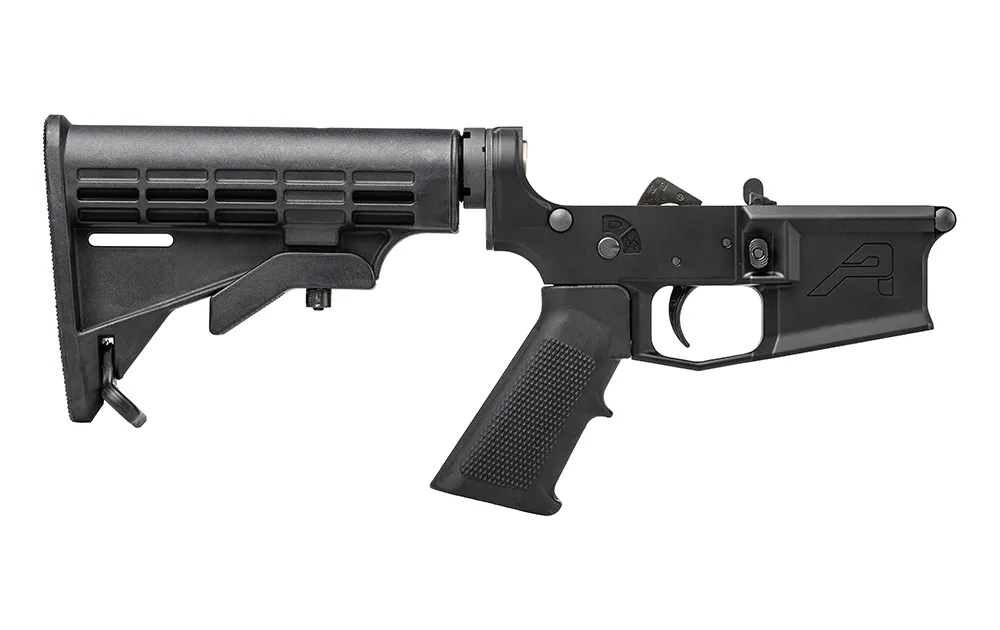
The AR-15 lower receiver is the serialized, regulated part of the rifle. Everything else (upper, barrel, bolt carrier group, stock) can be bought without a background check. This makes the lower receiver the obvious target for 3D printing. Early 3D printed AR lowers cracked after a few dozen rounds, but modern designs using reinforced PLA+ or nylon have significantly improved durability.
That said, a factory AR-15 lower costs $50 to $150 and will last tens of thousands of rounds. A 3D printed lower might last a few hundred before needing replacement. For most people, buying a complete rifle from our best AR-15 guide or best AR-15s under $1,000 guide makes infinitely more sense. And if you want to build from parts the traditional way, our how to build an AR-15 guide walks you through it step by step.
How 3D Printed Guns Work
The Printing Process
Most 3D printed firearms use FDM (Fused Deposition Modeling) printers, which are the standard consumer-grade machines you can buy for $200 to $500. The printer melts a spool of plastic filament and deposits it layer by layer to build up a 3D object from a digital file. A typical lower receiver or pistol frame takes 8 to 20 hours to print depending on the design and printer settings.
Materials
- PLA/PLA+: The most common filament. Easy to print, rigid, but brittle under stress. Fine for accessories and cosmetic parts. Marginal for structural firearm components.
- ABS: What the original Liberator was made from. Tougher than PLA, more heat-resistant, but prone to warping during printing. Requires a heated bed and enclosure.
- Nylon (PA6/PA12): The gold standard for 3D printed firearms. Flexible, impact-resistant, and heat-tolerant. Much harder to print successfully, but dramatically more durable. This is what serious builders use.
- Carbon fiber reinforced nylon: The strongest consumer-printable material. Used for the most demanding applications. Requires an all-metal hotend and careful calibration.
What You Still Need to Buy
A 3D printed gun is never 100% printed. You need metal parts for the barrel, firing pin, springs, and in most cases the bolt or slide. For a Glock-pattern build, that means a factory or aftermarket slide, barrel, trigger assembly, and spring kit. For an AR-15, you print the lower but buy everything else. The printed component is the regulated part (the frame or receiver), and the rest are commercially available parts.
For the AR-15 platform, our best AR-15 parts and accessories guide covers everything you’d need for the non-printed components, and buying AR-15 parts online covers where to source them.
3D Printed Guns vs Factory Firearms: An Honest Comparison
| Factor | 3D Printed Gun | Factory Firearm |
|---|---|---|
| Cost | $200-$500 (printer + materials + parts) | $300-$2,000+ (complete, ready to fire) |
| Reliability | Variable. Failures possible. | Thousands of rounds, proven |
| Durability | Hundreds to low thousands of rounds | Tens of thousands of rounds |
| Accuracy | Acceptable at close range | Precise at all intended ranges |
| Time to Acquire | Hours to days (print + assembly) | Minutes to days (purchase + background check) |
| Serial Number | None (unless you add one) | Yes (federally required) |
| Legal to Own | Yes, in most states (see below) | Yes, with background check |
| Warranty | None | Manufacturer warranty |
| Best For | Hobbyists, political statement, proof of concept | Self-defense, hunting, sport, carry |
Let’s be real: for any practical purpose (self-defense, hunting, competition, concealed carry), a factory gun is the better choice by every measurable metric. A budget AR-15 under $1,000 will outperform any 3D printed rifle. A Glock 19 will outlast any printed frame by a factor of 50. If you want a gun for actual use, buy one from a real manufacturer.
The value of 3D printed firearms isn’t in replacing factory guns. It’s in proving that manufacturing firearms at home is possible, which changes the entire calculus of gun control.
Are 3D Printed Guns Legal?
This is the question everyone asks, and the answer is more straightforward than the media makes it seem.
Federal Law
Under federal law, it is legal to manufacture a firearm for personal use without a license, serial number, or registration. This has been the case since the Gun Control Act of 1968. That includes 3D printed firearms. The key restrictions are:
- You cannot be a prohibited person (felon, domestic violence conviction, etc.)
- You cannot manufacture a firearm with the intent to sell it without an FFL
- The firearm must comply with the Undetectable Firearms Act (must contain at least 3.7 oz of steel detectable by a metal detector)
- The firearm must comply with all NFA regulations (no unregistered short-barreled rifles, suppressors, or machine guns)
State Laws
This is where it gets complicated. State laws on homemade firearms vary widely:
- Permissive states (Texas, Florida, Arizona, most of the South and Mountain West): Generally follow federal law. Manufacturing a firearm for personal use is legal without serialization.
- Restrictive states (California, New York, New Jersey, Connecticut, etc.): Require serial numbers on homemade firearms, may require background checks on parts, and some have outright bans on unserialized firearms.
- California specifically requires you to obtain a serial number from the California DOJ before manufacturing any firearm, including 3D printed ones.
Check your state’s specific laws before printing anything. Our gun laws by state hub has guides for every state, including California, Arizona, Alabama, and Alaska.
Ghost Guns: What They Actually Are
“Ghost gun” has become a media buzzword, but it just means a firearm without a serial number. That’s it. Any homemade firearm that wasn’t manufactured by a licensed manufacturer doesn’t have a serial number, whether it was 3D printed, CNC milled from an 80% blank, or hand-machined in a garage. The term is deliberately scary-sounding, and politicians love it for that reason.
The reality is that homemade firearms have been legal in the United States since the country was founded. The concept predates the serial number requirement itself. George Washington’s Continental Army used homemade muskets. The right to manufacture your own firearms for personal use is deeply rooted in American law and tradition.
The ATF has been pushing to regulate ghost guns more aggressively, and the 2022 ghost gun rule attempted to require serialization of homemade firearms and 80% kits. Enforcement and legal challenges are ongoing. The Supreme Court’s bump stock ruling showed that executive overreach on firearms regulation has limits, but the regulatory landscape continues to shift.
The Ghost Gunner and 80% Lowers
The Ghost Gunner, also from Defense Distributed, is technically not a 3D printer. It’s a desktop CNC mill designed to finish 80% lower receivers into functional firearm components. An 80% lower is an unfinished receiver blank that is not legally a firearm because it hasn’t been machined to the point where it can accept a fire control group. The Ghost Gunner completes that final 20% of machining.
The 80% lower approach is different from 3D printing because you start with a metal blank and mill it to spec. The result is a standard aluminum or polymer receiver that’s functionally identical to a factory part. It’s more durable than anything you can 3D print, but it requires a $2,000+ CNC machine instead of a $300 printer.
If you’re interested in building from 80% blanks, check our 80% Glock 19 build guide and how to build an AR-15 guide. For context on why 80% kits became popular as a hedge against gun control, see our gun control insurance article.
3D Printed Gun Accessories (Legal and Easy)
Not everything about 3D printing and guns involves printing receivers. A huge portion of the community focuses on accessories and non-regulated parts, which is completely legal everywhere and genuinely useful.
- Grips and grip panels: Custom 1911 grips, AR-15 pistol grips, and Glock backstraps. Easy to print and customize.
- Magazine loaders and speed loaders: Some of the most practical printed items. They actually work well.
- Handguards and rail covers: Lightweight alternatives to metal accessories.
- Storage solutions: Magazine holders, safe organizers, cleaning kit holders.
- Training aids: Dummy rounds, snap caps, and dry fire training devices.
The 3D printing community shares designs for these accessories freely, and printing them is a great way to get into the hobby without any legal concerns. If you’re more interested in buying factory accessories, our best AR-15 parts and accessories guide has the top picks.
The Political Argument: Why 3D Printed Guns Matter
Here’s the uncomfortable truth that gun control advocates don’t want to talk about: 3D printed firearms have made a total gun ban functionally impossible. The cat is out of the bag. The files are on the internet. Consumer 3D printers are everywhere. You cannot un-invent this technology.
If a blanket firearms ban ever did come to pass, history has shown that prohibition rarely works. Alcohol prohibition gave us the Mob. Drug prohibition gave us cartels. A gun ban would give us a thriving black market in homemade firearms, 3D printed guns, and improvised weapons. There’s already a significant sub-culture of 3D printed firearms in Europe, where gun control is far stricter. If a blanket ban ever happened in the US, it’s hard to imagine America making a different choice.
This makes 3D printing one of the strongest arguments for maintaining the current system of legal, regulated firearms sales. It’s better for everyone if guns are manufactured by reputable companies, sold through licensed dealers, and tracked with serial numbers. The alternative is a world where nobody knows who has what, and quality control doesn’t exist. That’s the world gun control extremists are accidentally pushing us toward.
Why Most People Should Just Buy a Real Gun
If you’re reading this thinking about printing a gun because you actually need a firearm for self-defense, home defense, hunting, or concealed carry: don’t. Buy a real gun from a real manufacturer. It will be safer, more reliable, more accurate, and come with a warranty. The background check takes minutes, not hours of calibrating a printer.
Here’s where to start:
- Home defense: Our best guns for home defense guide covers rifles, shotguns, and pistols. Also see shotgun vs AR-15 for home defense.
- Concealed carry: Start with our 15 best concealed carry handguns guide.
- First gun: Our best handguns for beginners guide walks you through every consideration.
- Budget AR-15: Get a factory AR-15 under $500 that will outlast any printed receiver by a factor of 100.
- New to buying online: Our complete guide to buying guns online explains the FFL process.
And always, always follow the basic rules of gun safety whether you’re shooting a factory Glock or a printed prototype.
Where to Buy Factory Firearms Online
Skip the printer and get the real thing from these trusted retailers:
- Palmetto State Armory: Best prices on AR-15s, Glocks, and budget firearms. Their PSA AR-15 kits are hard to beat.
- Guns.com: Massive selection of handguns, rifles, and shotguns from every major manufacturer.
- Brownells: The go-to for AR-15 parts, tools, and complete firearms. If you want to build, not print, start here.
- Sportsman’s Guide: Great for ammo deals and budget firearms.
- GrabAGun: Competitive prices and fast shipping.
Use our price checker tool to compare prices across all major retailers before you buy.
The Bottom Line
3D printed firearms are a fascinating technology, a powerful political argument, and a terrible choice for anyone who actually needs a reliable gun. The community has come a long way from the Liberator’s single plastic shot to functional semi-auto carbines like the FGC-9. The materials have improved. The designs have improved. The reliability is getting better every year.
But the real significance of 3D printed guns isn’t practical. It’s philosophical. The technology has proven, once and for all, that you cannot ban firearms. The knowledge exists. The tools are consumer-grade. The files are free. The genie isn’t going back in the bottle, and that changes everything about how we should think about gun policy.
For now, most of us will keep buying factory guns from real manufacturers. And that’s fine. That’s the system working as intended. 3D printed guns are the insurance policy that ensures it stays that way.
FAQ: 3D Printed Guns
Are 3D printed guns legal?
Under federal law, it is legal to manufacture a firearm for personal use, including 3D printed firearms, as long as you are not a prohibited person and the gun complies with the Undetectable Firearms Act. However, state laws vary significantly. States like California and New York require serial numbers on homemade firearms, while most states follow federal law. Always check your specific state laws before printing any firearm components.
Can you really 3D print a working gun?
Yes. Modern 3D printed firearms like the FGC-9 are functional semi-automatic weapons capable of firing thousands of rounds. Earlier designs like the 2013 Liberator were crude single-shot pistols, but the technology has advanced significantly. 3D printed Glock frames and AR-15 lower receivers are common in the DIY community. However, 3D printed guns still require metal parts for barrels, firing pins, and springs.
What is a ghost gun?
A ghost gun is simply a firearm without a serial number. This includes any homemade firearm, whether 3D printed, CNC milled from an 80 percent lower, or hand-machined. Manufacturing a firearm for personal use without a serial number has been legal under federal law since the Gun Control Act of 1968. Some states now require serialization of homemade firearms.
How much does it cost to 3D print a gun?
A basic FDM 3D printer costs 200 to 500 dollars. Filament for a single frame or receiver costs 5 to 20 dollars. However, you also need metal parts like a barrel, slide or bolt carrier group, springs, and firing pins, which can cost 150 to 400 dollars depending on the platform. Total cost for a complete 3D printed pistol is roughly 300 to 600 dollars, comparable to buying a budget factory firearm.
What materials are used for 3D printed guns?
The most common materials are PLA+ and ABS for basic components, and nylon for structural firearm parts. Nylon is the gold standard for 3D printed firearms due to its impact resistance, flexibility, and heat tolerance. Carbon fiber reinforced nylon is the strongest option. The original Liberator used ABS plastic, which was prone to cracking. Modern designs using nylon are significantly more durable.
Are 3D printed guns as good as factory guns?
No. Factory firearms are superior in reliability, durability, accuracy, and longevity. A factory Glock or AR-15 will last tens of thousands of rounds, while 3D printed components typically last hundreds to low thousands of rounds before needing replacement. For any practical purpose like self-defense, hunting, or concealed carry, a factory firearm is the better choice. 3D printed guns are primarily a hobby and a political statement about the futility of firearms bans.
Author

14,752+ Gun & Ammo Deals
Updated daily from 10+ top retailers. Filter by category, caliber, action type, and price.