
Last updated September 2026 · By Nick Hall. Reviewed against FBI Uniform Crime Reports, the Police Executive Research Forum (PERF) policing-equipment surveys, the International Association of Chiefs of Police (IACP) firearms materials, and the manufacturer-specific law enforcement specifications for the major duty platforms.
Some of the links below are affiliate links, meaning at no additional cost to you, we may earn a commission if you click through and make a purchase.
- Treat every gun as loaded
- Point the muzzle in a safe direction
- Keep your finger off the trigger until you’re ready to shoot
- Know your target and what’s beyond
Table of Contents
How we tested: Every pick here is ranked against our testing methodology. Minimum round counts, accuracy and reliability protocols, the failures that disqualify a gun. Where we have not shot a specific variant ourselves, we say so in that section.
Introduction: The Firearms That Protect America
Law enforcement agencies put firearms through the most punishing evaluations on the planet. Before a police department adopts a new sidearm or patrol rifle, that weapon has been torture-tested across tens of thousands of rounds, submerged in mud, baked in desert heat, and frozen in northern winters. If a gun survives LE testing, it works. Period.
I’ve spent years covering the intersection of law enforcement and civilian firearms. The truth is, most of the guns police officers carry every day are the same models you can buy at your local gun shop. The civilian market and the LE market overlap almost completely in 2026, and that’s great news for anyone shopping for a proven, reliable firearm.
Law Enforcement Firearms by Category at a Glance
The table below maps the major law enforcement firearm categories to the dominant platforms, agency adoption rates, and what the civilian descendant looks like. Police agency procurement decisions ripple into the civilian market with a typical 5-10 year lag, which is why a great deal of the modern American defensive pistol market traces directly to choices made by police chiefs over the last forty years.
| Category | Dominant platforms | Approximate adoption | Civilian descendant |
|---|---|---|---|
| Duty pistol | Glock 17/19/22/45, SIG P320/M17, S&W M&P | Glock ~65%, SIG ~20%, S&W ~10% | Same platforms in civilian variants |
| Patrol rifle | Colt M4 Commando, Daniel Defense, BCM RECCE | ~85% AR-15 platform across all agencies | Civilian AR-15 in various tiers |
| Tactical shotgun | Remington 870, Mossberg 590A1, Benelli M4 | Remington ~50%, Mossberg ~30%, Benelli ~10% | Same platforms; civilian 870 and 590 universal |
| Sniper / precision | Remington 700 LE, Accuracy International AT, SIG SSG 3000 | Remington 700 dominant; AI growing in major agencies | Civilian Remington 700; AI premium-only |
| SMG / PCC | H&K MP5/SP5K, SIG MPX, Colt 9mm carbine | Specialty units only; ~5% of agencies issue | Civilian SP5, MPX, PCC carbines |
| Backup / off-duty | Glock 43X, SIG P365, S&W Bodyguard, J-frame | Officer-purchased; varies by agency policy | Same platforms; dominant CCW market |
This guide covers every major category of firearm used by American police, federal agencies, SWAT teams, and military police. From the Glock 17 that dominates patrol holsters to the Barrett .50 BMG rifles used by specialized units, we break down what agencies actually carry and why. If you want to buy what the professionals trust with their lives, this is the place to start.
Along the way, I’ll link out to our in-depth reviews and roundups so you can dig deeper into any platform that catches your eye. Whether you’re a first-time buyer looking for a proven self-defense pistol or a seasoned shooter building out your collection, the LE stamp of approval is one of the best indicators of real-world reliability you’ll find. Check out our full guide to police duty pistols from around the world for an even broader look at what agencies carry internationally.
Duty Pistols
The duty pistol is the most important firearm in any officer’s kit. It’s the gun they carry every single shift, the one they train with the most, and the one they’ll reach for first in a lethal force encounter. The modern LE duty pistol market is dominated by striker-fired polymer handguns in 9mm, though a few legacy DA/SA platforms still hold strong in federal service.

Glock 17 / Glock 19
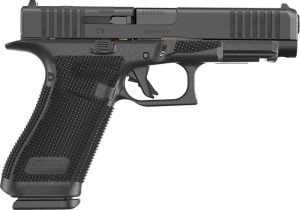
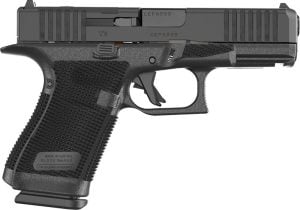
There’s no way around it: Glock owns the law enforcement pistol market. Estimates put Glock’s share of the U.S. LE duty pistol market at roughly 65%, and that number has been climbing for over two decades. The Glock 17 (full-size, 17+1 capacity) is the standard issue for uniformed patrol, while the Glock 19 (compact, 15+1) is preferred by plainclothes detectives, federal agents, and officers who want a slightly more concealable option.
What makes the Glock platform so dominant is boring reliability. These guns run dirty, run hot, run cold, and just keep working. The aftermarket support is unmatched because every holster manufacturer, every night sight company, and every weapons light maker builds for Glock first. Parts are cheap, armorers are everywhere, and training ammunition costs are low in 9mm.
The Gen5 MOS variants are the current standard for agencies that want optics-ready pistols out of the box. If you’re looking for what works on the street with a decades-long track record, start here. Read our full breakdown in the best Glock pistols guide.

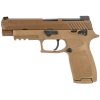
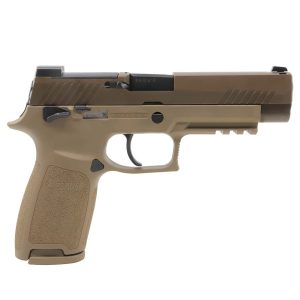
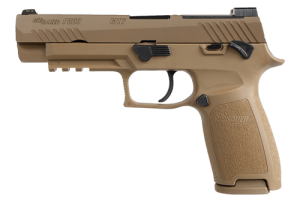
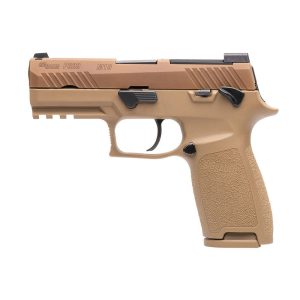
Sig Sauer P320 / M17 / M18
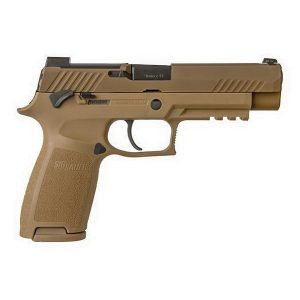
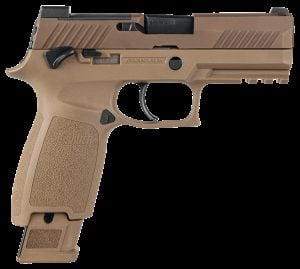
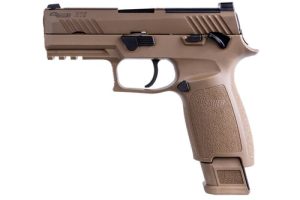
The Sig Sauer P320 platform exploded onto the scene after winning the U.S. Army’s Modular Handgun System (MHS) contract in 2017, becoming the M17 (full-size) and M18 (compact). That military adoption gave the P320 enormous credibility, and LE agencies have been switching over in growing numbers ever since. The modular chassis system lets departments swap grip modules and slide assemblies without buying entirely new guns, which appeals to budget-conscious agencies.
I’d be doing you a disservice if I didn’t address the elephant in the room. The P320 has faced a series of lawsuits and media reports alleging uncommanded discharges, where the pistol fires without the trigger being pulled. Sig has consistently denied any design defect, and the guns have passed multiple independent safety tests. But the controversy is real, and you should read the full breakdown in our Sig P320 problems article before making a decision. Plenty of agencies carry them without incident. Others have passed.
Setting aside that controversy, the P320 is a genuinely excellent shooting pistol. The trigger is crisp, the ergonomics are superb, and the modularity is a real advantage for shooters who want one serialized chassis that fits multiple configurations. Check out our complete Sig Sauer P320 review for the full picture.
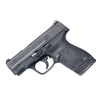
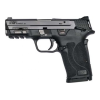
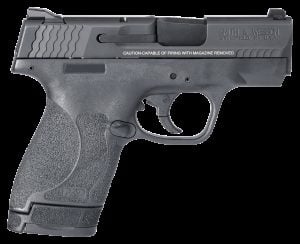
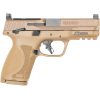
Smith & Wesson M&P 2.0
Smith & Wesson’s M&P (Military & Police) line is the third most popular duty pistol in American law enforcement, and it’s there on merit. The M&P 2.0 brought significant improvements over the original: a better trigger, more aggressive texturing, and improved ergonomics. Agencies that adopt the M&P often cite the trigger as a key differentiator. It’s one of the best stock triggers in the striker-fired duty pistol category.
The M&P 2.0 is also one of the most affordable duty-grade pistols on the market, which matters when a department is outfitting hundreds of officers. Street prices consistently run $100-$150 less than comparable Glock or Sig models. For the civilian buyer, that value proposition is even stronger. You’re getting a gun that meets the same LE standards at a lower price point.
I’ve always appreciated how the M&P 2.0 fits the hand. The four interchangeable palmswell inserts let you customize the grip without buying aftermarket parts. For a full review, check out our Smith & Wesson M&P 2.0 Compact review.


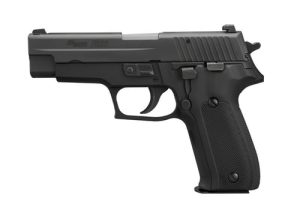
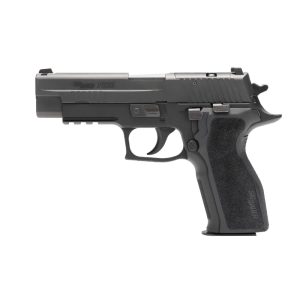
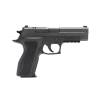
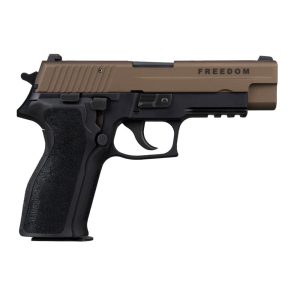
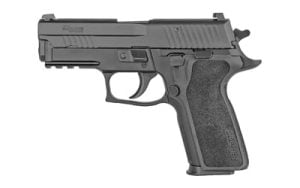
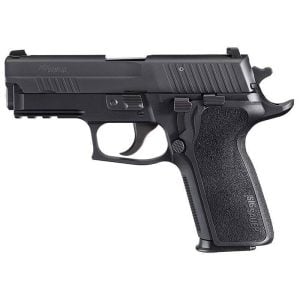
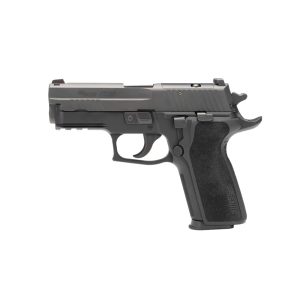
Sig Sauer P226 / P229
The Sig P226 and its compact sibling, the P229, represent the old guard of LE duty pistols. These are DA/SA (double action/single action) hammer-fired guns, and they were the gold standard before the striker-fired revolution took over. The P226 served as the primary sidearm for the Navy SEALs (as the Mk25) for decades, and the P229 in .357 SIG was the standard issue for the Secret Service, DHS, and multiple federal agencies.
While most agencies have moved to striker-fired platforms, the P226 and P229 still see service with federal agencies that haven’t transitioned yet, and with individual officers who prefer the DA/SA trigger system. The long, heavy first pull acts as an additional safety layer, which some veteran officers swear by. The single-action pull on subsequent shots is outstanding.
These are heavier guns than their polymer counterparts, and they cost more. But the build quality is exceptional, and they shoot like precision instruments. If you appreciate classic craftsmanship in a duty pistol, the P226 family is hard to beat. See our full ranking in the top 10 Sig Sauer pistols guide.
Patrol Rifles
The patrol rifle became standard equipment for American police departments after the 1997 North Hollywood shootout, when officers armed only with pistols and shotguns were outgunned by rifle-armored bank robbers. Today, virtually every patrol car in America has an AR-15 pattern rifle in the trunk or rack. The 5.56 NATO cartridge offers superior range, accuracy, and barrier penetration compared to pistol calibers, while actually posing less risk of over-penetration than many pistol rounds in urban environments.
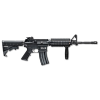
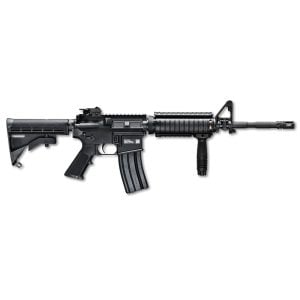
Colt / FN M4 Carbine
The M4 Carbine is the baseline. Colt and FN are the primary military contractors, and their LE/civilian variants set the standard that every other AR-15 is measured against. The direct impingement gas system is simple, proven, and understood by every armorer in the country. Barrel lengths range from 14.5″ (with pinned/welded muzzle device for 16″ OAL) to standard 16″ for patrol use.
Departments that buy from Colt or FN are paying for mil-spec consistency and a known track record. These aren’t the fanciest ARs on the market, but they are the most battle-tested. Millions of M4s have been deployed worldwide, and the platform’s reliability under combat conditions is thoroughly documented. For civilian buyers, the Colt LE6920 and FN 15 Military Collector series offer near-identical specifications to what agencies receive.
If you’re building your first AR or want a baseline to compare everything else against, the M4 pattern rifle is where to start. See our comprehensive best AR-15 rifles guide for a full breakdown of the market. You can also find great deals on AR platforms at Palmetto State Armory.
Daniel Defense DDM4
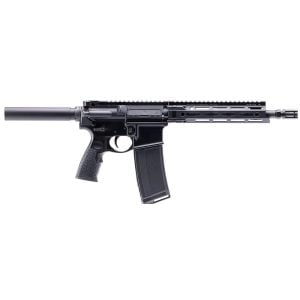
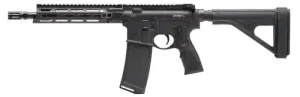
Daniel Defense has become the go-to premium AR-15 for law enforcement agencies with bigger budgets. The DDM4 line features cold hammer forged (CHF) barrels, a proprietary bolt carrier group, and the kind of fit and finish that makes budget ARs feel like toys. When an agency wants the best and is willing to pay for it, Daniel Defense is usually at the top of the shortlist.
The DDM4 V7 is the most popular model for patrol use, offering a 16″ barrel with Daniel Defense’s MFR (M-LOK Free Float Rail) handguard. These rifles shoot sub-MOA out of the box with match ammunition, which is well beyond what most patrol situations require but gives officers a significant advantage when precision matters. The DD furniture, including their pistol grip and buttstock, is among the best in the industry.
For civilians, the DDM4 lineup represents the upper tier of factory AR-15s. You’re paying a premium over a mil-spec rifle, but the improvement in barrel quality, overall build, and resale value is real. Brownells regularly stocks the full DD lineup. Check the best AR-15 rifles guide for where DD fits in the broader market.
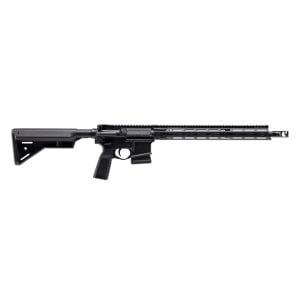
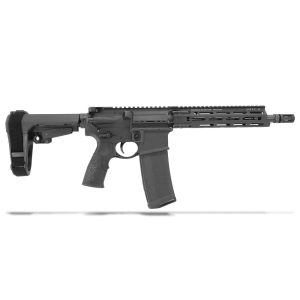
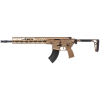
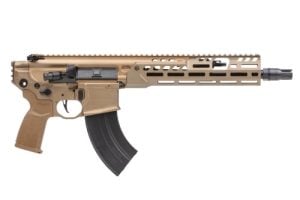
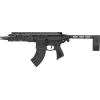
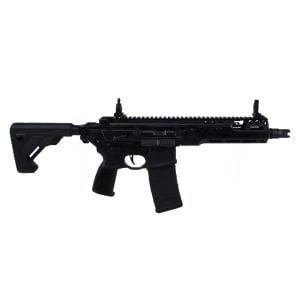
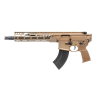
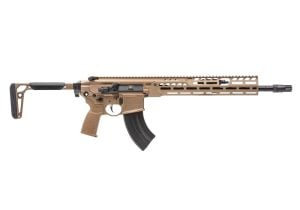
Sig Sauer MCX
The Sig MCX is the future of the LE patrol rifle, and arguably the present. This short-stroke gas piston system with a folding stock gives officers a rifle that’s significantly more compact than a standard AR-15 when stored, while offering improved reliability in adverse conditions. The piston system keeps carbon fouling out of the receiver, which means less cleaning and fewer stoppages over extended use.
The MCX gained massive visibility after U.S. SOCOM selected the MCX Spear (now the XM7) as the next-generation squad weapon. While the military version fires the new 6.8x51mm cartridge, the LE and civilian MCX variants are available in 5.56 NATO and .300 Blackout. The .300 BLK version is particularly popular with SWAT teams and specialized units that want suppressed capability in a compact package.
The MCX isn’t cheap, and the proprietary components mean you can’t simply swap in standard AR-15 parts for everything. But if your agency or your personal use case demands a compact, folding, piston-driven rifle, the MCX is the best option on the market right now. For the 9mm PCC variant, check out our Sig MPX review.
Tactical Shotguns
The shotgun’s role in law enforcement has evolved significantly over the past two decades. Where it used to be the primary long gun in every patrol car, it’s increasingly been replaced by the AR-15 for general patrol. But the shotgun still fills critical roles: breaching, less-lethal deployment, and close-quarters situations where the devastating terminal effect of buckshot is exactly what’s needed. Every agency still has shotguns in the armory, and many officers still prefer them.
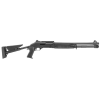
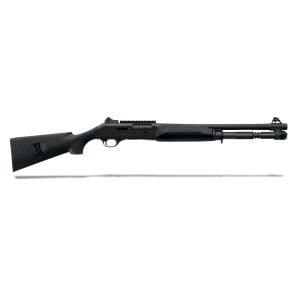
Benelli M4
The Benelli M4 is the finest tactical semi-automatic shotgun ever made. That’s not hyperbole. When the U.S. Marine Corps adopted it as the M1014 Joint Service Combat Shotgun, they put it through a testing protocol that eliminated every other contender. The Auto-Regulating Gas-Operated (ARGO) system is brilliantly simple: two small pistons, minimal parts, and a self-cleaning design that runs reliably with everything from light target loads to full-power slugs.
In law enforcement, the M4 is the standard for agencies that want a semi-auto shotgun. The ability to deliver rapid follow-up shots without short-stroking a pump action is a real advantage under stress. I’ve seen officers short-stroke pump guns during qualification under zero pressure. In a gunfight, that problem multiplies. The M4 eliminates it entirely.
The downside is the price. The M4 is expensive, often running $1,800-$2,000 at retail. But for what you get, it’s worth every dollar. Read our full Benelli M4 review for a deep dive. EuroOptic often has competitive pricing on Benelli shotguns.



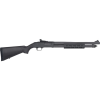
Remington 870
The Remington 870 is the most widely issued pump-action shotgun in American law enforcement history. Over 11 million have been produced since 1950, and for decades, the 870 Police model was the default shotgun in virtually every patrol car in the country. The dual action bars provide smooth, reliable cycling, and the platform’s simplicity means any officer can be trained on it quickly.
Remington’s bankruptcy and corporate troubles created legitimate concerns about quality control in recent years. The current Remington, now operating under RemArms, has been working to rebuild that reputation. If you’re buying new, inspect carefully. If you can find a pre-2007 870 Police model, you’ve got one of the best pump shotguns ever made, hands down.
The aftermarket for the 870 is second only to the AR-15. Stocks, forends, barrel options, magazine extensions, side saddles: if you can imagine it, someone makes it for the 870. That kind of ecosystem is a massive advantage for both agencies and individual buyers. Read our Remington 870 review for the full breakdown.
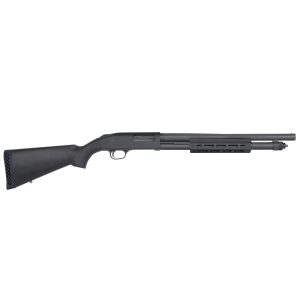
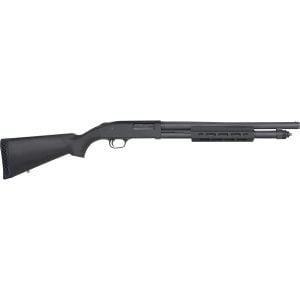
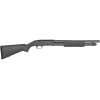
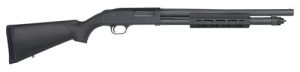
Mossberg 590A1
The Mossberg 590A1 holds a distinction that no other pump-action shotgun can claim: it’s the only pump shotgun to pass the U.S. military’s Mil-Spec 3443E testing protocol. That test includes a 6,000-round endurance evaluation and environmental exposure testing that simulates the worst conditions imaginable. The 590A1 passed. The 870 did not.
What separates the 590A1 from the standard 590 is the heavy-walled barrel, metal trigger guard, and metal safety button. These upgrades make the gun more durable under hard use and in extreme temperatures. The top-mounted safety is ambidextrous by design, which is a genuine advantage for left-handed shooters and during stress situations where fine motor skills degrade.
For the money, the 590A1 is arguably the best tactical pump shotgun you can buy. It costs less than a new-production 870 Police in many cases, and it has the mil-spec pedigree to back up its reputation. Check out our Mossberg 590A1 review for a thorough evaluation.
Sniper and Precision Rifles
Law enforcement precision rifles serve a very different purpose than military sniper rifles. Most LE engagements happen at 100 yards or less, often much less. The priority is surgical accuracy on a single target, frequently with hostages or bystanders nearby. There is zero margin for error. These rifles, and the officers who wield them, are held to an absolute standard: one shot, one stop, every single time.
Remington 700 (M24 / M40 Platform)
The Remington 700 action is the foundation of precision rifle shooting in America. The U.S. Army’s M24 Sniper Weapon System and the USMC’s M40 series are both built on the 700 action, and the vast majority of LE precision rifles in service today are either factory Remington 700s or custom builds using the 700 footprint. The action is simple, strong, accurate, and has more aftermarket support than any bolt-action rifle in existence.
For LE use, the Remington 700 Police (700P) in .308 Winchester was the standard for decades. Many departments still issue them, and they perform well within typical LE engagement distances. The .308 cartridge offers excellent terminal performance at the ranges LE snipers operate, and the recoil is manageable enough for rapid follow-up shots if needed.
The aftermarket ecosystem for the 700 action is staggering. Chassis systems from Magpul, MDT, and KRG turn a basic 700 into a modern precision rig. Custom barrel options from Krieger, Bartlein, and Proof Research push accuracy to extreme levels. If you’re building a precision rifle from scratch, the 700 action is the most logical starting point.
Accuracy International
When money is no object and the mission demands absolute precision, Accuracy International is the name at the top of the list. Founded in the UK and adopted by military and LE agencies worldwide, AI rifles represent the pinnacle of bolt-action precision rifle engineering. The AXSR and AT-X platforms offer sub-half-MOA accuracy from the factory, modular caliber conversion, and a folding stock that makes transport and storage far easier than traditional precision rifles.
In American LE, AI rifles are most commonly found in SWAT and HRT (Hostage Rescue Team) units at the federal level. The FBI’s HRT has used AI platforms extensively. At the state and local level, departments with dedicated sniper programs increasingly specify AI rifles when budgets allow. The cost is substantial (often $5,000-$8,000+), but the performance is unmatched.
For civilian precision shooters and PRS competitors, AI rifles are the benchmark everyone else is trying to match. If you’re serious about long-range shooting and want the best, EuroOptic is one of the best sources for Accuracy International rifles in the U.S.
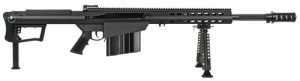
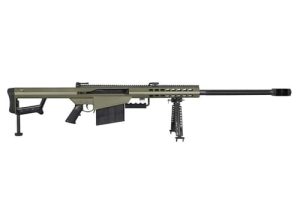
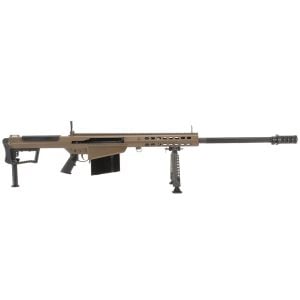
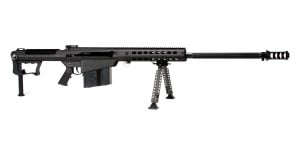
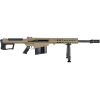
Barrett M82 / M107
The Barrett M82 (and its current military designation, the M107) is the definitive .50 BMG semi-automatic rifle. Originally designed for anti-materiel use (disabling vehicles, destroying equipment at extreme range), the Barrett has found a role with specialized military and LE units for situations where standard rifle calibers simply aren’t enough. We’re talking about engagements beyond 1,000 yards, shooting through barriers, and stopping vehicles.
In law enforcement, the .50 BMG is extremely niche. You’ll find these rifles with federal tactical teams and a handful of state-level units that maintain them for specific scenarios. The recoil-operated semi-automatic action makes the .50 BMG surprisingly manageable, though “manageable” is relative when you’re talking about a round that generates over 13,000 ft-lbs of muzzle energy.
For civilians, the Barrett M107A1 is legal in most states and represents the ultimate in long-range rifle capability. It’s also one of the most expensive firearms most people will ever buy. Check out our most powerful rifles guide for more on the .50 BMG and other extreme-caliber platforms.
Submachine Guns and PCCs
Submachine guns and pistol-caliber carbines (PCCs) fill a specific niche in law enforcement: close-quarters operations where a full-size rifle is too long or too loud, but a pistol doesn’t provide enough accuracy or capacity. Think building searches, dignitary protection, vehicle operations, and indoor CQB. The 9mm cartridge in a shoulder-fired platform gives officers significantly better hit probability than a handgun, with reduced over-penetration risk compared to rifle calibers.
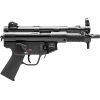
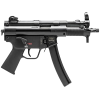
Heckler & Koch MP5
The HK MP5 is the most iconic submachine gun in the world, and it has been the gold standard for LE and military special operations for over 50 years. The SAS made it famous at the Iranian Embassy siege in 1980. Germany’s GSG9 carried it. Navy SEALs used it. And SWAT teams across America have run MP5s since the 1970s. The roller-delayed blowback action provides incredibly smooth recoil impulse and outstanding accuracy for a 9mm platform.
While many agencies have moved on to more modern platforms, the MP5 remains in active service with departments that maintain their existing inventory. The civilian-legal semi-auto version is the HK SP5, which replicates the MP5’s handling and accuracy in a legal configuration. It’s not cheap (expect to pay $2,500-$3,000), but the shooting experience is genuinely special.
If you’ve ever wanted to own a piece of tactical history that also happens to be one of the softest-shooting 9mm platforms on the market, the SP5 is the way to do it. Read our HK SP5 review for the full breakdown.
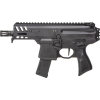
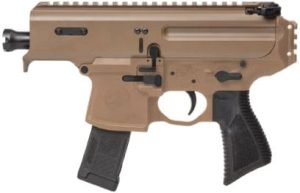
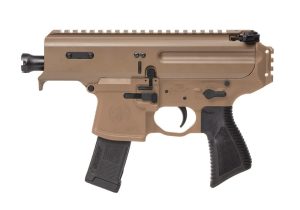
Sig Sauer MPX
The Sig MPX is the modern replacement for the MP5 in many law enforcement agencies. It uses a short-stroke gas piston system rather than the roller-delayed blowback of the MP5, and it accepts AR-style controls that most officers are already trained on. That training commonality is a big deal for agencies that don’t want to maintain proficiency on multiple manual of arms systems.
The MPX offers AR-15 ergonomics in a 9mm package: same safety, same magazine release, same bolt catch/release. For officers who carry an AR-15 on patrol, transitioning to the MPX for CQB requires almost no retraining. Sig also offers the MPX in various barrel lengths, including SBR configurations for LE agencies and pistol/brace configurations for civilians.
The MPX has also become a dominant force in PCC competition, which speaks to its accuracy and reliability under high-volume use. If you’re considering a pistol-caliber carbine for home defense or competition, this is one of the best options available. Full details in our Sig MPX review.
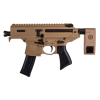
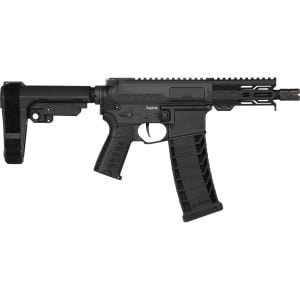
CMMG Banshee
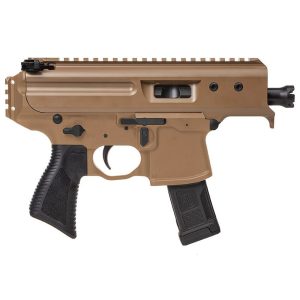
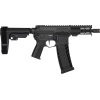
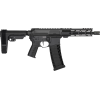
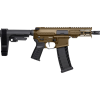
The CMMG Banshee has carved out a growing role in law enforcement as agencies look for compact PCCs built on the familiar AR-15 platform. What sets the Banshee apart is CMMG’s Radial Delayed Blowback operating system, which significantly reduces felt recoil compared to standard direct blowback PCCs. The result is a 9mm carbine that shoots flatter and softer than most of the competition.
Vehicle teams, plainclothes units, and officers who need a compact shoulder-fired weapon that fits in a backpack or under a seat have been gravitating toward the Banshee. The short barrel options (5″ and 8″) make it extremely maneuverable in tight spaces. CMMG offers it in multiple calibers, but 9mm and .45 ACP are the most popular for LE applications.
For civilians, the Banshee is an outstanding home defense PCC and a blast to shoot at the range. The Radial Delayed Blowback system genuinely makes a noticeable difference in recoil management. Browse the options in our best 9mm AR pistols guide.
Backup and Concealed Carry Guns
Every experienced officer carries a backup gun, or at least should. The backup weapon is the last line of defense if the primary duty pistol is lost, taken, or malfunctions during a critical incident. Backup guns also serve as the primary carry weapon for plainclothes detectives, undercover officers, and off-duty carry. The requirements are straightforward: small, light, reliable, and chambered in a serious defensive caliber.
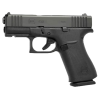
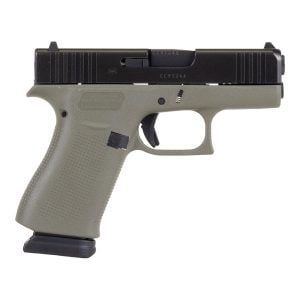
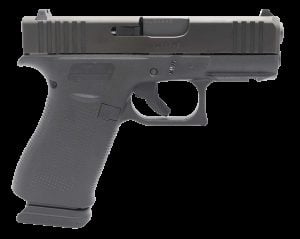
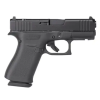
Glock 43X / Glock 42
Glock dominates the LE backup gun market just like it dominates the duty gun market. The Glock 43X (9mm, 10+1 capacity) is the current favorite for officers who want maximum firepower in a slim package. The 43X MOS variant accepts micro red dot sights, which is increasingly popular even on backup-size guns. The Glock 42 (.380 ACP, 6+1) fills the ultra-compact niche for ankle holster carry and deep concealment.
The advantage of carrying a Glock backup when your duty gun is also a Glock is obvious: identical manual of arms, identical trigger feel, and the department only needs to stock one type of cleaning kit and armorer tools. Many departments that issue Glock duty pistols offer a discount program for Glock backup guns, making it even easier for officers to stay in the ecosystem.
For civilian concealed carry, the 43X is one of the most popular choices in America for good reason. It balances concealability with shootability better than almost anything else on the market. With aftermarket Shield Arms S15 magazines, you can bump capacity to 15+1 in the same slim frame. Read our Glock 43X review for the full story.
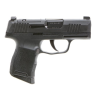
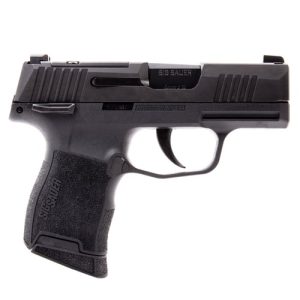
Sig Sauer P365
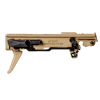
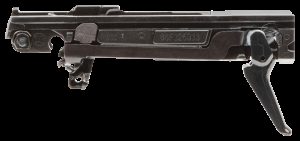
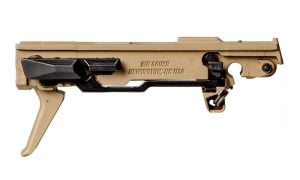
The Sig P365 changed the micro-compact market when it launched with a 10+1 capacity in a gun smaller than the Glock 43. That capacity advantage in a tiny package made it an instant hit with both civilians and law enforcement. The P365 and its variants (P365X, P365XL, P365 Macro) cover the full spectrum from deep concealment to compact duty gun territory.
For plainclothes officers and federal agents, the P365XL (12+1, 3.7″ barrel) has become particularly popular. It’s small enough to conceal under a suit jacket but large enough to shoot well at qualification distances. The P365 Macro pushes the platform even further with a 17+1 capacity that rivals full-size duty guns. Sig has essentially built an entire ecosystem within the P365 family.
The trigger on the P365 is excellent for its size class, and Sig’s build quality is consistently high. If you’re choosing between the P365 and the Glock 43X, you really can’t go wrong with either. It comes down to ergonomic preference and which trigger pull you prefer. Check our full Sig P365 review for a detailed comparison.
Smith & Wesson J-Frame Revolvers
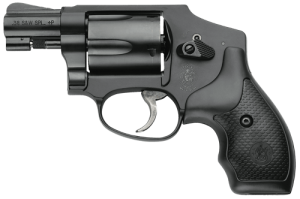
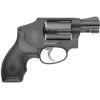
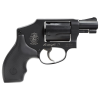
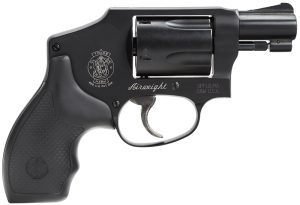
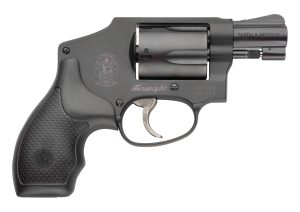
The S&W J-Frame revolver is the classic LE backup gun, and it still sees significant carry in 2026. Models like the 442 (aluminum frame.38 Special, hammerless) and 642 (same, but stainless) have been riding in ankle holsters for decades. The appeal is simplicity: no magazine to lose, no slide to rack, no external safety. Draw, point, pull the trigger. That’s it.
The J-Frame’s limitation is obvious: five rounds of .38 Special (or .357 Magnum in the steel-framed models) is far less than the 10-15 rounds a micro-compact semi-auto carries. For many officers, the capacity disadvantage is a deal-breaker. But for veterans who grew up on revolvers, and for anyone who values absolute mechanical simplicity in a last-ditch gun, the J-Frame still makes sense.
I’ll be honest: I still carry a 442 as an occasional pocket gun. There’s something reassuring about a weapon that has essentially zero chance of malfunctioning. For a broader look at .38 Special options, check out our guide to the best .38 Special revolvers.
Why LE Firearms Matter to Civilians
You might be wondering why you should care what law enforcement carries. The answer is simple: LE adoption is the most rigorous vetting process any firearm can go through. Before a major department adopts a new pistol, that gun has been through tens of thousands of rounds in torture testing, environmental extremes, drop testing, and reliability evaluations that no consumer review or YouTube video can replicate. When a gun passes LAPD, NYPD, or FBI testing, it works.
If police officers trust a firearm with their lives every single day, you can trust it with yours. That logic applies to home defense, concealed carry, and any other serious defensive application. The guns covered in this guide aren’t range toys or safe queens. They’re tools that have been validated under the harshest real-world conditions imaginable.
There’s also a massive practical benefit to buying LE-adopted firearms: aftermarket support. When millions of Glock 19s are in service worldwide, every holster maker, sight manufacturer, and accessories company builds for that platform first. Holsters are available the day a gun launches. Training courses are built around it. Parts are cheap, plentiful, and available everywhere. That ecosystem matters more than most people realize when they’re shopping.
The civilian versions of most LE firearms are functionally identical to what agencies issue. The Glock 17 you buy at your local gun shop is the same gun, with the same barrel, the same trigger, and the same reliability, as the one in a patrol officer’s holster. You’re getting proven, battle-tested hardware at civilian retail prices. That’s a phenomenal value proposition, and it’s why the best concealed carry handguns list overlaps heavily with LE adoption.
The Shift from .40 S&W to 9mm
If you’ve been around firearms for a while, you might remember when .40 S&W was the dominant LE caliber. The FBI adopted the .40 in the early 1990s after the 1986 Miami shootout exposed the limitations of their 9mm loads, and most of American law enforcement followed suit. For nearly 25 years, the .40 S&W was king. Then the FBI switched back to 9mm in 2015, and the industry shifted almost overnight.
What changed? Ammunition technology. Modern 9mm jacketed hollow point loads like Federal HST, Speer Gold Dot, and Hornady Critical Duty have closed the terminal performance gap with .40 S&W almost entirely. The FBI’s own testing showed that current-generation 9mm JHP rounds achieve nearly identical penetration depth and expansion diameter as .40 S&W loads. When the performance is equal, every other advantage goes to 9mm.
Those advantages are significant. 9mm offers higher magazine capacity (typically 2-3 more rounds per magazine), less recoil (which means faster follow-up shots and better hit probability), and substantially lower training ammunition costs. For a department training hundreds of officers, the cost savings alone are compelling. Add in reduced recoil for smaller-statured officers and faster qualification pass rates, and the decision becomes obvious.
Today, the vast majority of American LE agencies have transitioned to 9mm, and the .40 S&W market has contracted dramatically. If you’re buying a duty-type pistol in 2026, 9mm is the right call for almost everyone. For a deeper look at the caliber debate, check out our 9mm vs .45 ACP comparison and our guide to the best 9mm ammo for self-defense.
Related Guides
More from USA Gun Shop
- Best Glock Pistols
- Top 10 Sig Sauer Pistols
- Best Smith & Wesson Pistols
- Sig Sauer P320 Review
- Sig P320 Problems
- S&W M&P 2.0 Compact Review
- Benelli M4 Review
- Remington 870 Review
- Mossberg 590A1 Review
- HK SP5 Review
- Sig Sauer MPX Review
- Best AR-15 Rifles
- Most Powerful Rifles
- Best Concealed Carry Handguns
- Police Duty Pistols from Around the World
- Glock 43X Review
- Sig P365 Review
- Best .38 Special Revolvers
- Best 9mm AR Pistols
- 9mm vs .45 ACP
- Best 9mm Ammo
Sources and Further Reading
- U.S. Department of Justice, Office of Community Oriented Policing Services (COPS), law enforcement firearms training and equipment standards.
- FBI Uniform Crime Reports, Law Enforcement Officers Killed and Assaulted (LEOKA) data series.
- Police Executive Research Forum (PERF), annual policing technology and equipment surveys.
- International Association of Chiefs of Police (IACP), firearms and use-of-force policy materials.
- U.S. Government Accountability Office (GAO) reports on federal law enforcement firearms procurement.
- National Tactical Officers Association (NTOA) standards and equipment recommendations.
- Manufacturer law enforcement specifications from Glock Inc., SIG Sauer, Smith & Wesson, Colt Defense, Daniel Defense, Heckler & Koch, Benelli Defense, and Accuracy International.
Frequently Asked Questions
What gun do most police officers carry?
The Glock 17 and Glock 19 are the most common police duty pistols in America, used by roughly 65% of law enforcement agencies. The Sig Sauer P320 (M17/M18) is the second most popular and growing. Smith & Wesson M&P 2.0 is third. Nearly all agencies have standardized on 9mm.
What rifle do police use?
Most police patrol rifles are AR-15 pattern rifles chambered in 5.56 NATO, typically Colt, FN, or Daniel Defense. SWAT and tactical units may use Sig MCX (piston-driven) or specialized precision rifles from Remington or Accuracy International. The standard configuration is a 14.5 or 16-inch barrel with a red dot or LPVO optic.
What shotgun do police use?
The Remington 870 has been the most common police shotgun for decades. The Mossberg 590A1 is the only pump shotgun to pass US military testing and is growing in LE adoption. For tactical units, the Benelli M4 semi-auto is the premium choice, adopted by the US Marine Corps and numerous SWAT teams.
Why did police switch from .40 S&W to 9mm?
The FBI switched back to 9mm in 2015 after concluding that modern 9mm hollow point ammunition matches .40 S&W in terminal performance. 9mm offers higher capacity (15-17 rounds vs 13-15), less recoil for faster follow-up shots, and cheaper ammunition for more frequent training. Most agencies followed the FBI lead.
Can civilians buy the same guns as police?
In most cases, yes. The civilian versions of LE firearms (Glock 17, Sig P320, Benelli M4, AR-15 pattern rifles) are identical to law enforcement models. The main exceptions are select-fire (full-auto) weapons and items restricted by state law. Civilian semi-auto versions of LE guns are widely available.
What is the best gun for home defense based on what police use?
Based on LE testing and adoption, the Glock 19 (9mm pistol), Mossberg 590A1 (pump shotgun), or an AR-15 in 5.56 NATO are the top choices. All three are proven in LE service, widely available, affordable, and have massive aftermarket support for holsters, lights, and accessories.
What pistol do most American police carry today?
The Glock 17 and Glock 19 dominate American police duty pistol usage at roughly 65 percent across all agencies. The SIG Sauer P320 / M17 is the second most common at approximately 20 percent and growing rapidly since the U.S. military adoption in 2017. Smith & Wesson M&P holds the third spot at approximately 10 percent. The remainder is fragmented across Beretta, Walther, Heckler & Koch, and various legacy platforms. Caliber-wise, the industry has converged on 9mm; the .40 S&W that dominated American policing from 1991 to 2014 has been displaced agency-by-agency since the FBI's 2014 reversal.
Why did American police shift from .40 S&W back to 9mm?
The FBI's 2014 Ammunition Solicitation testimony to Congress cited modern 9mm JHP terminal-ballistics parity with .40 S&W, lower felt recoil for the same energy, faster split times on multi-target engagements, higher magazine capacity, and reduced training-injury rates from wrist strain. The bureau's policy reversal triggered a chain reaction in police procurement that has continued for a decade. State and local agencies have transitioned at roughly fifty per year since 2015; the U.S. Border Patrol returned to 9mm in 2017; the U.S. Coast Guard, Marshals Service, and DEA all followed. The .40 is now a declining caliber in American policing.
Why do civilians care about law enforcement firearm choices?
Police procurement decisions ripple into the civilian market with a typical 5-10 year lag. The 1985 military adoption of the Beretta M9 produced the civilian Beretta 92FS market; the 1995-onward Glock adoption by police produced the modern Glock-dominant CCW market; the 2017 SIG M17 adoption produced the civilian P320 market. When a major agency selects a new platform, that platform becomes the de facto standard for civilian buyers within a decade. The current SIG XM7 Spear NGSW adoption will likely produce a civilian 6.8x51 / MCX Spear market over the next ten years.
6,216+ Gun & Ammo Deals
Updated daily from 200+ top retailers. Filter by category, caliber, action type, and price.