
Last updated March 9th 2026
I have carried concealed daily for over a decade and fired tens of thousands of rounds through handguns at every price point — from $250 budget pistols to $3,000+ custom builds. Every recommendation in this guide is based on trigger time and real-world carry experience, not spec sheets or press releases. Some links are affiliate links that support our independent testing. Read our editorial policy.

Quick Answer: Best Handguns by Purpose
If you already know what you need and just want a recommendation, here are my top picks:
- Best First Handgun Overall: Sig Sauer P320 — Modular, reliable, $500-$600
- Best for Concealed Carry: Sig Sauer P365 — 10+1 in a micro-compact frame, $499
- Best for Home Defense: Glock 19 Gen 5 — The do-everything pistol, $549
- Best Budget Handgun: Taurus G3C — Reliable and under $250
- Best Full-Size Range Pistol: CZ P-10F — Best factory trigger under $500
- Best Revolver: S&W 686 Plus — The gold standard .357 Magnum
- Best 1911: Springfield Armory Loaded — Classic feel, modern reliability, $899
Find the Best Price in Seconds
Search once, compare 100+ trusted retailers instantly.
Why Choosing the Right First Handgun Matters
Your first handgun shapes your entire shooting experience. Buy the wrong one and you will develop a flinch from excessive recoil, struggle with a trigger that is too heavy, or end up with a gun that sits in a drawer because it is too large to carry. Buy the right one and you will shoot more, train more, and build fundamentals that make you a competent, confident shooter.
I have seen this play out hundreds of times. A new shooter buys a snub-nose .357 Magnum because someone told them it was “simple” — they hate shooting it, they cannot hit anything past 7 yards, and their wrists hurt after 50 rounds. Or they buy a full-size .45 ACP because it looked cool online, then realize they cannot conceal it in anything short of a winter parka.
This guide exists to help you avoid those mistakes. I will walk you through everything you need to know — from caliber selection to action types to specific model recommendations — so you can buy one handgun that actually fits your life. If you are already past this stage and want to see model comparisons, jump to our beginner handgun recommendations or our roundup of the best concealed carry handguns.
Step 1: Define Your Purpose
Before looking at a single handgun, answer this question honestly: what is the primary job this gun needs to do? Your answer determines the size, caliber, action type, and budget you should be looking at. Most handgun purposes fall into four categories:
Concealed Carry (CCW/EDC)
If you plan to carry your handgun daily, size and weight are king. A compact or subcompact 9mm that you can comfortably carry 12+ hours a day is infinitely more useful than a full-size pistol that stays home because it prints through every shirt you own. You want something thin, light (under 24 ounces loaded), and with a capacity of at least 10 rounds.
The micro-compact 9mm category has exploded since the Sig P365 proved you could fit 10+1 rounds into a subcompact frame. Today, every major manufacturer makes a competitive micro-compact. See our deep dive on the best 9mm micro-compact pistols and the best subcompact 9mm handguns for detailed comparisons.
Before you carry, you will need a permit in most states — check our gun laws by state guide for current requirements. And seriously consider concealed carry insurance — it is cheap peace of mind.
Home Defense
For home defense, concealability does not matter. You want a handgun that is easy to shoot accurately under stress, has a weapon-mounted light (mandatory for target identification in the dark), and holds enough ammunition. A full-size or compact 9mm with a 15-17 round magazine, a Streamlight TLR-7A or Surefire X300U, and night sights or a red dot is the ideal setup.
If you are comparing handguns to long guns for home defense, an AR-15 or home defense shotgun is objectively more effective — rifles are easier to shoot accurately and 5.56 fragments faster through drywall than pistol rounds. But a handgun lets you keep one hand free (for a phone, a child, or a door), and that matters in a real scenario. Read our home defense strategies guide for a thorough breakdown.
Range and Target Shooting
If your handgun will live at the range, prioritize shootability over portability. A full-size pistol with a 4.5-5 inch barrel, a clean trigger, and good sights will make your range sessions far more enjoyable. Weight is actually a benefit here — heavier guns absorb more recoil, which means faster follow-up shots and less fatigue during long sessions.
The best full-size 9mm pistols are purpose-built for this role. If you are interested in competition, our beginner’s guide to competitive shooting will help you understand which divisions and gun types work for each sport.
General Purpose (Do-Everything)
Most first-time buyers actually need a do-everything gun — something they can carry, shoot at the range, and keep on the nightstand. The compact 9mm is the answer. A Glock 19, Sig P320 Compact, S&W M&P 2.0 Compact, or Springfield Echelon gives you 15 rounds, enough barrel for accuracy, and a size that works with a good holster for concealed carry. If I could only own one handgun, it would be a compact 9mm. Period.
Step 2: Choose Your Caliber
Caliber debates have raged since the invention of the metallic cartridge. Here is the objective reality in 2026, backed by modern ballistic testing and FBI data:
9mm Luger — The Clear Winner for Most People
The 9mm is the world’s most popular handgun caliber for good reason. Modern 9mm hollow-point ammunition (Federal HST, Speer Gold Dot, Hornady Critical Duty) expands reliably and penetrates to FBI-standard depths of 12-18 inches in calibrated gel. The FBI, virtually every police department in America, and most military special operations units use 9mm.
Why 9mm over everything else? Lower recoil means faster follow-up shots and easier training. Higher capacity — a compact 9mm holds 15 rounds where a comparable .45 ACP holds 7-10. Cheaper ammunition — 9mm practice ammo runs 20-28 cents per round versus 35-50 cents for .45 ACP. More affordable ammo means more training, and more training means better accuracy. For a deep dive on why everybody uses 9mm, we wrote a whole article on it.
For specific ammunition recommendations by purpose, see our best 9mm ammo guide.
.45 ACP — The Classic That Still Works
The .45 ACP throws a bigger, heavier bullet (230 grains vs. 124 grains for 9mm) at slower velocities. Does it hit harder? Marginally. Does that matter with modern hollow-point designs? Not nearly as much as caliber warriors on forums claim. The FBI abandoned .45 ACP decades ago, not because it did not work, but because their agents shot better and faster with 9mm.
That said, if you love the 1911 platform or simply prefer .45 ACP, modern pistols handle it well. The best subcompact .45s and best .45 ACP 1911 pistols are excellent firearms. Just understand the trade-offs: more recoil, lower capacity, more expensive ammo. For a full comparison, read 9mm vs .45 ACP and 9mm vs .45 vs .40 S&W.
.380 ACP — For the Smallest Carry Guns
The .380 ACP is essentially a shorter, lower-pressure 9mm cartridge. It allows manufacturers to build extremely small, lightweight pistols for deep concealment. Modern .380 defensive ammo (Hornady Critical Defense, Federal HST Micro) performs adequately in gel testing, though it sits at the minimum threshold for reliable expansion.
I recommend .380 only when physical limitations (small hands, arthritis, limited grip strength) make a 9mm genuinely uncomfortable to shoot. The best .380 ACP pistols are solid firearms, but if you can handle a micro-compact 9mm like the P365, you get more power in nearly the same size. See our .380 ACP ammo guide for the best defensive loads.
.357 Magnum / .38 Special — For Revolver Enthusiasts
If you are drawn to revolvers, .357 Magnum is the caliber to choose because any .357 Magnum revolver also fires milder .38 Special ammunition. This gives you flexibility: train with low-recoil .38 Special wadcutters and carry with .357 Magnum defensive loads. The best .357 Magnum revolvers are beautifully made firearms that will last generations. For smaller revolvers suited to concealed carry, check the best .38 revolvers for CCW.
Other Calibers
.40 S&W — Once the law enforcement standard, now largely replaced by 9mm. Offers no meaningful advantage over 9mm with modern ammo but kicks harder and holds fewer rounds. The best .40 S&W pistols are fine firearms, but I would not choose .40 for a first handgun in 2026. 10mm Auto — A powerhouse cartridge popular for hunting and bear country carry. Not a beginner caliber. See the best 10mm pistols and best 10mm carry guns if you are interested. .22 LR — An excellent training caliber (basically free to shoot) but not suitable for self-defense. Many shooters keep a Ruger Mark IV or similar .22 pistol as a dedicated trainer.
Step 3: Understand Action Types
The action type determines how the trigger works, how the gun fires, and what your shooting experience feels like. This is where most guides lose people, so I will keep it simple and practical.
Striker-Fired
A striker-fired pistol uses an internal striker (instead of an external hammer) to fire the cartridge. The trigger pull is consistent shot-to-shot — typically 5-6 pounds with a short, predictable reset. There is no external safety to disengage on most models (though some offer one). You draw, you press the trigger, it fires. Every time, the same way.
This is the dominant action type in 2026. The Glock 19, Sig P365, S&W M&P series, Springfield Hellcat, and Walther PDP are all striker-fired. For a first handgun, striker-fired is what I recommend to nearly everyone. The simplicity of operation — no external safety to forget, no hammer to manage, one consistent trigger pull — means fewer things to think about under stress.
DA/SA (Double Action / Single Action)
DA/SA pistols have a heavy first trigger pull (double action, 10-12 pounds) that both cocks and releases the hammer, followed by lighter subsequent shots (single action, 4-5 pounds) as the slide cocks the hammer for you. The heavy first pull acts as a built-in safety margin — it is very difficult to fire accidentally.
The transition between the heavy DA pull and the light SA pull takes practice to master. This is why I generally do not recommend DA/SA for first-time buyers — the inconsistent trigger can be frustrating during early training. However, experienced shooters often prefer DA/SA for carry because of that extra safety margin. The best 9mm DA/SA pistols include the CZ 75, Beretta 92X, Sig P226, and HK USP — all legendary designs.
SAO (Single Action Only)
Single-action-only pistols — most famously the 1911 — have a light, crisp trigger pull (3-5 pounds) that only releases the hammer. The gun must be carried “cocked and locked” — hammer back, manual safety engaged. You disengage the safety as you draw. This requires training and muscle memory, but the trigger quality is unmatched.
I love 1911s. The trigger on a well-tuned 1911 is the finest in the handgun world. But I would not recommend one as a first handgun — the manual safety adds a training requirement, the capacity is limited (7-8 rounds in .45 ACP, 9-10 in 9mm), and quality 1911s are expensive. Once you have experience, explore our guides to affordable 1911 handguns, custom 1911s, and Kimber 1911 pistols.
Revolver (DA/SA)
Modern revolvers are DA/SA — you can pull the trigger in double action (heavy, long pull) or cock the hammer for a single-action shot (short, light pull). Revolvers are mechanically simple, incredibly reliable, and satisfying to shoot. The downsides: limited capacity (5-6 rounds in most carry revolvers), slow reloads, and a heavy double-action trigger that takes significant training to shoot well.
Revolvers make excellent nightstand guns, range guns, and hunting sidearms. For concealed carry, they have been largely replaced by micro-compact 9mms that hold twice the ammunition in a similar-sized package. But if you genuinely prefer revolvers, they are absolutely viable. See the best .357 Magnum revolvers, best .22 revolvers, and best .44 Magnum revolvers for our top picks.
Step 4: Pick the Right Size
Handgun size categories can be confusing because manufacturers play fast and loose with terms. Here is the practical reality of each size class:
Full-Size
Barrel: 4.5-5 inches | Capacity: 17-21 rounds (9mm) | Weight: 25-32 oz
Examples: Glock 17, Sig P320 Full, CZ P-10F, Beretta 92X, S&W M&P 2.0 Full
Full-size pistols are the easiest to shoot well. The longer barrel gives better sight radius, the weight absorbs recoil, and the grip fills your hand completely. They are the best choice for home defense, range use, and competition. They are the worst choice for concealed carry unless you are a large person who dresses around the gun. Browse our best full-size 9mm pistols for the complete list.
Compact
Barrel: 3.8-4.2 inches | Capacity: 15-17 rounds (9mm) | Weight: 22-28 oz
Examples: Glock 19, Sig P320 Compact, S&W M&P 2.0 Compact, Springfield Echelon, Walther PDP Compact
The compact category is the sweet spot for most buyers. A compact 9mm can serve as your carry gun, your home defense gun, and your range gun without being terrible at any of those roles. The Glock 19 is the most popular handgun in America for this exact reason — it does everything well enough. Our best compact 9mm pistols guide covers the top options in detail.
Subcompact
Barrel: 3.2-3.6 inches | Capacity: 10-13 rounds (9mm) | Weight: 18-24 oz
Examples: Glock 26, Glock 43X, S&W M&P Shield Plus, Walther PDP F-Series
Subcompacts are specifically designed for concealed carry. They sacrifice barrel length and grip size for concealability. The Glock 43X and S&W Shield Plus are the most popular in this class — both hold 10+ rounds and are thin enough for appendix carry in a t-shirt. See our best subcompact 9mm handguns for the full list.
Micro-Compact
Barrel: 3.0-3.2 inches | Capacity: 10-15 rounds (9mm) | Weight: 17-21 oz
Examples: Sig P365, Springfield Hellcat, Kimber Mako, S&W Equalizer
Micro-compacts revolutionized the concealed carry market. The Sig P365 proved that you could fit double-stack capacity into a single-stack-sized frame, and every manufacturer followed. These are the smallest 9mm handguns you can buy while still having a real sight radius and 10+ rounds. They are purpose-built for daily carry. Our best 9mm micro-compact pistols guide covers every contender in this red-hot category.
Best Handguns for Beginners (2026 Picks)
These are my actual recommendations based on personal experience — rifles I have shot, carried, and would trust my life to. Each one earned its place through range time and real-world use.
Best Overall First Handgun: Sig Sauer P320 Compact
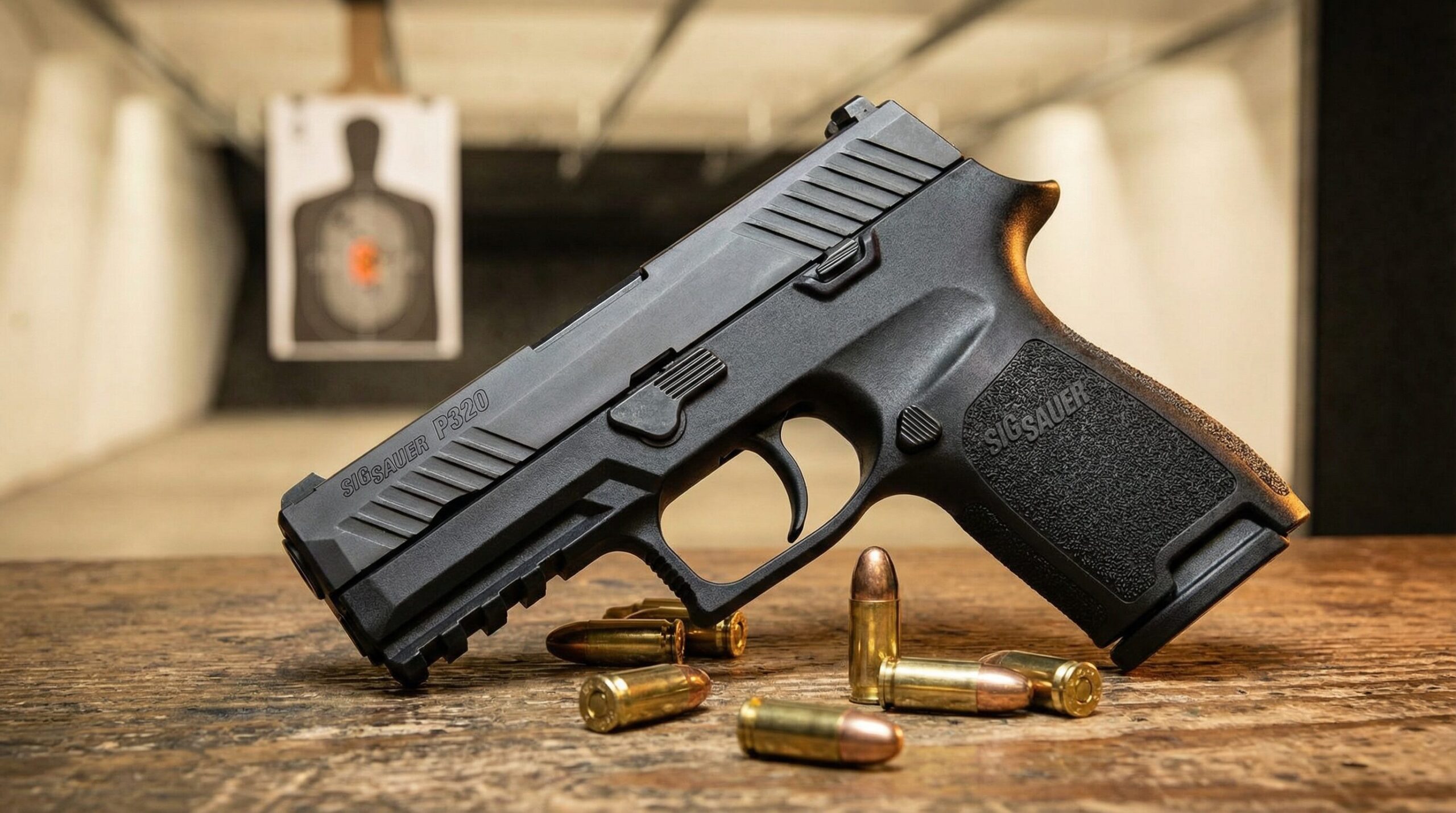
Street price: $500-$600
Caliber: 9mm
Capacity: 15+1 (compact), 17+1 (full-size)
Barrel: 3.9″
Weight: 25.8 oz
Sig Sauer P320 Compact
The P320 is the most versatile handgun on the market. Its modular chassis system means the serialized “firearm” is a removable stainless steel chassis that drops into different grip modules. Buy it in compact, and you can later swap to a full-size, subcompact, or carry-length grip module for $40-$50 — no FFL required. The US Army chose it as the M17/M18 service pistol, and the M18 variant has proven itself in military service worldwide.
In our 1,500-round test, the P320 ran flawlessly with every ammunition type we fed it. The trigger is excellent for a striker-fired pistol — clean take-up with a crisp break at around 5.5 pounds. The optics-ready slide accepts most popular red dots without adapter plates.
Who it is for: First-time buyers who want maximum flexibility, anyone who may want to change configurations later, shooters who appreciate the US military’s service pistol.
Best for Concealed Carry: Sig Sauer P365 / P365X
Street price: $499-$599
Caliber: 9mm
Capacity: 10+1 (flush), 12+1 or 15+1 (extended)
Barrel: 3.1″
Weight: 17.8 oz
Sig Sauer P365
The P365 changed the concealed carry world forever. Before it launched, you had to choose between capacity (double-stack) and concealability (single-stack). The P365 fit a 10-round magazine into a frame barely larger than a single-stack Glock 43. Five years later, it is still the benchmark every micro-compact is measured against.
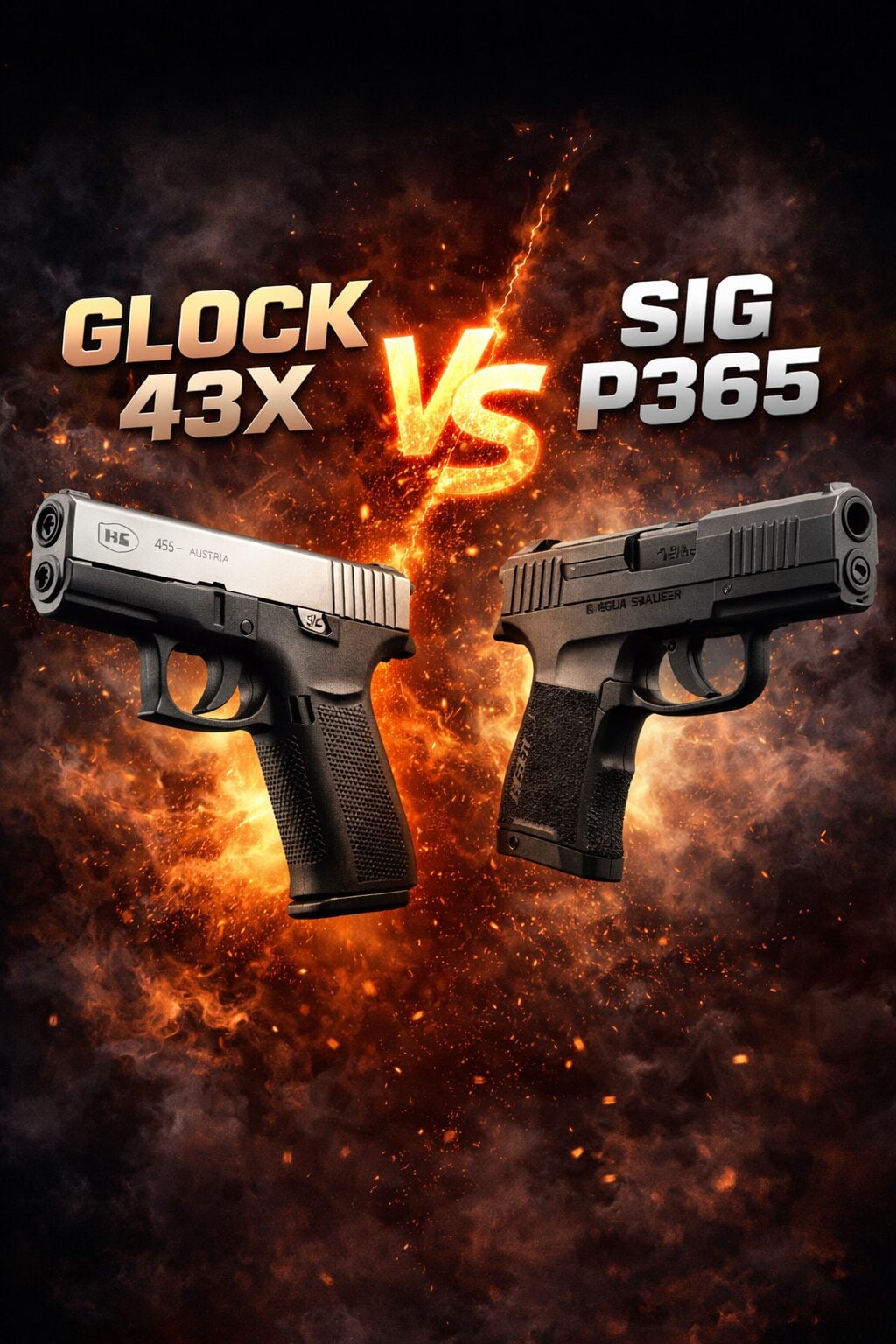
The P365X adds a slightly larger grip and a flat trigger — I prefer the X model for people with medium or larger hands. Both versions are optics-ready. Read our full Sig P365 review and see how it compares in our Glock 43X vs. Sig P365 head-to-head.
Who it is for: Anyone who will carry daily, smaller-framed shooters, people who prioritize concealment without sacrificing capacity.
Best Do-Everything Handgun: Glock 19 Gen 5
Street price: $549-$599
Caliber: 9mm
Capacity: 15+1
Barrel: 4.02″
Weight: 23.6 oz
Glock 19 Gen 5
The Glock 19 needs no introduction. It is the most popular handgun in America and possibly the world. Is it the best at anything? No. Does it do everything well? Yes. The Gen 5 added an improved barrel (Glock Marksman Barrel), ambidextrous slide stop, flared mag well, and removed finger grooves. Our 2,000-round review confirmed what everyone already knows: it runs.
The aftermarket support is unmatched — more holsters, lights, sights, triggers, and accessories are made for the Glock 19 than for any other handgun in existence. You will never struggle to find gear. For the full Glock lineup, see our guides to the best Glock pistols, best Glocks for concealed carry, and cheaper Glock alternatives.
Who it is for: Anyone who wants one handgun that does everything, people who value simplicity and aftermarket support, law enforcement and military personnel.
Best Budget Handgun: Taurus G3C
Street price: $229-$269
Caliber: 9mm
Capacity: 12+1
Barrel: 3.2″
Weight: 22 oz
Taurus G3C
Taurus has come a long way from the quality issues that plagued them a decade ago. The G3C is a genuinely good pistol — reliable, accurate enough, and astonishingly affordable. At under $250, it puts home defense capability within reach for buyers on the tightest budgets.
Is it as refined as a Glock 19? No. The trigger is serviceable but not great, the slide is a bit stiff, and the finish is basic. But it goes bang every time you pull the trigger, and it holds 12+1 rounds of 9mm. For the money, nothing else comes close. See our full best Taurus handguns guide for more from the brand, and check the best CCW guns under $400 for more budget options.
Who it is for: Budget-conscious first-time buyers, anyone who needs a reliable home defense handgun without breaking the bank.
Best Full-Size Range Pistol: CZ P-10F
Street price: $449-$499
Caliber: 9mm
Capacity: 19+1
Barrel: 4.5″
Weight: 28.2 oz
CZ P-10F
CZ makes some of the best triggers in the striker-fired world, and the P-10F is the crown jewel. The trigger breaks clean at about 4.5 pounds with a short, tactile reset that competition shooters love. It holds 19+1 rounds, the ergonomics are outstanding (CZ grips fit hands like they were custom-made), and the accuracy is exceptional.
If your primary use case is range shooting, target practice, or getting into competition, the P-10F is the best value in the full-size category. The best CZ pistols guide covers the entire lineup — including the legendary CZ 75 and its variants.
Who it is for: Range enthusiasts, aspiring competitors, shooters who prioritize trigger quality and accuracy above all else.
Best Revolver: Smith & Wesson 686 Plus
Street price: $799-$899
Caliber: .357 Magnum / .38 Special
Capacity: 7 rounds
Barrel: 4″ (also available in 3″ and 6″)
Weight: 35 oz
If you want a revolver, the 686 Plus is the one to get. The stainless steel L-frame is built like a bank vault, the double-action trigger is smooth out of the box, and the 7-round cylinder gives you one extra round over standard .357s. Shoot .38 Special at the range for cheap practice, carry .357 Magnum for defense.
Our 1,500-round S&W 686 Plus review confirmed what revolver enthusiasts already know — this is a forever gun. Your grandchildren will shoot this revolver. For more options, see the best .357 Magnum revolvers and best Smith & Wesson pistols.
Smith & Wesson 686 Plus
Who it is for: Revolver enthusiasts, hunters who need a powerful sidearm, shooters who appreciate craftsmanship and simplicity.
How to Test Before You Buy
Never buy a handgun you have not held — and ideally, never buy one you have not shot. Here is how to make an informed decision:
Visit a Range That Rents
Most indoor ranges rent handguns for $10-$20 plus ammo. Shoot your top 2-3 candidates with at least 50 rounds each. Pay attention to: how the grip fills your hand (no gaps, no stretching to reach the trigger), where the recoil impulse goes (does it torque left or right?), how the sights track during recoil, and how the trigger resets. The gun that feels the most natural in your hand is usually the right one.
Handle Before Buying Online
Visit a local gun store and handle the models you are considering. Wrap your hand around the grip — your trigger finger should reach the trigger face comfortably without straining. Rack the slide — can you do it easily? Work the controls — are the magazine release and slide stop reachable without shifting your grip?
Once you know what you want, buy online for the best price. Online retailers are typically $50-$150 cheaper than local stores. Use our gun price comparison tool to search across dozens of retailers, read our guide to the best online gun stores, and follow our step-by-step how to buy guns online tutorial. Keep an eye on our daily gun deals — popular handguns regularly go on sale.
Find the Best Price in Seconds
Search once, compare 100+ trusted retailers instantly.
What to Check at the Gun Counter
Trigger reach: Your index finger should contact the trigger at the center of the first pad. If you are using the tip of your finger or the joint, the grip is the wrong size. Slide operation: Rack the slide using the overhand “slingshot” method, not the pinch method. If you cannot rack it easily, consider a model with a lighter recoil spring or a slide release lever. Sight picture: Point the unloaded gun at a target — can you pick up the sights quickly? Are they visible in the store’s lighting? Magazine release: Can you press it without breaking your firing grip?
Essential Accessories for Your First Handgun
Your handgun purchase is not complete without these items. Budget an extra $200-$400 beyond the cost of the gun itself:
Holster (If Carrying)
A quality holster is not optional — it is a safety device. It protects the trigger from negligent discharges, secures the gun to your body, and enables a fast, consistent draw. Buy a Kydex holster made specifically for your gun model. Universal nylon holsters are dangerous — they do not retain the gun properly and can allow objects into the trigger guard.
For concealed carry, appendix inside-the-waistband (AIWB) is the fastest draw position and the easiest to conceal. The Tier 1 Concealed Axis Elite, T.Rex Arms Sidecar, and JM Custom Kydex are top-tier choices. Budget $60-$120 for a quality holster — your first cheap holster will end up in a drawer within a month.
Ammunition
Buy two types: practice/range ammo (FMJ/ball) for training and defensive ammo (JHP/hollow-point) for carry and home defense. For 9mm practice ammo, Federal American Eagle, PMC Bronze, Blazer Brass, and Winchester White Box are all reliable options at 20-28 cents per round in 2026.
For defensive ammo, my top three choices are: Federal HST 124-grain (the law enforcement standard), Speer Gold Dot 124-grain (excellent expansion and penetration), and Hornady Critical Duty 135-grain (barrier-blind performance). Buy at least 200 rounds of your chosen defensive load — fire 50-100 through your gun to confirm reliability, and keep the rest loaded in your carry and home defense magazines. Read our best 9mm ammo guide for the full breakdown, and check our daily ammo deals for the best prices.
Eye and Ear Protection
Mandatory. Electronic ear protection (Howard Leight Impact Sport at $40-$50 or Walker Razor at $35-$45) lets you hear conversations and range commands while blocking gunshot noise. ANSI Z87.1-rated eye protection is non-negotiable — hot brass, powder residue, and occasional fragmentation make eye protection a safety essential. Budget $60-$80 for both.
Weapon-Mounted Light (Home Defense)
If your handgun serves any defensive role, a weapon-mounted light is essential. You must positively identify your target before firing. The Streamlight TLR-7A ($100-$120) fits compact and full-size pistols and produces 500 lumens with a clean, focused beam. The Surefire X300U-B ($250-$300) is the professional standard at 1,000 lumens. Make sure your holster accommodates a weapon light — most quality Kydex holsters are made for specific gun/light combinations.
Red Dot Sight (Optional but Recommended)
Pistol red dots have gone from competition novelty to mainstream necessity. A red dot gives you faster target acquisition, better accuracy (especially at distance), and the ability to focus on the target rather than the front sight. The Holosun 507C ($260-$300) is the best value in the market. The Trijicon RMR Type 2 ($450) is the professional-grade standard.
Most modern handguns come optics-ready with milled slides or MOS plates. If yours does not, having a slide milled typically costs $75-$150. See our best pistol red dot sights guide for detailed comparisons.
Handgun Safety Fundamentals
Every handgun owner must know and follow the four universal firearm safety rules. These are non-negotiable:
- Treat every firearm as if it is loaded. Even if you just cleared it. Even if someone else just cleared it. Always.
- Never point the muzzle at anything you are not willing to destroy. Be aware of where your muzzle is pointed at all times — during handling, holstering, cleaning, and storage.
- Keep your finger off the trigger until you are ready to fire. Your trigger finger stays straight along the frame until your sights are on target and you have made the conscious decision to shoot.
- Be sure of your target and what is beyond it. Bullets penetrate. Bullets miss. Know what is behind and around your target before you fire.
Take a class. The NRA Basic Pistol course or a reputable local instructor will teach you safe handling, marksmanship fundamentals, and range etiquette. Budget $100-$200 for a beginner course — it is the best investment you will make as a new handgun owner. Many states require a training course for a concealed carry permit.
Secure storage is also essential. If there are children in your home, a quick-access pistol safe (Fort Knox PB1, Vaultek VT20i, or Hornady RAPiD Safe) gives you fast access while preventing unauthorized use. A full-size gun safe is the gold standard for long-term storage.
Handgun Legal Considerations by State
Handgun laws vary dramatically across the United States. Here is what you need to know:
Purchase requirements: Federal law requires you to be 21 to buy a handgun from a licensed dealer (FFL). Some states have waiting periods (3-14 days), purchase permits, or registration requirements. A few states maintain handgun rosters that restrict which models can be sold (California’s roster is the most restrictive).
Concealed carry: As of 2026, 29 states have constitutional carry (permitless concealed carry for legal gun owners). The remaining states require a permit, which typically involves a background check, training course, and application fee. Some states (California, New York, New Jersey, Hawaii, Maryland) have historically been very restrictive with permit issuance, though the 2022 Bruen Supreme Court decision has impacted these “may-issue” schemes.
Reciprocity: Not all states recognize other states’ carry permits. Before carrying across state lines, verify reciprocity. We maintain a comprehensive gun laws by state guide that covers purchase requirements, carry laws, and restrictions for all 50 states.
Our detailed guide on concealed carry tips and techniques covers the practical side of legally carrying a handgun.
Handgun Maintenance Basics
Handgun maintenance is straightforward. Here is the minimum you need to do:
Clean after every range session — or at least every 500 rounds. Unlike rifles, handguns run on tighter tolerances and benefit from more frequent cleaning. Field strip (every modern handgun disassembles without tools), wipe down the barrel with a bore brush and solvent, clean the slide rails and breech face, and clean the feed ramp.
Lubricate properly. Apply a thin layer of quality gun oil (Slip 2000 EWL, Lucas Extreme Duty, or CLP) to the barrel hood, slide rails, and any metal-on-metal contact points. Do not drown it — a thin film is all you need. Too much oil attracts dirt and can cause malfunctions.
Inspect regularly. Check your recoil spring every 3,000-5,000 rounds — a worn recoil spring causes cycling issues. Inspect the firing pin channel for debris. Check the extractor for wear. Most handgun parts are inexpensive and easy to replace.
Rotate carry ammo. If you carry daily, replace your defensive ammunition every 6-12 months. The repeated chambering cycle (loading and unloading from the chamber) can cause bullet setback, and exposure to sweat, humidity, and temperature changes can degrade primers and powder.
Common Beginner Mistakes to Avoid
- Buying a gun that is too small. Tiny guns are harder to shoot, have more recoil, and are less accurate. Your first handgun should be a compact — not a micro-compact — unless you specifically need deep concealment.
- Choosing caliber based on “stopping power” arguments. Modern 9mm hollow-points perform within 1-2% of .40 S&W and .45 ACP in FBI gel testing. Shot placement beats caliber every time. Pick 9mm for your first handgun.
- Skipping professional training. YouTube is not training. A qualified instructor will identify and fix bad habits (anticipating recoil, flinching, improper grip) in 30 minutes that take 5,000 rounds of self-teaching to correct.
- Buying cheap holsters. Your first $15 Amazon holster will be uncomfortable, insecure, and dangerous. Budget $60-$120 for a quality Kydex holster from the start. You will save money in the long run by not buying five cheap holsters before finally getting a good one.
- Not practicing enough. Owning a handgun does not make you proficient. Budget for at least 200 rounds of range time per month during your first year. Dry-fire practice (with a verified empty gun) is free and builds fundamentals faster than live fire.
- Listening to what someone else carries instead of what fits YOU. Your hands, your body type, your wardrobe, and your comfort level are unique. The best handgun for your buddy may be the worst handgun for you. Handle and shoot before you buy.
Frequently Asked Questions
What is the best handgun for a woman?
The same factors that make a handgun good for anyone — proper fit, manageable recoil, reliable operation — apply regardless of gender. That said, shooters with smaller hands should pay special attention to grip circumference and trigger reach. The Sig P365, S&W M&P Shield EZ (with its easy-to-rack slide), and Walther PDP F-Series (designed specifically for smaller hands) are excellent options. The most important thing is to handle and shoot before buying. Do not let anyone tell you that you “need” a revolver or a .380 because you are a woman — many women shoot full-size 9mm pistols with no issues.
Should I get a revolver or a semi-automatic?
For most first-time buyers, a semi-automatic pistol is the better choice. It holds more ammunition (15 rounds vs. 5-6), is faster to reload, has a thinner profile for concealed carry, and offers a lighter trigger pull in striker-fired configurations. Revolvers are not “simpler” — the heavy double-action trigger is actually harder for beginners to shoot well. That said, revolvers are excellent firearms. If you are drawn to them, go for it — just train with that long double-action trigger pull. Our guides to the best .357 revolvers and best .38 revolvers cover the top picks.
How much should I spend on my first handgun?
The sweet spot is $400-$600. At this price, you get handguns from major manufacturers (Glock, Sig Sauer, Smith & Wesson, Springfield, Walther, CZ) with proven reliability and real warranties. You can find functional handguns for $200-$300 (Taurus G3C, Ruger Security-9), but the $400-$600 range gives you significantly better triggers, ergonomics, and overall refinement. Spending over $800 on a first handgun is unnecessary — put the savings toward ammo and training.
Is 9mm enough for self-defense?
Yes. Emphatically yes. Modern 9mm hollow-point ammunition (Federal HST, Speer Gold Dot, Hornady Critical Duty) consistently expands to .55-.70 caliber and penetrates 14-17 inches in calibrated ballistic gel — well within the FBI’s 12-18 inch standard. The FBI, nearly every US police department, and most military special operations units use 9mm. The caliber debate was settled years ago by actual ballistic testing. Read our 9mm vs. .45 ACP analysis for the detailed data.
Do I need a manual safety on my handgun?
No, but it is a personal choice. Most modern striker-fired pistols rely on internal passive safeties (firing pin block, trigger safety) rather than external manual safeties. These internal safeties prevent the gun from firing unless the trigger is pulled. A quality holster that covers the trigger guard is the most important “safety” for a concealed carry gun. If a manual safety makes you more comfortable, models like the S&W M&P 2.0 with thumb safety and the Sig P320 with safety are available. Just train to disengage it consistently under stress.
Can I buy a handgun online?
Yes, and it is completely legal. You purchase the handgun online, the seller ships it to a local FFL dealer, and you complete the transfer in person (Form 4473, background check, transfer fee). The process typically saves $50-$150 over local retail prices. Read our complete how to buy guns online guide for the step-by-step process, and use our price comparison tool to find the best deal. You must be 21 or older to purchase a handgun.
What is the difference between a pistol and a revolver?
A pistol (semi-automatic) uses a detachable magazine and feeds cartridges automatically — each trigger pull fires one round, ejects the case, and chambers the next round. A revolver uses a rotating cylinder (typically holding 5-7 rounds) that advances with each trigger pull. Pistols generally hold more ammunition, are flatter for concealment, and are faster to reload. Revolvers are mechanically simpler, require less maintenance, and chamber more powerful cartridges (.357 Magnum, .44 Magnum).
How do I find a good FFL dealer near me?
When buying online, you need a local FFL dealer to receive and transfer the firearm. Most gun stores and pawn shops with firearms licenses handle transfers for $20-$50. Ask about their transfer fee before you buy. Many online retailers have FFL finder tools built into their checkout process. Our guide to buying guns online includes tips for finding a reliable transfer dealer in your area.
Looking for recommendations tailored to fit and ergonomics? Our guide to the best guns for women covers the best handguns for smaller hands and different carry needs.
Final Thoughts
Choosing your first handgun comes down to three decisions: purpose, caliber, and size. For most people, the answer is a compact or subcompact 9mm from a major manufacturer — Glock, Sig Sauer, Smith & Wesson, Springfield, or CZ. Handle it before you buy it, invest in quality ammunition and a quality holster, and take a training class before you start carrying.
The handgun you shoot well and carry consistently is infinitely better than the “perfect” handgun that sits in a safe. Start with a proven model, train with it, and upgrade when — and if — your needs change.
Ready to find the best price? Use our price comparison tool to search across dozens of online retailers, or browse our latest gun deals for current discounts. And if you are also considering a rifle, our AR-15 buyer’s guide walks through the same decision-making process for America’s most popular rifle platform.
Ready to start carrying? Our complete concealed carry guide covers everything beyond the gun — laws, holsters, ammo, training, insurance, and daily carry tips.
Keep your firearms running reliably. Our complete gun cleaning and maintenance guide covers step-by-step cleaning for handguns, rifles, and shotguns — plus storage, rust prevention, and recommended supplies.
Complete Handgun Resource Library
By Size & Purpose
- Best Full Size 9mm Pistols — range, duty, and home defense
- Best Compact 9mm Pistols — the most popular EDC size
- Best Subcompact 9mm Pistols — deep concealment options
- Best Micro Compact 9mm Pistols — the newest ultra-small 9mms
- Best Concealed Carry Handguns — top picks across all calibers
- Cheap CCW Guns Under $400 — budget carry options
- Best Guns for Women — sized and selected for smaller hands
By Caliber
- Best .380 ACP Pistols — low recoil, easy to shoot
- Best 10mm Pistols — powerful all-around performers
- Best 10mm Carry Pistols — compact 10mm options
- Best Subcompact .45 ACP Pistols — big bore in a small package
- Best .357 Magnum Revolvers — the classic powerhouse
- Best .38 Revolvers — reliable and easy to use
- Best .44 Magnum Revolvers — maximum handgun power
By Brand
- Best Glock Pistols | Best Glocks for CCW | Glock Alternatives
- Best Smith & Wesson Pistols | Best Sig Sauer Pistols
- Best CZ Pistols | Best Springfield Armory Pistols
Reviews
- Glock 19 Gen 5 (2,000 rds) | Glock 26 Gen 5 (1,500 rds) | G43X vs P365
- Sig P365 | Sig P320 (1,500 rds) | Sig M18 (1,500 rds)
- Springfield Hellcat (1,500 rds) | Springfield Echelon (1,000 rds)
- S&W M&P Shield Plus | Daniel Defense H9 (500 rds)
Learn More
- Complete Concealed Carry Guide — laws, holsters, training & best guns
- Concealed Carry Tips & Techniques
- Why You Need CCW Insurance
- Why Does Everybody Use 9mm? | 9mm vs .45 ACP
- Best Websites to Buy Handguns Online